What is Total Communication, and why your child might need it more than just speech
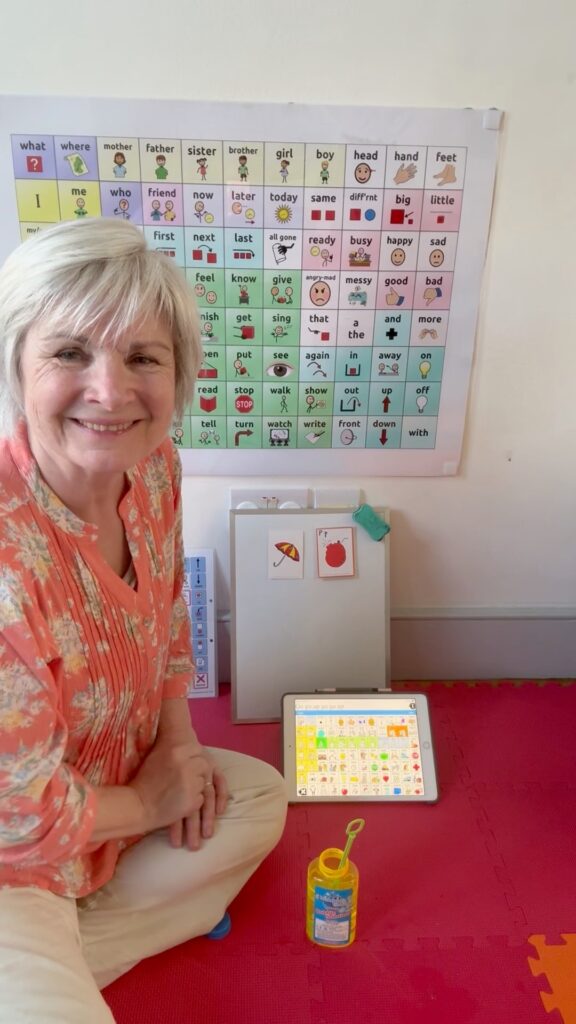
Sonja smiling

When a child’s speech is difficult to understand, it can feel overwhelming for everyone involved. As a parent, your instinct is often to focus on helping your child ‘talk properly’. And that makes complete sense. Speech is important. But here’s the key message I want to share with you:

Speech is just one way to communicate.

And when speech is not yet clear, not yet reliable, or not yet available, children need other ways to get their message across.

This is where Total Communication comes in.

What is Total Communication?

Total Communication is an approach that encourages the use of all available ways to communicate, not just speech.

This can include:

  • spoken words
  • gestures and pointing
  • facial expressions
  • signing (such as Makaton)
  • pictures or symbols
  • drawing
  • electronic AAC (Augmentative and Alternative Communication), such as apps like LAMP Words for Life

It’s not about replacing speech. It’s about supporting communication in every possible way.

Think of it like this: if speech is currently unclear or limited, why restrict a child to the hardest route? Why not give them more tools to succeed?

‘But won’t this stop my child from talking?’

This is one of the most common concerns I hear in clinic.

Parents often worry that if a child starts using signs or a communication device, they will become ‘dependent’ on it and stop trying to talk.

The research tells us something very different.

Studies consistently show that AAC does not prevent speech development. In fact, it often supports it.

  • A review by Millar, Light & Schlosser (2006) found that AAC interventions do not reduce speech production and may actually increase it.
  • Romski & Sevcik (2005) demonstrated that children given AAC often develop stronger overall communication skills, including spoken language.
  • More recent work continues to show that providing AAC early can accelerate language development, not delay it.

So rather than ‘giving up on speech’, using AAC is actually building the foundations that speech needs.

Why Total Communication matters, especially for unintelligible children

When a child is very difficult to understand, they are often experiencing a hidden frustration:

‘I know what I want to say, but no one understands me.’

Over time, this can lead to:

  • reduced confidence
  • behavioural frustration
  • withdrawal from communication
  • fewer opportunities to practise language

If a child cannot successfully communicate, they communicate less. And when they communicate less, their language development slows down.

Total Communication breaks this cycle.

By giving a child reliable ways to be understood, we:

  • reduce frustration
  • increase interaction
  • build confidence
  • create more opportunities for language learning

And importantly, we allow them to show us what they already know.

AAC is a bridge, not a barrier

Using AAC (whether that’s pointing to pictures, signing, or using a device) does something powerful:

It separates language from speech.

A child might have lots of ideas, vocabulary, and understanding but their speech system (especially in cases like phonological disorder or childhood apraxia of speech) cannot yet keep up.

AAC allows the child to:

  • express complex ideas now
  • practise sentence structure
  • develop vocabulary
  • take part in conversations

All while their speech is still developing.

In other words, AAC doesn’t replace speech. It keeps language moving forward while speech catches up.

What does this look like in real life?

In therapy, I often use a combination of approaches:

  • modelling simple signs alongside speech
  • pointing to symbols while talking
  • encouraging children to gesture or show
  • using drawings to support understanding
  • incorporating an AAC device such as LAMP Words for Life

You might see a child:

  • say part of a word
  • point to a symbol
  • use a gesture
  • and look at you expectantly

That is communication success.

And success builds motivation.

‘I just want them to talk’

Of course you do. And I do too!! That’s always the goal.

But here’s the important shift in thinking:

Children learn to talk by communicating, not by waiting until speech is perfect.

If we hold out for clear speech before allowing other communication methods, we risk:

  • limiting their ability to interact
  • reducing practice opportunities
  • increasing frustration

But if we support all communication, we give them:

  • more chances to express themselves
  • more positive communication experiences
  • more input and feedback

And that is what drives progress.

A balanced approach

Total Communication doesn’t mean ‘speech is no longer important’.

It means:

  • we continue targeted speech therapy
  • we work on sounds and clarity
  • and we support communication in the meantime

It’s not either/or.

It’s both/and.

Final thought

If your child’s speech is difficult to understand, the most important question is not:

‘Are they talking clearly yet?’

It’s:

‘Can they successfully communicate?’

Because communication is the foundation of:

  • relationships
  • learning
  • confidence
  • wellbeing

And every child deserves a voice, in whatever form that voice takes right now.

Feel free to contact me if your child needs help with speech and communication.

Sonja McGeachie

Highly Specialist Speech and Language Therapist

Owner of The London Speech and Feeding Practice.

References (parent-friendly):


Health Professions Council registered
Royal College of Speech & Language Therapists Member
Member of ASLTIP

Find a speech and language therapist for your child in London. Are you concerned about your child’s speech, feeding or communication skills and don’t know where to turn? Please contact me and we can discuss how I can help you or visit my services page.

3

Similar Posts

  • ·

    Unlocking language and thinking skills: The power of sequencing

    Sonja demonstrates the power of sequencing

    As speech and language therapists, we often use a variety of techniques to help children develop their communication and cognitive skills. One incredibly valuable tool in our toolkit is the use of sequencing activities. But what exactly is sequencing, and why is it so beneficial?

    What is sequencing?

    Sequencing, at its core, involves arranging items, events, or actions in a specific order. This could involve putting pictures in the correct order to tell a story, following the steps in a recipe, or understanding the order of daily routines like brushing teeth or getting dressed.

    The link between sequencing and language

    Sequencing is fundamental to language development and is quintessential to executive functioning skills in several ways:

    • Narrative skills: Storytelling, whether oral or written, relies heavily on sequencing. A child needs to understand the order of events (beginning, middle, end) to construct a coherent narrative.
    • Explanations and instructions: Providing clear explanations or instructions requires the ability to sequence information logically. For example, explaining how to play a game or how to get from one place to another. In the video clip below we are working on ‘how do make a sandwich’.
    • Vocabulary development: Sequencing helps children understand temporal words and phrases like ‘first,’ ‘then,’ ‘next,’ ‘before,’ and ‘after’.
    • Sentence structure: Constructing grammatically correct sentences often involves sequencing words in a specific order (e.g., subject-verb-object).

    Beyond language, sequencing plays a crucial role in developing executive functioning skills. These are higher-level cognitive skills that help us plan, organise, and manage our time and actions.

    Sequencing activities can help children improve in the following areas:

    • Planning and organisation: Sequencing tasks require children to think ahead, plan the steps involved, and organise them in a logical order.
    • Problem-solving: When they are faced with a problem, sequencing helps children break it down into smaller, more manageable steps.
    • Working memory: Holding information in mind and manipulating it, such as remembering the steps in a multi-step direction, is supported by sequencing skills.
    • Cognitive flexibility: Being able to adjust to changes in a sequence or think of alternative sequences promotes cognitive flexibility.

    Examples of sequencing activities

    Here are some practical examples of sequencing activities you can do with your child:

    • Picture sequencing: Use a set of picture cards to tell a short story or illustrate a process (e.g., making a sandwich, going to the park). Ask your child to arrange the cards in the correct order.
    • Story retelling: After reading a story, have your child retell it, focusing on the order of events.
    • Following instructions: Give your child multi-step instructions to follow (e.g., ‘First, get your shoes. Then, put on your coat. Next, go to the door.’).
    • Sequencing during play: Integrate sequencing into everyday play. For example, while building with blocks, talk about the steps: ‘First, we put this block here. Next, we add this one…’
    • Daily routines: Create visual schedules for daily routines, like getting ready for school or bedtime, to help children understand the sequence of events.
    • In the video clip below I am using an on-line language activity which is often fun for children as they can use their finger to swipe the pictures effortlessly into the right place and, if we realise at the end of the story that we have made a little error, we can then easily re-jig the pictures into their correct place.

    In conclusion

    Sequencing activities offer a powerful way to support children’s language development and enhance their executive functioning skills. By helping children understand and create order, we equip them with essential tools for communicating, learning, and navigating the world around them.

    Do get in touch via my contact form if you are concerned about your child’s development.

    Sonja McGeachie

    Highly Specialist Speech and Language Therapist

    Owner of The London Speech and Feeding Practice.


    Health Professions Council registered
    Royal College of Speech & Language Therapists Member
    Member of ASLTIP

    Find a speech and language therapist for your child in London. Are you concerned about your child’s speech, feeding or communication skills and don’t know where to turn? Please contact me and we can discuss how I can help you or visit my services page.
    1
  • ·

    Explore activities for Gestalt Language Processors to aid communication

    Speech Therpaist in London

    When you have a child who uses Gestalts it is often difficult to think and adapt clinic activities into those to use at home. More importantly, you find that individualising your activities for your child who uses Gestalt are time-consuming. But you value its importance for their communication development.

    You feel so busy, you are taking them to other appointments, or trying to get through your daily activities, all whilst still ensuring your child’s emotional needs are met. You know life should not get in the way of your child’s therapy activities at home, but it does. We know your spare time is precious and limited, so let us achieve your child’s or young person’s goals in the allotted time you have which meets their way of learning (using Gestalts).

    We wanted to support you by exploring items which you may have at home, and we will give you some key phrases which you can start to model with your child. Whereas our last blog introduced the idea of gestalt language processors, we are now developing ideas to give you the tools to implement activities at home. We recognise how overwhelming it may feel, and this is one of the reasons to make activities as straight forward as possible. Therapy does not need to be complicated; it just needs to be carried out on a regular basis.

    Explore the samples I’ve created to give you an idea of how this might look but please consult with a Speech and Language Therapist who knows about Gestalt Language Processing so that you can work together to develop great home activities for your child.

    Want to learn more about gestalt language processing?

    Please contact me for help.


    Find a speech and language therapist for your child in London. Are you concerned about your child’s speech, feeding or communication skills and don’t know where to turn? Please contact me and we can discuss how I can help you or visit my services page.

    1
  • ·

    Milestones of autistic children: Crawling, walking, and talking

    For all children every milestone achieved is a testament to the unique and intricate process unfolding within each young mind. For autistic children, this journey may present a distinct pattern, with some reaching developmental milestones like crawling, walking, and talking later than their neurotypical peers. Let’s have a look into the fascinating realm of Autism and explore why some autistic children might crawl, walk, and talk later, shedding light on the underlying factors contributing to this unique way of developing.

    1. Individual Pacing:

    Child development is not a one-size-fits-all journey. Each child, whether neurotypical or autistic, has a unique timeline for achieving milestones. Autistic children, like any other children, follow their own pacing. This individual rhythm might lead them to focus on one set of skills before they progress to others. Like some neurotypical children might focus on talking earlier than walking, autistic children might prioritise other areas before crawling or talking.

    2. Neurodevelopmental Complexity:

    The human brain is a remarkable entity, with a bewildering array of interconnected processes that lead to us achieving our developmental milestones. Autistic children often have variations in “neural wiring”, which can impact the balance between gross motor skills (crawling, walking) and fine motor skills. Speech and language acquisition falls under fine motor skills and may be momentarily disrupted due to the divergent neurological pathways at play in autism.

    2. Sensory Processing Differences:

    One of the hallmarks of autism is altered sensory processing. Autistic children often experience sensory stimuli differently than their neurotypical peers. This heightened or diminished sensitivity can influence a child’s desire or ability to engage in activities like crawling and walking. The sensation of movement while crawling or walking, for instance, might be overwhelming for some autistic children, causing them to either avoid or delay these activities.

    3. Visual-Spatial Abilities:

    Autistic children and adults frequently display excellent visual-spatial abilities. This strength might lead some children to focus more on activities that engage these skills, potentially delaying their engagement with activities like walking or talking. As they navigate their environment and process information visually, they might naturally invest more time in activities that stimulate this particular cognitive ability and strength.

    4. Communication Challenges:

    For many autistic children, speaking can be a really complex and difficult endeavour. Communication delays are a common feature of autism. This can affect both receptive and expressive language development. While some children might be physically capable of crawling or walking, they may not yet have the tools to communicate their desires and intentions. This leads to a temporary focus on non-speaking forms of expression. This does not mean that they do not communicate at all. But autistic individuals often start out using jargoning or echolalia as a form of communication as well as behaviours and physical forms of communication.

    5. Executive Functioning and Motor Skills:

    Executive functioning, or abilities for planning, organising, and carrying out tasks, can vary in autistic children. These skills are crucial for activities like crawling, walking, and talking, which need coordination and planning. About 40% of autistic persons have a motor planning difficulty.

    6. Intense Interests and Routines:

    Autistic children often develop intense interests in specific subjects, sometimes to the exclusion of other activities. These interests might become their primary mode of engagement. They might side-line milestones like crawling, walking, or talking. The mostly rigid adherence to routines and preferences might cause them to allocate more time to their preferred activities. This delays their engagement with other developmental tasks.

    How can Speech and Language Therapy help:

    Support and Intervention:

    Early intervention and regular Speech and Language Therapy play a pivotal role in the developmental journey of autistic children. Therapies tailored to individual needs can aid in bridging the gaps between milestones. Occupational therapy, for example, can help address sensory sensitivities and motor skill challenges that might impact crawling and walking. Speech therapy can help communication development, gradually bridging the gap between non-verbal expressions and spoken language.

    For example, we now know that echolalia or jargoning of longer phrases with intonation, repeating scripts from favourite tv shows or songs have many meanings and communicative functions. For example, a child who utters long strings of echolalic utterances, often difficult to understand, might want to do any one of the following:

    • Comment
    • greet
    • ask a question
    • make a request
    • express surprise
    • negate something.

    We now understand that the way to support a child with echolalia is to acknowledge all utterances and try and find out what the meaning is behind these scripts. This is very supportive. Over time it will lead a child to move on to understanding and saying more clear and self-generated language. For more information about this Natural Language Acquisition here are some other great websites for you to look at:

    Conclusion

    In conclusion, the journey of an autistic child’s development is a testament to the uniqueness and complexity of the human mind. The delays or differences in achieving milestones like crawling, walking, and talking can be attributed to a range of factors, including

    • neurodevelopmental intricacies,
    • sensory processing variations,
    • and communication challenges.

    It’s crucial to recognise that these delays are not indicative of a lack of potential, but rather a manifestation of the intricate interplay between an autistic child’s strengths and challenges. By embracing these differences and providing tailored support, we can help each autistic child unfold their potential at their own pace.

    Do get in touch if you would like to book an appointment where we can explore how to help your child develop and thrive

    Do get in touch if you would like to book an appointment where we can explore how to help your child develop and thrive


    Find a speech and language therapist for your child in London. Are you concerned about your child’s speech, feeding or communication skills and don’t know where to turn? Please contact me and we can discuss how I can help you or visit my services page.

    0
  • ·

    What Is Echolalia And Does It Have A Function? How Can Speech Therapy Help With Echolalia?

    What Is Echolalia And Does It Have A Function? How Can Speech Therapy Help With Echolalia?

    Echolalia is a term used when assessing or treating children with Autism. The term refers to the repetition or echoing of utterances, either our own or others’. It can also be echoing phrases heard on television, advertising jingles or catchy repeat phrases used in tv programmes or nursery rhymes and songs. Whilst we all use echolalia occasionally and it can be observed in typically developing children, we tend not to see/hear it beyond the age of 2.5 years old. Children with ASD, however, do use echolalia often into late childhood.

    There are generally two types of Echolalia:

    Immediate echolalia

    Here the repeated phrases or words are produced immediately after someone has spoken the original words or within two conversational turns of the original utterance.

    Delayed echolalia

    The repeat echoing of the original utterance occurs sometime later, more than two conversational turns or with a much longer time delay. Due to the delay it can be hard to interpret the meaning of the echolalic utterance as it may refer to something that happened long ago and in a different context to the originally utterance.

    (Stiegler, 2015, Fay 1967, Blanc 2014)

    There are other unconventional speech behaviours which include:

    • Perseveration of Speech – persistent repetition of speech
    • Repetitive questioning – persisting even though answers were given
    • Vocalisations such as: humming, whistling, clicking, squealing etc.

    Much research has gone into the meaning and treatment of Echolalia and the following list consists of possible functions that have been identified:

    • Information sharing
    • Responding to answers
    • Labelling
    • Drawing attention to self
    • Protesting
    • Requesting
    • Giving instructions
    • Self-regulation, calming

    (Stiegler 2015, Prizant 1983)

    Echolalia does have a function and is part of the Gestalt Learning Process (where longer units of speech are memorised and then used as a whole without the individual words being meaningful).

    As a Speech and Language Therapist I promote sound and proven Intervention based on the Hanen Programme which helps provide a highly facilitative Interaction Style and I will tell you a bit more in my next blog how the “More Than Words” approach can help children with echolalia move through their Gestalt Learning into more analytic processing of language, grammar and meaning.


    Find a speech and language therapist for your child in London. Are you concerned about your child’s speech, feeding or communication skills and don’t know where to turn? Please contact me and we can discuss how I can help you or visit my services page.

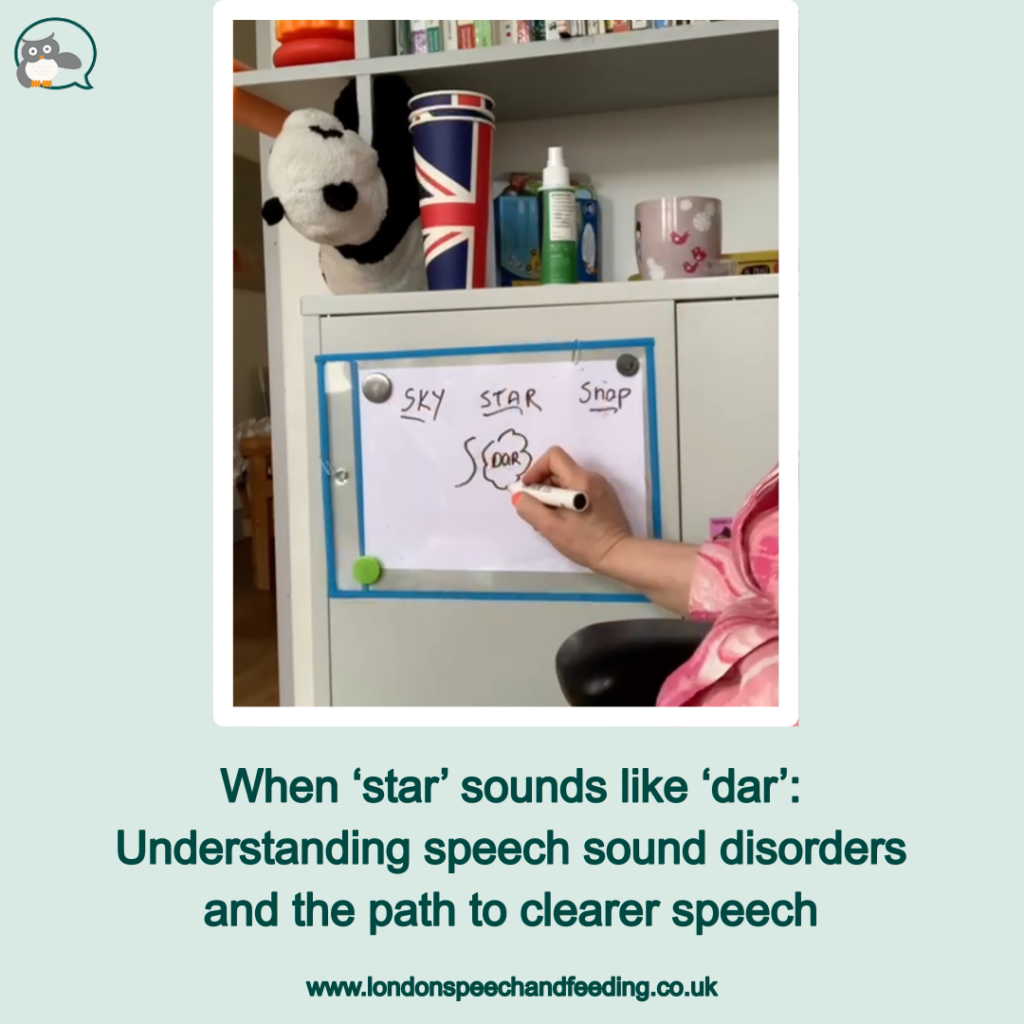
  • When ‘star’ sounds like ‘dar’: Understanding speech sound disorders and the path to clearer speech

    If your child says ‘dar’ instead of ‘star’, you might be wondering if they will simply outgrow it or if they require specialised support. While ‘cluster reduction’—dropping one of the sounds in a blend—is a normal part of learning to talk, we typically expect these sounds to lock into place by age four years. If these errors persist as a child approaches school age, it often signals a speech sound delay that may now no longer pass without help. As a Speech and Language Therapist, I specialise in helping children bridge this gap using evidence-based techniques like backward chaining.

    This isn’t about constant correction; it’s about providing the right clinical scaffolding to move a child from ‘frustrated’ to ‘fluent’ before they hit those critical early school years.

    Dropping sounds from words is a common feature of speech sound difficulties, and while it can look small on the surface, it can have a big impact on how clearly a child is understood. In this short video clip, I’m working with a child on an /ST/ sound cluster, demonstrating how I use an evidence-based speech therapy technique called backward chaining to help children build clearer speech with confidence.

    What’s actually happening when a child drops the ‘S’?

    Clusters like /ST/, /SP/, and /SK/ are tricky. They require:

    • precise timing
    • careful airflow
    • and the ability to blend sounds smoothly

    For many children, especially those with speech sound difficulties, this is a big ask.

    So instead of hearing:

    ‘star’

    we might hear:

    ‘tar’ or ‘dar’

    This isn’t laziness or refusal. It’s the child simplifying the word to make it manageable.

    Why I don’t start by saying ‘say star’

    Telling a child to ‘just add the S’ rarely works.

    Instead, I meet them where they are already successful.

    In this clip, the child can already say ‘dar’ clearly. That’s our starting point.

    Backward chaining: building speech from success

    Backward chaining means we:

    1. Start with the part of the word the child can already say
    2. Gradually add the missing sound
    3. Keep the child feeling successful at every step

    So rather than jumping straight to ‘star’, we:

    • secure the ending
    • gently introduce the /S/
    • and blend it in a way that feels achievable

    This approach reduces frustration, builds confidence, and helps the sound stick not just in the therapy room, but out in the real world.

    Why this matters beyond one word

    This isn’t just about saying ‘star’.

    It’s about:

    • teaching the mouth a new movement pattern
    • giving the brain time to organise the sound sequence
    • and helping the child feel capable, not corrected

    When therapy feels safe and successful, children are far more likely to generalise their new sounds into everyday speech.

    Speech therapy works best when children feel supported not tested.

    If your child struggles with speech clarity

    If your child:

    • drops sounds from words
    • avoids longer or trickier words
    • or becomes frustrated when they’re not understood

    This is the kind of work I do every day building speech step by step, in a way that respects each child’s pace and strengths.

    Support can be gentle, effective, and empowering.

    If you’d like to learn more about how speech therapy can support your child, you’re always welcome to get in touch.

    Sonja McGeachie

    Highly Specialist Speech and Language Therapist

    Owner of The London Speech and Feeding Practice.


    Health Professions Council registered
    Royal College of Speech & Language Therapists Member
    Member of ASLTIP

    Find a speech and language therapist for your child in London. Are you concerned about your child’s speech, feeding or communication skills and don’t know where to turn? Please contact me and we can discuss how I can help you or visit my services page.

    3
  • ·

    Why Imitation is so Important

    Target Activities and Games For Kids

    Why imitation is so important and how can speech and language therapy help children who struggle to imitate?

    Imitation or copying starts in early infancy. When we observe a young baby and his parent or familiar adult we can see clearly and frequently that the baby will be intently looking at adult’s face and try to copy their facial expressions, smiles and all those funny baby sounds we often make with young babies.

    These sounds are called “motherese” and are the beginnings of a little conversation between the parent and the baby. The “conversation can go back and forth for a long time and include sounds, as well as facial expressions.

    A little later on, once the baby can crawl and sit up unaided the copying then goes on to include toys and objects. Mum or Dad will show their toddler how to use a drum or how to put a little train on the wooden tracks and the toddler will try and copy this. They may not succeed and be a little clumsy perhaps but the act of copying anything and everything their favourite adult does is typically seen throughout the day.

    We all know and have laughed at mums or dads saying; ssshhh don’t say that in front of the baby he/she will copy you, watch your mouth! (as dad is swearing at the broken radiator….)

    This imitation goes on for years and includes eventually of course little words, more words, putting words together and then creating sentences, all the while our toddler is listening to how their adults speak, not only what they say but how they say it. This is how dialects and accents can be transmitted easily from parent /family to child.

    Copying in Children with Autism

    We know that children with autism often struggle to imitate. We see children on the spectrum typically having great difficulty to copy adults or children; this can be seen in very reduced play with their peers in nursery for example.

    Children with autism tend to have reduced joint attention and engagement with others and need to develop the ability and awareness to copy others in order to then engage more jointly with others.

    Speech and Language Therapy can help with Parent Child Interaction work and Coaching, here is how:

    During my coaching work with parents I teach step by step how to help a child who struggles to imitate:

    We look at all the researched skills and actions that adults can take to help their little one to copy, starting with close observation of their child’s interests, then following and including their child’s play and copying/imitating their child in how they play. I teach steps in a graduated way so that it is easy to see the progress and joyful to have the results at the end.

    The results are clear to see over time: our children on the spectrum learn to imitate actions, with objects and gestures, then sounds and words. Alongside this increased imitation skill the child can then develop more joint attention and engagement.

    I would always recommend Parent Child Interaction Training as a first port of call as we learn so many great techniques which are well researched by the Hanen Programme, www.hanen.org. Do drop me a line if you would like to find out more.


    Find a speech and language therapist for your child in London. Are you concerned about your child’s speech, feeding or communication skills and don’t know where to turn? Please contact me and we can discuss how I can help you or visit my services page.