One activity, endless opportunities for speech and language therapy targets
Communication does not happen in neat little boxes. In Speech and Language Therapy we often use one great activity to target multiple areas of speech and or language development all at once.
Children are trying to:
- understand language
- build sentences
- organise their thoughts
- pronounce sounds
- remember words
- use grammar
- follow social interaction
- communicate meaning…
all at the same time.
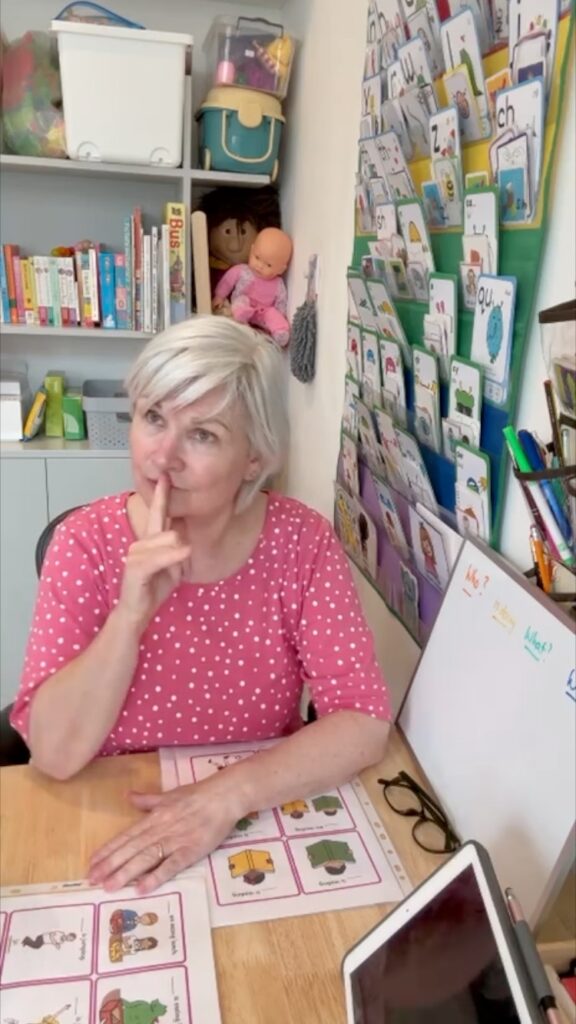
This short therapy clip is a little example of that.
Within one playful interaction, we naturally work on:
- grammar
- sentence expansion
- pronouns
- speech sound errors
- modelling
- visual cueing
- turn-taking
- confidence in communication
And, importantly, the child remains engaged, relaxed, and successful throughout.
Using language activities to refine speech sound targets
We all learn language through:
- shared attention
- play
- repetition
- connection
- modelling
- responsive interaction
As a Speech and Language Therapist I am constantly thinking and considering how to bring in all the targets a child is working on. The reason for that is that often we do not have a full therapy hour to work leisurely and calmly on various targets! Many children have short attention focus and ‘go off the boil’ quickly and often suddenly. Therefore, I always feel a sense of ‘make hay whilst the sun shines’ and pack it all in whilst the going is good. So then we can afford five minutes of trampolining in between activities to help the child regulate themselves without losing valuable speech therapy opportunities or time.
- How can I expand this sentence?
- How can I model better grammar?
- Can I gently shape the pronunciation here?
- Should I recast that phrase?
- Is this the right moment to pause and encourage a longer utterance?
- How can I keep communication flowing while still targeting goals?
These decisions happen continuously during therapy.
Building longer sentences naturally
In this clip, one of the key areas we are targeting is sentence expansion through Colourful Semantics, which is a particularly useful and researched approach, developed by UK Speech and Language Therapist Alison Bryan in 1997 to support children with speech and language difficulties.
Colourful Semantics is a visual, colour-coded therapy approach that helps children break down, understand, and construct sentences by assigning specific colours to thematic roles (e.g., Who, What Doing, What).
Many children with language delay use reduced language for example: they might say:
- ‘dog’ instead of ‘the dog is running fast’
- ‘eatin a dinner’ instead of we are eating our dinner
- ‘baby shhh’ instead of ‘the baby is sleeping’.
Using the Colourful Semantics Framework helps create a solid baseline from which to work and with which to construct basic good sentences using WHO is DOING WHAT and WHERE.
We are building language upward gently and positively.
This technique is incredibly powerful because children learn language through hearing it used meaningfully over and over again.
Supporting pronouns through real conversation
Pronouns can be surprisingly difficult for many children.
Words such as:
- he
- she
- him
- her
- they
require children to understand perspective, grammar, and sentence structure all at once. Using pictures and basing the activity on the Colourful Semantics Model I can shape pronouns repeatedly as part of the overall activity.
Books, pictures, and play scenes are fantastic for this because they create endless opportunities for meaningful repetition.
Again, this may look simple from the outside.
But underneath it is highly intentional clinical work.
Listening for speech sound errors at the same time
While supporting grammar and language, I am also constantly listening to the child’s speech production.
In this short interaction, I respond to speech sound errors as they arise.
Sometimes I:
- model the correct production
- emphasise a sound slightly
- use visual cues
- slow the word down
- add gesture or sign support
- encourage another attempt.
And sometimes I intentionally let the error go in order to protect confidence and maintain communication flow.
That balance is incredibly important.
Children need support. But they also need to feel successful communicating.
The child simply experiences this as warm, responsive interaction.
But underneath it is detailed clinical reasoning.
This is why effective therapy is never about simply owning resources or downloading activities online.
The real skill lies in:
- how the therapist uses the activity
- how they adapt moment by moment
- how they analyse communication in real time
- how they shape interaction to maximise learning opportunities.
One activity. Endless opportunities.
A single book, picture scene, or playful interaction can provide opportunities to support:
- speech sounds
- language development
- grammar
- vocabulary
- attention
- confidence
- social communication
- emotional connection.
The magic is not in the activity itself.
The magic is in how a therapist uses it.
Because excellent speech therapy is never ‘just playing’.
It is careful, responsive, evidence-based intervention woven seamlessly into joyful interaction.
Contact me avia my contact form if you would like me to work with your child.

Sonja McGeachie
Highly Specialist Speech and Language Therapist
Owner of The London Speech and Feeding Practice.
Reference
Bryan A (1997) Colourful semantics. In: Chiat S, Law J, and Marshall J (eds) Language disorders in children and adults: psycholinguistic approaches to therapy. London: Whurr, 143–61.


Find a speech and language therapist for your child in London. Are you concerned about your child’s speech, feeding or communication skills and don’t know where to turn? Please contact me and we can discuss how I can help you or visit my services page.