A day in my speech clinic: Mastering the /SP/ cluster

I very often work on /S/ Blends (/SP/ /ST/ /SM/ /SK/ /SN/ and /SL/). When we work on these sound blends (like SPider, STop, or SMile), we are using a clever speech therapy ruse! Because these blends are complex, teaching a child how to master them naturally helps them clear up simpler single sounds (like just /S/ or just /P/) at the same time. Plus, because S-blend words are so common in everyday language think spoon, spy, spot, and spin, practising them gives your child an immediate confidence boost when they are understood much more easily.

Good news: high-repetition motor practice doesn’t have to be a chore. In fact, the more sensory input we can provide, the faster those new neural pathways are built. Recently, I recorded a series of seven short clips to demonstrate how we can weave intense speech practice into the fabric of play.

Here is a look at a typical day in the clinic focusing on /SP/ blends.

1. The sensory sandbox:

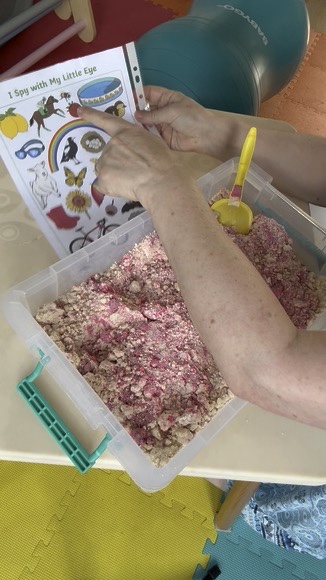
We started our session at the sensory table. Sensory bins can often work well because they provide tactile feedback that grounds the child’s focus (of course they are usually messy, so one needs to have the physical space and energy for it to be fair!).

  • The Activity: I pointed to our ‘I Spy’ board before we dove into the sand. Using a toy spade we dug for hidden objects and named them each time we found one.
  • Every time we scooped, we practised Spade. Every discovery was a spider, a spoon or a spotty animal. By pairing the physical effort of digging with the speech sound, we help the brain synchronise motor planning and vocal execution.
2. Bingo dabbers rock!

Next, we moved to making ink marks on paper.

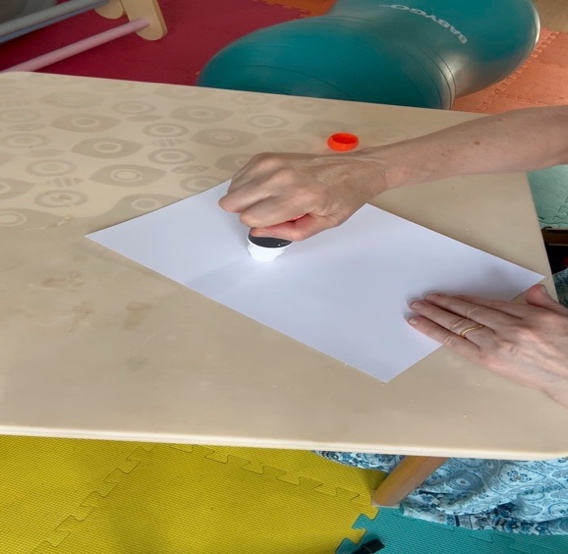
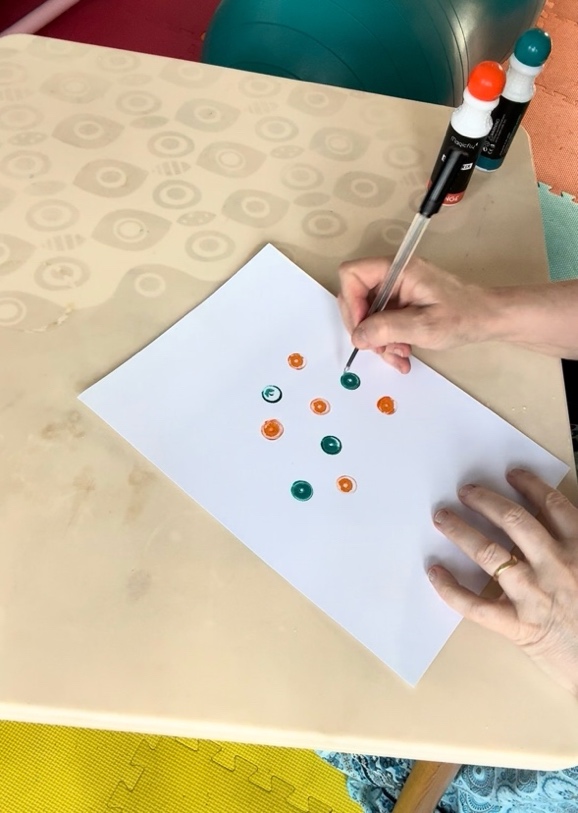
  • The Activity: I demonstrated making spots with coloured bingo dabbers.
  • We treated each ink spot as a visual anchor. Stamp –Spot Stamp –Spot. This creates a rhythmic pacing that prevents the child from rushing. It’s a wonderful way to get 50+ repetitions in under five minutes without the child even realising they are ‘working’.
3. Drawing spiders

Building on the previous activity, we took those spots and turned them into something more complex.

  • The Activity: I drew spiders out of the spots we had just made.
  • Drawing the legs provided a perfect opportunity for ‘stretch’ sounds. As we drew a long leg, we practise a long, hissy ‘Sssssssss’, snapping into the /P/ as the pen hits the spot.
4. Wind-up spinners

High-energy toys are excellent for eliciting ‘power’ sounds.

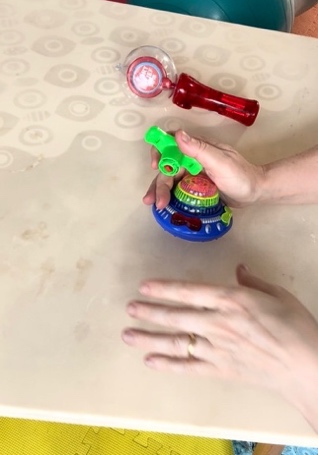
  • The Activity: I brought out two mechanical wind-up spinners.
  • Method: The child says Spin or Spinner to get me to wind them up. The anticipation of the toy moving acts as a natural reinforcer.
5. The Incy Wincy spider game

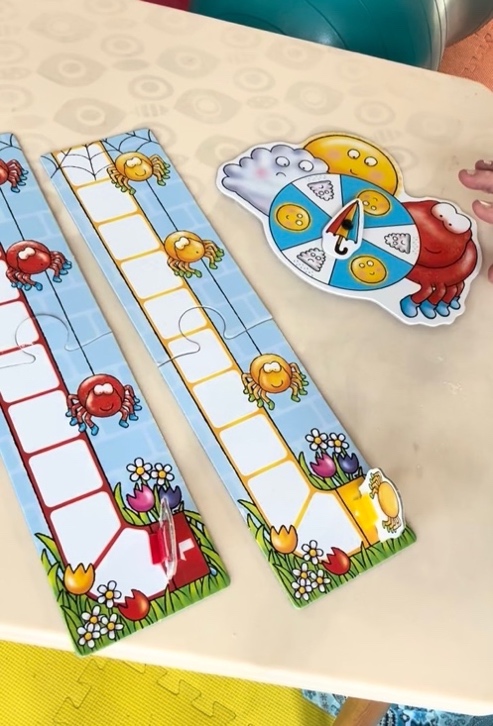
  • The Activity: I spun a game spinner to determine how many steps our toy spiders would take up the spout.
  • This activity is a triple threat. We practised ‘Spin’, ‘Spider’, and ‘Spout’ all in one go. The visual of the spider moving up the spout also helps with the concept of UP and DOWN of course.
6. Searching for Spot

Books are a great tool for generalisation, taking a sound from a single word and moving it into phrases and sentences.

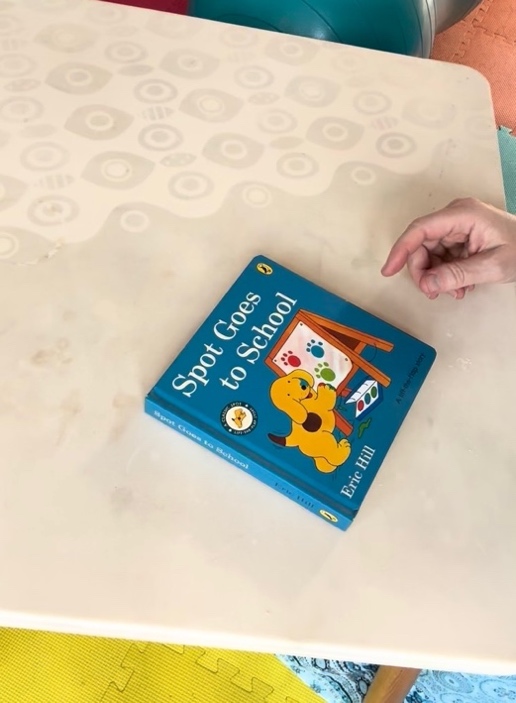
  • The Activity: We went through a ‘Spot the Dog’ book.
  • Instead of just reading, we used the ‘I Spy’ strategy. ‘I spy Spot! He has a big spot on his back!’ This encourages the child to use the target word in a functional, communicative way rather than just repeating it after me.
7. Finally, sponging off some sand

We ended the session with some ‘heavy work’ and cleaning.

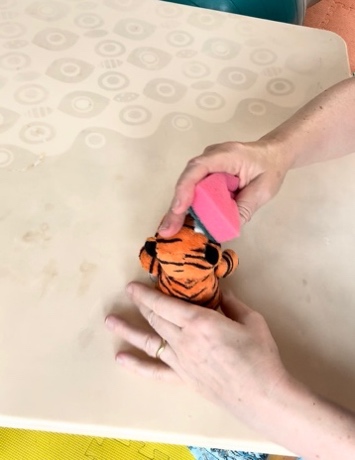
  • The Activity: We took a soft toy that had gotten a bit ‘dusty’ in the sandbox and used a sponge to clean it down.
  • The action of squeezing the sponge provides proprioceptive input (pressure), which can be very calming and help a child focus on their articulatory placement for those final repetitions of the day.
A day in my speech clinic: Mastering the /SP/ cluster

Speech therapy works on motor learning. Just like learning to ride a bike or play the piano, the brain needs thousands of correct repetitions to make a movement automatic. By using /SP/ words in these seven distinct, sensory-rich ways, we:

  1. Reduce frustration: The focus is on the play, not the correction.
  2. Increase engagement: A child who is having fun will stay in the learning zone longer.
  3. Provide context: The child learns that saying /SP/ correctly helps them get the spade, spin the spinner, and find the spider.

Next time I will show you some more activities for /ST/ and /SM/ words. If you have any super ideas for /S/ cluster words please leave me your suggestions in the comments on instagram, I would appreciate it thank you! 😊

If you are concerned about your child’s speech, please do not hesitate to get in touch. I would love to help you find some answers.

Sonja McGeachie

Highly Specialist Speech and Language Therapist

Owner of The London Speech and Feeding Practice.


Health Professions Council registered
Royal College of Speech & Language Therapists Member
Member of ASLTIP

Find a speech and language therapist for your child in London. Are you concerned about your child’s speech, feeding or communication skills and don’t know where to turn? Please contact me and we can discuss how I can help you or visit my services page.

3

Similar Posts

  • ·

    The role of spinning and swinging in speech and language therapy

    Sonja with a child on a swinging with a stuffed monkey

    Spinning and swinging are often observed behaviours in autistic children. While these actions might seem repetitive or unusual to some, they serve crucial functions for these children. Understanding the underlying reasons for spinning and swinging can provide valuable insights into how to support autistic children and incorporate these activities into therapeutic settings.

    Why do children spin?

    Spinning is a common sensory-seeking activity in autistic children. Sensory seeking means that the child actively looks for sensory input to regulate their nervous system. Here’s why spinning can be beneficial:

    • Vestibular input: Spinning stimulates the vestibular system, which is located in the inner ear and is responsible for balance and spatial orientation. For children with sensory processing difficulties, spinning can provide essential sensory input.
    • Calming effect: For some children, spinning can be a self-regulating strategy. The rhythmic motion can help to calm the nervous system and reduce anxiety.
    • Sensory exploration: Spinning allows children to explore their sensory experiences. It can help them understand their bodies and how they move in space.

    The allure of swinging

    The rhythmic back-and-forth motion of a swing offers several benefits:

    • Vestibular input: Like spinning, swinging stimulates the vestibular system, helping to improve balance and coordination.
    • Proprioceptive input: Swinging provides proprioceptive input, which is the sense of where your body is in space. This information is crucial for motor planning and coordination.
    • Calming and organising: The rhythmic motion of swinging can have a calming effect on the nervous system, helping to regulate emotions and improve focus.
    • Social interaction: Swinging can be a shared experience, fostering social interaction and communication.
    • Facilitating communication: While swinging, children are so much more relaxed and open to communication. The rhythmic motion can also help facilitate singing, humming, listening to my singing, non-verbal communication for sure but also more verbal and mouth words can be heard from children on my swing. If nothing else, it is so fun and helps build trust and rapport between my child and me.

    Therapeutic Activities Combining Spinning, Swinging, and Speech and Language Therapy

    Here are some therapeutic techniques that I use at London Speech and Feeding to combine movement with speech and language development:

    • Swinging with verbal prompts: While the child is swinging, I provide simple verbal prompts such as ‘up’, ‘down’, ‘fast’, and ‘slow.’ This helps to develop receptive language skills and improve auditory processing.
    • Sensory-motor play: I like to combine swinging with tactile activities like playing with textured balls or bean bags. This can facilitate language development through descriptive language, words and scripts like: ‘that’s so soft’, ‘oooh tickle tickle tickle!’
    • Storytelling on the swing: Often I manage to create a story while the child is swinging. This can improve narrative skills, vocabulary, and imagination. Recently I did the ‘Tiger who came to tea’ story and each time the swing stopped the tiger came and ‘ate some more cakes’ and ‘tickled their tummy’ whilst eating. It may make not much sense but my child loved it and we had ‘more tiger eat more’.
    • Song and rhyme time: Often I sing the ‘rumble in the jungle’ song while swinging my child to enhance phonological awareness, rhythm, and timing.
    • Visual supports always help: I use LAMP Words for Life AAC support during swinging and show core words such as: ‘go’ / ‘stop’/ ‘more’ / ‘tickle tickle’ etc. #lampwordsforlife #aac
    • Movement-based activities: We can incorporate activities that require sequencing, such as imitating animal movements or following simple commands while swinging. This can improve motor planning and language comprehension.

    For more information follow me on Instagram, Facebook or LinkedIn.

    Sonja McGeachie

    Early Intervention Speech and Language Therapist

    Feeding and Dysphagia (Swallowing) Specialist The London Speech and Feeding Practice

    The London Speech and Feeding Practice


    Find a speech and language therapist for your child in London. Are you concerned about your child’s speech, feeding or communication skills and don’t know where to turn? Please contact me and we can discuss how I can help you or visit my services page.

    1
  • ·

    How to model AAC with our minimally speaking students?

    modelling AAC

    How should we start? Should we use prompts? What kind of prompts? hand-over-hand or just pointing? Should we wait, and, if so, how long? Introducing an alternative communication system (AAC) to our child is for many of us a confusing and sometimes scary prospect, but it needn’t be! Let me reassure you and share some tricks of my practice in this area.

    Once we have decided to try for a picture based communication system, I usually start with a paper-based single page with between 48–88 core-words. I choose the number of words depending on where the child is developmentally and also verbally.

    If a child does have a small handful of words already, I might start with the 88-cell board below. If, on the other hand, my student is completely non-speaking and still quite little then I might go for the 48-cell below here or I might have even less cells to start with. Again, sometimes I start with an electronic device in my clinic just to trial and introduce the idea and to see if, or how, a student responds. 

    Below are some samples: a 49-cell board which I made for a child in a nursery setting

    Below a Saltillo WordPower board that can be downloaded from the Saltillo website:

    Example of a slightly more advanced board, again from the Saltillo Website

    And here below one example of a board I made for a specific activity for a child who loves water and sand play:

    It is perfectly possible to be very flexible and create a suitable board for any student, starting with as few as 2–5 cells and working up to over a 100 (very small ones) on a sheet of A4 or A3 paper.

    So once we have a good board for our child, what now? How do we start introducing this into our daily life?

    We can start by showing/pointing to the word GO within a play activity. For example:

    • a car run,
    • or a marble run,
    • or a spinner activity,
    • a wind-up toy,
    • anything that can be stopped and started easily.

    How to start?

    I will talk us through each of the steps using the example for the word ‘GO’.

    First phase

    The first phase is a TEACHING/ LEARNING PHASE. In this phase we do not expect our student to do anything, to copy us or to point to the board. If they do that it is of course a huge bonus and we will celebrate it.

    Our job is to simply MODEL/SHOW/GIVE EXAMPLES of how we can use the board, by steadily and regularly pointing to the chosen word or words. We do so across the day and across settings:

    • play
    • meal time
    • getting dressed/undressed
    • bath time
    • going to the car/shops
    • etc

    Once we can be sure that our student has been submerged and SOAKED in seeing the coreboard being used, say after some 3–4 weeks of using it consistently…

    Second phase

    We can begin to move into the second phase which is the PRACTICE PHASE. By now the student has seen the boards and he or she has seen the word GO (as a example) modelled many times.

    Now we can start to see if we can tempt our student into trying this out for themselves.

    What sort of TEMPTING are we talking about? Take a look at the Prompt Hierarchy below, which shows us what to do to get our student to be independently communicating as soon as possible. 

    The PROMPT HIERARCHY: what sort of prompting should we do, should we expect something from our student or how should we view this stage?

    1.  TEMPT AND PAUSE

    I have the AAC near to the toy and each time the child starts another round of the activity I say clearly ‘GO’ and I point to the picture as do so. I then pause and wait to see what happens. NOTHING? Then…

    1. USE SIGNS AND BODY LANGUAGE

    Next time the child starts another round I might be very animated and do a Makaton sign for GO as I say ‘GO’ and I make a very over point to the picture again. Then I wait. STILL NOTHING? OK then…

    1. OPEN-ENDED QUESTION

    Now I might say ‘GO’ and follow with: ‘OOH I WONDER IF THERE IS A PICTURE TO POINT TO…’

    ‘OH LOOK HERE IS GO!’ I then point to GO.

     STILL NO RESPONSE?

    1. ASK FOR A RESPONSE

    I might say ‘GO’ followed by ‘LOOK! LET’S POINT TO GO HERE ON THE PICTURE.’

    STILL NO RESPONSE? 

    1.  PHYSICAL TOUCH

    Next time I say ‘GO’ I will try and take the student’s hand, help isolate their finger and help him or her to point to the actual picture.

    REMEMBER: Prompting serves a very important function in scaffolding learning for students BUT if we are constantly prompting kids, then we are teaching them to only communicate when someone tells them to. We want our student to become as independent in speaking and using words as possible.

    So once I have done Physical Prompting I will try and phase back down to number 1 where all I need to do is point to the picture or look at the board with the aim that the student will then point to the picture.

    Take away points:

    • Keep the learning phase pressure-free and model without expecting our student to jump in. In other words, let’s model first without expectation. Later we can have a little bit of expectation.
    • After they’ve been exposed to and have been ‘soaked’ in plenty of AAC input, then, YES, we can create an opportunity to help them say or point to the word on their own.
    • We can model BOTH with and without expectation.
    • Only after LOTS of exposure, use the least to most prompting hierarchy and start creating opportunities for a student to become an independent communicator.

    Do get in touch if you have any questions or comments or if you would like some practical help.

    I am always pleased to hear from you.


    Find a speech and language therapist for your child in London. Are you concerned about your child’s speech, feeding or communication skills and don’t know where to turn? Please contact me and we can discuss how I can help you or visit my services page.

    0
  • Six ways to prepare your child for the Christmas festivities

    It feels like the Christmas festivities start earlier and earlier every year. This makes it harder for your child with communication difficulties to process what is happening. Whilst you can’t do anything about the events that happen around your child, you can start to put into practice strategies which may support them and allow them to regulate their emotions.

    Speech Therpaist in London
    Six ways to prepare your child for the Christmas festivities

    Explore six ideas here:

    1. Print off or buy a blank calendar to use at home

    You can start to write in activities out of the usual routine and add a picture to allow your child to understand what it’s about. You can also use it as a countdown to Christmas Day to try to prevent ‘how long’ questions.

    2. Make use of visual timetables

    These are useful in everyday settings and activities but also when change occurs.

    3. Be aware of any non-uniform days

    Days like ‘Christmas Jumper Day’ can make your child feel uncomfortable and may affect their behaviour. By giving yourself time, you can have conversations with your child’s teacher to find a more suitable alternative. For example, they can wear a Christmas t-shirt that they find more comfortable.

    4. Think about what will benefit your child

    Do they like being surrounded by people or do they prefer a quiet space on a 1:1 basis? Christmas activities often involve lots of group work in school (e.g., rehearsing for carol concerts or plays). They might prefer to pre-record their part in the Christmas play or create pieces of art which can be used. At home, they may prefer one guest visiting at a time, rather than all at once.

    5. Explore how your child is feeling

    It’s important to find out how your young person is feeling and how these impact on the activities of that day. It might be that your child doesn’t like surprises and the intensity of opening gifts is too much for them. They may prefer gifts to be left unwrapped and given throughout the day, rather than all at once.

    6. Consider sensory needs

    Ensure your young person has everything they need to meet their sensory needs. This can be e.g. noise cancelling headphones, fidget toys, or comforting items. These will particularly be helpful with routines changing, often with little notice. If at home, you may wish to not put lights on the Christmas tree if visual stimuli become too much.

    Remember clear communication between home, school and other family members is vital during this time. By having clear communication and expectations, your young person will feel more secure. And you can have a Christmas that is right for you and your family.


    Find a speech and language therapist for your child in London. Are you concerned about your child’s speech, feeding or communication skills and don’t know where to turn? Please contact me and we can discuss how I can help you or visit my services page.

  • · ·

    Baby-led weaning: Empowering little eaters from the start

    I had a mum ask me about Baby Led Weaning the other day. So I thought I would write a blog on all the useful questions she had and what we discussed as it may help lots of mums and dads out there.

    As a Paediatric Feeding SLT, one of the exciting developments in recent years is the growing interest in baby-led weaning (BLW). This approach to introducing solids has gained significant traction, and for good reason. It empowers infants to take the lead in their feeding journey, fostering a positive relationship with food and supporting important developmental milestones.

    What exactly is baby-led weaning?

    At its core, baby-led weaning is about offering your baby appropriately sized and textured solid foods from the very beginning, allowing him or her to self-feed. Instead of spoon-feeding purées, you present whole, soft foods that your baby can grasp, bring to his or her mouth, and explore at his or her own pace. This means no mashing, no blending, and no forcing spoons into reluctant mouths. It’s a fun, messy, and intuitive process that is led by your baby’s natural instincts.

    The genesis of baby-led weaning

    ‘Baby-led weaning’ was popularised by British health visitor Gill Rapley. In the early 2000s, Rapley observed that babies naturally develop the skills needed to self-feed and that traditional spoon-feeding might actually hinder this development. Her work, particularly her book Baby-Led Weaning: The Essential Guide to Introducing Solid Foods (co-authored with Tracey Murkett), published in 2008, brought BLW into the mainstream and provided a structured framework for parents. Her research and observations highlighted the benefits of trusting a baby’s innate ability to regulate his or her intake and explore different textures.

    What’s the deal?

    Implementing BLW is simpler than you might think, though it does require a shift in mindset. Here’s a breakdown of what it typically involves:

    • Readiness is key: The golden rule of BLW is to wait until your baby shows clear signs of readiness. This isn’t about age alone, but rather developmental milestones. Your baby should be at least six months old, able to sit unassisted, have good head and neck control, show an interest in food (e.g., reaching for yours), and have lost his or her tongue-thrust reflex (which pushes solids out of his or her mouth).
    • Offer finger foods: Start with soft, easily graspable foods cut into finger-sized sticks or spears. Think cooked sweet potato fries, steamed broccoli florets (soft enough to mash with gentle pressure), banana sticks, or avocado slices. The goal is for babies to be able to pick it up and get some into their mouth.
    • Embrace the mess: BLW is inherently messy, especially in the beginning. Food will be squished, dropped, and smeared. This is a crucial part of the learning process as babies explore textures, smells, and the properties of food. A wipeable mat under the highchair and a good bib are your best friends!
    • Observe, don’t interfere: Allow your baby to lead. He or she will decide what to eat, how much, and how quickly. Avoid putting food into his or her mouth or pressuring him or her to eat more. This respects his or her hunger and fullness cues, laying the foundation for healthy eating habits.
    • Continue breastmilk or formula: Until your baby is well-established on solids, breastmilk or formula remains his or her primary source of nutrition. Solids are for exploration, taste, and developing skills, gradually increasing in quantity over time.

    The benefits of baby-led weaning

    The advantages of BLW extend far beyond simply getting food into your baby. From a speech and feeding perspective, the benefits are compelling:

    • Develops oral motor skills: Chewing, gnawing, and manipulating various food textures are crucial for developing the muscles in the mouth, jaw, and tongue. This strengthens the oral motor skills necessary for speech development.
    • Enhances fine motor skills and hand-eye coordination: The act of grasping food, bringing it to the mouth, and coordinating these movements significantly refines fine motor skills and hand-eye coordination.
    • Promotes self-regulation and intuitive eating: By allowing babies to control their intake, BLW helps them tune into their own hunger and fullness cues, fostering a healthy relationship with food and reducing the likelihood of overeating.
    • Encourages adventurous eating: Exposure to a wide variety of tastes and textures from the outset can lead to less picky eating later. Babies are more likely to accept new foods when they have been in control of their exploration.
    • Facilitates family mealtimes: BLW integrates babies into family mealtimes from an early age, promoting social interaction and making mealtime a shared, enjoyable experience.

    When is baby-led weaning appropriate, and when not?

    While BLW offers numerous benefits, it’s not a one-size-fits-all approach.

    When BLW is appropriate:

    • When your baby meets all the developmental readiness signs: This is paramount for safety and success.
    • When you are comfortable with the mess and the learning curve: It requires patience and a relaxed attitude.
    • When you are committed to offering a variety of safe, appropriate foods.
    • When you are willing to learn about and practise safe food preparation to minimise choking hazards.

    When BLW might not be appropriate (or requires extra caution and professional guidance):

    • If your baby has a history of prematurity or significant developmental delays: His or her oral motor skills might not be sufficiently developed.
    • If your baby has certain medical conditions or anatomical differences (e.g., cleft palate, severe reflux, swallowing difficulties): These may necessitate a modified approach to feeding.
    • If there are significant feeding difficulties, aversion, or a history of choking incidents.
    • If you feel overly anxious about choking: While BLW, when done correctly, is not associated with a higher choking risk than traditional weaning, parental anxiety can impact the feeding experience. Education and consultation with a professional can help alleviate these concerns.

    A note on safety: Choking hazards

    It’s crucial to understand the difference between gagging and choking. Gagging is a natural reflex that helps prevent choking and is very common in BLW as babies learn to manage food in their mouths. Choking is silent and serious. To minimise choking risks:

    • Always supervise your baby closely during mealtimes.
    • Offer appropriately sized and textured foods. Avoid small, round, hard foods like whole grapes, nuts, popcorn, and large chunks of meat.
    • Ensure your baby is sitting upright and calm.
    • Educate yourself on infant CPR.

    Final thoughts

    Baby-led weaning is a wonderfully empowering approach that celebrates a baby’s natural abilities and fosters a positive and independent relationship with food. As Speech and Language Therapists we often see the positive impact it has on oral motor development, self-regulation, and overall feeding confidence. By understanding what it entails, when it’s appropriate, and prioritising safety, you can embark on this exciting journey with your little one, helping him or her become a confident and capable eater from the very first bite.

    If you would like help and support with weaning your baby whilst continuing to breastfeed then please get in touch!

    Sonja McGeachie

    Highly Specialist Speech and Language Therapist

    Owner of The London Speech and Feeding Practice.

    Health Professions Council registered
    Royal College of Speech & Language Therapists Member
    Member of ASLTIP

    Find a speech and language therapist for your child in London. Are you concerned about your child’s speech, feeding or communication skills and don’t know where to turn? Please contact me and we can discuss how I can help you or visit my services page.

    1
  • ·

    A bite-sized guide to Speech and Language Therapy: feeding and swallowing

    What is a Speech and Language – Feeding Therapist?

    You’ve probably heard of speech therapists helping people who stutter or struggle to pronounce words. But did you know that they also work with children and adults who have problems with eating and swallowing? This specialised area is called Speech and Language Therapy: Feeding and Swallowing, or Dysphagia Therapy.

    Why does a Speech Therapist help with eating and swallowing?

    The mouth, tongue, and throat are all involved in both speech and swallowing. When there’s a problem with any of these parts, it can affect both your ability to talk and to eat. For example:

    • Weak tongue muscles: Can make it hard to chew food and to form sounds.
    • Difficulty coordinating swallowing: Can lead to choking or aspiration (when food or liquid goes into the lungs).
    • Sensory issues: Can make certain textures or tastes feel unpleasant or overwhelming.
    • Communication: If we are not able to express ourselves we are likely to have difficulties during daily mealtimes: how do we ask for ‘more’ of something, how do we say we have had enough or we don’t like a particular food?

    How does a Speech and Language Therapist help?

    Our work involves a combination of assessment and therapy. We carefully observe how your child feeds, eats and swallows, and we look into your child’s mouth to help us see what the cause of the difficulties are: could be a very highly-arched palate, it could be a very flaccid/low tone tongue, it could be poor dentition. Then, we create a personalised treatment plan to address your specific needs.

    Here are some of the things we might do:

    • Teach swallowing techniques: We can help your child learn strategies to improve or facilitate a safe swallow.
    • Recommend dietary modifications: We may suggest changes to your child’s diet to make it easier to eat and swallow.
    • Provide sensory therapy: If your child has sensory needs we can help your child become more comfortable with different textures, tastes, and smells.
    • Work on oral motor skills: We can help to encourage more effective chewing, or drinking skills, or we can help your child to close his/her mouth more during chewing or drinking from a straw.
    • Collaborate with other professionals: We often work closely with doctors, nurses, occupational therapists, and dietitians to provide comprehensive care.

    What kinds of problems do Speech and Language Therapists help with?

    We see a wide range of feeding and swallowing difficulties, including:

    • Delayed feeding: Children who are slow to develop feeding skills or who have difficulty transitioning to solid foods.
    • Tongue-ties: Babies can have significant difficulties with feeding when the tongue is very tightly tethered to the floor of the mouth.
    • Refusal to eat: Children who refuse to eat certain foods or textures.
    • Aspiration: When food or liquid goes into the lungs, which can lead to pneumonia and other serious complications.
    • Chewing difficulties: Problems with chewing food, such as difficulty breaking down food or keeping food in the mouth.
    • Swallowing difficulties: Problems with swallowing, such as feeling like food is stuck or choking.
    • Neurological conditions: Conditions like cerebral palsy, down syndrome or other genetic syndromes can affect feeding and swallowing.
    • Developmental delays: Children with developmental delays may have difficulties with feeding and swallowing.

    Is there hope?

    If your child is struggling with feeding or swallowing, know that there is help available. Speech and Language Therapy can make a significant difference in your and your child’s quality of life. We’re here to support you every step of the way.

    Remember, you don’t have to suffer in silence. If you’re concerned about your child feeding or swallowing, please reach out. You can find a Speech and Language Therapist with a Feeding/dysphagia qualification near you via www.asltip.co.uk or contact me.

    Sonja McGeachie

    Early Intervention Speech and Language Therapist

    Feeding and Dysphagia (Swallowing) Specialist The London Speech and Feeding Practice

    The London Speech and Feeding Practice


    Find a speech and language therapist for your child in London. Are you concerned about your child’s speech, feeding or communication skills and don’t know where to turn? Please contact me and we can discuss how I can help you or visit my services page.

    1
  • Why I love ‘Colourful Semantics’ in speech therapy

    One of the most common concerns parents bring to speech and language therapy is:
    ‘My child understands so much… but they struggle to put sentences together’.

    Some children use only single words.
    Others miss out key parts of sentences.
    Some mix up word order.
    Others find it difficult to answer questions or explain their ideas clearly.

    This is where one of my favourite therapy approaches can be incredibly powerful: Colourful Semantics.

    Colourful Semantics is a highly effective and evidence-informed way of supporting children to build stronger sentence structure, grammar, understanding, and expressive language skills.

    It is a visual approach to language development originally created by a UK Speech and Language Therapist, Alyson Bryan in 1997 to help children understand how sentences are organised.

    Different parts of a sentence are represented by different colours.

    For example:

    • Who? is orange.
    • What doing? is yellow.
    • What? is green.
    • Where? is blue.

    As children progress more colours are added:

    • To Whom? Is pink.
    • Adjectives (what like) is purple.
    • Time Phrase is brown.

    Using colours gives children a visual framework for building sentences in a way that feels structured, predictable, and achievable.

    Instead of language feeling abstract and overwhelming, children can see how sentences fit together.

    For many children, this is massively helpful as it gives structure and predictability.

    Why some children struggle with sentences

    Language development is incredibly complex.

    To build a sentence, we need to:

    • think of vocabulary
    • organise grammar
    • sequence words
    • understand meaning
    • remember sentence structure
    • physically say the words clearly enough to communicate

    That is a huge amount happening all at once.

    Some children may:

    • leave out verbs
    • miss pronouns
    • use immature grammar
    • struggle with word order
    • rely on very short phrases
    • find it difficult to expand beyond single words.

    For example:

    • ‘Boy jump’
    • ‘Him eating’
    • ‘Dog there’
    • ‘Want juice’.

    These children often know more than they can express.

    Colourful Semantics helps bridge that gap.

    Why visual supports matter

    Many children—especially those with language delays, developmental language disorder (DLD), autism, or social communication difficulties—benefit enormously from visual support.

    Visual systems reduce the processing load.

    Instead of relying only on spoken language, children are given an additional way to organise information.

    The colours act almost like ‘anchors’ for language.

    A child may begin to understand:

    • orange = who
    • yellow = action
    • green = object
    • blue = place.

    This makes sentence building more concrete and less overwhelming.

    It also supports children who struggle with:

    • attention
    • auditory memory
    • processing spoken language
    • sequencing
    • confidence using language independently.

    Supporting sentence expansion naturally

    One of the things I love most about Colourful Semantics is how flexible it is.

    It can be used:

    • in play
    • with books
    • during conversation
    • with picture scenes
    • in storytelling
    • during movement activities
    • within everyday routines.

    Therapy does not need to feel rigid or worksheet-heavy.

    Many children who usually avoid talking become much more willing to attempt longer sentences when they feel successful.

    Children often begin to use:

    • verbs more accurately
    • pronouns more consistently
    • better word order
    • improved sentence organisation
    • and more complete ideas.

    For example, instead of:

    • ‘Him running’

    A child may gradually move toward:

    • ‘He is running.’

    The colours help children understand the ‘jobs’ words have within a sentence.

    This is particularly useful for children who need explicit teaching of language structure rather than simply learning through exposure alone.

    Supporting children with speech difficulties too

    One thing I particularly value in therapy is approaches that support multiple communication areas at once.

    Colourful Semantics is excellent for this.

    While building sentences, we can also naturally target:

    • speech sounds
    • intelligibility
    • vocabulary
    • social communication
    • turn-taking
    • attention and listening
    • confidence speaking.

    For example, if a child is working on the /K/ sound, we might intentionally build sentences containing target words:

    • ‘The cat is coming.’
    • ‘The boy is kicking.’
    • ‘The duck is in the box.’

    This allows speech and language goals to work together rather than separately.

    Therapy becomes more functional, meaningful, and engaging.

    Building confidence through success

    One of the biggest barriers many children experience is not simply language difficulty. It is the emotional impact of struggling to communicate.

    Some children become frustrated.
    Others withdraw.
    Some stop attempting longer sentences altogether because communication feels too hard.

    Colourful Semantics can help rebuild confidence because it gives children a clear structure for success. That feeling matters enormously.

    When children feel successful, they participate more.
    They attempt more.
    They communicate more.

    And communication grows through communication.

    Why I use colourful semantics

    There is no single ‘magic’ therapy approach for every child.

    But Colourful Semantics remains one of the most versatile and effective tools I use because it can be adapted so beautifully to individual children.

    It supports:

    • early language
    • grammar
    • sentence structure
    • comprehension
    • expressive language
    • storytelling
    • confidence
    • functional communication.

    Most importantly, it helps children organise language in a way that finally starts to make sense to them.

    And when language starts to make sense, communication can truly begin to flourish.

    Contact me via my contact form if you would like me to work with your child.

    Sonja McGeachie

    Highly Specialist Speech and Language Therapist

    Owner of The London Speech and Feeding Practice.

    Reference

    Bryan A (1997) Colourful semantics. In: Chiat S, Law J, and Marshall J (eds) Language disorders in children and adults: psycholinguistic approaches to therapy. London: Whurr, 143–61.


    Health Professions Council registered
    Royal College of Speech & Language Therapists Member
    Member of ASLTIP

    Find a speech and language therapist for your child in London. Are you concerned about your child’s speech, feeding or communication skills and don’t know where to turn? Please contact me and we can discuss how I can help you or visit my services page.

    3