Why I love ‘Colourful Semantics’ in speech therapy
One of the most common concerns parents bring to speech and language therapy is:
‘My child understands so much… but they struggle to put sentences together’.

Some children use only single words.
Others miss out key parts of sentences.
Some mix up word order.
Others find it difficult to answer questions or explain their ideas clearly.

This is where one of my favourite therapy approaches can be incredibly powerful: Colourful Semantics.

Colourful Semantics is a highly effective and evidence-informed way of supporting children to build stronger sentence structure, grammar, understanding, and expressive language skills.

It is a visual approach to language development originally created by a UK Speech and Language Therapist, Alyson Bryan in 1997 to help children understand how sentences are organised.

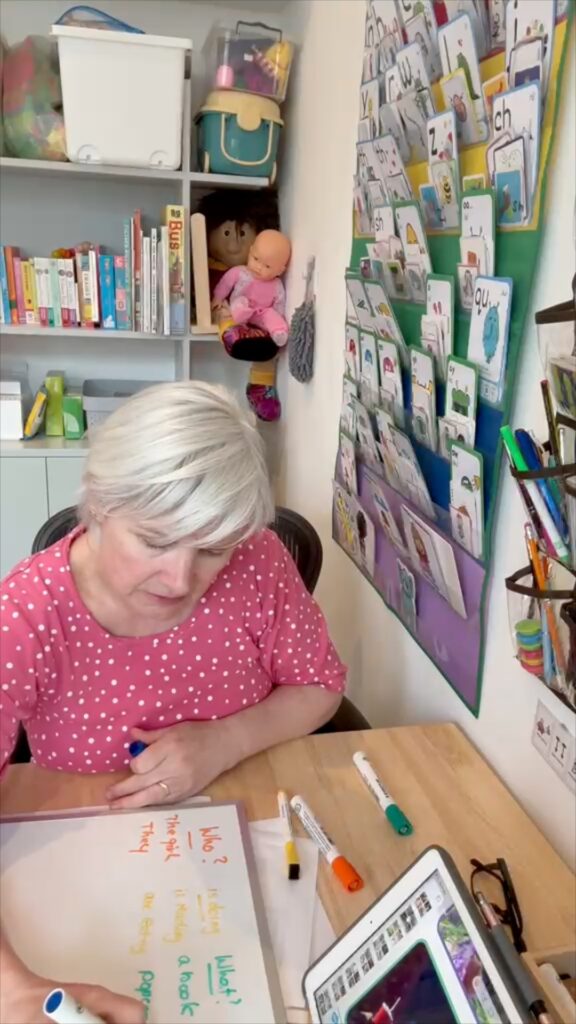
Different parts of a sentence are represented by different colours.

For example:

  • Who? is orange.
  • What doing? is yellow.
  • What? is green.
  • Where? is blue.

As children progress more colours are added:

  • To Whom? Is pink.
  • Adjectives (what like) is purple.
  • Time Phrase is brown.

Using colours gives children a visual framework for building sentences in a way that feels structured, predictable, and achievable.

Instead of language feeling abstract and overwhelming, children can see how sentences fit together.

For many children, this is massively helpful as it gives structure and predictability.

Why some children struggle with sentences

Language development is incredibly complex.

To build a sentence, we need to:

  • think of vocabulary
  • organise grammar
  • sequence words
  • understand meaning
  • remember sentence structure
  • physically say the words clearly enough to communicate

That is a huge amount happening all at once.

Some children may:

  • leave out verbs
  • miss pronouns
  • use immature grammar
  • struggle with word order
  • rely on very short phrases
  • find it difficult to expand beyond single words.

For example:

  • ‘Boy jump’
  • ‘Him eating’
  • ‘Dog there’
  • ‘Want juice’.

These children often know more than they can express.

Colourful Semantics helps bridge that gap.

Why visual supports matter

Many children—especially those with language delays, developmental language disorder (DLD), autism, or social communication difficulties—benefit enormously from visual support.

Visual systems reduce the processing load.

Instead of relying only on spoken language, children are given an additional way to organise information.

The colours act almost like ‘anchors’ for language.

A child may begin to understand:

  • orange = who
  • yellow = action
  • green = object
  • blue = place.

This makes sentence building more concrete and less overwhelming.

It also supports children who struggle with:

  • attention
  • auditory memory
  • processing spoken language
  • sequencing
  • confidence using language independently.

Supporting sentence expansion naturally

One of the things I love most about Colourful Semantics is how flexible it is.

It can be used:

  • in play
  • with books
  • during conversation
  • with picture scenes
  • in storytelling
  • during movement activities
  • within everyday routines.

Therapy does not need to feel rigid or worksheet-heavy.

Many children who usually avoid talking become much more willing to attempt longer sentences when they feel successful.

Children often begin to use:

  • verbs more accurately
  • pronouns more consistently
  • better word order
  • improved sentence organisation
  • and more complete ideas.

For example, instead of:

  • ‘Him running’

A child may gradually move toward:

  • ‘He is running.’

The colours help children understand the ‘jobs’ words have within a sentence.

This is particularly useful for children who need explicit teaching of language structure rather than simply learning through exposure alone.

Supporting children with speech difficulties too

One thing I particularly value in therapy is approaches that support multiple communication areas at once.

Colourful Semantics is excellent for this.

While building sentences, we can also naturally target:

  • speech sounds
  • intelligibility
  • vocabulary
  • social communication
  • turn-taking
  • attention and listening
  • confidence speaking.

For example, if a child is working on the /K/ sound, we might intentionally build sentences containing target words:

  • ‘The cat is coming.’
  • ‘The boy is kicking.’
  • ‘The duck is in the box.’

This allows speech and language goals to work together rather than separately.

Therapy becomes more functional, meaningful, and engaging.

Building confidence through success

One of the biggest barriers many children experience is not simply language difficulty. It is the emotional impact of struggling to communicate.

Some children become frustrated.
Others withdraw.
Some stop attempting longer sentences altogether because communication feels too hard.

Colourful Semantics can help rebuild confidence because it gives children a clear structure for success. That feeling matters enormously.

When children feel successful, they participate more.
They attempt more.
They communicate more.

And communication grows through communication.

Why I use colourful semantics

There is no single ‘magic’ therapy approach for every child.

But Colourful Semantics remains one of the most versatile and effective tools I use because it can be adapted so beautifully to individual children.

It supports:

  • early language
  • grammar
  • sentence structure
  • comprehension
  • expressive language
  • storytelling
  • confidence
  • functional communication.

Most importantly, it helps children organise language in a way that finally starts to make sense to them.

And when language starts to make sense, communication can truly begin to flourish.

Contact me via my contact form if you would like me to work with your child.

Sonja McGeachie

Highly Specialist Speech and Language Therapist

Owner of The London Speech and Feeding Practice.

Reference

Bryan A (1997) Colourful semantics. In: Chiat S, Law J, and Marshall J (eds) Language disorders in children and adults: psycholinguistic approaches to therapy. London: Whurr, 143–61.

Health Professions Council registered
Royal College of Speech & Language Therapists Member
Member of ASLTIP

Find a speech and language therapist for your child in London. Are you concerned about your child’s speech, feeding or communication skills and don’t know where to turn? Please contact me and we can discuss how I can help you or visit my services page.
3

Similar Posts

  • Submucous cleft palate: What is it and how does it impact on speech?

    Submucous cleft palate: What is it and how does it impact on speech?

    What exactly is a submucous cleft palate?

    A submucous cleft palate (SMCP) is much less obvious than its counterparts, cleft of lip and/or palate, and can profoundly impact a child’s speech development. It leads to often extreme hyper nasal speech and difficulty with producing many sounds (/K/ /G/ /T/ /D/ /P/ /B/ /S/ /Z/ /F/ /V/).

    In short, the muscles and bone of the soft palate, and sometimes the hard palate, do not fuse completely during foetal development and the mucous membrane that lines the roof of the mouth remains intact, effectively camouflaging the underlying muscular and bony deficit.

    So, while the surface of the palate appears normal, the essential muscle and functions responsible for sealing off the nasal cavity from the oral cavity during speech are compromised. This cleft (or lack of muscle) can be seen as a bluish midline discoloration of the soft palate, often a bifid (split) uvula, and at times a notch in the posterior border of the hard palate can be felt upon palpation. However, these signs aren’t always present or easily discernible, contributing to the difficulty arriving at a diagnosis.

    Diagnosing a submucous cleft palate is often akin to searching for a needle in a haystack, especially for the untrained eye. Unlike overt clefts that are visually apparent at birth, an SMCP can go undiagnosed for years, sometimes well into childhood or even adolescence. Paediatricians and even ENT surgeons have been known to miss it during routine checks due to the intact mucosal lining. Parents might notice their child’s speech sounds ‘different’ or ‘nasal’ but struggle to pinpoint the cause. Children might undergo extensive speech therapy without a proper diagnosis, as the underlying structural issue continues to hinder progress.

    My experience as a speech therapist in private practice:

    Over my years of practice, I have encountered several children presenting with persistent hyper-nasal speech and significant difficulties producing plosive and fricative sounds.

    It has been incredibly rewarding, though at times challenging, to successfully diagnose SMCP in a number of these children. My approach often involves:

    • a meticulous oral motor examination,
    • careful listening for the specific qualities of hypernasality,
    • and a deep understanding of the physiological requirements for clear speech sound production.

    When I suspect an SMCP, I refer these children to Great Ormond Street Hospital where a fantastic multidisciplinary team, typically including ENT surgeons and a specialist speech-language therapist can conduct more definitive assessments. These assessments often involve instrumental analyses such as videofluoroscopy or nasoendoscopy, which provide objective measures of velopharyngeal function and visual confirmation of the anatomical deficit.

    The path to resolution: surgery, therapy, and successful outcomes

    Surgery

    The journey for these children, once diagnosed, often involves surgical intervention. It’s not uncommon for children with SMCP to undergo multiple operations to achieve optimal velopharyngeal closure. These procedures aim to reconstruct or augment the velopharyngeal mechanism, enabling it to effectively separate the oral and nasal cavities during speech. The specific surgical approach depends on the individual child’s anatomy and the severity of the velopharyngeal insufficiency. It’s a testament to the skill of these specialised surgeons that such intricate repairs can be performed with remarkable success.

    Speech therapy

    Following surgery these children embark on the crucial phase of speech therapy. While surgery addresses the structural problem, speech therapy helps a child learn to utilise their newly improved anatomy. It involves intensive work on developing oral airflow, establishing correct articulatory placement, and reducing learned compensatory strategies that have developed due to the original structural deficit. It is immensely gratifying to witness the transformation. Children who once struggled to produce basic sounds, whose speech was difficult to understand, gradually develop clear speech.

    Next steps?

    If you’re a parent concerned about your child’s speech and feeding, you’re not alone. The journey can feel confusing, but professional guidance can make all the difference. Never hesitate to have a second opinion when you have that niggling feeling that there is something that has not yet been explored. At London Speech and Feeding I specialise in being thorough and thinking outside the box.

    I am here to provide the support you need. Reach out to schedule a consultation and take the first step towards helping your child communicate and thrive.

    Sonja McGeachie

    Highly Specialist Speech and Language Therapist

    Owner of The London Speech and Feeding Practice.


    Health Professions Council registered
    Royal College of Speech & Language Therapists Member
    Member of ASLTIP

    Find a speech and language therapist for your child in London. Are you concerned about your child’s speech, feeding or communication skills and don’t know where to turn? Please contact me and we can discuss how I can help you or visit my services page.

    1
  • ·

    Target activities and games

    Target Activities and Games For Kids
    Target Activities and Games For Kids

    Target Activities and Games

    AMAZINGLY EASY Activities that we can do at home and in the clinic to help our children practise those targets!

    I bet you have wondered what amazing things are done by a therapist in the clinic that you could not possibly do at home…? Well, if so I am here to tell you that you will be absolutely fine with just a few select toys and games and you will be able to get those targets done in a jiffy!

    What we clinicians do very well and what you probably can’t do yourself is formulate and design the targets that are important for your child to practice. Once we have assessed or reviewed your child’s progress and needs we can then design the perfect next step of targets for you.

    So for example, we have decided your little one needs to be practicing their ‘r’ sounds at the beginning of short words. We decided that based on our clinical expertise and our assessment and we have already worked with your child and managed to get this tricky ‘r’ sound just about right on its own. Now we are ready for short word practice.

    It has been researched that in order for the brain pathways to re-shape or reform we need to get about 100 words in per day of our target sound. That sounds like quite a lot, right? But actually….. it’s not that bad. After all you only need to say 5-7 words about 20 times and hey presto that’s about 80-100 words.

    So here are some simple games I use in my clinic all the time and these games are easily available online or in your local toy shops and this is how to do them:

    Pop the Pirate

    Pop the Pirate, sooo good and popular:

    Lay out your target words which you will have been given by your speech therapist and put a few swords on each word.

    Each time your child picks up a sword they will need to say the target word 5 x, like:

    rip rip rip rip rip or run run run run run just like that in a row, bish bash bosh.

    Then they can stick the sword into the barrel. Onto the next sword which they can pick and then again

    race race race race race and stick in another sword

    So with this little lot I put out 5 target words and 3 swords on each.

    You will therefore get…… 15 words per picture, and that makes….75 words , there that is nearly all you need to do.

    If you then do another little game like this one:

    Magnetic board game

    This is a Magnetic Board game, and they are suddenly EVERYWHERE. But you could also just take a baking sheet and some fridge magnet you might have kicking about.

    Same principle as before, but now since this is your SECOND game of the day and you have already got 75 targets under your belt you only need to do one more round of 5 target words each:

    Each time your child picks up a magnet piece they will say the target word 5 more times:

    Ray ray ray ray ray and DONE you will now at the end of this short round have 105!! target words done with just two little fun games.

    How good is this? Your child won’t hardly notice that they are in fact doing their speech therapy homework.

    You’re welcome 🙂

    Get in touch if you would like me to help finding good targets for your child to work on. They can be speech and/or language targets with this game method.


    Find a speech and language therapist for your child in London. Are you concerned about your child’s speech, feeding or communication skills and don’t know where to turn? Please contact me and we can discuss how I can help you or visit my services page.
  • · · ·

    Autism – Benefits of Early Assessment and Intervention

    I think my child might be autistic – how can we help?
    Image by macrovector on Freepik

    Consulting a Specialist Speech and Language Therapist can help you in several ways: assessment, informal and formal observation, discussion and advice, onward referrals, direct intervention, parent coaching, educational support and much more, all geared towards supporting you the parents, and helping your child to flourish and thrive.

    First up, we can help you with assessment and advice: with a wealth of expertise in observing childrens’ play and communication, as well as knowledge of the latest research we can see a child’s strengths and areas of struggle very quickly indeed.

    Within a short space of time, we can identify the areas we need to focus on and start guiding you towards helping your child to connect, respond, react and feel better.

    Early detection is key

    If autism is detected in infancy, then therapy can take full advantage of the brain’s plasticity. It is hard to diagnose Autism before 18 months but there are early signs we know to look out for. Let’s have a brief look at the sorts of things we look at.

    The earliest signs of Autism involve more of an absence of typical behaviours and not the presence of atypical ones.

    • Often the earliest signs are that a baby is very quiet and undemanding. Some babies don’t respond to being cuddled or spoken to. Baby is being described as a ‘good baby, so quiet, no trouble at all’.
    • Baby is very object focused: he/she may look for long periods of time at a red spot/twinkly item further away, at the corner of the room for example.
    • Baby does not make eye contact: we can often see that a baby looks at your glasses for example instead of ‘connecting’ with your eyes.
    • At around 4 months we should see a baby copying adults’ facial expressions and some body movements, gestures and then increasingly cooing sounds we make; babies who were later diagnosed with autism were not seen to be doing this.
    • Baby does not respond with smiles by about 6 months.
    • By about 9 months, baby does not share sounds in a back-and-forth fashion.
    • By about 12 months baby does not respond/turn their heads when their name is called.
    • By around 16 months we have no spoken words; perhaps we hear sounds that sound like ‘speech’ but we cannot make out what the sounds are.
    • By about 24 months we see no meaningful two-word combinations that are self-generated by the toddler. We might see some copying of single words.

    24 months plus:

    • Our child is not interested in other children or people and seems unaware of others in the same room/play area.
    • Our child prefers to play alone, and dislikes being touched, held or cuddled.
    • He/she does not share an interest or draw attention to their own achievements e.g., ‘daddy look I got a dog’.
    • We can see our child not being aware that others are talking to them.
    • We see very little creative pretend play.
    • In the nursery our child might be rough with other children, pushing, pinching or scratching, biting sometimes; or our child might simply not interact with others and be unable to sit in a circle when asked to.

    What sort of speech and language difficulties might we see?

    Our child might do any of the following:

    • have no speech at all, but uses body movements to request things, takes adults by the hand
    • repeat the same word or phrase over and over; sometimes straight away after we have said it or sometimes hours later
    • repeat phrases and songs from adverts or videos, nursery rhymes or what dad says every day when he gets back from work etc.
    • copy our way of intonation
    • not understand questions – and respond by repeating the question just asked:
      • adult: Do you want apple? child: do you want apple?
    • not understand directions or only high frequency directions in daily life
    • avoid eye contact or sometimes ‘stares’
    • lack of pointing or other gestures

    Common behaviours:

    • Hand flapping
    • Rocking back-and-forth
    • Finger flicking or wriggling/moving
    • Lining up items/toys
    • Wheel spinning, spinning around self
    • Flicking lights on and off, or other switches
    • Running back-and-forth in the room, needing to touch each wall/door
    • Loud screaming when excited
    • Bashing ears when frustrated or excited
    • Atypical postures or walking, tip toeing, can be falling over easily, uncoordinated
    • Can be hyper sensitive to noises, smells, textures, foods, clothing, hair cutting, washing etc.
    • Being rigid and inflexible, needing to stick to routines, unable to transition into new environments
    • Food sensitivity, food avoidance, food phobias

    I mentioned this to be a ‘brief’ look at the areas and it is: each topic is looked at very deeply and each area is multi-facetted therefore a diagnosis is rarely arrived at very quickly. We want to make sure we have covered all aspects and have got to know your child very well before coming to conclusions.

    Early detection is key, because we want to start helping your child to make progress as quickly as is possible. If you feel /know that your child is delayed in their speech and language development and you would like a professional opinion then please do contact me, I look forward to supporting you. It is important to know at this point, that if your child only has one or two of the above aspects it may mean that your child is simply delayed for reasons other than Autism and if that is the case, we will be able to help you iron out a few areas of need so that your child can go on thriving.

    If you need help with your child, please do not hesitate to contact me.


    Find a speech and language therapist for your child in London. Are you concerned about your child’s speech, feeding or communication skills and don’t know where to turn? Please contact me and we can discuss how I can help you or visit my services page.

    1
  • Can AI help my child’s speech delay? What it can do and what it can’t

    If you’re worried about your child’s speech, you are absolutely not alone. Many parents I work with tell me the same thing:

    ‘I’ve been Googling…’
    ‘I asked ChatGPT what activities to try…’
    ‘TikTok said we should practise this sound every day…’

    It makes complete sense. When waiting lists are long, evenings are quiet, and your child is struggling to communicate, it’s natural to look for help wherever you can find it.

    AI tools can actually be helpful in some ways. But they also have clear limits especially for children with significant speech delays or speech sound disorders.

    Here’s an honest, balanced guide to what AI can do, and what it simply can’t.

    ✔️ What AI can help with

    1. Explaining things in simple language

    AI can be very helpful for explaining speech and language terms in a way that’s easy for parents to understand for example, what a phonological delay is, or what Childhood Apraxia of Speech means. It can also suggest possible reasons for a child’s speech delay based on the information you provide.

    The difficulty is that parents (or teachers) can only ask questions based on what they notice or perceive to be the problem. In practice, this doesn’t always tell the full story. For example, parents often report that their child ‘can say certain words’, but during an assessment we may find those words are actually produced with consistent error patterns. These patterns give important clues about the underlying nature of the difficulty, whether it’s a delay or a disorder and they guide the speech therapist in choosing the most effective targets to improve intelligibility.

    2. Suggesting games and activities

    AI is very good at suggesting ideas for games and practice, such as word lists, simple play activities, sound practice games, book suggestions, and ways to encourage talking within everyday routines. These can be especially helpful when you feel stuck or want some fresh inspiration for supporting your child at home. It can help to think of AI as a big ideas bank, somewhere to dip into when you need new, playful ways to keep practice engaging.

    3. Helping you prepare questions for a therapist

    Some parents use AI to list questions before an assessment, understand reports and organise concerns.

    This can make therapy feel less overwhelming and more collaborative.

    Used this way, AI can actually support the therapy process.

    ❌ Where and why AI cannot replace real life speech therapy

    There is substantial research supporting the effectiveness of real-life speech therapy compared to generic online resources or AI-generated suggestions. Here are some key points highlighting why in-person therapy is often more beneficial:

    • Personalisation: Speech therapists assess each child’s unique needs, strengths, and challenges through direct observation and interaction. This personalised approach allows for tailored interventions that address specific issues, which generic resources cannot provide.
    • Nuanced understanding: Therapists are trained to recognise subtle cues in speech production, including the nuances of sound articulation, language comprehension, and social communication. This expertise enables us to identify underlying issues that may not be apparent through generic assessments.
    • Motivational support: A speech therapist can provide encouragement, motivation, and emotional support, which can significantly enhance a child’s willingness to participate and engage in therapy. This relational aspect is crucial for building confidence and reducing anxiety around communication.
    • Evidence-based practices: As a highly trained and specialised speech therapist I utilise evidence-based practices that are grounded in research, ensuring that the techniques used are effective and up to date. This contrasts with generic online information, which may not always be reliable or validated.
    • Progress monitoring: In-person therapy allows for ongoing assessment and adjustments to the treatment plan. We track progress over time and modify strategies as needed, ensuring that the therapy remains effective and relevant.

    Research studies consistently show that individualised, face-to-face interventions lead to better outcomes in speech therapy than generalised approaches. For parents and caregivers, seeking professional help tends to provide a more effective path toward improving their child’s communication skills.

    The healthiest way to think about AI

    AI works best as a starting point, not a substitute. You might use it to understand your child’s report and learn how speech develops,

    But if your child has significant delay or difficulty being understood, what makes the real difference is:

    • A tailored assessment
    • A clear therapy plan
    • Expert target selection
    • Ongoing adjustment
    • Support for both child and you the parent!

    Dear parents,

    If you’ve been turning to AI for help, it doesn’t mean you’re doing anything wrong. It means you care!

    But please know the best outcomes usually come from combining your daily support at home with guidance and support from your speech therapist who knows you and your child.

    Many of my past and present clients tell me that they really value my ‘handholding’ and me guiding them in between the sessions. A quick check in is often all that is needed but it makes a huge difference!

    If you’d like support or advice, please contact me and I can help guide the next steps.

    Sonja McGeachie

    Highly Specialist Speech and Language Therapist

    Owner of The London Speech and Feeding Practice.


    Health Professions Council registered
    Royal College of Speech & Language Therapists Member
    Member of ASLTIP

    Find a speech and language therapist for your child in London. Are you concerned about your child’s speech, feeding or communication skills and don’t know where to turn? Please contact me and we can discuss how I can help you or visit my services page.

    3
  • · ·

    Why ‘Prosody’ Matters in Childhood Apraxia of Speech (CAS)

    Prosody refers to the ‘music’ of speech — the rhythm, pitch, stress, and volume that convey meaning and emotion beyond the literal words themselves. Think about a monotone statement like ‘Really?’ compared to one with a rising inflection, expressing genuine curiosity.

    When I work with children on producing speech sound sequences, we focus on mastering individual sounds and then putting them together into target words. A crucial element that can significantly impact a child’s speech production is ‘prosody’.

    In CAS, where the difficulty lies in planning and executing the motor movements for speech, prosody can be a powerful tool for producing clearer words and phrases.

    Here’s why working on prosody is an essential tool in CAS speech therapy:

    1.  It aids Motor Learning:

    Apraxia of Speech means that the planning and execution of speech movements are impaired. When we use exaggerated intonation or stress patterns while modelling words, we are providing additional prosodic variation and, therefore, additional auditory cues. These cues often help my student to carry out the correct motor movements for a word or syllable sequence.

    For instance, I might say ‘ball’ with a high-pitched emphasis on the ‘b’ sound. This auditory cue might be more effective in guiding the child’s tongue placement than simply repeating the word without variation.

    In this little video clip I get my student to say the word ‘snuggle’ (since we were working on that particular sound sequence: snuggle, snout, snore and sneeze) with a high voice and then a lower voice ‘like a bear’ — again it provides that extra auditory cue, but, in addition, the fun aspect also helps to take away the intense focus on a tricky movement pattern.

    By now the new pathways have been laid through repeated practice and now automaticity takes over and without too much effort my student can suddenly produce a motor pattern. It’s magical when it happens and gives me such a thrill.

    2. It makes speech more engaging and natural sounding:

    Children with CAS often sound robotic or flat due to challenges with prosodic elements. By incorporating variations in pitch, volume, and rhythm during therapy, we can help achieve a more natural flow of speech

    3. It makes it easier to express our emotions:

    Children with CAS often struggle to express themselves emotionally; partly through the difficulty of producing clear words — period, but also in addition due to the difficulties or absence of musicality and rhythm in their speech.

    Therefore, it is so important to incorporate activities focused on practising different emotions with varied intonation patterns. This can really empower our students to put emotions into their words.

    Good words to practise are fun words like ‘Wow!’ or ‘Yeiih’ or power words and phrases like ‘No!’ or ‘Gimme that’ etc.

    Making Therapy Fun and Engaging:

    Speech therapy for CAS doesn’t have to be all drills and exercises (though to be fair sometimes we can’t quite get round to making each and every word huge fun though we try…).

    I aim to make all my sessions fun and have intrinsic rewards built into the speech practice where possible.

    Home practice tips:

    Therapy shouldn’t exist in a bubble. Working on prosody during sessions is crucial, but it’s equally important to integrate these skills into everyday interactions. Parents and caregivers can model appropriate prosody during playtime, story time, or even simple conversations. This consistent reinforcement helps our children to generalise their newfound skills and use them naturally in their daily lives.

    • Sing songs and rhymes: Songs naturally incorporate variations in pitch and rhythm. Singing familiar songs and creating silly rhymes can be a delightful way to practise prosody.
    • Use puppets and toys: Assign different voices and personalities to puppets or toys. This encourages children to experiment with pitch and volume to differentiate characters.
    • Read aloud with enthusiasm: Model expressive reading, varying your voice for different characters and emphasising key words. This makes reading time engaging and helps children understand the power of prosody.

    Please feel free to contact me if your child has speech sound difficulties. It is my passion. I love supporting children with apraxia.

    Sonja McGeachie

    Early Intervention Speech and Language Therapist

    Feeding and Dysphagia (Swallowing) Specialist The London Speech and Feeding Practice

    The London Speech and Feeding Practice


    Find a speech and language therapist for your child in London. Are you concerned about your child’s speech, feeding or communication skills and don’t know where to turn? Please contact me and we can discuss how I can help you or visit my services page.

    1
  • · ·

    How can we support babbling and early speech development? SLT tricks and tips

    My baby isn’t babbling and developing speech – what can I do to support?

    While every baby develops at their own pace, if your child isn’t babbling by nine months, it’s worth seeking help from an Early Intervention Health Professional, such as a doctor and a speech therapist. Don’t panic! There are many reasons for delayed babbling, and early intervention is key.

    In the meantime, it is highly recommended that we talk, sing, and read to our baby often. Exaggerate sounds and expressions, and respond to their coos and smiles. This playful interaction helps stimulate their communication skills.

    Below are some tips and tricks from my experience of working with babies and toddlers who need a little bit of help and support to develop.

    The benefits of imitating your baby

    Copying your baby’s sounds and gestures isn’t just silly fun, it’s a powerful learning tool! By mimicking their babbles and actions, you activate “mirror neurons” in their brain that help them connect sounds with meaning. This playful back-and-forth teaches turn-taking, a foundation for conversation. Plus, it encourages them to copy you, building their own language skills and social interaction abilities.

    This is a nice clip on youtube showing how copying/imitating your baby looks like:

    Here are some fun ways to imitate your baby:

    • Matchmaker: Grab two of the same, or two similar toys your child loves, like rainmakers or shakers. Give one to your baby and keep the other for yourself. When your child plays with his/her toy, mirror his/her actions with yours! This creates a fun, interactive game.
    • Face Time: Get down to your baby’s level, sitting opposite him/her on the floor or kneeling. This makes eye contact easy and encourages him/her to look at you during your playful imitation.
    • Be the Funniest You: Go all out with silly faces, exaggerated sounds, and big gestures. The goal is to capture your baby’s attention and make you irresistible to watch. This playful energy encourages him/her to interact and potentially imitate you back!

    By incorporating these tips, you can turn imitation into a fun and engaging way to boost your baby’s communication skills. I have seen this happen numerous times over the past decades. It is very powerful, go ahead and try it! You cannot be silly and goofy enough!

    Great toy ideas:

    Did you know that speech and language development starts with how we talk to our babies?

    Adults naturally use a special way of speaking called motherese. It involves a higher pitch, slower pace, and exaggerated sounds compared to regular conversation. Sentences are simpler, with shorter words and repetition. This grabs babies’ attention, helps them distinguish sounds, and reinforces word meaning.

    Imitation is a key part of motherese. We wait for our baby to make a sound or gesture, then playfully imitate it with exaggeration. Babies notice this right away and often respond with more vocalisations, creating a mini conversation. This back-and-forth teaches turn-taking, a foundation for future conversations.

    By responding warmly and engaging in these playful interactions, we encourage our babies to keep exploring the world of communication. Talking, singing, reading and, of course, imitating, these simple actions can have a big impact on a baby’s language development.

    Once your conversation is underway then try and keep it going for as long as possible. It’s a beautiful dance of turn-taking, even without words!

    A last word on oxytocin

    There’s evidence suggesting early non-verbal communication with your baby can increase a mother’s oxytocin levels, often called the ‘love hormone’. This hormone plays a key role in bonding and social connection. Positive interactions, touch, and stress reduction all contribute to oxytocin release, strengthening the mother–baby bond.

    For parents of babies with extra needs

    The stress of caring for a child with medical needs or developmental delays can be difficult. Stress can lower oxytocin levels, creating a cycle of sadness for both parent and child.

    Breaking the cycle:

    1. Knowledge is Power: Understanding the importance of communication can empower parents.
    2. Seek Support: Speech therapists and other healthcare professionals can provide valuable guidance on communication strategies.
    3. Start Small, Celebrate Big: Even small interactions can boost oxytocin. Focus on playful imitation and positive reinforcement. Remember, friends, family and healthcare professionals are there to encourage you.

    This approach can help reverse the negative cycle and create a more positive and connected relationship between parent and child.

    I hope this is helpful! Don’t hesitate to reach out with any questions.

    Kind regards

    Sonja McGeachie

    Early Intervention Speech and Language Therapist

    Feeding and Dysphagia (Swallowing) Specialist The London Speech and Feeding Practice

    The London Speech and Feeding Practice


    Find a speech and language therapist for your child in London. Are you concerned about your child’s speech, feeding or communication skills and don’t know where to turn? Please contact me and we can discuss how I can help you or visit my services page.

    2