Why tongue lateralisation matters: The hidden feeding skill that every toddler needs

|

When parents think about feeding milestones, they often focus on what their child is eating. Are they accepting lumps? Will they eat vegetables? Are they managing finger foods?

However, one of the most important skills happening behind the scenes is something many parents have never heard of: tongue lateralisation.

Tongue lateralisation simply means the tongue’s ability to move from side to side inside the mouth. Although this sounds like a small movement, it is one of the key building blocks for safe chewing, efficient eating and later speech development.

As a Speech and Language Therapist specialising in infant feeding, I frequently assess children who have delayed or absent tongue lateralisation. The encouraging news is that this skill can often be developed. But like many areas of development, there is an optimal window during which children learn it most naturally.

What does the tongue actually do during eating?

Eating is an incredibly complex process involving the lips, jaw, cheeks, tongue and swallowing muscles all working together.

For mature chewing, the tongue needs to:

  • move food from the centre of the mouth onto the back gums and molars
  • keep the food positioned while the jaw chews
  • collect scattered pieces of food from around the mouth
  • reform the chewed food into a single cohesive bolus
  • move that bolus safely to the middle of the tongue before swallowing.

Without good tongue lateralisation, food often stays in the middle or front of the mouth where it cannot be chewed effectively.

Children may compensate by:

  • swallowing pieces whole
  • mashing food with the front teeth only
  • relying on sucking instead of chewing
  • holding food in their cheeks
  • gagging frequently
  • refusing more challenging textures altogether.

These children are often described as ‘fussy eaters’, when in reality they may simply lack the oral motor skills needed to manage more advanced textures comfortably.

When should tongue lateralisation develop?

Tongue lateralisation begins to emerge during the second half of the first year of life as babies start exploring textured foods.

Between approximately 6 and 12 months, babies naturally begin learning to move food sideways towards their gums for early chewing. As molars develop during the second year, these movements become more refined and efficient.

This period represents an important developmental window because babies are biologically programmed to experiment with increasingly varied textures. Repeated opportunities to chew different foods strengthen the tongue, jaw and cheek muscles while building the complex movement patterns needed for mature eating.

If a child remains on smooth purées or very soft foods for too long, they may miss hundreds of opportunities to practise these essential movements.

Why does this developmental window matter?

Like learning to crawl, walk or ride a bicycle, oral motor skills develop through repeated practice.

Children who do not experience enough chewing opportunities during infancy can sometimes continue to rely on immature sucking and munching patterns well into toddlerhood.

This does not mean the opportunity is completely lost after infancy. Many toddlers can still learn tongue lateralisation successfully with the right support. However, the longer an immature pattern is used, the more established it becomes, making change more challenging.

That is why early assessment is so valuable.

Signs your toddler may have poor tongue lateralisation

You may notice your child:

  • chews mainly with the front teeth
  • bites but does not chew efficiently
  • keeps food in the centre of the mouth
  • pockets food in the cheeks
  • frequently spits out textured foods
  • gags on lumps
  • prefers soft foods
  • swallows before food has been adequately chewed
  • takes a very long time to finish meals.

Not every child showing these signs has an oral motor difficulty, but they do warrant further assessment.

How can we encourage tongue lateralisation?

The good news is that the tongue learns through experience.

One of the best ways to encourage side-to-side movement is by offering long, resistive foods that naturally encourage the tongue to move food towards the side gums for chewing. We also call them sometimes HARD MUNCHABLES – they look like on the following image.
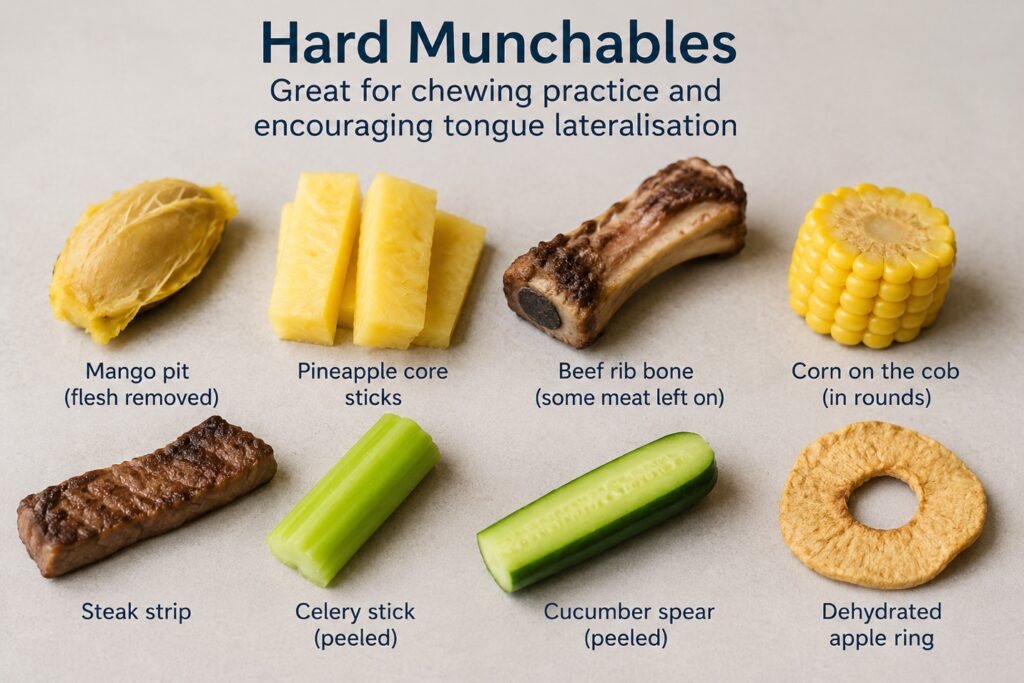
Hard munchablers

Examples include:

  • mango pits with most of the flesh removed
  • pineapple core strips
  • thick steak strips
  • cooked pork strips
  • peeled celery sticks
  • thick cucumber spears
  • roasted pepper strips
  • corn on the cob cut into manageable rounds
  • dehydrated apple rings
  • large clean cooked rib bones with a little meat remaining for supervised chewing practice.

These foods are not intended for children to consume large pieces quickly. Instead, they provide resistance that encourages the jaw, cheeks and tongue to work together while giving valuable sensory feedback.

A simple technique that can help

Some toddlers struggle because they never naturally move food to the side of their mouths.

In these cases, placing a long strip of food gently onto the side gums can sometimes trigger the chewing pattern automatically. This gives the tongue an opportunity to experience where chewing should occur.

This should always be done calmly, with the child sitting upright and under close adult supervision.

Every child develops differently

Some children are more likely to experience delayed tongue lateralisation than others.

This may include children who:

  • remained on purées for an extended period
  • have developmental delays
  • have low muscle tone
  • were born prematurely
  • have significant sensory processing differences
  • have experienced prolonged tube feeding or medical conditions affecting feeding.

A feeding assessment can identify whether tongue movement, jaw stability, sensory processing or another factor is contributing to the difficulty.

Early intervention makes a difference

One of the biggest misconceptions I hear is:

‘They’ll grow out of it.’

Some children do. Others don’t.

Without intervention, inefficient chewing patterns can persist for years, affecting food variety, mealtime confidence and nutritional intake. In some cases, immature oral motor patterns may also contribute to unclear speech production later on, although feeding and speech skills do not always develop at the same rate.

The earlier we identify a problem, the easier it usually is to help children develop more mature, efficient chewing patterns.

Final thoughts

Tongue lateralisation may not be a term many parents recognise, but it is one of the foundations of successful feeding.

By offering opportunities to chew a variety of safe textures during infancy, parents help build the complex tongue movements needed for efficient eating throughout childhood.

If your toddler still struggles with chewing, gags on textured foods, or seems unable to move food around their mouth, don’t simply wait and hope they will outgrow it. A comprehensive feeding assessment can identify exactly where the difficulty lies and provide practical strategies tailored to your child’s needs.

Sometimes a few small changes at the right time can make a lifetime of difference. Do get in touch with me. I would love to hear from you and help your little one develop good chewing skills and eating habits.

Sonja McGeachie

Highly Specialist Speech and Language Therapist

Owner of The London Speech and Feeding Practice.


Health Professions Council registered
Royal College of Speech & Language Therapists Member
Member of ASLTIP

Find a speech and language therapist for your child in London. Are you concerned about your child’s speech, feeding or communication skills and don’t know where to turn? Please contact me and we can discuss how I can help you or visit my services page.

3

Similar Posts

  • · · · ·

    Let’s ditch the ‘Fix-It’ approach to autistic play and stimming

    Let’s ditch the 'Fix-It' approach to autistic play and stimming

    December is often presented as a time of perfect, reciprocal play. Children are supposed to be unwrapping toys, sharing, and engaging in imaginative scenarios with family. But for parents of young autistic children, this high-pressure, socially demanding period can often feel like a battleground.

    If you’ve been told to interrupt your child’s stimming, push for eye contact, or force them to play ‘functionally’ with toys, it’s time to take a deep breath. Those traditional approaches are not only stressful—they often miss the point of your child’s communication.

    As a neurodiversity-affirming Speech and Language Therapist, I want to encourage you this December: You are allowed to follow your child’s lead, validate his or her unique interests, and trust that his or her play and movement are profoundly meaningful.

    1. Stimming: not a distraction, but a regulator 💡

    Stimming is short for self-stimulatory behaviour and includes repetitive movements or sounds like hand flapping, humming, rocking, finger flicking, or repeating phrases (called echolalia).

    For years, parents were incorrectly advised to block or eliminate these behaviours. The neurodiversity-affirming view tells us the exact opposite: Stimming is a vital and essential tool for your child’s self-regulation.

    Think of stimming as an internal volume dial:

    • Too loud/overwhelmed: Your child may stim to reduce incoming sensory input (e.g., rocking to ground himself or herself in a busy room).
    • Too quiet/under-stimulated: Your child may stim to increase sensory input and focus (e.g., running back and forth to maintain alertness).

    The shift: validate, don’t block

    Instead of saying, ‘Stop flapping your hands’, try to understand the message behind the movement.

    • Observe: When does the stimming happen? Is it before a meltdown? When your child excited? When your child is bored?
    • Validate: Name the need, not just the behaviour. You might say, ‘I see your body needs to move fast right now. That helps you calm down!’
    • Co-regulate: If the stim is unsafe (e.g., head-banging), help your child find a safer, alternative stim that meets the same sensory need (e.g., pushing hard against a wall, squeezing a stress ball).

    By validating your child’s need to regulate, you are building trust, reducing anxiety, and teaching him or her critical self-awareness.

    2. Autistic play: Meaningful, even if it’s monologue

    The traditional idea of ‘good play’ often involves turn-taking, pretending, and specific toy functions (e.g., pushing a train around a track). When an autistic child spends 30 minutes lining up cars, spinning their wheels, or scripting whole scenes from a favourite movie, it can often be dismissed as non-functional or repetitive.

    In neurodiversity-affirming practice, we recognise that autistic play is authentic play. These activities are crucial for learning, deep focus, and imaginative development.

    • Lining up toys may be an exploration of patterns, visual organisation, and order.
    • Spinning wheels may be a deep interest in cause-and-effect and visual sensory input.
    • Scripting is often a way to process language, regulate emotions, and practise complex social situations in a safe, controlled way.

    Make a change: Join your child’s world, don’t drag them to yours.

    Stop trying to force the ‘right’ way to play. Instead, try these neuro-affirming strategies:

    1. Be a co-regulator, not a director: If your child is lining up cars, sit down next to him or her. Instead of moving a car, try handing him or her another car to line up. Focus on the shared interest rather than forcing interaction.
    2. Narrate (don’t question): Avoid constantly asking, ‘What are you doing?’ or ‘What does this car say?’ This puts pressure on your child to perform. Instead, narrate your observations using his or her interest: ‘I see you made a long, straight line of red cars. Look at all the wheels spinning!’
    3. Validate the interest: Show genuine appreciation for your child’s focus. ‘Wow, you know so much about how magnets stick together! That’s incredible.’

    3. The communication revolution: Honouring gestalt language processing 

    Many young autistic children communicate in ways that don’t fit the traditional model of building language word-by-word. Many use Gestalt Language Processing (GLP).

    A gestalt language processor learns language in chunks or scripts (e.g., ‘what’s-in-there?’ or ‘ready-go!’). These chunks (or gestalts) are not random; they are often tied to an emotional memory or meaning. Over time, the child breaks down these big chunks into individual words then learns to recombine those words creatively.

    If your child repeats movie phrases or whole sentences that seem unrelated, he or she is likely a gestalt language processor!

    Affirm the script, then model something useful.

    1. Affirm the script: When your child says a script, respond to the meaning or emotion behind it, not the literal words. If he or she says, ‘We’re going to need a bigger boat’, and he or she is looking at a messy toy pile, he or she may be trying to express overwhelm or a need for help. You can affirm: ‘That pile is too big! I can help you move it.’
    2. Model new ‘mix and match’ scripts: To help your child move from whole scripts to single words, you can model shorter, slightly changed versions of the script, also called ‘mitigated gestalts’. If they say, ‘I want to go home now’, you might model, ‘Let’s go home, now’ or ‘I wanna go home’.

    By honouring your child’s communication style, you validate his or her experience and naturally support his or her path to language development—a core part of neurodiversity-affirming SLT.

    Your December gift to your little one:

    This December, stop trying to make your child fit into a neurotypical box. Instead, make your home a safe space where he or she can be his or her authentic selves.

    Prioritise regulation and connection over compliance.

    Trust that when your child is regulated, his or her communication, learning, and engagement will flourish naturally. This is the true gift of neurodiversity-affirming practice.

    Download and print my neuro-affirming quick reference guide and keep this guide handy on your fridge and/or in your child’s play area for a quick reminder to prioritise connection over conformity.

    Sonja McGeachie

    Highly Specialist Speech and Language Therapist

    Owner of The London Speech and Feeding Practice.

    Health Professions Council registered
    Royal College of Speech & Language Therapists Member
    Member of ASLTIP

    Find a speech and language therapist for your child in London. Are you concerned about your child’s speech, feeding or communication skills and don’t know where to turn? Please contact me and we can discuss how I can help you or visit my services page.

    2
  • · ·

    The hidden impact of mouth breathing and open mouth posture on speech and feeding

    When most people think about speech or feeding difficulties, they picture the tongue, lips, or chewing skills, but how a child breathes at rest plays a surprisingly big role too.

    Mouth breathing and open mouth resting posture can quietly influence everything from how a child’s face grows to how clearly they speak, to how confidently they chew and swallow. It’s something many parents never think about, until they start noticing the subtle signs.

    Let’s explore why this happens, what to look for, and how to gently support better breathing and oral posture.

    Recent research supports this link between mouth breathing and speech difficulties. For example, a 2022 study by Alhazmi et al., published in the Journal of Pharmacy and Bioallied Sciences, found that 81.7% of children aged 9–17 who breathed primarily through their mouths presented with speech sound disorders. The study highlights how mouth breathing can significantly influence orofacial development and articulation patterns.

    💨 Why we’re designed to breathe through our nose

    Our bodies are made for nasal breathing. When we breathe through the nose, the air is filtered, warmed, and humidified before reaching the lungs. The tongue naturally rests against the roof of the mouth, the lips close gently, and the jaw stays relaxed, all of which encourage healthy oral development.

    In contrast, mouth breathing often means the tongue rests low in the mouth and the lips stay apart. Over time, this posture can subtly reshape how the muscles and bones of the face grow.

    Children who breathe through their mouths most of the time may develop:

    • A longer face and narrower palate
    • Forward head posture
    • Slightly open lips and low tongue position at rest
    • A tendency toward drooling or noisy breathing
    • A dry mouth and consequently bad breath
    • At times the tongue pushes constantly against the front teeth causing them to grow forward (buck teeth)

    These changes are not anyone’s fault, as they often start because of blocked noses, allergies, enlarged adenoids, low facial muscle tone or habits formed when a child was younger. But understanding the pattern helps us know how to support change.

    🗣 How mouth breathing affects speech

    Speech depends on precise coordination between the lips, tongue, and jaw. The resting position of these structures affects how ready they are to move.

    1. Reduced tongue strength and placement, i.e. the tongue rests low in the mouth (as it does in mouth breathing), it’s harder for children to lift it efficiently for sounds like /T/, /D/, /N/, /L/, and /S/. This can lead to speech that sounds slightly slushy or unclear, or a frontal lisp.
    2. Open mouth posture and resonance: An open mouth at rest may affect how air vibrates in the oral and nasal cavities. Children might have speech that sounds a bit ‘muffled’ or lacks crispness because the lips and jaw aren’t fully supporting articulation.
    3. Fatigue and breath control: Mouth breathing can lead to drier mouths and less efficient breath support. That can make longer sentences or conversations feel tiring, especially in noisy environments.

    🥄 How mouth breathing affects feeding and chewing

    Feeding involves the same structures that control speech, so posture and breathing patterns matter here, too.

    1. Chewing efficiency: Children who habitually keep their mouths open often have low tongue tone and reduced jaw stability. They may prefer softer foods, chew slowly, or struggle with mixed textures.
    2. Swallowing pattern: A tongue that rests low may push forward when swallowing. This ‘tongue-thrust swallow’ can interfere with efficient chewing and even affect dental alignment over time.
    3. Breathing while eating: Since it’s hard to chew, swallow, and breathe through the mouth simultaneously, children who can’t comfortably nasal breathe may rush bites or pause to catch their breath. This can contribute to coughing, choking, or food refusal.

    Common signs to watch for

    Parents often notice subtle clues before realising mouth breathing is a pattern. Some red flags include:

    • Lips habitually open at rest
    • Drooling after the toddler years
    • Snoring or noisy breathing during sleep
    • Preference for soft foods or grazing eating habits
    • Dark circles under the eyes due to allergies
    • Frequent colds, congestion, or mouth odour
    • Speech that sounds slushy or unclear despite good effort

    If several of these sound familiar, it’s worth mentioning them to your child’s GP, dentist, or speech and language therapist.

    👩‍⚕️ What can help

    1. Address the underlying cause: If nasal blockage, allergies, or enlarged adenoids are making nasal breathing difficult, a medical assessment is the first step. ENT specialists can rule out or treat physical causes.
    2. Encourage closed mouth rest: Gentle reminders like ‘Lips together, tongue up, breathe through your nose’ can help older children become aware of their resting posture. For younger ones, visual cues (stickers or mirrors) can make it a game.
    3. Build oral-motor strength and awareness: Speech therapists can design activities to strengthen the tongue and lips, improve jaw stability, and encourage balanced breathing. This might include blowing games, tongue-tip lifts, use of dental-palatal devices or oral-motor exercises disguised as play.
    4. Support good posture: Sometimes mouth breathing goes hand-in-hand with forward-head posture. Encouraging upright sitting during meals and screen time helps keep the airway open and supports better breathing habits.
    5. Make nasal breathing part of daily routines: Gentle nose-breathing practice during calm times (reading, bedtime, car rides) helps normalise it. Avoid making it a battle: calm, consistent reminders work best.

    🌱 A gentle note on change

    Patterns of mouth breathing develop over time, and change doesn’t happen overnight. It’s important to approach this with curiosity, not criticism. The aim isn’t ‘perfect breathing,’ but to give your child the tools and awareness to breathe comfortably and efficiently.

    Small improvements in nasal breathing and resting posture can lead to big gains in speech clarity, eating confidence, and even sleep quality.

    💡 The takeaway

    Breathing seems automatic, and it is! but how we breathe matters. Mouth breathing and open-mouth posture can quietly shape how a child speaks, eats, and grows.

    By noticing early signs, addressing underlying causes, and building supportive habits, you can help your child move toward stronger, clearer speech and more comfortable mealtimes.

    Just like every area of development, progress starts with connection, patience, and gentle consistency, one calm breath at a time.

    Sonja McGeachie

    Highly Specialist Speech and Language Therapist

    Owner of The London Speech and Feeding Practice.

    References

    Alhazmi, A., Alshamrani, A., Alhussain, A., et al. (2022). Mouth Breathing and Speech Disorders: A Multidisciplinary Study. Journal of Pharmacy and Bioallied Sciences 14(5):911. https://www.researchgate.net/publication/361978128_Mouth_breathing_and_speech_disorders_A_multidisciplinary_evaluation_based_on_the_etiology


    Health Professions Council registered
    Royal College of Speech & Language Therapists Member
    Member of ASLTIP

    Find a speech and language therapist for your child in London. Are you concerned about your child’s speech, feeding or communication skills and don’t know where to turn? Please contact me and we can discuss how I can help you or visit my services page.
    2
  • One activity, endless opportunities for speech and language therapy targets

    Communication does not happen in neat little boxes. In Speech and Language Therapy we often use one great activity to target multiple areas of speech and or language development all at once.

    Children are trying to:

    • understand language
    • build sentences
    • organise their thoughts
    • pronounce sounds
    • remember words
    • use grammar
    • follow social interaction
    • communicate meaning…

    all at the same time.

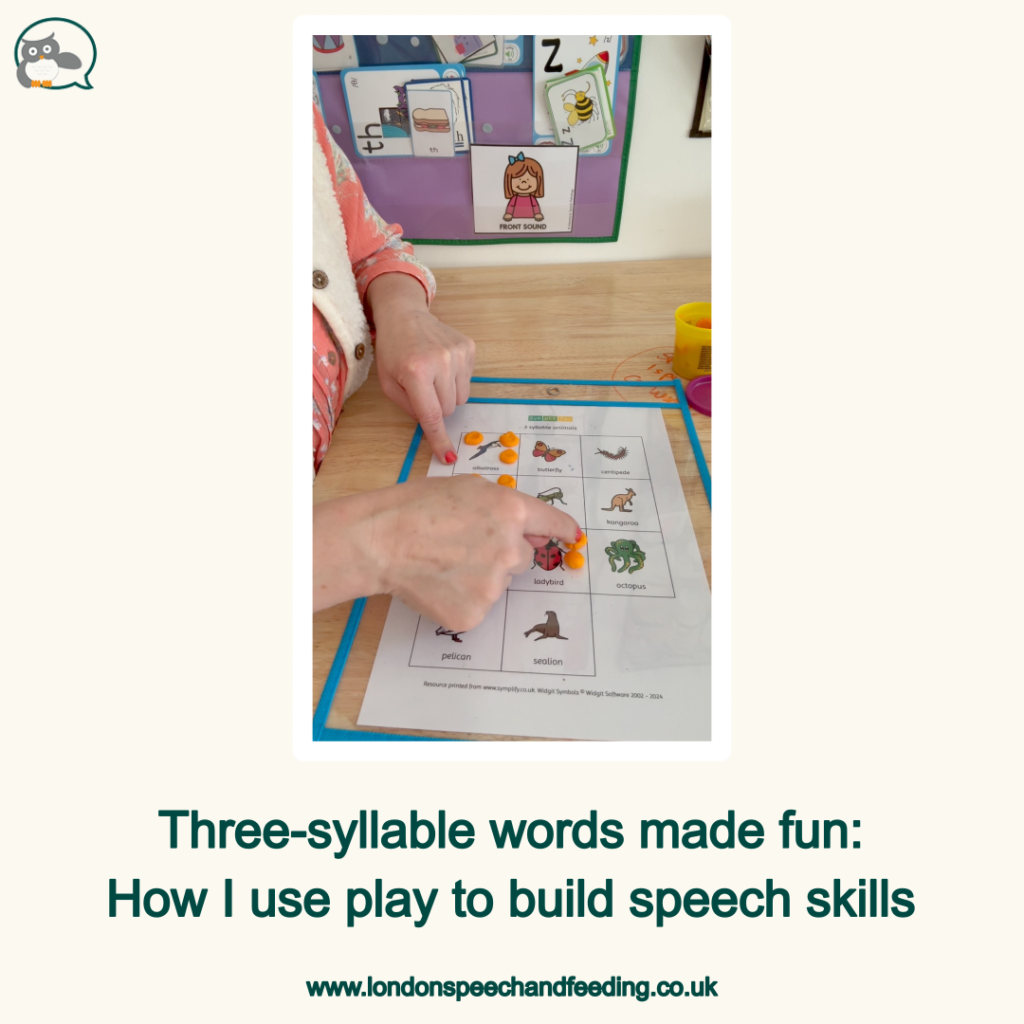
    This short therapy clip is a little example of that.

    Within one playful interaction, we naturally work on:

    • grammar
    • sentence expansion
    • pronouns
    • speech sound errors
    • modelling
    • visual cueing
    • turn-taking
    • confidence in communication

    And, importantly, the child remains engaged, relaxed, and successful throughout.

    Using language activities to refine speech sound targets

    We all learn language through:

    • shared attention
    • play
    • repetition
    • connection
    • modelling
    • responsive interaction

    As a Speech and Language Therapist I am constantly thinking and considering how to bring in all the targets a child is working on. The reason for that is that often we do not have a full therapy hour to work leisurely and calmly on various targets! Many children have short attention focus and ‘go off the boil’ quickly and often suddenly. Therefore, I always feel a sense of ‘make hay whilst the sun shines’ and pack it all in whilst the going is good. So then we can afford five minutes of trampolining in between activities to help the child regulate themselves without losing valuable speech therapy opportunities or time.

    • How can I expand this sentence?
    • How can I model better grammar?
    • Can I gently shape the pronunciation here?
    • Should I recast that phrase?
    • Is this the right moment to pause and encourage a longer utterance?
    • How can I keep communication flowing while still targeting goals?

    These decisions happen continuously during therapy.

    Building longer sentences naturally

    In this clip, one of the key areas we are targeting is sentence expansion through Colourful Semantics, which is a particularly useful and researched approach, developed by UK Speech and Language Therapist Alison Bryan in 1997 to support children with speech and language difficulties.

    Colourful Semantics is a visual, colour-coded therapy approach that helps children break down, understand, and construct sentences by assigning specific colours to thematic roles (e.g., Who, What Doing, What).

    Many children with language delay use reduced language for example: they might say:

    • ‘dog’ instead of ‘the dog is running fast’
    • ‘eatin a dinner’ instead of we are eating our dinner
    • ‘baby shhh’ instead of ‘the baby is sleeping’.

    Using the Colourful Semantics Framework helps create a solid baseline from which to work and with which to construct basic good sentences using WHO is DOING WHAT and WHERE.

    We are building language upward gently and positively.

    This technique is incredibly powerful because children learn language through hearing it used meaningfully over and over again.

    Supporting pronouns through real conversation

    Pronouns can be surprisingly difficult for many children.

    Words such as:

    • he
    • she
    • him
    • her
    • they

    require children to understand perspective, grammar, and sentence structure all at once. Using pictures and basing the activity on the Colourful Semantics Model I can shape pronouns repeatedly as part of the overall activity.

    Books, pictures, and play scenes are fantastic for this because they create endless opportunities for meaningful repetition.

    Again, this may look simple from the outside.

    But underneath it is highly intentional clinical work.

    Listening for speech sound errors at the same time

    While supporting grammar and language, I am also constantly listening to the child’s speech production.

    In this short interaction, I respond to speech sound errors as they arise.

    Sometimes I:

    • model the correct production
    • emphasise a sound slightly
    • use visual cues
    • slow the word down
    • add gesture or sign support
    • encourage another attempt.

    And sometimes I intentionally let the error go in order to protect confidence and maintain communication flow.

    That balance is incredibly important.

    Children need support. But they also need to feel successful communicating.

    The child simply experiences this as warm, responsive interaction.

    But underneath it is detailed clinical reasoning.

    This is why effective therapy is never about simply owning resources or downloading activities online.

    The real skill lies in:

    • how the therapist uses the activity
    • how they adapt moment by moment
    • how they analyse communication in real time
    • how they shape interaction to maximise learning opportunities.

    One activity. Endless opportunities.

    A single book, picture scene, or playful interaction can provide opportunities to support:

    • speech sounds
    • language development
    • grammar
    • vocabulary
    • attention
    • confidence
    • social communication
    • emotional connection.

    The magic is not in the activity itself.

    The magic is in how a therapist uses it.

    Because excellent speech therapy is never ‘just playing’.

    It is careful, responsive, evidence-based intervention woven seamlessly into joyful interaction.

    Contact me avia my contact form if you would like me to work with your child.

    Sonja McGeachie

    Highly Specialist Speech and Language Therapist

    Owner of The London Speech and Feeding Practice.

    Reference

    Bryan A (1997) Colourful semantics. In: Chiat S, Law J, and Marshall J (eds) Language disorders in children and adults: psycholinguistic approaches to therapy. London: Whurr, 143–61.


    Health Professions Council registered
    Royal College of Speech & Language Therapists Member
    Member of ASLTIP

    Find a speech and language therapist for your child in London. Are you concerned about your child’s speech, feeding or communication skills and don’t know where to turn? Please contact me and we can discuss how I can help you or visit my services page.

    3
  • · ·

    Baby-led weaning: Empowering little eaters from the start

    I had a mum ask me about Baby Led Weaning the other day. So I thought I would write a blog on all the useful questions she had and what we discussed as it may help lots of mums and dads out there.

    As a Paediatric Feeding SLT, one of the exciting developments in recent years is the growing interest in baby-led weaning (BLW). This approach to introducing solids has gained significant traction, and for good reason. It empowers infants to take the lead in their feeding journey, fostering a positive relationship with food and supporting important developmental milestones.

    What exactly is baby-led weaning?

    At its core, baby-led weaning is about offering your baby appropriately sized and textured solid foods from the very beginning, allowing him or her to self-feed. Instead of spoon-feeding purées, you present whole, soft foods that your baby can grasp, bring to his or her mouth, and explore at his or her own pace. This means no mashing, no blending, and no forcing spoons into reluctant mouths. It’s a fun, messy, and intuitive process that is led by your baby’s natural instincts.

    The genesis of baby-led weaning

    ‘Baby-led weaning’ was popularised by British health visitor Gill Rapley. In the early 2000s, Rapley observed that babies naturally develop the skills needed to self-feed and that traditional spoon-feeding might actually hinder this development. Her work, particularly her book Baby-Led Weaning: The Essential Guide to Introducing Solid Foods (co-authored with Tracey Murkett), published in 2008, brought BLW into the mainstream and provided a structured framework for parents. Her research and observations highlighted the benefits of trusting a baby’s innate ability to regulate his or her intake and explore different textures.

    What’s the deal?

    Implementing BLW is simpler than you might think, though it does require a shift in mindset. Here’s a breakdown of what it typically involves:

    • Readiness is key: The golden rule of BLW is to wait until your baby shows clear signs of readiness. This isn’t about age alone, but rather developmental milestones. Your baby should be at least six months old, able to sit unassisted, have good head and neck control, show an interest in food (e.g., reaching for yours), and have lost his or her tongue-thrust reflex (which pushes solids out of his or her mouth).
    • Offer finger foods: Start with soft, easily graspable foods cut into finger-sized sticks or spears. Think cooked sweet potato fries, steamed broccoli florets (soft enough to mash with gentle pressure), banana sticks, or avocado slices. The goal is for babies to be able to pick it up and get some into their mouth.
    • Embrace the mess: BLW is inherently messy, especially in the beginning. Food will be squished, dropped, and smeared. This is a crucial part of the learning process as babies explore textures, smells, and the properties of food. A wipeable mat under the highchair and a good bib are your best friends!
    • Observe, don’t interfere: Allow your baby to lead. He or she will decide what to eat, how much, and how quickly. Avoid putting food into his or her mouth or pressuring him or her to eat more. This respects his or her hunger and fullness cues, laying the foundation for healthy eating habits.
    • Continue breastmilk or formula: Until your baby is well-established on solids, breastmilk or formula remains his or her primary source of nutrition. Solids are for exploration, taste, and developing skills, gradually increasing in quantity over time.

    The benefits of baby-led weaning

    The advantages of BLW extend far beyond simply getting food into your baby. From a speech and feeding perspective, the benefits are compelling:

    • Develops oral motor skills: Chewing, gnawing, and manipulating various food textures are crucial for developing the muscles in the mouth, jaw, and tongue. This strengthens the oral motor skills necessary for speech development.
    • Enhances fine motor skills and hand-eye coordination: The act of grasping food, bringing it to the mouth, and coordinating these movements significantly refines fine motor skills and hand-eye coordination.
    • Promotes self-regulation and intuitive eating: By allowing babies to control their intake, BLW helps them tune into their own hunger and fullness cues, fostering a healthy relationship with food and reducing the likelihood of overeating.
    • Encourages adventurous eating: Exposure to a wide variety of tastes and textures from the outset can lead to less picky eating later. Babies are more likely to accept new foods when they have been in control of their exploration.
    • Facilitates family mealtimes: BLW integrates babies into family mealtimes from an early age, promoting social interaction and making mealtime a shared, enjoyable experience.

    When is baby-led weaning appropriate, and when not?

    While BLW offers numerous benefits, it’s not a one-size-fits-all approach.

    When BLW is appropriate:

    • When your baby meets all the developmental readiness signs: This is paramount for safety and success.
    • When you are comfortable with the mess and the learning curve: It requires patience and a relaxed attitude.
    • When you are committed to offering a variety of safe, appropriate foods.
    • When you are willing to learn about and practise safe food preparation to minimise choking hazards.

    When BLW might not be appropriate (or requires extra caution and professional guidance):

    • If your baby has a history of prematurity or significant developmental delays: His or her oral motor skills might not be sufficiently developed.
    • If your baby has certain medical conditions or anatomical differences (e.g., cleft palate, severe reflux, swallowing difficulties): These may necessitate a modified approach to feeding.
    • If there are significant feeding difficulties, aversion, or a history of choking incidents.
    • If you feel overly anxious about choking: While BLW, when done correctly, is not associated with a higher choking risk than traditional weaning, parental anxiety can impact the feeding experience. Education and consultation with a professional can help alleviate these concerns.

    A note on safety: Choking hazards

    It’s crucial to understand the difference between gagging and choking. Gagging is a natural reflex that helps prevent choking and is very common in BLW as babies learn to manage food in their mouths. Choking is silent and serious. To minimise choking risks:

    • Always supervise your baby closely during mealtimes.
    • Offer appropriately sized and textured foods. Avoid small, round, hard foods like whole grapes, nuts, popcorn, and large chunks of meat.
    • Ensure your baby is sitting upright and calm.
    • Educate yourself on infant CPR.

    Final thoughts

    Baby-led weaning is a wonderfully empowering approach that celebrates a baby’s natural abilities and fosters a positive and independent relationship with food. As Speech and Language Therapists we often see the positive impact it has on oral motor development, self-regulation, and overall feeding confidence. By understanding what it entails, when it’s appropriate, and prioritising safety, you can embark on this exciting journey with your little one, helping him or her become a confident and capable eater from the very first bite.

    If you would like help and support with weaning your baby whilst continuing to breastfeed then please get in touch!

    Sonja McGeachie

    Highly Specialist Speech and Language Therapist

    Owner of The London Speech and Feeding Practice.


    Health Professions Council registered
    Royal College of Speech & Language Therapists Member
    Member of ASLTIP

    Find a speech and language therapist for your child in London. Are you concerned about your child’s speech, feeding or communication skills and don’t know where to turn? Please contact me and we can discuss how I can help you or visit my services page.

    1
  • ·

    How can I incorporate AAC into my speech therapy sessions?

    Many parents are surprised when I bring AAC into a session, especially if they’ve come to see me primarily for speech sound work.

    They might wonder: ‘If we’re working on pronunciation, why are we using a communication device?’

    The simple answer is this: speech therapy is about communication first, and speech sounds second. Supporting a child’s ability to express themselves clearly and confidently is always the priority, and AAC can be a powerful tool alongside spoken speech.

    What do we mean by AAC?

    AAC stands for Augmentative and Alternative Communication.

    This can include:

    • A speech-generating device (such as LAMP Words for Life or GRID as I used in the photo below)
    • A communication app on a tablet
    • A symbol board or communication book
    • Gestures, signs, or visual supports

    AAC does not replace speech. Instead, it supports language development, reduces frustration, and builds communication success while speech skills are developing.

    Pretend Play using Speech and AAC in my clinic room

    But I mainly work on speech sounds… So how does AAC fit?

    Most of the children I see are working on:

    • Articulation difficulties
    • Phonological delay
    • Motor planning challenges (including apraxia/dyspraxia)
    • Unclear speech affecting confidence

    For these children, AAC isn’t a separate therapy. It’s simply woven naturally into what we are already doing.

    If a child brings their device to sessions, I actively include it. If they don’t yet use AAC but could benefit from visual or symbolic support, I may introduce simple options within activities.

    Using AAC to support speech practice

    Let’s say we are working on early speech targets like: ‘GO’.

    We might practise:

    • Saying the word verbally
    • Listening for the target sound
    • Using play (TOY TRAIN GOING ROUND A TRACK)

    Now we can extend this using AAC.

    On the device or communication board, we might model: ‘LET’S GO’ or ‘IT’s GOING up the hill’.

    This allows the child to:

    • Practise their speech sound target
    • Build a simple sentence
    • Experience successful communication even if speech is not fully clear yet

    All responses are valid and supported.

    AAC helps children communicate more than they can say

    Many children can understand and think in longer phrases than they can physically say.

    For example:

    • A child who verbally says single words may build longer phrases on AAC.
    • A child who struggles to plan speech movements may use AAC to communicate smoothly while still practising verbal attempts.
    • A child who becomes frustrated when misunderstood gains a reliable backup system.

    Rather than slowing speech progress, AAC often:

    • Reduces communication pressure
    • Increases participation in therapy
    • Encourages more attempts at speech
    • Supports language growth

    When children feel understood, they usually become more motivated to try speaking.

    There are no ‘prerequisites’ for AAC

    One of the biggest myths I hear is: ‘My child isn’t ready for AAC yet.’

    In reality, children do not need to:

    • Reach a certain speech level
    • Use pictures first
    • Prove they understand everything
    • Show immediate interest

    Instead, we presume competence and introduce AAC in meaningful, playful ways.

    That means:

    • Modelling words while blowing bubbles
    • Commenting during playdough activities
    • Choosing words during games
    • Building simple phrases in shared reading

    AAC should never feel like extra ‘work’. It’s simply another way to join in communication.

    My goal is always the same: to help each child communicate as clearly, confidently, and successfully as possible, using every helpful tool available.

    If your child uses AAC (or might benefit from it)

     Please feel free to:

    • Bring the device to sessions
    • Show me how your child currently uses it
    • Share advice from school or other therapists

    I am very happy to incorporate AAC into our work together so that speech practice, language development, and real communication all move forward hand-in-hand. Because ultimately, therapy isn’t just about producing perfect sounds. It’s about helping your child be heard and understood.

    If you’d like support or advice, please contact me and I can help guide the next steps.

    Sonja McGeachie

    Highly Specialist Speech and Language Therapist

    Owner of The London Speech and Feeding Practice.


      Health Professions Council registered
      Royal College of Speech & Language Therapists Member
      Member of ASLTIP

      Find a speech and language therapist for your child in London. Are you concerned about your child’s speech, feeding or communication skills and don’t know where to turn? Please contact me and we can discuss how I can help you or visit my services page.

      3
    • · ·

      Speech prompts and strategies I use in Speech Sound Therapy

      This particular student has a mild motor planning difficulty and six weeks ago he came to me with a very strong lisp. In addition to the lisp he is struggling to produce a number of sounds, SH and L on its own and all the clusters (FL/BL/KL/PL) but also CH together with some vowel difficulties.

      The prompts are a mix partially from the DTTC (Dynamic Temporal and Tactile Cueing) model by Dr Edythe Strand as well as phonological models I have learned over the years, and some of them are my own.

      Visual/picture prompts and Images

      Here I use the ‘Flat Tyre’ Sound, to offer as an image for a new S sound and the ‘Tick Tock’ Sound for a new image of the T sound. Both cards are from the Bjorem Speech Sound Deck, which I love and use almost daily.

      Gestural Cues

      I like to use all the ‘cued articulation’ hand cues by Jane Passy for consonants and fricatives. Here we use our fingers and hand to illustrate what our tongue does, and we also show whether a sound is voiced or voiceless. When I use one finger it is voiceless (k/f/s/p) and when I use two fingers for the same cue it means that the voice needs to be turned on: (g/v/z/b/n/m). For vowels I like to use Pam Marshalla’s cue system.

      Simultaneous production

      We say the word together.

      Direct imitation

      I say the word and my student copies me directly.

      Imitation after a delay

      I say the word and then after a little wait my student says the word.

      Spontaneous production

      My student has now learned to say the word by him/herself.

      Offering feedback

      It sounds like… I just heard… I didn’t hear the first sound there? Can you try again?

      Letting the student reflect

      By just shaking my head or by looking quizzical so that my student realises something didn’t quite go right.

      Postitive reinforcement

      ‘Yes that was it, do it again, nice one…’

      Cognitive reframing

      This is a technique where we identify different semantic cues and metaphors or imagery cues, so instead of teaching or focusing on a sound we try out viewing each syllable from a different point of view.

      For example: ‘yellow’. I have had great success with this one: we start with just saying ‘yeah yeah yeah’. I might make a little joke and say something like ‘imagine your mum says tidy your bedroom, what do you say or what do you think?’ Answer: ‘yeah yeah yeah’. Then we practice ‘low’ together, I might blow some bubbles high and low and we talk about ‘low’. And then we put ‘Yeah’ and ‘Low’ together and now we have YELLOW!! It might at first still sound a bit odd, like ‘yea-low’ but we soon shape that up and have the real word.

      Each student is different and having a great rapport is crucial to our success.

      Then a little game break after some 7–10 or so repetitions and always trying to finish on a positive note.

      What game breaks do I use:

      Very quick ones! Students can post something, place a counter in a game, take out a Jenga block from the tower, pop in a counter for ‘connect 4’, stick a sword into the Pop the Pirate barrel or add a couple of Lego blocks to something they are building.

      I hope this is helpful, please contact me for any questions.

      Sonja McGeachie

      Early Intervention Speech and Language Therapist

      Feeding and Dysphagia (Swallowing) Specialist The London Speech and Feeding Practice

      The London Speech and Feeding Practice


      Find a speech and language therapist for your child in London. Are you concerned about your child’s speech, feeding or communication skills and don’t know where to turn? Please contact me and we can discuss how I can help you or visit my services page.

      1