Using AAC in daily life

| |

Communication is a fundamental human right, a bridge that connects us to the world and each other. For many, spoken language is the primary mode, but for individuals with complex communication needs, Augmentative and Alternative Communication (AAC) offers a powerful pathway to expression and connection. This guide will demystify AAC, highlight the crucial role of modelling, and provide practical examples of how low-tech AAC can be seamlessly integrated into everyday activities.

What is AAC in a nutshell?

AAC encompasses a wide range of tools and strategies that supplement or replace spoken language. It’s not about replacing speech, but rather about providing additional ways for individuals to communicate effectively. Think of it as a spectrum:

  • Unaided AAC: This involves using only your body, such as gestures, facial expressions, body language, and sign language.
  • Aided AAC: This involves external tools or devices. These can range from low-tech options like picture boards and communication books to high-tech speech-generating devices (SGDs) and apps on tablets.

The beauty of AAC lies in its flexibility and personalisation. It empowers individuals to express their wants, needs, thoughts, and feelings, fostering independence and participation in all aspects of life.

Modelling is KEY: Showing, not just telling

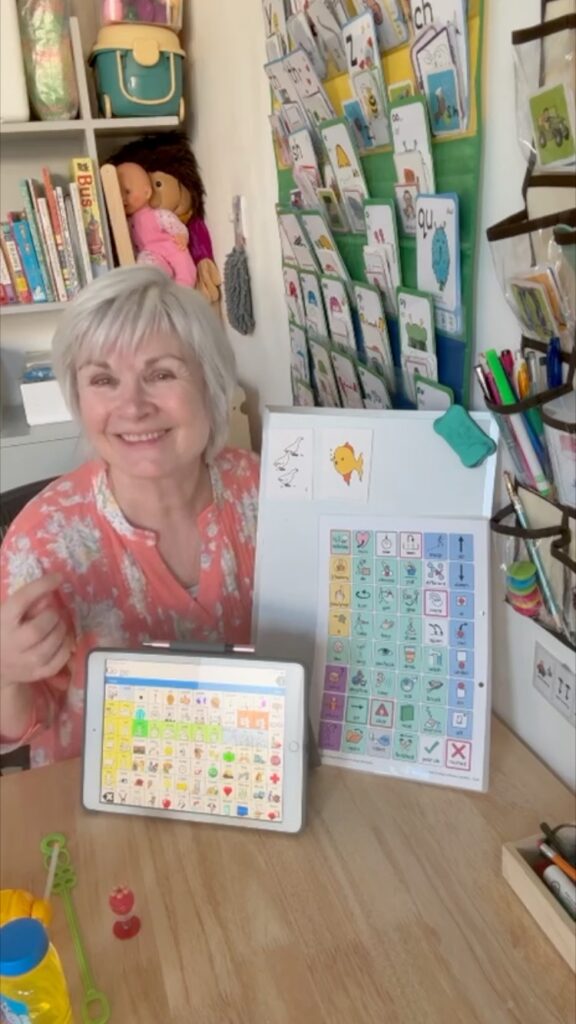
Imagine trying to learn a new language without ever hearing it spoken. It would be incredibly difficult, right? The same principle applies to AAC. Modelling is the single most important strategy for teaching and supporting AAC users. It means actively using the AAC system yourself while talking, demonstrating how to navigate the system and express messages.

Here’s why modelling is so vital:

  • It’s how we learn language: Typically developing children learn language by hearing it constantly around them. AAC users need the same immersion.
  • It reduces pressure: When you model, you’re not asking the individual to communicate, you’re just showing them how it’s done. This takes the pressure off and makes learning more enjoyable.
  • It expands vocabulary and concepts: By modelling a variety of words and phrases, you introduce new vocabulary and demonstrate how to combine symbols to create more complex messages.
  • It demonstrates purpose: Modelling shows that AAC is a functional and effective way to communicate, not just a set of pictures.

So, how do you model? It’s simple: point to the symbols on the communication board or device as you speak the words. For example, if you say, ‘Time to eat breakfast,’ you might point to ‘time’, ‘eat’, and ‘breakfast’ on the board.

Low-tech AAC in action: Everyday activities

Low-tech AAC, such as communication boards, books, or single-page displays, is incredibly versatile and can be easily incorporated into daily routines. These can be as simple as printed pages with symbols, laminated for durability.

Let’s explore how low-tech AAC can be used throughout a typical day, with examples of symbols:

1. Getting ready for nursery

Mornings can be busy, but they also offer rich communication opportunities. A ‘Getting Ready’ communication board can help sequence activities and offer choices.

Activity example:

‘Time to get up!’ (point to GET UP). ‘What do you want to wear today, the blue shirt or the red shirt?’ (point to GET DRESSED) ‘Then, we brush teeth’ (point to TOOTHBRUSH) and so on.

AAC mornings symbol examples

2. Breakfast Time

Mealtimes are perfect for making choices, expressing preferences, and commenting. A ‘Breakfast’ communication board can focus on food items, actions, and social comments.

Example symbols:

AAC meal times symbol examples

Activity example:

‘What do you want to eat for breakfast?’ (point to EAT). ‘Do you want cereal or toast?’ (point to CEREAL or TOAST). If they finish their milk, you could say, ‘Are you ALL DONE or do you want MORE MILK?’ (point to symbols).

3. Catching the Bus

Even routine transitions like catching the bus can be communication rich. A small, portable ‘Travel’ board can be useful.

Example symbols:

AAC catching the bus symbol examples

3. Being on the playground

The playground is a dynamic environment perfect for commenting, requesting actions, and engaging in social play.

AAC playground symbol examples

Activity example:

‘Let’s PLAY!’ (point to PLAY). ‘Do you want to go on the SWING or the SLIDE?’ (point to symbols). If they are on the swing, you can say, ‘Do you want to go FAST or SLOW?’ (point to symbols) and ‘Push AGAIN!’ (point to PUSH) You can also model social language like ‘It’s MY TURN.’

Beyond the symbols: Key takeaways

  • Consistency is key: Use AAC consistently across all environments and with all communication partners.
  • Be patient: Learning a new language takes time. Celebrate small successes.
  • Make it fun: Integrate AAC into play and enjoyable activities.
  • Follow the individual’s lead: Respond to all communication attempts, even if they are imperfect.

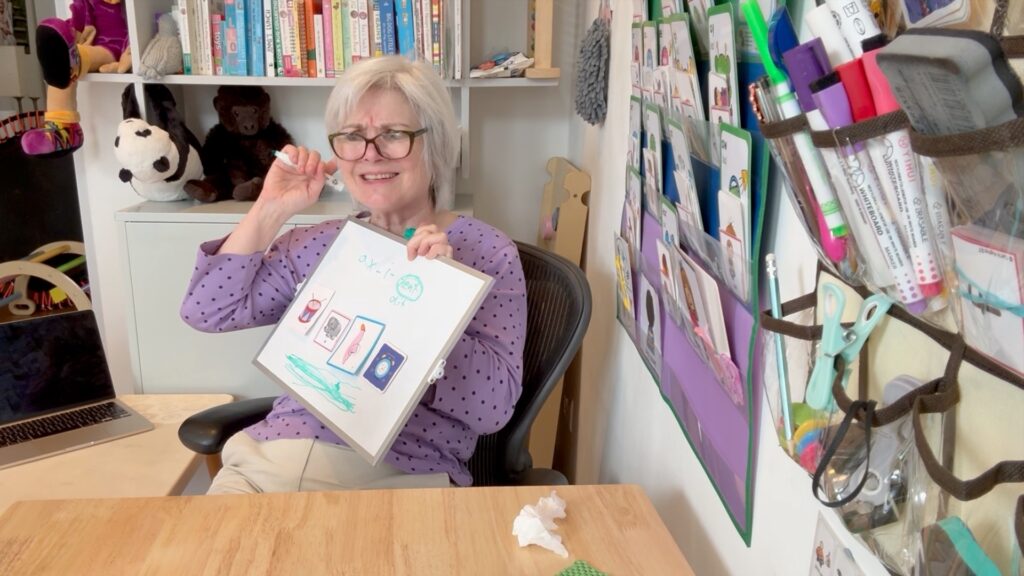
In the video below I model how to integrate AAC into everyday activities with a few more examples and I discuss the difference between AAC and PECS.

If you need some inspiration with using AAC or would like your child assessed for the right type of AAC then please get in touch.

Sonja McGeachie

Highly Specialist Speech and Language Therapist

Owner of The London Speech and Feeding Practice.


Health Professions Council registered
Royal College of Speech & Language Therapists Member
Member of ASLTIP

Find a speech and language therapist for your child in London. Are you concerned about your child’s speech, feeding or communication skills and don’t know where to turn? Please contact me and we can discuss how I can help you or visit my services page.

1

Similar Posts

  • Attention Autism Therapy

    Sonja is kneeling on a multicoloured carpet holding a bucket in one hand and a toy in the other
    Sonja

    Attention Autism” is an Early Years Intervention designed by Gina Davies, Specialist Speech and Language Therapist. Gina created this amazing therapy approach based on her many years of working with children on the autism spectrum. It aims to develop natural and spontaneous communication through the use of highly motivating activities. These activities offer your child an IRRESISTABLE INVITATION to engage and attend to.

    I love using this approach and have trained in all of the stages including the Curiosity Stage which is for another blog. I use it frequently with all children who have trouble attending, listening, sitting or waiting regardless of whether they are neuro-diverse or neuro-typical, this activity and method is so great for all children!!

    Why is it important for our children to attend and listen?

    It is commonly assumed that, as our child has passed their hearing tests he/she will be able to listen and respond to being called, being questioned or asked to do something. However, all children I see in my practice have reduced joint attention skills, which means that whilst their hearing is often good, even brilliant to the point that they can often hear a faint noise somewhere outside the house like a distant train rushing by – but strangely they can’t seem to hear their name being called. Parents often ask me why this is the case, why can my child not turn round when I call him?

    The reason lies in the difference between hearing and listening. Listening is a skill that needs to be learned and practiced. As a child develops, their hearing tunes into (listening) the sounds and noises they hear on a daily basis. This is how a child develops understanding of the speech sounds they hear every day (which then form the basis of their native language); they also get to know “their door bell, dog barking next door, daddy coming up the stairs” and so on. They tune into those common every day sounds and noises and gradually start to copy speech sounds to form words. So listening is tuning our ears to the sounds that surround us. In contrast, many of us have to work in large office spaces or noisy environment, perhaps even a café, etc, where we are able to tune out those environmental noises and sounds that surround us, for otherwise we will not get that report/piece of work done in time! Our focus means that we become single-minded and single-channelled concentrating on our work and so we do not hear people chat and clutter all around us.

    Tuning in and out is a skill that we learn and some of us are better than it that others, it comes largely with practice but also with motivation – I go back to the report that needs doing by end of the day – my motivation is strong and I can now focus and blend out all around me so that I get the work done. Other times when I am not so motivated I might doodle and tune into what is being said at the table next to me, because my focus is not that strongly dedicated to my work.

    Many children who are delayed in their development and especially children on the neuro-diverse continuum have difficulty with tuning in. By contrast, they are very good at being single-minded, single focused on what it is they are wanting/needing to do at any one point. And so they cannot listen to sounds, speech, noises around them very easily at all. They are fully absorbed in their activity and are not able to look and listen to mum/dad calling their name. Once we understand this we can start helping our children to practise tuning in a bit more bit by bit and day by day.

    Enter the Attention Autism approach!

    There are 4 stages to this method:

    Stage 1: The Bucket to Focus Attention

    The first stage involves filling a bucket with visually engaging toys that aim to help children learn how to focus their attention. Three toys will be presented to the child/group one at a time and the therapist will make simple comments about each toy to help introduce them to the children and expand their vocabulary.

    Important to know: the Attention Autism approach does not require the child to look at the adult, or to sustain eye-gaze on the objects. Instead engagement may be indicated by non-verbal signals such as seeming alert and interested, and looking frequently at the object.

    Stage 2: The Attention Builder

    At this stage the child/group is introduced to visually stimulating activities. This stage aims to build and sustain attention for a longer period of time. Activities may include ideas such as:

    • Flour castles which can be built like sandcastles, using flour, a bowl and moulds
    • Erupting volcano activity
    • Wriggly worms foam – pile shaving foam onto an upside down plastic flower pot with the holes taped over; then slowly press down another plastic flower pot over the shaving foam and the foam will come through the top holes looking like wriggly worms, especially if you have dropped a bit of food colouring on top of the foam

    Important: children are not required to make eye contact or sit still during these activities. The focus is on engagement, in whatever way the child demonstrates this.

    Stage 3: The Interactive Game – Turn-Taking and Shifting Attention

    The therapist demonstrates a simple engaging activity and invites children up to have a turn. This may be the same activity from stage 2 or something new. The aim is for children to learn to shift their attention from the group/sitting experience to doing something and then going back to sitting again.

    Stage 4: Individual Activity

    In the final stage of Attention Autism, the adult models an activity, and then each child is given the same equipment to use themselves. They do not have to copy exactly what the adult modelled. The aim is for the child watching to have a go independently with confidence, and then to take their materials back to the leading adult at the end. The activity should be engaging and enjoyable for the children. The Attention Autism approach aims to foster an interest in learning new things and to inspire communication in whatever form works for the child.

    Ideally this should be practised 4-5 times a week aside from the therapy session. But I have seen it work with just 2-3 practice repeats per week. It can be tough in the beginning until your child gets used to the “no touch just look” rule but with a little bit of practice usually children do sit well for the first part of the Bucket activity within about 10 sessions and after that you are on a roll!

    Do get in touch with me if you would like to find out more about this approach! Here is a great link to Gina Davis’s Autism Centre facebook site for more inspiration: https://facebook.com/ginadaviesautism/.


    Find a speech and language therapist for your child in London. Are you concerned about your child’s speech, feeding or communication skills and don’t know where to turn? Please contact me and we can discuss how I can help you or visit my services page.

  • · ·

    Navigating the exciting 9–18 months journey: Your baby’s communication milestones

    Between 9 and 18 months, your little one undergoes a remarkable transformation, blossoming from a curious explorer into a budding communicator. This period is filled with exciting milestones in speech, language, and social development. Let’s delve into what you can expect.

    9–12 months: The world opens up

    Communication takes flight

    • Babbling becomes more complex with a wider range of sounds. By babbling we mean syllables like: pa ga ka ma da and then ‘baba’ gohgoh’. First we hear one and two syllables together and then longer and longer strings! This is so exciting!
    • First words! One day around the 12 months–14 months mark we hear a first word! My older son’s first word was ‘Licht’ which is the German word for ‘light’ as literally every time I carried him along the corridors in our home, I pointed out the light switches to him and turned them off and on a few times. And each time I said ‘Licht!’ and it stuck! PS: sadly I cannot remember what my younger son’s first word was… poor second and third babies they just have to muddle along and call loudly to get noticed!
    • Understanding grows! Baby now understands simple instructions like ‘where is your ball’ and responds by looking to the ball across the room!

    Social butterflies

    • Your baby now starts to show interest in other children, and may try to copy their actions. Now we are getting proper traction with simple social games like peek-a-boo and patty-cake. Whilst your baby is generally interested in other people and children he or she may show separation anxiety when mum or dad or other familiar person suddenly leaves the room and they feel alone with strangers.

    Fine motor skills

    • Pincer grasp develops. This is where your child puts an index finger to the thumb in order to pick up of small objects, hold them and transfer them to either a box, back on the floor or into the other hand.
    • Your baby may start to explore objects by banging, shaking, and mouthing.

    12–15 months: Words are taking shape

    • Language explosion: From our early words we now suddenly see baby’s vocabulary expanding, with new words added each week. I would highly recommend parents keep a little journal of all the words they hear. If nothing else this is a wonderful aide-memoire for years down the road when you might like to reminisce about the first ten words. I promise you otherwise you won’t recall! (especially for second and third babies; I would do this now, had I the time again).
    • Understanding grows:
      • By about 15 months our baby can follow simple two-step instructions like ‘Go get your shoes and bring them here.’
      • Begins to understand the concept of ‘no.’ and that’s a very useful thing. Though before you breathe a sigh of relief… your toddler may well show you that he is understanding a ‘no’ though he may not stop doing what he is doing or come down off the table!
    • Playtime gets interactive:
      • Now we engage in more complex play, such as stacking blocks, pretending to eat with a spoon, and imitating actions.
      • Many toddlers now start showing an interest in picture books.

    15–18 months: Communication blossoms

    • Words combine: Towards 18 months or around about then your toddler may start to put two words together, such as ‘more milk’ or ‘bye-bye dada.’
    • Gestures and sounds: Now we also use gestures to communicate, such as pointing, shaking head ‘no,’ and waving ‘bye-bye.’
    • Exploration and curiosity:
      • Your toddler is now EVERYWHERE! Turn your back and he or she is gone! Your toddler now shows a strong sense of curiosity and explores their environment with enthusiasm.
    • Copying
    • Look out for actions and gestures your toddler will copy such as clapping hands or patting a cushion or banging a spoon on the table .

    Remember

    • Every child develops at his or her own pace.
    • These are just general guidelines, and some children may reach certain milestones earlier or later than others.
    • If you have any concerns about your child’s development, please consult with your speech and language therapist. We are always keen to hear from parents and happy to help promote all those lovely early skills.

    General tips to encourage communication if you feel your child needs a little more help

    • Talk, talk, talk! Engage in frequent chatting with your child.
    • Listen to your child: Allow for periods of silence when playing with your child to allow them to say something or make sounds which you can then copy and respond to.
    • Read aloud regularly. Use books with simple words and pictures.
    • Play interactive games: Hickory Dickory Dock, Row Row the boat, Old McDonalds, 5 little monkeys jumping on the bed, chasing and catching, tickling games.
    • Respond to your child’s babbling and gestures. You can copy them or if your toddler says long strings of babbling you cannot understand you could just say: ‘Oh ok!? ‘yes that’s great!’ ‘who knew!’ ‘wow you’ve got much to say!’ as if you understood.
    • Limit screen time or if your child is very passionate about watching clips then sit and watch with your child so that you can see what is the best bit, which songs they like the best and what sort of phrases they love hearing.

    This exciting period of rapid growth and development is a precious time for both you and your child.

    By providing a loving, stimulating, and responsive environment, you will naturally nurture their communication skills! Any more questions, please get in touch!

    Sonja McGeachie

    Early Intervention Speech and Language Therapist

    Feeding and Dysphagia (Swallowing) Specialist The London Speech and Feeding Practice

    The London Speech and Feeding Practice


    Find a speech and language therapist for your child in London. Are you concerned about your child’s speech, feeding or communication skills and don’t know where to turn? Please contact me and we can discuss how I can help you or visit my services page.

    1
  • · ·

    The picky eater’s plate: Introducing solids to toddlers with ARFID

    Designed by Freepik

    Mealtimes can be a battleground for parents of picky eaters, especially toddlers with Avoidant/Restrictive Food Intake Disorder (ARFID). I see a great number of toddlers with Autism traits and many of my clients are picky eaters from mild to severe. Take a look at my blog for an outline of what the issues are and how to try and help.

    ARFID goes beyond typical ‘picky eating’ and can significantly impact a child’s growth, nutrition, and social-emotional well-being. If your toddler is resistant to trying new foods or has a very limited diet, here are some strategies to navigate the introduction of solids:

    1. Understand ARFID:

    ARFID is a diagnosable eating disorder characterised by:

    • Limited food variety: Eating only a small range of foods, often with specific textures or colours.
    • Fear of new foods: Intense anxiety or aversion to trying unfamiliar foods.
    • Sensory sensitivities: Heightened sensitivity to taste, smell, texture, or appearance of food.
    • Lack of interest in eating: May show little interest in food or mealtimes.

    2. Seek professional guidance:

    • Paediatrician and/or gastroenterologist: Rule out any underlying medical conditions.
    • Registered dietitian: Assess nutritional needs and create a balanced meal plan.
    • Speech and language therapist (SLT): If oral-motor skills or sensory sensitivities are contributing to feeding difficulties.
    • Occupational therapist (OT): If sensory processing challenges are affecting mealtime behaviours.
    • Child psychologist: If anxiety or emotional factors are contributing to ARFID.

    3. Strategies for introducing solids:

    • Start small: Introduce one new food at a time, in small amounts, alongside familiar favourites.
    • Patience is key: It can take multiple exposures (up to 10–15 times!) for a child to accept a new food. Don’t give up!
    • Positive reinforcement: Praise and encouragement for any interaction with the new food, even just touching or smelling it.
    • No pressure: Avoid forcing or pressuring the child to eat. This can create negative associations with food.
    • Make it fun: Present food in playful ways, use cookie cutters for fun shapes, or involve the child in food preparation.
    • Sensory exploration: Encourage exploration of food through touch, smell, and sight before tasting.
    • Role modelling: Show the child that you enjoy eating a variety of foods.
    • Use fun utensils: your child might like characters from ‘Frozen’ or ‘Dinosaurs’ or ‘Diggers’ there are a host of character-based cutlery and cups/plates to be had. Also, I really rate these two items very highly they are so good so I want to share these with you. Both are available online. But warning: the cup is outrageously expensive as it comes from the United States and is sold by a small scale company. But I feel this is cup very worth trying, I have had good results with this.
    • Gradual desensitisation: Start with foods that are similar in texture or taste to accepted foods, then gradually introduce more challenging options.
    • Food chaining: Introduce new foods that are similar in taste, texture, or appearance to accepted foods.

    4. Mealtime Environment:

    • Positive and relaxed: Create a calm and enjoyable mealtime atmosphere.
    • No distractions: Minimise distractions like TV or toys.
    • Consistent schedule: Offer meals and snacks at regular times.
    • Child-sized portions: Offer small, manageable portions to avoid overwhelming the child.
    • Involve the child: Let the child choose their utensils, plate, or cup.

    5. Remember:

    • Every child is different: What works for one child may not work for another.
    • Progress takes time: Be patient and celebrate small victories.
    • Focus on the positive: Praise any positive interaction with food.
    • Seek support: Connect with other parents or support groups.

    Introducing solids to toddlers with ARFID can be challenging, but with patience, persistence, and professional guidance, you can help your child develop a healthier relationship with food.

    Get in touch with me via my contact form if you need support

    Sonja McGeachie

    Early Intervention Speech and Language Therapist

    Feeding and Dysphagia (Swallowing) Specialist The London Speech and Feeding Practice

    The London Speech and Feeding Practice


    Find a speech and language therapist for your child in London. Are you concerned about your child’s speech, feeding or communication skills and don’t know where to turn? Please contact me and we can discuss how I can help you or visit my services page.

    1
  • · · · ·

    Holiday disruptions & New Year routines: How to support your child’s feeding, communication and regulation over the festive season

    Holiday disruptions & New Year routines

    The festive season is a wonderful time for many families, but for children with feeding challenges, sensory differences, or autism traits, December can feel overwhelming. Changes in routine, busier environments, travel, new foods, disrupted sleep, and well-meaning relatives giving ‘advice’ can all affect a child’s feeding, communication and overall regulation.

    As a speech and language therapist specialising in Early Years, I see the same pattern each year: children often make progress during the term, only to struggle in late December when everything becomes unpredictable. The good news? With a bit of preparation, children can not only cope better, but they can actually make significant developmental gains during the holidays.

    This blog will help you feel confident, supported and prepared for the transition from ‘festive mode’ to a smoother, regulated start in January.

    1. Why routines matter so much. Especially now

    Young children thrive on predictability. For neurodivergent children or those with sensory, feeding or communication needs, routine isn’t just helpful: it’s the backbone of emotional regulation.

    In December, typical patterns change:

    • Mealtimes shift or become irregular
    • Bedtime slides
    • New foods appear
    • Loud social gatherings overwhelm
    • Travel disrupts naps and comfort routines
    • Therapies pause
    • Childcare closes

    Any one of these can lead to feeding refusals, more meltdowns, increased stimming, reduced communication attempts or regression in speech sounds.

    It’s simply the nervous system responding to too much change.

    2. Protecting feeding progress during holiday mealtimes

    My last blog and insta post have a nice social story on festive meals. They are often the trickiest part of the season for families I support. Children with sensory-based feeding challenges, or ARFID traits may find holiday foods completely unfamiliar and challenging.

    What helps:

    • Offer one ‘safe food’ at every meal
    • Keep portion sizes tiny
    • Use the ‘buffet rule’
    • Rehearse tricky moments

    3. Supporting communication when routines are disrupted

    Holiday time actually offers more opportunities for communication, just in different ways.

    Strategies:

    • Slow down and follow your child’s lead
    • Use everyday routines as language opportunities
    • Keep AAC going even if casually

    4. Understanding holiday ‘regressions’ and know they’re temporary

    This is almost always due to nervous system overload. Children don’t truly ‘lose’ skills; they temporarily prioritise regulation over learning.

    5. A gentle January reset: How to start the New Year smoothly

    • Re-establish predictability early
    • Return to preferred foods
    • Book early support if needed
    • Focus on regulation first

    Sonja McGeachie

    Highly Specialist Speech and Language Therapist

    Owner of The London Speech and Feeding Practice.


    Health Professions Council registered
    Royal College of Speech & Language Therapists Member
    Member of ASLTIP

    Find a speech and language therapist for your child in London. Are you concerned about your child’s speech, feeding or communication skills and don’t know where to turn? Please contact me and we can discuss how I can help you or visit my services page.

    Reference:

    Bronson, M. (2000). Self-regulation in early childhood. Guilford Press.

    2
  • ·

    Transforming Mealtimes

    Speech Therpaist in London

    Transforming Mealtimes

    Below are two reviews I got from grateful clients over the past 4-6 weeks; this blog is more about how Feeding Therapy can help you than blowing my own trumpet…. though that said, it is always so nice and gratifying to hear when parents are happy and hopeful about their little one’s feeding journey. Feeding Therapy is a substantial part of my work as a Children’s Speech and Language Therapist. One of my specialist subjects is Autism and we find that many children on the Autism Spectrum are very specific about eating, and will often refuse a range of typical family foods in favour of a narrow range of foods/snacks.

    Mostly, feeding difficulties are a combination and complex cocktail of factors that have contributed to the current status quo: sure, there may have been some physical problems to start off with, such as reflux causing the baby discomfort, constipation, a very tight tongue tie or a swallowing problem caused by neurological difficulties and of course sensory processing difficulties are also very physical experiences. We always begin with a very thorough case history taking and information gathering, followed by an oral assessment and observation of the actual swallow to establish what might have been – or still might be – the cause for the feeding difficulties.

    In most of the cases I see in my practice, the original obvious cause is no longer present, especially with older children. So, if the swallowing is fine, the reflux is no longer present, the tongue was divided (twice!) why are they still not eating much, refusing to try new foods, only accept certain textures etc.

    The answer is extremely complex and multi-faceted and this little blog is not covering any factors in detail (we would be here all night) -I mentioned sensory processing difficulties earlier on. These are mostly still present but often not acknowledged or recognised by parents. And it is certainly the case that one of the contributors is parental anxiety; this tends to run very high and has been for many months, sometimes years. This in turn often leads to very tense and unpleasant, endlessly long meal times and many times children are force-fed several times a day in order to “get something down there” as otherwise they would probably starve themselves.

    Additionally, parents end up only offering a very narrow range of foods because that is all their child will eat. This ends up in a vicious cycle of children being fed porridge-style food for all meal times and of course they won’t progress to more mature foods if these mature foods are never on offer.

    In order to help address and disentangle some of the issues I often introduce the “Division of Responsibility in Feeding” as researched and recommended by Ellyn Satter (The Satter Feeding Dynamics Model)

    Here are the main points of her approach:

    Children have a natural ability with eating, they eat as much as they need and they grow in the way that is right for them and they learn to eat what their parents eat. (E Satter). The parent is responsible for WHAT the child eats, WHERE and WHEN the child eats. The child is responsible for HOW MUCH they eat or WHETHER to eat. Satter proposes that parents should guide their child’s transition from nipple feeding through semi-solids, then thick and lumpy foods to finger foods and then on to normal family meals.

    Please note: this model is only appropriate for children where the original physical cause is no longer present!

    Of course it’s not easy! It requires a huge shift in thinking about feeding and it requires to trust our children to know what is best for them. This is very big for most parents, as it is not how we were brought up and it is not commonly known that babies and children know what is good for them!

    However, it is certainly true that parents who follow this particular approach and make small, steady changes in the way the offer foods, and in the way they create family meal times differently, children make very nice, pleasing progress and over some months we often see remarkable positive changes.

    I like to work in a team and especially for this type of problem it is essential to have a multi-disciplinary approach. A knowledgeable dietician is an enormous plus in any feeding team as is of course a

    Paediatrician and/ or a Gastroenterologist and the most important people in the team are the parents!

    Feeding Therapy is all about collaboration and a ‘team around the child” approach. When we have this in place and there is trust amongst the team members then we make fantastic progress.

    Do get in touch with me if you would like some help with your tricky feeder.

    Lovely Reviews

    I visited London Speech and Feeding a couple of days ago with my 8-month-old granddaughter and her mother. Sonja made us feel comfortable and at ease from our first introductions. She was able to pinpoint my granddaughter’s mum’s anxiety around weaning very quickly. She not only gave her the tools to do this successfully, but also really encouraged my granddaughter’s mum and instilled confidence that she had everything she needed to make this sometimes-difficult transition without further anxiety.

    Sonja was very thorough in her initial assessment of my granddaughter’s physical milestones and her developing speech. My granddaughter felt very comfortable with Sonja and happily played along with her. Then came the big moment – trying out various foods! We were amazed to see just how easily my granddaughter, with Sonja’s expert encouragement, took to sampling the wonderful array of different delicious morsels Sonja had prepared for the session. My granddaughter even drank from a cup for the first time! Wonderful!

    Sonja then emailed a summary of the session and an extensive array of resources with suggestions for my granddaughter’s mum which she has now put into action. My granddaughter’s mum couldn’t thank Sonja enough for her caring attitude, extensive knowledge, and warm professionalism. I have no hesitation in recommending Sonja, she’s a fantastic Feeding Therapist!

    Sonja (and her lovely colleague, Sandra) were stupendous. I had brought my one-year-old son to see them as I was concerned that he wasn’t eating enough. They looked at his history and we ate together to make sure they had all the information they needed to give an accurate diagnosis. Whilst our outcome was that Henry was in fact doing brilliantly (and I just needed to chill out a bit!), I would imagine if there was something more serious going on, Sonja would make you feel just as supported and empowered as she did with us. Excellent follow-ups too. Money well spent for a bit of reassurance for a stressed out mama. Thank you, Sonja!


    Find a speech and language therapist for your child in London. Are you concerned about your child’s speech, feeding or communication skills and don’t know where to turn? Please contact me and we can discuss how I can help you or visit my services page.
  • Explore 12 questions to determine whether your child may be Autistic

    A young boy is in the foreground and has turned his head away from the woman sitting next to him.
    May your child be autistic?

    As professionals, when diagnosing young children with an Autistic Spectrum Condition, it is vital we work as a multi-disciplinary team, so you will likely see many professionals. This may include Educational Psychologist, Dietician, General Practitioner, Occupational Therapist, Paediatrician, Special Educational Needs Coordinator, Speech and Language Therapist and Social worker. Once the evidence is collated, then a diagnosis may be made.

    You may be wondering what are some of the early signs of social communication difficulties? Whilst no autistic child is the same and we know Autism is very much a very wide spectrum of abilities and needs there are some autistic spectrum characteristics we do typically see in the early years of childhood. You may wish to think about these areas or presentations to help you prepare for the Speech and Language Therapy appointment.

    Twelve questions

    1. Does your child respond to their name?
    2. Are they fixated with watching their hands?
    3. Do they have sensory processing difficulties such as bright lights, food textures, or loud noises?
    4. Are they meeting their milestones or are they delayed?
    5. Do they flap their arms or legs when excited?
    6. Have you noticed any rocking back and forth?
    7. Do they blink excessively or display any facial tics?
    8. Do they play with a particular sort of toy e.g. spinning toys?
    9. Have you noticed that they lack interest in toys?
    10. Have they regressed in their language? Perhaps you’ve noticed they are not using words that they have previously learnt.
    11. Do they use gestures to communicate their needs? How do they communicate their wants and needs?
    12. Do they appear to be in their own world?

    You are not alone

    These questions are by no means exhaustive and there are many more factors to consider. But it is important to trust your instincts as you are the expert on your child and know your child the best. Regardless of whether you see all of the above points or none, do not hesitate to have an assessment if you are concerned as, even if it turns out to be nothing to worry about, there is always at least one or two great pieces of advice I can offer you on the way and you will leave feeling hopeful and empowered. It’s always best to seek early intervention with communication difficulties. This allows strategies and support to be put in place. Never feel alone, always speak out.

    Find communication support here from me, Sonja, (Specialist Speech and Language Therapist)


    Find a speech and language therapist for your child in London. Are you concerned about your child’s speech, feeding or communication skills and don’t know where to turn? Please contact me and we can discuss how I can help you or visit my services page.