There is more than one way to model communication: Using speech prompts, signs, and AAC together in therapy
|

One of the most important things I have learned as a paediatric speech and language therapist is this:

Children do not all learn communication in the same way.

Some children learn best through listening.
Some need visual support.
Some need movement and gesture.
Some benefit from symbols or technology.
And many children need multiple supports together before communication truly starts to develop.

That is why flexible, responsive therapy matters so much.

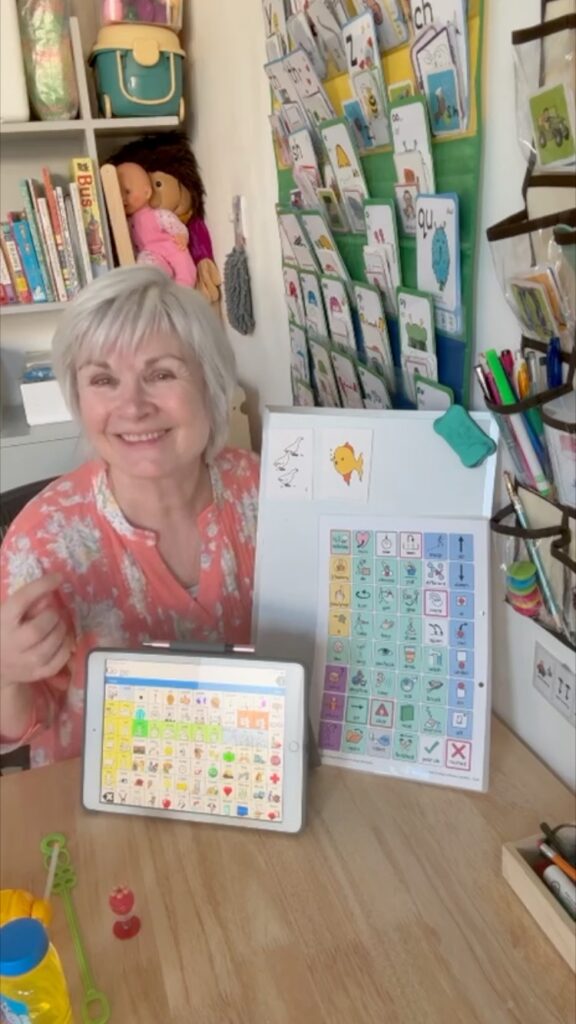
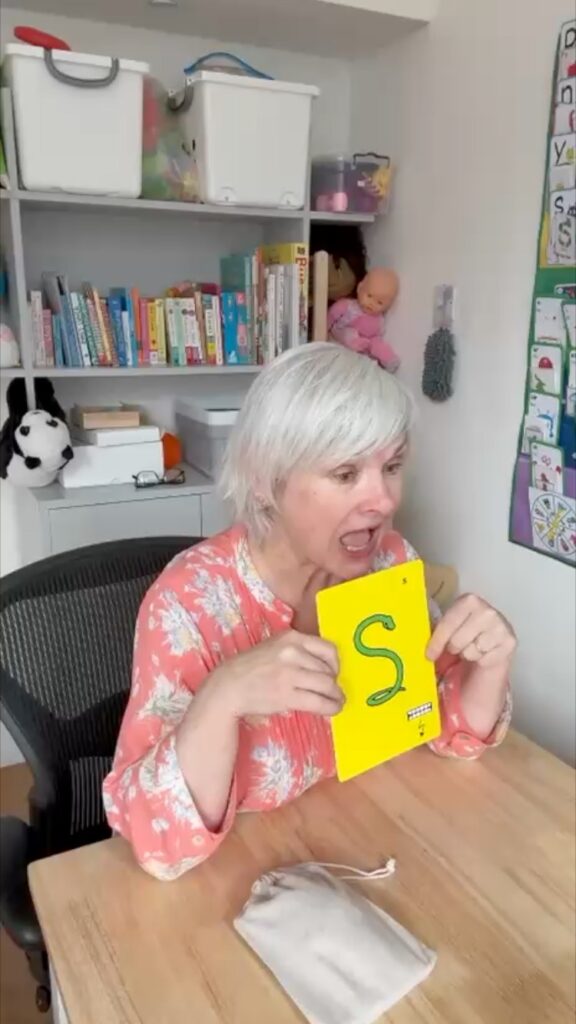
In this short therapy clip, I model just two simple words:
‘Go’ and ‘Up’.

But underneath those tiny moments is a combination of therapeutic strategies:

  • speech sound prompting
  • visual cueing
  • Makaton signing
  • AAC (Augmentative and Alternative Communication) modelling
  • repetition
  • motor planning support
  • language modelling
  • total communication principles.

Communication is bigger than speech alone

One of the biggest misconceptions about speech therapy is the idea that communication only ‘counts’ if a child says the word verbally.

In reality, communication comes in many forms:

  • speech
  • gesture
  • facial expression
  • signing
  • pointing
  • symbols
  • body language
  • AAC.

This is particularly true for children with:

  • developmental language disorder (DLD)
  • autism
  • motor speech difficulties
  • childhood apraxia of speech (CAS)
  • phonological difficulties
  • global developmental delay
  • complex communication needs.

These children often need communication to be presented through multiple pathways at once.

That is where total communication approaches become so powerful.

This is important to know: this does not confuse children. In fact, for many children, it does the opposite. It creates clarity.

Careful sound prompting helps bridge that gap.

Research and clinical experience consistently show that signs often support spoken language development rather than hinder it.

Research suggests that learning signs alongside spoken language does not hinder speech development and may support overall language acquisition, communication confidence, and vocabulary growth in many children.

For many children, signs actually help speech emerge because they:

  • reduce communication pressure
  • build confidence
  • strengthen understanding of words.

A child who can successfully communicate is far more likely to keep attempting interaction.

The power of AAC and LAMP Words for Life

In the clip, I also model language using an electronic AAC system: LAMP Words for Life.

AAC stands for Augmentative and Alternative Communication.

AAC includes any tool that supports communication beyond speech alone, including:

  • picture systems
  • symbol boards
  • communication books
  • speech-generating devices.

LAMP Words for Life is one of my favourite AAC systems because it focuses on consistent motor patterns and meaningful language development. Because communication is not about achieving perfection. It is about connection.

And when children are given multiple ways to express themselves, they often become more confident, more engaged, and more willing to interact with the world around them.

That is the true power of total communication therapy.

Contact me via my contact form if you would like me to work with your child.

Sonja McGeachie

Highly Specialist Speech and Language Therapist

Owner of The London Speech and Feeding Practice.

Reference

Pontecorvo, Elana & Higgins, Michael & Mora, Joshua & Lieberman, Amy & Pyers, Jennie & Caselli, Naomi. (2023). Learning a Sign Language Does Not Hinder Acquisition of a Spoken Language. Journal of Speech, Language, and Hearing Research. 66. 1291-1308. DOI 10.1044/2022_JSLHR-22-00505.

Health Professions Council registered
Royal College of Speech & Language Therapists Member
Member of ASLTIP

Find a speech and language therapist for your child in London. Are you concerned about your child’s speech, feeding or communication skills and don’t know where to turn? Please contact me and we can discuss how I can help you or visit my services page.
3

Similar Posts

  • Learn the benefits of Cycles Phonology Approach in Speech Therapy

    A grey, green and orange circle overlaid with Cycles Phonological Approach
    Cycles Phonogogical approach

    When your child attends Speech and Language Therapy, it can look like your child’s therapist is playing. Therapy needs to be fun, which means carrying out therapy through the medium of play. But remember every approach used has evidence behind it. We need to know that therapy will be successful, so an evidence-based approach is essential.

    One of the approaches used for Speech Therapy (i.e., working on speech sound production) is the Cycles Phonology Approach. This approach focuses on the patterns and processes rather than each individual sound. For example, it may be working on final consonant deletion, so the omission of the final sound in words. As Speech and Language Therapists we understand that children can get frustrated and fatigued working on the same sound every day. This approach attempts to solve that. Hodson suggests, the approach is also useful for children with more speech sound errors, as therapists see progress in areas not targeted.

    How does the Cycles Phonology Approach work?

    Your Speech and Language Therapist will assess your child’s speech development and will then analyse the results. They will also look for which sounds they can produce with support (this is called stimulability). They will analyse patterns in the results and will formulate a plan.

    The Cycles Phonology Approach intervention allows your child to work in blocks. This might mean they work for half a week for 30 minutes on (e.g., clusters). Then the next half they’ll work for 30 minutes on a different process (e.g., omission of sounds at the end of words).

    Research has found that the following error patterns respond well to this approach:

    • Syllables (identifying the different parts in a word e.g., “ae-ro-plane”)
    • Final Consonant deletion (omission of the final sound e.g., “ca” instead of “cat”)
    • Initial consonant deletion (omission of the first sound e.g., “at” instead of “cat”)
    • Fronting (instead of making a sound at the back of the mouth, it’s made at the front e.g., “tatinstead of “cat)
    • Backing (instead of making a sound at the front of the mouth, it’s made at the back e.g., “guninstead of “bun)
    • S blends (e.g., “sl, sm, sn, sk, sw”)
    • Gliding of liquids (e.g., “lellow instead of yellow”, “wabbit instead of rabbit)

    What does a Speech and Language Therapy session look like when using the Phonology Cycles Approach?

    The format of the session remains the same for whichever speech sound pattern your child is working on. Your child’s Speech and Language Therapist will review the previous session. Then they will use an activity to work on your child hearing the sound several times (this is called ‘auditory bombardment’). Then your child will practise saying the sound. Next, the Speech and Language Therapist will check if your child can say any of the sounds which they haven’t been able to produce before, with support. This is called a stimulability check. After this, your child will take part in an activity which builds their awareness of sounds in words (such as a rhyming or syllable activity). The session will finish with another auditory bombardment task (i.e., hearing their tricky sound repeatedly).

    I will give you advice for practising at home, as it’s vital that your child learns in the correct way. We aim for 100 turns in therapy sessions, so it’s vital your child is motivated.

    Contact me to improve your child’s speech sounds and improve their confidence when talking.


    Find a speech and language therapist for your child in London. Are you concerned about your child’s speech, feeding or communication skills and don’t know where to turn? Please contact me and we can discuss how I can help you or visit my services page.

    1
  • Empty Set and Phonology approaches

    I have been avoiding the use of the Empty Set approach for the longest time as I was not sure if it would work seeing that I am challenging two sounds my student struggles with at the same time. But I decided to give it a go and it works a treat!

    With this approach, we use two sounds that our student is struggling with. For example, in my video this student cannot produce /sh/ and /r/. Both sounds have different rules, so I decided to contrast them with each other.

    • The rules of /sh/ are: no voice, air is pushed out through teeth, produced at the front.
    • The rules for /r/ are: use your voice, produce the sound in the middle of the mouth by shaping your tongue in a particular way.

    So I chose the words ‘shoes’ and ‘ruse’ as their rules are quite different. Contrasting two sounds the student does not know has been shown to lead to greater change in the child’s articulation. And I can certainly vouch for this as my student is making the best progress with this approach.

    Phonology Therapy – what is it, why and how?

    Phonology is the study of the sound system of a language. It’s distinct from articulation therapy which focuses on the physical production of sounds.

    Phonology therapy focuses on rules. For example, sounds that are produced at the front of the mouth, in contrast to sounds that are produced at the back of the mouth, or sounds that are produced with a long air stream: /s/ or /f/ versus short sounds like /p/ or /t/; sounds are produced with voice or without voice.

    Many children, and sometimes adults, are unaware of some of the speech rules and confuse and replace individual sounds. They might say TAT instead of CAT or SIP instead of SHIP.

    A quick overview of phonology approaches I use:

    Minimal Pairs:

    This approach is good for single sound substitutions. We offer word pairs that differ by only one sound, like ‘ship’ and ‘sip.’ One of our first goal in therapy is to highlight the difference between the target sound (e.g., /sh/) and the sound the child uses (e.g., /s/). This helps discriminate and eventually produce the correct sound.

    Multiple Oppositions:

    A child might replace lots of sounds with a single sound like a /d/. So instead of ‘four’, ‘chore’ and ‘store’ our child says ‘door’, making speech very unintelligible.

    The approach is typically geared towards shaking up the phonological system. Our goal is to choose two to four targets that are different from each other, and different from the substituted sound. If our child’s favourite sound is /d/ they can use their voice and make a short sound by stopping their airflow. So I will choose a different target sound to change up the speech system. For example I might choose an /f/, a /m/ and a /k/ sound. So I would contrast: ‘door’ with ‘four’, ‘more’ and ‘core’.

    Maximal Oppositions:

    In the Maximal Oppositions approach the treatment sets consists of words that are minimally contrasted and that have maximal or near maximal feature differences between each word pair. One word in a pair represents a sound the child ‘knows’ (can say at word level) and the other represents a sound the child does not know (cannot say).

    For example, a child may ‘know’ /m/ and be able to say words like ‘man’, ‘mat’ and ‘mine’. However, the same child may be unable to say /f/ as in ‘fan’, ‘fat’ and ‘fine’. The consonants /f/ and /m/ are maximally opposed as follows.

    I am always delighted to work on speech sound disorders, I love the challenge and the successes we can celebrate together. Get in touch with me!

    Sonja McGeachie

    Early Intervention Speech and Language Therapist

    Feeding and Dysphagia (Swallowing) Specialist The London Speech and Feeding Practice

    The London Speech and Feeding Practice


    Find a speech and language therapist for your child in London. Are you concerned about your child’s speech, feeding or communication skills and don’t know where to turn? Please contact me and we can discuss how I can help you or visit my services page.

    1
  • · ·

    The power of containment: A therapeutic approach for autistic children

    Photo by lemonlenz

    The practice of wrapping or swaddling children, often referred to as ‘containment,’ has been used for centuries to soothe and comfort infants. I use this therapeutic approach with autistic children at the London Speech and Feeding Practice. While it might seem counterintuitive, the act of being tightly wrapped can provide significant benefits for children who struggle with sensory processing, emotional regulation, and communication.

    Understanding sensory processing and autism

    Autistic persons often experience challenges with sensory processing, which is their brain’s ability to interpret and respond to sensory information. This can lead to sensory overload or under-responsivity. Containment can be a valuable tool in helping children regulate their sensory input.

    Photo by lemonlenz

    To summarise, here are some of the benefits of containment:

    • Sensory Regulation:
      • Provides deep pressure input: The tight, enveloping sensation of being wrapped can provide deep pressure input, which is calming and organising for many children.
      • Reduces sensory overload: By creating a controlled sensory environment, containment can help to reduce overstimulation and promote a sense of safety.
    • Emotional Regulation:
      • Containment creates a sense of security: Being wrapped tightly can mimic the feeling of being in the womb, providing a sense of security and comfort.
      • Facilitates calming: The deep pressure input can help to calm the nervous system and reduce anxiety.
    • Improved Body Awareness:
      • Enhances proprioception: Containment can improve the child’s awareness of their body in space, which is essential for motor development and sensory integration. I often provide extra pressure on a child’s arms and legs sticking out of the yoga mat; this helps my child understand where their limbs are in space: I can feel my legs and I can feel my arms and I can feel where they are right now, i.e. they are under Sonja’s hand, I can feel them.
    • Facilitates Communication – and this is obviously where I come in as a Speech and Language Therapist:
      • Swaddling creates a safe space: When a child feels calm and secure, they are more likely to engage in communication.
      • Enhances joint attention: The shared experience of being wrapped can foster joint attention, which is essential for language development. You can see this one in my highlights where I swaddle my student in the yoga mat (picture above). She absolutely loves it, and what is more she is calm and steady when usually this child likes to be on the move constantly. Here we have a wonderful moment of joint engagement. She looks at me, she can listen to what I say or sing, and she can tell me in her own way to carry on rolling her or to carry on singing or providing calming pressure to her legs and arms or to stop.

    A few pointers for when you try this at home: How to practise containment safely and effectively

    • Create a safe environment: Ensure the wrapping material is soft, breathable, and free from any hazards.
    • Observe your child’s cues: Pay attention to your child’s body language and verbal cues to determine their comfort level.
    • Respect your child’s boundaries: If your child shows signs of distress, stop the containment immediately – this might seem obvious but sometimes we adults get so carried away with some ‘great idea’ that we have seen work elsewhere. And so we can be a little too ‘determined’ sometimes to ‘make it happen’… perhaps this rings a bell with some of my readers.
    • MAKE IT FUN: Start carefully and take it step by step. See if the student is having a nice time. It is all about trust and therefore it might not work the very first time you do it.

    It’s important to remember that containment is not a one-size-fits-all approach. Some children may respond better to other sensory-based interventions. However, for many autistic children containment can be a valuable tool in their journey towards improved communication and emotional regulation.

    For more information follow me on Instagram, Facebook or LinkedIn.

    Sonja McGeachie

    Early Intervention Speech and Language Therapist

    Feeding and Dysphagia (Swallowing) Specialist The London Speech and Feeding Practice

    The London Speech and Feeding Practice


    Find a speech and language therapist for your child in London. Are you concerned about your child’s speech, feeding or communication skills and don’t know where to turn? Please contact me and we can discuss how I can help you or visit my services page.

    1
  • · · ·

    The joy of container play: Exploring play development and understanding of how things work

    Have you heard the term ‘Container play’? I use this very often with children in my sessions as it is so versatile and an enjoyable activity that can be done in parallel with a child or together. Container play is a powerful tool for fostering development in young children, especially those with developmental delays. This seemingly mundane activity provides a rich environment for sensory exploration, motor skill development, and cognitive growth.

    What is container play?

    Container play involves children interacting with various containers—boxes, buckets, bowls, cups, various bags, etc.—and filling, emptying, and transferring objects within and between them. Objects can include literally anything: small beads, bead chains, table tennis balls, wooden pegs, dinosaurs or any other little person toy, blocks of varying sizes, sand, water, or any other safe material. Larger containers obviously take larger items: socks, stuffed animals, bigger balls, bigger blocks etc really the choices are endless.

    Benefits for children with developmental delays:

    Sensory exploration:

    • Touch: Children explore different textures and temperatures of containers and objects.
    • Sight: They observe how objects look inside and outside the containers, how light reflects off them, and how colours change.
    • Sound: They listen to the sounds of objects clinking, rattling, and splashing.
    • Proprioception: Filling and emptying containers helps develop body awareness and spatial awareness.

    For neurodivergent children who might have sensory regulation difficulties, consider the following adaptions to accommodate your child’s sensory needs:

    • Over-stimulation: For children who are easily overstimulated, start with simple setups using a limited number of containers and objects. Gradually increase the complexity as they tolerate it.
    • Under-stimulation: For children who seek sensory input, provide a variety of textures and materials, such as sand, water, slime, or beans.
    • Temperature: Offer a variety of temperature options. Some children may enjoy warm water or cool sand.
    • Lighting: Adjust the lighting to create a calming or stimulating environment.
    • Focus on one sense at a time: Initially, focus on one sensory aspect, such as the feel of sand or the sound of water.
    • Weighted containers: Use heavy containers filled with rice or beans to provide deep pressure input.
    • Fidget toys: Incorporate fidget toys into the activity to provide sensory input and help with self-regulation.
    • Tactile exploration: Encourage exploration of different textures using objects with varying surfaces.

    Fine motor skill development:

    • Hand-eye coordination: Scooping, pouring, and transferring objects require precise hand-eye coordination.
    • Pincer grasp: Picking up small objects helps develop fine motor skills like the pincer grasp.
    • Strength and dexterity: Manipulating containers and objects strengthens hand muscles and improves dexterity. Opening and closing containers can be a huge area of interest; how does the top screw back on, or off?

    Cognitive development:

    • Cause and effect: Children learn that their actions (e.g., pouring water or sand) have consequences (e.g., the water spills).
    • Spatial awareness: They develop an understanding of concepts like inside, outside, full, empty, and over/under; also how big is the vessel and how much goes in before it’s full or spills over. How small is the vessel opening and what do I need to do to get the beads into the container.
    • Problem-solving: Children learn to solve problems, such as how to get an object out of a narrow container or how to transfer water without spilling.

    Social and emotional development:

    • Communication: Container play can encourage communication as children interact with others, sharing toys and commenting on their actions. Asking for help to open and close a container is often a great opportunity to practise ‘help me’ or ‘open it’
    • Turn-taking: Sharing containers and materials helps children learn to take turns and cooperate.
    • Sensory regulation: For children with sensory sensitivities, container play can be a calming and self-regulating activity.

    Tips for engaging children in container play:

    • Create a safe and inviting environment. A shower curtain on the floor makes things easier for tidy up afterwards. And it allows for spillages.
    • Provide a variety of containers: Use different sizes, shapes, and materials. Use containers that are visually interesting and pleasing, perhaps a festive biscuit tin, or a tin that looks like train engine. Use see-through containers at first which make the filling and emptying more obvious. This is important for children who have no previous experience with this type of play and need to ‘warm up’ to it. Once a child loves and is used to container play you can go wild with all types of containers.
    • Offer a variety of objects: Include balls, blocks, sand, water, and other age-appropriate materials.
    • Join in the fun! Start off the process, show your child what the joy of the activity is for yourself, how fun it is to fill and empty containers, provide enough containers for your child to start playing alongside you, and comment on their actions.
    • Follow your child’s lead: Allow them to explore and experiment at their own pace.
    • Adapt activities: Adjust the level of challenge based on your child’s abilities and interests.

    Container play is a simple yet powerful tool that can support the overall development of young children, especially those with developmental delays. By providing a rich and engaging sensory experience, container play can help children build essential skills in motor, cognitive, social, and emotional domains.

    If you have any questions or would like to have more in-depths demonstration of this or other play styles for your child please contact me.

    I look forward to hearing from you.

    Sonja McGeachie

    Early Intervention Speech and Language Therapist

    Feeding and Dysphagia (Swallowing) Specialist The London Speech and Feeding Practice

    The London Speech and Feeding Practice


    Find a speech and language therapist for your child in London. Are you concerned about your child’s speech, feeding or communication skills and don’t know where to turn? Please contact me and we can discuss how I can help you or visit my services page.

    1
  • · ·

    Your child’s communication journey

    Understanding our neurodiversity-affirming, child-led approach

    Welcome to a different kind of therapy!

    Your child’s communication journey

    The start of a new year often brings fresh hope, and sometimes fresh worries, for parents supporting their child’s communication. I am always genuinely excited to begin a new journey with children and their families, and I know that, for many parents, this kind of therapy may look very different from what they were expecting.

    Parents (and children!) are often surprised to discover that our sessions are playful, joyful, and intentionally low-pressure. You won’t see demands for eye contact, sitting still, or being told to ‘do it this way’ or ‘put the red square there’. Instead, you’ll see your child being met exactly where they are.

    For families who have previously experienced more adult-led or behaviour-based approaches including Applied Behaviour Therapy, this difference can feel unfamiliar at first. Because of that, I want to take a moment to prepare you for what child-led, neurodiversity-affirming therapy looks like, so you can feel confident, comfortable, and reassured from day one.

    Why doesn’t child-led therapy look like ‘traditional’ therapy?

    Many people picture speech and language therapy as sitting at a table, using flashcards, or practising words through repetition. While those approaches can work well for some children, they are often not effective or appropriate for many neurodivergent children—including children with autistic profiles, ADHD, or demand-sensitive nervous systems.

    Our approach is grounded in a simple and powerful truth:

    Children learn best when they feel safe, motivated, and emotionally connected.

    When a child’s nervous system feels calm and secure, learning becomes possible. When a child feels pressured or controlled, communication often shuts down, even if they can speak.

    🎯 Our purpose: Communication through connection

    Our goal is not simply to help your child say more words. Our goals go deeper and are built on strong foundations:

    • Trust and regulation: We focus on building a trusting relationship where your child feels safe, understood, and emotionally regulated. A calm nervous system is the starting point for all communication.
    • Motivation: We follow your child’s intrinsic motivation, the things they naturally enjoy to make communication meaningful, joyful, and purposeful.
    • Spontaneous communication: We create opportunities for your child to communicate because they want to, not because they are asked or instructed to.

    🧸 What to expect in a session

    Our sessions are intentionally child-led and often look very much like play.

    FeatureWhat it looks likeWhy we do this
    Minimal toysWe usually offer just 3–4 carefully chosen activities (such as bubbles, blocks, or sensory play).Less is more. Fewer choices reduce overwhelm and help children focus on what genuinely interests them.
    Child choosesYour child decides what to play with and how to engage.This immediately establishes us as a safe, non-demanding partner and increases motivation.
    The therapist’s roleWe join your child’s play, observing closely and responding naturally.We model language, share attention, and reflect your child’s experiences in a way that feels natural and supportive.
    No pressure or demandsThere are no ‘must-do’ tasks. If your child wants to spin, crash, line up toys, or repeat an activity, we follow.Reducing demands lowers anxiety and supports communication, particularly for children with demand-sensitive profiles.

    Is this really effective?

    It’s completely natural to wonder, ‘Are they just playing?’ The answer is yes, and very intentionally so.

    Our sessions are guided by nearly 30 years of speech and language therapy experience, alongside clear, achievable goals tailored to each individual child. Play is a child’s natural language and their most powerful learning tool.

    Within play, we are constantly creating opportunities to:

    • Build joint attention (sharing focus and interest)
    • Model language at the right level
    • Encourage back-and-forth communication
    • Develop a deep, authentic connection

    If your child has struggled to engage or communicate in more structured or demand-heavy settings, this child-led approach is often the key to unlocking their potential.

    💛 What this might look like at home

    You may notice that when pressure is reduced:

    • Your child begins communicating more during everyday routines
    • Language emerges through play, movement, or shared enjoyment
    • Communication feels more natural and less forced

    Small moments could be a shared smile, a look, a sound, a gesture. All matter. These are the building blocks of meaningful communication.

    📚 Resources for parents

    If you’d like to explore these ideas further, you may find the following helpful:

    I look forward to meeting you and your child. Please bring any questions, uncertainties, or curiosities to our first session, there is no such thing as a silly question. This is a journey we take together. Contact me via my contact form.

    Sonja McGeachie

    Highly Specialist Speech and Language Therapist

    Owner of The London Speech and Feeding Practice.


    Health Professions Council registered
    Royal College of Speech & Language Therapists Member
    Member of ASLTIP

    Find a speech and language therapist for your child in London. Are you concerned about your child’s speech, feeding or communication skills and don’t know where to turn? Please contact me and we can discuss how I can help you or visit my services page.
    3
  • · ·

    My child is hard to understand at school age. Should I be concerned?

    Many parents notice speech errors when their children are toddlers. At that stage it often feels quite normal. Young children are still learning the sounds of their language, and those early mispronunciations can be very endearing.

    But as children grow older, parents sometimes begin to wonder:

    ‘Should my child still be speaking like this?’

    A common concern I hear from families is that their child is still difficult to understand even after starting school. Sometimes it is a parent who notices it first. Other times it is a teacher who gently mentions that classmates occasionally struggle to understand what a child is saying.

    When this happens, parents naturally wonder whether it is something their child will grow out of, or whether some extra support might help.

    When should children’s speech be clear?

    Children learn speech sounds gradually over several years. Some sounds develop earlier, while others take longer to master.

    By the time children reach five to six years of age, most of their speech should be clear enough for unfamiliar adults to understand. There may still be a few tricky sounds developing (such as /R/ or /TH/), but overall speech should be fairly easy to follow.

    If a child is frequently difficult to understand at school age, it can sometimes indicate that a speech sound difficulty has persisted beyond the stage when it would normally resolve on its own.

    Why some children remain hard to understand

    There are several reasons why speech clarity may still be developing in older children.

    Phonological patterns

    Some children continue to use speech patterns that are typical of younger children. For example:

    • saying ‘tat’ instead of ‘cat’
    • saying ‘doe’ instead of ‘go’
    • leaving sounds out of words

    These patterns are called phonological processes. They are a normal part of early speech development, but when they persist into the school years they can make speech difficult for others to understand.

    Difficulty producing specific sounds

    Other children may have difficulty producing certain individual sounds clearly. This might include sounds such as:

    • /S/
    • /SH/
    • /R/
    • /TH/

    These difficulties are called articulation difficulties.

    A child might understand exactly what they want to say but find it hard to produce the sound accurately with their tongue, lips or airflow.

    Motor speech planning challenges

    For some children, the difficulty lies in the planning and coordination of the movements needed for speech.

    Speech requires very precise timing between the tongue, lips, jaw and breath. If the brain finds it difficult to organise these movements consistently, speech can sound unclear or inconsistent.

    In some cases this may relate to Childhood Apraxia of Speech, although only a full assessment can determine this.

    Why clarity matters for school-age children

    Speech clarity becomes particularly important once children start school.

    At this stage, children are:

    • Answering questions in class
    • Talking with friends
    • Reading aloud
    • Developing confidence in communication

    When speech is difficult to understand, children sometimes become more hesitant to speak, particularly in group situations.

    This can affect confidence and participation, even when the child has lots of ideas they would like to share.

    The good news: speech can improve

    The encouraging news is that speech sound difficulties can often improve significantly with the right support.

    Speech therapy focuses on helping children:

    • Learn how sounds are produced
    • Practise accurate speech movements
    • Understand how sounds change meaning in words
    • Build consistency through structured practice

    Different children benefit from different therapy approaches. Some need support with phonological patterns, while others benefit from more motor-based practice that strengthens speech coordination.

    Often therapy combines several strategies to support the child’s individual speech profile.

    When to seek advice

    If your child is already at school and you find that people outside the family often struggle to understand them, it can be helpful to seek advice from a speech and language therapist.

    A detailed assessment can help identify:

    • Which sounds are causing difficulty
    • Whether patterns such as fronting or sound substitutions are present
    • Whether motor planning challenges may be contributing
    • Which therapy approach is likely to be most effective

    Early support can help children develop clearer speech and greater confidence in communication.

    Every child’s speech journey is different

    Speech development is not the same for every child. Some children master speech sounds quickly, while others need a little more guidance along the way.

    The important thing is that support is available when children need it.

    With the right strategies and practice, many children make excellent progress and develop speech that is clearer, more confident and easier for others to understand. If you are concerned about your child’s speech clarity or ongoing speech sound errors, a speech and language assessment can help identify the underlying difficulty and guide the most appropriate support.

    Feel free to contact me on my contact page.

    Sonja McGeachie

    Highly Specialist Speech and Language Therapist

    Owner of The London Speech and Feeding Practice.


    Health Professions Council registered
    Royal College of Speech & Language Therapists Member
    Member of ASLTIP

    Find a speech and language therapist for your child in London. Are you concerned about your child’s speech, feeding or communication skills and don’t know where to turn? Please contact me and we can discuss how I can help you or visit my services page.
    3