Why pretend play is the perfect therapy vehicle for children with dyspraxia
| |

Picture this. A small dinosaur is stomping across a wooden floor. A tiny teacup is being filled with imaginary juice. Someone, probably you, has just been told very firmly that you are the baby and you must go to sleep now.

To the outside world, this is just play. Joyful, chaotic, completely ordinary toddler play.

But for a child with Childhood Apraxia of Speech (CAS), also known as verbal dyspraxia, what is happening inside a well-designed pretend play session is anything but ordinary. It is, in fact, some of the most powerful motor speech therapy we have.

Let me explain why.

First, a quick reminder: what is dyspraxia?

Childhood Apraxia of Speech is a motor speech disorder. The difficulty does not lie in the muscles of the mouth, those are perfectly capable. The difficulty lies in the brain’s ability to plan and sequence the precise movements needed to produce speech sounds consistently and accurately.

A child with CAS knows what they want to say. The message is there. But somewhere between the intention and the execution, the plan breaks down. Words come out differently each time, or not at all. It is effortful, unpredictable, and for many children, deeply frustrating.

What this means for therapy is important: CAS requires motor learning, not just language stimulation. And motor learning has very specific conditions under which it thrives.

Repetition is the medicine and pretend play delivers it without the child noticing

One of the most well-established principles of motor learning is that new movement patterns need to be practised many, many times before they become reliable. Think of learning to ride a bike, or to touch-type. Repetition is how the motor system builds consistency.

For speech, this means a child needs many opportunities to attempt a target word or phrase within a single session. In a formal drilling exercise, this quickly becomes tedious and dysregulating, especially for young children. After five attempts at ‘go’, most three-year-olds have mentally left the building.

But inside a pretend play scenario? The word ‘go’ appears naturally and meaningfully dozens of times. The car goes. The train goes. Ready, steady, go. Go to sleep. Go there doggie. Every repetition is embedded in a moment that makes sense to the child, which means they are motivated to keep going, and the practice is accumulating without any sense of effort or demand.

A relaxed brain learns better

There is a reason I tend not to sit a dyspraxic child at a table with flashcards and ask them to repeat after me. It is not because I lack structure. Every session I run has clear targets and intentional design. It is because we know that anxiety and pressure actively interfere with motor learning.

When a child feels observed, corrected, or under pressure to perform, the cognitive load increases and the very motor planning system we are trying to support becomes less accessible. The errors increase. The frustration escalates. The session unravels.

Pretend play, by contrast, creates a state of engaged, relaxed absorption. The child is leading. They are safe. They are having fun. In this state, the brain is far more receptive to new motor patterns being laid down. I am not asking the child to perform speech. I am simply being present, following their lead, and slipping in carefully chosen models at exactly the right moments.

Child-led play gives us the child’s own words to target

Another reason pretend play works so beautifully for children with dyspraxia is that it tells us exactly which words matter most to this particular child, right now, today. When a child reaches for the toy telephone and hands it to me with enormous expectation, I know that ‘hello’ is a word worth targeting in this moment. When they are clearly trying to tell me that the baby needs feeding, ‘more’ and ‘eat’ have instant, genuine relevance.

Targeting words a child is already motivated to say means the communication attempt is coming from them. And a self-initiated attempt, even an approximation, is neurologically far more valuable than a prompted imitation.

What this looks like in practice

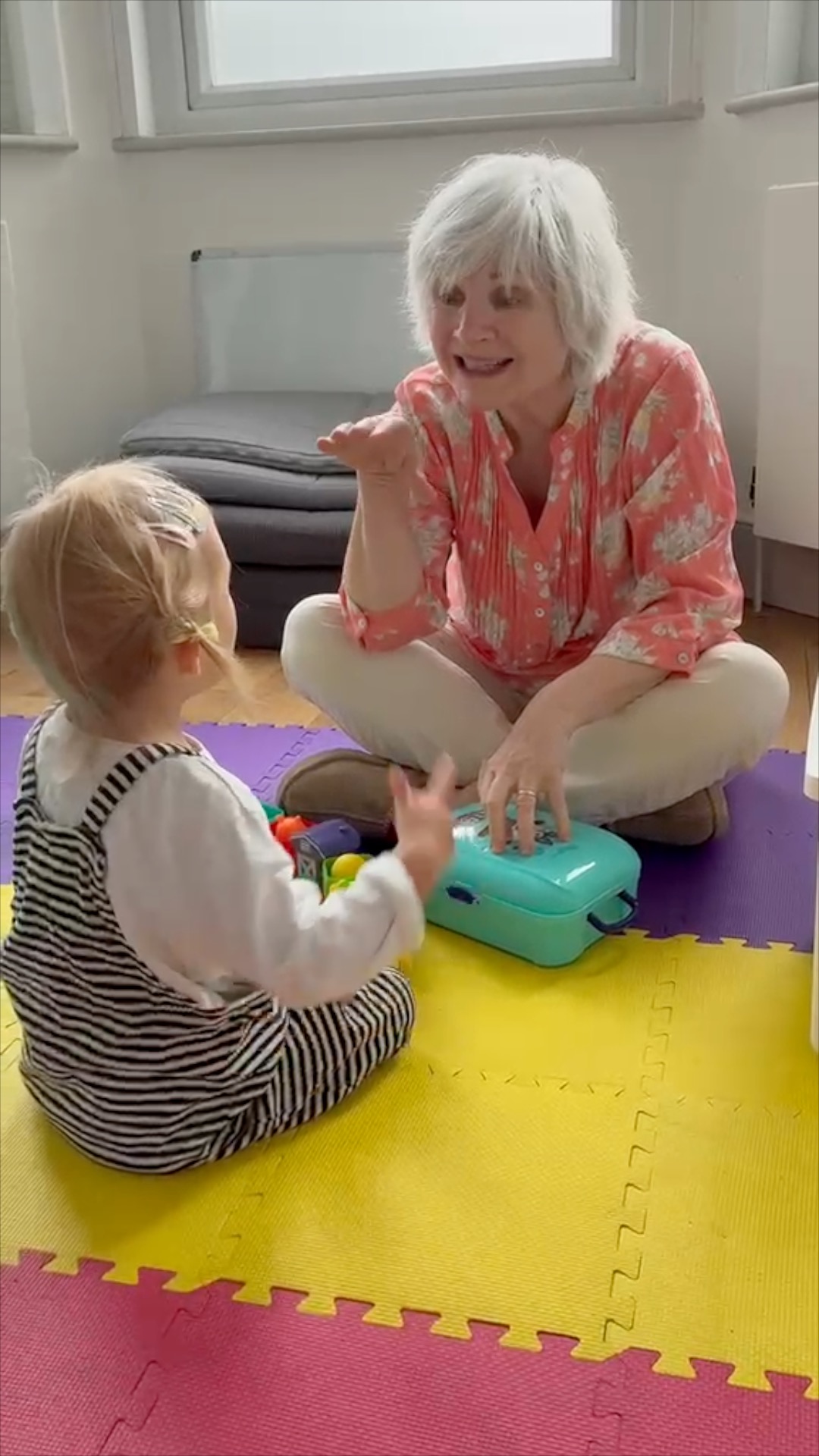
In the short video clip below you can see this dynamic in action. Notice how the session looks relaxed and playful on the surface. The child is absorbed in the pretend play scenario we have created together.

Notice, though, what is happening underneath:

  • the consistent, gentle modelling of target words
  • the use of Makaton signs alongside speech to provide an additional sensory pathway
  • the visual mouth cues that give the child a roadmap for how a sound is shaped
  • and running through all of it, the repetition. The same words, again and again, wrapped in play.

This is not therapy disguised as play. It is therapy that is play, because for a child with dyspraxia, those two things are not in opposition. They are, in fact, perfectly aligned.

If you are concerned about your child’s speech and wondering whether verbal dyspraxia might be a factor, please do not hesitate to get in touch. I would love to help you find some answers.

Sonja McGeachie

Highly Specialist Speech and Language Therapist

Owner of The London Speech and Feeding Practice.


Health Professions Council registered
Royal College of Speech & Language Therapists Member
Member of ASLTIP

Find a speech and language therapist for your child in London. Are you concerned about your child’s speech, feeding or communication skills and don’t know where to turn? Please contact me and we can discuss how I can help you or visit my services page.

3

Similar Posts

  • · · ·

    How parent coaching turns story time into a communication success

    We often hear from parents who are trying their best to connect with their child, especially when reading books, but are met with frustration. They’ll say, ‘I read the book exactly as it’s written, but my child can’t focus for very long and just runs off!’ or ‘my child just flicks through the pages then turns it upside down and runs off with it’ or similar.

    It’s a common story. Traditional reading—going through the text from cover-to-cover—has its place of course, but for little ones with a language delay or autism it can move too quickly and place all the focus on the book’s words, not on the interaction.

    But what if I told you that story time could become one of the most fun and productive times for your child’s communication development?

    Watch the fantastic little video clip above! You can see the pure joy and connection between this dad and his son. This is the same family who, just a few weeks ago, felt defeated when trying to read a book, with their child quickly losing interest and leaving the reading/book corner.

    What changed?

    The power of parent coaching and Hanen principles

    The difference you see in the video is the direct result of parent interaction therapy, or parent coaching, based on the internationally recognised Hanen principles.

    I didn’t ‘fix’ the child. Instead, I coached the parents in a few simple, powerful strategies that completely changed the dynamic of their interaction. Instead of being a time for teaching and instruction, story time became a back-and-forth conversation.

    Here are the four major transformations that coaching helped this family achieve:

    1. From reader to play partner

    Before coaching, the parents felt their job was to read the text and to teach the words in it to their child. Now, their job is to follow their child’s lead. They learned to Observe, Wait, and Listen (OWL). If the child points to the tree or the badger on the page, the parent talks about the tree or the badger.

    The result

    The child is now initiating and leading the conversation! He is sharing what he finds interesting, which makes him feel powerful and keeps him deeply engaged.

    2. Building connection and attention

    When parents focus solely on reading, they often forget to make frequent eye contact and use animated facial expressions. The principles taught them to put the text aside and prioritise connection.

    The result

    Our little boy is looking at his dad more frequently, making great eye contact, and clearly having fun! When the interaction is fun, the child’s attention span naturally lengthens, allowing him to attend to the book and the interaction for a much longer time.

    3. Creating opportunities for communication

    The parents learned simple ways to prompt communication without pressure. They stopped asking knowledge-based questions (‘What colour is that? Or point to the pig!’), which can feel like a test.

    Instead, they learned to use techniques like ‘Saying less and pausing’ or ‘copying their little one’s echolalia ‘, signalling that they are very interested in what he is saying and that his communication matters!

    The result

    The child is now spontaneously using strings of sounds and gestures to communicate his needs and interests, knowing and enjoying his parents’ enthusiastic responses.

    This video is a testament to the fact that you are your child’s best therapist. With the right tools and coaching, you can transform everyday routines, like reading a book, into the most joyful and effective communication sessions.

    4. Acknowledging and interpreting echolalia

    In the video, you may hear the little boy repeat a phrase from the book or from what his dad just said. This is called echolalia, and for a long time, it was often dismissed or discouraged.

    However, a core principle of our parent coaching is that echolalia is communication. For children who are ‘Gestalt Language Processors,’ these memorised phrases (or ‘gestalts’) are their building blocks of language.

    The key is not to stop the repetition, but to become a ‘language detective’ and ‘interpreter’!

    By modelling the correct, first-person phrase right after the echo, parents/caregivers are teaching a child how to break down the ‘chunk’ and use the individual words functionally. They are showing their child: ‘I heard you. Your communication makes sense to me.’

    This strategy is a game-changer because it:

    1. Validates the child’s communication: It honours the child’s natural way of learning language, which boosts their confidence and willingness to communicate.
    2. Facilitates language development: It provides the child with the next step—a meaningful, functional phrase—to move them from repeating language to generating their own spontaneous sentences.

    Look at the child’s face again in the video. When his dad acknowledges and interprets his communication, you see that spark of joy and connection—that’s the moment when true, functional language learning happens!

    Ready to unlock the potential in your family’s story time? Contact me to learn more about our parent coaching programs.

    Sonja McGeachie

    Highly Specialist Speech and Language Therapist

    Owner of The London Speech and Feeding Practice.

    Health Professions Council registered
    Royal College of Speech & Language Therapists Member
    Member of ASLTIP

    Find a speech and language therapist for your child in London. Are you concerned about your child’s speech, feeding or communication skills and don’t know where to turn? Please contact me and we can discuss how I can help you or visit my services page.

    2
  • Why imitation is a powerful strategy to support social communication

    Before reading this blog, it’s important to understand what we mean by ‘social communication’ and ‘imitation’. Social communication is more complex than it first appears. It refers to many aspects of communication such as body language, voice, conversational skills, social ‘rules’ (such as being polite and using manners), interpersonal skills (such as developing friendships), and emotional literacy (such as appropriacy and developing self-awareness). Imitation refers to the simple act of copying.

    You may have noticed that your child has difficulties in some of the areas mentioned above. They might be less responsive to you and appear to be quite happy in their own world. Whilst we do not want to change their unique characteristics, we do need to prepare them for future experiences, and what is socially acceptable.

    How will copying my child develop their social communication?

    1. If your child is already engaged with a certain activity, they are already interested and motivated. You’re not competing for their attention.
    2. Both yours and your child’s attention is on the same activity which makes imitating for you (as the parent) easier.
    3. Studies have demonstrated that when a parent imitates a child, they are more likely to look at the adult.
    4. Imitation not only supports eye contact but supports facial expressions (such as smiling), may increase vocalisations, and encourages your child to sit closer to you.
    5. Children learn through trial and error. They may start to try to perform new actions to gain their parents attention. Let your child lead the play!!

    How do I start imitating my child?

    1. Start with observing them. Take the time just to watch. You don’t need to make notes. Sit back and observe their actions, movements, and sounds they make.
    2. Wait for your child’s reaction when they realise you are copying their actions. Remember they may not notice, you don’t need to remind them, simply copy them again.
    3. Having the same set up as your child allows them to feel in control. So, you may have two sets of the same activity rather than copying using their set of toys.

    This may sound daunting, but it doesn’t have to be. Start with a ten-minute time frame where you choose to copy your child. This is where you can practise your imitation strategy. Ten minutes a day is far more effective than an hour every two weeks. You may feel self-conscious but trust the process. Build your confidence, whilst exposing your child’s to increased language and communication, enabling them to develop vital social communication skills.

    Look at the video above to watch the strategy in action!

    Support is only a click away. I’m here to help.


    Find a speech and language therapist for your child in London. Are you concerned about your child’s speech, feeding or communication skills and don’t know where to turn? Please contact me and we can discuss how I can help you or visit my services page.

    0
  • · ·

    Strategies to support children with eating difficulties

    where the cause is NOT a swallowing problem, but we are having a “fussy eater” in the family, seeming for no obvious reason

    When parents have a child who find mealtimes or eating difficult, it can put pressure on the whole family dynamics. Once we have observed a child’s eating and drinking skills and found that they are not swallowing impaired, but are for want of a better word “fussy” or “picky”, we can then start to look at what might be underpinning the food aversions/picky eating/food avoidance. Two of the main questions parents have (of course) are:

    • ‘is my child getting the right nutrition?’
    • ‘how can I have less anxiety-provoking and stressful mealtimes?’

    We all tend to have an image in our minds about the ‘perfect mealtime’, and how mealtimes ‘should’ be. Speech and Language Therapists with a Feeding Specialism are the perfect professionals to help you unpick feeding issues. We are trained to look at swallowing and oral skills and we also know a lot about feeding behaviours and sensory difficulties which could be causing your child’s eating avoidance.

    Here are some strategies that can support children with their eating:

    1. Create and maintain a mealtime culture that suits your home and lifestyle. Then stick to that. We all need some routine in our lives to thrive. Mealtimes are no different. It might be that you eat in the same place for every meal, with the same knives and forks, concentrating on maintaining good posture. Children learn by repetition so the more familiar it is, the easier they will find it. In the physical sense, our bodies also need preparing for food, regardless of whether we are eating with our mouths or we are tube-fed. We want every child to connect all the dots of the process. It starts with their eyes, noses, expectations, memories of past experiences, feelings and then finally their mouths….
    2. Be an excellent role model. Children learn through watching others, so your child will be observing you without you knowing. Ensure that you are positive about the food you are all eating, and talk about how delicious, tasty, juicy, and yummy the foods are. Make the atmosphere around the dinner table light hearted. Even though you are secretly stressed about your child not eating, try and not show this. Instead pick a topic or put on some nice music, or talk about something your child might be interested in, and try and avoid coercing your child to eat. Leave small finger foods on their plates and have a range of foods available on the table so that your child can see that everyone is eating a range of foods and enjoying them.
    3. Use positive reinforcement. Try and think of mealtimes as fun and motivating. Children who are happy will likely be more inclined to try foods and take part in family mealtimes. Reward all interactions around food, so if your child merely touches a new food then praise this behaviour. Or if your child licks a food just once, again make a nice comment and praise your child for touching and licking the food. The takeaway here is to try and keep all messages positive around food.
    4. Keep offering all types of food. What often happens is that parents stop serving foods they know will not be eaten. This makes sense in a way; we don’t want wastage! However, try and keep the doors open and re-offer all types of foods, even the ones that your child has not wanted in the past. Try and give your child one food they will like and one food they have tasted before and liked before, even a little, and then one new food to try. So, your child always has something to fall back on and they can join in with eating. But they can also try (or at least look at and think about trying) other foods that you and perhaps the siblings are eating.

    Take a look at this website, I find it very helpful in showing parents what types of foods and how big a portion to offer

    Have a go and try and implement some of the ideas above, and should you get stuck please get in touch!


    Find a speech and language therapist for your child in London. Are you concerned about your child’s speech, feeding or communication skills and don’t know where to turn? Please contact me and we can discuss how I can help you or visit my services page.

    0
  • One book, dozens of therapy opportunities: What speech therapy really looks like

    As speech and language therapists, some of the most effective moments in therapy don’t come from flashcards, worksheets, or even drilling sounds (though to be fair I do drill quite a lot too! needs must…😊).

    By and large they happen in natural interaction — during shared attention, laughter, storytelling, and connection.

    This short video clip captures that.

    In under two minutes, while simply reading a book together with a three-year-old child, we naturally work on:

    • Speech sounds
    • Vowel production
    • Early phonological patterns
    • Motor planning
    • Signing and total communication
    • Visual cueing
    • Repetition and practice
    • Confidence building
    • And engagement through play

    To many people, it may just look like ‘reading a book’.

    But underneath that moment are years of specialist training, clinical decision-making, preparation, and therapeutic skill.

    Therapy hidden inside play

    One of the most important parts of paediatric speech therapy is knowing how to embed targets into meaningful interaction.

    Books are one of my favourite therapy tools! Why: because as speech therapists we need to prepare for our child and our sessions. And having a book gives me the structure to know beforehand what kind of sounds or words might be coming up. Then I can be prepared for providing extra support for them. As you can see in this clip, I had the sound cards just there because I had anticipated what might be coming up!

    A single story can provide opportunities for:

    • Speech sound practice
    • Vocabulary development
    • Sentence building
    • Turn-taking
    • Symbolic understanding
    • Attention and listening
    • Gesture and signing
    • Motor speech cueing
    • And social communication

    In this clip, I follow my little one’s interests while carefully weaving in her individual therapy targets.

    It looks relaxed and spontaneous — and it is — but it is also highly intentional.

    Catching opportunities in the moment

    One lovely example in the clip is when she says ‘yes’.

    She is now starting to say the final /S/ sound, so I immediately model and draw attention to it using the ‘snake sound’ visual cue, giving her positive feedback that she can now also try using this sound at the start of words.

    My gently shaping the word ‘yeSSSS.’ gives her:

    • Auditory feedback
    • Visual support
    • And an achievable opportunity to try again

    A few seconds later, we naturally practise it again.

    That’s responsive therapy.

    Speech therapists are constantly listening, analysing, adapting, and deciding:

    • When should I model?
    • When should I pause?
    • When should I repeat?
    • When should I let it go?
    • How can I keep confidence high while still targeting speech?

    These decisions happen in seconds.

    Working on speech without ‘stopping the play’

    Another moment in the clip focuses on the word ‘out’, where the vowel sound is one of her speech targets.

    Then we move into practising the word ‘open’, a word she has previously found difficult.

    Within this one word, we can support:

    • Sequencing
    • Motor planning
    • Lip shape
    • Vowel production
    • And speech sound accuracy

    We also briefly practise the /K/ sound — a sound produced at the back of the mouth which can be particularly tricky to produce.

    Instead of explaining it verbally (which is often too abstract for young children), I use:

    • Visual demonstration
    • Exaggerated mouth movements
    • Gesture/sign support
    • And playful modelling

    Children learn through seeing, hearing, doing, and experiencing.

    That is why Speech Therapists use multiple layers of cueing simultaneously.

    Why I use signs alongside speech

    Throughout the clip, I also use signs such as ‘book’ and ‘pig’.

    Using signs does not stop children talking.

    In fact, for many children, signs:

    • Reduce frustration
    • Support understanding
    • Increase participation
    • Reinforce vocabulary
    • And help bridge the gap while speech is developing

    Communication always comes first.

    Speech is only one part of communication.

    When children feel successful communicating, they are far more likely to keep trying.

    The skill behind ‘natural’ therapy

    One thing I often hear from parents is:

    ‘You make it look so easy.’

    That is actually one of the biggest compliments a therapist can receive. (Though we also often feel we need to justify our very existence with these thoughts because we don’t just play/just read but we know it can look like that!) 😊 this is the reason for this blog…

    High-quality paediatric therapy should feel warm, playful, responsive, and natural.

    But underneath that natural interaction is:

    • Clinical knowledge
    • Phonological analysis
    • Motor speech understanding
    • Language development expertise
    • Sensory awareness
    • Relationship-building
    • And careful session planning

    Before this session even began, I already knew:

    • Which speech patterns to target
    • Which words would likely appear in the book
    • What visual cues might help
    • Which signs to model
    • And how to adapt depending on the child’s responses

    That preparation allows therapy to stay child-led without losing therapeutic focus.

    Following the child while leading the therapy

    The best therapy is rarely rigid.

    Children do not learn communication through pressure or endless correction. They learn through interaction.

    That is exactly what this short clip demonstrates.

    One book.
    One conversation.
    Hundreds of tiny therapeutic decisions.

    And all within a joyful moment shared together.

    Because good speech therapy should never feel like hard work for a child.

    It should feel like connection, confidence, success — and fun.

    If you’re concerned about your child’s speech and language or wondering whether they might benefit from speech therapy, feel free to get in touch.

    Sonja McGeachie

    Highly Specialist Speech and Language Therapist

    Owner of The London Speech and Feeding Practice.


    Health Professions Council registered
    Royal College of Speech & Language Therapists Member
    Member of ASLTIP

    Find a speech and language therapist for your child in London. Are you concerned about your child’s speech, feeding or communication skills and don’t know where to turn? Please contact me and we can discuss how I can help you or visit my services page.

    3
  • ·

    Discover how Attention Autism can support your Autistic child’s communication

    “I’ve got something in my bag, in my bag, in my bag,

    I’ve got something in my bag,

    what it is”

    You might be wondering why your Speech and Language Therapist is singing this song and then presenting items from a zipped-up bag. Let me take you through stage one of this evidence-based approach.

    There are many aims of ‘bucket or bag time’. During stage one, you are simply engaging your child’s attention (whilst also exposing them to language). It’s important to remember that you are not forcing your child to say or do anything. The idea is that the items in the bag or bucket ‘offers an irresistible invitation to learn’ (Gina Davies, 2020).

    You don’t need ‘special’ expensive toys. Use what you have at home. It might be that you have some bubbles, a wind-up toy. You might have some foil that you can roll up into a ball, or a balloon. Keep these items for ‘bucket time’. This means that your child is likely to be excited and motivated for the activity. The only stipulation is that these items must be highly motivating and must be the most exciting thing in the room. You’ll want to cover up any distractions.

    So, you have your items and your opaque zipped bag, next you’ll want to put the items into the bag ensuring the zip is closed. The zip is important as it increases suspense and excitement as your child cannot see inside. You can also comment when unzipping ‘open bag’ using the signs ‘open’ + ‘bag’ to support your child’s understanding. Your Speech and Language Therapist can help with any Makaton signs that are unknown. The idea of this activity is that the item isn’t touched by your child. This can seem a little odd or feel “mean” but there is a reason for this: we want our child to look at us as well as the object or toy. As soon as we allow our child to touch and play with that toy their attention will go to the toy alone and we won’t get JOINT attention or engagement. This is the reason why we SHOW interesting things for a brief moment and then put these items back into the bag or bucket and out comes the next item. If your child wants to grab the toy and gets upset, then they may not be quite ready for this approach.

    Next, we sing the song (as above) and unzip the bag taking out one of the items. The use of pausing is important. Pause after the song: does your child try to use gesture or sound? You can also use this opportunity to model short phrases, ideally one or two words such “it’s a spinner! Wow… so many colours”. After a couple of turns, repeat the process and pull out a different item. We tend not to sing the song each time for the next item. Just sing it at the beginning and then get on with producing the amazing, wonderful things in your bag. No hard and fast rules though, apart from “don’t let the child touch the toys”.

    The biggest factor here is that you and your child enjoy the activity together. Have lots of fun!!

    Keep up to date with our latest blogs to explore more stages of Attention Autism.

    If you need speech, language or communication support or advice, I am always here to help.


    Find a speech and language therapist for your child in London. Are you concerned about your child’s speech, feeding or communication skills and don’t know where to turn? Please contact me and we can discuss how I can help you or visit my services page.

    0
  • ·

    Bilingualism – should I speak only English with my speech delayed child?

    Introduction

    Bilingualism is a beautiful aspect of our diverse world. Growing up in a bi- or multi-lingual household is a wonderful gift, allowing children to communicate with a broader range of people and access many cultures.

    My own two children grew up in a bilingual German-English speaking household. They have both been so enriched by this experience, not only language- and learning-wise but of course also culturally: their world has always been so open and colourful. Growing up in inner London and having their German family and mum’s friends as well, this has been a wonderful experience. Both my boys speak German well (not quite like native speakers but like very good second language speakers) and both have very easily learned 3rd and 4th languages additionally when in secondary school.

    Whilst bilingualism has untold benefits, it’s not uncommon for bilingual children to take slightly longer to reach certain speech milestones. This should not be automatically mistaken for speech disorders but rather seen as a natural part of bilingual language development.

    Bilingualism and speech delays

    Sometimes, of course, we do see speech delays or disorders where a child’s speech development lags significantly behind their peers. We often see a delay in both languages equally, making it extra hard for to communicate effectively. BUT PLEASE KNOW the family speaking in multi-lingual languages never caused the delay/disorder!

    If there is a delay or a disorder any number of other reasons could have caused it, such as:

    • hearing impairments,
    • reduced phonological awareness,
    • sensory processing issues,
    • reduced attention and reduced joint attention,
    • neuro-developmental delays or difficulties,
    • general or specific learning difficulties
    • or sometimes other genetic factors.

    So, to say that the difficulty is due to a child being exposed to several languages is a red herring. (no offence to herrings!)

    Speech therapy

    Speech therapy can be powerful to help bilingual /multilingual children with speech delays unlock their full linguistic potential. By providing individualised assessments, targeted interventions, and involving families, speech therapy can bridge the gap between speech delays and bilingualism. It’s essential for the therapist and parents to work together to support the children in their unique linguistic journeys, helping them communicate effectively and thrive in both of their languages.

    Happy Islamic family sitting on the floor
    Image by Freepik

    Speak your home language at home

    Many parents report that they worry about speaking their home language at home and instead they have been focusing on just speaking English at home. They now rarely use their home language with their child. They fear that speaking a language other than English with their child will cause further delay and hinder their progress. All parents want the best for their child and often parents fear that their child won’t fit in or will be seen as ‘different’. So we can understand why parents feel that the English language is the only one worth having.

    But the opposite is the case: it is crucial to speak in both languages freely, both at home and outside the home! Both languages will benefit your child, no matter what the delay or difficulty is. Acquiring a ‘mother tongue’ or native language is absolutely vital for children to have a good, solid linguistic grounding on which to build other languages. Bilingual children may mix languages during speaking and parents may equally mix their languages. This does not hinder language development and is a natural part of linguistic development.

    Speak freely and naturally

    What is far more important than the question: ‘which language should I say this in?’ Instead think: ‘let me speak freely and naturally, let me respond naturally, in good intonation and let communication flow freely to the child.’

    Speech therapy can be a crucial resource for bilingual or multilingual children and their families.

    We work on targeted interventions to address speech and language difficulties, helping your child develop essential communication skills. For home practice between therapy sessions, we can recommend tailored treatment plans to help you help your child in daily life. Our input could be focusing on articulation, phonological awareness, attention and listening, vocabulary development and grammar.

    Family support is crucial in speech therapy. We like to work closely with parents to provide guidance and strategies for fostering language development in both languages at home.

    If you have any worries about your child being delayed in a bilingual or multilingual household do get in touch and we will be happy to support you in your journey.


    Find a speech and language therapist for your child in London. Are you concerned about your child’s speech, feeding or communication skills and don’t know where to turn? Please contact me and we can discuss how I can help you or visit my services page.

    1