Autism Acceptance

  • · · · ·

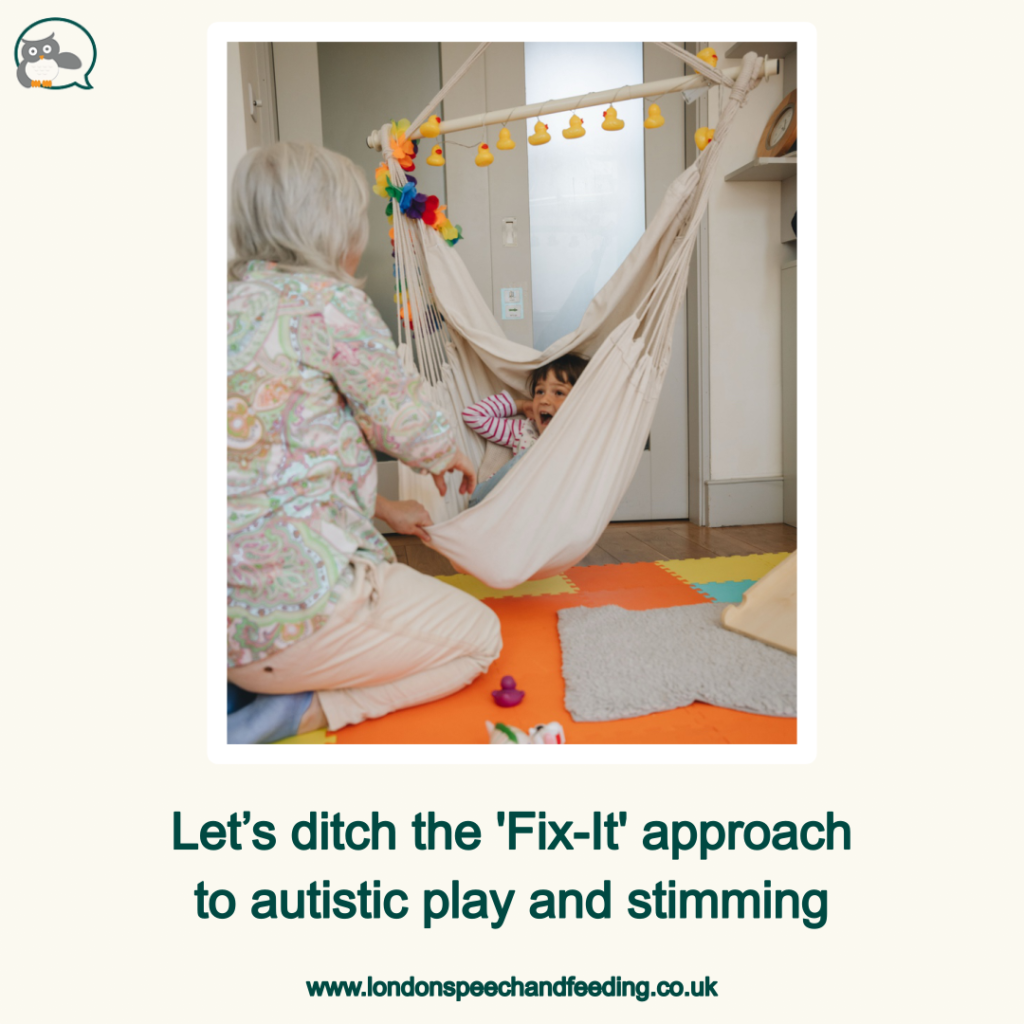
    Let’s ditch the ‘Fix-It’ approach to autistic play and stimming

    Let’s ditch the 'Fix-It' approach to autistic play and stimming

    December is often presented as a time of perfect, reciprocal play. Children are supposed to be unwrapping toys, sharing, and engaging in imaginative scenarios with family. But for parents of young autistic children, this high-pressure, socially demanding period can often feel like a battleground.

    If you’ve been told to interrupt your child’s stimming, push for eye contact, or force them to play ‘functionally’ with toys, it’s time to take a deep breath. Those traditional approaches are not only stressful—they often miss the point of your child’s communication.

    As a neurodiversity-affirming Speech and Language Therapist, I want to encourage you this December: You are allowed to follow your child’s lead, validate his or her unique interests, and trust that his or her play and movement are profoundly meaningful.

    1. Stimming: not a distraction, but a regulator 💡

    Stimming is short for self-stimulatory behaviour and includes repetitive movements or sounds like hand flapping, humming, rocking, finger flicking, or repeating phrases (called echolalia).

    For years, parents were incorrectly advised to block or eliminate these behaviours. The neurodiversity-affirming view tells us the exact opposite: Stimming is a vital and essential tool for your child’s self-regulation.

    Think of stimming as an internal volume dial:

    • Too loud/overwhelmed: Your child may stim to reduce incoming sensory input (e.g., rocking to ground himself or herself in a busy room).
    • Too quiet/under-stimulated: Your child may stim to increase sensory input and focus (e.g., running back and forth to maintain alertness).

    The shift: validate, don’t block

    Instead of saying, ‘Stop flapping your hands’, try to understand the message behind the movement.

    • Observe: When does the stimming happen? Is it before a meltdown? When your child excited? When your child is bored?
    • Validate: Name the need, not just the behaviour. You might say, ‘I see your body needs to move fast right now. That helps you calm down!’
    • Co-regulate: If the stim is unsafe (e.g., head-banging), help your child find a safer, alternative stim that meets the same sensory need (e.g., pushing hard against a wall, squeezing a stress ball).

    By validating your child’s need to regulate, you are building trust, reducing anxiety, and teaching him or her critical self-awareness.

    2. Autistic play: Meaningful, even if it’s monologue

    The traditional idea of ‘good play’ often involves turn-taking, pretending, and specific toy functions (e.g., pushing a train around a track). When an autistic child spends 30 minutes lining up cars, spinning their wheels, or scripting whole scenes from a favourite movie, it can often be dismissed as non-functional or repetitive.

    In neurodiversity-affirming practice, we recognise that autistic play is authentic play. These activities are crucial for learning, deep focus, and imaginative development.

    • Lining up toys may be an exploration of patterns, visual organisation, and order.
    • Spinning wheels may be a deep interest in cause-and-effect and visual sensory input.
    • Scripting is often a way to process language, regulate emotions, and practise complex social situations in a safe, controlled way.

    Make a change: Join your child’s world, don’t drag them to yours.

    Stop trying to force the ‘right’ way to play. Instead, try these neuro-affirming strategies:

    1. Be a co-regulator, not a director: If your child is lining up cars, sit down next to him or her. Instead of moving a car, try handing him or her another car to line up. Focus on the shared interest rather than forcing interaction.
    2. Narrate (don’t question): Avoid constantly asking, ‘What are you doing?’ or ‘What does this car say?’ This puts pressure on your child to perform. Instead, narrate your observations using his or her interest: ‘I see you made a long, straight line of red cars. Look at all the wheels spinning!’
    3. Validate the interest: Show genuine appreciation for your child’s focus. ‘Wow, you know so much about how magnets stick together! That’s incredible.’

    3. The communication revolution: Honouring gestalt language processing 

    Many young autistic children communicate in ways that don’t fit the traditional model of building language word-by-word. Many use Gestalt Language Processing (GLP).

    A gestalt language processor learns language in chunks or scripts (e.g., ‘what’s-in-there?’ or ‘ready-go!’). These chunks (or gestalts) are not random; they are often tied to an emotional memory or meaning. Over time, the child breaks down these big chunks into individual words then learns to recombine those words creatively.

    If your child repeats movie phrases or whole sentences that seem unrelated, he or she is likely a gestalt language processor!

    Affirm the script, then model something useful.

    1. Affirm the script: When your child says a script, respond to the meaning or emotion behind it, not the literal words. If he or she says, ‘We’re going to need a bigger boat’, and he or she is looking at a messy toy pile, he or she may be trying to express overwhelm or a need for help. You can affirm: ‘That pile is too big! I can help you move it.’
    2. Model new ‘mix and match’ scripts: To help your child move from whole scripts to single words, you can model shorter, slightly changed versions of the script, also called ‘mitigated gestalts’. If they say, ‘I want to go home now’, you might model, ‘Let’s go home, now’ or ‘I wanna go home’.

    By honouring your child’s communication style, you validate his or her experience and naturally support his or her path to language development—a core part of neurodiversity-affirming SLT.

    Your December gift to your little one:

    This December, stop trying to make your child fit into a neurotypical box. Instead, make your home a safe space where he or she can be his or her authentic selves.

    Prioritise regulation and connection over compliance.

    Trust that when your child is regulated, his or her communication, learning, and engagement will flourish naturally. This is the true gift of neurodiversity-affirming practice.

    Download and print my neuro-affirming quick reference guide and keep this guide handy on your fridge and/or in your child’s play area for a quick reminder to prioritise connection over conformity.

    Sonja McGeachie

    Highly Specialist Speech and Language Therapist

    Owner of The London Speech and Feeding Practice.


    Health Professions Council registered
    Royal College of Speech & Language Therapists Member
    Member of ASLTIP

    Find a speech and language therapist for your child in London. Are you concerned about your child’s speech, feeding or communication skills and don’t know where to turn? Please contact me and we can discuss how I can help you or visit my services page.
    2
  • ·

    Milestones of autistic children: Crawling, walking, and talking

    For all children every milestone achieved is a testament to the unique and intricate process unfolding within each young mind. For autistic children, this journey may present a distinct pattern, with some reaching developmental milestones like crawling, walking, and talking later than their neurotypical peers. Let’s have a look into the fascinating realm of Autism and explore why some autistic children might crawl, walk, and talk later, shedding light on the underlying factors contributing to this unique way of developing.

    1. Individual Pacing:

    Child development is not a one-size-fits-all journey. Each child, whether neurotypical or autistic, has a unique timeline for achieving milestones. Autistic children, like any other children, follow their own pacing. This individual rhythm might lead them to focus on one set of skills before they progress to others. Like some neurotypical children might focus on talking earlier than walking, autistic children might prioritise other areas before crawling or talking.

    2. Neurodevelopmental Complexity:

    The human brain is a remarkable entity, with a bewildering array of interconnected processes that lead to us achieving our developmental milestones. Autistic children often have variations in “neural wiring”, which can impact the balance between gross motor skills (crawling, walking) and fine motor skills. Speech and language acquisition falls under fine motor skills and may be momentarily disrupted due to the divergent neurological pathways at play in autism.

    2. Sensory Processing Differences:

    One of the hallmarks of autism is altered sensory processing. Autistic children often experience sensory stimuli differently than their neurotypical peers. This heightened or diminished sensitivity can influence a child’s desire or ability to engage in activities like crawling and walking. The sensation of movement while crawling or walking, for instance, might be overwhelming for some autistic children, causing them to either avoid or delay these activities.

    3. Visual-Spatial Abilities:

    Autistic children and adults frequently display excellent visual-spatial abilities. This strength might lead some children to focus more on activities that engage these skills, potentially delaying their engagement with activities like walking or talking. As they navigate their environment and process information visually, they might naturally invest more time in activities that stimulate this particular cognitive ability and strength.

    4. Communication Challenges:

    For many autistic children, speaking can be a really complex and difficult endeavour. Communication delays are a common feature of autism. This can affect both receptive and expressive language development. While some children might be physically capable of crawling or walking, they may not yet have the tools to communicate their desires and intentions. This leads to a temporary focus on non-speaking forms of expression. This does not mean that they do not communicate at all. But autistic individuals often start out using jargoning or echolalia as a form of communication as well as behaviours and physical forms of communication.

    5. Executive Functioning and Motor Skills:

    Executive functioning, or abilities for planning, organising, and carrying out tasks, can vary in autistic children. These skills are crucial for activities like crawling, walking, and talking, which need coordination and planning. About 40% of autistic persons have a motor planning difficulty.

    6. Intense Interests and Routines:

    Autistic children often develop intense interests in specific subjects, sometimes to the exclusion of other activities. These interests might become their primary mode of engagement. They might side-line milestones like crawling, walking, or talking. The mostly rigid adherence to routines and preferences might cause them to allocate more time to their preferred activities. This delays their engagement with other developmental tasks.

    How can Speech and Language Therapy help:

    Support and Intervention:

    Early intervention and regular Speech and Language Therapy play a pivotal role in the developmental journey of autistic children. Therapies tailored to individual needs can aid in bridging the gaps between milestones. Occupational therapy, for example, can help address sensory sensitivities and motor skill challenges that might impact crawling and walking. Speech therapy can help communication development, gradually bridging the gap between non-verbal expressions and spoken language.

    For example, we now know that echolalia or jargoning of longer phrases with intonation, repeating scripts from favourite tv shows or songs have many meanings and communicative functions. For example, a child who utters long strings of echolalic utterances, often difficult to understand, might want to do any one of the following:

    • Comment
    • greet
    • ask a question
    • make a request
    • express surprise
    • negate something.

    We now understand that the way to support a child with echolalia is to acknowledge all utterances and try and find out what the meaning is behind these scripts. This is very supportive. Over time it will lead a child to move on to understanding and saying more clear and self-generated language. For more information about this Natural Language Acquisition here are some other great websites for you to look at:

    Conclusion

    In conclusion, the journey of an autistic child’s development is a testament to the uniqueness and complexity of the human mind. The delays or differences in achieving milestones like crawling, walking, and talking can be attributed to a range of factors, including

    • neurodevelopmental intricacies,
    • sensory processing variations,
    • and communication challenges.

    It’s crucial to recognise that these delays are not indicative of a lack of potential, but rather a manifestation of the intricate interplay between an autistic child’s strengths and challenges. By embracing these differences and providing tailored support, we can help each autistic child unfold their potential at their own pace.

    Do get in touch if you would like to book an appointment where we can explore how to help your child develop and thrive

    Do get in touch if you would like to book an appointment where we can explore how to help your child develop and thrive


    Find a speech and language therapist for your child in London. Are you concerned about your child’s speech, feeding or communication skills and don’t know where to turn? Please contact me and we can discuss how I can help you or visit my services page.

    0