Total Communication

  • What is Total Communication, and why your child might need it more than just speech

    Sonja smiling

    When a child’s speech is difficult to understand, it can feel overwhelming for everyone involved. As a parent, your instinct is often to focus on helping your child ‘talk properly’. And that makes complete sense. Speech is important. But here’s the key message I want to share with you:

    Speech is just one way to communicate.

    And when speech is not yet clear, not yet reliable, or not yet available, children need other ways to get their message across.

    This is where Total Communication comes in.

    What is Total Communication?

    Total Communication is an approach that encourages the use of all available ways to communicate, not just speech.

    This can include:

    • spoken words
    • gestures and pointing
    • facial expressions
    • signing (such as Makaton)
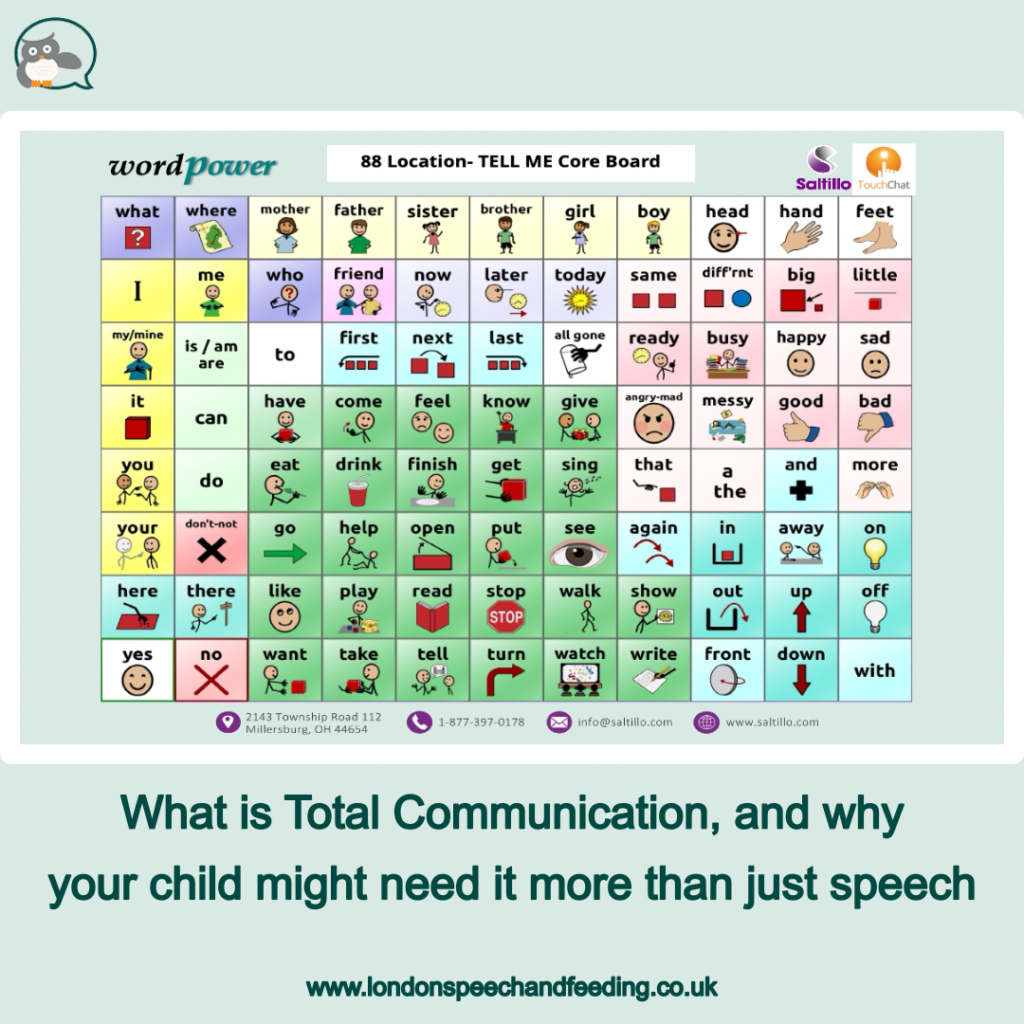
    • pictures or symbols
    • drawing
    • electronic AAC (Augmentative and Alternative Communication), such as apps like LAMP Words for Life

    It’s not about replacing speech. It’s about supporting communication in every possible way.

    Think of it like this: if speech is currently unclear or limited, why restrict a child to the hardest route? Why not give them more tools to succeed?

    ‘But won’t this stop my child from talking?’

    This is one of the most common concerns I hear in clinic.

    Parents often worry that if a child starts using signs or a communication device, they will become ‘dependent’ on it and stop trying to talk.

    The research tells us something very different.

    Studies consistently show that AAC does not prevent speech development. In fact, it often supports it.

    • A review by Millar, Light & Schlosser (2006) found that AAC interventions do not reduce speech production and may actually increase it.
    • Romski & Sevcik (2005) demonstrated that children given AAC often develop stronger overall communication skills, including spoken language.
    • More recent work continues to show that providing AAC early can accelerate language development, not delay it.

    So rather than ‘giving up on speech’, using AAC is actually building the foundations that speech needs.

    Why Total Communication matters, especially for unintelligible children

    When a child is very difficult to understand, they are often experiencing a hidden frustration:

    ‘I know what I want to say, but no one understands me.’

    Over time, this can lead to:

    • reduced confidence
    • behavioural frustration
    • withdrawal from communication
    • fewer opportunities to practise language

    If a child cannot successfully communicate, they communicate less. And when they communicate less, their language development slows down.

    Total Communication breaks this cycle.

    By giving a child reliable ways to be understood, we:

    • reduce frustration
    • increase interaction
    • build confidence
    • create more opportunities for language learning

    And importantly, we allow them to show us what they already know.

    AAC is a bridge, not a barrier

    Using AAC (whether that’s pointing to pictures, signing, or using a device) does something powerful:

    It separates language from speech.

    A child might have lots of ideas, vocabulary, and understanding but their speech system (especially in cases like phonological disorder or childhood apraxia of speech) cannot yet keep up.

    AAC allows the child to:

    • express complex ideas now
    • practise sentence structure
    • develop vocabulary
    • take part in conversations

    All while their speech is still developing.

    In other words, AAC doesn’t replace speech. It keeps language moving forward while speech catches up.

    What does this look like in real life?

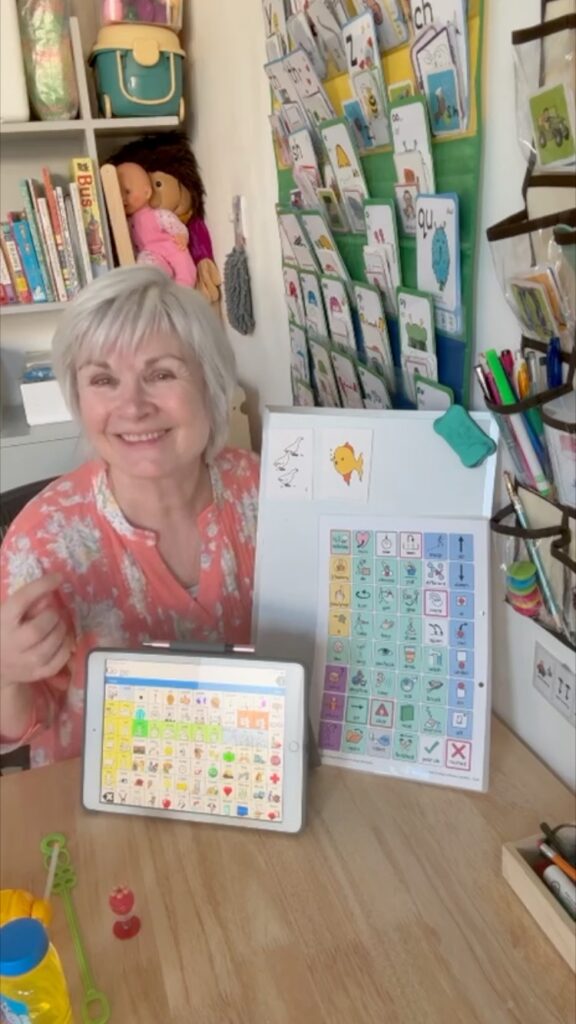
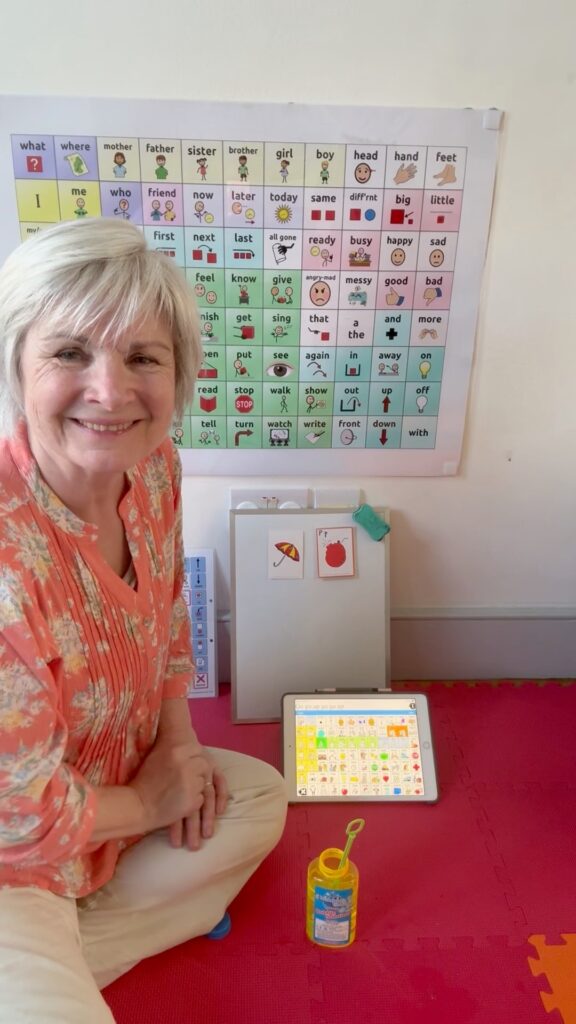
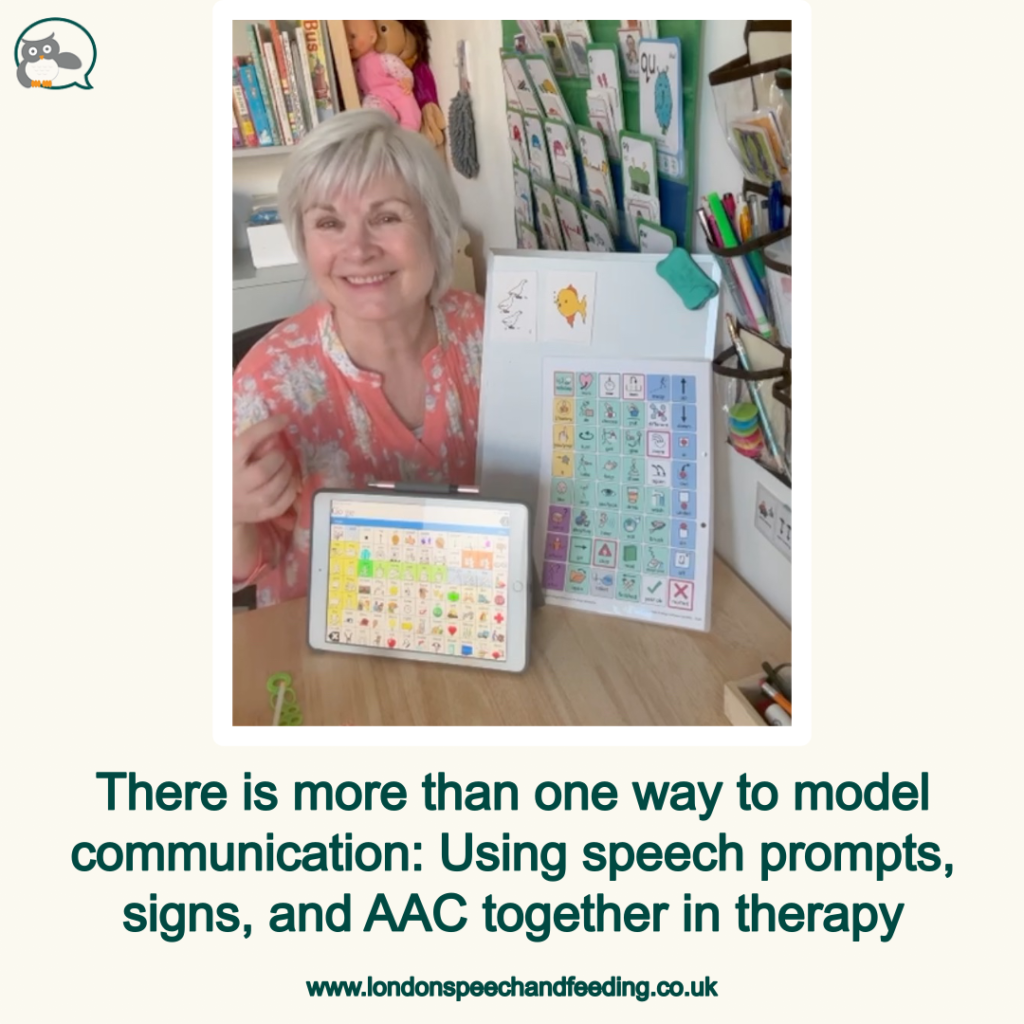
    In therapy, I often use a combination of approaches:

    • modelling simple signs alongside speech
    • pointing to symbols while talking
    • encouraging children to gesture or show
    • using drawings to support understanding
    • incorporating an AAC device such as LAMP Words for Life

    You might see a child:

    • say part of a word
    • point to a symbol
    • use a gesture
    • and look at you expectantly

    That is communication success.

    And success builds motivation.

    ‘I just want them to talk’

    Of course you do. And I do too!! That’s always the goal.

    But here’s the important shift in thinking:

    Children learn to talk by communicating, not by waiting until speech is perfect.

    If we hold out for clear speech before allowing other communication methods, we risk:

    • limiting their ability to interact
    • reducing practice opportunities
    • increasing frustration

    But if we support all communication, we give them:

    • more chances to express themselves
    • more positive communication experiences
    • more input and feedback

    And that is what drives progress.

    A balanced approach

    Total Communication doesn’t mean ‘speech is no longer important’.

    It means:

    • we continue targeted speech therapy
    • we work on sounds and clarity
    • and we support communication in the meantime

    It’s not either/or.

    It’s both/and.

    Final thought

    If your child’s speech is difficult to understand, the most important question is not:

    ‘Are they talking clearly yet?’

    It’s:

    ‘Can they successfully communicate?’

    Because communication is the foundation of:

    • relationships
    • learning
    • confidence
    • wellbeing

    And every child deserves a voice, in whatever form that voice takes right now.

    Feel free to contact me if your child needs help with speech and communication.

    Sonja McGeachie

    Highly Specialist Speech and Language Therapist

    Owner of The London Speech and Feeding Practice.

    References (parent-friendly):


    Health Professions Council registered
    Royal College of Speech & Language Therapists Member
    Member of ASLTIP

    Find a speech and language therapist for your child in London. Are you concerned about your child’s speech, feeding or communication skills and don’t know where to turn? Please contact me and we can discuss how I can help you or visit my services page.
    3
  • · ·

    LAMP Words for Life: A revolutionary AAC system

    Introduction

    When working with non-speaking or minimally speaking children the LAMP Words for Life AAC (Augmentative and Alternative Communication) system is my absolute go-to every time. For me it stands out as a revolutionary system that has transformed the lives of many of my non-speaking students. LAMP Words for Life is a ROBUST, comprehensive language-based AAC system and it is designed to help any user to express their thoughts, feelings, and needs effectively, thereby achieving maximal independence in their daily life. A winner!

    There is a whole host of AAC apps and systems out there and each has their own advantages and benefits for sure. I have tried a good number of other systems. I do also like certain features of other AAC systems for sure. For example GRID: I love the versatility of GRID and the ease of editing the system is fantastic.

    Why I think it works so well

    However, strangely I always return to LAMP when push comes to shove. I have thought very carefully about it and so here are my thoughts on why this is and why it works so well:

    1. Intuitive interface: LAMP Words for Life features are for me really user-friendly and it is easy to navigate and understand (this is very important for non-techy people). I think it makes sense and it is accessible to users of all ages and abilities. Yes the pictures are a little bit different to other symbol systems we use, especially here in the UK to be sure, and this is one of the reasons why it is good to have a variety of systems available, so that we can cater for students who are used to other symbols or do very well with specific symbol core boards. I have learned though that the pictures are not that important when using LAMP because the entire system is based on MOTOR PLANNING. And once one knows the motor plan to find a picture it is in our brain and we do not look at the picture any more. So, the motor plan to find a word is much more important when using LAMP than worrying about what the picture looks like.
    2. Comprehensive vocabulary: The system offers a vast vocabulary of words and phrases, covering a wide range of topics and contexts. This enables users to express themselves effectively on a variety of subjects. That said, almost every time I use LAMP there is a little word I need and it’s not on there. But that’s not a problem: for example, I was looking for ‘sunglasses’ the other day. Sure, there is ‘sun’ and ‘glasses’ but that would be two separate motor plans and for my student that would be too many for now, so it was very easy to quickly add the new word ‘sunglasses’ under ‘accessories’ or ‘beach wear’ — I added it within less than one minute. Likewise, there are a ton of words which cater for the US market, and I tend to change them to fit the UK vocabulary like ‘nappy’ for ‘diaper’. Or I delete them entirely if I feel my child will never need to use a certain word like ‘conference’ or ‘nun’. PS: should they get to a point of using the system as an adult independently then these words can surely be added again, or if my student ever moves to the US then the words can be changed back to US terms again without any problem.
    3. Grammar support: LAMP provides built-in grammar support, helping users construct grammatically correct sentences. This can be particularly beneficial for individuals with language processing difficulties. But what I love about the way LAMP is organised here is that, in contrast with other systems I have used, it does not PREDICT what you want to say, it lets the user decide and find the right grammatical structure. I appreciate this because, just like I hate my phone or email offering predictive text or offer corrections to my words, I really do not get the systems that offer automatically a grammar change which mostly I don’t want. Where that is the case, I am often confused and hindered in finding the correct wording. I love the simplicity of LAMP and at the same the complexity that can be achieved gradually with practice. LAMP is fully designed to enable a user to build up not only vocabulary but a full language system. On a course recently I was able to hear adult LAMP users speaking to the audience in full and quick grammatically well-rounded sentences on a host of topics.
    4. Customisation: LAMP can be customised to meet the individual needs of each user. This includes options for adjusting the vocabulary, layout, and accessibility features. It is not as easy to edit as GRID I will say and that can cause me a little bit of frustration at times, but on balance I still vastly prefer the system as a whole. It can also be customised quite well for Gestalt Language Processors. It takes a little bit of practice and thinking about how best to do this but I have found a way that works well which I demonstrate in the short video clip.
    5. Community support: LAMP Words for Life has a thriving community of users on Facebook and this is so valuable and inspiring. Therapists and families of LAMP users alike share experiences, provide resources, and offer encouragement. This can be a valuable source of support for both users and their families.
    6. Comprehensive support: LAMP Words for Life offers quick and thorough support services, including training, resources, and ongoing assistance. This is invaluable and reassuring for both users and caregivers.
    7. Research-based: The development of LAMP Words for Life is based on extensive research and evidence-based practices. This ensures that the system is grounded in sound scientific principles.

    Conclusion

    To conclude LAMP Words for Life is a powerful AAC which provides us with a means of effective communication, language development, and social interaction. Whether you are a parent of a non-speaking child or a speech therapist looking for innovative AAC solutions, LAMP Words for Life is worth exploring.

    Example on how to use AAC at story time

    Feel free to contact me if you need help with your child.

    Sonja McGeachie

    Early Intervention Speech and Language Therapist

    Feeding and Dysphagia (Swallowing) Specialist The London Speech and Feeding Practice

    The London Speech and Feeding Practice


    Find a speech and language therapist for your child in London. Are you concerned about your child’s speech, feeding or communication skills and don’t know where to turn? Please contact me and we can discuss how I can help you or visit my services page.
    1