Explaining pronoun reversal: A window into gestalt language processing

| |
Explaining pronoun reversal: A window into gestalt language processing

Have you noticed your child referring to themselves as ‘you’, or calling you ‘me’? This seemingly confusing mix-up of pronouns, known as pronoun reversal, often raises concerns for parents. Below I outline why your child does this and want to reassure you that it is to do with his or her unique language learning style.

Gestalt language processing: Learning in chunks

Many children, particularly those on the autism spectrum, use a gestalt language processing approach. Unlike analytic language processors who learn individual words and build sentences, gestalt language processors learn language in whole ‘chunks’ or ‘gestalts’. Think of these gestalts as pre-packaged scripts they pick up from their environment — phrases, sentences, even snippets of songs or movie lines.

As Marge Blanc, author of Natural language acquisition on the autism spectrum, explains, ‘When a child picks up an entire gestalt (script), he’s got the pronoun of the original speaker. So ‘pronoun reversal’ is nothing more than that.’

So your child is simply repeating what they’ve heard, without yet understanding the individual word meanings or grammatical functions.

Imagine your child hearing ‘You want a rice cake?’ repeated frequently. They might then use this phrase to express their own desire for a rice cake, even though it doesn’t grammatically fit. So they are thinking and saying ‘You want a rice cake?’ and the meaning of this phrase is: ‘I want a rice cake’. This isn’t a sign of confusion, but a natural step in their language development. They’re working with the tools they have: the scripts they’ve acquired.

How can we support their natural language journey

Instead of trying to ‘correct’ pronoun usage, our role as caregivers and speech therapists is to support the child’s natural language progression. Here’s how we can do this:

  1. Learn about their gestalt stage and run with it: In the early stages (1–3) of gestalt language development, correcting pronouns can be counterproductive. These children are still processing language as whole units, not individual words. Direct corrections can lead to frustration and hinder their natural language exploration.
  2. Patience and trust: Gestalt language processing follows a predictable, albeit sometimes non-linear, path. By understanding their current stage, we can provide targeted support. Language sampling and scoring, guided by the Natural Language Acquisition framework, help us pinpoint their stage and tailor our approach.
  3. Model language strategically: In the early stages, avoid using pronouns like ‘you’ and ‘you’re’. Instead, model language from the child’s perspective or use joint perspectives. For example, instead of ‘Are you thirsty?’, try ‘I’m thirsty!’ or ‘Let’s get some water’,

The big picture: Language unfolds naturally

Pronoun reversal is a stepping stone, not a stumbling block. As gestalt language processors progress, they begin to break down these gestalts into smaller units and develop their own self-generated language. This is when their understanding and use of pronouns naturally emerge.

By shifting our perspective from ‘error correction’ to ‘developmental support’, we create a nurturing environment for these children to thrive. We empower them to navigate their unique language journey, ultimately leading to more meaningful and independent communication.

So, to summarise:

  • Pronoun reversal is a typical characteristic of early-stage gestalt language processing.
  • Focus on modelling language from the child’s perspective or a joint perspective.
  • Avoid correcting pronouns in the early stages.
  • Trust the process and support the child’s natural language development.

Let’s celebrate the diverse ways our children learn to communicate and empower them to find their unique voice!

If you have any questions or would like some help with understanding your little gestalt language learner, please get in touch with me via my contact form.

Sonja McGeachie

Highly Specialist Speech and Language Therapist

Owner of The London Speech and Feeding Practice.


Health Professions Council registered
Royal College of Speech & Language Therapists Member
Member of ASLTIP

Find a speech and language therapist for your child in London. Are you concerned about your child’s speech, feeding or communication skills and don’t know where to turn? Please contact me and we can discuss how I can help you or visit my services page.

1

Similar Posts

  • · ·

    Why auditory memory matters (especially for little ones!)

    Why auditory memory matters (especially for little ones!)

    Have you ever stopped to think about how we learn to speak, understand, and communicate effectively? It’s a complex dance of various cognitive skills, and one often overlooked but absolutely crucial player in this orchestra is auditory memory. It’s not just about remembering sounds. It’s about remembering sequences of sounds, which is fundamental to language development.

    What exactly is auditory memory?

    At its core, auditory memory is our ability to take in, process, store, and recall information that we hear. Think of it as your brain’s internal recording studio. When someone speaks to you, your auditory memory is busy at work, capturing the individual sounds, the order in which they appear, and the rhythm and intonation of the words. This isn’t just for long-term recall; it’s also vital for working auditory memory, which allows us to hold onto a small amount of auditory information for a short period, just long enough to make sense of it.

    For speech and language, auditory memory is essential for:

    • Understanding spoken language: To comprehend a sentence, we need to remember the beginning of the sentence by the time we hear the end.
    • Following instructions: Remembering a sequence of commands relies heavily on auditory memory.
    • Learning new words: We hear a word, remember its sound, and connect it to its meaning.
    • Developing phonological awareness: This is the ability to recognise and manipulate the sounds in spoken language, a critical precursor to reading. Auditory memory helps children distinguish between similar-sounding words (e.g., ‘cat’ vs. ‘bat’) and segment words into individual sounds.
    • Producing clear speech: To articulate words correctly, we need to recall the precise sequence of sounds that make up that word.
    • Developing conversational skills: Remembering what was just said helps us formulate appropriate responses.

    When auditory memory falls short: The impact on speech

    When auditory memory is poor, particularly in young children, the ripple effects on speech and language development can be significant. Children might struggle with:

    • Following multi-step directions: ‘Put on your shoes, get your coat, and meet me at the door’ can become an overwhelming jumble of sounds.
    • Learning new vocabulary: They might hear a new word repeatedly but struggle to retain its sound pattern, making it difficult to recognise or use later.
    • Understanding stories or conversations: Missing key details or losing the thread of a narrative because they can’t hold enough information in their working memory.
    • Developing phonological skills: Difficulty with rhyming, identifying initial sounds in words, or blending sounds together to form words, which can impact early literacy.
    • Speech production: They might mispronounce words, omit sounds, or struggle with the correct sequencing of sounds within words.
    • Social communication: Difficulty participating in group discussions, remembering names, or recalling what their peers have said.
    • Academic performance: Auditory memory challenges can impact a child’s ability to learn in a classroom setting, where much of the instruction is delivered verbally.

    It’s important to note that poor auditory memory isn’t a sign of low intelligence, but rather a specific processing challenge that can be addressed with targeted support.

    Nurturing auditory memory in under 5s: Preparing for schooling

    The good news is that auditory memory is a skill that can be strengthened and developed, especially during the crucial early years. For children under five, laying a strong foundation in auditory memory is an invaluable gift as they prepare for the demands of formal schooling. Here’s what we can do to help:

    1. Read aloud regularly: This is perhaps one of the most powerful tools. As you read, encourage your child to listen for specific words, predict what happens next, and retell parts of the story. Vary your voice, use different intonations, and pause to emphasise key words.
    2. Play auditory memory games:
      • ‘Simon says’: This classic game is fantastic for following multi-step instructions. Start with one command and gradually increase the number.
      • ‘I Spy’ with sounds: Instead of colours, describe sounds. ‘I spy with my little ear something that goes “moo”.’
      • Rhyming games: Sing rhyming songs, read rhyming books, and encourage your child to come up with words that rhyme.
      • Sound matching: Use everyday objects to make sounds (e.g., shaking keys, tapping a spoon) and have your child identify or match them.
      • ‘Memory chain’: Start a sentence and have your child add to it, remembering everything that came before: ‘I went to the market and bought an apple.’ ‘I went to the market and bought an apple and a banana.’
    3. Sing songs and nursery rhymes: Repetitive songs and nursery rhymes are excellent for developing auditory memory, rhythm, and phonological awareness. The predictable patterns help children anticipate and remember sequences of sounds and words.
    4. Give multi-step instructions (and praise!): Start with two-step instructions and gradually increase the complexity as your child’s skills improve. Always give positive reinforcement when they succeed. ‘Please pick up the red block and put it in the box.’
    5. Engage in active listening: Model good listening skills yourself. When your child is speaking, give them your full attention. Ask clarifying questions to encourage them to elaborate and organise their thoughts.
    6. Reduce background noise: A quiet environment makes it easier for young children to focus on auditory information. Minimise distractions like TV or loud music during activities that require listening.
    7. Use visual cues: While we’re focusing on auditory memory, sometimes pairing auditory information with visual cues can be helpful, especially initially. For example, when giving instructions, demonstrate the action as you say it.
    8. Be patient and consistent: Developing auditory memory takes time and consistent practice. Celebrate small victories and create a playful, supportive environment for learning.

    By actively engaging in these strategies, we can empower our youngest learners to build robust auditory memory skills, setting them up for success not only in speech and language development but also in their overall academic journey. It’s an investment that truly pays dividends in their future communication and learning abilities.

    Any comments or if you need help and support with your child’s speech please do not hesitate to get in touch with me: simply fill out the contact form here on the website. I endeavour to reply within 48 hours.

    Sonja McGeachie

    Highly Specialist Speech and Language Therapist

    Owner of The London Speech and Feeding Practice.

    Health Professions Council registered
    Royal College of Speech & Language Therapists Member
    Member of ASLTIP

    Find a speech and language therapist for your child in London. Are you concerned about your child’s speech, feeding or communication skills and don’t know where to turn? Please contact me and we can discuss how I can help you or visit my services page.

    1
  • · ·

    Baby-led weaning: Empowering little eaters from the start

    I had a mum ask me about Baby Led Weaning the other day. So I thought I would write a blog on all the useful questions she had and what we discussed as it may help lots of mums and dads out there.

    As a Paediatric Feeding SLT, one of the exciting developments in recent years is the growing interest in baby-led weaning (BLW). This approach to introducing solids has gained significant traction, and for good reason. It empowers infants to take the lead in their feeding journey, fostering a positive relationship with food and supporting important developmental milestones.

    What exactly is baby-led weaning?

    At its core, baby-led weaning is about offering your baby appropriately sized and textured solid foods from the very beginning, allowing him or her to self-feed. Instead of spoon-feeding purées, you present whole, soft foods that your baby can grasp, bring to his or her mouth, and explore at his or her own pace. This means no mashing, no blending, and no forcing spoons into reluctant mouths. It’s a fun, messy, and intuitive process that is led by your baby’s natural instincts.

    The genesis of baby-led weaning

    ‘Baby-led weaning’ was popularised by British health visitor Gill Rapley. In the early 2000s, Rapley observed that babies naturally develop the skills needed to self-feed and that traditional spoon-feeding might actually hinder this development. Her work, particularly her book Baby-Led Weaning: The Essential Guide to Introducing Solid Foods (co-authored with Tracey Murkett), published in 2008, brought BLW into the mainstream and provided a structured framework for parents. Her research and observations highlighted the benefits of trusting a baby’s innate ability to regulate his or her intake and explore different textures.

    What’s the deal?

    Implementing BLW is simpler than you might think, though it does require a shift in mindset. Here’s a breakdown of what it typically involves:

    • Readiness is key: The golden rule of BLW is to wait until your baby shows clear signs of readiness. This isn’t about age alone, but rather developmental milestones. Your baby should be at least six months old, able to sit unassisted, have good head and neck control, show an interest in food (e.g., reaching for yours), and have lost his or her tongue-thrust reflex (which pushes solids out of his or her mouth).
    • Offer finger foods: Start with soft, easily graspable foods cut into finger-sized sticks or spears. Think cooked sweet potato fries, steamed broccoli florets (soft enough to mash with gentle pressure), banana sticks, or avocado slices. The goal is for babies to be able to pick it up and get some into their mouth.
    • Embrace the mess: BLW is inherently messy, especially in the beginning. Food will be squished, dropped, and smeared. This is a crucial part of the learning process as babies explore textures, smells, and the properties of food. A wipeable mat under the highchair and a good bib are your best friends!
    • Observe, don’t interfere: Allow your baby to lead. He or she will decide what to eat, how much, and how quickly. Avoid putting food into his or her mouth or pressuring him or her to eat more. This respects his or her hunger and fullness cues, laying the foundation for healthy eating habits.
    • Continue breastmilk or formula: Until your baby is well-established on solids, breastmilk or formula remains his or her primary source of nutrition. Solids are for exploration, taste, and developing skills, gradually increasing in quantity over time.

    The benefits of baby-led weaning

    The advantages of BLW extend far beyond simply getting food into your baby. From a speech and feeding perspective, the benefits are compelling:

    • Develops oral motor skills: Chewing, gnawing, and manipulating various food textures are crucial for developing the muscles in the mouth, jaw, and tongue. This strengthens the oral motor skills necessary for speech development.
    • Enhances fine motor skills and hand-eye coordination: The act of grasping food, bringing it to the mouth, and coordinating these movements significantly refines fine motor skills and hand-eye coordination.
    • Promotes self-regulation and intuitive eating: By allowing babies to control their intake, BLW helps them tune into their own hunger and fullness cues, fostering a healthy relationship with food and reducing the likelihood of overeating.
    • Encourages adventurous eating: Exposure to a wide variety of tastes and textures from the outset can lead to less picky eating later. Babies are more likely to accept new foods when they have been in control of their exploration.
    • Facilitates family mealtimes: BLW integrates babies into family mealtimes from an early age, promoting social interaction and making mealtime a shared, enjoyable experience.

    When is baby-led weaning appropriate, and when not?

    While BLW offers numerous benefits, it’s not a one-size-fits-all approach.

    When BLW is appropriate:

    • When your baby meets all the developmental readiness signs: This is paramount for safety and success.
    • When you are comfortable with the mess and the learning curve: It requires patience and a relaxed attitude.
    • When you are committed to offering a variety of safe, appropriate foods.
    • When you are willing to learn about and practise safe food preparation to minimise choking hazards.

    When BLW might not be appropriate (or requires extra caution and professional guidance):

    • If your baby has a history of prematurity or significant developmental delays: His or her oral motor skills might not be sufficiently developed.
    • If your baby has certain medical conditions or anatomical differences (e.g., cleft palate, severe reflux, swallowing difficulties): These may necessitate a modified approach to feeding.
    • If there are significant feeding difficulties, aversion, or a history of choking incidents.
    • If you feel overly anxious about choking: While BLW, when done correctly, is not associated with a higher choking risk than traditional weaning, parental anxiety can impact the feeding experience. Education and consultation with a professional can help alleviate these concerns.

    A note on safety: Choking hazards

    It’s crucial to understand the difference between gagging and choking. Gagging is a natural reflex that helps prevent choking and is very common in BLW as babies learn to manage food in their mouths. Choking is silent and serious. To minimise choking risks:

    • Always supervise your baby closely during mealtimes.
    • Offer appropriately sized and textured foods. Avoid small, round, hard foods like whole grapes, nuts, popcorn, and large chunks of meat.
    • Ensure your baby is sitting upright and calm.
    • Educate yourself on infant CPR.

    Final thoughts

    Baby-led weaning is a wonderfully empowering approach that celebrates a baby’s natural abilities and fosters a positive and independent relationship with food. As Speech and Language Therapists we often see the positive impact it has on oral motor development, self-regulation, and overall feeding confidence. By understanding what it entails, when it’s appropriate, and prioritising safety, you can embark on this exciting journey with your little one, helping him or her become a confident and capable eater from the very first bite.

    If you would like help and support with weaning your baby whilst continuing to breastfeed then please get in touch!

    Sonja McGeachie

    Highly Specialist Speech and Language Therapist

    Owner of The London Speech and Feeding Practice.


    Health Professions Council registered
    Royal College of Speech & Language Therapists Member
    Member of ASLTIP

    Find a speech and language therapist for your child in London. Are you concerned about your child’s speech, feeding or communication skills and don’t know where to turn? Please contact me and we can discuss how I can help you or visit my services page.

    1
  • ·

    Let’s relax about making EYE CONTACT already…

    There’s been a long tradition with teaching staff and with Speech and Language Therapists working in schools that eye contact should be a goal. It is well known that Autistic individuals (whether that be children or adults) mostly avoid eye contact. Whilst it’s part of the way we communicate, it shouldn’t be used as a necessity for an individual who feels that it is uncomfortable. Whilst it does show that you’re listening and showing an interest, it’s not a fair expectation for neurodiverse children.

    Autistic children can find making and maintaining eye contact physically and emotionally uncomfortable as well as unnatural. It adds an extra layer of stress and has been reported to increase distractions rather than reduce them. Children who engage in conversations in their own way (i.e., with reduced eye contact) are not shown to suffer with schooling, work, or social interaction.

    By having fun through meaningful activities, I often experience that ‘BINGO’ moment (a phrase coined by Alex @meaningfulspeech) where the child is enjoying themselves and naturally makes eye contact. There is no demand on them, they are in a fun, engaging environment which suit their strengths and supports their needs.

    Following this, I often reflect on this question ‘Should we make eye contact as a goal?’

    It very much depends on the situation. If it places more demands on the child and becomes stressful. Then no. There are many strategies we can use which gain eye contact without placing extra demands on the child. We need to be mindful to adapt the environment and not place neurotypical expectations to meet the needs of neurodiverse children.

    How can you encourage eye contact without demand?

    • If you’re using toys, try holding them up to your eye level.
    • You can adjust your position, try sitting face to face during play.
    • Always get down to your child’s level. This might mean that you lay on the floor if your child is positioned in this way.
    • During play, waiting is extremely powerful. Before a key part of the activity, wait and see if your child looks at you. Remember silence is golden!
    • The best way I find is: do something unusual during play. It might be that you spray shaving foam with the lid still on. Or you bring out a wow toy and make it spin/light up or make a noise. A balloon can be good – see video clip. Use the excitement of the activity, and wait to see if you achieve that ‘BINGO’ moment.
    • Create opportunities when there are no toys involved such as during ‘tickles’ or ‘hide and seek’. Autistic children find it difficult to shift their attention between a toy and an adult. So by removing one option, you’re setting them up to succeed.

    Remember, it takes practice and time for you to develop these skills. Try one at a time and experiment, see which works best for your child. If you need speech, language or communication support or advice, I am always here to help.


    Find a speech and language therapist for your child in London. Are you concerned about your child’s speech, feeding or communication skills and don’t know where to turn? Please contact me and we can discuss how I can help you or visit my services page.

    0
  • ·

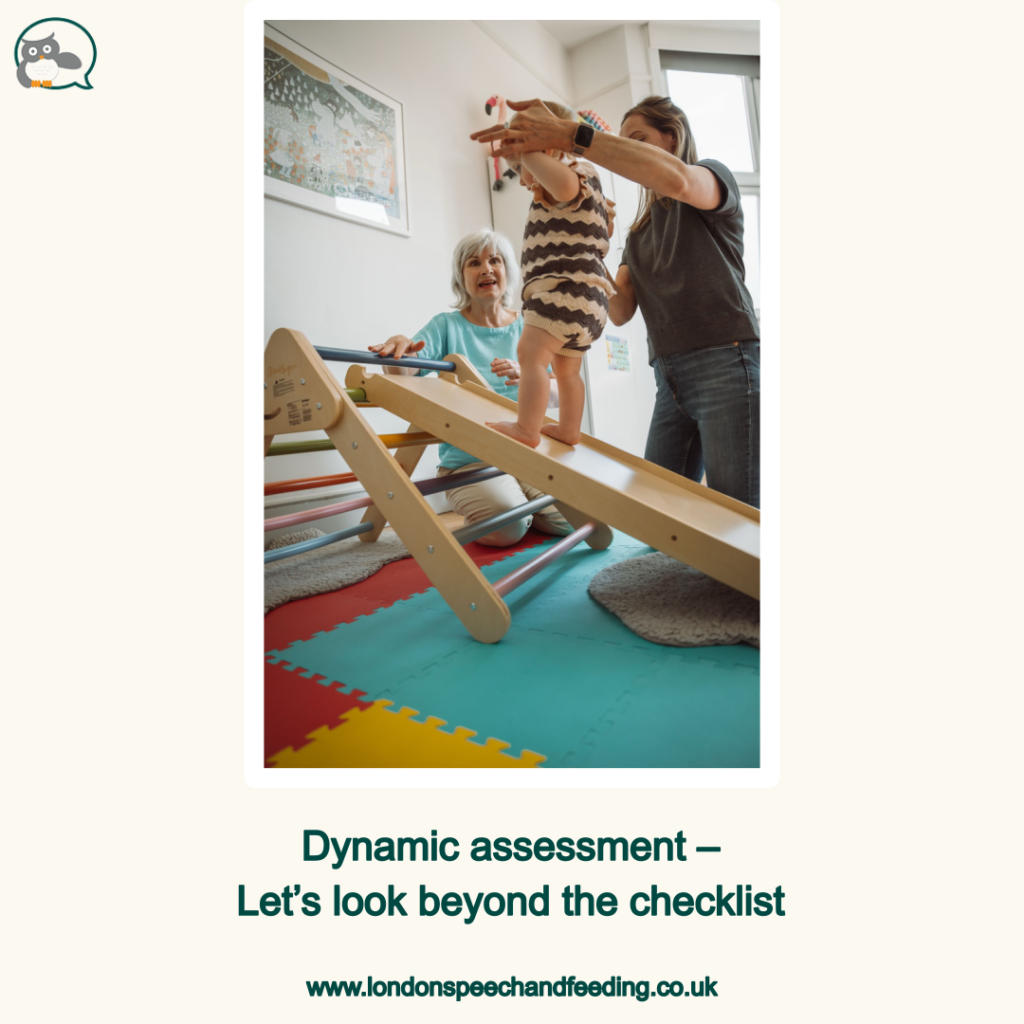
    Dynamic assessment – Let’s look beyond the checklist

    Dynamic assessment – Let’s look beyond the checklist

    As a parent, you’re always observing your child, celebrating his or her milestones, and sometimes, wondering if he or she is quite on track. When it comes to speech, language, play, attention, and listening, these early years are a whirlwind of development! It’s natural to seek guidance if you have concerns, and that’s where a truly comprehensive assessment comes in.

    But what exactly does ‘comprehensive’ mean, especially when it goes beyond a typical checklist? You can find any number of check lists online these days but whilst they can give you an overall idea of what a child is typically expected to do at any given age, it can also start leading you into a rabbit hole of anxiety of ‘what-iffery’.

    At The London Speech and Feeding Practice I believe in something far more insightful than a static evaluation: Dynamic Assessment. Think of it as an in-depth, interactive investigation into your child’s unique communication landscape, exploring not just what he or she can do, but how he or she learns and why he or she might be facing challenges. This is so important.

    What makes an assessment ‘dynamic’?

    Imagine trying to understand a child’s personality by just looking at a single photograph. It gives you a glimpse, but it hardly tells the whole story. Traditional, formal assessments, while valuable, can sometimes be like that photograph – a snapshot of skills at one specific moment.

    Dynamic assessment, on the other hand, is a living, breathing process. It’s called ‘dynamic’ because:

    • It’s interactive and responsive: It adapts to your child’s needs in real-time. It’s not about sticking rigidly to a pre-set schedule of tests. Instead, it’s about observing, gently prompting, and providing support to see how your child responds and learns. This allows me to understand his or her learning potential, not just his or her current performance.
    • It’s holistic and multi-faceted: I look at the whole child. We delve deep into not just speech and language, but also his or her play skills (a crucial window into cognitive and social development), attention and listening abilities, and his or her social engagement. These areas are intricately linked, and a delay in one can often impact others.
    • It integrates multiple perspectives: Your insights as a parent are invaluable! Before we even meet, my comprehensive onboarding questionnaire gathers essential background. During the assessment, your feedback, observations, and comments are woven into the fabric of our session. You are the expert on your child, and your voice is central to forming a complete picture.
    Dynamic assessment – Let’s look beyond the checklist

    More than just ‘speech’: A deep dive into development

    You might initially be concerned about your child’s speech sounds, or perhaps his or her ability to form sentences. These are vital areas, but my approach goes much further. I’m keen to understand:

    • The ‘why’ behind the ‘what’: Is a child struggling with language because of difficulties with understanding instructions (receptive language), or with expressing themselves (expressive language)? Are his or her attention skills impacting his or her ability to follow a conversation? Is his or her play demonstrating imaginative thought, or does he or she prefer more structured, repetitive activities? These nuances are critical.
    • Differential diagnosis: This is where the skill of an experienced clinician truly comes into its own. Through dynamic assessment, I can differentiate between a developmental delay (where a child is following a typical progression but at a slower pace) and a disorder (where his or her development is following an atypical pattern). This distinction is vital because it guides the type of support and intervention that will be most effective. Understanding the cause of the delay or disorder is paramount to creating a targeted, impactful therapy plan.

    The art of observation

    While I draw upon evidence-based practice as well as a formal, standardised assessment as well as my extensive clinical knowledge, I also rely heavily on the art of observation. From the moment your child walks into the room, I’m establishing rapport, engaging them in play, and creating a safe, fun environment. It’s through this genuine interaction – often without them even realising they’re being ‘assessed’ – that the most authentic insights emerge.

    This is where the magic happens:

    • Building rapport: A child who feels comfortable and connected will show you so much more of his or her true abilities and personality. I pride myself on creating an atmosphere where children can relax and simply be themselves.
    • Play as a window: Play isn’t just fun; it’s a child’s natural language. It reveals his or her understanding of the world, his or her problem-solving skills, his or her social engagement, and his or her ability to use symbols and language.
    • Skilled interpretation: My years of experience allow me to see beyond surface-level behaviours and interpret the subtle cues that might indicate underlying strengths or challenges. This goes far beyond what any standardised test alone can capture.

    Why choose a clinician who offers dynamic assessment?

    In essence, a dynamic assessment provides a rich, nuanced, and truly personalised understanding of your child. It’s an investment in:

    • Accuracy: Leading to a more precise diagnosis and understanding of his or her unique profile.
    • Tailored support: Enabling the creation of highly individualised therapy goals that truly meet your child where he or she is and gently guide him or her forward.
    • Empowerment: You’ll leave with not just answers, but also practical strategies and a clear path forward, feeling confident and informed.

    If you’re seeking a thorough, empathetic, and truly insightful assessment for your child’s communication development in London, I invite you to get in touch. Let’s work together to unlock your child’s full potential.

    Sonja McGeachie

    Highly Specialist Speech and Language Therapist

    Owner of The London Speech and Feeding Practice.


    Health Professions Council registered
    Royal College of Speech & Language Therapists Member
    Member of ASLTIP

    Find a speech and language therapist for your child in London. Are you concerned about your child’s speech, feeding or communication skills and don’t know where to turn? Please contact me and we can discuss how I can help you or visit my services page.

    1
  • ·

    Explore activities for Gestalt Language Processors to aid communication

    Speech Therpaist in London

    When you have a child who uses Gestalts it is often difficult to think and adapt clinic activities into those to use at home. More importantly, you find that individualising your activities for your child who uses Gestalt are time-consuming. But you value its importance for their communication development.

    You feel so busy, you are taking them to other appointments, or trying to get through your daily activities, all whilst still ensuring your child’s emotional needs are met. You know life should not get in the way of your child’s therapy activities at home, but it does. We know your spare time is precious and limited, so let us achieve your child’s or young person’s goals in the allotted time you have which meets their way of learning (using Gestalts).

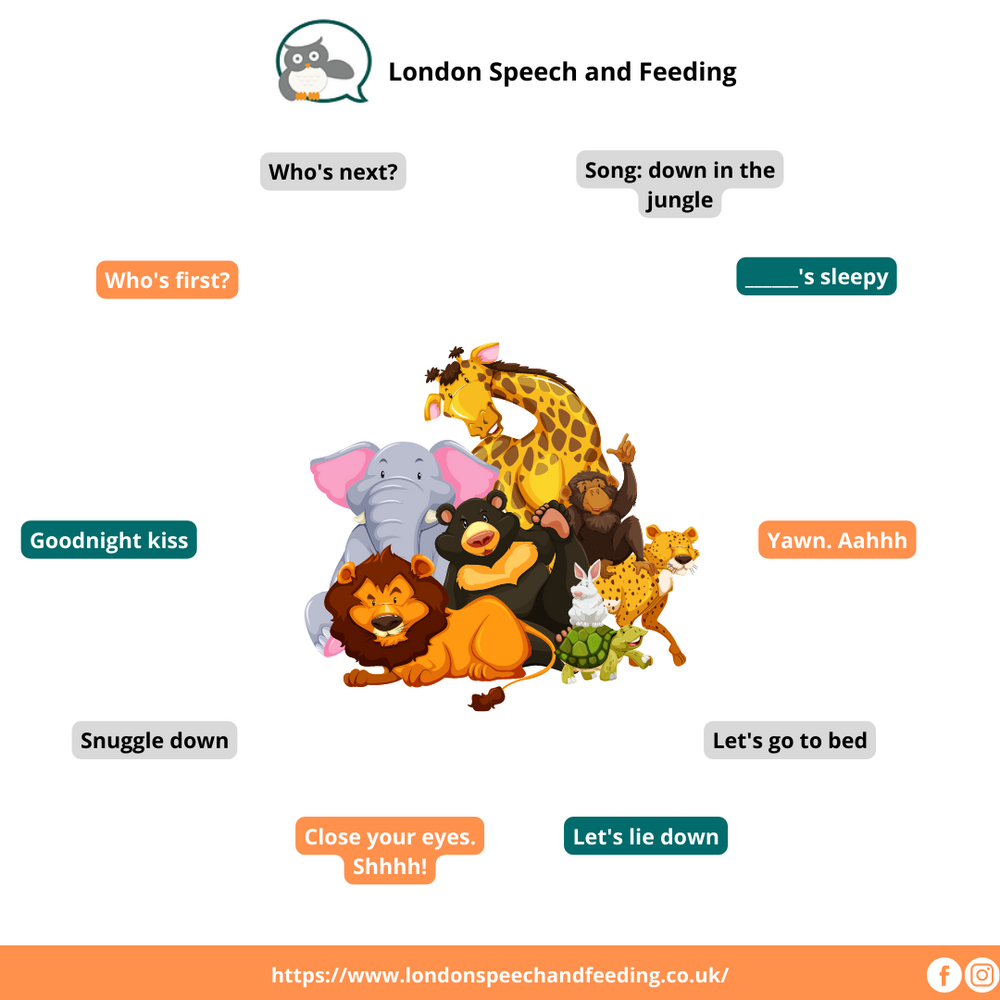
    We wanted to support you by exploring items which you may have at home, and we will give you some key phrases which you can start to model with your child. Whereas our last blog introduced the idea of gestalt language processors, we are now developing ideas to give you the tools to implement activities at home. We recognise how overwhelming it may feel, and this is one of the reasons to make activities as straight forward as possible. Therapy does not need to be complicated; it just needs to be carried out on a regular basis.

    Explore the samples I’ve created to give you an idea of how this might look but please consult with a Speech and Language Therapist who knows about Gestalt Language Processing so that you can work together to develop great home activities for your child.

    Want to learn more about gestalt language processing?

    Please contact me for help.


    Find a speech and language therapist for your child in London. Are you concerned about your child’s speech, feeding or communication skills and don’t know where to turn? Please contact me and we can discuss how I can help you or visit my services page.

    1
  • What is FRONTING?

    Kids Speech Therapist London

    Does your child say “Dough” instead of “Go”? Or “Tea” instead of “Key”? Do you hear a /Sh/ instead of an /S/ does “see” sound more like “she”?

    We Speechies call this a Fronting Pattern which means that a sound that should be produced at the back of the throat with the back of the tongue, like K or G , is said at the front of the mouth with the tip of the tongue, like a T or a D or SH. When this happens speech can be really hard to make out because these sounds are literally everywhere in everyday sentences. Just think how many K’s and G’s we hear in a simple sentence?

    For example, I heard my little student say earlier today: “I know what game we can play in your garden? It’s the one with cones and rings and cushions! I know where it is I can get it.”

    But it sounded like:

    “I know what DAME we DAN play in the DARDEN! It’s the one with TONES and rings and TUSHIONS! I know where it is I TAN DED it.”

    If that sounds familiar to you, here is a little overview of what we can do about it:

    First up it’s always good to start with general speech sounds awareness: does a child hear syllables and intonation? Do they know words that rhyme? Can they follow or copy a simple beat with a drum? Can they listen and hear quiet sounds and loud sounds and can they copy those? Can they follow mouth and tongue movements:, for example : stick out your tongue, lick your lips, click your tongue, blow raspberries?

    Then it really helps to talk about BACK and FRONT of things and to draw attention to the back of the mouth and the back of the tongue and the front tip of the tongue and how sounds are made in the mouth. I often use a puppet to show this or a model of a mouth like this one here in the picture.

    Next we try and listen to words starting with a BACK sounds like a K or a G , and I read out a list of words with those sounds: COW, CORE, CAT, CONE, KEY etc or ARK, EEK, OAK, ACHE…

    Or GOO GUY GUM GONE

    After that we try and see if a student can actually produce a single sound like a K or a G just by itself. If they can, that’s a really great start and if they can’t I help them to produce one – over a few sessions we usually get there. We call this Sound production in isolation.

    Once a child can produce a sound correctly, on its own, we try and start working on very simple words that are really powerful like “GO”!!!!! in a motivating game or “CAR” for little ones who love a car racing track.

    Now that we have established the back sounds and are using it in short words, we can gradually re-train brain pathways and oral- motor/movement pathways to use these new sounds in many words and then short phrases. That can take time!! This is called generalisation and it is not uncommon for it to take up a whole year for fluent speech to be error-free .

    Why does it take so long? Being able to produce a correct and clear K or G sound does not mean it will be used easily. Our brain pathways are fixated or habituated to the error sound. It takes time for habits to change. A child might be able to hear the word TIGER with a G in the middle and she knows that it is not a TIDER but when saying it her tongue automatically moves forward rather than lifts up at the back. It’s a bit like a person who has a rounded back: the brain knows to stand upright and how not to slouch, but when we don’t focus on it, ooops we have slouched again because that is what we are comfortable doing and our body moves with our habit.

    It takes effort and motivation to change our movement patterns and that includes our tongue and lip patterns! We usually get there through a huge variety of games and practice. Lots and lots of repetition is key as is motivation to change.

    Parents and carers are crucial in the success of Speech Therapy!

    We need your feedback at home, the regular short and sweet exercises, the constant positive encouragement and great modelling of speech sounds. We often find that parents are tuned into their child’s error sounds and can understand them much better than anyone else. This is great of course in many ways, however, it also means that the child has less motivation to change: if mummy understands me then my world is ok.

    I will give you a short outline of what different speech therapy models I use in my practice, be it in clinic face to face or on-line in my future blogs soon.


    Find a speech and language therapist for your child in London. Are you concerned about your child’s speech, feeding or communication skills and don’t know where to turn? Please contact me and we can discuss how I can help you or visit my services page.