When you have a child who uses Gestalts it is often difficult to think and adapt clinic activities into those to use at home. More importantly, you find that individualising your activities for your child who uses Gestalt are time-consuming. But you value its importance for their communication development.
You feel so busy, you are taking them to other appointments, or trying to get through your daily activities, all whilst still ensuring your child’s emotional needs are met. You know life should not get in the way of your child’s therapy activities at home, but it does. We know your spare time is precious and limited, so let us achieve your child’s or young person’s goals in the allotted time you have which meets their way of learning (using Gestalts).
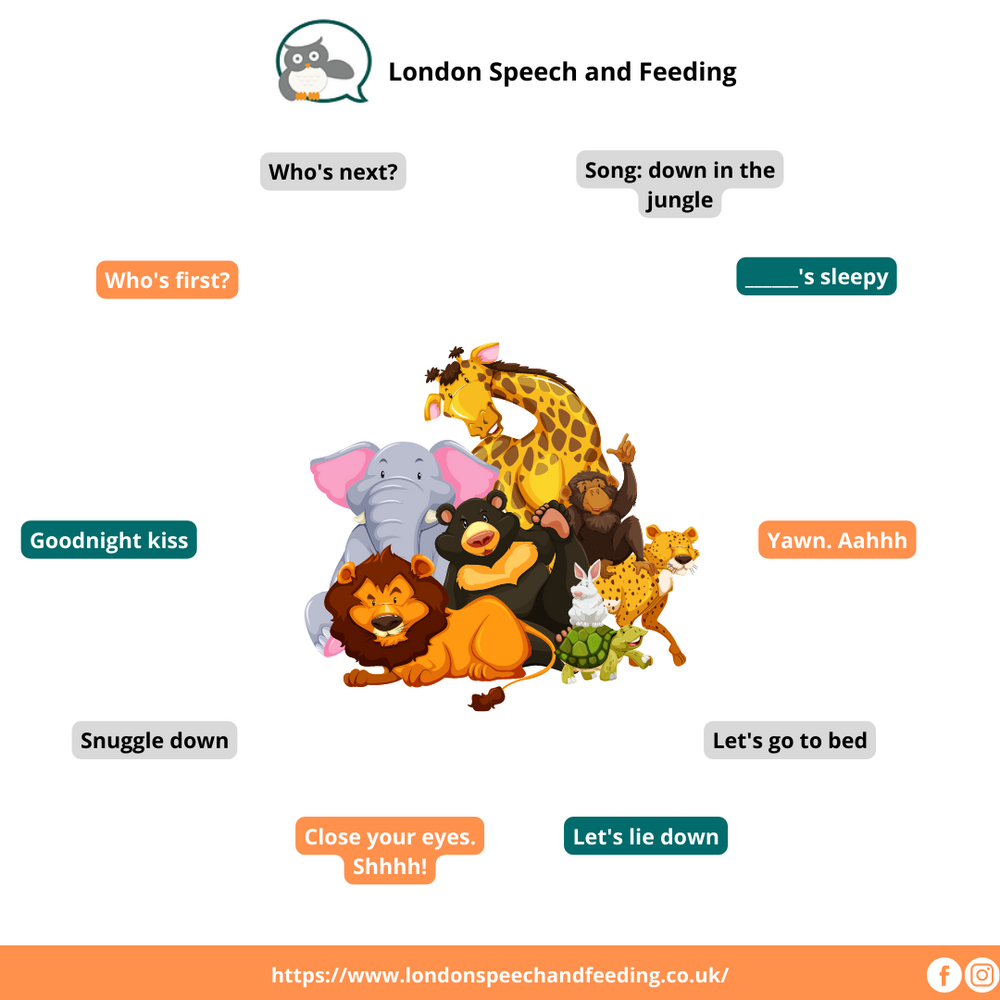
We wanted to support you by exploring items which you may have at home, and we will give you some key phrases which you can start to model with your child. Whereas our last blog introduced the idea of gestalt language processors, we are now developing ideas to give you the tools to implement activities at home. We recognise how overwhelming it may feel, and this is one of the reasons to make activities as straight forward as possible. Therapy does not need to be complicated; it just needs to be carried out on a regular basis.
Explore the samples I’ve created to give you an idea of how this might look but please consult with a Speech and Language Therapist who knows about Gestalt Language Processing so that you can work together to develop great home activities for your child.
Want to learn more about gestalt language processing?
Find a speech and language therapist for your child in London. Are you concerned about your child’s speech, feeding or communication skills and don’t know where to turn? Please contact me and we can discuss how I can help you or visit my services page.
Your Speech Therapist might have been advising you to introduce words to your child with the help of a CORE BOARD. What on earth is she talking about and why would we want to do this, I hear you think – and in fact this is what I get asked a lot, as I often do recommend using Core Boards.
Core boards belong to the category of Augmentative and Alternative Communication (AAC ) and they can be really useful for:
Children or adults who cannot speak at all or who are very hard to understand.
Children who are slow to speak and have difficulty expressing themselves verbally, due to genetic conditions as Down Syndrome, Verbal dyspraxia, Autism or any other learning difficulty that means a child is slow to develop speech.
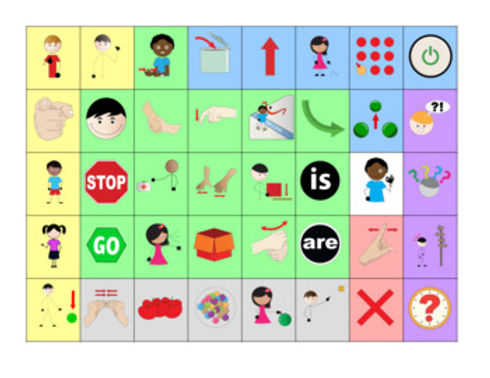
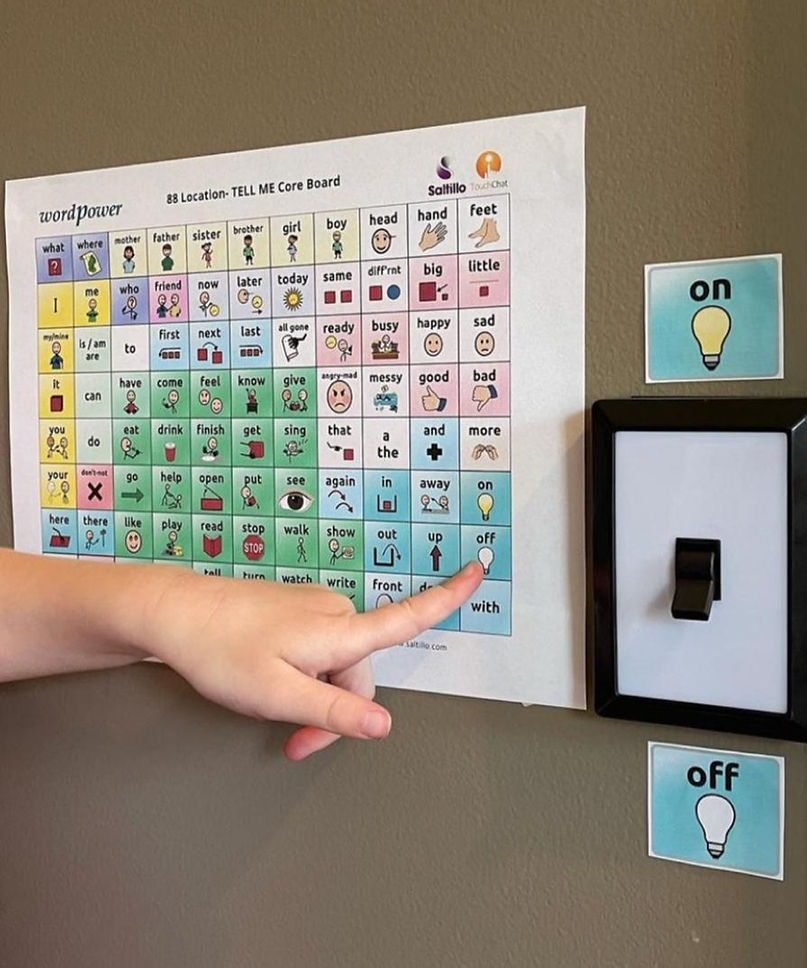
Here is what a Core board might look like, in fact this is one that I love to use. It is made by Beautiful Speech Life, there are a ton of similar boards out there for free. I have also made my own, you can check it out on my Instagram feed.
What is Core Vocabulary/ Core words?
Core vocabulary consists of the most common words used by children throughout a day. In 2003 Banajee and Dicarlo et al found that 50 % of pre-schoolers in their project used nine words consistently across their daily play and meal routines. These words are Core words and are typically the ones you can see on a board, like the one above.
How To Use It
Adults always first need to consistently model and show their child how to use a board. This is key! For example: Adult can point to “YOU” “WANT” ‘MORE” and then point to the cup of Water on the counter. Child could then reply either by shaking his/her head and/or pointing to “NOT” which also stands for “NO”. Then adult can point to “NOT” “MORE” and do an OK sign as well. Eventually Child can initiate a request and point to “I” “ WANT” “MORE” and then point to the cup on the counter.
This is not as cumbersome or limited as it first sounds or appears. Here’s why: As adult you can talk normally and, of course, many words you are using will not be on this board. But some will be, and you will be surprised how many you can find when you start using it. So you could say quite normally: Hey lovely (name of your child) would YOU LIKE some MORE water? The words in capital are on the board which you can point to as you speak normally. Basically, you are showing/saying to your child: “We can speak and these are the pictures we can use to help us; We call this TOTAL COMMUNICATION, as communication is so much more than just words! Great communication can be silent, where we use our facial expression, our smile, our eyes, our hand gestures, body movements and yes, of course, words. But when words fail us, these boards are so helpful.
This still does not answer your original question of: why would I want to do this, I want my child to talk!? You are a SPEECH Therapist, please help my child TALK, not point to pictures, that is not what I had in mind.
Let Me Explain
When speech is difficult for a child it doesn’t mean that there is nothing to talk about! Of course, we want all our children and all people to speak because it is the easiest and most effective way of communicating, no doubt! However, sometimes this is very hard for some children and whilst we are always working towards speech where possible, we also want to make sure that whilst figuring out how to speak, your child has a MEANS TO COMMUNICATE. Using a board like this might well be a temporary strategy but whilst you are using it and working on their speech you will find a reduction in tantrums and frustration as you child is able to express themselves more effectively.
Often we find that as soon as we offer a CORE VOCABULARY like the above sample a child who has had no or very few words suddenly blossoms and starts to point to new words on the board and starts to PRACTICE USING THESE WORDS!! Practice makes perfect, right? Yes it totally does! There is lots of evidence that tells us that using Core Vocabulary Boards ENHANCE AND SUPPORT SPEECH PRODUCTION AND NOT HINDER IT. Using a board like this will only ever be helpful to your child and will never make your child “lazy” – too lazy to speak? NO SUCH THING!
Here is what one of my parents says about the core board we use with her little boy:
“the board has been a game changer, my son is a visual learner so it really helps to have the board as he associates communication so much easier this way. We have incorporated his twin sister who models it’s use and have definitely seen improvement in speech through its support and his frustration around being unable to verbally communicate at times has definitely lessened”
K Connolly, Mother of Tom (aged 3.5 years).
Reading and hearing this makes me so happy!
In addition to general core board above I also sometimes use a Core Board that is specific to an activity, such as for example BLOWING BUBBLES. Below is an example of such a board, which you can use very nicely during a bubble blowing activity and sometimes it is a nice place to start for newcomers, this can be an easy introduction. You can download this and many similar boards on www.widgit.com for free!
There is so much more to say about AAC and using Coreboards, visit my Instagram you can find a bit more information on how I use them.
Find a speech and language therapist for your child in London. Are you concerned about your child’s speech, feeding or communication skills and don’t know where to turn? Please contact me and we can discuss how I can help you or visit my services page.
Imitation, the act of mirroring someone else’s actions, gestures, sounds, or words, is a fundamental skill that plays a crucial role in human development. It’s how babies learn to wave ‘bye-bye’, how toddlers pick up new words, and how children acquire social skills. But for children with autism imitation can be a significant challenge and understanding why it’s important and how to foster it becomes a key focus for parents, educators, and speech and language therapists.
Why is imitation important?
Imitation is a building block for a wide range of developmental skills:
Social interaction: Imitation is the foundation of social reciprocity. When a child imitates, he or she is engaging in a shared experience, connecting with another person, and learning to take turns in social exchanges.
Communication development: Imitation is closely linked to language acquisition. Children often imitate sounds and words before they can produce them independently. Imitation also helps them understand the meaning of gestures and facial expressions, which are vital for nonverbal communication.
Cognitive development: Imitation plays a role in problem-solving, learning new skills, and understanding cause and effect. By imitating actions, children explore their environment and learn how things work.
Emotional development: Imitation helps children understand and share emotions. When a child imitates a smile, he or she may begin to understand the feeling of happiness.
Imitation challenges in autism
Many children with autism face challenges with imitation, which can affect their development in these key areas. These challenges can manifest in different ways:
Difficulty imitating motor actions: Children with autism may struggle to imitate simple motor movements, such as clapping hands, waving, or playing ‘peek-a-boo’.
Limited vocal imitation: Imitating sounds, words, and phrases can be difficult for some children with autism, which can impact their speech development.
Challenges with social imitation: Imitating social cues, such as facial expressions, gestures, and body language, can be particularly challenging for children with autism, affecting their ability to engage in social interactions.
Why do children with autism struggle with imitation?
The exact reasons for imitation difficulties in autism are complex and not fully understood. However, several factors may contribute:
Neurological differences: Research suggests that differences in brain structure and function, particularly in areas involved in social perception and motor control, may play a role.
Sensory processing differences: Some children with autism may have sensory differences that make it difficult to attend to and process the movements or sounds they are expected to imitate.
Attention and motivation: Challenges with attention, focus, and social motivation can also affect a child’s ability to engage in imitation.
How to foster imitation in children with autism
Fortunately, imitation skills can be developed and improved through targeted interventions and strategies. Here are some approaches that I use in my practice as a speech and language therapist working with autistic children and their families:
Create a playful and engaging environment: Children are more likely to imitate when they are having fun and feel motivated. I use toys, games, and activities that the child enjoys.
Start with simple imitation: Begin by imitating simple motor movements that the child is already capable of and gradually introduce more complex actions.
Imitate the child first: As the Hanen Program emphasises, imitating the child’s actions, sounds, and words can encourage him or her to interact and communicate more.
Use visual supports: Visual aids, such as pictures, photos or videos, can help children with autism understand what is expected of them and make imitation easier.
Break down complex actions: Divide complex actions into smaller, more manageable steps. For example, to teach a child to brush their teeth, break it down into steps like ‘pick up toothbrush’, ‘put toothpaste on brush’, and ‘move brush on teeth’.
Reinforce imitation attempts: Provide positive reinforcement, such as praise, smiles, or preferred activities, when the child attempts to imitate, even if the imitation is not perfect.
Integrate imitation into daily routines: Incorporate imitation into everyday activities, such as imitating sounds during playtime, imitating gestures during songs, or imitating actions during self-care routines.
The role of speech therapy
Speech-language therapists play a crucial role in helping children with autism develop imitation skills, particularly in the areas of vocal and verbal imitation. As part of my therapeutic role, I offer the following:
Assessing a child’s imitation abilities.
Developing individualised therapy plans to target specific imitation goals.
Using a variety of techniques to encourage vocal imitation.
Working with parents and caregivers to provide strategies and support for promoting imitation at home.
Summary
Imitation is a fundamental skill that is essential for social, communication, cognitive, and emotional development. While children with autism may face challenges with imitation, it is a skill that can be developed and improved with targeted interventions and support. By understanding the importance of imitation and using effective strategies to foster it, parents, educators, and therapists can make a significant difference in the lives of children with autism, helping them to connect with others, learn new skills, and reach their full potential.
Find a speech and language therapist for your child in London. Are you concerned about your child’s speech, feeding or communication skills and don’t know where to turn? Please contact me and we can discuss how I can help you or visit my services page.
Feeding therapy is a specialised form of therapy and support that helps children develop healthy eating habits and overcome challenges related to food. It’s often used for children with picky eating, feeding disorders, or sensory processing issues.
What is feeding therapy?
Feeding therapy involves a series of techniques designed to improve a child’s eating skills and attitudes towards food. In the UK it’s typically provided by speech and language therapists and dietitians. These professionals work closely with parents and caregivers to create a personalised treatment plan tailored to each child’s unique needs.
How does feeding therapy work?
Feeding therapy sessions are typically 30–60 minutes long and involve a variety of techniques, including:
Family counselling: Providing support and guidance to parents and caregivers. This can help address any practical, behavioural and emotional issues that may be impacting the child’s eating.
Play-based activities: Engaging children in fun activities while introducing new foods or textures. This can help alleviate anxiety and make mealtimes more enjoyable.
Sensory exploration: Helping children become more comfortable with different tastes, smells, and textures. This can be achieved through activities like touching, smelling, and tasting various foods.
Oral motor exercises: Improving chewing, swallowing, and lip coordination. These exercises can help children develop the necessary skills for eating independently.
Behavioural techniques: Using positive reinforcement to encourage healthy eating habits. This can involve rewarding children for trying new foods or eating a variety of meals.
When is feeding therapy needed?
Feeding therapy may be beneficial for children who:
Are picky eaters: Refuse to eat a variety of foods or have strong preferences.
Have feeding disorders: Experience difficulties with eating, such as swallowing or chewing.
Have sensory processing issues: Are sensitive to certain textures, smells, or tastes.
Have medical conditions: Such as autism, cerebral palsy, or gastrointestinal disorders.
Feeding therapy strategies you can try at home
While professional feeding therapy can be invaluable, there are several techniques you can try at home to support your child’s eating development:
Create a positive mealtime environment: Make mealtimes enjoyable and stress-free by avoiding distractions, limiting screen time, and creating a calm atmosphere.
Create regular mealtimes and mealtime routines: Introduce set ways of announcing meal times, including songs or short nursery rhymes, try and involve your child with table setting, even just carrying their spoon to the table and putting the beaker next to the plate and ensure that meal time finishes after about 30 minutes, again with a set routine so that the child always knows: this is how we do it in our home, now I am finished and meal time is over.
Introduce new foods gradually: Start with small amounts and gradually increase exposure. This can help reduce anxiety and make new foods less overwhelming.
Model healthy eating: Show your child how to enjoy a variety of foods by eating a balanced diet yourself.
Avoid forcing food: Allow your child to choose and explore foods at their own pace. Forcing them to eat can create negative associations with food.
Seek professional help
If you’re concerned about your child’s eating habits, consult with a feeding therapist. We can provide guidance and support.
Remember, feeding therapy is a collaborative process between parents, caregivers, and professionals. With patience, understanding, and the right strategies, you can help your child develop healthy eating habits and enjoy meals.
Would you like to know more about specific techniques or have any other questions about feeding therapy?
Feeding and Dysphagia (Swallowing) Specialist The London Speech and Feeding Practice
The London Speech and Feeding Practice
Find a speech and language therapist for your child in London. Are you concerned about your child’s speech, feeding or communication skills and don’t know where to turn? Please contact me and we can discuss how I can help you or visit my services page.
As speech and Language therapists (SLTs), we know that where your tongue goes, so goes your sound. This blog post will explore why tongue placement is so vital for speech correction and how we use tools and techniques to help our clients find their ‘sweet spot’ for sound production.
Let me show you here a little video clip where I am using my dentist’s mouth/teeth model to help my clients navigate their tongue movements.
The tongue: A tiny muscle with a big job
The tongue is a small but mighty muscle. It’s incredibly versatile, playing a key role in eating, swallowing, and, of course, speaking. For each speech sound, the tongue, along with the lips and jaw, needs to move to a very specific spot. Think of it like a dance: every part of your mouth has a choreographed movement to produce the correct sound. If the tongue is out of sync, the sound comes out muffled, distorted, or just plain wrong.
The trouble with our tongue movements is that most of us never think about how the tongue has to move and what it does to: swallow, chew, drink, suck and speak. Most parents when asked to think about their own tongue placement for say the /S/ sound are completely lost as to what their tongue is doing. Yet, of course, they produce a perfect /S/ and perfect speech in general. The same goes for swallowing. When did you last think about what happens in your mouth when you swallow? I bet you have not thought about it. We ‘just do it’, right?
Why is tongue placement so important?
Accurate tongue placement is the foundation of clear articulation. When a child struggles with a particular sound, it’s often because his or her tongue isn’t quite reaching the right spot or moving in the correct way. For example, the /S/ sound requires the tongue to be slightly raised and positioned behind the top teeth, creating a narrow channel for air to flow through. If the tongue is too far forward, you might get a /TH/ sound instead. If it’s too far back, the /S/ can sound muffled.
Visual aids: Our secret weapon
We SLTs love our visual aids! They’re incredibly helpful for showing clients exactly where their tongue needs to be. Here are some of our favourite tools:
Mirrors: Mirrors provide instant feedback. Clients can see their tongue’s position and make adjustments in real-time. We often use hand mirrors or even the mirror on a compact for quick checks.
Tongue depressors: These simple tools can gently guide the tongue to the correct position. We might use them to show where the tongue tip should rest for the /L/ sound or how the sides of the tongue should touch the molars for the /K/ and /G/ sounds.
Diagrams and models: Pictures and models of the mouth can help clients visualise the tongue’s movements. We might use a cross-section diagram of the mouth to show how the tongue forms different sounds.
Beyond the tongue: The jaw’s role
While the tongue takes centre stage, the jaw plays a supporting role. It provides a stable base for the tongue and helps control the opening and closing of the mouth. Sometimes, jaw stability is an issue, and we might use techniques to help clients find a comfortable and stable jaw position.
Making it fun and engaging
Learning correct tongue placement can be challenging, but we make it fun! We use games, stories, and playful activities to keep clients motivated. For younger children, we might use silly voices or pretend to be animals. For older children, we might incorporate their interests, like using a car analogy for tongue movements.
The takeaway
Correct tongue placement is essential for clear speech. By using visual aids, interactive techniques, and a bit of creativity, we can help our clients master their speech sounds and communicate with confidence.
If you have any concerns about your child’s speech, don’t hesitate to reach out to a qualified speech and language therapist, we are here to help! Contact me via my contact form.
Sonja McGeachie
Early Intervention Speech and Language Therapist
Feeding and Dysphagia (Swallowing) Specialist The London Speech and Feeding Practice
The London Speech and Feeding Practice
Find a speech and language therapist for your child in London. Are you concerned about your child’s speech, feeding or communication skills and don’t know where to turn? Please contact me and we can discuss how I can help you or visit my services page.
If you’re worried about your child’s speech, you are absolutely not alone. Many parents I work with tell me the same thing:
‘I’ve been Googling…’ ‘I asked ChatGPT what activities to try…’ ‘TikTok said we should practise this sound every day…’
It makes complete sense. When waiting lists are long, evenings are quiet, and your child is struggling to communicate, it’s natural to look for help wherever you can find it.
AI tools can actually be helpful in some ways. But they also have clear limits especially for children with significant speech delays or speech sound disorders.
Here’s an honest, balanced guide to what AI can do, and what it simply can’t.
✔️ What AI can help with
1. Explaining things in simple language
AI can be very helpful for explaining speech and language terms in a way that’s easy for parents to understand for example, what a phonological delay is, or what Childhood Apraxia of Speech means. It can also suggest possible reasons for a child’s speech delay based on the information you provide.
The difficulty is that parents (or teachers) can only ask questions based on what they notice or perceive to be the problem. In practice, this doesn’t always tell the full story. For example, parents often report that their child ‘can say certain words’, but during an assessment we may find those words are actually produced with consistent error patterns. These patterns give important clues about the underlying nature of the difficulty, whether it’s a delay or a disorder and they guide the speech therapist in choosing the most effective targets to improve intelligibility.
2. Suggesting games and activities
AI is very good at suggesting ideas for games and practice, such as word lists, simple play activities, sound practice games, book suggestions, and ways to encourage talking within everyday routines. These can be especially helpful when you feel stuck or want some fresh inspiration for supporting your child at home. It can help to think of AI as a big ideas bank, somewhere to dip into when you need new, playful ways to keep practice engaging.
3. Helping you prepare questions for a therapist
Some parents use AI to list questions before an assessment, understand reports and organise concerns.
This can make therapy feel less overwhelming and more collaborative.
Used this way, AI can actually support the therapy process.
❌ Where and why AI cannot replace real life speech therapy
There is substantial research supporting the effectiveness of real-life speech therapy compared to generic online resources or AI-generated suggestions. Here are some key points highlighting why in-person therapy is often more beneficial:
Personalisation: Speech therapists assess each child’s unique needs, strengths, and challenges through direct observation and interaction. This personalised approach allows for tailored interventions that address specific issues, which generic resources cannot provide.
Nuanced understanding: Therapists are trained to recognise subtle cues in speech production, including the nuances of sound articulation, language comprehension, and social communication. This expertise enables us to identify underlying issues that may not be apparent through generic assessments.
Motivational support: A speech therapist can provide encouragement, motivation, and emotional support, which can significantly enhance a child’s willingness to participate and engage in therapy. This relational aspect is crucial for building confidence and reducing anxiety around communication.
Evidence-based practices: As a highly trained and specialised speech therapist I utilise evidence-based practices that are grounded in research, ensuring that the techniques used are effective and up to date. This contrasts with generic online information, which may not always be reliable or validated.
Progress monitoring: In-person therapy allows for ongoing assessment and adjustments to the treatment plan. We track progress over time and modify strategies as needed, ensuring that the therapy remains effective and relevant.
Research studies consistently show that individualised, face-to-face interventions lead to better outcomes in speech therapy than generalised approaches. For parents and caregivers, seeking professional help tends to provide a more effective path toward improving their child’s communication skills.
The healthiest way to think about AI
AI works best as a starting point, not a substitute. You might use it to understand your child’s report and learn how speech develops,
But if your child has significant delay or difficulty being understood, what makes the real difference is:
A tailored assessment
A clear therapy plan
Expert target selection
Ongoing adjustment
Support for both child and you the parent!
Dear parents,
If you’ve been turning to AI for help, it doesn’t mean you’re doing anything wrong. It means you care!
But please know the best outcomes usually come from combining your daily support at home with guidance and support from your speech therapist who knows you and your child.
Many of my past and present clients tell me that they really value my ‘handholding’ and me guiding them in between the sessions. A quick check in is often all that is needed but it makes a huge difference!
Find a speech and language therapist for your child in London. Are you concerned about your child’s speech, feeding or communication skills and don’t know where to turn? Please contact me and we can discuss how I can help you or visit my services page.
As a speech and language therapist, one of the most common questions I hear from parents is:
‘They can talk, but their speech still sounds immature. Is this normal?’
Many children between the ages of three and seven use speech patterns that make their words sound different from adult speech. These patterns are known as phonological processes, and for younger children, they are a normal part of speech development.
However, when these processes persist beyond the expected age, they can start to affect clarity, confidence and learning, especially once children enter school.
Phonological processes are patterns of sound simplification that children use while their speech system is developing.
Instead of learning each sound one by one, children initially organise sounds into patterns that make speech easier to produce. This is a normal and efficient strategy for a developing brain.
For example:
saying ‘tar’ instead of ‘car’
saying ‘poon’ instead of ‘spoon’
saying ‘bud’ instead of ‘bus’
These are not ‘bad habits’. They are part of how speech develops.
The key question is how long these patterns last.
Common phonological processes (and when they usually disappear)
Below are some of the most common processes parents notice in 3–7-year-olds.
1. Final consonant deletion
Leaving off the last sound in a word
‘ca’ for cat, ‘da’ for dog
Typically resolved by 3–3½ years
2. Fronting
Replacing back sounds (k, g) with front sounds (t, d)
‘tar’ for car, ‘do’ for go
Typically resolved by 3½–4 years
3. Cluster reduction
Omitting one sound in a consonant cluster
‘poon’ for spoon, ‘top’ for stop
Typically resolves by 4–5 years (some clusters slightly later)
4. Gliding
Replacing /R/ or /L/ with /W/ or /Y/
‘wabbit’ for rabbit, ‘yion’ for lion
Can be typical up to 5–6 years
5. Weak syllable deletion
Leaving out unstressed syllables
‘nana’ for banana
Usually resolved by 4 years
If these patterns continue past the expected age, speech can remain difficult to understand particularly for unfamiliar listeners such as teachers, peers, and also Auntie Karen or grandparents who visit once in a while.
Why phonological processes matter in school-age children
By the time children reach reception and Year 1, speech clarity becomes increasingly important.
Persistent phonological difficulties can affect:
being understood by teachers and peers
phonics and early reading
spelling
confidence in speaking
willingness to participate in class
Some children become aware that they ‘sound different’ and may speak less, avoid longer words, or become frustrated when misunderstood.
What’s the difference between a delay and a disorder?
This is an important distinction.
A phonological delay means a child is following the normal pattern of development, just more slowly.
A phonological disorder means the child is using atypical patterns, or continuing age-expected patterns well beyond when they should have resolved.
You may want to seek professional advice if your child:
is 3½ years or older and still hard to understand
is understood well by family but not by others
becomes frustrated or avoids talking
has difficulty with phonics or spelling
uses several phonological processes at once
has not made progress despite time and encouragement
Early support does not mean something is ‘wrong’. It simply helps speech development move forward more efficiently.Research consistently shows that unresolved phonological processes beyond the expected age can impact intelligibility, literacy and confidence (Dodd, 2014; Bowen, 2015).
How speech therapy helps phonological development
Phonological therapy is not about drilling individual sounds endlessly.
Instead, therapy focuses on:
helping children recognise sound patterns
building awareness of contrasts (e.g. ‘tar’ vs ‘car’)
practising speech in meaningful, playful ways
supporting generalisation so progress carries into everyday speech
For school-aged children, therapy is usually structured, motivating and highly targeted and progress can be very encouraging.
A final reassurance
Many children with phonological difficulties go on to develop clear, confident speech with the right support.
If you’re unsure whether your child’s speech is ‘just a phase’ or something that needs attention, a professional assessment can give clarity and peace of mind.
Find a speech and language therapist for your child in London. Are you concerned about your child’s speech, feeding or communication skills and don’t know where to turn? Please contact me and we can discuss how I can help you or visit my services page.