Explore how Intensive Interaction develops Autistic children’s communication

|

Intensive Interaction is an approach that I might suggest for your child. Here is an overview of this approach to increase your knowledge. There are a range of approaches that overlap and having trained in them all I use them all interchangeably to tailor to each child individually. This approach is particularly good for children who work mostly to their own agenda and find it hard to engage with others.

So, what is Intensive Interaction?

According to its founder, Hewett (1980), the approach “involves mirroring a person’s actions, sounds and facial expressions.” This allows your child to recognise and form communication between themselves and another, in a fun, play-based setting. Attention and listening are the fundamentals to speech and language development. By using the Intensive Interaction approach, we can increase the time your child can attend for and with another person. We are working towards a child enjoying another person’s presence. We are hoping to make gains with playing together with a child, taking turns and achieving reciprocity. That is the platform which we need to start with to build communication, language, words and perhaps even speech.

There are many aspects that this approach supports:

  • such as using facial expressions
  • being in the presence of other people
  • having a shared space
  • attending to others
  • recognising and using non-verbal behaviours (e.g., gestures)
  • making sounds/noises (vocalisations) that have meaning
  • and eye contact. Although, we must be careful when suggesting ‘improving’ the use of eye contact. For some individuals making eye contact can be physically painful. So be aware that we are not making our children ‘look’ we are encouraging their natural behaviour.

Who benefits from Intensive Interaction?

Children with more complex communication and learning delay can benefit from the Intensive Interaction approach. Each session can be adapted to the needs of the individual and the sessions can be designed to use the whole or part of the approach. It is especially useful for children who are finding it hard to engage in any way socially with another person. Autistic children who tend to work to their own agenda often benefit from this approach.

How is Intensive Interaction implemented?

You need to have an environment that your child is comfortable in, and to be able to come down to their level so that you can see each other. This is why I often visit children in their own homes to ensure that they are comfortable and that they can withdraw for periods of time if they need to as well.

Ensure your child knows you’re there and you are 100% present. This is very important. I would recommend that you put your phone away for some 10 minutes or so and give your undivided attention to your child for that period of time.

Waiting

Waiting is very important: we need to give your child time to process what is happening around them. After waiting for a response, you might want to start copying any gestures they use, any facial expressions they make, or perhaps imitate any sounds. You’ll want to continue with this for a few minutes to see if the communication between you and your child changes. Remember always take the cues from your child; if they communicate a message with you, respond. It might be that they are ready to finish and that they’ve shown this by walking away or signing.

Giving your child a way to respond is vital. We can use visuals to support their communication. We can create ‘yes’ and ‘no’ symbols so they can use them in a functional way.

A top tip in these sessions is to use mirrors, so that your child can see and begin to recognise their own facial expressions.

There are other programmes that overlap with Intensive Interaction such as Hanen with following your child’s lead and the Gina Davies Curiosity Programme.

Now you know a bit about Intensive Interaction, why not book a call to discuss how we can support your Autistic child’s communication using this evidence-based approach.


Find a speech and language therapist for your child in London. Are you concerned about your child’s speech, feeding or communication skills and don’t know where to turn? Please contact me and we can discuss how I can help you or visit my services page.

0

Similar Posts

  • · ·

    Living life with a lisp

    You may be questioning ‘will my child grow out of having a lisp?’ There are so many myths out there that it’s sometimes difficult to find your way out of a complex maze of information.

    The good news: lisps can be successfully treated by a Speech and Language Therapist and the earlier it’s resolved, the better. We know from the evidence base that some children’s lisps will resolve and, as always, it is completely age appropriate to have this speech pattern up until aged 4 ½.

    As with any speech and language targets your child will need to be motivated to practise their newly acquired techniques, at home and in other settings. They will eventually be able to generalise this skill, but it takes lots of practice. So, think carefully about if your child is ready and motivated before commencing Speech and Language Therapy.

    There are essentially two ways in which your child has acquired a lisp. It’s key here to mention that parents have no blame in this.

    1. They’ve mis-learned it and now incorrect production has become a habit
    2. Children have difficulties organising the sounds to make a clear production

    You may be surprised to realise that there are different types of lisps. But all the techniques will be the same.

    1. Interdental lisp

    When your child pushes their tongue too far forward, they will make a /th/ sound instead of /s/ and /z/

    1. Dental lisp

    This is where your child’s tongue pushes against their teeth

    1. Lateral lisp

    Air comes over the top of the tongue and down the sides

    1. Palatal lisp

    Your palate is the roof of your child’s mouth. Sometimes they will touch their palate when making certain sounds (e.g., /s/ and /z/)

    It’s useful for you to know what type of lisp your child has because you can then support them to make the correct production. You’ll be able to talk about where in the mouth their tongue is and where it needs to be to produce a clear sound. Your Speech and Language Therapist will be able to help you with this.

    Top therapy tips for lisps

    1. Awareness is key. Does your child know where their tongue and teeth are (i.e., are they behind their teeth)? Do they notice the air escaping? Use a mirror so that your child can see not only themselves but also you in the mirror.
    2. Repetition! As with most therapeutic intervention, practice makes perfect. So little and often is key!
    3. Make sessions fun, perhaps around your child’s interests or allow them to drink from a straw
    4. Comment on how the sound is produced (e.g., /z/ is like a bee, /s/ is like a snake)
    5. Use tactile cues. Your child’s vocal folds vibrate when they produce a sound like /z/ but not with /s/. You could use the words ‘loud’ and ‘quiet’ to describe this.
    6. Start with a /t/ sound and gradually elongate the sound to an /s/

    Having a lisp may not be problematic for some, but for other children, it can have a significant impact on their emotional wellbeing. Intervening at an early age can prevent this from happening. We always advocate for early intervention!

    Contact Sonja for support on resolving your child’s lisp.


    Find a speech and language therapist for your child in London. Are you concerned about your child’s speech, feeding or communication skills and don’t know where to turn? Please contact me and we can discuss how I can help you or visit my services page.

    0
  • ·

    Baby-Led Weaning: A Speech and Language Therapist’s Take

    Let’s face it, introducing solids is a rollercoaster for parents. You’re bombarded with advice (solicited and otherwise) on purees, spoon-feeding, and the much-discussed ‘baby-led weaning’ (BLW). As a speech-language/feeding therapist I see the world through the lens of communication and development, as well as safe munching and swallowing. BLW can be a fantastic option for many little foodies. But is it right for yours? Let’s take a dive into the messy, hilarious world of toddler feeding.

    BLW in a nutshell

    Your baby, perched in their highchair, eyes wide with excitement and curiosity reaches out for a platter of food. He/She grabs a fat avocado slice, and curiously explore it with his/her lips, gums and tongue. He/She spits some of it out, mashes bits of it into his/her hair, there was a tiny swallow and the rest is smeared onto the high chair tray. Now he/she grabs a bit of the banana and rinse and repeat as before, except this one he/she keeps in his/her mouth for bit longer and takes a tiny bit more before the rest gets deposited into his/her bib.

    This, in a nutshell, is BLW! It’s all about letting your little one take the lead in exploring new foods, textures, and tastes. No spoon-feeding, just pure, messy, self-directed feeding fun.

    The pros of letting your little one loose on solids:

    • Motor Skills: BLW is a sensory party for developing motor skills. Picking up that slippery banana or gumming a chewy piece of toast strengthens those tiny hands and mouth muscles. These are the very skills they’ll need for future talking and chewing.
    • Texture Time: BLW exposes your baby to a variety of textures right from the start. Think soft, steamed broccoli florets or smooth, banana half-slices. This sensory exploration helps them develop an understanding of different textures in the world, which can translate to better oral motor skills needed for speech development.
    • Independence: BLW fosters a sense of self-feeding independence. Your toddler learns to control how much he/she eats and the pace of his/her meal. This can lead to better self-regulation later on, not just with food, but in other areas of his/her development too.
    • A wider variety of flavours: BLW encourages exposure to a wider variety of tastes and smells. Let your baby discover the sweetness of roasted sweet potato or the tang of mashed avocado! This early exploration can lead to less picky eating down the road.

    There are some valid concerns:

    • Gagging vs. Choking: One of the biggest concerns parents have about BLW is choking. However, gagging is a natural reflex that helps babies learn to move food safely around their mouths. Choking is much rarer, and with proper food selection and supervision, the risk is very low. The con here really is parental anxiety more than anything else and if you can overcome this then a bit of gagging is just fine and part of the process. Choking, again most children do choke occasionally a bit! Of course, close supervision and common sense is very important here.
    • It’s ever so messy!: Be prepared for mashed banana on the highchair tray, rogue peas flung across the room, and a general sense of chaos. But then again, this is an important part of the learning process! I would encourage you to embrace the mess (within reason and your personal tolerance level) and focus on the fun of exploration.
    • Nutritional Concerns: Some parents worry that babies won’t get enough nutrients with BLW. While it might take a while for them to master the art of self-feeding, a healthy child’s body is pretty good at self-regulating. Offer a variety of healthy options, and he/she will eventually get the hang of it.

    BLW: Is it right for your Little One?

    BLW isn’t a one-size-fits-all approach. Here are some things to consider:

    • Developmental Milestones: Babies should be able to sit up with good head control and show an interest in food before starting BLW.
    • General good health and absence of food intolerances, allergies, or other significant health issues which might dictatea more controlled feeding regime.
    • Gag Reflex: A strong gag reflex is a good sign. It shows your baby’s natural ability to move food safely around their mouth. If, however, your baby’s gag is overly sensitive and causes frequent bouts of vomiting please consult your health care professional for an assessment (GP, Paediatrician, Dietician, Speech and Language – Feeding Therapist).
    • Your Comfort Level: BLW requires a relaxed and patient approach. If you’re feeling stressed about the mess or potential choking hazards, it might not be the right fit for you.

    A final mouthful:

    BLW can be a fantastic way to introduce your baby to solids. It promotes exploration, independence, and a love for food. Remember, there’s no pressure to go all-in on BLW. You can always combine it with spoon-feeding or purees to find an approach that works for your family and your child. The most important thing is to create a positive and relaxed mealtime environment where your little one can explore the wonderful world of food at their own pace.

    P.S. As an SLT, I always recommend chatting with your health care professional. This way you can address any concerns you might have and ensure your baby is developmentally and physically on track for this exciting new chapter.

    Don’t hesitate to contact me!

    Sonja McGeachie

    Early Intervention Speech and Language Therapist

    Feeding and Dysphagia (Swallowing) Specialist The London Speech and Feeding Practice

    The London Speech and Feeding Practice


    Find a speech and language therapist for your child in London. Are you concerned about your child’s speech, feeding or communication skills and don’t know where to turn? Please contact me and we can discuss how I can help you or visit my services page.

    1
  • Speech sound disorders

    Kids Speech Therapist London
    Speech Sound Disorders

    Treatment Approaches – A Typical Session

    There are various great ways to treat speech sound disorders and I use all the approaches available selectively; I decide what works with each individual child and I also vary the approach depending on the child’s frame of mind at any given time during my session.

    Some of the approaches are more “drill-based” and require a child to be able to pay attention and really participate actively in the therapy, and this is what I am showing you today with this video clip.

    My little student here has been working with me for some time and from only saying a handful of words which were not very easy to understand he has come a long way. He does have some features of Verbal Dyspraxia which I shall briefly outline here:

    • Making sounds in general is a struggle, especially when asked to copy certain sounds, example: ‘can you say: a ee ou oo?”
    • Repeating sound sequences or words sequences is hard, for example: “say p-t-k in sequence” or “say fish chips fish chips fish chips
    • When saying the same word again and again, different mistakes can be heard
    • Intonation difficulties: speech sounds monotonous
    • Vocabulary is very limited

    Some therapy approaches are more play based, for example the Core Word method: here we pick a few words at a time which are very significant to the child and therefore highly motivating to try and say. These could be characters of Pokemon or Minecraft for example, or simple words like “GO!”

    When you watch the video you will see that I use a lot of visual prompting, such as showing him where the tongue is moving to or from. I do this with my index finger and this approach is called Tactile Cueing or “Cued Articulation”. Part of the approach is to give a visual prompt and then reduce the prompt as the learner is more able to produce the correct sounds. Once he can produce the sound on its own, we quickly move to the sound within a word.

    I do mix and match my approaches and in fact here I am drilling but I also use the Core Word which for him (YELLOW) — it’s his favourite colour and I happen to have quite a few good games where a YELLOW something or other can be asked for….. WHO KNEW!? 🙂


    Find a speech and language therapist for your child in London. Are you concerned about your child’s speech, feeding or communication skills and don’t know where to turn? Please contact me and we can discuss how I can help you or visit my services page.

  • ·

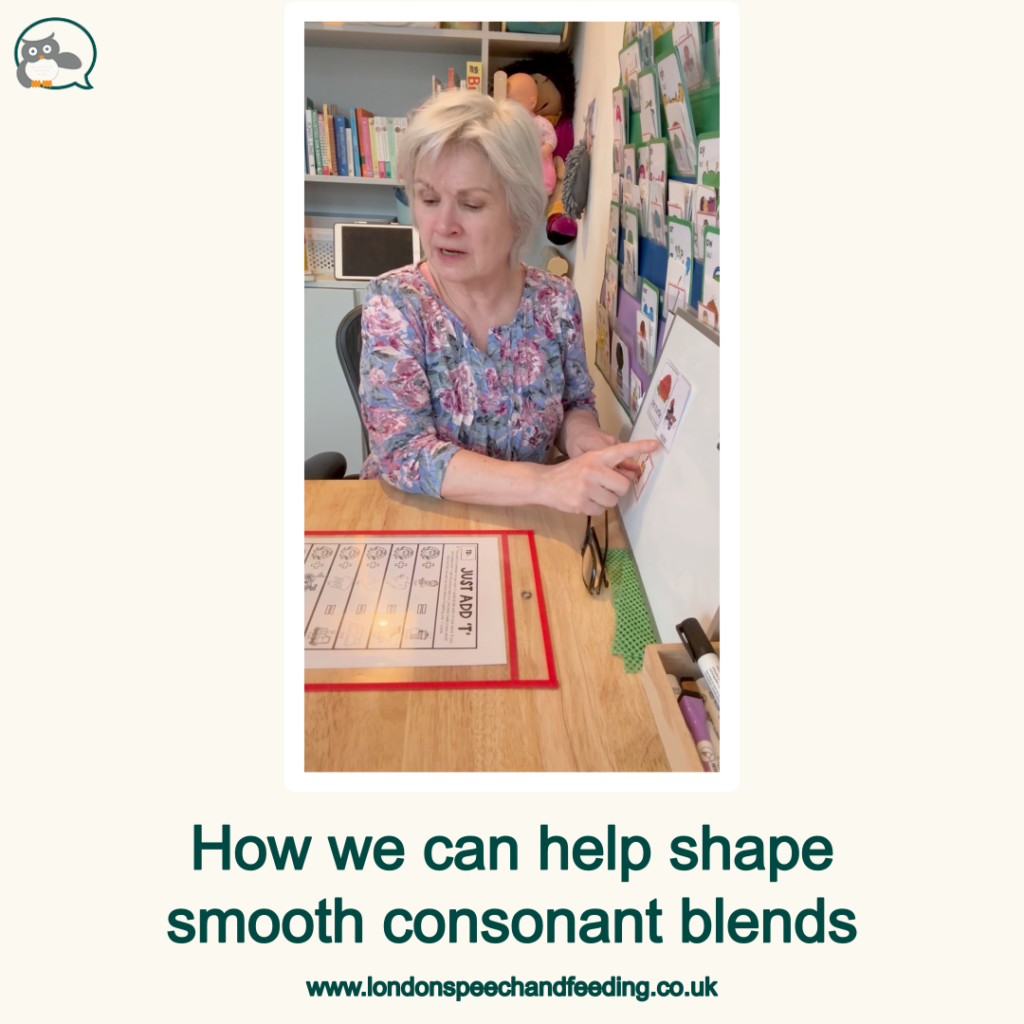
    How we can help shape smooth consonant blends

    For many children, especially those navigating Childhood Apraxia of Speech (CAS), the challenge isn’t just making individual sounds. It’s the ‘speech gymnastics’ required to move smoothly from one sound to the next.

    You might notice that instead of saying ‘Train’, your child says ‘Ter-ain’, or for ‘Frog’, you hear ‘Fer-og’. That sneaky little ‘uh’ sound in the middle is what we call a schwa vowel. In the world of speech science, this is known as epenthesis. It’s essentially a ‘repair strategy’ the brain uses to break up a difficult cluster of sounds into two easier pieces.

    While it might seem like a small detail, that tiny vowel makes a big difference in how fluent and clear a child’s speech sounds. In today’s post (and the video below), I am working with my student on ironing out that schwa by focusing on co-articulation—the art of getting the mouth ready for the second sound while still finishing the first.

    The ‘best friends’ strategy

    To help my student understand this complex movement, I use visual cues and a story. There are many ways to portray two sounds living closely together, but for this session, I used the ‘Best Friends’ story.

    In our story, the /T/ and the /R/ are older brother best friends who want to play together. The ‘schwa’ sound is represented by a little sister who keeps trying to jump in the middle of their game! Because my student has a younger sister, this scenario was instantly familiar and helped him visualise why we needed to ‘close the gap’ between those two sounds.

    Alternative methods I often use:

    Beyond stories, I often use other visual and tactile methods to show the closeness of two sounds:

    • The sliding finger: I draw two dots on a paper—one for /T/ and one for /R/. We slide a finger quickly from one to the other. I might say, ‘Don’t let the ‘uh’ monster jump in the gap!’
    • The rubber band: We stretch a rubber band as we speak. I tell my student that the word is one long, smooth stretch, rather than two separate ‘pops’.
    • Visual cues for ‘quiet’ sounds: I often put my finger to my lips or tap my throat to remind a child to keep the first sound voiceless. If the voice stays ‘off’ during the /T/, it’s much harder for that schwa vowel to creep in.

    The importance of ‘pure’ modelling

    A major hurdle in clearing up these blends is how we, as adults, model sounds. Often, when teaching the alphabet, we say ‘Kuh’, ‘Puh’ or ‘Tuh’. But if you listen closely, you’re actually adding a vowel! If a child learns that /K/ says ‘Kuh’, it’s only natural they will say ‘Kuh-R’ for /KR/.

    To give your child a cleaner blueprint, try modeling ‘pure’ sounds. Think of whispering rather than talking:

    • The /K/ sound: A short, sharp burst of air from the back of the throat. No voice! (A quiet /K/ click).
    • The /P/ sound: Just a ‘pop’ of air from the lips. If your throat vibrates, the vowel has snuck in.
    • The /T/ sound: A tiny tap of the tongue behind the teeth.

    Why is this important?

    You might ask, ‘If I can still understand them, does it really matter if they say “ter-ain”?

    The goal of speech therapy isn’t just functional communication; it’s building phonological awareness. When a child adds extra vowels, it can eventually impact their literacy. If they hear ‘ter-ain,’ they are much more likely to eventually spell it as ‘terain’ or ‘traint’.

    By helping them master these clusters through co-articulation now, we are setting them up for success in reading and writing. And we are giving them the confidence to speak with ease.

    Feel free to contact me if your child needs help with clusters or other difficulties either aligned with Childhood Apraxia of Speech or other articulation difficulties.

    Sonja McGeachie

    Highly Specialist Speech and Language Therapist

    Owner of The London Speech and Feeding Practice.

    References

    • Hall, N. (2011). Vowel Epenthesis. In The Blackwell Companion to Phonology (eds M. Oostendorp, C.J. Ewen, E. Hume and K. Rice). In this work, epenthesis is defined as the insertion of a vowel to break up complex consonant clusters into simpler, more manageable syllables. This is often viewed as a ‘repair strategy’ used by the brain when a transition between sounds is too complex to execute quickly.
    • Aichert, I., & Ziegler, W. (2004) Brain and Language 88(1):148-59. Syllable frequency and syllable structure in apraxia of speech. This research highlights that children with Apraxia often struggle specifically with word-onset clusters, leading to distortions like the schwa.
    • Browman, C. P., & Goldstein, L. (1992) Phonetica 1992;49(3-4):155-80. Articulatory Phonology: An Overview. This paper explains that fluent speech requires ‘gestural overlap,’ where the movements for two different sounds happen simultaneously. This supports the ‘Best Friends’ method of keeping sounds close together.

    Health Professions Council registered
    Royal College of Speech & Language Therapists Member
    Member of ASLTIP

    Find a speech and language therapist for your child in London. Are you concerned about your child’s speech, feeding or communication skills and don’t know where to turn? Please contact me and we can discuss how I can help you or visit my services page.
    3
  • ·

    The great air debate: How different swallowing patterns impact breastfeeding and reflux

    The great air debate

    As a Speech and Language Therapist specialising in infant feeding, I often hear from worried mums describing their breastfed baby’s fussiness. ‘My baby is so burpy and gassy,’ ‘might it be reflux?’ or ‘she just seems uncomfortable after every feed’. While these concerns are incredibly valid and distressing for both baby and mum (and dads!), the underlying cause isn’t always what you might think. Often, the culprit isn’t primarily a digestive issue, but rather a mechanical one: how effectively your baby is managing air during feeding.

    Many parents are told their baby has ‘colic’ or ‘reflux’ and are offered solutions that don’t quite hit the mark because they overlook a fundamental aspect of feeding: the suck-swallow-breathe sequence. Understanding this intricate dance can be the key to unlocking a calmer, happier feeding experience for your baby and you.

    Understanding the suck-swallow-breathe sequence

    Your baby’s mouth, tongue, jaw, and throat muscles work together in a precise rhythm like a beautifully orchestrated symphony. First your baby draws milk, then swallows it, and then takes a breath, all without interruption. This is the ideal suck-swallow-breathe (SSB) sequence.

    When the SSB sequence functions optimally, a baby latches deeply, creates good suction, draws milk, swallows efficiently, and then pauses just long enough to take a gentle breath before the next suck. This smooth, coordinated process minimises the amount of air swallowed.

    However, for various reasons (it could be a shallow latch, oral motor challenges, an uncoordinated suck, or even an overly fast milk flow) this sequence can get a bit out of sync. Instead of a smooth rhythm, you might see:

    • Suck-suck-swallow-gasp!: Too much air pulled in with the swallow.
    • Rapid, shallow sucking followed by gulping: Inefficient milk transfer and air intake.
    • Clicking noises during feeding: Loss of suction, indicating air entry.
    • Frequent detaching and re-latching: Often to ‘catch a breath’ or because of discomfort.

    Each of these patterns can lead to increased air intake.

    The root cause: Air trapping leading to a gassy breastfed baby

    When a baby swallows too much air during a feed, that air must go somewhere. It builds up in the stomach, causing bloating, discomfort, and often leads to the familiar reflux-like symptoms parents describe: arching, spitting up, burping excessively, or simply appearing distressed.

    It’s a common misconception that all gassiness or reflux symptoms in a breastfed baby are due to something in the mother’s diet or a genuine digestive disorder. While these can be factors, as an SLT, we first look at the mechanics of the feed. If a baby is constantly struggling to maintain a seal, sucking inefficiently, or having to gulp to keep up with flow, he or she is inevitably swallowing air. This air then creates pressure, which can push milk back up (silent reflux) or out (visible reflux).

    Think of it like trying to drink through a straw with a hole in it. You’re sucking, but you’re also pulling in air, making it harder to get the liquid and leaving you with more bubbles in your stomach.

    Why mechanical speech therapy assessment is key

    This is where the distinction between a medical diagnosis (true gastro oesophageal reflux disease or GORD) and a functional feeding challenge becomes critical. A paediatrician will assess for medical causes and may prescribe medication to reduce stomach acid. This can be appropriate for severe cases of GORD.

    However, if the primary issue is air being trapped due to a suboptimal suck-swallow pattern, medication only treats the symptom (acid burning) and not the root cause (air intake). This is precisely where a Speech and Language Therapist specialising in infant feeding comes in.

    My role is to meticulously observe and assess your baby’s oral motor skills, latch, tongue function, and the efficiency of their SSB sequence. I look for subtle signs of inefficiency that contribute to excessive air swallowing.

    • Is the tongue elevating correctly to create suction?
    • Is the jaw stable, or is it excessively moving?
    • Is the latch deep enough to prevent air leaks?
    • Can the baby coordinate suck, swallow, and breathe without gasping?

    By identifying these mechanical challenges, I can then implement targeted strategies to improve feeding efficiency and reduce air intake, often leading to a significant reduction in reflux-like symptoms and overall discomfort.

    Strategies to optimise air management during breastfeeding

    The good news is that many babies can learn to feed more efficiently with the right support. Here are some general strategies we might explore:

    1. Optimise latch and position: A deep, asymmetric latch is crucial. Experiment with different positions that allow for a deeper latch and better head/neck alignment, such as laid-back feeding or upright positions.
    2. Paced feeding (even at the breast): If your milk flow is very fast, consider removing your baby from the breast briefly if you hear excessive gulping or see him or her struggling to breathe. This allows him or her to catch up and manage the flow.
    3. Support the jaw and cheeks: Sometimes, gentle support to the baby’s jaw or cheeks can help them maintain a more stable, efficient suck. I can demonstrate specific techniques for this.
    4. Burping effectively: While burping won’t get rid of all swallowed air, upright burping positions and gentle back rubs can help release some of it.
    5. Pre-feed oral preparation: Gentle oral massage or stretches before a feed can sometimes ‘wake up’ the oral muscles and improve coordination.

    Addressing the ‘Great Air Debate’ isn’t about blaming anyone; it’s about empowering parents with a deeper understanding of their baby’s feeding mechanics. By focusing on the how, not just the what, we can often resolve persistent feeding challenges, reduce discomfort, and make breastfeeding a more joyful, peaceful experience for both you and your little one.

    If you suspect your baby’s gassiness or reflux symptoms are related to how they are managing air during feeds, don’t hesitate to reach out for a specialist assessment.

    Sonja McGeachie

    Highly Specialist Speech and Language Therapist

    Owner of The London Speech and Feeding Practice.


    Health Professions Council registered
    Royal College of Speech & Language Therapists Member
    Member of ASLTIP

    Find a speech and language therapist for your child in London. Are you concerned about your child’s speech, feeding or communication skills and don’t know where to turn? Please contact me and we can discuss how I can help you or visit my services page.

    2
  • · ·

    My child is hard to understand at school age. Should I be concerned?

    Many parents notice speech errors when their children are toddlers. At that stage it often feels quite normal. Young children are still learning the sounds of their language, and those early mispronunciations can be very endearing.

    But as children grow older, parents sometimes begin to wonder:

    ‘Should my child still be speaking like this?’

    A common concern I hear from families is that their child is still difficult to understand even after starting school. Sometimes it is a parent who notices it first. Other times it is a teacher who gently mentions that classmates occasionally struggle to understand what a child is saying.

    When this happens, parents naturally wonder whether it is something their child will grow out of, or whether some extra support might help.

    When should children’s speech be clear?

    Children learn speech sounds gradually over several years. Some sounds develop earlier, while others take longer to master.

    By the time children reach five to six years of age, most of their speech should be clear enough for unfamiliar adults to understand. There may still be a few tricky sounds developing (such as /R/ or /TH/), but overall speech should be fairly easy to follow.

    If a child is frequently difficult to understand at school age, it can sometimes indicate that a speech sound difficulty has persisted beyond the stage when it would normally resolve on its own.

    Why some children remain hard to understand

    There are several reasons why speech clarity may still be developing in older children.

    Phonological patterns

    Some children continue to use speech patterns that are typical of younger children. For example:

    • saying ‘tat’ instead of ‘cat’
    • saying ‘doe’ instead of ‘go’
    • leaving sounds out of words

    These patterns are called phonological processes. They are a normal part of early speech development, but when they persist into the school years they can make speech difficult for others to understand.

    Difficulty producing specific sounds

    Other children may have difficulty producing certain individual sounds clearly. This might include sounds such as:

    • /S/
    • /SH/
    • /R/
    • /TH/

    These difficulties are called articulation difficulties.

    A child might understand exactly what they want to say but find it hard to produce the sound accurately with their tongue, lips or airflow.

    Motor speech planning challenges

    For some children, the difficulty lies in the planning and coordination of the movements needed for speech.

    Speech requires very precise timing between the tongue, lips, jaw and breath. If the brain finds it difficult to organise these movements consistently, speech can sound unclear or inconsistent.

    In some cases this may relate to Childhood Apraxia of Speech, although only a full assessment can determine this.

    Why clarity matters for school-age children

    Speech clarity becomes particularly important once children start school.

    At this stage, children are:

    • Answering questions in class
    • Talking with friends
    • Reading aloud
    • Developing confidence in communication

    When speech is difficult to understand, children sometimes become more hesitant to speak, particularly in group situations.

    This can affect confidence and participation, even when the child has lots of ideas they would like to share.

    The good news: speech can improve

    The encouraging news is that speech sound difficulties can often improve significantly with the right support.

    Speech therapy focuses on helping children:

    • Learn how sounds are produced
    • Practise accurate speech movements
    • Understand how sounds change meaning in words
    • Build consistency through structured practice

    Different children benefit from different therapy approaches. Some need support with phonological patterns, while others benefit from more motor-based practice that strengthens speech coordination.

    Often therapy combines several strategies to support the child’s individual speech profile.

    When to seek advice

    If your child is already at school and you find that people outside the family often struggle to understand them, it can be helpful to seek advice from a speech and language therapist.

    A detailed assessment can help identify:

    • Which sounds are causing difficulty
    • Whether patterns such as fronting or sound substitutions are present
    • Whether motor planning challenges may be contributing
    • Which therapy approach is likely to be most effective

    Early support can help children develop clearer speech and greater confidence in communication.

    Every child’s speech journey is different

    Speech development is not the same for every child. Some children master speech sounds quickly, while others need a little more guidance along the way.

    The important thing is that support is available when children need it.

    With the right strategies and practice, many children make excellent progress and develop speech that is clearer, more confident and easier for others to understand. If you are concerned about your child’s speech clarity or ongoing speech sound errors, a speech and language assessment can help identify the underlying difficulty and guide the most appropriate support.

    Feel free to contact me on my contact page.

    Sonja McGeachie

    Highly Specialist Speech and Language Therapist

    Owner of The London Speech and Feeding Practice.


    Health Professions Council registered
    Royal College of Speech & Language Therapists Member
    Member of ASLTIP

    Find a speech and language therapist for your child in London. Are you concerned about your child’s speech, feeding or communication skills and don’t know where to turn? Please contact me and we can discuss how I can help you or visit my services page.
    3