Let’s live and breathe AAC

|

We all have the right and want to express thoughts, feelings, and needs. For non-speaking or minimally speaking children, finding an avenue to communicate effectively can be a challenging journey. Parents are often at a loss as to where to start. Sometimes a little bit of Makaton signing has been used here and there but we mostly find that gradually signing fades as parents feel that it just doesn’t seem to get copied and used by the children.

They live and breathe their system

This is where we need to pick up the pieces and start again: because all successful families where children start using their boards or their electronic AAC (Augmentative and Alternative Communication) systems do this one thing: THEY LIVE AND BREATHE THEIR SYSTEM.

  • They have boards in every single room of the house;
  • They have a board in the car, attached to the side of car door so their child can point to it as they need to;
  • They have a smaller board in their handbag/rucksack when out and about;
  • They have a board for shopping and attach it to the shopping trolley;
  • They are never ever without their board.

Because they realise that a child should never be without their mouths to speak, should never be without a means to speak. They use their own board to model and the child has always access to their board to model back or to just look.

This is where success begins

Success begins at consistent and joyful use of the board/AAC system throughout the entire day. If we think about it, doesn’t it make sense? Of course, it does! We talk to our child for the first two years of their life continuously wherever we are and our child is continuously encouraged to use their mouths for talking in all situations.

Same goes for Signing: Makaton or any other sign system is a very powerful means to aid communication and I certainly advocate and use it in practice. Though much like words, signs are very elusive and temporary—as soon as the sign has been made it is gone and no longer present. Same with words of course. This can be difficult for people who need longer to process information.

The beauty of symbols or photographs is that they are permanent: they don’t vanish, they stay and with the core board they stay in the same place! This is very reassuring. We can learn where a symbol is and we can be assured that it will still be there the next time we look at the board.

AAC core board

Here is a picture of a core board:

AAC board

You can download this and other boards for free on the Saltillo Word Power website.

It has 48 cells and we can see the most frequently used core words on here, words that we use 80% of the day when talking with our non-speaking/minimally speaking children, younger children and children with cognitive delay. We keep our sentences short and we say phrases pertaining to their daily lives;

  • Let’s GET your toy
  • PUT it here, PUT it away, PUT it IN
  • Let’s READ a book
  • UP you get
  • WANT some MORE?
  • That’s GOOD isn’t it?
  • Let’s OPEN the box and LOOK

And so on… All these phrases can be aided with the above board. Your child will learn OVER TIME and OVER CONTINUOUS USE where GET/PUT/MORE/WANT/IN—where these symbols are. For children who are slow to process this is so helpful, to have a visual representation of what has just been said. It aids understanding in the first place. Gradually as a child starts to copy they will point to powerful symbols themselves and if they want to speak they can also speak of course:

A child might point to WANT + MORE and then say with their mouths: BANANA!

Board examples

Here are some other boards I have made specifically for daily situations and preferences of some of my students. Here is one for toileting:

AAC toileting board

And another one:

These boards incorporate high-frequency and versatile words, enabling us to make little sentences.

Building Language and Literacy Skills

AAC Core Boards are not just tools for immediate communication. They also play a pivotal role in language and literacy development. By using these boards, non-speaking children engage with words and symbols, reinforcing their understanding of language structure and grammar.

Over time they naturally absorb language patterns, laying the foundation for improved literacy skills.

Customisation for Individual Needs

Every non-speaking child is unique, and their communication needs can vary significantly. AAC Core Boards are designed with this diversity in mind. The boards can be adapted to include specific vocabulary relevant to the child’s daily life, interests, and activities. This personalisation ensures that the AAC Core Board is a true reflection of the child’s personality and needs, making communication more engaging and effective.

Collaboration between AAC Core Boards and Speech Therapy

While AAC Core Boards are an incredible tool, they are only used effectively by the non-speaking child when the board is used BY ALL COMMUNICATION PARTNERS around the child.

Again, I know I am being repetitive here, but the board needs to be used and modelled by the adults constantly in the first place and for a period of time before we can expect our children to take an interest and use the boards themselves. Think how long it typically takes for a child to learn their first word: around a year! During that time the adults talk constantly to their child without hesitation or expectation! The same goes for introducing this new way of communicating.

Collaborating with your child’s speech-language therapist (SLT) ensures that your child receives the right guidance in using the AAC system. SLTs can assess your child’s communication abilities, recommend appropriate boards and provide guidance on how to best implement them.

Conclusion

For non-speaking children, AAC Core Boards are bridges to their world.

These boards foster language development, social interaction, and personal expression. AAC Core Boards offer a beacon of hope, helping non-speaking children break through communication barriers and thrive in a world that is waiting to hear their voices. Boards are simple for anyone to use and understand. Have a go! You will be surprised how lovely it is to use a board with ease and once your child sees you do this, you have a chance for your child to start copying you…and express something! HOW ABOUT THAT! I look forward to hearing your stories!

The London Speech and Feeding Practice


Find a speech and language therapist for your child in London. Are you concerned about your child’s speech, feeding or communication skills and don’t know where to turn? Please contact me and we can discuss how I can help you or visit my services page.

1

Similar Posts

  • Tele-therapy – What Is that And how does it work With Speech And Language Therapy?

    Tele-Therapy – What Is That And How Does It Work With Speech And Language Therapy?
    Tele-Therapy – What Is That And How Does It Work With Speech And Language Therapy?

    How can I help you assess and support your child when you live outside London or just can’t come to see me for any reason? The short answer is: YES I CAN and we can do it virtually! There are separate areas I can target using Teletherapy.

    Here is one of them:

    Parent – Child Interaction / Attunement

    Through the pandemic and lock-down I have had opportunity to re-think how I can help people virtually and what I can do to ensure that parents continue to feel empowered and help their children make good progress even when I cannot personally come to their home or they cannot visit me.

    My training with the HANEN METHOD came in so handy as of course in the US and Canada therapists and families traditionally cover huge areas and often are too far away from each other. They have been practising on-line/virtual or now known TELE-THERAPY for decades and are very advanced with research, materials and support in this area. I skilled up at the beginning of the pandemic early 2020 and by around April I was up and running! Nobody was able to see anyone in lockdown and of course parents were still desperate for help with their children.

    The basic premise when supporting young children under the age of 5 years is that a NATURALISTIC approach is the best and very well researched to be highly effective. This means that the parents or caregivers are the most important and consistent key people in every child’s life and they are the best therapists and AGENTS FOR CHANGE.

    Parents spent the most time with their child, even when they are working parents! – they are still most likely to spend many hours in the evenings and weekends with their child. When we are looking at how Social Communication develops we know that it emerges from birth through daily interaction and daily activities: playing, snuggling, running, eating, getting dressed, shopping with mum, sitting in the car with dad, playground, dinner around the table, bath time, story time, teeth brushing, bed time. These are the consistent areas where interaction takes place and where social communication can develop/be supported/ be enhanced. – do check out my other blog as well on this topic “What is Speech and Language Therapy”.

    Parents Are The Agents Of Change

    What do I mean by that? Parent-Child Interaction work focuses on helping the parent to tune in with their child and therefore enabling the child to tune in with the parent, in turn. Its about TUNING IN. This is often missing when children have social communication difficulties: they do not tune in. And parents end up tuning less into their children as time goes on, because the interaction is always so one-sided. Parents tell me again and again how hard it is to engage with their child as there seems to be so little “come-back”.

    I teach your really powerful strategies that you can implement quite easily during your normal daily activities! You will not need to do any “home work”, i.e anything extra on top of what you normally do with your child anyway! How good is that!?

    Each week I will teach you one or two new strategies to try out and together we will workshop exactly how you could do this. So you will walk away knowing what activities to target and how. Over a short period of time you will see positive changes, because you , the parent, have changed! PARENTS ARE THE AGENTS OF CHANGE. This is incredibly empowering for the parent as in the end you won’t need a therapist because you have become the ideal, consistent, expert therapist for your own child. The strategies will stay with you for life and over time you will be using them without even thinking about it. And your child will learn – over time – to tune in with you. TADAAAH! You’re welcome!

    So give Tele-Therapy a try! I would really recommend it:

    • Convenient as you do not need to travel, and therefore cost and time saving.
    • It takes just one hour out of your busy day, not 3 hours with travel in London etc.
    • You will be fully supported with on-line video clips, slides, my write-ups and other materials I often make for you to support your journey.
    • You will feel empowered to help your child develop the very day you start the therapy.
    • You can have weekly support, fortnightly or monthly. You can contact me for brief hand-holds in between and most importantly your child will make progress.

    If you would like to discuss this a bit more, get in touch with me! I would love to help. Check out my google reviews of clients who have done Tele-therapy with me, some of them live abroad, as far away as Australia and Tanzania or Germany. You will see it can work so very well.

    Find a speech and language therapist for your child in London. Are you concerned about your child’s speech, feeding or communication skills and don’t know where to turn? Please contact me and we can discuss how I can help you or visit my services page.

  • ·

    What Is Echolalia And Does It Have A Function? How Can Speech Therapy Help With Echolalia?

    What Is Echolalia And Does It Have A Function? How Can Speech Therapy Help With Echolalia?

    Echolalia is a term used when assessing or treating children with Autism. The term refers to the repetition or echoing of utterances, either our own or others’. It can also be echoing phrases heard on television, advertising jingles or catchy repeat phrases used in tv programmes or nursery rhymes and songs. Whilst we all use echolalia occasionally and it can be observed in typically developing children, we tend not to see/hear it beyond the age of 2.5 years old. Children with ASD, however, do use echolalia often into late childhood.

    There are generally two types of Echolalia:

    Immediate echolalia

    Here the repeated phrases or words are produced immediately after someone has spoken the original words or within two conversational turns of the original utterance.

    Delayed echolalia

    The repeat echoing of the original utterance occurs sometime later, more than two conversational turns or with a much longer time delay. Due to the delay it can be hard to interpret the meaning of the echolalic utterance as it may refer to something that happened long ago and in a different context to the originally utterance.

    (Stiegler, 2015, Fay 1967, Blanc 2014)

    There are other unconventional speech behaviours which include:

    • Perseveration of Speech – persistent repetition of speech
    • Repetitive questioning – persisting even though answers were given
    • Vocalisations such as: humming, whistling, clicking, squealing etc.

    Much research has gone into the meaning and treatment of Echolalia and the following list consists of possible functions that have been identified:

    • Information sharing
    • Responding to answers
    • Labelling
    • Drawing attention to self
    • Protesting
    • Requesting
    • Giving instructions
    • Self-regulation, calming

    (Stiegler 2015, Prizant 1983)

    Echolalia does have a function and is part of the Gestalt Learning Process (where longer units of speech are memorised and then used as a whole without the individual words being meaningful).

    As a Speech and Language Therapist I promote sound and proven Intervention based on the Hanen Programme which helps provide a highly facilitative Interaction Style and I will tell you a bit more in my next blog how the “More Than Words” approach can help children with echolalia move through their Gestalt Learning into more analytic processing of language, grammar and meaning.


    Find a speech and language therapist for your child in London. Are you concerned about your child’s speech, feeding or communication skills and don’t know where to turn? Please contact me and we can discuss how I can help you or visit my services page.

  • How can we help practise speech targets with our children during the day, without it being an “extra tedious ask”?

    Image by Freepik

    Say, your child replaces the ‘f’ sound with a ‘p’ so they say PAN when they mean FAN or POUR when they mean FOUR. Now after one or two therapy sessions we have managed to get your child to “bite your lip and blow” and we are seeing a little ‘f’ sound right there! Result! But now we need to practise this so it becomes a habit, so that we can start building up some little words like FAN and FUR and FAR or FOUR….

    Now, for older children, let’s say over 6 years old, we might just get away with saying: ‘darling come and sit down now and do your speech practice quickly before you go and play.’ But for the little ones, under 5 years old, it is often necessary to “package” the practice within daily activities.

    Daily activities

    So, our goal might be: produce an ‘f’ about 50 times a day. You might think: ‘oh gosh, I won’t be able to do that, it’s too much’, but wait! It can actually be done as part of your daily activities.

    Here are some little examples and you will be able to think of some more for sure.

    Morning

    Before brushing teeth look into the mirror together and say ‘let’s practise our “bunny sound” quickly: bite your lip and blow: FFF FFF FFF FFF FFF FFF FFFF’. Look in the mirror, get as many done here as possible, 10-15, RESULT! Now brush teeth and done.

    Mid-morning snack

    A … muffin? Pop a little birthday candle on it and say: ‘let’s practice our Bunny Sound here quickly: bite your lip and blow and try and blow out this candle.’ FFF FFF FFF FFF FFF (you might have to re-light it a few times). Do 10-15, now eat the cake, done!

    Play

    Pretend to fly an aeroplane and say: “’oh look, I can make the ‘bunny sound’ and make a noise at the same time VVV VVV VVV VVV VVV. That’s cool, let’s try. Ten times?’

    Lunch

    ‘Oh, that soup is a bit hot, let’s blow it, let’s do it with our “bunny sound”: FFF FFF FFF.’ Do ten and by now you have done most if not all of your repeats.

    Book time

    Select a book with a lot of ‘f’ sounds it in or a book with bunnies (your Speech Therapist will make suggestions). Read the book together with your child and each time there is a bunny or a fish practise the FFF FFF FFF FFF.

    By now you will probably have exceeded your target of 50 times FFFs a day!!

    Story telling

    Now for something different like “Story Telling”: your child’s goal might be: “to talk about what’s first, then, next and finally”.

    Examples:

    Tooth brushing

    Ask your child to think about what is first, what’s next and then last before you start brushing teeth.

    Meal times

    Talk about what did we eat the other day at Nando’s? ‘First, I had xxx then I had xxx. What about you?’ Or as you are about to lay the table: ‘what do we need to do first, then and then?’

    Dressing

    Pretend to be an alien who does not know what to do first, get it all wrong and have a laugh… ‘oh I think those underpants must go on my head?!’ Etc

    Play time

    Use figurines with farms or Lego houses or Playmobil and help your child make up simple little stories using first, then next and last.

    Books

    Share a book with a clear start, middle and finish and talk about the characters, who does what, who is first, then and then and finally.

    At the end of each session with your child we will talk about what the targets for the week will be and together we can think about how you can incorporate your practice easily into your daily life, no matter how busy you are!

    Be sure to bring this up next time you have your session, so that we can figure out together what will work for you and your daily schedules.

    Together we can make it happen!

    Sonja


    Find a speech and language therapist for your child in London. Are you concerned about your child’s speech, feeding or communication skills and don’t know where to turn? Please contact me and we can discuss how I can help you or visit my services page.

    0
  • · ·

    Speech Sounds Practice at home

    Speech therapists use a variety of tools to help children master specific sounds, and then the students are sent home with some practice sheets to use daily. Parents are able to observe what we do in the session, but I know that back at home three days later they can’t quite remember what it was all about and how to do the practice.

    Here I explain the importance of visual cues, finger shapes, pictures, and semantic prompts (fancy speech therapy term for word clues!). By understanding these tools, you can turn practice time into a fun and engaging experience for both of you.

    Why Visual Cues matter?

    Imagine learning a new language just by listening. It’s tough, right? Young children learning new speech sounds face a similar challenge. Visual cues act like flashcards for their minds, giving them a clear picture of how to position their mouth and tongue.

    • Mirrors: Encourage your child to watch your face (and theirs) in the mirror as you make the sound together. This helps them see the tongue placement and lip movements required.
    • Mouth pictures: Speech therapy sheets often have pictures of mouths making specific sounds. Point to the picture and explain how the tongue and lips look, then have your child try to imitate it.
    • Your face is the best cue! Don’t underestimate the power of your own face. Over-enunciate the sound and let your child observe your mouth movements. Watch this little video clip where I am teaching the /SH/ sound to my little student. You cannot see him but we are both sitting on the floor opposite one another so that he can see me easily.

    Finger fun: making sounds with our hands

    Finger shapes are another powerful tool in my speech therapy arsenal. Think of them as fun reminders of how to position the tongue.

    • ‘Open Wide’ fingers: For sounds like /AH/ and /OH/, hold your fingers wide apart, mimicking an open mouth.
    • ‘Tongue Up’ fingers: For sounds like /T/ and /D/, touch the tip of your thumb to your other fingers, creating a little ‘wall’ like the tongue tip touches the teeth ridge.
    • ‘Snake Tongue’ fingers: For the /S/ sound, wiggle your pinky finger to represent the snake-like tongue tip.
    • In this little video clip I am demonstrating the C-shape moving forward which I had taught my child, showing how the windy sound (/SH/) travels forward with lips open and slightly pursed.

    Bringing sounds to life with pictures

    Pictures serve as visual prompts to connect the sound with a familiar word.

    • Video clip: I am using the WINDY SOUND picture and the FLAT TYRE sound picture to represent /SH/ and /S/ respectively
    • Point and Say: Point to each picture and say the word clearly, emphasising the target sound. Encourage your child to repeat.

    Unlocking sounds with semantic prompts

    Semantic prompts are fancy words for clues that help your child guess the target sound. They can be simple questions or descriptive words.

    • ‘Can you feel the wind whooshing?’ (/SH/)
    • Think of tyre going flat, or a balloon losing air, or a train coming to a slow halt (/S/)

    Practice makes progress, but fun makes it funnier!

    Remember, the key is to keep practice sessions light and engaging. Here are some extra tips:

    • Short and sweet: Stick to short practice times (5-10 minutes) to avoid frustration.
    • Make it a routine: Integrate practice time into your daily routine, like after breakfast or before bedtime.
    • Positive reinforcement: Celebrate your child’s efforts with praise and high fives!
    • Make it multisensory: Incorporate sensory activities like blowing bubbles for /F/ or feeling the wind for /SH/.

    Parents you’re a vital part of your child’s speech development, and together we can make huge progress quickly.

    Please contact me if your child has speech sound difficulties.

    Sonja McGeachie

    Early Intervention Speech and Language Therapist

    Feeding and Dysphagia (Swallowing) Specialist The London Speech and Feeding Practice

    The London Speech and Feeding Practice


    Find a speech and language therapist for your child in London. Are you concerned about your child’s speech, feeding or communication skills and don’t know where to turn? Please contact me and we can discuss how I can help you or visit my services page.

    1
  • ·

    Joint attention for children with autism

    Kids Speech Therapist London

    Why is joint engagement important for communication development?

    It has been well-documented that the development of joint attention is impaired in children who have social communication difficulties or autism. It is, in fact, this impairment which distinguishes children with ASD from children who have other developmental delays.

    A lack of joint attention in very young children is an early sign of autism as it is a signal that there is a disruption in the motivation to connect socially with others. Since this is a crucial element, I thought I would outline what we mean by Joint Attention as supported by the research undertaken at Hanen.org.

    In typically developing children, the ability to shift attention between a person and an object for the purposes of connecting socially or for requesting develops around the same time. However, for children with ASD, these components emerge one at a time and in a linear fashion. Children with ASD usually start with requesting something and later they may learn to share attention for social sharing. (see pattern below as a general guide).

    As with typical development, there is variation in the order that these skills emerge but the following patterns of development is commonly seen:

    • Reaching, taking adult’s arm/hand or pointing to ask for something — but without looking at the adult
    • Gradually alternating looking between person and object of desire
    • Then learning to follow the point of another — which is responding to joint attention initiated by another
    • Directing attention to share interests — without looking at the adult: pointing to a truck on the road/ helicopter circling above
    • Then directing attention to share interest by alternating gaze shift between person and object — here the child is now initiating joint attention.

    What is important to note is that in order to fulfil the criteria for true joint attention, the purpose of directing the attention of another person must be social in nature. In other words, it must not be exclusively to obtain a desirable object or event/action. True Joint Attention is seen verbally or non-verbally; we want to share a thought with another person and direct them to something we are interested or excited or spooked by.

    For example: we can see an amazing firework display in the distance and we want to quickly direct our friend’s attention to this. In order to do this we might be tugging their sleeve/arm whilst pointing to the display in the distance, and perhaps we might add “wow look over there!” We are doing so simply to share an interest without obtaining anything, we are just being social with each other. So True Joint Attention is not just looking at what we want to have, then look at the person who can get this for us and then point to the item. We can say that this is the precursor to true joint attention, which is purely social in nature.

    Because true joint attention is an essential precursor to typical language development, the absence of joint attention in children with ASD contributes to difficulties with language learning. Beuker, K., Rommelse, N., Donders, R. & Buitelaar, J. (2013).

    The Hanen programme for Parent Child Interaction teaches parents of children with Social Communication Difficulties step by step how to enable their children to learn to pay attention to an object and the parent at the same time.

    We learn how to enable a child to:

    • engage take turns
    • shift eye gaze between toy and adult
    • copy adult’s actions, gestures and then words
    • play with toys in different, new ways
    • interact and for longer periods of time
    • have fun whilst playing

    If you would like to know more about the Hanen programme please get in touch. I look forward to exploring the topic with you and help guide you forward if this is something your child is struggling with.


    Find a speech and language therapist for your child in London. Are you concerned about your child’s speech, feeding or communication skills and don’t know where to turn? Please contact me and we can discuss how I can help you or visit my services page.

  • ·

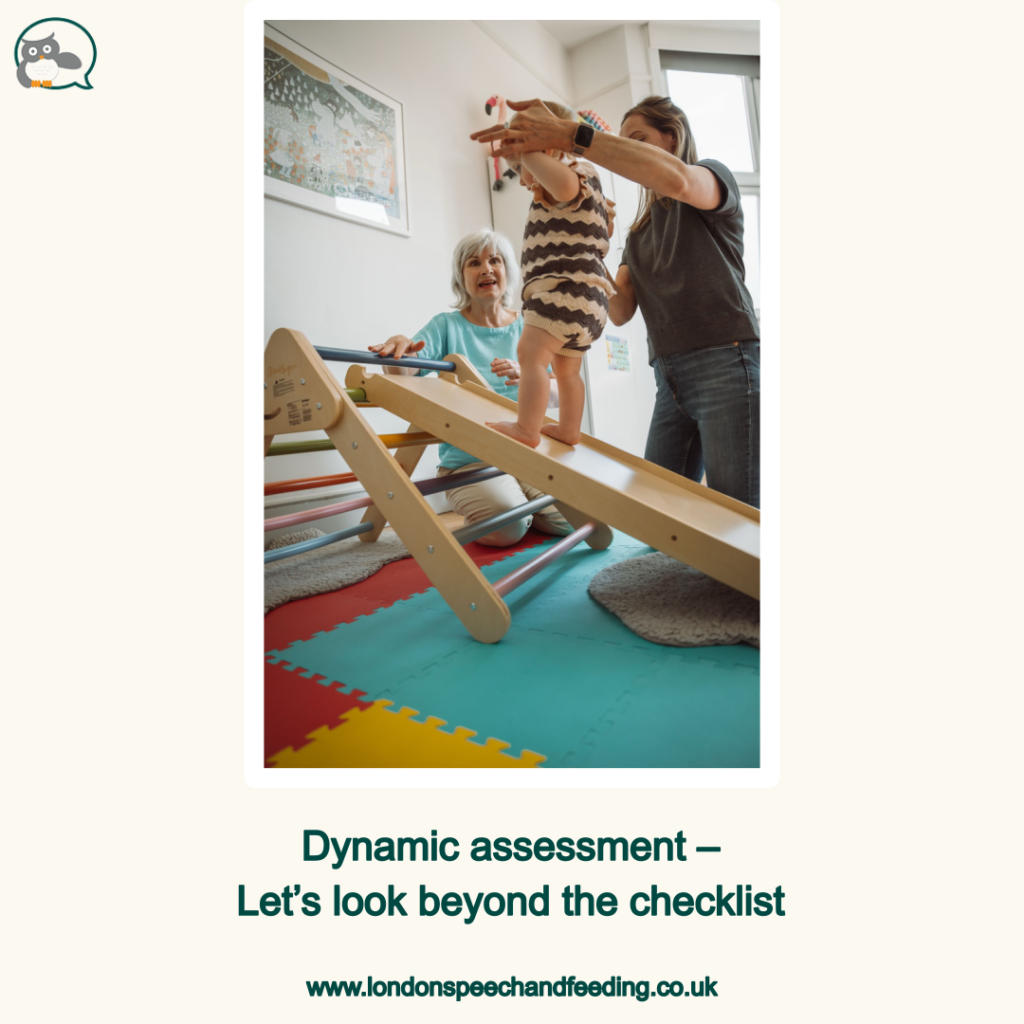
    Dynamic assessment – Let’s look beyond the checklist

    Dynamic assessment – Let’s look beyond the checklist

    As a parent, you’re always observing your child, celebrating his or her milestones, and sometimes, wondering if he or she is quite on track. When it comes to speech, language, play, attention, and listening, these early years are a whirlwind of development! It’s natural to seek guidance if you have concerns, and that’s where a truly comprehensive assessment comes in.

    But what exactly does ‘comprehensive’ mean, especially when it goes beyond a typical checklist? You can find any number of check lists online these days but whilst they can give you an overall idea of what a child is typically expected to do at any given age, it can also start leading you into a rabbit hole of anxiety of ‘what-iffery’.

    At The London Speech and Feeding Practice I believe in something far more insightful than a static evaluation: Dynamic Assessment. Think of it as an in-depth, interactive investigation into your child’s unique communication landscape, exploring not just what he or she can do, but how he or she learns and why he or she might be facing challenges. This is so important.

    What makes an assessment ‘dynamic’?

    Imagine trying to understand a child’s personality by just looking at a single photograph. It gives you a glimpse, but it hardly tells the whole story. Traditional, formal assessments, while valuable, can sometimes be like that photograph – a snapshot of skills at one specific moment.

    Dynamic assessment, on the other hand, is a living, breathing process. It’s called ‘dynamic’ because:

    • It’s interactive and responsive: It adapts to your child’s needs in real-time. It’s not about sticking rigidly to a pre-set schedule of tests. Instead, it’s about observing, gently prompting, and providing support to see how your child responds and learns. This allows me to understand his or her learning potential, not just his or her current performance.
    • It’s holistic and multi-faceted: I look at the whole child. We delve deep into not just speech and language, but also his or her play skills (a crucial window into cognitive and social development), attention and listening abilities, and his or her social engagement. These areas are intricately linked, and a delay in one can often impact others.
    • It integrates multiple perspectives: Your insights as a parent are invaluable! Before we even meet, my comprehensive onboarding questionnaire gathers essential background. During the assessment, your feedback, observations, and comments are woven into the fabric of our session. You are the expert on your child, and your voice is central to forming a complete picture.
    Dynamic assessment – Let’s look beyond the checklist

    More than just ‘speech’: A deep dive into development

    You might initially be concerned about your child’s speech sounds, or perhaps his or her ability to form sentences. These are vital areas, but my approach goes much further. I’m keen to understand:

    • The ‘why’ behind the ‘what’: Is a child struggling with language because of difficulties with understanding instructions (receptive language), or with expressing themselves (expressive language)? Are his or her attention skills impacting his or her ability to follow a conversation? Is his or her play demonstrating imaginative thought, or does he or she prefer more structured, repetitive activities? These nuances are critical.
    • Differential diagnosis: This is where the skill of an experienced clinician truly comes into its own. Through dynamic assessment, I can differentiate between a developmental delay (where a child is following a typical progression but at a slower pace) and a disorder (where his or her development is following an atypical pattern). This distinction is vital because it guides the type of support and intervention that will be most effective. Understanding the cause of the delay or disorder is paramount to creating a targeted, impactful therapy plan.

    The art of observation

    While I draw upon evidence-based practice as well as a formal, standardised assessment as well as my extensive clinical knowledge, I also rely heavily on the art of observation. From the moment your child walks into the room, I’m establishing rapport, engaging them in play, and creating a safe, fun environment. It’s through this genuine interaction – often without them even realising they’re being ‘assessed’ – that the most authentic insights emerge.

    This is where the magic happens:

    • Building rapport: A child who feels comfortable and connected will show you so much more of his or her true abilities and personality. I pride myself on creating an atmosphere where children can relax and simply be themselves.
    • Play as a window: Play isn’t just fun; it’s a child’s natural language. It reveals his or her understanding of the world, his or her problem-solving skills, his or her social engagement, and his or her ability to use symbols and language.
    • Skilled interpretation: My years of experience allow me to see beyond surface-level behaviours and interpret the subtle cues that might indicate underlying strengths or challenges. This goes far beyond what any standardised test alone can capture.

    Why choose a clinician who offers dynamic assessment?

    In essence, a dynamic assessment provides a rich, nuanced, and truly personalised understanding of your child. It’s an investment in:

    • Accuracy: Leading to a more precise diagnosis and understanding of his or her unique profile.
    • Tailored support: Enabling the creation of highly individualised therapy goals that truly meet your child where he or she is and gently guide him or her forward.
    • Empowerment: You’ll leave with not just answers, but also practical strategies and a clear path forward, feeling confident and informed.

    If you’re seeking a thorough, empathetic, and truly insightful assessment for your child’s communication development in London, I invite you to get in touch. Let’s work together to unlock your child’s full potential.

    Sonja McGeachie

    Highly Specialist Speech and Language Therapist

    Owner of The London Speech and Feeding Practice.


    Health Professions Council registered
    Royal College of Speech & Language Therapists Member
    Member of ASLTIP

    Find a speech and language therapist for your child in London. Are you concerned about your child’s speech, feeding or communication skills and don’t know where to turn? Please contact me and we can discuss how I can help you or visit my services page.

    1