Principles of motor learning in childhood apraxia of speech: A guide for parents and therapists

|
Image by Freepik

Childhood Apraxia of Speech (CAS) is a complex neurological disorder that affects a child’s ability to plan and coordinate the movements necessary for speech production. Children with CAS often have difficulty with articulation, prosody, and fluency, making it challenging for them to communicate effectively. While there is no cure for CAS, speech and language therapy can significantly improve a child’s communication skills and overall quality of life. Understanding the principles of motor learning is crucial for both parents and speech therapists to support children with CAS on their speech journey.

What is MOTOR LEARNING?

Motor learning refers to the process of acquiring and refining new skills through practice and experience. This applies to all aspects of movement, including speech production. The brain constantly receives sensory information about the movements being made and adjusts them based on the desired outcome. A breakdown or interruption of this process can make it difficult for children to plan, sequence, and coordinate the intricate movements involved in speech.

What key principles do we use in speech and language therapy for motor learning?

  • Task Specificity: Speech Therapy activities that directly target the specific speech sounds or skills your child is working on. For example, if your child is struggling with /p/, practising isolated /p/ sounds, words with /p/, and phrases with /p/ would be most beneficial.
  • Massed vs. Distributed Practice: We consider the optimal amount and distribution of practice sessions throughout the day. Massed practice involves concentrated practice in a single session, while distributed practice spreads practice sessions throughout the day. The best approach depends on the individual child’s learning style and attention span.
  • Feedback: We provide clear and immediate feedback to help your child understand the accuracy and effectiveness of their attempts. This feedback can be auditory, visual, or touch based.
  • Error Correction: We aim to gently correct errors so that we can help your child refine their movements and avoid developing bad habits. The focus is on providing specific cues and guidance rather than simply pointing out mistakes.
  • Variety and Progression: We gradually introduce new challenges and variations in speech therapy activities to prevent plateaus and maintain motivation.
  • Motivation and Engagement: A big part of our work is to make therapy sessions fun and engaging to keep your child motivated and actively participating. We use games, songs, and activities that your child enjoys while incorporating targeted practice opportunities.

What about home work?

Yes we need your help and here are some examples of how this could look:

  • Task Specificity: During story time, focus on practising target sounds present in the story. Have your child repeat words or phrases containing the sound and encourage them to identify the sound in other words.
  • Massed vs. Distributed Practice: Instead of one long practice session, try shorter, more frequent sessions throughout the day. This can help maintain focus and prevent fatigue. It is recommended to go for 100 repetitions of the target sound per day, every day in between the sessions. We can decide together how you can best do that through either massed or distributed practice. We can decide after the session.
  • Feedback: Use a mirror to provide visual feedback on lip and tongue placement during sound production. Record the child’s speech and play it back to help them self-monitor their accuracy.

I quite like this mirror below but any table top mirror will work as long as it is not too small. Your child should see their whole face easily.

tabletop mirror
  • Error Correction: If the child makes an error, gently model the correct sound or movement without shaming or criticising. Provide specific cues such as ‘lips together’ for /p/ or ‘tongue up’ for /t/.
  • Variety and Progression: We will guide you on exactly what words to practise so this is something you need not worry about.
  • Motivation and Engagement: Use games, songs, and activities that your child enjoys. Play a game of ‘I Spy’ focusing on words with the target sound or create silly sentences with the sound to make practice fun.

Let’s work together!

It is crucial for parents, therapists, and other caregivers to work collaboratively to ensure a consistent and comprehensive approach to supporting your child’s speech development. Speech and Language Therapists can provide guidance and resources on implementing these principles at home, while parents can share observations and progress updates to inform therapy sessions.

Remember, every child with CAS learns at their own pace. By understanding and applying the principles of motor learning, parents and speech therapists can create a supportive and stimulating environment that empowers children with CAS to reach their full communication potential.

Do get in touch if you would like some in-person or on-line 1:1 support with this. It can be overwhelming to figure it all out alone.


Find a speech and language therapist for your child in London. Are you concerned about your child’s speech, feeding or communication skills and don’t know where to turn? Please contact me and we can discuss how I can help you or visit my services page.

2

Similar Posts

  • · ·

    Explaining pronoun reversal: A window into gestalt language processing

    Explaining pronoun reversal: A window into gestalt language processing

    Have you noticed your child referring to themselves as ‘you’, or calling you ‘me’? This seemingly confusing mix-up of pronouns, known as pronoun reversal, often raises concerns for parents. Below I outline why your child does this and want to reassure you that it is to do with his or her unique language learning style.

    Gestalt language processing: Learning in chunks

    Many children, particularly those on the autism spectrum, use a gestalt language processing approach. Unlike analytic language processors who learn individual words and build sentences, gestalt language processors learn language in whole ‘chunks’ or ‘gestalts’. Think of these gestalts as pre-packaged scripts they pick up from their environment — phrases, sentences, even snippets of songs or movie lines.

    As Marge Blanc, author of Natural language acquisition on the autism spectrum, explains, ‘When a child picks up an entire gestalt (script), he’s got the pronoun of the original speaker. So ‘pronoun reversal’ is nothing more than that.’

    So your child is simply repeating what they’ve heard, without yet understanding the individual word meanings or grammatical functions.

    Imagine your child hearing ‘You want a rice cake?’ repeated frequently. They might then use this phrase to express their own desire for a rice cake, even though it doesn’t grammatically fit. So they are thinking and saying ‘You want a rice cake?’ and the meaning of this phrase is: ‘I want a rice cake’. This isn’t a sign of confusion, but a natural step in their language development. They’re working with the tools they have: the scripts they’ve acquired.

    How can we support their natural language journey

    Instead of trying to ‘correct’ pronoun usage, our role as caregivers and speech therapists is to support the child’s natural language progression. Here’s how we can do this:

    1. Learn about their gestalt stage and run with it: In the early stages (1–3) of gestalt language development, correcting pronouns can be counterproductive. These children are still processing language as whole units, not individual words. Direct corrections can lead to frustration and hinder their natural language exploration.
    2. Patience and trust: Gestalt language processing follows a predictable, albeit sometimes non-linear, path. By understanding their current stage, we can provide targeted support. Language sampling and scoring, guided by the Natural Language Acquisition framework, help us pinpoint their stage and tailor our approach.
    3. Model language strategically: In the early stages, avoid using pronouns like ‘you’ and ‘you’re’. Instead, model language from the child’s perspective or use joint perspectives. For example, instead of ‘Are you thirsty?’, try ‘I’m thirsty!’ or ‘Let’s get some water’,

    The big picture: Language unfolds naturally

    Pronoun reversal is a stepping stone, not a stumbling block. As gestalt language processors progress, they begin to break down these gestalts into smaller units and develop their own self-generated language. This is when their understanding and use of pronouns naturally emerge.

    By shifting our perspective from ‘error correction’ to ‘developmental support’, we create a nurturing environment for these children to thrive. We empower them to navigate their unique language journey, ultimately leading to more meaningful and independent communication.

    So, to summarise:

    • Pronoun reversal is a typical characteristic of early-stage gestalt language processing.
    • Focus on modelling language from the child’s perspective or a joint perspective.
    • Avoid correcting pronouns in the early stages.
    • Trust the process and support the child’s natural language development.

    Let’s celebrate the diverse ways our children learn to communicate and empower them to find their unique voice!

    If you have any questions or would like some help with understanding your little gestalt language learner, please get in touch with me via my contact form.

    Sonja McGeachie

    Highly Specialist Speech and Language Therapist

    Owner of The London Speech and Feeding Practice.


    Health Professions Council registered
    Royal College of Speech & Language Therapists Member
    Member of ASLTIP

    Find a speech and language therapist for your child in London. Are you concerned about your child’s speech, feeding or communication skills and don’t know where to turn? Please contact me and we can discuss how I can help you or visit my services page.

    1
  • Empty Set and Phonology approaches

    I have been avoiding the use of the Empty Set approach for the longest time as I was not sure if it would work seeing that I am challenging two sounds my student struggles with at the same time. But I decided to give it a go and it works a treat!

    With this approach, we use two sounds that our student is struggling with. For example, in my video this student cannot produce /sh/ and /r/. Both sounds have different rules, so I decided to contrast them with each other.

    • The rules of /sh/ are: no voice, air is pushed out through teeth, produced at the front.
    • The rules for /r/ are: use your voice, produce the sound in the middle of the mouth by shaping your tongue in a particular way.

    So I chose the words ‘shoes’ and ‘ruse’ as their rules are quite different. Contrasting two sounds the student does not know has been shown to lead to greater change in the child’s articulation. And I can certainly vouch for this as my student is making the best progress with this approach.

    Phonology Therapy – what is it, why and how?

    Phonology is the study of the sound system of a language. It’s distinct from articulation therapy which focuses on the physical production of sounds.

    Phonology therapy focuses on rules. For example, sounds that are produced at the front of the mouth, in contrast to sounds that are produced at the back of the mouth, or sounds that are produced with a long air stream: /s/ or /f/ versus short sounds like /p/ or /t/; sounds are produced with voice or without voice.

    Many children, and sometimes adults, are unaware of some of the speech rules and confuse and replace individual sounds. They might say TAT instead of CAT or SIP instead of SHIP.

    A quick overview of phonology approaches I use:

    Minimal Pairs:

    This approach is good for single sound substitutions. We offer word pairs that differ by only one sound, like ‘ship’ and ‘sip.’ One of our first goal in therapy is to highlight the difference between the target sound (e.g., /sh/) and the sound the child uses (e.g., /s/). This helps discriminate and eventually produce the correct sound.

    Multiple Oppositions:

    A child might replace lots of sounds with a single sound like a /d/. So instead of ‘four’, ‘chore’ and ‘store’ our child says ‘door’, making speech very unintelligible.

    The approach is typically geared towards shaking up the phonological system. Our goal is to choose two to four targets that are different from each other, and different from the substituted sound. If our child’s favourite sound is /d/ they can use their voice and make a short sound by stopping their airflow. So I will choose a different target sound to change up the speech system. For example I might choose an /f/, a /m/ and a /k/ sound. So I would contrast: ‘door’ with ‘four’, ‘more’ and ‘core’.

    Maximal Oppositions:

    In the Maximal Oppositions approach the treatment sets consists of words that are minimally contrasted and that have maximal or near maximal feature differences between each word pair. One word in a pair represents a sound the child ‘knows’ (can say at word level) and the other represents a sound the child does not know (cannot say).

    For example, a child may ‘know’ /m/ and be able to say words like ‘man’, ‘mat’ and ‘mine’. However, the same child may be unable to say /f/ as in ‘fan’, ‘fat’ and ‘fine’. The consonants /f/ and /m/ are maximally opposed as follows.

    I am always delighted to work on speech sound disorders, I love the challenge and the successes we can celebrate together. Get in touch with me!

    Sonja McGeachie

    Early Intervention Speech and Language Therapist

    Feeding and Dysphagia (Swallowing) Specialist The London Speech and Feeding Practice

    The London Speech and Feeding Practice


    Find a speech and language therapist for your child in London. Are you concerned about your child’s speech, feeding or communication skills and don’t know where to turn? Please contact me and we can discuss how I can help you or visit my services page.

    1
  • ·

    Four Ways to Progress your Child’s Language and Build Confidence

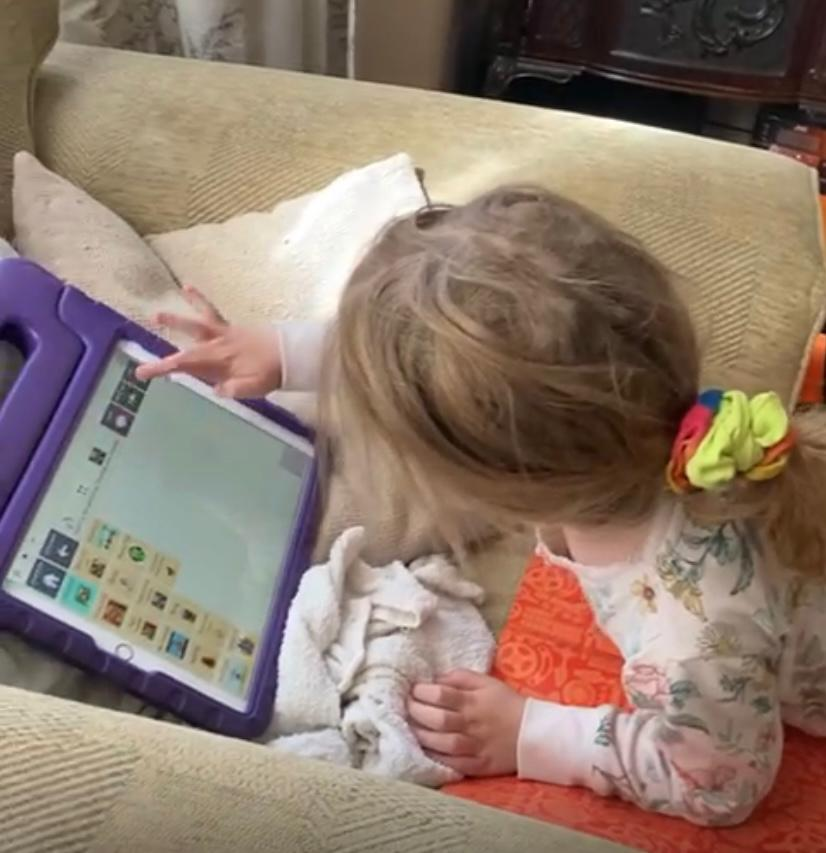
    A child is using a tablet

    Watching your child’s confidence grow as their language develops is something you dream of. You feel helpless, you watch your child repeat language over and over and this concerns you. You know you should be supporting their communication development, but you feel stuck. You’ve reached the point where you don’t know where to turn to for support. Accessing the knowledge of a Speech and Language Therapist is a great place to start.

    Here are four ways to support your child’s language:

    1. Provide great communication models that include scripts or “gestalts”

    Instead of commenting with single words like “apple” or two word phrases e.g., “want apple”, it is more beneficial to comment with small sentences or scripts such as “let’s eat an apple”, “I want an apple mummy”, “I want more apple please” or “I’m hungry daddy.”

    These are phrases that include more intonation and rhythm (top tip: ensure you do use appropriate intonation and rhythm), and your child is likely to pick up those phrases and copy them much more easily than single words or two-word phrases.

    2. Offer a robust Alternative and Augmentative Communication (AAC) device

    There are many examples of AAC devices such as ‘Lamp for Life’ or ‘Grid Smartbox’. It’s vital that you consult a Speech and Language Therapist with a specialism within this area of communication. You want your child to be able to communicate their wants and needs. Furthermore, their communication buttons need to be tailored to your child’s interests so they are motivated to use them (e.g. if your child likes Thomas the Tank Engine, you may wish to program in specific phrases such as “I want to watch Thomas the Tank Engine”. It is also important that the devices are suitable for your child’s physical and emotional stage of development.

    3. Learn to be a word detective

    Listen to your child’s echolalia (or repetitions) and try to understand what they mean. Their communication is often meaningful around a previous experience. For example, one of my students says, “bang my head” and that actually means “I want to play that tickling game again” (where I banged my head the other day).

    4. Take turns with your child and copy their scripts

    This shows you are listening actively and value their attempts at language. We all love it when someone is actively listening and trying to decode what we are saying.

    Take heart and try not to worry. You’re doing the best you can. Your child is more than likely a Gestalt Processing Learner and so they are moving through very defined stages. Echolalia (repetition) is the first of many, so you have an exciting journey ahead watching your little one’s language grow and develop.

    Reduce your child’s frustration and build their confidence today.

    Contact me here for speech and language advice and AAC support


    Find a speech and language therapist for your child in London. Are you concerned about your child’s speech, feeding or communication skills and don’t know where to turn? Please contact me and we can discuss how I can help you or visit my services page.
  • ·

    Four struggles parents face when out and about with children with speech, language, and communication difficulties

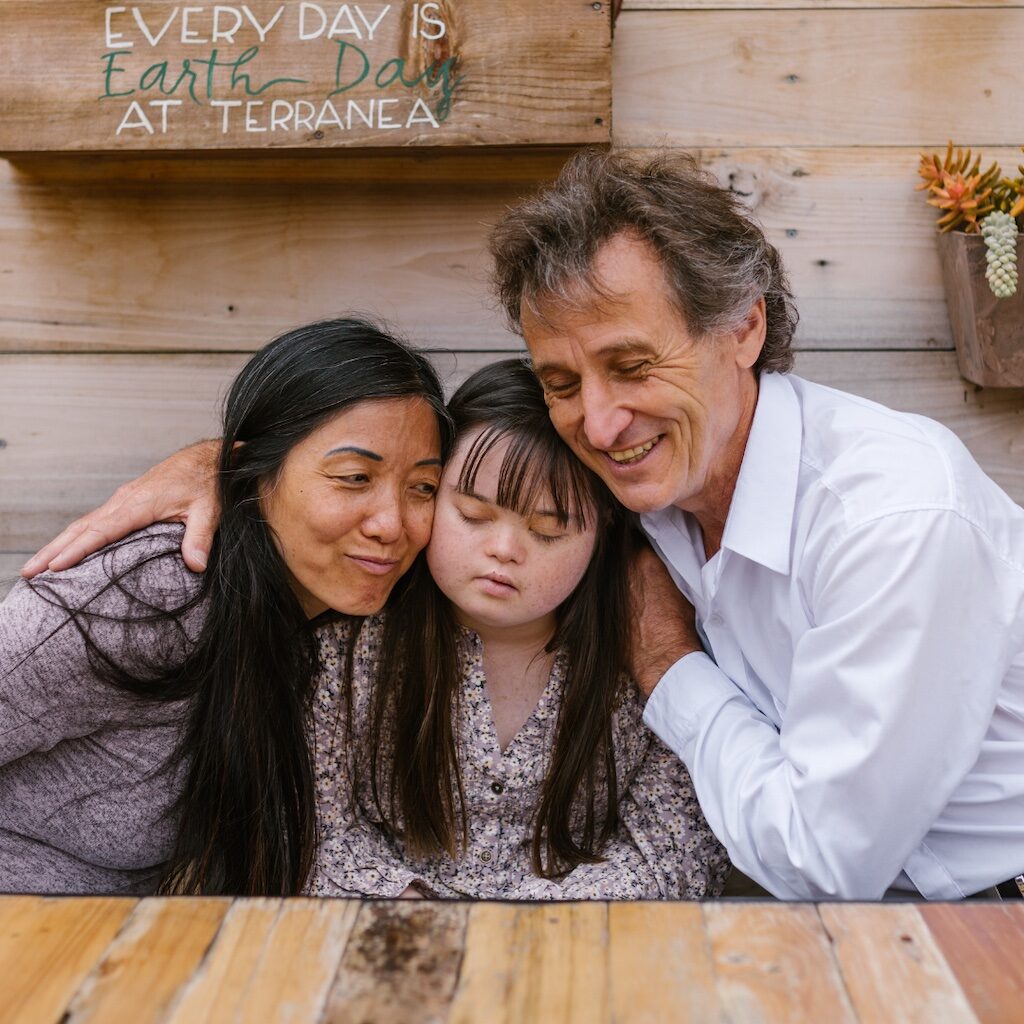
    A man and a woman hug a young girl at a table
    Hug

    You (as parents) often describe yourselves as being under constant pressure and stress when looking after your children and young people with Special Educational Needs and Disabilities (SEND). You may find going out to do the simplest of tasks a challenge. And you will try to avoid social situations out of fear and anxiety. One of the most important factors to you is having like-minded people who understand your position as a parent with a young person with additional needs. Let’s look at some of the challenges you face and how I can support you and your family.

    1. Challenging behaviour and going out to the shops

    When your child displays challenging behaviour and won’t go into a shop without buying a toy that they insist on having, it can be tough on your family. You see people around you staring as you try to manage the situation. They do not understand the pressures you face, or that the simplest of tasks are a huge challenge.

    I can support you by giving strategies to use when out and about. I know that using visuals is important for your child. They may not understand or take in language when they are in a heightened state of anxiety or feeling overwhelmed. You could print pictures of the places you’re going to and put them on an easily accessible chain. Then you could use that chain when out and about at the shops. You may want to introduce a visual timetable at home. That way your child or young person understands where they are going. This may lessen their anxiety and subsequent behaviour.

    2. Your child is not able to communicate their needs to an unfamiliar communication partner

    When your child has difficulty communicating to an unfamiliar person it can be hard to manage. You feel yourself explaining your situation repeatedly. I can provide your child with individualised strategies or communication aids which support your child to communicate with both familiar and unfamiliar communication partners. We’ll work together to find which communication methods work in different situations and how your child will use these to help their independence.

    3. Being overwhelmed

    Your child or young person may easily be overwhelmed which may contribute to behaviour changes. I’ll work with your family to understand what the behaviour means, looking at what happened before and what happened afterwards. We’ll not only look at the behaviour but at the environment as well. This can inform how you can support your child or young person in the future, to reduce sensory stimuli (if needed) and for them to feel emotionally regulated.

    4. People avoid engaging with you

    One of the hardest things as a parent is for others to avoid you. You see them crossing the street because they don’t know what to say to you. All you want is them to accept you, to maintain your identity as a person and not as a SEND parent. I can support you emotionally. I can give you advice on local support networks where you can find other parents in a similar situation.

    We know the stresses that being a parent with a child with SEND comes with. Please know I am always here to support you, to find solutions so that when you’re next out and about. Your experience will be a little easier and you’ll feel less isolated.

    Improve your child’s communication, confidence, reduce overwhelm and feel supported here.


    Find a speech and language therapist for your child in London. Are you concerned about your child’s speech, feeding or communication skills and don’t know where to turn? Please contact me and we can discuss how I can help you or visit my services page.

    1
  • · ·

    My child won’t eat! What can we do to help?

    Image by freepik

    I get lots of enquiries about this topic, parents up and down the country struggle to feed their children. Mealtimes with toddlers can sometimes feel like a war zone!

    Reasons

    The reasons for food refusal are many and very varied. Perhaps your child was born prematurely and had lots of tubes and things sticking to his or her face? Or maybe your child had gastro-oesophageal reflux and this caused pain every time he or she swallowed. Some children have motor problems so it was hard to coordinate swallowing with breathing and caused frustration and anxiety? Many children have sensory integration difficulties and these make it difficult for them to grasp all the different textures and colours they are eating.

    When I take a case history for a new feeding client, I always try to first establish how the child learned not to feed/eat. I use the word ‘learned’ here with intent as eating is a learned behaviour. We tend to think that it must just be instinctive and natural but this is not the case. Instinct is a small part of the very beginning of feeding, in that a baby naturally roots for the breast but this only works out well and leads to more natural ‘instinctive’ feeding if that initial instinct is not interrupted or impacted on negatively by any of the above reasons.

    So just as a baby learns to eat or drink the milk it can also learn not to do so. The baby can learn to avoid eating in order to bypass discomfort, or — and this is another important factor — in order to gain more positive attention from the caregiver!

    Research shows that we learn about food in two ways:

    1. A connection is made between a food and a physical reaction. This needs to happen only once and it can stick: think about feeling sick after a binge on a certain food/drink… You won’t want to go near that very food again for some time, if ever! If a certain food causes pain then that connection can be made quickly and we won’t want to touch this food again.
    2.  We learn through reinforcement and punishment:
    1. Reinforcement:
    • If we get praised for eating our plate with a pudding, then we tend to eat more to get the pudding.
    • Equally if granny sits with us for hours at the table reading us a story because we do not eat or don’t eat much/quickly, we will continue this because we want granny to keep reading for us.
    1. Punishment can work in two ways:
    • Child gets punished for not eating and will eat more to avoid punishment.
    • Child eats less as the fear of punishment is so unpleasant and leads to total lack of appetite.

    As speech therapists we do not endorse any of those above strategies because none of them give us the desired effect.

    What do we want to achieve? We want our children to eat naturally, with enjoyment. We don’t want them to over eat, to binge eat, or to starve themselves. Eating needs to become a joyful, natural and organic behaviour if our child is to be healthy and thrive.

    Recommendations

    Here are three top recommendations I make regularly with good effect:

    1. Structure: have a routine at mealtimes, eating at the table, in the same room with our favourite utensils. Always helping in food preparation, perhaps setting out the table placemats etc, and then tidying up — taking the plate to the kitchen counter, scraping left overs into the recycle bin can be part of this. This way we can introduce repetition to our food/eating learning.
    • Positioning: the right chair with a good footrest, supporting our child’s trunk well, and facilitating our child eating at the table (instead of sitting in a high chair with a tray) is one of my first and favourite tips. I do favour a Tripp Trapp style chair (I have no association with that company).

    Tube fed children ought to also sit at the table with the rest of the family and first of all be offered foods and drinks to handle or play with. Some tube fed children are able to eat a small amount of pureed foods and they ought to be offered this first before being topped up with their tube feeds, whilst sitting down. Lying down for your tube feed is not a normal way of eating. Tube feed infants should be offered a pacifier whilst being tube fed and be in an upright position so that they start having an association between getting full/feeling satiated and their mouth.

    • Sociability: I encourage family mealtimes, or at least the caregiver eating with their child together, so that the child is able to copy and observe what normal eating looks like. We need to be super positive about eating and food consumption so that our child can see and copy this. If the parent is a fussy eater then this may cause the child to copy exactly the same behaviour. Many parents who come to me with their fussy children are themselves also picky about food.

    There are many other tips and strategies and I will be more than pleased to assist, please contact me.

    Sonja McGeachie

    Early Intervention Speech and Language Therapist

    Feeding and Dysphagia (Swallowing) Specialist The London Speech and Feeding Practice

    The London Speech and Feeding Practice


    Find a speech and language therapist for your child in London. Are you concerned about your child’s speech, feeding or communication skills and don’t know where to turn? Please contact me and we can discuss how I can help you or visit my services page.

    1
  • · ·

    AAC Systems and Speech and Language Development

    Introduction

    I see a lot of minimally speaking or non-verbal children in my practice. Some children are autistic and others are severely challenged with motor planning and some are both. Some children are simply delayed in their spoken language for reasons that we don’t quite know yet.

    Regardless of the causes, what is always apparent pretty quickly is that apart from the odd gestures or Makaton signs (mainly ‘more” ‘finished’ and “biscuit) we don’t have a robust alternative for speech in place. Instead, what we often have is a child with lots of frustration and tantrums and some behaviours we really don’t want like: hitting, biting, pushing, grabbing and often throwing… There are others, too many to mention, but we don’t enjoy watching our children in these states. And we are often fearful of what might happen next if we don’t find a way to calm our child.

    Fear not

    In my work, before I get to offer an alternative means of communication, I often have to work with a fair amount of resistance on the parents’ side as parents tend to feel that allowing such a system into their lives will prevent their child from speaking. They fear that their child will so enjoy pressing those buttons that they will become lazy and not talk at all.

    I totally get it!

    Parents often feel overwhelmed by the task of getting their own heads round how to use AAC, either in paper form or a computerised system. This can be a great turn-off for lots of people who feel they are not very “techy” – like myself actually! Indeed, it is true to say that I resisted operating in this field for a long time as I didn’t feel able to navigate electronic devices. But fear not. Truly, most systems are very user-friendly. The support is great. And I have managed to become quite proficient in one or two of these systems, through using it daily. It really is as simple as that.

    Alternative and Augmentative Communication (AAC)

    There is plenty of research on the efficacy of Alternative and Augmentative Communication (AAC). It is now very well understood and proven that, once we introduce our child to a good, attractive way of communicating that they can actually do, in time children who can speak will speak. Speaking is more effective than any AAC system. It is more versatile, more fun, and when human beings have discovered how to speak, most will do so in favour of any other system.

    Many children and adults, for many reasons, were never going to speak an awful lot, or with great difficulty. Or they were not going to like to speak. Or they were going to like to speak some times but not other times… And for all those people an AAC system is invaluable and a wonderful resource.

    Neuro-diversity affirming means that we do not impose one system of communication on our children (speaking with our mouth) only because it is the one we are using and most people we know too.

    Of course, we want the best for our children, and we want them to have the easiest and most straight forward existence on Earth. Of course we do. Speaking with our mouth does help with that. But we must come to understand that not all children and people feel like that and they struggle to use their mouth for talking.

    Personal experience

    I have difficulties understanding this myself, I will be very honest here. And I will say that – shoot me down in flames SLT fraternity – but I am learning to accept that using an AAC system proficiently is a very good alternative for when speech is not coming. I am learning to accept that some people are perfectly able to speak, and might do so but not always and only when conditions are right. I came into the profession as a speech therapist with the idea that I would help anybody that came to me to speak with their mouth. But I have changed my stance on that and now am happy to help anybody that comes to me to communicate most effectively with whatever works for them. I will always try for speech if I can … Just because it’s easiest!

    Acceptance

    Now I will equally celebrate a child pointing to a symbol or making a sign for something. It is a fantastic moment when it happens for the parents and me and the child! And we can always hope for more speech to come as we go. Nothing wrong with our aspirations, is there?

    The basic premise is this: accept any mode of communication as valid, as long as your communication partner understands what it means. Don’t require individuals to repeat themselves in another modality. Do model the response in the modality you are trying to teach. So, a child can point to a symbol and I will respond with speaking (with my mouth) but I will also respond by pointing to a symbol because that way I am signalling that both are ok and that I have understood and am encouraging the person to say some more.

    Here is some research;

    Binger, C., Berens, J., Kent-Walsh, J., & Taylor, S. (2008) The effects of aided AAC interventions on AAC use, speech and symbolic gestures. Seminars in Speech and Language, 29, 101-111.

    Sennott, S.C., Light, J., & McNaughton, D. (2016). AAC modelling intervention research review. Research and Practice for Persons with Severe Disabilities, 41, 101–15.

    Dada, S., & Alant, E. (2009). The effect of aided language stimulation on vocabulary acquisition in children with little or no functional speech. American Journal of Speech-Language Pathology, 18, 50–64.

    Contact me if you would like your child to have neurodiversity affirming speech and language therapy.


    Find a speech and language therapist for your child in London. Are you concerned about your child’s speech, feeding or communication skills and don’t know where to turn? Please contact me and we can discuss how I can help you or visit my services page.
    0