Rethinking the PECS Approach

|

I want to talk about some concerns of SLTs, parents and increasingly autistic adults who explain to us how this communication method did not really work so well and why.

What is PECS in a nutshell:

PECS (Picture Exchange Communication System) is based on the idea of exchanging pictures in return for desired items. For more advanced users, it is used to communicate different functions such as emotions, comments, negations using the exchange of a sentence strip. It was founded on the principles of Applied Behavioural Analysis (ABA).

How does that look in practice?

In my experience, having been trained in the approach myself, the overall aim is eventually for the child to spontaneously go and get their picture book (PECS book), open it, look through a range of pages to select the correct picture of what they want to have or say, then go and find their communication partner, and finally place that picture onto the communication partner’s outstretched palm to be rewarded with an item or with a response of some sort. Or the child selects a range of pictures to create a little sentence, such as: ‘the blue fish swims in the sea’, ‘the red bird flies in the sky’ or ‘I see a red bird’ for example. This can be part of a structured table top activity.

The system follows a series of phases, starting from simple picture exchanges to eventually construction of sentences using symbols. PECS’s aim is to promote communication initiation and reduce frustration for those who struggle with speech.

So far so good one might say, why not? Before I go into the various concerns, I would want to add my own working experience with PECS, and whilst it is my opinion, I would say I have NEVER seen a working PECS book being used spontaneously!

My experience

I have seen attempts of stages 1 and 2 done quite well, in schools, and where people knew that I was coming in “to have a look at how PECS is working with child X”. Yes, in those instances an effort was made of course to try and show me how it worked. I must add that have never been very impressed. I cannot recall it used for any other items than: biscuits/quavers/crisps/ raisins and bubbles/puzzle pieces or spinners.

If we want to see a child trained to exchange for these items in a structured setting, i.e., the child sits at a little table with the adult sitting opposite enticing the child with one or other item, then yes that can be done successfully. I have seen children exchange 25 pictures with a crisp on it, for said crisp and they might have asked for another 25 of those crisps given half the chance. Yes. Good. But. I have yet to see a child go to their PECS book and go through all the motions that I mentioned above to get a crisp. In school they don’t need to: they know that crisps are only available when the PECS book is being practised. Otherwise, let’s be honest, it’s fruit at 10.30 am!

So, they don’t get a spontaneous opportunity to ask for highly motivating items as that is not how school works, is it? ‘SIR! Can I have a crisp?’ At 10.02am, in the middle of maths? Didn’t think so… So in reality this does not get practised in my experience.

A few concerns in no particular order:

Limited Generalisation

One issue often raised is the limited generalisation of skills learned through PECS. The structured nature of the program may result in a child only being able to communicate effectively within the specific contexts where they were taught to use the system (as I suggest above: crisps: yes, please let’s do the PECS for it). This limitation can pose challenges when trying to apply communication skills in new or unstructured/spontaneous situations.

Lack of Spontaneity

Critics suggest that PECS can sometimes lead to scripted and less spontaneous communication. This is also what I have observed. Since the method is designed to follow a structured progression, there is a concern that individuals might struggle to initiate communication outside of the established framework, potentially hindering their ability to engage in more natural interactions.

Narrow range of communication functions being practised

While PECS is quite successful in focusing on requesting and naming items, there are many other important communication functions, such as expressing emotions, asking questions, giving opinions or greetings for instance. We can argue that a communication core board where we have a whole range of different core words available lends itself much better to practising a range of communicative functions.

The Pictures are movable

They are attached to the book via Velcro. They are constantly being picked and exchanged and then returned to the book. This means that the pictures tend to be always in different places. This goes against the motor planning that takes place when one is learning a new skill: imagine you want to learn to touch type and the letters always move and are at different places? How can you be quick about finding a letter? You can never get to “automatic” with this type of approach.

Communication is not taught via behavioural means

Only if you say “banana” in the way that I dictate that you should will you get a piece of banana. Who does that? Nobody. Typically, child points to the counter where there is a banana and says: ‘ba’ or ‘ana’ and mother/carer will look over there and say ‘oh banana! You want a banana? Ok there you go have a piece.’ Or something like it. Mother will not say: ‘SAY BANANA or else you won’t get it.’ Child hears mum saying ‘Banana’ each time and with time will point and say ‘banana’ or ‘I want-a-nana’ or something. This is how communication is learned: through the adult modelling it cheerfully all day long and the child hearing it and then gradually copying it.

One other gripe I personally have but I am reliably informed by all my parents that they share this about PECS:

IT IS SO LABOUR INTENSIVE!

There are 10, 50, 100’s of little pictures that first of all need laminating… then velcroing, then finding and replacing. As I said above, it’s a constant moveable feast for one, but also you LOSE them. Yep. You want to find the picture for “trampoline”. ‘Where is it? I saw it yesterday… We had it outside when we practised you asking for the trampoline. I am sure we put it back? Where is it??? Ok. We need to print off a new one.’

It is also labour intensive for the first stage where you need to have TWO adults to ease the exchange (pick up and release of picture into the communication partner’s hand). Who has two adults available for what can be weeks until the child is able to pick up and release by themselves?

YEP. So it’s really not for me you can tell! I much prefer Core boards (see my previous post on using one) or electronic speech generating AAC devices like GRID, or LAMP or TOUCHCHAT. These are all great to use and there is good support out there for introducing these.

Finding a Balance

While the concerns surrounding the PECS approach are valid, it’s fair to note that the method also has some merits. There is anecdotal evidence of many individuals who have successfully improved their communication skills and quality of life through PECS. But, finding a balance between using PECS as a stepping stone and ensuring the development of more comprehensive and SPONTANEOUS communication is key.

As educators and therapists, we need to extend the focus beyond requesting and labelling by incorporating symbols that represent emotions, actions, and more complex ideas. This expansion encourages a broader range of communication functions. When the time is right, gradually transitioning from PECS to more advanced communication methods such as Core boards or electronic AAC tools and speech-generating devices is the way forward.

We want to value all communication equally and our approach ought to be playful and child-led and to focus on intrinsic motivation instead of extrinsic rewards and reinforcers.

If you have any questions or if you are looking for a therapist who endorses play-based and child-led therapy approaches, please do reach out.


Find a speech and language therapist for your child in London. Are you concerned about your child’s speech, feeding or communication skills and don’t know where to turn? Please contact me and we can discuss how I can help you or visit my services page.

0

Similar Posts

  • ·

    Let’s live and breathe AAC

    We all have the right and want to express thoughts, feelings, and needs. For non-speaking or minimally speaking children, finding an avenue to communicate effectively can be a challenging journey. Parents are often at a loss as to where to start. Sometimes a little bit of Makaton signing has been used here and there but we mostly find that gradually signing fades as parents feel that it just doesn’t seem to get copied and used by the children.

    They live and breathe their system

    This is where we need to pick up the pieces and start again: because all successful families where children start using their boards or their electronic AAC (Augmentative and Alternative Communication) systems do this one thing: THEY LIVE AND BREATHE THEIR SYSTEM.

    • They have boards in every single room of the house;
    • They have a board in the car, attached to the side of car door so their child can point to it as they need to;
    • They have a smaller board in their handbag/rucksack when out and about;
    • They have a board for shopping and attach it to the shopping trolley;
    • They are never ever without their board.

    Because they realise that a child should never be without their mouths to speak, should never be without a means to speak. They use their own board to model and the child has always access to their board to model back or to just look.

    This is where success begins

    Success begins at consistent and joyful use of the board/AAC system throughout the entire day. If we think about it, doesn’t it make sense? Of course, it does! We talk to our child for the first two years of their life continuously wherever we are and our child is continuously encouraged to use their mouths for talking in all situations.

    Same goes for Signing: Makaton or any other sign system is a very powerful means to aid communication and I certainly advocate and use it in practice. Though much like words, signs are very elusive and temporary—as soon as the sign has been made it is gone and no longer present. Same with words of course. This can be difficult for people who need longer to process information.

    The beauty of symbols or photographs is that they are permanent: they don’t vanish, they stay and with the core board they stay in the same place! This is very reassuring. We can learn where a symbol is and we can be assured that it will still be there the next time we look at the board.

    AAC core board

    Here is a picture of a core board:

    AAC board

    You can download this and other boards for free on the Saltillo Word Power website.

    It has 48 cells and we can see the most frequently used core words on here, words that we use 80% of the day when talking with our non-speaking/minimally speaking children, younger children and children with cognitive delay. We keep our sentences short and we say phrases pertaining to their daily lives;

    • Let’s GET your toy
    • PUT it here, PUT it away, PUT it IN
    • Let’s READ a book
    • UP you get
    • WANT some MORE?
    • That’s GOOD isn’t it?
    • Let’s OPEN the box and LOOK

    And so on… All these phrases can be aided with the above board. Your child will learn OVER TIME and OVER CONTINUOUS USE where GET/PUT/MORE/WANT/IN—where these symbols are. For children who are slow to process this is so helpful, to have a visual representation of what has just been said. It aids understanding in the first place. Gradually as a child starts to copy they will point to powerful symbols themselves and if they want to speak they can also speak of course:

    A child might point to WANT + MORE and then say with their mouths: BANANA!

    Board examples

    Here are some other boards I have made specifically for daily situations and preferences of some of my students. Here is one for toileting:

    AAC toileting board

    And another one:

    These boards incorporate high-frequency and versatile words, enabling us to make little sentences.

    Building Language and Literacy Skills

    AAC Core Boards are not just tools for immediate communication. They also play a pivotal role in language and literacy development. By using these boards, non-speaking children engage with words and symbols, reinforcing their understanding of language structure and grammar.

    Over time they naturally absorb language patterns, laying the foundation for improved literacy skills.

    Customisation for Individual Needs

    Every non-speaking child is unique, and their communication needs can vary significantly. AAC Core Boards are designed with this diversity in mind. The boards can be adapted to include specific vocabulary relevant to the child’s daily life, interests, and activities. This personalisation ensures that the AAC Core Board is a true reflection of the child’s personality and needs, making communication more engaging and effective.

    Collaboration between AAC Core Boards and Speech Therapy

    While AAC Core Boards are an incredible tool, they are only used effectively by the non-speaking child when the board is used BY ALL COMMUNICATION PARTNERS around the child.

    Again, I know I am being repetitive here, but the board needs to be used and modelled by the adults constantly in the first place and for a period of time before we can expect our children to take an interest and use the boards themselves. Think how long it typically takes for a child to learn their first word: around a year! During that time the adults talk constantly to their child without hesitation or expectation! The same goes for introducing this new way of communicating.

    Collaborating with your child’s speech-language therapist (SLT) ensures that your child receives the right guidance in using the AAC system. SLTs can assess your child’s communication abilities, recommend appropriate boards and provide guidance on how to best implement them.

    Conclusion

    For non-speaking children, AAC Core Boards are bridges to their world.

    These boards foster language development, social interaction, and personal expression. AAC Core Boards offer a beacon of hope, helping non-speaking children break through communication barriers and thrive in a world that is waiting to hear their voices. Boards are simple for anyone to use and understand. Have a go! You will be surprised how lovely it is to use a board with ease and once your child sees you do this, you have a chance for your child to start copying you…and express something! HOW ABOUT THAT! I look forward to hearing your stories!

    The London Speech and Feeding Practice


    Find a speech and language therapist for your child in London. Are you concerned about your child’s speech, feeding or communication skills and don’t know where to turn? Please contact me and we can discuss how I can help you or visit my services page.

    1
  • · ·

    Practical tips for speech and language development

    As parents, we all want our children to develop strong communication skills. This starts early, with the simple sounds and babbles of a new-born baby. Here are some practical tips to help you encourage your baby or toddler’s speech and language development through play and everyday activities.

    General tips for creating a language-rich environment

    • Talk to your child frequently throughout the day: Even when they’re young, they’re absorbing information. Describe what you’re doing, name objects around the house, and respond to their babbling.
    • Read aloud regularly: Books are a great way to introduce new words and concepts. Choose books with simple language, bright pictures, and repetitive phrases.
    • Sing songs and nursery rhymes: These provide a fun way to practise pronunciation and rhythm.
    • Label objects: Put labels on toys, furniture, and everyday items to help your child associate words with objects.

    Engage with your child in their play activities

    • Pretend play: Encourage imaginative play by pretending to be different characters or animals.
    • Build and create: Use blocks, Legos, or playdough to build and create different structures.
    • Outdoor activities: Explore the world around you. Talk about different plants, animals, and weather conditions.

    Tips for effective communication

    • Get down to their level: When talking to your child, get down on their level to make eye contact and show that you’re listening.
    • Use simple language: Avoid using too many complex words or long sentences. In the early years (0–3 years) try and make things concrete, stay in the ‘here and now’ — point and gesture lots to help your child understand what you say
    • Be patient: Give your child time to respond and don’t rush them.
    • Model good language: Use clear and correct language yourself.
    • Speak in your native, natural Language: If English is your second language try and speak to your child in your native language: it is more natural and your will probably know better how to speak and sing to young children in your own native language.

    Reading to your child

    Reading to your child is a powerful way to boost their language skills and create lasting memories.

    Reading to your child is more than just a bedtime ritual; it’s a powerful tool for fostering their language and literacy skills. Studies have shown that children who are read to regularly develop larger vocabularies, stronger comprehension skills, and a greater love of learning.

    Why is reading so important?

    • Vocabulary expansion: When you read to your child, you expose them to new words and concepts. This helps them build a strong vocabulary, which is essential for effective communication and learning.
    • Improved comprehension: Reading aloud helps children understand the meaning of words and sentences. This improves their comprehension skills, making it easier for them to learn and understand new information.
    • Enhanced cognitive development: Reading stimulates a child’s brain and helps them develop critical thinking skills, problem-solving abilities, and imagination.
    • Stronger emotional bonds: Reading together creates a special bond between you and your child. It’s a time for cuddling, bonding, and sharing stories.
    • The Reach Out and Read Foundation found that children who are read to regularly have significantly larger vocabularies and better language skills than those who are not.
    • A study published in the journal Paediatrics revealed that reading to children can have a positive impact on their academic achievement, even years later.

    By making reading a regular part of your child’s life, you are investing in their future success. So, grab a book, get cozy, and enjoy the wonderful world of stories together!

    Here are some great books I love using in my Speech Therapy sessions:

    Books for 6 months to 2 years

    Touch and Feel Books

    • Touchy-Feely Farm by DK Books: This book features different textures to explore, such as soft fur, rough bark, and squishy mud.
    • Baby Touch: Animals by DK Books: This book introduces various animals and their textures, like soft feathers, scaly skin, and furry coats.

    Lift-the-Flap Books

    • Peek-a-Boo! Animals by DK Books: This book has flaps to lift revealing different animals hiding underneath.
    • Where’s Spot? by Eric Hill: A classic lift-the-flap book that encourages spatial awareness and vocabulary.

    Pop-Up Books

    • Pop-Up Farm by DK Books: This book features fun pop-up elements that bring the farm to life.
    • Pop-Up Jungle by DK Books: Explore a vibrant jungle with this interactive pop-up book.

    Sound Books

    • Sound Books: Farm by DK Books: This book features sounds that correspond to different farm animals.
    • Sound Books: Safari by DK Books: Listen to the sounds of various safari animals in this interactive book.

    Interactive Books

    • That’s Not My… Series by Usborne: These interactive books feature tactile elements that encourage exploration and vocabulary.
    • Peek-a-Boo! I Spy by DK Books: This board book with flaps encourages visual tracking and vocabulary.

    These books are designed to engage young children through their senses and encourage exploration. The repetitive nature of these books helps toddlers learn new words and concepts while having fun.

    Books for 2 years ++

    Classic favourites

    • The Very Hungry Caterpillar by Eric Carle: This colourful and interactive book is a classic for a reason. It introduces simple words, colours, and days of the week.
    • Brown Bear, Brown Bear, What Do You See? by Bill Martin Jr. and Eric Carle: This repetitive story helps children learn colours and animals.
    • Where’s Spot? by Eric Hill: A simple hide-and-seek book that encourages vocabulary and spatial awareness.

    Modern classics for children 3 years – 6 years

    • The Gruffalo by Julia Donaldson and Axel Scheffler: A fun and imaginative story that introduces more complex vocabulary and rhyming.
    • Room on a Broom by Julia Donaldson and Axel Scheffler: Another rhyming story that encourages counting and vocabulary.
    • The Tiger Who Came to Tea by Judith Kerr: A playful and imaginative story that introduces various foods and social skills.

    Books for children 6 years ++

    • The Adventures of the Little Prince by Antoine de Saint-Exupéry: A philosophical tale that introduces complex vocabulary and themes.
    • Charlie and the Chocolate Factory by Roald Dahl: A whimsical and imaginative story that introduces a variety of characters and settings.
    • Harry Potter and the Sorcerer’s Stone by J.K. Rowling: A classic fantasy series that introduces a wide range of vocabulary and concepts.

    Remember: The best books for your child are the ones they enjoy. Encourage them to explore different genres and find stories that spark their imagination.

    Please feel free to contact me.

    Sonja McGeachie

    Early Intervention Speech and Language Therapist

    Feeding and Dysphagia (Swallowing) Specialist The London Speech and Feeding Practice

    The London Speech and Feeding Practice


    Find a speech and language therapist for your child in London. Are you concerned about your child’s speech, feeding or communication skills and don’t know where to turn? Please contact me and we can discuss how I can help you or visit my services page.

    1
  • The tricky /R/: Mastering tongue placement for clear speech

    The /R/ sound is notoriously challenging for many children (and even some adults!). It’s one of the most complex sounds in the English language, with various pronunciations depending on its position in a word. If your child is struggling with their /R/s, you’re not alone. As Speech and Language Therapists (SLTs), we frequently work on this sound, and a key component of our therapy is focusing on proper tongue placement.

    Why is the /R/ so difficult?

    The /R/ sound requires precise coordination of the tongue, jaw, and lips. Unlike sounds like /P/ or /B/ that involve simple lip movements, the /R/ involves intricate tongue movements and tension. There are also different ways to produce the /R/ sound, which adds to the complexity:

    • Retroflex /R/: The tongue tip curls up and back towards the roof of the mouth.
    • Bunched /R/: The body of the tongue bunches up towards the roof of the mouth, while the tongue tip remains down.

    The importance of tongue placement

    Regardless of which /R/ variation is being targeted, accurate tongue placement is crucial. Even a slight deviation can result in a distorted or inaccurate sound. That’s why SLTs dedicate significant time to teaching and practising tongue positioning.

    Speech therapy techniques: Focusing on the tongue

    Here’s a glimpse into how I address /R/ sound difficulties, with a focus on tongue placement:

    • Visual aids:
      • Mirrors: I use a mirror to help children see their tongue movements and make adjustments.
      • Tongue diagrams and models: These visual tools provide a clear representation of where the tongue should be positioned.
    • Tactile cues:
      • Tongue depressors: These can be used to gently guide the tongue into the correct position.
      • Food-grade tools: Sometimes, I use flavoured tongue depressors or other tools to provide tactile feedback and increase awareness of tongue placement.
    • Auditory discrimination:
      • I help children distinguish between correct and incorrect /R/ sounds.
      • I use auditory cues and verbal feedback to reinforce proper pronunciation.
    • Exercises and drills:
      • Tongue strengthening exercises: Strengthening the tongue muscles can improve control and coordination.
      • Tongue placement drills: We practise positioning the tongue in the desired location and holding it there.
      • Sound approximation techniques: Sometimes we use other sounds to help approximate the /R/ sound. For example, I use the /L/ sound, to help achieve the correct tongue placement. Once my child has found the /L/ sound it is then a matter of pulling back just slightly to get a good /R/.
    • Contextual practice:
      • Once the child can produce the /R/ sound in isolation, we gradually introduce it into syllables, words, phrases, and sentences.
      • We also practise the /R/ sound in different contexts, such as at the beginning, middle, and end of words.

    Tips for Parents:

    • Be patient and supportive: Learning the /R/ sound takes time and practice.
    • Practise regularly: Short, frequent practice sessions are more effective than long, infrequent ones.
    • Make it fun! Use games, stories, and other engaging activities to keep your child motivated.
    • Work with an SLT: A qualified SLT can provide personalised guidance and support.

    In conclusion:

    The /R/ sound can be challenging, but with targeted speech therapy and a focus on tongue placement, most children can achieve clear and accurate pronunciation.

    I hope this blog post is helpful!

    Get in touch with me via my contact form if you need support

    Sonja McGeachie

    Early Intervention Speech and Language Therapist

    Feeding and Dysphagia (Swallowing) Specialist The London Speech and Feeding Practice

    The London Speech and Feeding Practice


    Find a speech and language therapist for your child in London. Are you concerned about your child’s speech, feeding or communication skills and don’t know where to turn? Please contact me and we can discuss how I can help you or visit my services page.

    1
  • · ·

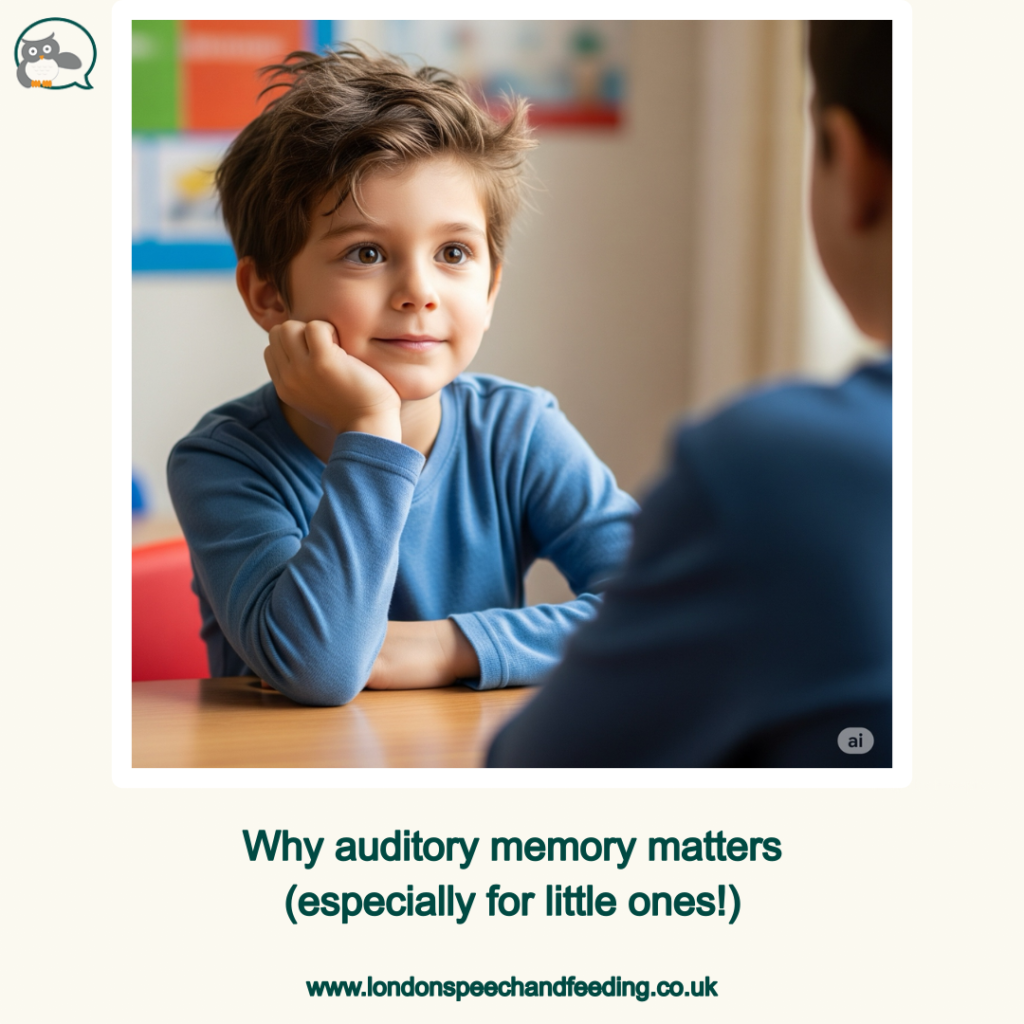
    Why auditory memory matters (especially for little ones!)

    Why auditory memory matters (especially for little ones!)

    Have you ever stopped to think about how we learn to speak, understand, and communicate effectively? It’s a complex dance of various cognitive skills, and one often overlooked but absolutely crucial player in this orchestra is auditory memory. It’s not just about remembering sounds. It’s about remembering sequences of sounds, which is fundamental to language development.

    What exactly is auditory memory?

    At its core, auditory memory is our ability to take in, process, store, and recall information that we hear. Think of it as your brain’s internal recording studio. When someone speaks to you, your auditory memory is busy at work, capturing the individual sounds, the order in which they appear, and the rhythm and intonation of the words. This isn’t just for long-term recall; it’s also vital for working auditory memory, which allows us to hold onto a small amount of auditory information for a short period, just long enough to make sense of it.

    For speech and language, auditory memory is essential for:

    • Understanding spoken language: To comprehend a sentence, we need to remember the beginning of the sentence by the time we hear the end.
    • Following instructions: Remembering a sequence of commands relies heavily on auditory memory.
    • Learning new words: We hear a word, remember its sound, and connect it to its meaning.
    • Developing phonological awareness: This is the ability to recognise and manipulate the sounds in spoken language, a critical precursor to reading. Auditory memory helps children distinguish between similar-sounding words (e.g., ‘cat’ vs. ‘bat’) and segment words into individual sounds.
    • Producing clear speech: To articulate words correctly, we need to recall the precise sequence of sounds that make up that word.
    • Developing conversational skills: Remembering what was just said helps us formulate appropriate responses.

    When auditory memory falls short: The impact on speech

    When auditory memory is poor, particularly in young children, the ripple effects on speech and language development can be significant. Children might struggle with:

    • Following multi-step directions: ‘Put on your shoes, get your coat, and meet me at the door’ can become an overwhelming jumble of sounds.
    • Learning new vocabulary: They might hear a new word repeatedly but struggle to retain its sound pattern, making it difficult to recognise or use later.
    • Understanding stories or conversations: Missing key details or losing the thread of a narrative because they can’t hold enough information in their working memory.
    • Developing phonological skills: Difficulty with rhyming, identifying initial sounds in words, or blending sounds together to form words, which can impact early literacy.
    • Speech production: They might mispronounce words, omit sounds, or struggle with the correct sequencing of sounds within words.
    • Social communication: Difficulty participating in group discussions, remembering names, or recalling what their peers have said.
    • Academic performance: Auditory memory challenges can impact a child’s ability to learn in a classroom setting, where much of the instruction is delivered verbally.

    It’s important to note that poor auditory memory isn’t a sign of low intelligence, but rather a specific processing challenge that can be addressed with targeted support.

    Nurturing auditory memory in under 5s: Preparing for schooling

    The good news is that auditory memory is a skill that can be strengthened and developed, especially during the crucial early years. For children under five, laying a strong foundation in auditory memory is an invaluable gift as they prepare for the demands of formal schooling. Here’s what we can do to help:

    1. Read aloud regularly: This is perhaps one of the most powerful tools. As you read, encourage your child to listen for specific words, predict what happens next, and retell parts of the story. Vary your voice, use different intonations, and pause to emphasise key words.
    2. Play auditory memory games:
      • ‘Simon says’: This classic game is fantastic for following multi-step instructions. Start with one command and gradually increase the number.
      • ‘I Spy’ with sounds: Instead of colours, describe sounds. ‘I spy with my little ear something that goes “moo”.’
      • Rhyming games: Sing rhyming songs, read rhyming books, and encourage your child to come up with words that rhyme.
      • Sound matching: Use everyday objects to make sounds (e.g., shaking keys, tapping a spoon) and have your child identify or match them.
      • ‘Memory chain’: Start a sentence and have your child add to it, remembering everything that came before: ‘I went to the market and bought an apple.’ ‘I went to the market and bought an apple and a banana.’
    3. Sing songs and nursery rhymes: Repetitive songs and nursery rhymes are excellent for developing auditory memory, rhythm, and phonological awareness. The predictable patterns help children anticipate and remember sequences of sounds and words.
    4. Give multi-step instructions (and praise!): Start with two-step instructions and gradually increase the complexity as your child’s skills improve. Always give positive reinforcement when they succeed. ‘Please pick up the red block and put it in the box.’
    5. Engage in active listening: Model good listening skills yourself. When your child is speaking, give them your full attention. Ask clarifying questions to encourage them to elaborate and organise their thoughts.
    6. Reduce background noise: A quiet environment makes it easier for young children to focus on auditory information. Minimise distractions like TV or loud music during activities that require listening.
    7. Use visual cues: While we’re focusing on auditory memory, sometimes pairing auditory information with visual cues can be helpful, especially initially. For example, when giving instructions, demonstrate the action as you say it.
    8. Be patient and consistent: Developing auditory memory takes time and consistent practice. Celebrate small victories and create a playful, supportive environment for learning.

    By actively engaging in these strategies, we can empower our youngest learners to build robust auditory memory skills, setting them up for success not only in speech and language development but also in their overall academic journey. It’s an investment that truly pays dividends in their future communication and learning abilities.

    Any comments or if you need help and support with your child’s speech please do not hesitate to get in touch with me: simply fill out the contact form here on the website. I endeavour to reply within 48 hours.

    Sonja McGeachie

    Highly Specialist Speech and Language Therapist

    Owner of The London Speech and Feeding Practice.


    Health Professions Council registered
    Royal College of Speech & Language Therapists Member
    Member of ASLTIP

    Find a speech and language therapist for your child in London. Are you concerned about your child’s speech, feeding or communication skills and don’t know where to turn? Please contact me and we can discuss how I can help you or visit my services page.

    1
  • ·

    My child is not speaking yet. What can I do?

    My Child Is Not Speaking Yet What Can I Do?
    My Child Is Not Speaking Yet What Can I Do?

    SIMPLE SPEECH AND LANGUAGE THERAPY TIPS you can try out at home in daily life!

    So many new referrals come to me from parents of toddlers saying help, my little one does not speak yet, what can I do? Consider trying out those strategies, they really help:

    Increase playing with your child and try to have MORE FUN. Try and resist the urge to ‘teach’ your child. Fun activities are naturally more motivating and your child will learn new words more easily if you are both having fun together. Try and act goofy to get your child’s attention and make them laugh.

    Respect all play forms your child is interested in, not just play with typical/shop bought toys. Be a PLAY PARTNER instead of a PLAY DIRECTOR.

    My Child Is Not Speaking Yet What Can I Do?
    Go With What Your Child Is Interested In
    Go with what your child is interested in even if it isn’t that new toy you bought the other day! If you follow your child’s lead by watching him closely, you will discover what they are interested in. Then, if you wait and observe your little one he or she may try to communicate something about that favourite toy or activity.

    Use simple words and short phrases with correct grammar about your child’s interests. For example, if he gives you a toy and wants to play, use words to describe that activity, e.g. : “spinning”! “that’s spinning round and round” “wheee” “wow it’s spinning fast!”

    Your child is likely to learn the words that match activities he’s motivated and interested in.

    Show your child what words mean

    You can POINT to something as you say the word (e.g. point to a bird in the sky as you say “Look at the bird!”), ACT out what the word means (e.g. pretend to shiver as you talk about how “cold” it is), or HOLD UP OBJECT as you say it’s name (e.g. hold up your child’s coat as you say, “It’s time to put your coat on”).

    Stress key words and repeat them often. Children need to hear words several times in different situations before they really understand what they mean. Try to repeat words that are familiar to your child during everyday activities and routines. For example, you might use the word “go” when you are talking about going outside and duringva “ready steady go” game. Using the same word in different situations gives your child more information about what the word means.

    Stop asking too many questions, this is hard for adults to do as we often try to direct our children’s play.

    Respond positively to your child’s attempts to communicate, even if these attempts aren’t perfect. As children are learning about words, they sometimes attempt to say a word but don’t pronounce it correctly, or they might use an action or gesture instead of the word. When you notice your child attempt to communicate with you, respond as if he said the word. This shows him you are listening and that you understand what he is trying to tell you. It also encourages him to keep trying to communicate with you.

    Learning to say new words doesn’t happen overnight. It takes time for children to build their understanding enough that they can say a word and use it in the right situation. By using the tips above, you will give your child’s vocabulary a kickstart, and pave the way to new words.

    Do get in touch with me if you need more help. I specialise in providing individual on-line virtual coaching with parents . This is helpful and often necessary given how complex our children are and how difficult it is to acquire speech and language when for one reason or another it is not your thing!

    Find a speech and language therapist for your child in London. Are you concerned about your child’s speech, feeding or communication skills and don’t know where to turn? Please contact me and we can discuss how I can help you or visit my services page.

  • Learn why ‘watchful waiting’ isn’t the answer

    As a Speech and Language Therapist, I am a big advocate of early intervention. And I’m always encouraging you (as parents and carers) to seek intervention as early as possible. But you might be thinking, “my child just needs more time.” Have you ever wondered why early intervention is important? Read on to learn more.

    Speech Therpaist in London
    Watchful waiting is not the answer

    Early intervention

    By intervening at a later age or stage of development, you may be leading your child to develop consequences as a result. One consequence can be challenging behaviour due to their inability to express their wants and needs. They may have difficulty in understanding and following directions. This will not only affect their ability in the classroom but also socially, maintaining friendships. Early intervention can support understanding. This can also help you support your child in breaking down activities so they can fully take part in home and school life. The Early Intervention Foundation (2021) suggest that providing early intervention can develop a young person’s strengths. You can use these activities to support their needs which creates better outcome measures. This allows young people to reach their full potential across a range of settings. It can positively impact on mental health and self-esteem.n

    Positive outcomes

    Also, we are protecting our young people from harmful situations by giving them a voice. And by giving them a voice, they are:

    • more likely to achieve and
    • less likely to have in negative experiences such as crime and with the justice system.

    We know that social and emotional skills (such as developing self-awareness, social skills, and emotional regulation) are crucial to a young person’s development. Research has found that children with a higher level of social and emotional skills are more likely to:

    • achieve in education,
    • graduate from university,
    • have career prospects,
    • have positive work and family relationships,n
    • maintain good mental and physical health.

    By having these positive aspects in their lives, they are less likely to engage in antisocial behaviour and related crime. It’s easy to think this feels like a long way off for your family. But by giving them the best possible start, you are promoting a positive future in all aspects of their life.

    Contact me today to get started with speech, language and communication intervention.


    Find a speech and language therapist for your child in London. Are you concerned about your child’s speech, feeding or communication skills and don’t know where to turn? Please contact me and we can discuss how I can help you or visit my services page.

    1