The hidden impact of mouth breathing and open mouth posture on speech and feeding

| |

When most people think about speech or feeding difficulties, they picture the tongue, lips, or chewing skills, but how a child breathes at rest plays a surprisingly big role too.

Mouth breathing and open mouth resting posture can quietly influence everything from how a child’s face grows to how clearly they speak, to how confidently they chew and swallow. It’s something many parents never think about, until they start noticing the subtle signs.

Let’s explore why this happens, what to look for, and how to gently support better breathing and oral posture.

Recent research supports this link between mouth breathing and speech difficulties. For example, a 2022 study by Alhazmi et al., published in the Journal of Pharmacy and Bioallied Sciences, found that 81.7% of children aged 9–17 who breathed primarily through their mouths presented with speech sound disorders. The study highlights how mouth breathing can significantly influence orofacial development and articulation patterns.

💨 Why we’re designed to breathe through our nose

Our bodies are made for nasal breathing. When we breathe through the nose, the air is filtered, warmed, and humidified before reaching the lungs. The tongue naturally rests against the roof of the mouth, the lips close gently, and the jaw stays relaxed, all of which encourage healthy oral development.

In contrast, mouth breathing often means the tongue rests low in the mouth and the lips stay apart. Over time, this posture can subtly reshape how the muscles and bones of the face grow.

Children who breathe through their mouths most of the time may develop:

  • A longer face and narrower palate
  • Forward head posture
  • Slightly open lips and low tongue position at rest
  • A tendency toward drooling or noisy breathing
  • A dry mouth and consequently bad breath
  • At times the tongue pushes constantly against the front teeth causing them to grow forward (buck teeth)

These changes are not anyone’s fault, as they often start because of blocked noses, allergies, enlarged adenoids, low facial muscle tone or habits formed when a child was younger. But understanding the pattern helps us know how to support change.

🗣 How mouth breathing affects speech

Speech depends on precise coordination between the lips, tongue, and jaw. The resting position of these structures affects how ready they are to move.

  1. Reduced tongue strength and placement, i.e. the tongue rests low in the mouth (as it does in mouth breathing), it’s harder for children to lift it efficiently for sounds like /T/, /D/, /N/, /L/, and /S/. This can lead to speech that sounds slightly slushy or unclear, or a frontal lisp.
  2. Open mouth posture and resonance: An open mouth at rest may affect how air vibrates in the oral and nasal cavities. Children might have speech that sounds a bit ‘muffled’ or lacks crispness because the lips and jaw aren’t fully supporting articulation.
  3. Fatigue and breath control: Mouth breathing can lead to drier mouths and less efficient breath support. That can make longer sentences or conversations feel tiring, especially in noisy environments.

🥄 How mouth breathing affects feeding and chewing

Feeding involves the same structures that control speech, so posture and breathing patterns matter here, too.

  1. Chewing efficiency: Children who habitually keep their mouths open often have low tongue tone and reduced jaw stability. They may prefer softer foods, chew slowly, or struggle with mixed textures.
  2. Swallowing pattern: A tongue that rests low may push forward when swallowing. This ‘tongue-thrust swallow’ can interfere with efficient chewing and even affect dental alignment over time.
  3. Breathing while eating: Since it’s hard to chew, swallow, and breathe through the mouth simultaneously, children who can’t comfortably nasal breathe may rush bites or pause to catch their breath. This can contribute to coughing, choking, or food refusal.

Common signs to watch for

Parents often notice subtle clues before realising mouth breathing is a pattern. Some red flags include:

  • Lips habitually open at rest
  • Drooling after the toddler years
  • Snoring or noisy breathing during sleep
  • Preference for soft foods or grazing eating habits
  • Dark circles under the eyes due to allergies
  • Frequent colds, congestion, or mouth odour
  • Speech that sounds slushy or unclear despite good effort

If several of these sound familiar, it’s worth mentioning them to your child’s GP, dentist, or speech and language therapist.

👩‍⚕️ What can help

  1. Address the underlying cause: If nasal blockage, allergies, or enlarged adenoids are making nasal breathing difficult, a medical assessment is the first step. ENT specialists can rule out or treat physical causes.
  2. Encourage closed mouth rest: Gentle reminders like ‘Lips together, tongue up, breathe through your nose’ can help older children become aware of their resting posture. For younger ones, visual cues (stickers or mirrors) can make it a game.
  3. Build oral-motor strength and awareness: Speech therapists can design activities to strengthen the tongue and lips, improve jaw stability, and encourage balanced breathing. This might include blowing games, tongue-tip lifts, use of dental-palatal devices or oral-motor exercises disguised as play.
  4. Support good posture: Sometimes mouth breathing goes hand-in-hand with forward-head posture. Encouraging upright sitting during meals and screen time helps keep the airway open and supports better breathing habits.
  5. Make nasal breathing part of daily routines: Gentle nose-breathing practice during calm times (reading, bedtime, car rides) helps normalise it. Avoid making it a battle: calm, consistent reminders work best.

🌱 A gentle note on change

Patterns of mouth breathing develop over time, and change doesn’t happen overnight. It’s important to approach this with curiosity, not criticism. The aim isn’t ‘perfect breathing,’ but to give your child the tools and awareness to breathe comfortably and efficiently.

Small improvements in nasal breathing and resting posture can lead to big gains in speech clarity, eating confidence, and even sleep quality.

💡 The takeaway

Breathing seems automatic, and it is! but how we breathe matters. Mouth breathing and open-mouth posture can quietly shape how a child speaks, eats, and grows.

By noticing early signs, addressing underlying causes, and building supportive habits, you can help your child move toward stronger, clearer speech and more comfortable mealtimes.

Just like every area of development, progress starts with connection, patience, and gentle consistency, one calm breath at a time.

Sonja McGeachie

Highly Specialist Speech and Language Therapist

Owner of The London Speech and Feeding Practice.

References

Alhazmi, A., Alshamrani, A., Alhussain, A., et al. (2022). Mouth Breathing and Speech Disorders: A Multidisciplinary Study. Journal of Pharmacy and Bioallied Sciences 14(5):911. https://www.researchgate.net/publication/361978128_Mouth_breathing_and_speech_disorders_A_multidisciplinary_evaluation_based_on_the_etiology

Health Professions Council registered
Royal College of Speech & Language Therapists Member
Member of ASLTIP

Find a speech and language therapist for your child in London. Are you concerned about your child’s speech, feeding or communication skills and don’t know where to turn? Please contact me and we can discuss how I can help you or visit my services page.

2

Similar Posts

  • · ·

    My child won’t eat! What can we do to help?

    Image by freepik

    I get lots of enquiries about this topic, parents up and down the country struggle to feed their children. Mealtimes with toddlers can sometimes feel like a war zone!

    Reasons

    The reasons for food refusal are many and very varied. Perhaps your child was born prematurely and had lots of tubes and things sticking to his or her face? Or maybe your child had gastro-oesophageal reflux and this caused pain every time he or she swallowed. Some children have motor problems so it was hard to coordinate swallowing with breathing and caused frustration and anxiety? Many children have sensory integration difficulties and these make it difficult for them to grasp all the different textures and colours they are eating.

    When I take a case history for a new feeding client, I always try to first establish how the child learned not to feed/eat. I use the word ‘learned’ here with intent as eating is a learned behaviour. We tend to think that it must just be instinctive and natural but this is not the case. Instinct is a small part of the very beginning of feeding, in that a baby naturally roots for the breast but this only works out well and leads to more natural ‘instinctive’ feeding if that initial instinct is not interrupted or impacted on negatively by any of the above reasons.

    So just as a baby learns to eat or drink the milk it can also learn not to do so. The baby can learn to avoid eating in order to bypass discomfort, or — and this is another important factor — in order to gain more positive attention from the caregiver!

    Research shows that we learn about food in two ways:

    1. A connection is made between a food and a physical reaction. This needs to happen only once and it can stick: think about feeling sick after a binge on a certain food/drink… You won’t want to go near that very food again for some time, if ever! If a certain food causes pain then that connection can be made quickly and we won’t want to touch this food again.
    2.  We learn through reinforcement and punishment:
    1. Reinforcement:
    • If we get praised for eating our plate with a pudding, then we tend to eat more to get the pudding.
    • Equally if granny sits with us for hours at the table reading us a story because we do not eat or don’t eat much/quickly, we will continue this because we want granny to keep reading for us.
    1. Punishment can work in two ways:
    • Child gets punished for not eating and will eat more to avoid punishment.
    • Child eats less as the fear of punishment is so unpleasant and leads to total lack of appetite.

    As speech therapists we do not endorse any of those above strategies because none of them give us the desired effect.

    What do we want to achieve? We want our children to eat naturally, with enjoyment. We don’t want them to over eat, to binge eat, or to starve themselves. Eating needs to become a joyful, natural and organic behaviour if our child is to be healthy and thrive.

    Recommendations

    Here are three top recommendations I make regularly with good effect:

    1. Structure: have a routine at mealtimes, eating at the table, in the same room with our favourite utensils. Always helping in food preparation, perhaps setting out the table placemats etc, and then tidying up — taking the plate to the kitchen counter, scraping left overs into the recycle bin can be part of this. This way we can introduce repetition to our food/eating learning.
    • Positioning: the right chair with a good footrest, supporting our child’s trunk well, and facilitating our child eating at the table (instead of sitting in a high chair with a tray) is one of my first and favourite tips. I do favour a Tripp Trapp style chair (I have no association with that company).

    Tube fed children ought to also sit at the table with the rest of the family and first of all be offered foods and drinks to handle or play with. Some tube fed children are able to eat a small amount of pureed foods and they ought to be offered this first before being topped up with their tube feeds, whilst sitting down. Lying down for your tube feed is not a normal way of eating. Tube feed infants should be offered a pacifier whilst being tube fed and be in an upright position so that they start having an association between getting full/feeling satiated and their mouth.

    • Sociability: I encourage family mealtimes, or at least the caregiver eating with their child together, so that the child is able to copy and observe what normal eating looks like. We need to be super positive about eating and food consumption so that our child can see and copy this. If the parent is a fussy eater then this may cause the child to copy exactly the same behaviour. Many parents who come to me with their fussy children are themselves also picky about food.

    There are many other tips and strategies and I will be more than pleased to assist, please contact me.

    Sonja McGeachie

    Early Intervention Speech and Language Therapist

    Feeding and Dysphagia (Swallowing) Specialist The London Speech and Feeding Practice

    The London Speech and Feeding Practice


    Find a speech and language therapist for your child in London. Are you concerned about your child’s speech, feeding or communication skills and don’t know where to turn? Please contact me and we can discuss how I can help you or visit my services page.

    1
  • Help! My child has a lisp. What can we do about it?

    What is a LISP?

    There are different types of LISPS. Let me explain:

    A lisp is the difficulty making a clear ‘S’ and ‘Z’. Other sounds can also be affected by the tongue protruding too far forward and touching the upper teeth or the upper lip even. ‘T’ and ‘D’ can be produced with ‘too much tongue at the front’ and this can also have an impact on ‘CH’ and often also ‘SH’.

    1. Interdental lisp

    Protruding the tongue between the front teeth while attempting ‘S’ or ‘Z’ is referred to as interdental lisp; it can make the speech sound ‘muffled’ or ‘hissy’. Often, we associate a lisp with the person sounding a bit immature. The good news is that this type of lisp is the easiest to correct and, in my practice. I have a 100% success rate with this type of lisp.

    1. Lateral lisp

    In a lateral lisp the person produces the ‘S’ and ‘Z’ sounds with the air escaping over the sides of the tongue. This renders the ‘S’ as sounding ‘slushy’ or ‘wet’. This type of lisp is a bit harder to correct than the interdental lisp. In my experience this can be fixed but it might need a bit longer, more intensive therapy than the interdental lisp.

    1. Palatal lisp

    With a palatal lisp the ‘S’ sound is attempted with the tongue touching the palate, much further back than it should be. The ‘S’ sounds ‘windy’ and ‘hissy’. This is a quite rare lisp production but it is also not difficult to correct.

    These types of speech difficulties come under the category of ‘speech delay of unknown origin’ and may persist into adolescence and adulthood as ‘residual errors‘.

    Some thoughts on Treatment in general:

    Lisps can be treated successfully by a Speech and Language Therapist. However, for the treatment to work well, a student needs to be able to cooperate and want to improve his or her speech. Lisp remediation entails a fair amount of repetitive work and very young children or unmotivated older children don’t make the best candidates for treatment for this reason. Often students present with other speech, language or social communication difficulties and here the lisp might not be the priority for treating. For example, it might be that due to a student’s Attention Deficit Disorder they are simply not able to focus on speech practice in their daily life.

    When should treatment of lisp begin?

    Waiting well past 4½ years is not advisable as the longer we wait and do nothing the stronger engrained the erroneous tongue/speech habit will become. The ‘right’ age for therapy for one child may be different from the ‘right’ age for another child even within the same family. So do make an appointment with a speech and language therapist to assess and see whether your child might be ready to start therapy.

    Do lots of children lisp—is it normal?

    Until the age of about 4–4.5 years old it can be a perfectly normal developmental phase for some children to have the interdental lisp. But when we see and hear a lateral or palatal lisp we ought to act and see a speech and language therapist for sure.

    After the age of 4.5 or 5 years old most speech therapists would agree on at least having a look to see if treatment could be started. The longer we wait the harder it is to retrain the brain pathways to adopt new speech habits.

    What happens during the first Speech and Language Consultation?

    The first consultation takes about an hour and involves screening relevant areas of communicative function. We take a detailed history, examine the anatomy of the child’s mouth and tongue movements. We check for tongue tie, teeth formation, palate structure and function, as well as swallowing patterns.

    Then we begin straight away to try and see if any of the alveolar sounds (T/D/L/N) can be produced correctly with the right tongue placement as that would be the starting point from where to shape a good, clear ‘S’ sound.

    The first consultation usually ends with home practice being given, explained to parents and another appointment being made for follow up.

    Therapy – what does a session look like?

    Each therapy session consists of:

    1. Listening to sounds, discriminating sounds, identifying sounds, listening to rhyming sounds, sound awareness. We call this Auditory discrimination of single sounds: can the student hear the difference between two words that are the same apart from the first sound: ‘sing’ and ‘thing’ or ‘sigh’ and ‘thigh’?
    2. Sound production: using a variety of different prompts and cues we will teach how to physically make the new sound. Often, we work on making a NEW sound, instead of correcting the OLD one. We work on imitation of single sounds then gradually we try and make new sounds in short words, then longer words and then phrases and sentences.
    3. Games! We play games and try and have fun in between listening and producing our new sounds to help students stay motivated and even enjoy the therapy session and process.

    How long does it take to ‘fix up’ a lisp?

    It tends to take about one term with weekly sessions to help a student make good ‘S’ sounds in phrases and sentences. If the student can do the home practice every day in between the weekly sessions, then in most cases I am able to pronounce the lisp as ‘fixed’ after about one term.

    After that the student needs to practise, practise, practise, at home and in daily life to keep reminding themselves of their new skills and their new sound production.

    It is a matter of reminding and wanting to get it right. Occasionally a student returns to me for another term of simply practising their skills together with me as they are finding it hard for any number of reasons to practise at home. But generally, 8/10 students will be fine after some 12–13 sessions and their speech will be perceived as perfectly typical by family and friends.

    If your child has a lisp or any other speech error, please do not hesitate to contact me.


    Find a speech and language therapist for your child in London. Are you concerned about your child’s speech, feeding or communication skills and don’t know where to turn? Please contact me and we can discuss how I can help you or visit my services page.

    0
  • ·

    Top tips for the best chair when weaning / feeding your toddler

    Kids Speech Therapist London
    Top Tips For The Best Chair When Weaning / Feeding Your Toddler

    Many times I consult families for weaning or feeding difficulties and the immediate and most obvious problem I spot, as soon as I arrive or see any video footage for analysis: the high chair has no footrest! You know the one that is so popular from a certain Swedish company…and don’t get me wrong, most of my furniture is still from that same company and I mostly love it…after assembly and a fair bit of cursing…but the very cheap chair they sell is literally one of my pet hates…perhaps ‘hate’ is a bit strong, but I just do not like this chair at all. And the reason is simply this: IT HAS NO FOOTREST!? PS: it may do now, I have not been to said store in a while, but I have not come across any improved chairs in any of my clients’ homes!

    Who likes to have their feet dangling in mid-air at any time of the day? I really don’t!. I need to always have my feet firmly planted on the ground or on a footrest – should I find myself lucky enough to be sitting on a bar stool these days! As soon as I clamber up that stool and I have managed to find a hook for my handbag – here’s another bugbear, but I digress – as soon as…my feet are looking and rooting for that foot rest. Because it gives us stability and let’s face it, when on a bar stool…stability is what gets us through the evening.

    So back to our toddler: why would we imagine that our toddler feels any different about dangly legs? Imagine if you will, sitting on one of those bouncy gym balls… where would your feet be? Yes of course, on the floor, because otherwise all hell will break loose or, more to the point, your tummy muscles would get a nice work out, and that is FINE, no problem. Go for it, I know I should…

    But if you imagine sitting on a ball like this with your feet off the ground and now you are given a plate of food as well….. I personally don’t think that would end well.

    Of course our toddler in that high chair without a footrest is not quite as wobbly as you would be on that ball, but the principle is the same: there is very little stability and now s/he is meant to be tucking into some veggies as well.

    As I mentioned in my PS above, I do understand that there are now some additional footrests that can be fitted on the above Swedish chair, and if that becomes a bit more common place and is easy enough to do, then all is forgiven and please go ahead. However….. and I am not on ANY commission from the company I am about to recommend, but really, I have not come across a better chair that is so versatile and will last your child until they are about 12years old!! (Both my boys had one each and 20 years later, I still use both their hairs now for children that come to see me in my clinic. They are almost as good as new and adjust so easily and well to all different heights)

    Tripp Trapp® Chair
    Tripp Trapp® Chair

    Enter, the Stokke Tripp Trapp Chair. It costs a small fortune to be fair, but it did win the “best high chair award” in 2021. There are many cheaper versions available, for example, John Lewis sell a similar chair for about half the price! So do shop around.

    But what is so important to consider is that your child has a foot rest and that his trunk is at a 90 degree angle with your child’s thighs.

    This affords your child maximum stability and so now we can have a look at the rest of your child’s feeding skills and see what else can be done to help things, and there are many more strategies. But this is usually the first and a hugely important bit of advice I will give and the effect of better sitting, and increased stability is huge!

    Best of luck with shopping for your great new high chair. I would also say, if you have already got a chair without a footrest and you don’t want to get another one, I totally get that too. In that case, perhaps have a think about how you could enable your child to rest his/her feet on something, with the right 90 degree angle I mentioned above: perhaps a crate of some sort? a coffee/side table that could be placed under the chair for feet to rest on? a box? Once we become aware of the problem there is most often a solution to this issue. Your toddler will thank you!

    I hope this is helpful, please feel free to contact me if you have struggled with finding the right position for your child or if you found this blog post helpful.


    Find a speech and language therapist for your child in London. Are you concerned about your child’s speech, feeding or communication skills and don’t know where to turn? Please contact me and we can discuss how I can help you or visit my services page.

  • A Day In The Life Of An Independent Speech And Language Therapist

    A Day In The Life Of An Independent Speech And Language Therapist

    A Day In The Life Of An Independent Speech And Language Therapist

    I often get asked how many clients/children I see per working day or what my working day/life looks like. I always reply that every day is different, which is true, but there is a sort of average working day which looks a bit like this:

    I usually start preparing for my first client of the day at around 9.30 am: I clean the room, wipe down all the toys and materials (that’s if they are coming to my clinic room) and then it takes me about 30 minutes to select and sometimes make suitable materials, games and activities for the child’s therapy programme. Client arrives at 10.30 am and the fun begins. They leave around 11.30am, and the cleaning and wiping down starts again – yes it’s the pandemic but to be fair I would do this anyway. I quickly write up my notes and send home work to the client via email. Now it’s 12 noon and I start preparing for the next client at 12.30 pm. This might be online parent-child interaction coaching and so I need different materials and activities that are suitable for teletherapy. We finish around 1.30 pm and I will write up my notes before having some lunch.

    Lunch tends to not be around 30 minutes. Around 2.00 pm I start prepping again for the next client: selecting activities, going over their last session, making sure I have everything I need to start at 2.45pm – we finish at 3.45pm, I write up my notes and then have a cuppa. The next client might be more on-line coaching or a child coming to see me: room cleaned and tidy, materials and activities prepared: client arrives at 4.30 pm and we finish at 5.30 pm. I clean the toys again, write up my notes and it is 6.00 pm ready for dinner. So that was four clients between 9 am and 6pm allowing for preparation, aftercare, cleaning and coffee and lunch.

    Other days I might see three clients and do more admin like ordering toys or books or teletherapy activities, or making materials (we therapist make tons of materials, we’d put Blue Peter to shame!) Sometimes I do two home visits, one in the morning and one in the afternoon – the travelling/parking in London is so time consuming that it really reduces the number of clients I can see which is why I don’t do many of those.

    I hand pick my clients to make sure that we are a good fit, and my service is bespoke: no one client gets the same treatment as another; each client is unique, usually very well-known and always highly valued. That takes time and means that in reality each client gets about 2 hours of my time, that is the actual session plus all the preparation and aftercare.

    I love this way of working and would not ever want to return to seeing tons of clients each day, not knowing any of them really well, due to high caseload numbers, staff shortages and an overload of administration.

    My way of working affords all my lovely clients the help they need to be able to feel empowered and to then support their children to make progress; when working with children they make the best progress they can make, fulfilling their potential. My lovely reviews and testimonials tell me that my clients appreciate the extra attention.


    Find a speech and language therapist for your child in London. Are you concerned about your child’s speech, feeding or communication skills and don’t know where to turn? Please contact me and we can discuss how I can help you or visit my services page.

  • · ·

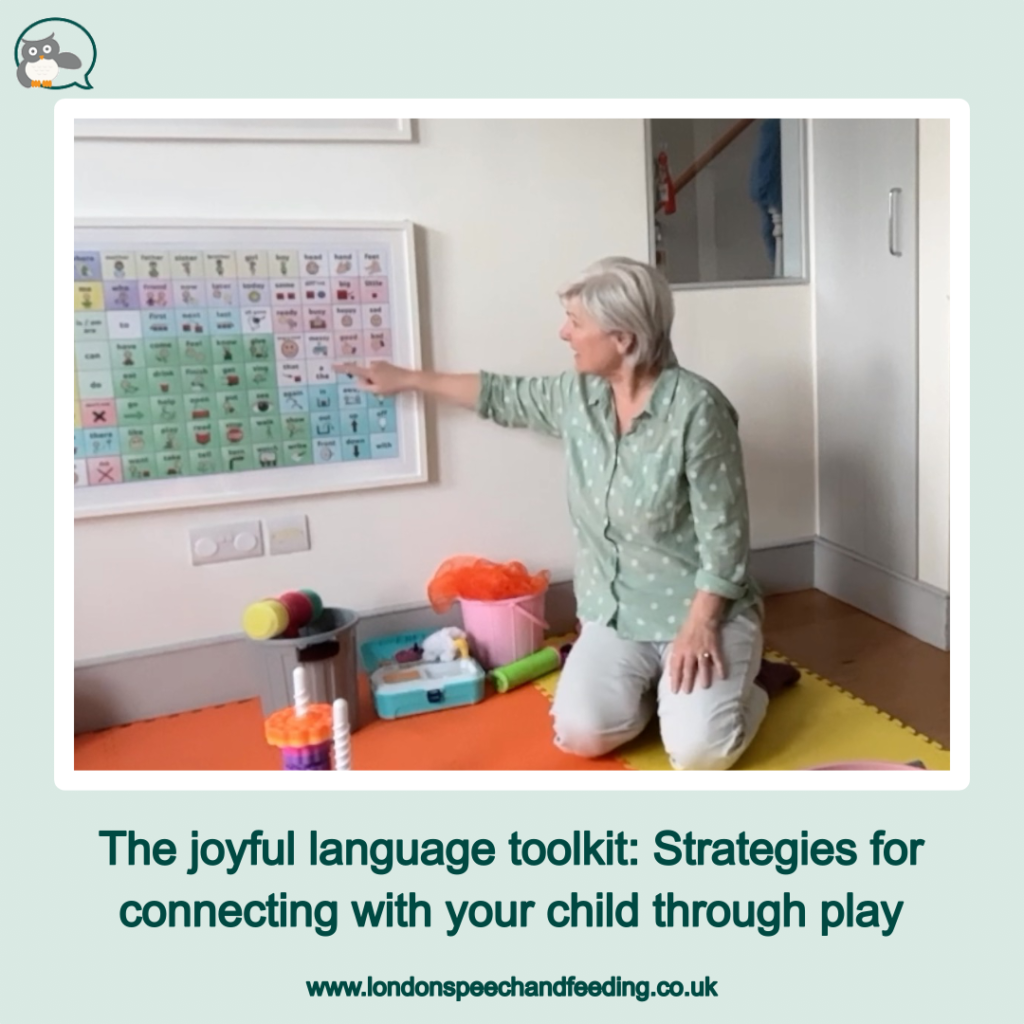
    The joyful language toolkit: Strategies for connecting with your child through play

    As parents and therapists, we all want to help our children communicate. But sometimes, the process can feel like ‘work’. If I had a penny for every parent saying ‘I find it so boring!’… Ok hang in… what if I told you the most effective therapy happens when it doesn’t look like therapy at all?

    My approach centres on connection, enthusiasm, and multi-sensory engagement. We don’t just teach words; we teach the joy of using them. These strategies can be used whether your child is speaking, using a core board, or communicating in his or her own unique way.

    Some of my favourite strategies

    Today I want to share a few of my favourite strategies to turn everyday interactions into powerful communication opportunities regardless of why or how big a delay your child is having.

    1. Facial expressions & exaggeration: Use an exaggerated facial expression to show surprise (wide eyes!), excitement (big smile!), or confusion (a crinkled brow!). Your face is a powerful teaching tool. I am always talking like a clown in my sessions. I can announce that I have also a normal speaking voice outside my clinic room! 😊
    2. Using your voice with intonation: Your voice is music! Use a singsong or ‘tuneful’ repeat to make words stand out. For example, ‘It’s a BIIIG ball!’ or ‘Let’s GO-O-O!’. Again think: clown!!
    3. Hands and body to show: Use gestures, hands, and body movements to demonstrate. Say ‘OPEN’ while pulling your hands apart, or ‘UP’ while raising the toy high above your head.
    4. Elongating our words: Stretching out key sounds or words gives them emphasis and more time for your child to process. ‘Criiiinkley’ ‘tiiickleyyyy’
    5. Core board & language modelling:
      • Model the core board with joy: Don’t just point: point with energy!
      • Model the core board repeatedly throughout the activity, showing genuine excitement. This demonstrates the board is a joyful tool, not homework.
      • Pointing to the core board: When you say a core word, point to the corresponding symbol. You are showing your child, ‘My words live here, and your words can too’.
    6. Describing it for your child: Help your child build his or her vocabulary by providing rich sensory language. ‘It’s squishy’, ‘It’s very noisy’, or ‘It’s so smooth’.
    7. Catchy phrases: Repetitive, positive phrases create a sense of shared fun. Use them consistently: ‘Oh, that’s a nice one!’ or ‘We like that!
    8. Following your child’s Interest: Put down your agenda and follow your child’s lead. If they pick up a block, talk about the block. This ensures they are engaged and ready to learn.
    9. Allowing for pauses: This is critical! After you made a comment, allow for a significant pause (count to five in your head) for your child to fill. The silence creates a powerful opportunity for them to initiate communication.
    10. Copying your child’s sounds: If he or she makes a sound (‘buh!’), you make the sound back! Copying your child’s sounds shows him or her ‘I hear you, and your communication is important’.
    11. Lots of repetition: Hearing a word many times in meaningful contexts is how we learn! Repeat key phrases and core words throughout the activity. Repetition is the key to retention.
    12. Getting turns: Explicitly teach and celebrate getting turns in a game. ‘My turn! Your turn!’ This is a foundational social and communication skill.
    13. Using tidy up as a teaching activity: Turn cleanup into a fun game! It’s a goldmine for core words like PUT IN, ALL DONE, HELP, and MORE. For example, ‘Let’s PUT IN the red block! Yay!’
    14. Using exaggerated repeats: When your child tries a sound or word, give it back with exaggerated, tuneful repeats.

    Try out all or even just a few of these strategies, and I can promise you, you’re not just encouraging language; you’re building a joyful, reciprocal relationship based on genuine communication!

    Which strategy are you excited to try first? Let me know in the comments!

    If I can help you with any of the above, if you want to practise these a bit more, I would love to help you!

    Sonja McGeachie

    Highly Specialist Speech and Language Therapist

    Owner of The London Speech and Feeding Practice.


    Health Professions Council registered
    Royal College of Speech & Language Therapists Member
    Member of ASLTIP

    Find a speech and language therapist for your child in London. Are you concerned about your child’s speech, feeding or communication skills and don’t know where to turn? Please contact me and we can discuss how I can help you or visit my services page.

    2
  • My child is very hard to understand! How can Speech Therapy help?

    Kids Speech Therapist London

    There are many reasons for speech sound delay or disorders and the first step is a thorough assessment.

    What does a Speech Assessment look like?

    With younger children, around 2 – 2.5 years we often start by collecting a good speech sample during play or general chatting. Sometimes we do this with an audiotape so that we are able to listen to your child’s speech sounds repeatedly in order to determine any speech error patterns. A good way to get a speech sample is looking at a favourite book together and trying to get your child to name as many items, animals or characters as possible in the book. For older children, 4.5 years plus we do more formal speech sound assessments where we show your child a series of pictures which focus on varying sounds or sound patterns, for example:

    • Are the end sounds present or left off, does your child say BE_ instead of BED for example?
    • Are the back sounds produced at the front of the mouth, is a digger a DIDDER or a pig a PID?
    • Are sound blends reduced, for instances a snake becomes a NAKE ?
    • Or do many phonemes (single speech sounds) collapse all into one error sound? Like all F , R or L become a B?

    Once we have discovered the error pattern we can then unravel the problem and work on solutions. We make a plan and prioritise which of the patterns we can target first, second and next. There are several approaches that can be used to tackle speech sound errors and most therapist have two or three favourite approaches as their go-to. I will fill you in on my favourite ones in future blogs.

    What does a Speech Therapy session look like?

    These days we have two options: on-line via zoom and face to face in the clinic setting.

    Both are great options!

    For all clients who live far away a zoom session will be the option to go for. But zoom sessions also work really well for the older child as, let’s face it, are there any kids out there who do not like a bit of screen time?

    I find that children around 5 years old really love the on-line games and sessions are fun and very effective. We usually start off with a quick game to warm up and then we go into the speech sound patterns we need to improve and work on. There are 100s of tried and tested on-line games and game decks which can be hugely entertaining and really nice to work with.

    In clinic, we also often start with a short game to settle in and then we target the various sound patterns we are working on within table top games, or arts and crafts activities. We aim to get up to 100 speech sound trials per session, using a variety of motivating games to keep our little ones going and focused.

    Both, face to face and on-line sessions are between 40-45 minutes long – time usually flies by! – and then parents get to practise home exercises to make sure that the new speech sounds are being practised every day.

    Over the coming weeks I shall do blogs on great games and home exercises that I give the parents and I will talk about games we do in the session that are fun and can be copied for home use. Watch this space!


    Find a speech and language therapist for your child in London. Are you concerned about your child’s speech, feeding or communication skills and don’t know where to turn? Please contact me and we can discuss how I can help you or visit my services page.