Support your child’s communication using books: OI FROG

|
Sonja's top recommendation: Oi Frog, written by Kes Gray and Jim Field. An exciting book for children to enhance their speech, language and communication.
Oi Frog by Kes Gray and Jim Field

Book corner with Oi Frog! by Kes Gray and Jim Field.

Books are an engaging way to support your child’s communication development. Even if your little one dislikes reading in the traditional sense. They will become immersed in this adventure, without realising they are taking in language and developing vital communication skills. This is one of my favourite series for children.

Increase fun and interaction

These books are made for fun and excitement! It may seem silly putting on different voices for different characters, but this is one way in which you can engage your child. Why not try to use different intonation patterns (e.g., you may use a deep voice for the dog, and a higher pitch for the cat)? Make your story interactive: you could ‘rawww’ like a lion and see who can make the loudest noise. Make noises to encourage interaction (e.g., when scratching his chin, make a squeaky sound!). You could also relate the experience back to your child (e.g., ‘can you scratch your chin?’).

Time to talk

Talk about what you can see on the front cover (e.g., There’s a frog on a log, how funny!) You could also ask your child to choose the rhyming words on a page in the book. Can your child tell you what rhymes with certain words (e.g., can you guess what a parrot sits on?)? Make use of every page. You could comment on your favourite frog and see if your child can talk about their favourite. You can support them by giving them an example (“my favourite frog is the one swimming backwards because he looks funny”). Then you could use this scaffold to support their answer. Your favourite is [________________] because [_________________]

If your child is reluctant to use language, the use of commenting can take the pressure of them (“look at all those frogs” or “he’s climbing up the stool”) is a powerful way in which you (as parents) can take the pressure off your child. A top tip I like to give is to make sure you pause regularly, which creates opportunities for your child to use language.

This book uses a subject-verb-object sentence structure (e.g., ‘hares sit on chairs’) which allows your child to hear a good model of a sentence. You could also talk about things in the book that belong in a certain category (e.g., animals, food) or begin with a specific sound. See if your child will name any more.

Reap the reward of repetitive language

Oi Frog uses repetitive rhyming language and puts emphasis on these words. This is important because the more your child hears a word, the more likely they are to remember, understand and use it in the correct context.

Emotions matter

Talk about how the animals feel and why they may feel this emotion (e.g., the cat’s feeling annoyed because…, Lions sit on irons, how does the lion feel?). Reasons can be difficult for children with communication difficulties. Support them by giving an example or by giving them an option (e.g., “does the lion feel happy or sad? I think the lion feels sad because he’s burnt his bottom on the iron! It’s too hot!”)
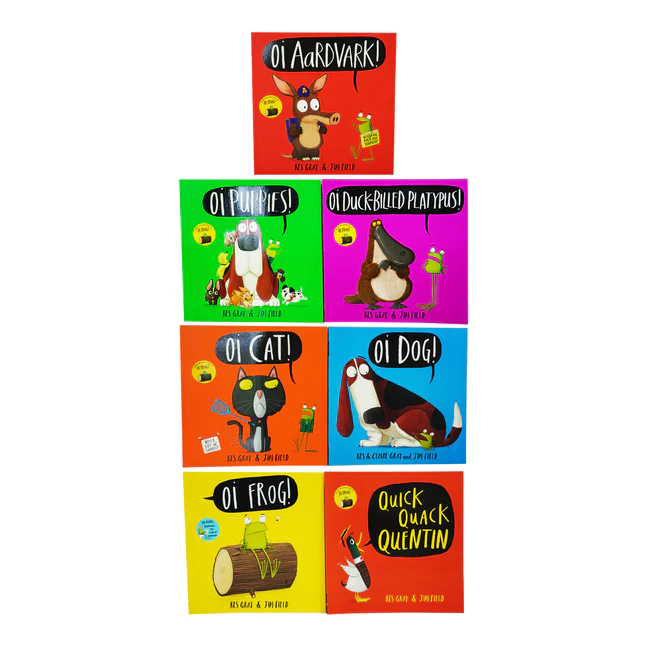
A collection of books
OI Books

Why not read similar stories? I highly recommend OI CAT, OI DOG and OI DUCK-BILLED PLATYPUS.

Need support for your child’s communication? Contact me here.


Find a speech and language therapist for your child in London. Are you concerned about your child’s speech, feeding or communication skills and don’t know where to turn? Please contact me and we can discuss how I can help you or visit my services page.
2

Similar Posts

  • ·

    Supporting children and families living with verbal dyspraxia

    “It’s brill-i-ant, it’s brill-ant, it’s brillnt”

    Have you ever wondered why children may pronounce a word correctly one minute and in the next breath they struggle to say the same word? It’s equally as frustrating for you as it is for your child. The biggest question of all is WHY? Why does this happen and what causes it? Whilst there are many explanations. When it persists, it might be a condition called verbal dyspraxia.

    What is verbal dyspraxia

    Verbal dyspraxia is a neurological motor speech disorder that affects the coordination and planning of muscle movements that are needed for speech production. A child may have difficulty making the precise movements needed for speech, which may result in inconsistent and unintelligible speech. Children may also have trouble sequencing sounds and syllables, producing speech sounds accurately, and coordinating the movements of their articulators (e.g., lips, tongue, teeth, jaw). This can lead to a range of speech errors (including sound distortions, substitutions, omissions, and difficulty with rhythm and prosody).

    We know that these speech errors, and not being able to get a message across, can be frustrating for children with speech difficulties. Can you imagine talking and limited people understanding you? It’s so tough on children and the people trying to communicate with them.

    Creating a person-centred therapy plan is vital. This allows your child to stay motivated, as intervention is likely to be long term. This planning may include favourite words to use during their hobby or favourite activity, or person-centred goals such as ‘giving Alexa an instruction’.

    Children with verbal dyspraxia can have several different ways of producing words, which often makes it trickier for them as there’s no consistent pattern to work with. So, we’ve put together some top tips to support their communication and make their (and your) lives a little easier in the process.

    Ten ways to make communication easier for your child with verbal dyspraxia

    • Have a list of frequently used words and practise this set. Little and often is best!
    • Use cued articulation to support speech production (ask your Speech and Language Therapist for the gestures)
    • Give time and use active listening. This means showing interest and trying not to think about what is on your never ending ‘to do’ list
    • Reduce frustration in any way that you can. This might mean allowing your child to demonstrate using gestures rather than speech. You might also give top tips for other adults or children who communicate with your child when out and about
    • Talk about the structure of words with your child (i.e., there are two beats/syllables in this word)
    • Show the written form of the word to go alongside their production
    • Split down tasks, so that your child only has to respond to one question at a time, reducing their motor capacity
    • Recognise when your child is working well and when they may need support of an Alternative and Augmentative Communication device
    • Allow all environments to have the same training and equipment (i.e., at school, home, out and about)
    • Have regular periods in the day where your child can practise their specific words in different environments. This can be effective for children with verbal dyspraxia

    Do you still have questions? Contact Sonja for support.


    Find a speech and language therapist for your child in London. Are you concerned about your child’s speech, feeding or communication skills and don’t know where to turn? Please contact me and we can discuss how I can help you or visit my services page.
    0
  • Submucous cleft palate: What is it and how does it impact on speech?

    Submucous cleft palate: What is it and how does it impact on speech?

    What exactly is a submucous cleft palate?

    A submucous cleft palate (SMCP) is much less obvious than its counterparts, cleft of lip and/or palate, and can profoundly impact a child’s speech development. It leads to often extreme hyper nasal speech and difficulty with producing many sounds (/K/ /G/ /T/ /D/ /P/ /B/ /S/ /Z/ /F/ /V/).

    In short, the muscles and bone of the soft palate, and sometimes the hard palate, do not fuse completely during foetal development and the mucous membrane that lines the roof of the mouth remains intact, effectively camouflaging the underlying muscular and bony deficit.

    So, while the surface of the palate appears normal, the essential muscle and functions responsible for sealing off the nasal cavity from the oral cavity during speech are compromised. This cleft (or lack of muscle) can be seen as a bluish midline discoloration of the soft palate, often a bifid (split) uvula, and at times a notch in the posterior border of the hard palate can be felt upon palpation. However, these signs aren’t always present or easily discernible, contributing to the difficulty arriving at a diagnosis.

    Diagnosing a submucous cleft palate is often akin to searching for a needle in a haystack, especially for the untrained eye. Unlike overt clefts that are visually apparent at birth, an SMCP can go undiagnosed for years, sometimes well into childhood or even adolescence. Paediatricians and even ENT surgeons have been known to miss it during routine checks due to the intact mucosal lining. Parents might notice their child’s speech sounds ‘different’ or ‘nasal’ but struggle to pinpoint the cause. Children might undergo extensive speech therapy without a proper diagnosis, as the underlying structural issue continues to hinder progress.

    My experience as a speech therapist in private practice:

    Over my years of practice, I have encountered several children presenting with persistent hyper-nasal speech and significant difficulties producing plosive and fricative sounds.

    It has been incredibly rewarding, though at times challenging, to successfully diagnose SMCP in a number of these children. My approach often involves:

    • a meticulous oral motor examination,
    • careful listening for the specific qualities of hypernasality,
    • and a deep understanding of the physiological requirements for clear speech sound production.

    When I suspect an SMCP, I refer these children to Great Ormond Street Hospital where a fantastic multidisciplinary team, typically including ENT surgeons and a specialist speech-language therapist can conduct more definitive assessments. These assessments often involve instrumental analyses such as videofluoroscopy or nasoendoscopy, which provide objective measures of velopharyngeal function and visual confirmation of the anatomical deficit.

    The path to resolution: surgery, therapy, and successful outcomes

    Surgery

    The journey for these children, once diagnosed, often involves surgical intervention. It’s not uncommon for children with SMCP to undergo multiple operations to achieve optimal velopharyngeal closure. These procedures aim to reconstruct or augment the velopharyngeal mechanism, enabling it to effectively separate the oral and nasal cavities during speech. The specific surgical approach depends on the individual child’s anatomy and the severity of the velopharyngeal insufficiency. It’s a testament to the skill of these specialised surgeons that such intricate repairs can be performed with remarkable success.

    Speech therapy

    Following surgery these children embark on the crucial phase of speech therapy. While surgery addresses the structural problem, speech therapy helps a child learn to utilise their newly improved anatomy. It involves intensive work on developing oral airflow, establishing correct articulatory placement, and reducing learned compensatory strategies that have developed due to the original structural deficit. It is immensely gratifying to witness the transformation. Children who once struggled to produce basic sounds, whose speech was difficult to understand, gradually develop clear speech.

    Next steps?

    If you’re a parent concerned about your child’s speech and feeding, you’re not alone. The journey can feel confusing, but professional guidance can make all the difference. Never hesitate to have a second opinion when you have that niggling feeling that there is something that has not yet been explored. At London Speech and Feeding I specialise in being thorough and thinking outside the box.

    I am here to provide the support you need. Reach out to schedule a consultation and take the first step towards helping your child communicate and thrive.

    Sonja McGeachie

    Highly Specialist Speech and Language Therapist

    Owner of The London Speech and Feeding Practice.


    Health Professions Council registered
    Royal College of Speech & Language Therapists Member
    Member of ASLTIP

    Find a speech and language therapist for your child in London. Are you concerned about your child’s speech, feeding or communication skills and don’t know where to turn? Please contact me and we can discuss how I can help you or visit my services page.
    1
  • ·

    Discover more about Verbal Dyspraxia

    What is Verbal Dyspraxia?

    Apraxia or dyspraxia is a difficulty in motor planning, which sometimes can be seen in both gross and fine motor skills, as well as speech. Gross motor refers to difficulties in coordinating the whole body (e.g., bumping into things frequently, often falling over hurting themselves or others through being “clumsy” or unsteady). Fine motor movements refer to smaller, more precise movements (e.g., difficulties doing anything with their hands such as holding a spoon or pen).

    Verbal dyspraxia

    In Dyspraxia of Speech, instead of seeing a coordinated smooth way of talking, we see the articulators (tongue, lips, cheeks) and voice coordinating very smoothly. The voice can be very quiet or very loud. Muscle tone can be weaker at times. Speech sounds are very unintelligible, with a flat voice that can sound forced. It may be that the timings of verbalisation appear random and that children can say a certain word once and never again. This is often what we hear from parents.

    It is interesting to note that many of our autistic clients are either non-speaking or are reluctant speakers. Sometimes they say a word once and then never again. Others say lots of words but the words are very hard to make out. Did you know that about 40% of autistic people have verbal dyspraxia? (Richard, 1997). Because the problem is one of motor planning, not of automatic motor execution, once a plan has become automatic, it is easier to get back to it and this is why we often see repetitive patterns that can be called ‘stims’ (Marge Blanc, 2004).

    How can Speech and Language Therapy help?

    Children with verbal dyspraxia can make great progress!

    We provide frequent and appropriate speech movement opportunities and with time and the right support, children will move forward and begin to speak more fluently and with greater intelligibility. It is important to know this can take time.

    We provide Oral Motor Therapy using a variety of approaches to practise breathing, vocalising on the outbreath, and sequencing our speech movements.

    We design carefully tailored programmes focusing on words that have a lot of power (e.g., NO, GO, UP, IN, OUT, LET’S GO, STOP).

    We offer shared enjoyment, and laughter. This helps a child find their voice. Other ways of finding our voices include singing or humming, or even yelling/shouting!

    The most difficult phase of verbal dyspraxia is initiation, that is to start talking, to start producing a word. Frequent “automatic” repetition supports children with initiation because it removes the element of “thinking to start”. I often ask a child to repeat a word 5-10 times (with rewards at the end. A little game works well). You can see that with repetition the act of initiating is taken out of the equation as you are “on a roll “as it were.

    Once a child starts to find their voice, we will be able to hear them talk lot… And if we give them credit and presume that what they are saying has meaning, we will find in time that their words become clearer and more intelligible. If we listen carefully, we can detect real words and phrases.

    For more tips and support, please get in touch!


    Find a speech and language therapist for your child in London. Are you concerned about your child’s speech, feeding or communication skills and don’t know where to turn? Please contact me and we can discuss how I can help you or visit my services page.
    0
  • ·

    Milestones of autistic children: Crawling, walking, and talking

    For all children every milestone achieved is a testament to the unique and intricate process unfolding within each young mind. For autistic children, this journey may present a distinct pattern, with some reaching developmental milestones like crawling, walking, and talking later than their neurotypical peers. Let’s have a look into the fascinating realm of Autism and explore why some autistic children might crawl, walk, and talk later, shedding light on the underlying factors contributing to this unique way of developing.

    1. Individual Pacing:

    Child development is not a one-size-fits-all journey. Each child, whether neurotypical or autistic, has a unique timeline for achieving milestones. Autistic children, like any other children, follow their own pacing. This individual rhythm might lead them to focus on one set of skills before they progress to others. Like some neurotypical children might focus on talking earlier than walking, autistic children might prioritise other areas before crawling or talking.

    2. Neurodevelopmental Complexity:

    The human brain is a remarkable entity, with a bewildering array of interconnected processes that lead to us achieving our developmental milestones. Autistic children often have variations in “neural wiring”, which can impact the balance between gross motor skills (crawling, walking) and fine motor skills. Speech and language acquisition falls under fine motor skills and may be momentarily disrupted due to the divergent neurological pathways at play in autism.

    2. Sensory Processing Differences:

    One of the hallmarks of autism is altered sensory processing. Autistic children often experience sensory stimuli differently than their neurotypical peers. This heightened or diminished sensitivity can influence a child’s desire or ability to engage in activities like crawling and walking. The sensation of movement while crawling or walking, for instance, might be overwhelming for some autistic children, causing them to either avoid or delay these activities.

    3. Visual-Spatial Abilities:

    Autistic children and adults frequently display excellent visual-spatial abilities. This strength might lead some children to focus more on activities that engage these skills, potentially delaying their engagement with activities like walking or talking. As they navigate their environment and process information visually, they might naturally invest more time in activities that stimulate this particular cognitive ability and strength.

    4. Communication Challenges:

    For many autistic children, speaking can be a really complex and difficult endeavour. Communication delays are a common feature of autism. This can affect both receptive and expressive language development. While some children might be physically capable of crawling or walking, they may not yet have the tools to communicate their desires and intentions. This leads to a temporary focus on non-speaking forms of expression. This does not mean that they do not communicate at all. But autistic individuals often start out using jargoning or echolalia as a form of communication as well as behaviours and physical forms of communication.

    5. Executive Functioning and Motor Skills:

    Executive functioning, or abilities for planning, organising, and carrying out tasks, can vary in autistic children. These skills are crucial for activities like crawling, walking, and talking, which need coordination and planning. About 40% of autistic persons have a motor planning difficulty.

    6. Intense Interests and Routines:

    Autistic children often develop intense interests in specific subjects, sometimes to the exclusion of other activities. These interests might become their primary mode of engagement. They might side-line milestones like crawling, walking, or talking. The mostly rigid adherence to routines and preferences might cause them to allocate more time to their preferred activities. This delays their engagement with other developmental tasks.

    How can Speech and Language Therapy help:

    Support and Intervention:

    Early intervention and regular Speech and Language Therapy play a pivotal role in the developmental journey of autistic children. Therapies tailored to individual needs can aid in bridging the gaps between milestones. Occupational therapy, for example, can help address sensory sensitivities and motor skill challenges that might impact crawling and walking. Speech therapy can help communication development, gradually bridging the gap between non-verbal expressions and spoken language.

    For example, we now know that echolalia or jargoning of longer phrases with intonation, repeating scripts from favourite tv shows or songs have many meanings and communicative functions. For example, a child who utters long strings of echolalic utterances, often difficult to understand, might want to do any one of the following:

    • Comment
    • greet
    • ask a question
    • make a request
    • express surprise
    • negate something.

    We now understand that the way to support a child with echolalia is to acknowledge all utterances and try and find out what the meaning is behind these scripts. This is very supportive. Over time it will lead a child to move on to understanding and saying more clear and self-generated language. For more information about this Natural Language Acquisition here are some other great websites for you to look at:

    Conclusion

    In conclusion, the journey of an autistic child’s development is a testament to the uniqueness and complexity of the human mind. The delays or differences in achieving milestones like crawling, walking, and talking can be attributed to a range of factors, including

    • neurodevelopmental intricacies,
    • sensory processing variations,
    • and communication challenges.

    It’s crucial to recognise that these delays are not indicative of a lack of potential, but rather a manifestation of the intricate interplay between an autistic child’s strengths and challenges. By embracing these differences and providing tailored support, we can help each autistic child unfold their potential at their own pace.

    Do get in touch if you would like to book an appointment where we can explore how to help your child develop and thrive

    Do get in touch if you would like to book an appointment where we can explore how to help your child develop and thrive


    Find a speech and language therapist for your child in London. Are you concerned about your child’s speech, feeding or communication skills and don’t know where to turn? Please contact me and we can discuss how I can help you or visit my services page.
    0
  • · ·

    Speech prompts and strategies I use in Speech Sound Therapy

    This particular student has a mild motor planning difficulty and six weeks ago he came to me with a very strong lisp. In addition to the lisp he is struggling to produce a number of sounds, SH and L on its own and all the clusters (FL/BL/KL/PL) but also CH together with some vowel difficulties.

    The prompts are a mix partially from the DTTC (Dynamic Temporal and Tactile Cueing) model by Dr Edythe Strand as well as phonological models I have learned over the years, and some of them are my own.

    Visual/picture prompts and Images

    Here I use the ‘Flat Tyre’ Sound, to offer as an image for a new S sound and the ‘Tick Tock’ Sound for a new image of the T sound. Both cards are from the Bjorem Speech Sound Deck, which I love and use almost daily.

    Gestural Cues

    I like to use all the ‘cued articulation’ hand cues by Jane Passy for consonants and fricatives. Here we use our fingers and hand to illustrate what our tongue does, and we also show whether a sound is voiced or voiceless. When I use one finger it is voiceless (k/f/s/p) and when I use two fingers for the same cue it means that the voice needs to be turned on: (g/v/z/b/n/m). For vowels I like to use Pam Marshalla’s cue system.

    Simultaneous production

    We say the word together.

    Direct imitation

    I say the word and my student copies me directly.

    Imitation after a delay

    I say the word and then after a little wait my student says the word.

    Spontaneous production

    My student has now learned to say the word by him/herself.

    Offering feedback

    It sounds like… I just heard… I didn’t hear the first sound there? Can you try again?

    Letting the student reflect

    By just shaking my head or by looking quizzical so that my student realises something didn’t quite go right.

    Postitive reinforcement

    ‘Yes that was it, do it again, nice one…’

    Cognitive reframing

    This is a technique where we identify different semantic cues and metaphors or imagery cues, so instead of teaching or focusing on a sound we try out viewing each syllable from a different point of view.

    For example: ‘yellow’. I have had great success with this one: we start with just saying ‘yeah yeah yeah’. I might make a little joke and say something like ‘imagine your mum says tidy your bedroom, what do you say or what do you think?’ Answer: ‘yeah yeah yeah’. Then we practice ‘low’ together, I might blow some bubbles high and low and we talk about ‘low’. And then we put ‘Yeah’ and ‘Low’ together and now we have YELLOW!! It might at first still sound a bit odd, like ‘yea-low’ but we soon shape that up and have the real word.

    Each student is different and having a great rapport is crucial to our success.

    Then a little game break after some 7–10 or so repetitions and always trying to finish on a positive note.

    What game breaks do I use:

    Very quick ones! Students can post something, place a counter in a game, take out a Jenga block from the tower, pop in a counter for ‘connect 4’, stick a sword into the Pop the Pirate barrel or add a couple of Lego blocks to something they are building.

    I hope this is helpful, please contact me for any questions.

    Sonja McGeachie

    Early Intervention Speech and Language Therapist

    Feeding and Dysphagia (Swallowing) Specialist The London Speech and Feeding Practice

    The London Speech and Feeding Practice


    Find a speech and language therapist for your child in London. Are you concerned about your child’s speech, feeding or communication skills and don’t know where to turn? Please contact me and we can discuss how I can help you or visit my services page.
    1
  • ·

    Dynamic assessment – Let’s look beyond the checklist

    Dynamic assessment – Let’s look beyond the checklist

    As a parent, you’re always observing your child, celebrating his or her milestones, and sometimes, wondering if he or she is quite on track. When it comes to speech, language, play, attention, and listening, these early years are a whirlwind of development! It’s natural to seek guidance if you have concerns, and that’s where a truly comprehensive assessment comes in.

    But what exactly does ‘comprehensive’ mean, especially when it goes beyond a typical checklist? You can find any number of check lists online these days but whilst they can give you an overall idea of what a child is typically expected to do at any given age, it can also start leading you into a rabbit hole of anxiety of ‘what-iffery’.

    At The London Speech and Feeding Practice I believe in something far more insightful than a static evaluation: Dynamic Assessment. Think of it as an in-depth, interactive investigation into your child’s unique communication landscape, exploring not just what he or she can do, but how he or she learns and why he or she might be facing challenges. This is so important.

    What makes an assessment ‘dynamic’?

    Imagine trying to understand a child’s personality by just looking at a single photograph. It gives you a glimpse, but it hardly tells the whole story. Traditional, formal assessments, while valuable, can sometimes be like that photograph – a snapshot of skills at one specific moment.

    Dynamic assessment, on the other hand, is a living, breathing process. It’s called ‘dynamic’ because:

    • It’s interactive and responsive: It adapts to your child’s needs in real-time. It’s not about sticking rigidly to a pre-set schedule of tests. Instead, it’s about observing, gently prompting, and providing support to see how your child responds and learns. This allows me to understand his or her learning potential, not just his or her current performance.
    • It’s holistic and multi-faceted: I look at the whole child. We delve deep into not just speech and language, but also his or her play skills (a crucial window into cognitive and social development), attention and listening abilities, and his or her social engagement. These areas are intricately linked, and a delay in one can often impact others.
    • It integrates multiple perspectives: Your insights as a parent are invaluable! Before we even meet, my comprehensive onboarding questionnaire gathers essential background. During the assessment, your feedback, observations, and comments are woven into the fabric of our session. You are the expert on your child, and your voice is central to forming a complete picture.
    Dynamic assessment – Let’s look beyond the checklist

    More than just ‘speech’: A deep dive into development

    You might initially be concerned about your child’s speech sounds, or perhaps his or her ability to form sentences. These are vital areas, but my approach goes much further. I’m keen to understand:

    • The ‘why’ behind the ‘what’: Is a child struggling with language because of difficulties with understanding instructions (receptive language), or with expressing themselves (expressive language)? Are his or her attention skills impacting his or her ability to follow a conversation? Is his or her play demonstrating imaginative thought, or does he or she prefer more structured, repetitive activities? These nuances are critical.
    • Differential diagnosis: This is where the skill of an experienced clinician truly comes into its own. Through dynamic assessment, I can differentiate between a developmental delay (where a child is following a typical progression but at a slower pace) and a disorder (where his or her development is following an atypical pattern). This distinction is vital because it guides the type of support and intervention that will be most effective. Understanding the cause of the delay or disorder is paramount to creating a targeted, impactful therapy plan.

    The art of observation

    While I draw upon evidence-based practice as well as a formal, standardised assessment as well as my extensive clinical knowledge, I also rely heavily on the art of observation. From the moment your child walks into the room, I’m establishing rapport, engaging them in play, and creating a safe, fun environment. It’s through this genuine interaction – often without them even realising they’re being ‘assessed’ – that the most authentic insights emerge.

    This is where the magic happens:

    • Building rapport: A child who feels comfortable and connected will show you so much more of his or her true abilities and personality. I pride myself on creating an atmosphere where children can relax and simply be themselves.
    • Play as a window: Play isn’t just fun; it’s a child’s natural language. It reveals his or her understanding of the world, his or her problem-solving skills, his or her social engagement, and his or her ability to use symbols and language.
    • Skilled interpretation: My years of experience allow me to see beyond surface-level behaviours and interpret the subtle cues that might indicate underlying strengths or challenges. This goes far beyond what any standardised test alone can capture.

    Why choose a clinician who offers dynamic assessment?

    In essence, a dynamic assessment provides a rich, nuanced, and truly personalised understanding of your child. It’s an investment in:

    • Accuracy: Leading to a more precise diagnosis and understanding of his or her unique profile.
    • Tailored support: Enabling the creation of highly individualised therapy goals that truly meet your child where he or she is and gently guide him or her forward.
    • Empowerment: You’ll leave with not just answers, but also practical strategies and a clear path forward, feeling confident and informed.

    If you’re seeking a thorough, empathetic, and truly insightful assessment for your child’s communication development in London, I invite you to get in touch. Let’s work together to unlock your child’s full potential.

    Sonja McGeachie

    Highly Specialist Speech and Language Therapist

    Owner of The London Speech and Feeding Practice.


    Health Professions Council registered
    Royal College of Speech & Language Therapists Member
    Member of ASLTIP

    Find a speech and language therapist for your child in London. Are you concerned about your child’s speech, feeding or communication skills and don’t know where to turn? Please contact me and we can discuss how I can help you or visit my services page.
    1