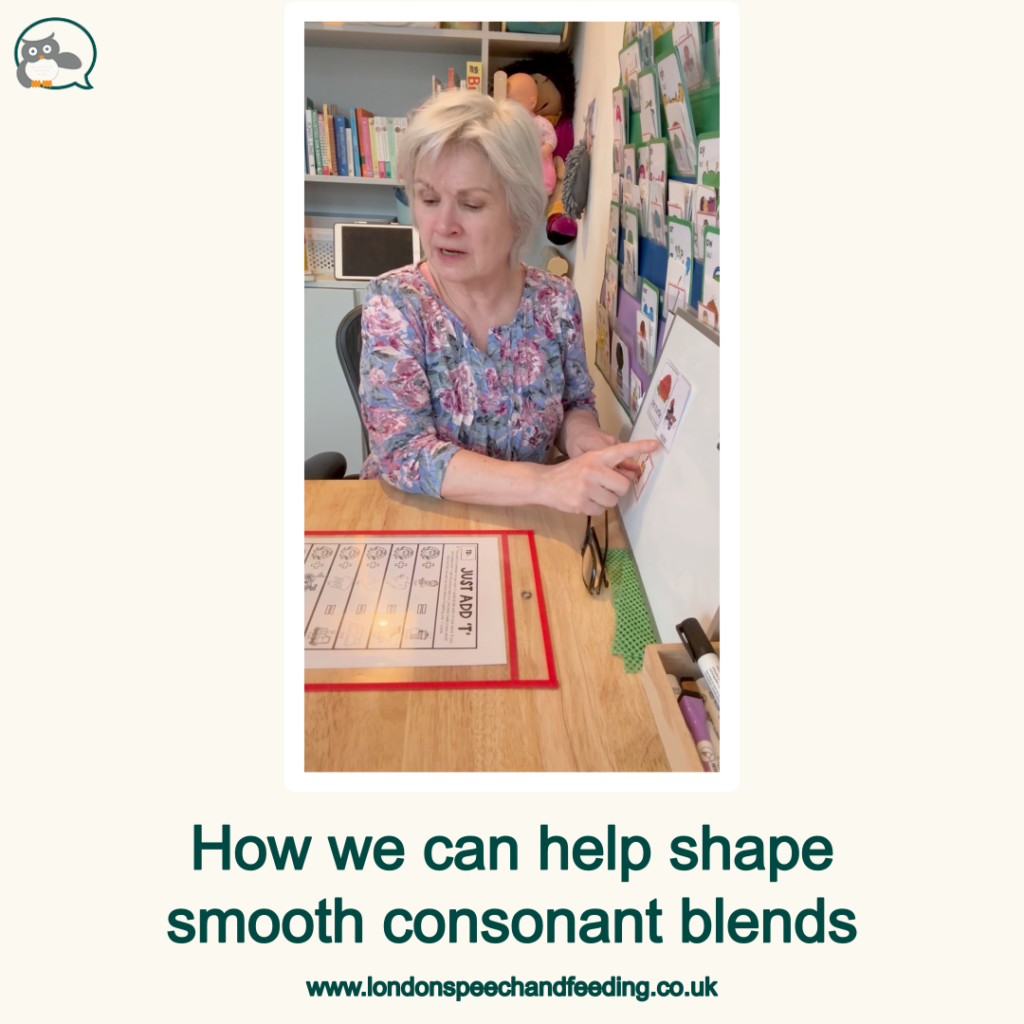
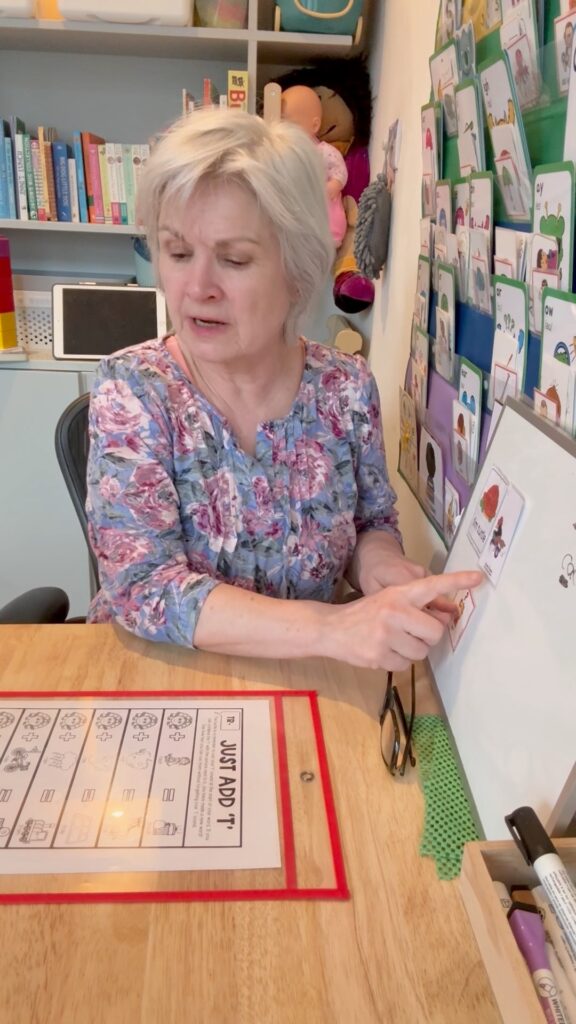
This particular student has a mild motor planning difficulty and six weeks ago he came to me with a very strong lisp. In addition to the lisp he is struggling to produce a number of sounds, SH and L on its own and all the clusters (FL/BL/KL/PL) but also CH together with some vowel difficulties.
Here I use the ‘Flat Tyre’ Sound, to offer as an image for a new S sound and the ‘Tick Tock’ Sound for a new image of the T sound. Both cards are from the Bjorem Speech Sound Deck, which I love and use almost daily.
Gestural Cues
I like to use all the ‘cued articulation’ hand cues by Jane Passy for consonants and fricatives. Here we use our fingers and hand to illustrate what our tongue does, and we also show whether a sound is voiced or voiceless. When I use one finger it is voiceless (k/f/s/p) and when I use two fingers for the same cue it means that the voice needs to be turned on: (g/v/z/b/n/m). For vowels I like to use Pam Marshalla’s cue system.
Simultaneous production
We say the word together.
Direct imitation
I say the word and my student copies me directly.
Imitation after a delay
I say the word and then after a little wait my student says the word.
Spontaneous production
My student has now learned to say the word by him/herself.
Offering feedback
It sounds like… I just heard… I didn’t hear the first sound there? Can you try again?
Letting the student reflect
By just shaking my head or by looking quizzical so that my student realises something didn’t quite go right.
Postitive reinforcement
‘Yes that was it, do it again, nice one…’
Cognitive reframing
This is a technique where we identify different semantic cues and metaphors or imagery cues, so instead of teaching or focusing on a sound we try out viewing each syllable from a different point of view.
For example: ‘yellow’. I have had great success with this one: we start with just saying ‘yeah yeah yeah’. I might make a little joke and say something like ‘imagine your mum says tidy your bedroom, what do you say or what do you think?’ Answer: ‘yeah yeah yeah’. Then we practice ‘low’ together, I might blow some bubbles high and low and we talk about ‘low’. And then we put ‘Yeah’ and ‘Low’ together and now we have YELLOW!! It might at first still sound a bit odd, like ‘yea-low’ but we soon shape that up and have the real word.
Each student is different and having a great rapport is crucial to our success.
Then a little game break after some 7–10 or so repetitions and always trying to finish on a positive note.
What game breaks do I use:
Very quick ones! Students can post something, place a counter in a game, take out a Jenga block from the tower, pop in a counter for ‘connect 4’, stick a sword into the Pop the Pirate barrel or add a couple of Lego blocks to something they are building.
Feeding and Dysphagia (Swallowing) Specialist The London Speech and Feeding Practice
The London Speech and Feeding Practice
Find a speech and language therapist for your child in London. Are you concerned about your child’s speech, feeding or communication skills and don’t know where to turn? Please contact me and we can discuss how I can help you or visit my services page.
As a speech and language therapist, I often get asked by parents what toys and books they should buy for their toddlers. It can feel overwhelming with so many options available! So, I’ve put together a list based on my experience and what I’ve found works well.
Remember, every child is unique!
Observe your toddler’s interests and play style. Some toys that are popular might not be engaging for your child.
Here are a few ideas to get you started:
Sensory Toys:
Stacking cups: These are fantastic for developing hand-eye coordination, fine motor skills, and understanding size relationships. (Various brands available) Note: You can stack many things you have around the house, like bowls or measuring cups, for a similar experience!
Shape sorters: Help with shape recognition, hand-eye coordination, and problem-solving. (Melissa & Doug, Vtech)
Sensory balls: Balls with different textures (soft, bumpy, squishy) provide tactile stimulation. (Various brands)
Push and pull toys: Encourage gross motor development and exploration. (Vtech, Fisher-Price)
Communication-focused toys:
Picture books with flaps: Engage curiosity and encourage language development. (Various brands)
Talking toys: Introduce new vocabulary and encourage imitation. (Vtech, Fisher-Price)
Musical instruments: Encourage exploration of sounds and develop auditory skills. (Bright Starts, Fisher-Price)
Now, let’s talk about books:
The Very Hungry Caterpillar by Eric Carle: A classic with repetitive text and vibrant illustrations, great for introducing vocabulary and concepts like days of the week.
Brown Bear, Brown Bear, What Do You See? by Bill Martin Jr. and Eric Carle: Simple, repetitive text and engaging illustrations make this a favourite for many toddlers.
Goodnight Moon by Margaret Wise Brown: A soothing bedtime story with calming illustrations.
Pat the Bunny by Dorothy Kunhardt: An interactive book with textures and flaps to engage young children.
Corduroy by Don Freeman: A heartwarming story about a teddy bear who loses his button.
Remember:
Observe your child’s interests: Choose toys and books that capture their attention and encourage exploration.
Engage with your child: Play with the toys together and read books aloud with enthusiasm.
Keep it simple: Start with a few toys and books and gradually introduce new ones.
Rotate toys: Keep playtime fresh by rotating toys and books regularly.
Most importantly, have fun! Reading and playing with your child should be a joyful experience for both of you.
Also consider the power of open-ended play
In today’s world filled with electronic gadgets, it’s easy to overlook the value of open-ended play. Open-ended toys lack specific functions or prescribed outcomes, allowing children to use their imaginations to explore and create. Unlike toys with pre-determined ways to play, open-ended toys encourage:
Creative thinking: Children can use them in countless ways, developing their own rules and narratives. A block can become a car, a house, or a spaceship, depending on the child’s imagination.
Problem-solving skills: Children learn to figure out how to use the toys, experimenting and adapting as they go. Don’t immediately rush in and fix things for your little one, let them think for themselves and then communication incentive: let them come and find you!
Fine motor skills: Many open-ended toys, like blocks, encourage the development of fine motor skills like grasping, stacking, and building.
Cognitive development: Children learn about cause and effect, spatial relationships, and problem-solving as they play with open-ended toys.
Social-emotional development: Open-ended play can foster social interaction and cooperation as children play together and share ideas.
Simple toys with big impact
Some of the best toys for toddlers are often the simplest ones. Here are a few examples:
Wooden blocks: Building towers, bridges, and forts encourages creativity and problem-solving.
Balls: Throwing, kicking, and rolling balls promote gross motor skills and hand-eye coordination.
Fabric: Bits of fabric can be draped, draped, and used for imaginative play.
Empty boxes: From cardboard boxes to tissue boxes, these can be transformed into anything a child can imagine: a car, a house, a spaceship!
Natural materials: Sticks, leaves, pinecones, and rocks can be used for imaginative play and sensory exploration.
Remember, the key to open-ended play is to let children explore and discover
Step back and observe, allowing your child to use his or her imaginations without too much direction. You might be surprised at the creative ways he or she uses simple toys!
Feeding and Dysphagia (Swallowing) Specialist The London Speech and Feeding Practice
The London Speech and Feeding Practice
Find a speech and language therapist for your child in London. Are you concerned about your child’s speech, feeding or communication skills and don’t know where to turn? Please contact me and we can discuss how I can help you or visit my services page.
My baby isn’t babbling and developing speech – what can I do to support?
While every baby develops at their own pace, if your child isn’t babbling by nine months, it’s worth seeking help from an Early Intervention Health Professional, such as a doctor and a speech therapist. Don’t panic! There are many reasons for delayed babbling, and early intervention is key.
In the meantime, it is highly recommended that we talk, sing, and read to our baby often. Exaggerate sounds and expressions, and respond to their coos and smiles. This playful interaction helps stimulate their communication skills.
Below are some tips and tricks from my experience of working with babies and toddlers who need a little bit of help and support to develop.
The benefits of imitating your baby
Copying your baby’s sounds and gestures isn’t just silly fun, it’s a powerful learning tool! By mimicking their babbles and actions, you activate “mirror neurons” in their brain that help them connect sounds with meaning. This playful back-and-forth teaches turn-taking, a foundation for conversation. Plus, it encourages them to copy you, building their own language skills and social interaction abilities.
This is a nice clip on youtube showing how copying/imitating your baby looks like:
Here are some fun ways to imitate your baby:
Matchmaker: Grab two of the same, or two similar toys your child loves, like rainmakers or shakers. Give one to your baby and keep the other for yourself. When your child plays with his/her toy, mirror his/her actions with yours! This creates a fun, interactive game.
Face Time: Get down to your baby’s level, sitting opposite him/her on the floor or kneeling. This makes eye contact easy and encourages him/her to look at you during your playful imitation.
Be the Funniest You: Go all out with silly faces, exaggerated sounds, and big gestures. The goal is to capture your baby’s attention and make you irresistible to watch. This playful energy encourages him/her to interact and potentially imitate you back!
By incorporating these tips, you can turn imitation into a fun and engaging way to boost your baby’s communication skills. I have seen this happen numerous times over the past decades. It is very powerful, go ahead and try it! You cannot be silly and goofy enough!
Did you know that speech and language development starts with how we talk to our babies?
Adults naturally use a special way of speaking called motherese. It involves a higher pitch, slower pace, and exaggerated sounds compared to regular conversation. Sentences are simpler, with shorter words and repetition. This grabs babies’ attention, helps them distinguish sounds, and reinforces word meaning.
Imitation is a key part of motherese. We wait for our baby to make a sound or gesture, then playfully imitate it with exaggeration. Babies notice this right away and often respond with more vocalisations, creating a mini conversation. This back-and-forth teaches turn-taking, a foundation for future conversations.
By responding warmly and engaging in these playful interactions, we encourage our babies to keep exploring the world of communication. Talking, singing, reading and, of course, imitating, these simple actions can have a big impact on a baby’s language development.
Once your conversation is underway then try and keep it going for as long as possible. It’s a beautiful dance of turn-taking, even without words!
A last word on oxytocin
There’s evidence suggesting early non-verbal communication with your baby can increase a mother’s oxytocin levels, often called the ‘love hormone’. This hormone plays a key role in bonding and social connection. Positive interactions, touch, and stress reduction all contribute to oxytocin release, strengthening the mother–baby bond.
For parents of babies with extra needs
The stress of caring for a child with medical needs or developmental delays can be difficult. Stress can lower oxytocin levels, creating a cycle of sadness for both parent and child.
Breaking the cycle:
Knowledge is Power: Understanding the importance of communication can empower parents.
Seek Support: Speech therapists and other healthcare professionals can provide valuable guidance on communication strategies.
Start Small, Celebrate Big: Even small interactions can boost oxytocin. Focus on playful imitation and positive reinforcement. Remember, friends, family and healthcare professionals are there to encourage you.
This approach can help reverse the negative cycle and create a more positive and connected relationship between parent and child.
Feeding and Dysphagia (Swallowing) Specialist The London Speech and Feeding Practice
The London Speech and Feeding Practice
Find a speech and language therapist for your child in London. Are you concerned about your child’s speech, feeding or communication skills and don’t know where to turn? Please contact me and we can discuss how I can help you or visit my services page.
Have you ever wondered why children may pronounce a word correctly one minute and in the next breath they struggle to say the same word? It’s equally as frustrating for you as it is for your child. The biggest question of all is WHY? Why does this happen and what causes it? Whilst there are many explanations. When it persists, it might be a condition called verbal dyspraxia.
What is verbal dyspraxia
Verbal dyspraxia is a neurological motor speech disorder that affects the coordination and planning of muscle movements that are needed for speech production. A child may have difficulty making the precise movements needed for speech, which may result in inconsistent and unintelligible speech. Children may also have trouble sequencing sounds and syllables, producing speech sounds accurately, and coordinating the movements of their articulators (e.g., lips, tongue, teeth, jaw). This can lead to a range of speech errors (including sound distortions, substitutions, omissions, and difficulty with rhythm and prosody).
We know that these speech errors, and not being able to get a message across, can be frustrating for children with speech difficulties. Can you imagine talking and limited people understanding you? It’s so tough on children and the people trying to communicate with them.
Creating a person-centred therapy plan is vital. This allows your child to stay motivated, as intervention is likely to be long term. This planning may include favourite words to use during their hobby or favourite activity, or person-centred goals such as ‘giving Alexa an instruction’.
Children with verbal dyspraxia can have several different ways of producing words, which often makes it trickier for them as there’s no consistent pattern to work with. So, we’ve put together some top tips to support their communication and make their (and your) lives a little easier in the process.
Ten ways to make communication easier for your child with verbal dyspraxia
Have a list of frequently used words and practise this set. Little and often is best!
Use cued articulation to support speech production (ask your Speech and Language Therapist for the gestures)
Give time and use active listening. This means showing interest and trying not to think about what is on your never ending ‘to do’ list
Reduce frustration in any way that you can. This might mean allowing your child to demonstrate using gestures rather than speech. You might also give top tips for other adults or children who communicate with your child when out and about
Talk about the structure of words with your child (i.e., there are two beats/syllables in this word)
Show the written form of the word to go alongside their production
Split down tasks, so that your child only has to respond to one question at a time, reducing their motor capacity
Recognise when your child is working well and when they may need support of an Alternative and Augmentative Communication device
Allow all environments to have the same training and equipment (i.e., at school, home, out and about)
Have regular periods in the day where your child can practise their specific words in different environments. This can be effective for children with verbal dyspraxia
Find a speech and language therapist for your child in London. Are you concerned about your child’s speech, feeding or communication skills and don’t know where to turn? Please contact me and we can discuss how I can help you or visit my services page.
Your child’s speech, language and communication difficulties may impact their self-esteem. And they may show signs of increased frustration. You want them to be full of confidence, increasing their participation in school and fully engaging with their peers.
1. Practise active listening
Speech difficulties can mean that it’s more challenging to understand what your child says. It’s important to show that you’re paying attention, giving them time to express themselves. Focus on what your child says rather than how they are speaking. Remember to maintain eye contact, and actively listen. Active listening and giving time can be trickier than it sounds. I can provide strategies to support your active listening skills.
2. Give other means and forms of communication
Allowing children to express themselves in a variety of ways (e.g., gesture, signs, written, use descriptions to describe a word (e.g., sand – you find it out the beach, it can have pebbles on it, it’s not the sea), use of symbols or high-tech augmentative communication methods such as a computer). Using different ways is vital in reducing frustration and communicating their message. If you’re unsure of what other forms of communication you can use, please contact me for some top tips.
3. Praise efforts
Providing specific praise allows your child to understand what they’ve achieved. E.g., you could praise the way your child listens, or how they take turns, or their resilience (e.g., “I like the way you listened” or “good listening”). Think of different ways you could praise you child during different activities, so you are prepared with phrases that you can use.
4. Have clear start and end points in activities
Some children with speech, language and communication needs have difficulties with transitioning from one activity to another. They also have difficulties with changes in routine. This can add to their frustration and changes in behaviour. So, how do you show a clear start and end to an activity? You can have a visual timetable, or you could have ‘start’ and ‘finish’ boxes where you place all the materials in the box labelled ‘start’. And once the activity has finished, you put the items in the box labelled ’finished’. If you need support with transitions, please contact me.
5. Use visuals
Visuals can support your child to understand routine and spoken language. Visuals can range from symbols to online images, to photographs, or a combination. Explore which type of visuals work well for your children. Using visuals can be powerful if used correctly. Make the most of the opportunities that visuals can provide for your family.
Increase confidence and reduce frustration in children with speech and language and communication difficulties today. Please feel free to contact me if you need any support or tips on maximising these opportunities.
Find a speech and language therapist for your child in London. Are you concerned about your child’s speech, feeding or communication skills and don’t know where to turn? Please contact me and we can discuss how I can help you or visit my services page.
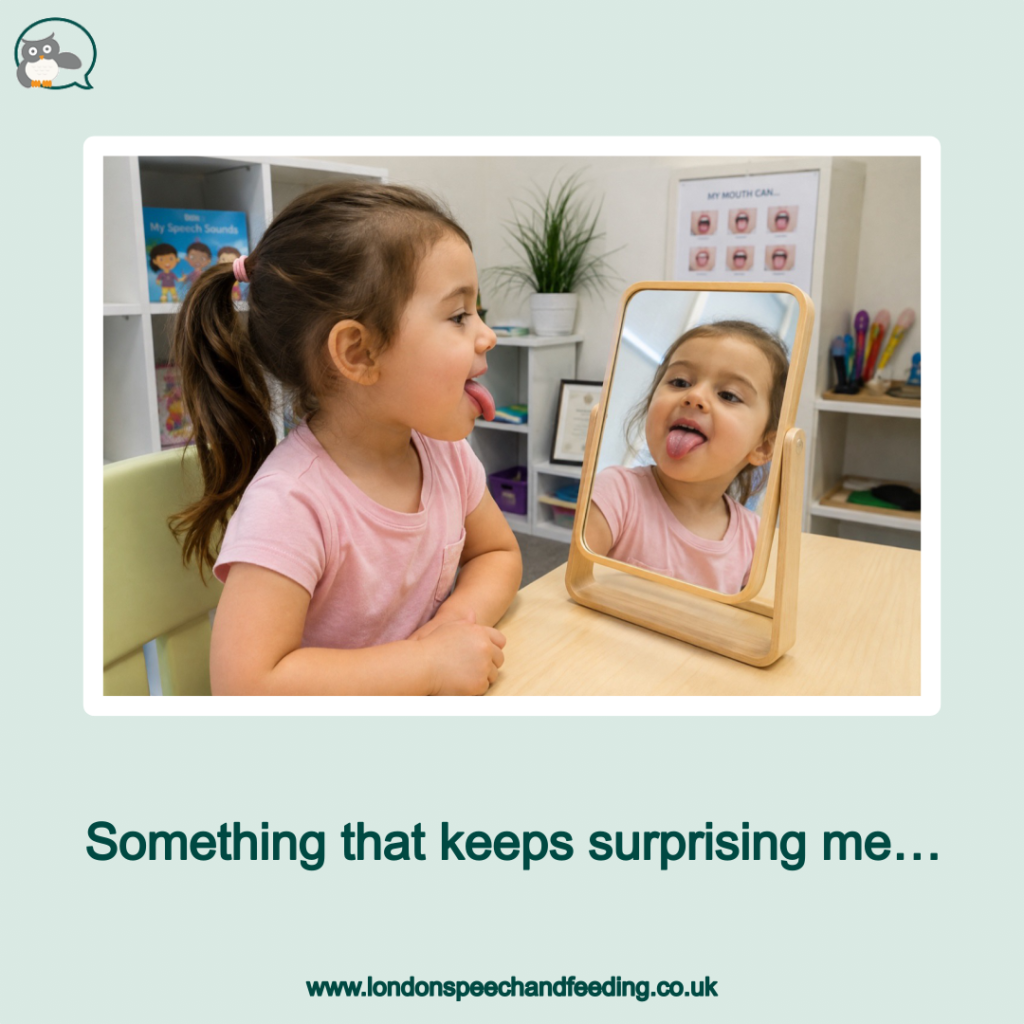
When most people think about speech or feeding difficulties, they picture the tongue, lips, or chewing skills, but how a child breathes at rest plays a surprisingly big role too.
Mouth breathing and open mouth resting posture can quietly influence everything from how a child’s face grows to how clearly they speak, to how confidently they chew and swallow. It’s something many parents never think about, until they start noticing the subtle signs.
Let’s explore why this happens, what to look for, and how to gently support better breathing and oral posture.
Recent research supports this link between mouth breathing and speech difficulties. For example, a 2022 study by Alhazmi et al., published in the Journal of Pharmacy and Bioallied Sciences, found that 81.7% of children aged 9–17 who breathed primarily through their mouths presented with speech sound disorders. The study highlights how mouth breathing can significantly influence orofacial development and articulation patterns.
💨 Why we’re designed to breathe through our nose
Our bodies are made for nasal breathing. When we breathe through the nose, the air is filtered, warmed, and humidified before reaching the lungs. The tongue naturally rests against the roof of the mouth, the lips close gently, and the jaw stays relaxed, all of which encourage healthy oral development.
In contrast, mouth breathing often means the tongue rests low in the mouth and the lips stay apart. Over time, this posture can subtly reshape how the muscles and bones of the face grow.
Children who breathe through their mouths most of the time may develop:
A longer face and narrower palate
Forward head posture
Slightly open lips and low tongue position at rest
A tendency toward drooling or noisy breathing
A dry mouth and consequently bad breath
At times the tongue pushes constantly against the front teeth causing them to grow forward (buck teeth)
These changes are not anyone’s fault, as they often start because of blocked noses, allergies, enlarged adenoids, low facial muscle tone or habits formed when a child was younger. But understanding the pattern helps us know how to support change.
🗣 How mouth breathing affects speech
Speech depends on precise coordination between the lips, tongue, and jaw. The resting position of these structures affects how ready they are to move.
Reduced tongue strength and placement, i.e. the tongue rests low in the mouth (as it does in mouth breathing), it’s harder for children to lift it efficiently for sounds like /T/, /D/, /N/, /L/, and /S/. This can lead to speech that sounds slightly slushy or unclear, or a frontal lisp.
Open mouth posture and resonance: An open mouth at rest may affect how air vibrates in the oral and nasal cavities. Children might have speech that sounds a bit ‘muffled’ or lacks crispness because the lips and jaw aren’t fully supporting articulation.
Fatigue and breath control: Mouth breathing can lead to drier mouths and less efficient breath support. That can make longer sentences or conversations feel tiring, especially in noisy environments.
🥄 How mouth breathing affects feeding and chewing
Feeding involves the same structures that control speech, so posture and breathing patterns matter here, too.
Chewing efficiency: Children who habitually keep their mouths open often have low tongue tone and reduced jaw stability. They may prefer softer foods, chew slowly, or struggle with mixed textures.
Swallowing pattern: A tongue that rests low may push forward when swallowing. This ‘tongue-thrust swallow’ can interfere with efficient chewing and even affect dental alignment over time.
Breathing while eating: Since it’s hard to chew, swallow, and breathe through the mouth simultaneously, children who can’t comfortably nasal breathe may rush bites or pause to catch their breath. This can contribute to coughing, choking, or food refusal.
Common signs to watch for
Parents often notice subtle clues before realising mouth breathing is a pattern. Some red flags include:
Lips habitually open at rest
Drooling after the toddler years
Snoring or noisy breathing during sleep
Preference for soft foods or grazing eating habits
Dark circles under the eyes due to allergies
Frequent colds, congestion, or mouth odour
Speech that sounds slushy or unclear despite good effort
If several of these sound familiar, it’s worth mentioning them to your child’s GP, dentist, or speech and language therapist.
👩⚕️ What can help
Address the underlying cause: If nasal blockage, allergies, or enlarged adenoids are making nasal breathing difficult, a medical assessment is the first step. ENT specialists can rule out or treat physical causes.
Encourage closed mouth rest: Gentle reminders like ‘Lips together, tongue up, breathe through your nose’ can help older children become aware of their resting posture. For younger ones, visual cues (stickers or mirrors) can make it a game.
Build oral-motor strength and awareness: Speech therapists can design activities to strengthen the tongue and lips, improve jaw stability, and encourage balanced breathing. This might include blowing games, tongue-tip lifts, use of dental-palatal devices or oral-motor exercises disguised as play.
Support good posture: Sometimes mouth breathing goes hand-in-hand with forward-head posture. Encouraging upright sitting during meals and screen time helps keep the airway open and supports better breathing habits.
Make nasal breathing part of daily routines: Gentle nose-breathing practice during calm times (reading, bedtime, car rides) helps normalise it. Avoid making it a battle: calm, consistent reminders work best.
🌱 A gentle note on change
Patterns of mouth breathing develop over time, and change doesn’t happen overnight. It’s important to approach this with curiosity, not criticism. The aim isn’t ‘perfect breathing,’ but to give your child the tools and awareness to breathe comfortably and efficiently.
Small improvements in nasal breathing and resting posture can lead to big gains in speech clarity, eating confidence, and even sleep quality.
💡 The takeaway
Breathing seems automatic, and it is! but how we breathe matters. Mouth breathing and open-mouth posture can quietly shape how a child speaks, eats, and grows.
By noticing early signs, addressing underlying causes, and building supportive habits, you can help your child move toward stronger, clearer speech and more comfortable mealtimes.
Just like every area of development, progress starts with connection, patience, and gentle consistency, one calm breath at a time.
Find a speech and language therapist for your child in London. Are you concerned about your child’s speech, feeding or communication skills and don’t know where to turn? Please contact me and we can discuss how I can help you or visit my services page.
This is an exciting time for both you and your baby! Between 3 and 6 months, communication literally explodes. While your little one may not be saying words yet, he or she is actively learning to understand and express themselves. Here’s a glimpse into what you can expect:
Understanding:
Recognises familiar voices:
Your baby will likely turn his or her head towards the sound of your or other familiar adults’ voices.
Tips for supporting and expanding: Talk, sing and chant! Your baby will love and smile at hearing your talking voice, and he or she will not be judging your singing talent! You can sing to your hearts content, perhaps some lovely nursery rhymes you remember from your childhood, or festive songs like Jingle bells !. Or you can simply make up your own little songs and chants alongside all the daily activities you do with or for your baby. You could have a ‘nappy’ song, a ‘let’s get you ready for the park’ song, a ‘I’m hungry’ song or a ‘mummy’s cooking soup’ chant. It does not have to be beautiful but what does help is having little rhymes and rhythms to your singing. Your baby will love it and soak it all up.
Begins to understand ‘no’:
Your baby may pause or stop an action when you say ‘no’ and shake your head at the same time.
Tips for supporting and expanding: I don’t think that at this stage you will have much cause to say ‘no’ to be fair but you could do it playfully and bring it into a ‘no more’ situation so that your baby can make the connection between ‘no’ and ‘finished’ or ‘stop’ or ‘done’. Feeding might be a good opportunity for this one. You could also ask ‘who is it’ when someone is ringing the bell or coming down the stairs, e.g. ‘oh I hear footsteps! Is this daddy??…. no it’s not daddy no it’s grandma! daddy’s gone out!’
Responds to his or her name:
Your baby will start to show a reaction when you call his or her name.
Tips for supporting and expanding: Try calling your baby’s name a lot, and get different family members or visitors calling your baby by his or her name and calling his or her name before saying ‘look’ or ‘peek-a boo’ etc.
Use Baby Signing: You can introduce simple gestures and signs such as ‘milk’ ‘nappy’ ‘sleep’ ‘dog’ ‘cat’ etc to help your baby make the connection between what you are saying and what he or she is seeing.
Expressing:
Cooing, gurgling and babbling:
These sounds are more than just adorable! They are your baby’s way of experimenting with his or her voice and learning to control his or her vocal cords.
You might hear sounds like ‘ba-ba-ba’ or ‘ga-ga-ga’. This is a huge milestone!
Tips for Supporting and expanding: This is a wonderful time to copy your baby’s sounds, celebrate them and show your baby that you are listening to his or her sounds and you are understanding everything he or she is saying! This is also a brilliant time to start reading to your baby. You can read any children’s books you fancy. Again your baby will adore the sound of your voice but increasingly he or she will also look at the pages of a book and try and understand and make connections between the words you say and the pictures he or she sees.
When you hear your child babbling you can try and give it meaning where possible, for example your baby says: ‘ba ba ba’ you could fall into ‘Baa Baa black sheep have you any wool’ song or you could say ‘mmmh banana!’ And show a banana that’s lying on the table. Or you could just say: ‘baba baaaaah you are saying ba! That’s so great!’ Anything goes really at this stage!
Facial expressions:
Your baby uses smiles, frowns, and other facial expressions to communicate his or her emotions (happy, sad, angry).
Tips for supporting and expanding: Try and make interesting and exaggerated facial expressions yourself when you are talking to your baby! Try and be a little bit clowney and really practise showing ‘surprise’ ‘boo’ or a big grin, smile, purse your lips, blow raspberries, open and close your mouth and make funny faces. Copy your baby when you see his or her facial expression change. When your baby looks confused, say ’oh we don’t know what’s happening we are confused!’. When your baby looks happy, say ‘you look soo happy! What a lovely smile!’
Eye contact:
Your baby will start making more and more eye contact with you during interactions.
Tips for supporting and expanding: Try and get ‘face to face’ a lot with your baby. When cuddling your baby look at his or her face and often make sure that it is easy for your baby to see and look at you. If you can lower your position so that your face is in line with your baby that will make things easier for you both.
Good games to play: ‘People-Games’ these are games where you do not need any toys to have a good time. All you need is the other person: Peek-a-boo, bumping your baby up and down on your lap with a song, Row Row Row your boat, tickling games, catch you games etc.
Now we are at 6 months another very exciting stage has arrived: feeding SOLIDS to our baby! More of this in my next post!
When to Seek Guidance:
If you have any concerns about your baby’s communication development, please don’t hesitate to consult with me. Early intervention can make a significant difference and really help your baby making progress.
Remember: Every baby develops at his or her own pace. These are general guidelines, and some babies may reach certain milestones earlier or later than others.
Feeding and Dysphagia (Swallowing) Specialist The London Speech and Feeding Practice
The London Speech and Feeding Practice
Find a speech and language therapist for your child in London. Are you concerned about your child’s speech, feeding or communication skills and don’t know where to turn? Please contact me and we can discuss how I can help you or visit my services page.