Could mouth breathing be affecting your child’s speech, sleep and development?
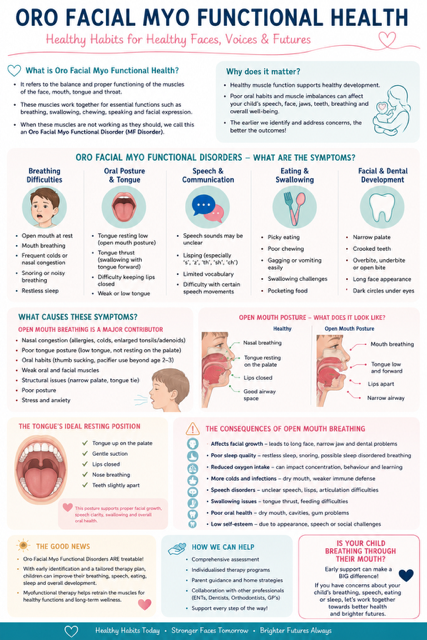
Could mouth breathing be affecting your child's speech, sleep and development?

Understanding Orofacial Myofunctional Disorders (OMDs)

Many parents contact me at London Speech and Feeding because they are worried about their child’s speech. Perhaps their child is difficult to understand, has a persistent lisp, struggles with feeding, snores at night, or always seems to have their mouth open.

What many families don’t realise is that these concerns may all be connected.

Increasingly, research and clinical experience are highlighting the important role of Orofacial Myofunctional Health, the way the muscles of the face, mouth, tongue and airway work together to support breathing, eating, sleeping and communication.

When these muscles are not functioning optimally, children may develop what are known as Orofacial Myofunctional Disorders (OMDs).

What Is Orofacial Myofunctional Health?

Orofacial Myofunctional Health refers to the healthy function and coordination of the:

  • lips
  • tongue
  • jaw
  • cheeks
  • facial muscles
  • airway.

These structures play a vital role in:

  • breathing
  • swallowing
  • chewing
  • speaking
  • facial growth
  • dental development
  • sleep quality.

When everything is working well, the lips remain gently closed at rest, breathing occurs through the nose, and the tongue rests against the roof of the mouth.

This seemingly simple posture has a profound influence on how a child’s face, teeth and airway develop.

What is an Orofacial Myofunctional Disorder?

An Orofacial Myofunctional Disorder occurs when there is an abnormal pattern of muscle function involving the face, mouth, tongue or airway.

Children with OMDs may experience difficulties with:

  • speech
  • feeding
  • swallowing
  • sleep
  • breathing
  • dental development
  • facial growth.

In many cases, these difficulties are linked to chronic mouth breathing.

Signs your child may have an Orofacial Myofunctional Disorder

Breathing and sleep signs

  • mouth open at rest
  • mouth breathing during the day
  • snoring
  • noisy breathing
  • restless sleep
  • frequent waking
  • dark circles under the eyes
  • chronic congestion
  • fatigue despite a full night’s sleep.

Speech signs

  • lisping
  • unclear speech
  • distorted speech sounds
  • difficulty producing certain sounds
  • persistent articulation difficulties
  • reduced speech intelligibility.

Feeding and swallowing signs

  • picky eating
  • messy eating
  • food remaining in the cheeks
  • gagging easily
  • difficulty chewing
  • long mealtimes
  • tongue thrust swallowing.

Facial and dental signs

  • narrow palate
  • crowded teeth
  • open bite
  • overbite
  • underbite
  • long face appearance
  • receding chin
  • poor lip seal.

If several of these signs sound familiar, a comprehensive assessment may be worthwhile.

Why does mouth breathing matter?

Many parents assume mouth breathing is simply a habit.

In reality, mouth breathing is often a symptom that something is preventing efficient nasal breathing.

Common causes include:

  • enlarged tonsils
  • enlarged adenoids
  • allergies
  • chronic nasal congestion
  • recurrent infections
  • structural airway differences
  • tongue tie
  • prolonged dummy use
  • thumb sucking
  • poor oral posture.

When nasal breathing becomes difficult, children naturally begin breathing through their mouths.

Over time, this can affect how the face, jaws and airway develop.

What does healthy oral posture look like?

Healthy oral posture is surprisingly simple:

  • lips
    • gently closed
  • tongue
    • resting against the roof of the mouth
  • teeth
    • slightly apart
  • breathing
    • through the nose.

This posture helps guide healthy jaw growth, facial development and airway formation.

Think of the tongue as a natural orthodontic support system. When it rests in the correct position, it helps shape the upper jaw and supports healthy facial growth.

The consequences of chronic mouth breathing

1. Speech difficulties

Children who breathe through their mouths often have altered tongue posture and reduced oral stability.

This can contribute to:

  • lisping
  • distorted sounds
  • reduced speech clarity
  • difficulty learning new speech sounds.

2. Feeding and swallowing difficulties

A low tongue posture may affect:

  • chewing efficiency
  • swallowing patterns
  • food management
  • oral motor coordination.

Many children develop a tongue thrust swallow, where the tongue pushes forward instead of moving efficiently during swallowing.

3. Poor sleep quality

Mouth breathing can contribute to:

  • snoring
  • restless sleep
  • frequent waking
  • daytime fatigue
  • reduced concentration.

Poor sleep can have a significant impact on learning, behaviour and emotional regulation.

4. Changes to facial growth

Over time, chronic mouth breathing may influence:

  • jaw development
  • facial proportions
  • dental alignment
  • airway size.

This can result in:

  • narrow palates
  • crowded teeth
  • long facial appearance
  • increased orthodontic needs.

5. Oral health concerns

The nose acts as a natural filter and humidifier.

When children breathe through their mouths:

  • The mouth becomes dry.
  • Saliva protection is reduced.
  • Risk of tooth decay increases.
  • Gum health may be affected.

Why this matters for speech therapy

Speech does not develop in isolation.

The tongue, lips, jaw and airway work together to support clear communication.

At London Speech and Feeding, we look beyond speech sounds alone.

A child who presents with:

  • persistent speech difficulties
  • lisping
  • feeding challenges
  • open mouth posture
  • snoring
  • poor sleep

may benefit from an assessment that explores underlying orofacial myofunctional factors.

Addressing these foundations can often support more effective progress in speech and feeding therapy.

How London Speech and Feeding can help

A comprehensive assessment may include observation of:

  • breathing patterns
  • lip posture
  • tongue posture
  • swallowing function
  • feeding skills
  • speech sound development
  • sleep concerns
  • oral structures.

Where appropriate, recommendations may include:

  • orofacial myofunctional therapy
  • speech therapy
  • feeding therapy
  • home programmes
  • ENT referral
  • orthodontic referral
  • collaborative multidisciplinary support.

The good news

Orofacial Myofunctional Disorders are often highly treatable when identified early.

Supporting healthy breathing, tongue posture and oral muscle function can positively influence:

If your child regularly breathes through their mouth, snores, struggles with speech clarity or has feeding difficulties, a specialist assessment may help identify the underlying cause.

  • speech clarity
  • feeding skills
  • sleep quality
  • facial growth
  • dental development
  • overall wellbeing.

At London Speech and Feeding, we are passionate about looking beyond symptoms and understanding the whole child. Contact me!

Sometimes the key to clearer speech starts with a simple question:

‘Is my child breathing through their nose?’

Sonja McGeachie

Highly Specialist Speech and Language Therapist

Owner of The London Speech and Feeding Practice.

Frequently Asked Questions

Can mouth breathing cause speech problems?

Yes. Mouth breathing can alter tongue posture, lip strength and oral stability, which may contribute to articulation difficulties and lisps.

Should I be worried if my child snores?

Regular snoring is not considered normal in children and may indicate airway obstruction or sleep-disordered breathing.

Can enlarged tonsils affect speech?

Yes. Enlarged tonsils may affect resonance, tongue positioning, swallowing and breathing patterns.

What age can children be assessed?

Children of all ages can be assessed if parents have concerns about speech, feeding, breathing or oral development.

What is Orofacial Myofunctional Therapy?

Orofacial Myofunctional Therapy focuses on improving breathing patterns, tongue posture, lip seal and oral muscle function to support overall health and development.

Health Professions Council registered
Royal College of Speech & Language Therapists Member
Member of ASLTIP

Find a speech and language therapist for your child in London. Are you concerned about your child’s speech, feeding or communication skills and don’t know where to turn? Please contact me and we can discuss how I can help you or visit my services page.
3

Similar Posts

  • ·

    Milestones of autistic children: Crawling, walking, and talking

    For all children every milestone achieved is a testament to the unique and intricate process unfolding within each young mind. For autistic children, this journey may present a distinct pattern, with some reaching developmental milestones like crawling, walking, and talking later than their neurotypical peers. Let’s have a look into the fascinating realm of Autism and explore why some autistic children might crawl, walk, and talk later, shedding light on the underlying factors contributing to this unique way of developing.

    1. Individual Pacing:

    Child development is not a one-size-fits-all journey. Each child, whether neurotypical or autistic, has a unique timeline for achieving milestones. Autistic children, like any other children, follow their own pacing. This individual rhythm might lead them to focus on one set of skills before they progress to others. Like some neurotypical children might focus on talking earlier than walking, autistic children might prioritise other areas before crawling or talking.

    2. Neurodevelopmental Complexity:

    The human brain is a remarkable entity, with a bewildering array of interconnected processes that lead to us achieving our developmental milestones. Autistic children often have variations in “neural wiring”, which can impact the balance between gross motor skills (crawling, walking) and fine motor skills. Speech and language acquisition falls under fine motor skills and may be momentarily disrupted due to the divergent neurological pathways at play in autism.

    2. Sensory Processing Differences:

    One of the hallmarks of autism is altered sensory processing. Autistic children often experience sensory stimuli differently than their neurotypical peers. This heightened or diminished sensitivity can influence a child’s desire or ability to engage in activities like crawling and walking. The sensation of movement while crawling or walking, for instance, might be overwhelming for some autistic children, causing them to either avoid or delay these activities.

    3. Visual-Spatial Abilities:

    Autistic children and adults frequently display excellent visual-spatial abilities. This strength might lead some children to focus more on activities that engage these skills, potentially delaying their engagement with activities like walking or talking. As they navigate their environment and process information visually, they might naturally invest more time in activities that stimulate this particular cognitive ability and strength.

    4. Communication Challenges:

    For many autistic children, speaking can be a really complex and difficult endeavour. Communication delays are a common feature of autism. This can affect both receptive and expressive language development. While some children might be physically capable of crawling or walking, they may not yet have the tools to communicate their desires and intentions. This leads to a temporary focus on non-speaking forms of expression. This does not mean that they do not communicate at all. But autistic individuals often start out using jargoning or echolalia as a form of communication as well as behaviours and physical forms of communication.

    5. Executive Functioning and Motor Skills:

    Executive functioning, or abilities for planning, organising, and carrying out tasks, can vary in autistic children. These skills are crucial for activities like crawling, walking, and talking, which need coordination and planning. About 40% of autistic persons have a motor planning difficulty.

    6. Intense Interests and Routines:

    Autistic children often develop intense interests in specific subjects, sometimes to the exclusion of other activities. These interests might become their primary mode of engagement. They might side-line milestones like crawling, walking, or talking. The mostly rigid adherence to routines and preferences might cause them to allocate more time to their preferred activities. This delays their engagement with other developmental tasks.

    How can Speech and Language Therapy help:

    Support and Intervention:

    Early intervention and regular Speech and Language Therapy play a pivotal role in the developmental journey of autistic children. Therapies tailored to individual needs can aid in bridging the gaps between milestones. Occupational therapy, for example, can help address sensory sensitivities and motor skill challenges that might impact crawling and walking. Speech therapy can help communication development, gradually bridging the gap between non-verbal expressions and spoken language.

    For example, we now know that echolalia or jargoning of longer phrases with intonation, repeating scripts from favourite tv shows or songs have many meanings and communicative functions. For example, a child who utters long strings of echolalic utterances, often difficult to understand, might want to do any one of the following:

    • Comment
    • greet
    • ask a question
    • make a request
    • express surprise
    • negate something.

    We now understand that the way to support a child with echolalia is to acknowledge all utterances and try and find out what the meaning is behind these scripts. This is very supportive. Over time it will lead a child to move on to understanding and saying more clear and self-generated language. For more information about this Natural Language Acquisition here are some other great websites for you to look at:

    Conclusion

    In conclusion, the journey of an autistic child’s development is a testament to the uniqueness and complexity of the human mind. The delays or differences in achieving milestones like crawling, walking, and talking can be attributed to a range of factors, including

    • neurodevelopmental intricacies,
    • sensory processing variations,
    • and communication challenges.

    It’s crucial to recognise that these delays are not indicative of a lack of potential, but rather a manifestation of the intricate interplay between an autistic child’s strengths and challenges. By embracing these differences and providing tailored support, we can help each autistic child unfold their potential at their own pace.

    Do get in touch if you would like to book an appointment where we can explore how to help your child develop and thrive

    Do get in touch if you would like to book an appointment where we can explore how to help your child develop and thrive


    Find a speech and language therapist for your child in London. Are you concerned about your child’s speech, feeding or communication skills and don’t know where to turn? Please contact me and we can discuss how I can help you or visit my services page.

    0
  • · ·

    How can we support babbling and early speech development? SLT tricks and tips

    My baby isn’t babbling and developing speech – what can I do to support?

    While every baby develops at their own pace, if your child isn’t babbling by nine months, it’s worth seeking help from an Early Intervention Health Professional, such as a doctor and a speech therapist. Don’t panic! There are many reasons for delayed babbling, and early intervention is key.

    In the meantime, it is highly recommended that we talk, sing, and read to our baby often. Exaggerate sounds and expressions, and respond to their coos and smiles. This playful interaction helps stimulate their communication skills.

    Below are some tips and tricks from my experience of working with babies and toddlers who need a little bit of help and support to develop.

    The benefits of imitating your baby

    Copying your baby’s sounds and gestures isn’t just silly fun, it’s a powerful learning tool! By mimicking their babbles and actions, you activate “mirror neurons” in their brain that help them connect sounds with meaning. This playful back-and-forth teaches turn-taking, a foundation for conversation. Plus, it encourages them to copy you, building their own language skills and social interaction abilities.

    This is a nice clip on youtube showing how copying/imitating your baby looks like:

    Here are some fun ways to imitate your baby:

    • Matchmaker: Grab two of the same, or two similar toys your child loves, like rainmakers or shakers. Give one to your baby and keep the other for yourself. When your child plays with his/her toy, mirror his/her actions with yours! This creates a fun, interactive game.
    • Face Time: Get down to your baby’s level, sitting opposite him/her on the floor or kneeling. This makes eye contact easy and encourages him/her to look at you during your playful imitation.
    • Be the Funniest You: Go all out with silly faces, exaggerated sounds, and big gestures. The goal is to capture your baby’s attention and make you irresistible to watch. This playful energy encourages him/her to interact and potentially imitate you back!

    By incorporating these tips, you can turn imitation into a fun and engaging way to boost your baby’s communication skills. I have seen this happen numerous times over the past decades. It is very powerful, go ahead and try it! You cannot be silly and goofy enough!

    Great toy ideas:

    Did you know that speech and language development starts with how we talk to our babies?

    Adults naturally use a special way of speaking called motherese. It involves a higher pitch, slower pace, and exaggerated sounds compared to regular conversation. Sentences are simpler, with shorter words and repetition. This grabs babies’ attention, helps them distinguish sounds, and reinforces word meaning.

    Imitation is a key part of motherese. We wait for our baby to make a sound or gesture, then playfully imitate it with exaggeration. Babies notice this right away and often respond with more vocalisations, creating a mini conversation. This back-and-forth teaches turn-taking, a foundation for future conversations.

    By responding warmly and engaging in these playful interactions, we encourage our babies to keep exploring the world of communication. Talking, singing, reading and, of course, imitating, these simple actions can have a big impact on a baby’s language development.

    Once your conversation is underway then try and keep it going for as long as possible. It’s a beautiful dance of turn-taking, even without words!

    A last word on oxytocin

    There’s evidence suggesting early non-verbal communication with your baby can increase a mother’s oxytocin levels, often called the ‘love hormone’. This hormone plays a key role in bonding and social connection. Positive interactions, touch, and stress reduction all contribute to oxytocin release, strengthening the mother–baby bond.

    For parents of babies with extra needs

    The stress of caring for a child with medical needs or developmental delays can be difficult. Stress can lower oxytocin levels, creating a cycle of sadness for both parent and child.

    Breaking the cycle:

    1. Knowledge is Power: Understanding the importance of communication can empower parents.
    2. Seek Support: Speech therapists and other healthcare professionals can provide valuable guidance on communication strategies.
    3. Start Small, Celebrate Big: Even small interactions can boost oxytocin. Focus on playful imitation and positive reinforcement. Remember, friends, family and healthcare professionals are there to encourage you.

    This approach can help reverse the negative cycle and create a more positive and connected relationship between parent and child.

    I hope this is helpful! Don’t hesitate to reach out with any questions.

    Kind regards

    Sonja McGeachie

    Early Intervention Speech and Language Therapist

    Feeding and Dysphagia (Swallowing) Specialist The London Speech and Feeding Practice

    The London Speech and Feeding Practice


    Find a speech and language therapist for your child in London. Are you concerned about your child’s speech, feeding or communication skills and don’t know where to turn? Please contact me and we can discuss how I can help you or visit my services page.

    2
  • ·

    Rethinking the PECS Approach

    I want to talk about some concerns of SLTs, parents and increasingly autistic adults who explain to us how this communication method did not really work so well and why.

    What is PECS in a nutshell:

    PECS (Picture Exchange Communication System) is based on the idea of exchanging pictures in return for desired items. For more advanced users, it is used to communicate different functions such as emotions, comments, negations using the exchange of a sentence strip. It was founded on the principles of Applied Behavioural Analysis (ABA).

    How does that look in practice?

    In my experience, having been trained in the approach myself, the overall aim is eventually for the child to spontaneously go and get their picture book (PECS book), open it, look through a range of pages to select the correct picture of what they want to have or say, then go and find their communication partner, and finally place that picture onto the communication partner’s outstretched palm to be rewarded with an item or with a response of some sort. Or the child selects a range of pictures to create a little sentence, such as: ‘the blue fish swims in the sea’, ‘the red bird flies in the sky’ or ‘I see a red bird’ for example. This can be part of a structured table top activity.

    The system follows a series of phases, starting from simple picture exchanges to eventually construction of sentences using symbols. PECS’s aim is to promote communication initiation and reduce frustration for those who struggle with speech.

    So far so good one might say, why not? Before I go into the various concerns, I would want to add my own working experience with PECS, and whilst it is my opinion, I would say I have NEVER seen a working PECS book being used spontaneously!

    My experience

    I have seen attempts of stages 1 and 2 done quite well, in schools, and where people knew that I was coming in “to have a look at how PECS is working with child X”. Yes, in those instances an effort was made of course to try and show me how it worked. I must add that have never been very impressed. I cannot recall it used for any other items than: biscuits/quavers/crisps/ raisins and bubbles/puzzle pieces or spinners.

    If we want to see a child trained to exchange for these items in a structured setting, i.e., the child sits at a little table with the adult sitting opposite enticing the child with one or other item, then yes that can be done successfully. I have seen children exchange 25 pictures with a crisp on it, for said crisp and they might have asked for another 25 of those crisps given half the chance. Yes. Good. But. I have yet to see a child go to their PECS book and go through all the motions that I mentioned above to get a crisp. In school they don’t need to: they know that crisps are only available when the PECS book is being practised. Otherwise, let’s be honest, it’s fruit at 10.30 am!

    So, they don’t get a spontaneous opportunity to ask for highly motivating items as that is not how school works, is it? ‘SIR! Can I have a crisp?’ At 10.02am, in the middle of maths? Didn’t think so… So in reality this does not get practised in my experience.

    A few concerns in no particular order:

    Limited Generalisation

    One issue often raised is the limited generalisation of skills learned through PECS. The structured nature of the program may result in a child only being able to communicate effectively within the specific contexts where they were taught to use the system (as I suggest above: crisps: yes, please let’s do the PECS for it). This limitation can pose challenges when trying to apply communication skills in new or unstructured/spontaneous situations.

    Lack of Spontaneity

    Critics suggest that PECS can sometimes lead to scripted and less spontaneous communication. This is also what I have observed. Since the method is designed to follow a structured progression, there is a concern that individuals might struggle to initiate communication outside of the established framework, potentially hindering their ability to engage in more natural interactions.

    Narrow range of communication functions being practised

    While PECS is quite successful in focusing on requesting and naming items, there are many other important communication functions, such as expressing emotions, asking questions, giving opinions or greetings for instance. We can argue that a communication core board where we have a whole range of different core words available lends itself much better to practising a range of communicative functions.

    The Pictures are movable

    They are attached to the book via Velcro. They are constantly being picked and exchanged and then returned to the book. This means that the pictures tend to be always in different places. This goes against the motor planning that takes place when one is learning a new skill: imagine you want to learn to touch type and the letters always move and are at different places? How can you be quick about finding a letter? You can never get to “automatic” with this type of approach.

    Communication is not taught via behavioural means

    Only if you say “banana” in the way that I dictate that you should will you get a piece of banana. Who does that? Nobody. Typically, child points to the counter where there is a banana and says: ‘ba’ or ‘ana’ and mother/carer will look over there and say ‘oh banana! You want a banana? Ok there you go have a piece.’ Or something like it. Mother will not say: ‘SAY BANANA or else you won’t get it.’ Child hears mum saying ‘Banana’ each time and with time will point and say ‘banana’ or ‘I want-a-nana’ or something. This is how communication is learned: through the adult modelling it cheerfully all day long and the child hearing it and then gradually copying it.

    One other gripe I personally have but I am reliably informed by all my parents that they share this about PECS:

    IT IS SO LABOUR INTENSIVE!

    There are 10, 50, 100’s of little pictures that first of all need laminating… then velcroing, then finding and replacing. As I said above, it’s a constant moveable feast for one, but also you LOSE them. Yep. You want to find the picture for “trampoline”. ‘Where is it? I saw it yesterday… We had it outside when we practised you asking for the trampoline. I am sure we put it back? Where is it??? Ok. We need to print off a new one.’

    It is also labour intensive for the first stage where you need to have TWO adults to ease the exchange (pick up and release of picture into the communication partner’s hand). Who has two adults available for what can be weeks until the child is able to pick up and release by themselves?

    YEP. So it’s really not for me you can tell! I much prefer Core boards (see my previous post on using one) or electronic speech generating AAC devices like GRID, or LAMP or TOUCHCHAT. These are all great to use and there is good support out there for introducing these.

    Finding a Balance

    While the concerns surrounding the PECS approach are valid, it’s fair to note that the method also has some merits. There is anecdotal evidence of many individuals who have successfully improved their communication skills and quality of life through PECS. But, finding a balance between using PECS as a stepping stone and ensuring the development of more comprehensive and SPONTANEOUS communication is key.

    As educators and therapists, we need to extend the focus beyond requesting and labelling by incorporating symbols that represent emotions, actions, and more complex ideas. This expansion encourages a broader range of communication functions. When the time is right, gradually transitioning from PECS to more advanced communication methods such as Core boards or electronic AAC tools and speech-generating devices is the way forward.

    We want to value all communication equally and our approach ought to be playful and child-led and to focus on intrinsic motivation instead of extrinsic rewards and reinforcers.

    If you have any questions or if you are looking for a therapist who endorses play-based and child-led therapy approaches, please do reach out.


    Find a speech and language therapist for your child in London. Are you concerned about your child’s speech, feeding or communication skills and don’t know where to turn? Please contact me and we can discuss how I can help you or visit my services page.

    0
  • · ·

    Hard munchables: Chewing through the weaning journey

    As a Speech and Language Therapist with a specialism in paediatric feeding, I’m constantly looking for ways to support families in developing their little ones’ oral motor skills and fostering a positive relationship with food. While Baby-Led Weaning (BLW) has revolutionised how many families introduce solids, (see my previous blog in July 25) a concept that often sparks discussion and curiosity is the use of ‘hard munchables.’

    What are hard munchables?

    The term ‘hard munchables’ refers to specific types of firm non-digestible food items that are offered to babies for oral exploration and skill development, not for nutrition. These are typically foods that babies cannot bite off or swallow in large pieces due to their texture, but which provide resistance for chewing practice.

    The phrase was coined by Marsha Dunn Klein, M.Ed., OTR/L, Occupational Therapist and feeding therapist. Well known for her work in paediatric feeding she introduced and advocated for the concept of hard munchables as part of a therapeutic feeding approach, particularly for infants learning to manage textures and develop crucial oral motor skills.

    Common examples of hard munchables include:

    • Large, raw carrot sticks: Too hard to bite through, but great for gnawing.
    • Celery sticks: Like carrots, offering firm resistance.
    • Large, raw apple slices (peeled chunks): A firm, slightly sweet option.
    • A firm, uncut pear core: With the seeds removed.
    • Dried mango cheeks (hard, unsweetened varieties): These offer a fibrous texture.
    • A large, fully cooked but firm piece of meat (like a steak bone with some meat attached): The meat provides flavour and a bit of shreddable texture, while the bone is for gnawing.
    • Hard crusts of bread or breadsticks (very firm, without soft inner crumb): These can soften slightly with saliva but offer significant resistance.
    Image by Freepik

    It’s crucial to emphasise that hard munchables are not for consumption or nutrition. They are tools for oral motor development and should always be offered under strict, active supervision.

    How do hard munchables fit into weaning?

    While weaning (traditional or Baby-Led Weaning) introduces solid foods that a baby can eventually bite and swallow, hard munchables are complementary to the weaning phase. They enhance that phase by helping a child to develop hand dexterity, hand to mouth movement, and oral development.

    It’s important to differentiate: Weaning provides the digestible food for eating, while hard munchables provide the tool for skill practice. They are not substitutes for each other but can be used together under careful guidance.

    Pros and cons from a speech therapy perspective

    As an SLT, I see both the potential benefits and the necessary precautions when incorporating hard munchables.

    Pros:

    • Enhanced oral motor development: Hard munchables provide excellent resistance training for the jaw, helping to develop the strength, endurance, and coordination needed for efficient chewing. This is foundational for moving beyond purées and very soft textures.
    • Promotes lateralisation of the tongue: The act of moving the hard item from side to side in the mouth encourages the tongue to move independently of the jaw, a crucial skill for managing food and for speech sound production.
    • Preparation for more complex textures: By strengthening the oral musculature and refining chewing patterns, hard munchables can help babies transition more smoothly to lumpy and mixed textures.
    • Sensory exploration: They offer rich sensory input (tactile, proprioceptive) that can be beneficial for oral mapping and awareness, especially for babies who might be orally sensitive.

    Cons:

    • Choking risk: While the intention is for the baby not to bite off pieces, there is always a risk. Small pieces can break off, or a baby might accidentally bite off a larger chunk than he or she can manage. Active, vigilant supervision is non-negotiable.
    • Not a replacement for digestible solids: It’s vital to remember that hard munchables are for practice, not nutrition. They should complement, not replace, the introduction of varied, digestible solid foods.
    • Not suitable for all babies: Babies with certain developmental delays, oral motor deficits, or medical conditions might not be appropriate candidates for hard munchables without highly specialised guidance. For instance, babies with an exaggerated gag reflex might find them overwhelming.

    Key Considerations for Parents

    Here are my top recommendations:

    1. Consult with a professional: Always discuss this with your Paediatric Feeding SLT first before you introduce hard munchables. We can assess your baby’s individual readiness and guide you on safe practices.
    2. Strict supervision: Never leave your baby unsupervised with a hard munchable, even for a second. Your full attention is required.
    3. Appropriate size: Ensure the item is large enough that the baby cannot fit the whole thing in their mouth. It should extend well beyond their fist.
    4. No biting off: The goal is gnawing and scraping, not biting off pieces. If your baby is consistently breaking off chunks, stop using them.
    5. Focus on skill, not consumption: Reiterate to yourself that this is for practice, not for eating.

    In conclusion, hard munchables, when used appropriately and under guidance, can be a very valuable tool to support oral motor development during the weaning journey. However, always be safe and consult with a specialist to ensure your little one develops his or her feeding skills effectively and joyfully.

    Sonja McGeachie

    Highly Specialist Speech and Language Therapist

    Owner of The London Speech and Feeding Practice.


    Health Professions Council registered
    Royal College of Speech & Language Therapists Member
    Member of ASLTIP

    Find a speech and language therapist for your child in London. Are you concerned about your child’s speech, feeding or communication skills and don’t know where to turn? Please contact me and we can discuss how I can help you or visit my services page.


    References:

    Rapley, G., & Murkett, T. (2008). Baby-Led Weaning: The Essential Guide to Introducing Solid Foods. Vermilion.

    Morris, S. E., & Klein, M. D. (2000). Pre-feeding skills: A comprehensive resource for feeding development. Pro-Ed.

    1
  • · ·

    Why auditory memory matters (especially for little ones!)

    Why auditory memory matters (especially for little ones!)

    Have you ever stopped to think about how we learn to speak, understand, and communicate effectively? It’s a complex dance of various cognitive skills, and one often overlooked but absolutely crucial player in this orchestra is auditory memory. It’s not just about remembering sounds. It’s about remembering sequences of sounds, which is fundamental to language development.

    What exactly is auditory memory?

    At its core, auditory memory is our ability to take in, process, store, and recall information that we hear. Think of it as your brain’s internal recording studio. When someone speaks to you, your auditory memory is busy at work, capturing the individual sounds, the order in which they appear, and the rhythm and intonation of the words. This isn’t just for long-term recall; it’s also vital for working auditory memory, which allows us to hold onto a small amount of auditory information for a short period, just long enough to make sense of it.

    For speech and language, auditory memory is essential for:

    • Understanding spoken language: To comprehend a sentence, we need to remember the beginning of the sentence by the time we hear the end.
    • Following instructions: Remembering a sequence of commands relies heavily on auditory memory.
    • Learning new words: We hear a word, remember its sound, and connect it to its meaning.
    • Developing phonological awareness: This is the ability to recognise and manipulate the sounds in spoken language, a critical precursor to reading. Auditory memory helps children distinguish between similar-sounding words (e.g., ‘cat’ vs. ‘bat’) and segment words into individual sounds.
    • Producing clear speech: To articulate words correctly, we need to recall the precise sequence of sounds that make up that word.
    • Developing conversational skills: Remembering what was just said helps us formulate appropriate responses.

    When auditory memory falls short: The impact on speech

    When auditory memory is poor, particularly in young children, the ripple effects on speech and language development can be significant. Children might struggle with:

    • Following multi-step directions: ‘Put on your shoes, get your coat, and meet me at the door’ can become an overwhelming jumble of sounds.
    • Learning new vocabulary: They might hear a new word repeatedly but struggle to retain its sound pattern, making it difficult to recognise or use later.
    • Understanding stories or conversations: Missing key details or losing the thread of a narrative because they can’t hold enough information in their working memory.
    • Developing phonological skills: Difficulty with rhyming, identifying initial sounds in words, or blending sounds together to form words, which can impact early literacy.
    • Speech production: They might mispronounce words, omit sounds, or struggle with the correct sequencing of sounds within words.
    • Social communication: Difficulty participating in group discussions, remembering names, or recalling what their peers have said.
    • Academic performance: Auditory memory challenges can impact a child’s ability to learn in a classroom setting, where much of the instruction is delivered verbally.

    It’s important to note that poor auditory memory isn’t a sign of low intelligence, but rather a specific processing challenge that can be addressed with targeted support.

    Nurturing auditory memory in under 5s: Preparing for schooling

    The good news is that auditory memory is a skill that can be strengthened and developed, especially during the crucial early years. For children under five, laying a strong foundation in auditory memory is an invaluable gift as they prepare for the demands of formal schooling. Here’s what we can do to help:

    1. Read aloud regularly: This is perhaps one of the most powerful tools. As you read, encourage your child to listen for specific words, predict what happens next, and retell parts of the story. Vary your voice, use different intonations, and pause to emphasise key words.
    2. Play auditory memory games:
      • ‘Simon says’: This classic game is fantastic for following multi-step instructions. Start with one command and gradually increase the number.
      • ‘I Spy’ with sounds: Instead of colours, describe sounds. ‘I spy with my little ear something that goes “moo”.’
      • Rhyming games: Sing rhyming songs, read rhyming books, and encourage your child to come up with words that rhyme.
      • Sound matching: Use everyday objects to make sounds (e.g., shaking keys, tapping a spoon) and have your child identify or match them.
      • ‘Memory chain’: Start a sentence and have your child add to it, remembering everything that came before: ‘I went to the market and bought an apple.’ ‘I went to the market and bought an apple and a banana.’
    3. Sing songs and nursery rhymes: Repetitive songs and nursery rhymes are excellent for developing auditory memory, rhythm, and phonological awareness. The predictable patterns help children anticipate and remember sequences of sounds and words.
    4. Give multi-step instructions (and praise!): Start with two-step instructions and gradually increase the complexity as your child’s skills improve. Always give positive reinforcement when they succeed. ‘Please pick up the red block and put it in the box.’
    5. Engage in active listening: Model good listening skills yourself. When your child is speaking, give them your full attention. Ask clarifying questions to encourage them to elaborate and organise their thoughts.
    6. Reduce background noise: A quiet environment makes it easier for young children to focus on auditory information. Minimise distractions like TV or loud music during activities that require listening.
    7. Use visual cues: While we’re focusing on auditory memory, sometimes pairing auditory information with visual cues can be helpful, especially initially. For example, when giving instructions, demonstrate the action as you say it.
    8. Be patient and consistent: Developing auditory memory takes time and consistent practice. Celebrate small victories and create a playful, supportive environment for learning.

    By actively engaging in these strategies, we can empower our youngest learners to build robust auditory memory skills, setting them up for success not only in speech and language development but also in their overall academic journey. It’s an investment that truly pays dividends in their future communication and learning abilities.

    Any comments or if you need help and support with your child’s speech please do not hesitate to get in touch with me: simply fill out the contact form here on the website. I endeavour to reply within 48 hours.

    Sonja McGeachie

    Highly Specialist Speech and Language Therapist

    Owner of The London Speech and Feeding Practice.


    Health Professions Council registered
    Royal College of Speech & Language Therapists Member
    Member of ASLTIP

    Find a speech and language therapist for your child in London. Are you concerned about your child’s speech, feeding or communication skills and don’t know where to turn? Please contact me and we can discuss how I can help you or visit my services page.
    1
  • ·

    What Is Echolalia And Does It Have A Function? How Can Speech Therapy Help With Echolalia?

    What Is Echolalia And Does It Have A Function? How Can Speech Therapy Help With Echolalia?

    Echolalia is a term used when assessing or treating children with Autism. The term refers to the repetition or echoing of utterances, either our own or others’. It can also be echoing phrases heard on television, advertising jingles or catchy repeat phrases used in tv programmes or nursery rhymes and songs. Whilst we all use echolalia occasionally and it can be observed in typically developing children, we tend not to see/hear it beyond the age of 2.5 years old. Children with ASD, however, do use echolalia often into late childhood.

    There are generally two types of Echolalia:

    Immediate echolalia

    Here the repeated phrases or words are produced immediately after someone has spoken the original words or within two conversational turns of the original utterance.

    Delayed echolalia

    The repeat echoing of the original utterance occurs sometime later, more than two conversational turns or with a much longer time delay. Due to the delay it can be hard to interpret the meaning of the echolalic utterance as it may refer to something that happened long ago and in a different context to the originally utterance.

    (Stiegler, 2015, Fay 1967, Blanc 2014)

    There are other unconventional speech behaviours which include:

    • Perseveration of Speech – persistent repetition of speech
    • Repetitive questioning – persisting even though answers were given
    • Vocalisations such as: humming, whistling, clicking, squealing etc.

    Much research has gone into the meaning and treatment of Echolalia and the following list consists of possible functions that have been identified:

    • Information sharing
    • Responding to answers
    • Labelling
    • Drawing attention to self
    • Protesting
    • Requesting
    • Giving instructions
    • Self-regulation, calming

    (Stiegler 2015, Prizant 1983)

    Echolalia does have a function and is part of the Gestalt Learning Process (where longer units of speech are memorised and then used as a whole without the individual words being meaningful).

    As a Speech and Language Therapist I promote sound and proven Intervention based on the Hanen Programme which helps provide a highly facilitative Interaction Style and I will tell you a bit more in my next blog how the “More Than Words” approach can help children with echolalia move through their Gestalt Learning into more analytic processing of language, grammar and meaning.


    Find a speech and language therapist for your child in London. Are you concerned about your child’s speech, feeding or communication skills and don’t know where to turn? Please contact me and we can discuss how I can help you or visit my services page.