Something that keeps surprising me…

|

After thirty years of helping children with lisps, you’d think very little would still surprise me. And yet…
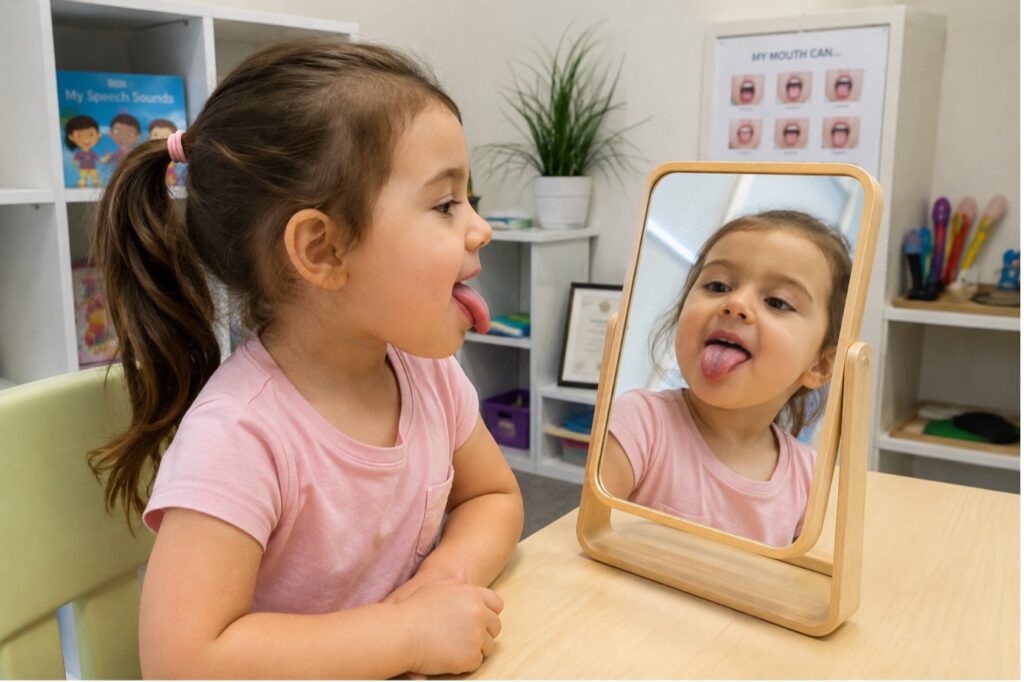
Girl looking at herself in a mirror and looking at her tongue

Every few weeks, a lovely, and well-informed parent will describe their five, six, or seven year-old’s slushy, sideways /S/ and then ask ‘So, how many sessions do we need to fix this? Perhaps five–six? ‘

And every time, I have to resist the urge to laugh, cry, and reach for the biscuits all at once. Because the honest answer, for an established lateral lisp in a school-aged child, is usually twenty sessions or more. Wait! Hear me out!…

‘Why so many?!’ … once you understand what’s actually going on inside your child’s mouth, the number 20+ does no longer sound outrageous and starts sounding rather reasonable.

First: not all lisps are equal

Most people picture a lisp as the gentle, even endearing /TH/ for /S/ — ‘thnake’ instead of ‘snake’. That’s an inter-dental lisp, where the tongue pokes forward between the teeth. It’s common, it’s developmentally normal in younger children, and this is the important bit, it’s usually visible. It’s still a bit tricky to correct at first but I often can show a child what to do, they can watch themselves in a mirror, and quite often we’re away. But it still takes a lot longer than parents think because just fixing the sound does not mean it will be produced correctly in normal, daily speech and conversation.

Lateral lisp

A lateral lisp on the other hand is an entirely different animal. Instead of the air flowing in a neat central stream down a groove in the middle of the tongue, it spills out over the sides, around the molars. The result is that wet, slushy, quality. It affects not just /S/ and /Z/, but very often /SH/, /CH/ and /J/ too which is a big chunk of English.

Here’s the snag: it’s happening where nobody can see it. There’s no mirror in the world that shows you the sides of your tongue as you are speaking, or chewing for that matter. We’re teaching a child to control a movement they can’t see, can’t easily feel, and have never once performed correctly in their life.

By five, six or even seven years old your child has said the /S/ sound about several hundred times a day, every day, for several years. It’s one of the most frequent sounds in English: it makes our plurals, our possessives, our verb endings. Every ‘cats’, ‘let’s’, ‘she runs’.

So we are now talking about a deeply ingrained motor habit, rehearsed tens of thousands of times, that now feels completely normal and correct to the child producing it. We’re not teaching a new skill onto a blank page; we’re overwriting a very strong habit. Think of a tennis player with a flawed serve who’s played for five years… You don’t fix that in a fortnight, and nobody expects you to.

The good news is: school children, seven-year-old and up, are brilliant at this work. They can self-monitor, they can practise independently, they can hear the difference. It just takes time.

The quiet culprit: where the tongue lives at rest…

Here’s the piece that most parents have never heard, and it explains a lot.

When the mouth is at rest, the tongue should sit up — tip resting lightly behind the top front teeth, body gently suctioned to the roof of the mouth, lips together, breathing through the nose.

Many children with a lateral lisp have a low, forward resting tongue posture. The tongue sits on the floor of the mouth, often with the lips slightly apart. This is frequently associated with a history of mouth breathing, blocked noses and allergies, enlarged tonsils or adenoids, prolonged dummy or thumb-sucking, and sometimes dental or orthodontic differences such as an open bite.

Why does this matter so much? Because a good /S/ requires the tongue’s sides to brace firmly against the upper back teeth to form that central channel. A tongue that spends 23 hours a day flopped on the floor of the mouth simply doesn’t have the habitual strength, position or awareness to do that on demand. We can teach a beautiful /S/ in the clinic — but if the tongue’s default setting is ‘down’, we’re swimming upstream all week.

So, for many children, part of the work is establishing a better resting posture alongside the sound itself. That’s foundational and it’s slow.

So what does twenty-plus sessions actually achieve?

Therapy for a lateral lisp moves through a strict hierarchy, and you cannot skip a rung:

  • Auditory discrimination: Can they hear the difference? (Often, initially, no.)
  • Eliciting the sound: Sometimes a single session, can be six.
  • Stabilisation: Building consistency in isolation, then syllables, then single words (beginning, middle, end).
  • Blends: Mastering challenging combinations like ‘spoon’, ‘street’, and ‘smile’.
  • Sentences: Moving to phrases, full sentences, and structured conversation.
  • Generalisation: Using it naturally with family, at school, when tired, or when telling a long story.
  • Self-monitoring: Training them to catch and correct themselves without therapist intervention.

Rushing a level guarantees a collapse two levels later. I’ve never once regretted going slowly; I’ve frequently regretted going fast.

The bit that decides everything: home practice

Let me be blunt in a nice way 😊 The child who practises five to ten minutes a day, six days a week, will finish in half the time of the child who practises the night before their session.

An hour with me per week is roughly 1% of your child’s waking life. The other 99% is where habits are made or unmade. What I need at home is:

  • Short and daily beats long and occasional: Five focused minutes, ideally at a consistent time.
  • Practise only at the set level: If we’re on words, don’t leap to sentences. That’s how we go backwards.
  • Give specific feedback: Say ‘that one was lovely and sharps or ‘that one slipped sideways, try again’.
  • Hold back on everyday corrections: Don’t correct them in normal conversation until we’re ready.
  • Record them occasionally: Children love hearing their own tangible progress.

The bottom line

I’m good at this. I’ve been doing it for thirty years and I love it. But I’m a therapist, not a magician, and the parents who get the best outcomes are the ones who view this as a partnership. When we work together—combining expert clinic guidance with steady, gentle practice at home, that ‘twenty-plus’ number isn’t a sentence. It’s simply the guideline to giving your child a clear, confident voice for the rest of their life.

Do get in touch with me. I would love to hear from you and help you and your child.

Sonja McGeachie

Highly Specialist Speech and Language Therapist

Owner of The London Speech and Feeding Practice.


Health Professions Council registered
Royal College of Speech & Language Therapists Member
Member of ASLTIP

Find a speech and language therapist for your child in London. Are you concerned about your child’s speech, feeding or communication skills and don’t know where to turn? Please contact me and we can discuss how I can help you or visit my services page.

3

Similar Posts

  • · · ·

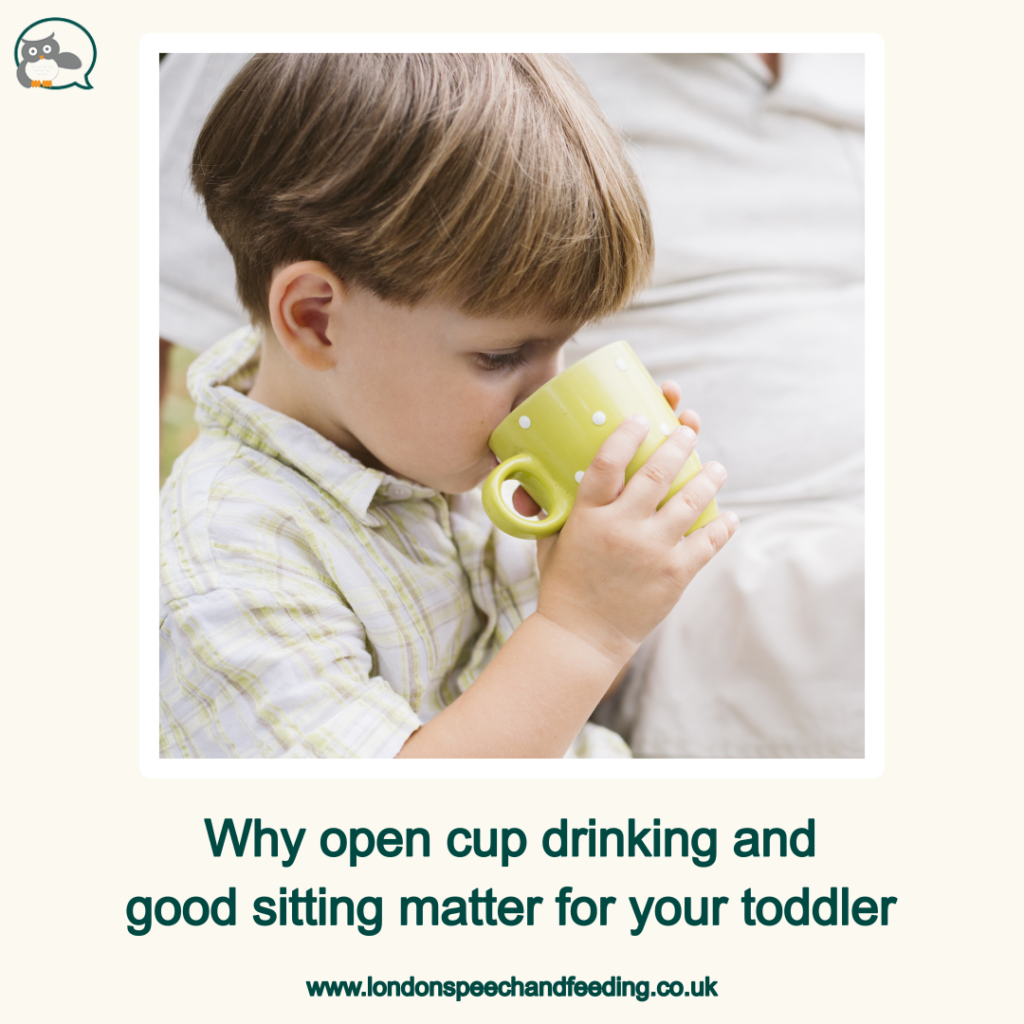
    Why open cup drinking and good sitting matter for your toddler

    When your baby reaches around 12 months, there is a lot going on developmentally. They are learning to walk, communicate, feed themselves and become increasingly independent. One small but important milestone that can sometimes get overlooked is learning to drink from an open cup.

    Many toddlers continue to have milk from a bottle well beyond their first birthday, and parents are often understandably reluctant to take it away. The bottle may be familiar, comforting and convenient, particularly at bedtime.

    But moving towards an open cup is not simply about changing the way your child drinks. It is part of their development of oral-motor skills, feeding independence and mealtime development.

    And there is another piece of the puzzle that is often overlooked: how your toddler is sitting while they eat and drink.

    The way the body is supported can make a real difference to what the mouth is able to do.

    Why introduce an open cup from around 12 months?

    Babies can begin learning to drink from an open cup much earlier than many parents realise. By around 12 months, most children should be given regular opportunities to practise drinking from an open cup alongside other suitable drinking vessels.

    An open cup encourages your toddler to learn a different pattern of drinking from the sucking pattern they have used with a bottle.

    With an open cup, your child needs to:

    • lean towards the cup and control its position
    • grade how much liquid enters the mouth
    • use their lips to help control the liquid
    • coordinate breathing and swallowing
    • develop increasingly mature tongue and jaw movements
    • learn to take a drink without relying on a teat or nipple.

    These are useful skills for developing efficient eating and drinking.

    This doesn’t mean that a toddler who still has a bottle at 14 or 18 months has somehow ‘missed their chance’. Children develop at different rates, and there is always an opportunity to work towards new skills.

    However, if a bottle remains the main or only way a child drinks for a long time, there can be fewer opportunities to practise these more mature drinking skills.

    What are the pitfalls of staying with a bottle for too long?

    The occasional bottle is not the issue. The concern is when a toddler continues to rely heavily on a bottle and therefore has little reason or opportunity to develop other drinking skills.

    A bottle encourages a sucking pattern which is appropriate for infancy. As children mature, we want to see increasing use of their lips, tongue, jaw and facial muscles in more sophisticated ways.

    Long-term bottle use can also make the transition to an open cup more difficult simply because the child has become very accustomed to the bottle.

    There can also be practical considerations around dental health, particularly when milk is offered frequently throughout the day or overnight.

    For many toddlers, the bottle has also become associated with comfort, sleep or emotional regulation. This can make giving it up feel like a very big change for the whole family.

    So rather than thinking, ‘The bottle has to disappear tomorrow’, think:

    ‘How can I gradually increase opportunities for open-cup drinking?’

    Offer the open cup regularly at meals. Let your toddler experiment. Expect spills. Keep the amount of liquid small initially and provide plenty of encouragement.

    Learning to drink is a skill. And skills need practice.

    But what has sitting got to do with drinking?

    Quite a lot!

    When we think about feeding, we naturally tend to focus on the mouth. We watch what the tongue is doing, whether a child chews, whether they cough or gag and what foods they accept.

    But feeding is a whole-body activity.

    Your child needs a stable body position before they can use their mouth efficiently.

    Think about trying to drink from a cup while sitting on a wobbly stool with your feet dangling in the air. You would probably find it much easier if your body was well supported.

    The same principle applies to toddlers.

    Tripp Trapp® Chair

    A well-designed highchair such as a Tripp Trapp chair can provide a stable base when it is correctly adjusted for the individual child. Ideally, your toddler should have:

    • hips well supported
    • knees comfortably bent
    • feet resting firmly on a footplate
    • a stable pelvis and trunk
    • the table or tray at an appropriate height

    This gives your child a solid foundation from which to move.

    And that matters because stability in the body supports movement and control in the mouth.

    Feet supported = better feeding?

    I sometimes hear parents say, ‘He doesn’t need the footrest don’t worry about it (as I crouch down with my Allenn key to adjust the Tripp Trapp chair) but I always explain it is very important to have his feet supported. Dangling legs can make it much harder to maintain a stable sitting position.

    When the feet are supported, your toddler can push gently through their feet and stabilise their pelvis and trunk. This can help them maintain a more organised position while eating and drinking.

    They can then devote more attention to the job in front of them:

    looking, reaching, grasping, chewing, swallowing and drinking.

    This is particularly important for toddlers who are developing their chewing skills or who find mealtimes physically demanding.

    A stable body supports a busy mouth

    Eating involves an extraordinary amount of coordination.

    Your toddler is managing food in their hands, bringing it to their mouth, biting, chewing, moving food around with their tongue, forming a bolus and swallowing,  often while simultaneously looking around, communicating and interacting with you.

    Drinking from an open cup adds another layer of coordination.

    Good postural support doesn’t teach a child to drink from a cup, but it can give them a much better physical foundation from which to practise the skill.

    This is why, when I assess a toddler’s feeding, I don’t just look inside the mouth.

    I also look at how the child is positioned.

    Making open-cup drinking part of everyday life

    You don’t need a complicated programme.

    At meals, offer a small amount of water in an open cup. You can help your toddler hold the cup initially, tipping it gently towards their lips and allowing them to control the drinking as much as possible.

    Some mess is completely normal!

    You might also use a small, lightweight open cup that is easy for little hands to manage.

    And remember that the goal is not to make every drink perfect. The goal is to give your child regular, positive opportunities to practise.

    If your toddler is struggling with drinking, frequently coughing or choking, refusing cups, relying heavily on a bottle, or experiencing difficulties with chewing and eating, it is worth seeking professional advice from a Speech and Language Therapist with expertise in paediatric feeding.

    The bigger picture

    Open-cup drinking and good sitting are not two unrelated developmental skills.

    They are part of the same picture.

    A stable body provides a foundation for skilled movement. Skilled movement supports feeding. And feeding skills develop through practice and opportunity.

    So as your toddler approaches and moves beyond their first birthday, think beyond simply asking, ‘How much milk are they drinking?’

    Think about how they are drinking, how they are sitting, and what opportunities they have to develop the skills they will need as they grow.

    And if you have a little one sitting beautifully at the table in a well-supported Tripp Trapp chair, remember: you’re not just creating a comfortable seat.

    You’re creating a stable foundation for eating, drinking, learning and growing.

    Do get in touch with me. I would love to hear from you and help your little one develop good sitting and drinking habits.

    Sonja McGeachie

    Highly Specialist Speech and Language Therapist

    Owner of The London Speech and Feeding Practice.

    Health Professions Council registered
    Royal College of Speech & Language Therapists Member
    Member of ASLTIP

    Find a speech and language therapist for your child in London. Are you concerned about your child’s speech, feeding or communication skills and don’t know where to turn? Please contact me and we can discuss how I can help you or visit my services page.

    3
  • · ·

    Childhood Apraxia of Speech: Signs and first steps (2–5 years)

    If you’ve found yourself wondering ‘Why can my child say a word one day, but not at all the next?’ it might be that your child has a motor speech difficulty. This means the challenge isn’t that your child doesn’t know what they want to say; it’s that their brain finds it harder to plan and coordinate the movements needed for clear speech. This speech difficulty is called Childhood Apraxia of Speech (CAS)

    Sonja showing power words on a board

    In this post, I’ll explain what CAS can look like in 2–5 year olds, what an assessment usually involves, and what you can start doing at home to support your child without turning life into ‘speech homework all day long’.

    What is childhood apraxia of speech (CAS)?

    Children with CAS often have lots to communicate about (and strong ideas!) but their speech may come out as:

    • Unclear
    • inconsistent
    • hard to ‘copy’ on demand
    • frustrating for them and for you

    CAS is not caused by laziness and it is not a parenting issue. It is also not something children simply ‘grow out of’ without support. But with the right therapy approach, children can absolutely build clearer speech over time.

    If you’d like to read more about verbal dyspraxia, you may also find this helpful: Supporting children and families living with verbal dyspraxia.

    Why is CAS such a big topic right now?

    Many families come to me after months (or years) of being told:

    • ‘She’ll talk when she is ready’
    • ‘He’s just shy’
    • ‘It’s probably a speech delay’
    • ‘It’s normal for toddlers’

    And sometimes it is a general delay. But sometimes it’s something more specific, like CAS.

    There’s also been a huge rise in parents seeking information online, and CAS is often mentioned alongside speech sound difficulties such as:

    • phonological delay (pattern-based speech errors)
    • articulation difficulties (one sound that won’t come out clearly)
    • inconsistent speech disorder

    These can look similar at first glance, which is why a specialist assessment matters.

    Signs of childhood apraxia of speech in 2–5 year olds

    Children develop speech at different rates, and not every unclear speaker has CAS. But here are some common features that may raise a flag, especially when you notice several together.

    1) Inconsistent speech errors

    Your child might say the same word in different ways:

    • ‘banana’ → nana / baba / mana
    • ‘daddy’ → gaga / daddy / dadi

    This inconsistency is one of the biggest clues.

    2) Difficulty copying words on request

    Some children speak more easily in natural play, but when asked ‘Say ___’, they freeze or the word becomes much harder.

    3) Limited sound repertoire

    They may use only a small set of consonants (like /M/, /N/, /B/, /D/) and avoid others.

    4) Vowel distortions

    Many children with typical delays mainly struggle with consonants. But in CAS, vowels can also sound ‘off’ or change between attempts.

    5) Speech that sounds effortful

    You might notice your child:

    • pauses between sounds
    • tries multiple times
    • looks like they’re ‘searching’ for the right mouth movement

    6) Longer words are much harder

    ‘Car’ might be easier than ‘carry’, and ‘carry’ easier than ‘caterpillar’.

    7) Prosody differences (rhythm and stress)

    Some children with CAS sound a little unusual in their speech rhythm, stress, or intonation.

    8) Frustration or reduced confidence

    When a child is frequently misunderstood, they may:

    • talk less
    • use gestures more
    • become upset when asked to repeat themselves

    Important note: none of these signs alone prove CAS but they are a strong reason to seek a speech assessment rather than waiting.

    CAS vs phonological delay vs articulation difficulty (quick guide)

    These are some of the most common questions I hear.

    If it’s mainly an articulation difficulty…

    A child may consistently say one sound incorrectly (for example, ‘thun’ for ‘sun’- lisp- but everything else is developing well.

    If it’s mainly a phonological delay…

    You might notice clear patterns, like:

    • leaving off the ends of words (‘ca’ for ‘cat’)
    • swapping back sounds for front sounds (‘tar’ for ‘car’)

    Patterns are often consistent and respond well to phonology-based therapy.

    If it might be CAS…

    Speech often feels less predictable, harder to imitate, and more impacted by word length and complexity.

    If you’re unsure, that’s completely normal, and exactly why assessment matters.

    What happens in a CAS assessment?

    A high-quality speech assessment for possible CAS usually includes:

    1) Parent discussion and developmental history

    We talk about:

    • pregnancy and birth history (where relevant)
    • feeding history
    • early sounds and babbling
    • first words and how speech has progressed
    • family history of speech/language needs

    2) A speech sound assessment

    Your child might be shown pictures or play-based prompts so we can hear:

    • what sounds they can say
    • what they simplify
    • whether errors are consistent or inconsistent

    3) An oral-motor and movement check

    This isn’t about ‘strength’. It’s about coordination and planning. We look at how your child manages speech movements and transitions.

    4) Stimulability testing

    This means: how easily can your child learn a new sound or word with support?

    For CAS, we often explore how they respond to:

    • slowed-down speech
    • visual cues
    • rhythm/tapping
    • short, simple syllable shapes

    5) Functional communication and confidence

    We look at how speech impacts daily life:

    • being understood at nursery
    • joining in with peers
    • asking for help
    • managing emotions when misunderstood

    At the end, you should leave with:

    • a clear explanation of what we think is going on
    • a therapy plan
    • practical home strategies
    • realistic next steps

    What parents can do at home

    Here are CAS-friendly strategies you can start right away.

    1) Choose ‘power words’

    Pick 1–2 words that matter most in your child’s daily life, such as:

    • more
    • help
    • mummy
    • again
    • stop
    • open

    These words are motivating and functional.

    2) Keep it short and successful

    For many children with CAS, the goal is quality over quantity.

    Try five minutes a day rather than 30 minutes of struggle.

    3) Support speech with rhythm

    Some children benefit from:

    • tapping a beat on the table
    • clapping syllables
    • using a gentle ‘marching’ rhythm

    This can help the brain organise the sequence of movements.

    4) Celebrate approximations

    If your child says ‘moh’ for ‘more’, that’s communication!

    We want them to feel:

    • safe
    • understood
    • proud to try again

    Confidence is a key part of progress.

    A short parent story (anonymised)

    One mum said to me:

    ‘We kept being told to wait. But I could see my child understood everything; they just couldn’t get the words out. Once we had an assessment and a plan, it felt like we finally knew what to do. The biggest change was his confidence. He started trying more.’

    When should you seek support?

    You don’t need to wait until school.

    It’s worth getting an assessment if your child is:

    • hard to understand compared with peers
    • becoming frustrated or withdrawing from talking
    • inconsistent with words they used to say
    • struggling to imitate speech sounds
    • showing signs that match CAS

    Early support can reduce stress for the whole family and help your child feel successful in communication.

    Here’s how I can help:

    ✅ A detailed speech assessment (including whether CAS is likely)

    ✅ A clear therapy plan with realistic goals

    ✅ Practical home strategies you can use immediately

    ✅ Support for nurseries and schools (where needed)

    ✅ In-person sessions in North-West London and online options

    Book your consultation here.

    Final gentle reminder

    You are not overreacting. Trust your instincts.

    Your child is communicating the best way they can, and with the right support, speech can become easier, clearer, and more confident.

    Sonja McGeachie

    Highly Specialist Speech and Language Therapist

    Owner of The London Speech and Feeding Practice.


    Health Professions Council registered
    Royal College of Speech & Language Therapists Member
    Member of ASLTIP

    Find a speech and language therapist for your child in London. Are you concerned about your child’s speech, feeding or communication skills and don’t know where to turn? Please contact me and we can discuss how I can help you or visit my services page.

    3
  • · ·

    Understanding phonological processes in 3–7-year-olds: What’s typical and when to seek help

    As a speech and language therapist, one of the most common questions I hear from parents is:

    ‘They can talk, but their speech still sounds immature. Is this normal?’

    Many children between the ages of three and seven use speech patterns that make their words sound different from adult speech. These patterns are known as phonological processes, and for younger children, they are a normal part of speech development.

    However, when these processes persist beyond the expected age, they can start to affect clarity, confidence and learning, especially once children enter school.

    This blog will help you understand:

    • what phonological processes are
    • which patterns are typical at different ages
    • and when it might be time to seek speech therapy support

    What are phonological processes?

    Phonological processes are patterns of sound simplification that children use while their speech system is developing.

    Instead of learning each sound one by one, children initially organise sounds into patterns that make speech easier to produce. This is a normal and efficient strategy for a developing brain.

    For example:

    • saying ‘tar’ instead of ‘car’
    • saying ‘poon’ instead of ‘spoon’
    • saying ‘bud’ instead of ‘bus’

    These are not ‘bad habits’. They are part of how speech develops.

    The key question is how long these patterns last.

    Common phonological processes (and when they usually disappear)

    Below are some of the most common processes parents notice in 3–7-year-olds.

    1. Final consonant deletion

    Leaving off the last sound in a word

    • ‘ca’ for cat, ‘da’ for dog
    • Typically resolved by 3–3½ years

    2. Fronting

    Replacing back sounds (k, g) with front sounds (t, d)

    • ‘tar’ for car, ‘do’ for go
    • Typically resolved by 3½–4 years

    3. Cluster reduction

    Omitting one sound in a consonant cluster

    • ‘poon’ for spoon, ‘top’ for stop
    • Typically resolves by 4–5 years (some clusters slightly later)

    4. Gliding

    Replacing /R/ or /L/ with /W/ or /Y/

    • ‘wabbit’ for rabbit, ‘yion’ for lion
    • Can be typical up to 5–6 years

    5. Weak syllable deletion

    Leaving out unstressed syllables

    • ‘nana’ for banana
    • Usually resolved by 4 years

    If these patterns continue past the expected age, speech can remain difficult to understand particularly for unfamiliar listeners such as teachers, peers, and also Auntie Karen or grandparents who visit once in a while.

    Why phonological processes matter in school-age children

    By the time children reach reception and Year 1, speech clarity becomes increasingly important.

    Persistent phonological difficulties can affect:

    • being understood by teachers and peers
    • phonics and early reading
    • spelling
    • confidence in speaking
    • willingness to participate in class

    Some children become aware that they ‘sound different’ and may speak less, avoid longer words, or become frustrated when misunderstood.

    What’s the difference between a delay and a disorder?

    This is an important distinction.

    • A phonological delay means a child is following the normal pattern of development, just more slowly.
    • A phonological disorder means the child is using atypical patterns, or continuing age-expected patterns well beyond when they should have resolved.

    A speech and language assessment helps identify:

    • which processes are present
    • how many are affecting speech
    • how consistent the errors are
    • and whether intervention is needed

    Signs it may be time to seek speech therapy

    You may want to seek professional advice if your child:

    • is 3½ years or older and still hard to understand
    • is understood well by family but not by others
    • becomes frustrated or avoids talking
    • has difficulty with phonics or spelling
    • uses several phonological processes at once
    • has not made progress despite time and encouragement

    Early support does not mean something is ‘wrong’. It simply helps speech development move forward more efficiently.Research consistently shows that unresolved phonological processes beyond the expected age can impact intelligibility, literacy and confidence (Dodd, 2014; Bowen, 2015).

    How speech therapy helps phonological development

    Phonological therapy is not about drilling individual sounds endlessly.

    Instead, therapy focuses on:

    • helping children recognise sound patterns
    • building awareness of contrasts (e.g. ‘tar’ vs ‘car’)
    • practising speech in meaningful, playful ways
    • supporting generalisation so progress carries into everyday speech

    For school-aged children, therapy is usually structured, motivating and highly targeted and progress can be very encouraging.

    A final reassurance

    Many children with phonological difficulties go on to develop clear, confident speech with the right support.

    If you’re unsure whether your child’s speech is ‘just a phase’ or something that needs attention, a professional assessment can give clarity and peace of mind.

    If you’d like support or advice, please contact me and I can help guide the next steps.

    Sonja McGeachie

    Highly Specialist Speech and Language Therapist

    Owner of The London Speech and Feeding Practice.

    Research references


    Health Professions Council registered
    Royal College of Speech & Language Therapists Member
    Member of ASLTIP

    Find a speech and language therapist for your child in London. Are you concerned about your child’s speech, feeding or communication skills and don’t know where to turn? Please contact me and we can discuss how I can help you or visit my services page.

    3
  • · ·

    Why pointing matters: Unpacking the power of this simple gesture

    As a speech and language therapist, I’m often asked about the significance of seemingly simple gestures in child development. One question that comes up frequently is, ‘Why is pointing so important?’ It might seem like a trivial action, but pointing is a powerful communication tool and a critical milestone in a child’s development.

    Why is pointing so important?

    Let’s delve into the theory behind why pointing matters:

    1. Pointing as pre verbal communication:

    Before children can use words, they use gestures to communicate their needs and interests. Pointing is one of the earliest and most important gestures. It allows children to:

    • Request: ‘I want that!’
    • Protest: ‘No, not that!’
    • Direct attention: ‘Look at that!’
    • Share interest: ‘Wow, cool!’

    2. Pointing and language development:

    Pointing is not just about communicating in the here and now; it also plays a crucial role in language development. Research shows that:

    • Early pointing predicts later language skills: Children who point more often tend to have larger vocabularies and better grammar later on.
    • Pointing helps children learn new words: When children point at something, adults tend to label it, providing valuable language input.
    • Pointing supports joint attention: Joint attention, or the shared focus of two individuals on an object or event, is essential for language learning. Pointing helps establish joint attention, creating opportunities for communication and learning.

    3. Pointing and social-emotional development:

    Pointing is not just about language; it’s also about social interaction. It allows children to:

    • Engage with others: Pointing invites others to share their focus and participate in their world.
    • Express emotions: Pointing can convey excitement, curiosity, or concern.
    • Develop social understanding: By observing how others respond to their pointing, children learn about social cues and communication.

    4. Pointing and cognitive development:

    Pointing is linked to cognitive skills, such as:

    • Understanding object permanence: The ability to know that objects exist even when they are out of sight.
    • Categorisation: The ability to group similar objects together.
    • Problem-solving: Pointing can be used to ask for help or to indicate a problem.

    5. Types of Pointing:

    It’s important to note that there are different types of pointing, each with its own significance:

    • Imperative pointing: To request something.
    • Declarative pointing: To share interest or direct attention.
    • Informative pointing: To provide information.

    If you have concerns about your child’s pointing or overall communication development, don’t hesitate to seek professional guidance from a speech-language therapist. Early intervention can make a significant difference in supporting your child’s communication journey.

    How can we create opportunities for pointing?

    • ‘Where’s the…?’ games:
      • Play games like ‘Where’s the doggy?’ or ‘Where’s the ball?’ and encourage your toddler to point to the object.
      • Start with familiar objects and gradually introduce new ones.
    • Reading together:
      • When reading picture books, ask your toddler to point to specific objects or characters on the page.
      • Use phrases like, ‘Can you point to the puppy?’
    • Everyday activities:
      • During daily routines, ask your toddler to point to things they want or need.
      • For example, ‘Do you want the apple or the banana?’
      • When walking outside say ‘LOOK’ and encourage pointing.
    • Use of toys:
      • Use toys that have buttons or points of interest that when pressed make a noise. Encourage your toddler to point to the area that makes the noise.
      • Use toys that have many different parts, and ask the toddler to point to a specific part.

    Model pointing:

    • Point yourself:
      • When you see something interesting, point to it and say the name of the object.
      • For example, ‘Look! A bird!’
    • Point to show choices:
      • When offering choices, point to each item as you name it.
      • For example, ‘Do you want the blue cup or the red cup?’ (Point to each cup).
    • Point to indicate direction:
      • When giving directions, point in the direction you want your toddler to go.
      • For example, ‘Let’s go that way!’ (Point).

    Make it rewarding:

    • Respond to pointing:
      • When your toddler points, immediately respond to their communication.
      • Give them the object they want, or acknowledge what they are pointing at.
    • Use positive reinforcement:
      • Praise and encourage your toddler when they point.
      • Say things like, ‘Good pointing!’ or ‘You showed me the car!’
    • Show excitement:
      • When they point to something, show excitement, this will encourage them to point again.

    Use specific techniques:

    • Use gestures and verbal cues:
      • Combine pointing with verbal cues and other gestures.
      • For example, say ‘Look!’ while pointing and nodding your head.
    • Simplify the environment:
      • Reduce distractions to help your toddler focus on the object you want them to point to.
    • Use exaggerated movements:
      • Use large, exaggerated pointing movements to draw your toddler’s attention.

    Consider developmental factors:

    • Age-appropriate expectations:
      • Remember that pointing develops at different rates for different children.
      • Be patient and supportive.
    • Underlying issues:
      • If your toddler is not pointing by 18 months, or if you have any concerns about their development, consult with a speech and language therapist.
      • There may be underlying sensory or motor issues.

    Key points:

    • Consistency is key. Practise these strategies regularly.
    • Make it fun and engaging for your toddler.
    • Celebrate every success, no matter how small.
    • If you have any concerns about your child’s development, contact your local health services.

    Great toys and items for pointing

    1. Interactive books:

    • Touch-and-feel books: Books with different textures, flaps to lift, and sounds encourage interaction and pointing. ‘Where’s the…?’ questions prompt pointing to specific features.
    • Books with simple pictures: Clear, uncluttered pictures make it easier for toddlers to focus and point to objects or characters.

    2. Cause-and-effect toys:

    • Activity cubes: These often have buttons, dials, and levers that produce sounds or actions when manipulated, prompting pointing and exploration.
    • Pop-up toys: Toys where figures pop up or things happen when a button is pressed encourage anticipation and pointing to the action.
    • Simple musical instruments: A toy piano, drum, or xylophone encourages pointing to the keys/surfaces to make sounds.

    3. Toys with parts to manipulate:

    • Shape sorters: Encourage pointing to the shapes and the matching holes.
    • Stacking cups or rings: Nesting cups or stacking rings invite pointing to select the correct size or order.
    • Puzzles with knobs: Simple puzzles with large knobs are easier for toddlers to grasp and point to the pieces.

    4. Toys that encourage joint attention:

    • Bubbles: Blowing bubbles and following them with your eyes and pointing encourages joint attention (shared focus).
    • Balls: Rolling a ball back and forth and pointing to where it’s going can promote joint attention and turn-taking.
    • Wind-Up Toys: Wind-up toys that move across the floor can be exciting to follow with pointing.

    5. Pretend play toys:

    • Toy telephones: Encourage pointing to the buttons and pretending to dial.
    • Dolls and stuffed animals: Pointing to the doll’s eyes, nose, mouth, etc., or asking the child to point to these features on themselves.
    • Toy food and dishes: Pretend play with food and dishes can involve pointing to request items or indicate actions (e.g., ‘Can I have the apple?’).

    Tips for using toys to encourage pointing:

    • Get involved: Play alongside your toddler, modelling pointing and using language to describe what you’re doing.
    • Follow their lead: Observe what your child is interested in and use that to encourage pointing.
    • Limit distractions: Reduce background noise and visual clutter to help your child focus.
    • Use gestures and words: Combine pointing with words and other gestures (e.g., ‘Look!’ while pointing).
    • Be patient and positive: Celebrate all attempts at pointing and provide lots of encouragement.

    Remember, the most important factor is the interaction you have with your child while playing. Use these toys as tools to create opportunities for communication and joint attention, and your toddler will be well on their way to mastering pointing!

    Get in touch with me via my contact form if you need support

    Sonja McGeachie

    Early Intervention Speech and Language Therapist

    Feeding and Dysphagia (Swallowing) Specialist The London Speech and Feeding Practice

    The London Speech and Feeding Practice


    Find a speech and language therapist for your child in London. Are you concerned about your child’s speech, feeding or communication skills and don’t know where to turn? Please contact me and we can discuss how I can help you or visit my services page.

    1
  • · · ·

    How parent coaching turns story time into a communication success

    We often hear from parents who are trying their best to connect with their child, especially when reading books, but are met with frustration. They’ll say, ‘I read the book exactly as it’s written, but my child can’t focus for very long and just runs off!’ or ‘my child just flicks through the pages then turns it upside down and runs off with it’ or similar.

    It’s a common story. Traditional reading—going through the text from cover-to-cover—has its place of course, but for little ones with a language delay or autism it can move too quickly and place all the focus on the book’s words, not on the interaction.

    But what if I told you that story time could become one of the most fun and productive times for your child’s communication development?

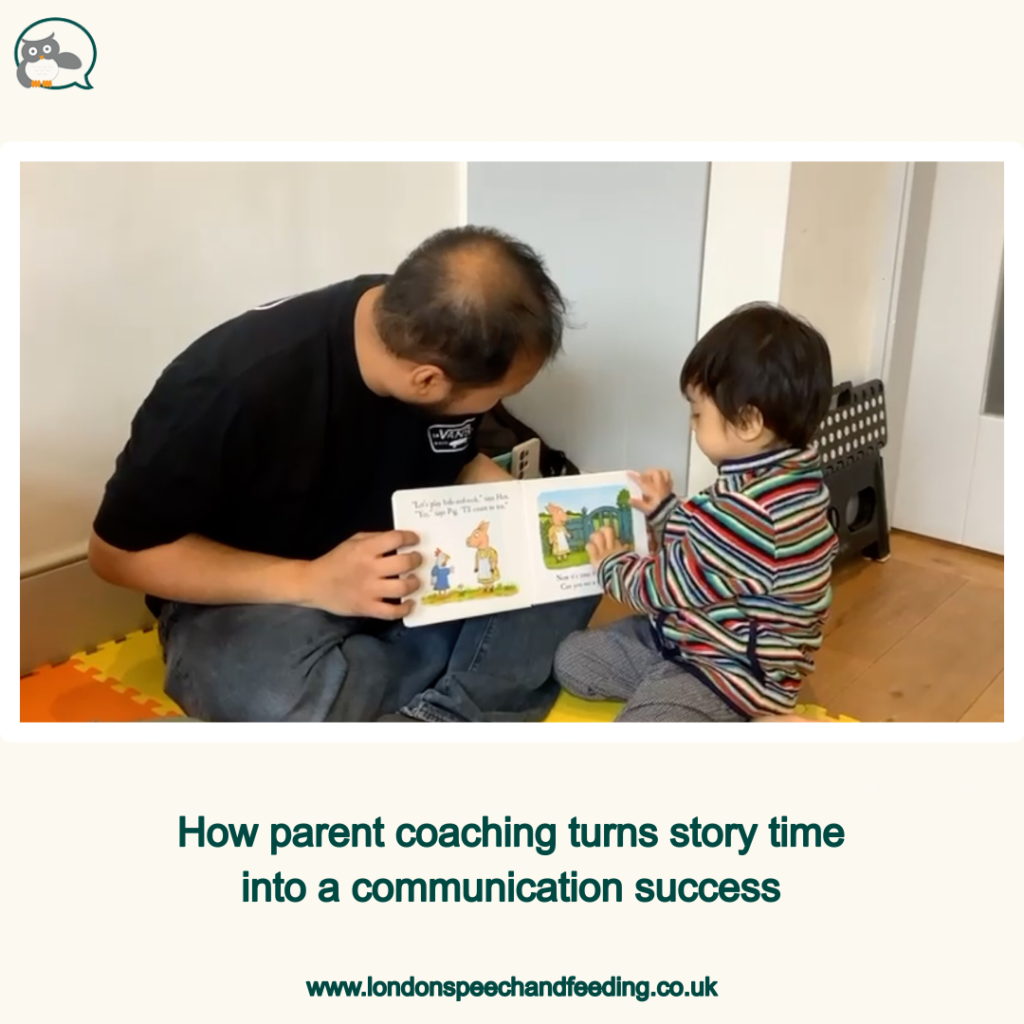
    Watch the fantastic little video clip above! You can see the pure joy and connection between this dad and his son. This is the same family who, just a few weeks ago, felt defeated when trying to read a book, with their child quickly losing interest and leaving the reading/book corner.

    What changed?

    The power of parent coaching and Hanen principles

    The difference you see in the video is the direct result of parent interaction therapy, or parent coaching, based on the internationally recognised Hanen principles.

    I didn’t ‘fix’ the child. Instead, I coached the parents in a few simple, powerful strategies that completely changed the dynamic of their interaction. Instead of being a time for teaching and instruction, story time became a back-and-forth conversation.

    Here are the four major transformations that coaching helped this family achieve:

    1. From reader to play partner

    Before coaching, the parents felt their job was to read the text and to teach the words in it to their child. Now, their job is to follow their child’s lead. They learned to Observe, Wait, and Listen (OWL). If the child points to the tree or the badger on the page, the parent talks about the tree or the badger.

    The result

    The child is now initiating and leading the conversation! He is sharing what he finds interesting, which makes him feel powerful and keeps him deeply engaged.

    2. Building connection and attention

    When parents focus solely on reading, they often forget to make frequent eye contact and use animated facial expressions. The principles taught them to put the text aside and prioritise connection.

    The result

    Our little boy is looking at his dad more frequently, making great eye contact, and clearly having fun! When the interaction is fun, the child’s attention span naturally lengthens, allowing him to attend to the book and the interaction for a much longer time.

    3. Creating opportunities for communication

    The parents learned simple ways to prompt communication without pressure. They stopped asking knowledge-based questions (‘What colour is that? Or point to the pig!’), which can feel like a test.

    Instead, they learned to use techniques like ‘Saying less and pausing’ or ‘copying their little one’s echolalia ‘, signalling that they are very interested in what he is saying and that his communication matters!

    The result

    The child is now spontaneously using strings of sounds and gestures to communicate his needs and interests, knowing and enjoying his parents’ enthusiastic responses.

    This video is a testament to the fact that you are your child’s best therapist. With the right tools and coaching, you can transform everyday routines, like reading a book, into the most joyful and effective communication sessions.

    4. Acknowledging and interpreting echolalia

    In the video, you may hear the little boy repeat a phrase from the book or from what his dad just said. This is called echolalia, and for a long time, it was often dismissed or discouraged.

    However, a core principle of our parent coaching is that echolalia is communication. For children who are ‘Gestalt Language Processors,’ these memorised phrases (or ‘gestalts’) are their building blocks of language.

    The key is not to stop the repetition, but to become a ‘language detective’ and ‘interpreter’!

    By modelling the correct, first-person phrase right after the echo, parents/caregivers are teaching a child how to break down the ‘chunk’ and use the individual words functionally. They are showing their child: ‘I heard you. Your communication makes sense to me.’

    This strategy is a game-changer because it:

    1. Validates the child’s communication: It honours the child’s natural way of learning language, which boosts their confidence and willingness to communicate.
    2. Facilitates language development: It provides the child with the next step—a meaningful, functional phrase—to move them from repeating language to generating their own spontaneous sentences.

    Look at the child’s face again in the video. When his dad acknowledges and interprets his communication, you see that spark of joy and connection—that’s the moment when true, functional language learning happens!

    Ready to unlock the potential in your family’s story time? Contact me to learn more about our parent coaching programs.

    Sonja McGeachie

    Highly Specialist Speech and Language Therapist

    Owner of The London Speech and Feeding Practice.


    Health Professions Council registered
    Royal College of Speech & Language Therapists Member
    Member of ASLTIP

    Find a speech and language therapist for your child in London. Are you concerned about your child’s speech, feeding or communication skills and don’t know where to turn? Please contact me and we can discuss how I can help you or visit my services page.

    2
  • · ·

    How can we support babbling and early speech development? SLT tricks and tips

    My baby isn’t babbling and developing speech – what can I do to support?

    While every baby develops at their own pace, if your child isn’t babbling by nine months, it’s worth seeking help from an Early Intervention Health Professional, such as a doctor and a speech therapist. Don’t panic! There are many reasons for delayed babbling, and early intervention is key.

    In the meantime, it is highly recommended that we talk, sing, and read to our baby often. Exaggerate sounds and expressions, and respond to their coos and smiles. This playful interaction helps stimulate their communication skills.

    Below are some tips and tricks from my experience of working with babies and toddlers who need a little bit of help and support to develop.

    The benefits of imitating your baby

    Copying your baby’s sounds and gestures isn’t just silly fun, it’s a powerful learning tool! By mimicking their babbles and actions, you activate “mirror neurons” in their brain that help them connect sounds with meaning. This playful back-and-forth teaches turn-taking, a foundation for conversation. Plus, it encourages them to copy you, building their own language skills and social interaction abilities.

    This is a nice clip on youtube showing how copying/imitating your baby looks like:

    Here are some fun ways to imitate your baby:

    • Matchmaker: Grab two of the same, or two similar toys your child loves, like rainmakers or shakers. Give one to your baby and keep the other for yourself. When your child plays with his/her toy, mirror his/her actions with yours! This creates a fun, interactive game.
    • Face Time: Get down to your baby’s level, sitting opposite him/her on the floor or kneeling. This makes eye contact easy and encourages him/her to look at you during your playful imitation.
    • Be the Funniest You: Go all out with silly faces, exaggerated sounds, and big gestures. The goal is to capture your baby’s attention and make you irresistible to watch. This playful energy encourages him/her to interact and potentially imitate you back!

    By incorporating these tips, you can turn imitation into a fun and engaging way to boost your baby’s communication skills. I have seen this happen numerous times over the past decades. It is very powerful, go ahead and try it! You cannot be silly and goofy enough!

    Great toy ideas:

    Did you know that speech and language development starts with how we talk to our babies?

    Adults naturally use a special way of speaking called motherese. It involves a higher pitch, slower pace, and exaggerated sounds compared to regular conversation. Sentences are simpler, with shorter words and repetition. This grabs babies’ attention, helps them distinguish sounds, and reinforces word meaning.

    Imitation is a key part of motherese. We wait for our baby to make a sound or gesture, then playfully imitate it with exaggeration. Babies notice this right away and often respond with more vocalisations, creating a mini conversation. This back-and-forth teaches turn-taking, a foundation for future conversations.

    By responding warmly and engaging in these playful interactions, we encourage our babies to keep exploring the world of communication. Talking, singing, reading and, of course, imitating, these simple actions can have a big impact on a baby’s language development.

    Once your conversation is underway then try and keep it going for as long as possible. It’s a beautiful dance of turn-taking, even without words!

    A last word on oxytocin

    There’s evidence suggesting early non-verbal communication with your baby can increase a mother’s oxytocin levels, often called the ‘love hormone’. This hormone plays a key role in bonding and social connection. Positive interactions, touch, and stress reduction all contribute to oxytocin release, strengthening the mother–baby bond.

    For parents of babies with extra needs

    The stress of caring for a child with medical needs or developmental delays can be difficult. Stress can lower oxytocin levels, creating a cycle of sadness for both parent and child.

    Breaking the cycle:

    1. Knowledge is Power: Understanding the importance of communication can empower parents.
    2. Seek Support: Speech therapists and other healthcare professionals can provide valuable guidance on communication strategies.
    3. Start Small, Celebrate Big: Even small interactions can boost oxytocin. Focus on playful imitation and positive reinforcement. Remember, friends, family and healthcare professionals are there to encourage you.

    This approach can help reverse the negative cycle and create a more positive and connected relationship between parent and child.

    I hope this is helpful! Don’t hesitate to reach out with any questions.

    Kind regards

    Sonja McGeachie

    Early Intervention Speech and Language Therapist

    Feeding and Dysphagia (Swallowing) Specialist The London Speech and Feeding Practice

    The London Speech and Feeding Practice


    Find a speech and language therapist for your child in London. Are you concerned about your child’s speech, feeding or communication skills and don’t know where to turn? Please contact me and we can discuss how I can help you or visit my services page.

    2