When you have a child who uses Gestalts it is often difficult to think and adapt clinic activities into those to use at home. More importantly, you find that individualising your activities for your child who uses Gestalt are time-consuming. But you value its importance for their communication development.
You feel so busy, you are taking them to other appointments, or trying to get through your daily activities, all whilst still ensuring your child’s emotional needs are met. You know life should not get in the way of your child’s therapy activities at home, but it does. We know your spare time is precious and limited, so let us achieve your child’s or young person’s goals in the allotted time you have which meets their way of learning (using Gestalts).
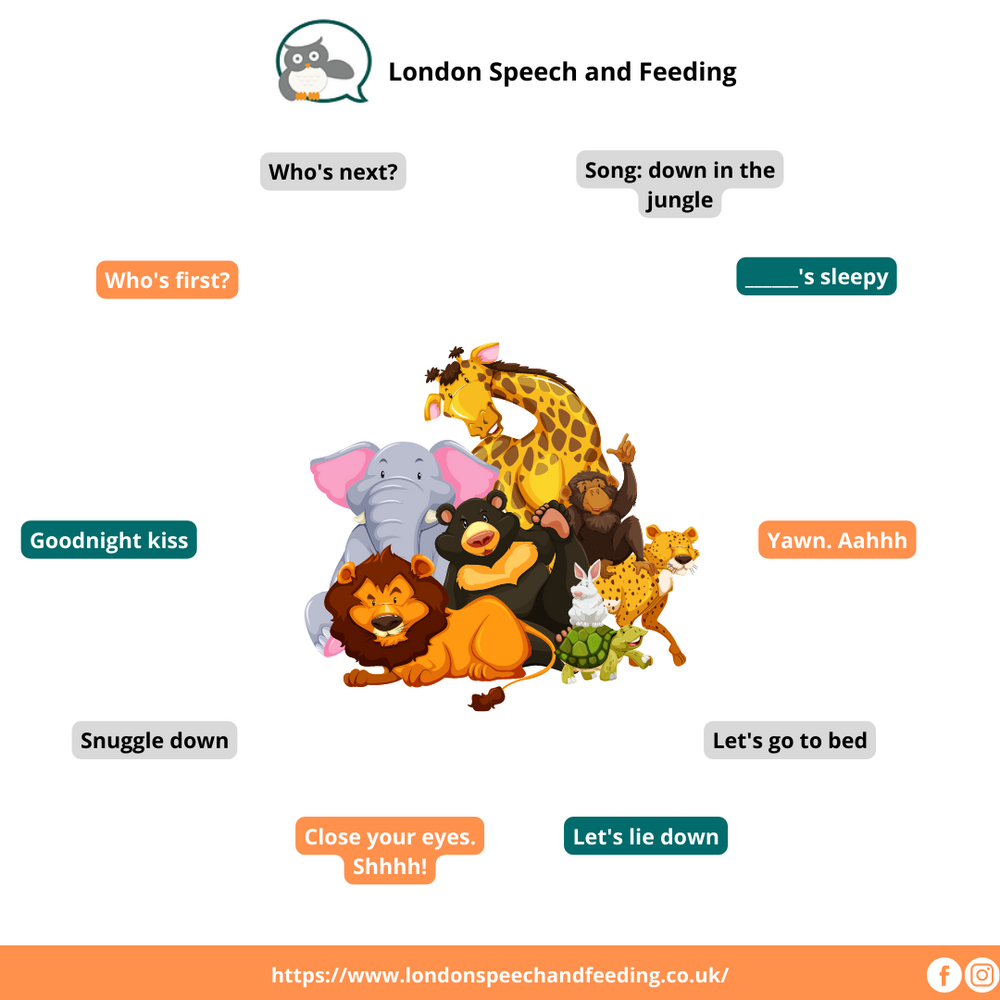
We wanted to support you by exploring items which you may have at home, and we will give you some key phrases which you can start to model with your child. Whereas our last blog introduced the idea of gestalt language processors, we are now developing ideas to give you the tools to implement activities at home. We recognise how overwhelming it may feel, and this is one of the reasons to make activities as straight forward as possible. Therapy does not need to be complicated; it just needs to be carried out on a regular basis.
Explore the samples I’ve created to give you an idea of how this might look but please consult with a Speech and Language Therapist who knows about Gestalt Language Processing so that you can work together to develop great home activities for your child.
Want to learn more about gestalt language processing?
Find a speech and language therapist for your child in London. Are you concerned about your child’s speech, feeding or communication skills and don’t know where to turn? Please contact me and we can discuss how I can help you or visit my services page.
Communication does not happen in neat little boxes. In Speech and Language Therapy we often use one great activity to target multiple areas of speech and or language development all at once.
Children are trying to:
understand language
build sentences
organise their thoughts
pronounce sounds
remember words
use grammar
follow social interaction
communicate meaning…
all at the same time.
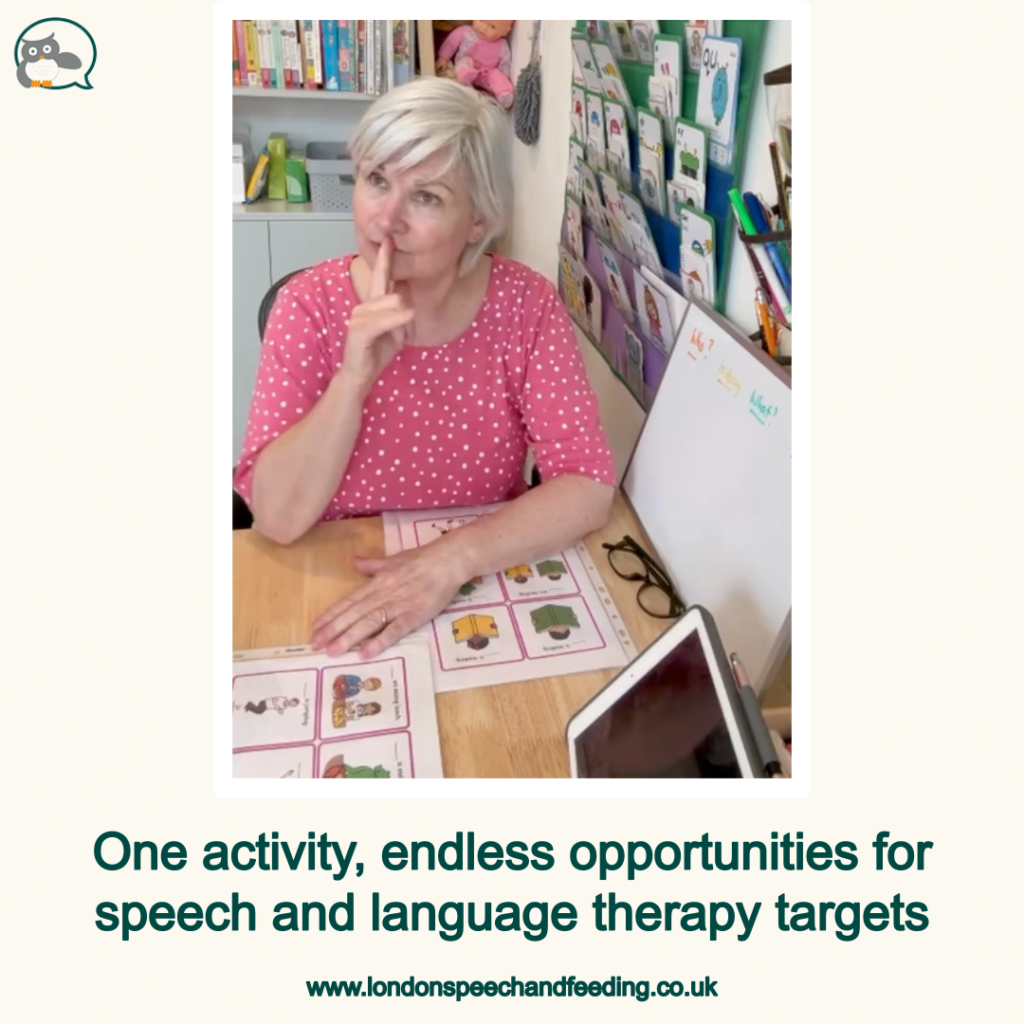
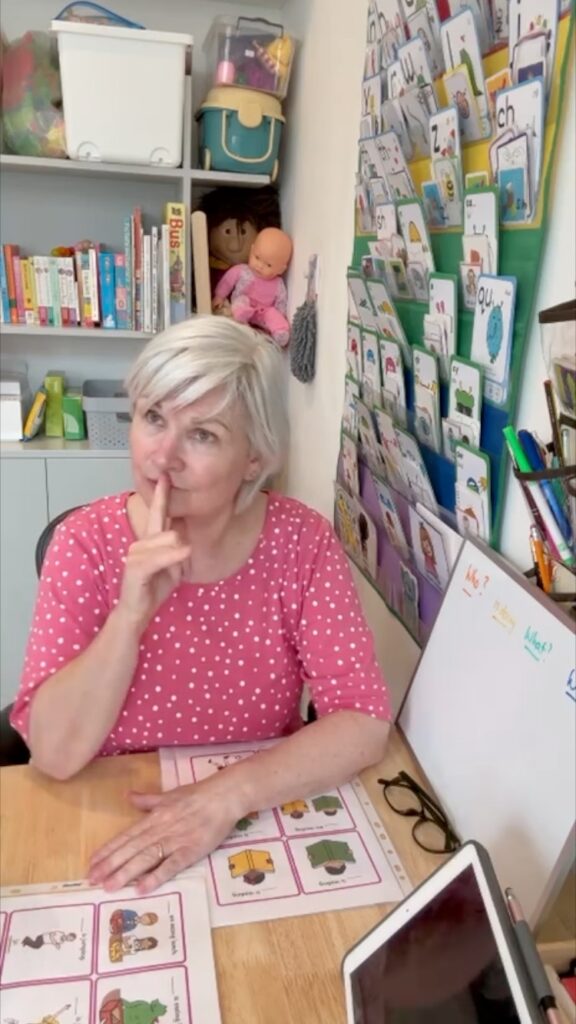
This short therapy clip is a little example of that.
Within one playful interaction, we naturally work on:
grammar
sentence expansion
pronouns
speech sound errors
modelling
visual cueing
turn-taking
confidence in communication
And, importantly, the child remains engaged, relaxed, and successful throughout.
Using language activities to refine speech sound targets
We all learn language through:
shared attention
play
repetition
connection
modelling
responsive interaction
As a Speech and Language Therapist I am constantly thinking and considering how to bring in all the targets a child is working on. The reason for that is that often we do not have a full therapy hour to work leisurely and calmly on various targets! Many children have short attention focus and ‘go off the boil’ quickly and often suddenly. Therefore, I always feel a sense of ‘make hay whilst the sun shines’ and pack it all in whilst the going is good. So then we can afford five minutes of trampolining in between activities to help the child regulate themselves without losing valuable speech therapy opportunities or time.
How can I expand this sentence?
How can I model better grammar?
Can I gently shape the pronunciation here?
Should I recast that phrase?
Is this the right moment to pause and encourage a longer utterance?
How can I keep communication flowing while still targeting goals?
These decisions happen continuously during therapy.
Building longer sentences naturally
In this clip, one of the key areas we are targeting is sentence expansion through Colourful Semantics, which is a particularly useful and researched approach, developed by UK Speech and Language Therapist Alison Bryan in 1997 to support children with speech and language difficulties.
Colourful Semantics is a visual, colour-coded therapy approach that helps children break down, understand, and construct sentences by assigning specific colours to thematic roles (e.g., Who, What Doing, What).
Many children with language delay use reduced language for example: they might say:
‘dog’ instead of ‘the dog is running fast’
‘eatin a dinner’ instead of we are eating our dinner
‘baby shhh’ instead of ‘the baby is sleeping’.
Using the Colourful Semantics Framework helps create a solid baseline from which to work and with which to construct basic good sentences using WHO is DOING WHAT and WHERE.
We are building language upward gently and positively.
This technique is incredibly powerful because children learn language through hearing it used meaningfully over and over again.
Supporting pronouns through real conversation
Pronouns can be surprisingly difficult for many children.
Words such as:
he
she
him
her
they
require children to understand perspective, grammar, and sentence structure all at once. Using pictures and basing the activity on the Colourful Semantics Model I can shape pronouns repeatedly as part of the overall activity.
Books, pictures, and play scenes are fantastic for this because they create endless opportunities for meaningful repetition.
Again, this may look simple from the outside.
But underneath it is highly intentional clinical work.
Listening for speech sound errors at the same time
While supporting grammar and language, I am also constantly listening to the child’s speech production.
In this short interaction, I respond to speech sound errors as they arise.
Sometimes I:
model the correct production
emphasise a sound slightly
use visual cues
slow the word down
add gesture or sign support
encourage another attempt.
And sometimes I intentionally let the error go in order to protect confidence and maintain communication flow.
That balance is incredibly important.
Children need support. But they also need to feel successful communicating.
The child simply experiences this as warm, responsive interaction.
But underneath it is detailed clinical reasoning.
This is why effective therapy is never about simply owning resources or downloading activities online.
The real skill lies in:
how the therapist uses the activity
how they adapt moment by moment
how they analyse communication in real time
how they shape interaction to maximise learning opportunities.
One activity. Endless opportunities.
A single book, picture scene, or playful interaction can provide opportunities to support:
speech sounds
language development
grammar
vocabulary
attention
confidence
social communication
emotional connection.
The magic is not in the activity itself.
The magic is in how a therapist uses it.
Because excellent speech therapy is never ‘just playing’.
It is careful, responsive, evidence-based intervention woven seamlessly into joyful interaction.
Bryan A (1997) Colourful semantics. In: Chiat S, Law J, and Marshall J (eds) Language disorders in children and adults: psycholinguistic approaches to therapy. London: Whurr, 143–61.
Find a speech and language therapist for your child in London. Are you concerned about your child’s speech, feeding or communication skills and don’t know where to turn? Please contact me and we can discuss how I can help you or visit my services page.
Many parents notice speech errors when their children are toddlers. At that stage it often feels quite normal. Young children are still learning the sounds of their language, and those early mispronunciations can be very endearing.
But as children grow older, parents sometimes begin to wonder:
‘Should my child still be speaking like this?’
A common concern I hear from families is that their child is still difficult to understand even after starting school. Sometimes it is a parent who notices it first. Other times it is a teacher who gently mentions that classmates occasionally struggle to understand what a child is saying.
When this happens, parents naturally wonder whether it is something their child will grow out of, or whether some extra support might help.
When should children’s speech be clear?
Children learn speech sounds gradually over several years. Some sounds develop earlier, while others take longer to master.
By the time children reach five to six years of age, most of their speech should be clear enough for unfamiliar adults to understand. There may still be a few tricky sounds developing (such as /R/ or /TH/), but overall speech should be fairly easy to follow.
If a child is frequently difficult to understand at school age, it can sometimes indicate that a speech sound difficulty has persisted beyond the stage when it would normally resolve on its own.
Why some children remain hard to understand
There are several reasons why speech clarity may still be developing in older children.
Phonological patterns
Some children continue to use speech patterns that are typical of younger children. For example:
saying ‘tat’ instead of ‘cat’
saying ‘doe’ instead of ‘go’
leaving sounds out of words
These patterns are called phonological processes. They are a normal part of early speech development, but when they persist into the school years they can make speech difficult for others to understand.
Difficulty producing specific sounds
Other children may have difficulty producing certain individual sounds clearly. This might include sounds such as:
/S/
/SH/
/R/
/TH/
These difficulties are called articulation difficulties.
A child might understand exactly what they want to say but find it hard to produce the sound accurately with their tongue, lips or airflow.
Motor speech planning challenges
For some children, the difficulty lies in the planning and coordination of the movements needed for speech.
Speech requires very precise timing between the tongue, lips, jaw and breath. If the brain finds it difficult to organise these movements consistently, speech can sound unclear or inconsistent.
In some cases this may relate to Childhood Apraxia of Speech, although only a full assessment can determine this.
Why clarity matters for school-age children
Speech clarity becomes particularly important once children start school.
At this stage, children are:
Answering questions in class
Talking with friends
Reading aloud
Developing confidence in communication
When speech is difficult to understand, children sometimes become more hesitant to speak, particularly in group situations.
This can affect confidence and participation, even when the child has lots of ideas they would like to share.
The good news: speech can improve
The encouraging news is that speech sound difficulties can often improve significantly with the right support.
Speech therapy focuses on helping children:
Learn how sounds are produced
Practise accurate speech movements
Understand how sounds change meaning in words
Build consistency through structured practice
Different children benefit from different therapy approaches. Some need support with phonological patterns, while others benefit from more motor-based practice that strengthens speech coordination.
Often therapy combines several strategies to support the child’s individual speech profile.
When to seek advice
If your child is already at school and you find that people outside the family often struggle to understand them, it can be helpful to seek advice from a speech and language therapist.
A detailed assessment can help identify:
Which sounds are causing difficulty
Whether patterns such as fronting or sound substitutions are present
Whether motor planning challenges may be contributing
Which therapy approach is likely to be most effective
Early support can help children develop clearer speech and greater confidence in communication.
Every child’s speech journey is different
Speech development is not the same for every child. Some children master speech sounds quickly, while others need a little more guidance along the way.
The important thing is that support is available when children need it.
With the right strategies and practice, many children make excellent progress and develop speech that is clearer, more confident and easier for others to understand. If you are concerned about your child’s speech clarity or ongoing speech sound errors, a speech and language assessment can help identify the underlying difficulty and guide the most appropriate support.
Find a speech and language therapist for your child in London. Are you concerned about your child’s speech, feeding or communication skills and don’t know where to turn? Please contact me and we can discuss how I can help you or visit my services page.
When parents first enquire about speech and language therapy, many assume it will happen face-to-face, in a clinic room, with a therapist sitting across from their child.
So when therapy is offered online, it’s natural for questions to arise:
Can this really work? Will my child engage? Will progress be slower?
This short video offers a glimpse into what online therapy can look like: calm, interactive, relationship-based, and surprisingly effective.
Online therapy is not ‘less than’ in the right circumstances
Teletherapy is not suitable for every child in every situation. However, for many school-aged children, particularly those who enjoy conversation, technology, and shared activities, online therapy can be an excellent fit.
The child you see in this video is around eight years old and was supported for a persistent lisp. Sessions were primarily online, with the occasional in-person appointment when helpful.
What made the difference was not the screen. It was the combination of engagement, support, and consistency.
Parent involvement changes everything
One of the greatest strengths of online therapy is the way it naturally invites parents in.
In this case, parents regularly joined the video sessions:
Listening in
Taking part when appropriate
Learning how to support practice gently between sessions
This meant that therapy didn’t stay ‘on the screen’. Strategies carried over into everyday conversation, making progress faster and more meaningful.
Speech sound therapy, including support for lisps, relies heavily on awareness, feedback, and confidence, all of which can be supported very effectively at home with the right guidance.
Therapy through a screen can still be deeply relational
A common concern is whether connection can truly be built online.
In reality, many children feel more relaxed in their own home environment. They are often more willing to talk, experiment with sounds, and reflect on their speech when they feel comfortable and supported.
Online sessions allow:
Shared focus and conversation
Clear visual feedback
Real-life practice in a familiar setting
Immediate parent support
For some children, this actually enhances engagement rather than limits it.
Real progress, real outcomes
Over the course of approximately 12 online sessions, alongside a small number of in-person appointments, this child achieved resolution of their lisp.
Progress was steady, positive, and confidence-building. Importantly, the child remained motivated and proud of their achievements throughout the process.
While every child’s journey is different, this example highlights what is possible when:
The child is ready
Parents are involved
Therapy is tailored and collaborative
If you’re considering online therapy
If you’re unsure whether teletherapy could work for your child, it’s worth remembering that effective speech and language therapy is less about the room you’re in, and more about:
Relationship
Understanding
Consistency
Carryover into daily life
For many families, online therapy offers flexibility, accessibility, and excellent outcomes especially when parents are active partners in the process.
If you’re at the start of your child’s speech journey and wondering whether online therapy could be the right fit, I’m always happy to talk it through. Sometimes clarity begins with simply understanding what therapy can look like
Teletherapy: Frequently Asked Questions
Is online speech and language therapy really effective?
Yes. For many children, particularly school-aged children, online therapy can be highly effective. Progress depends far more on engagement, consistency, and support than on physical location.
What age does online therapy work best for?
Teletherapy often works well for children from around six years and up, especially those who can attend to a screen, enjoy conversation, and follow simple instructions. That said, suitability is always considered individually and often a supportive adult is needed to help guide the child through the activities.
Can speech sound work (such as a lisp) really be done online?
Absolutely. Speech sound therapy relies on clear visual feedback, listening skills, and practice all of which can be supported very effectively online. Many children respond particularly well when practising in their own home environment.
Do parents need to be involved in sessions?
Parental involvement is strongly encouraged. Parents may sit in, join parts of the session, or support practice between appointments. This involvement often leads to quicker progress and better carryover into everyday speech.
Will my child still build a relationship with the therapist?
Yes. Strong therapeutic relationships can and do develop online. Many children feel more relaxed and confident communicating from home, which can actually enhance connection and learning.
Is online therapy suitable for every child?
Not in my experience. Some children benefit more from in-person support, or a combination of online and face-to-face sessions. A discussion and initial assessment help determine the best approach for each child.
Sonja McGeachie
Highly Specialist Speech and Language Therapist
Owner of The London Speech and Feeding Practice.
Find a speech and language therapist for your child in London. Are you concerned about your child’s speech, feeding or communication skills and don’t know where to turn? Please contact me and we can discuss how I can help you or visit my services page.
Childhood Apraxia of Speech (CAS) is a complex neurological disorder that affects a child’s ability to plan and coordinate the movements necessary for speech production. Children with CAS often have difficulty with articulation, prosody, and fluency, making it challenging for them to communicate effectively. While there is no cure for CAS, speech and language therapy can significantly improve a child’s communication skills and overall quality of life. Understanding the principles of motor learning is crucial for both parents and speech therapists to support children with CAS on their speech journey.
What is MOTOR LEARNING?
Motor learning refers to the process of acquiring and refining new skills through practice and experience. This applies to all aspects of movement, including speech production. The brain constantly receives sensory information about the movements being made and adjusts them based on the desired outcome. A breakdown or interruption of this process can make it difficult for children to plan, sequence, and coordinate the intricate movements involved in speech.
What key principles do we use in speech and language therapy for motor learning?
Task Specificity: Speech Therapy activities that directly target the specific speech sounds or skills your child is working on. For example, if your child is struggling with /p/, practising isolated /p/ sounds, words with /p/, and phrases with /p/ would be most beneficial.
Massed vs. Distributed Practice: We consider the optimal amount and distribution of practice sessions throughout the day. Massed practice involves concentrated practice in a single session, while distributed practice spreads practice sessions throughout the day. The best approach depends on the individual child’s learning style and attention span.
Feedback: We provide clear and immediate feedback to help your child understand the accuracy and effectiveness of their attempts. This feedback can be auditory, visual, or touch based.
Error Correction: We aim to gently correct errors so that we can help your child refine their movements and avoid developing bad habits. The focus is on providing specific cues and guidance rather than simply pointing out mistakes.
Variety and Progression: We gradually introduce new challenges and variations in speech therapy activities to prevent plateaus and maintain motivation.
Motivation and Engagement: A big part of our work is to make therapy sessions fun and engaging to keep your child motivated and actively participating. We use games, songs, and activities that your child enjoys while incorporating targeted practice opportunities.
What about home work?
Yes we need your help and here are some examples of how this could look:
Task Specificity: During story time, focus on practising target sounds present in the story. Have your child repeat words or phrases containing the sound and encourage them to identify the sound in other words.
Massed vs. Distributed Practice: Instead of one long practice session, try shorter, more frequent sessions throughout the day. This can help maintain focus and prevent fatigue. It is recommended to go for 100 repetitions of the target sound per day, every day in between the sessions. We can decide together how you can best do that through either massed or distributed practice. We can decide after the session.
Feedback: Use a mirror to provide visual feedback on lip and tongue placement during sound production. Record the child’s speech and play it back to help them self-monitor their accuracy.
I quite like this mirror below but any table top mirror will work as long as it is not too small. Your child should see their whole face easily.
Error Correction: If the child makes an error, gently model the correct sound or movement without shaming or criticising. Provide specific cues such as ‘lips together’ for /p/ or ‘tongue up’ for /t/.
Variety and Progression: We will guide you on exactly what words to practise so this is something you need not worry about.
Motivation and Engagement: Use games, songs, and activities that your child enjoys. Play a game of ‘I Spy’ focusing on words with the target sound or create silly sentences with the sound to make practice fun.
Let’s work together!
It is crucial for parents, therapists, and other caregivers to work collaboratively to ensure a consistent and comprehensive approach to supporting your child’s speech development. Speech and Language Therapists can provide guidance and resources on implementing these principles at home, while parents can share observations and progress updates to inform therapy sessions.
Remember, every child with CAS learns at their own pace. By understanding and applying the principles of motor learning, parents and speech therapists can create a supportive and stimulating environment that empowers children with CAS to reach their full communication potential.
Do get in touch if you would like some in-person or on-line 1:1 support with this. It can be overwhelming to figure it all out alone.
Find a speech and language therapist for your child in London. Are you concerned about your child’s speech, feeding or communication skills and don’t know where to turn? Please contact me and we can discuss how I can help you or visit my services page.
We use powerful motor learning principles to help children with CAS (Childhood Apraxia of Speech) learn how to produce better, clearer speech sounds in words, phrases and sentences.
What are these principles?
Principle 1: MASSED PRACTICE
This is where you see a child for lots of sessions in a shorter period of time, so for instance six weeks of three times weekly for 30 minutes.
This leads to motor performance or automaticity.
Principle 2. DISTRIBUTED PRACTICE
This is what I use, as most of my clients are not able to come and see me that often on a weekly basis. It is hard to travel in London and life is hectic. So I favour one session a week over say a term or two terms and a session is usually 45 minutes long.
This leads to improved Motor Learning and good generalisation.
During either Massed or Distributed Practice, we choose between 4 variables:
Principle 3: Constant vs Variable
Principle 4: Blocked vs Random
To explain:
Constant Practice is where we repeat the practice of a small handful of target words.
We practise the same target sound in the same word position, e.g. at the beginning of a word: ‘bee’, ‘bye’, ‘bow’, ‘baa’ or ‘key’, ‘car’, ‘cow’, ‘Kaye’ etc.
We keep the rate, pitch and intonation constant.
Variable Practice is where we vary the rate, volume, pitch and intonation of the targets
We use a larger number of sounds, and words that are motivating to say for the child.
For example, if a child loves Peppa Pig then I might choose the words: ‘Peppa’, ‘Daddy Pig’, ‘George’, ‘Mummy Pig’ and a couple of other favourite characters. My child might struggle with a number of sound sequences there but we will target them one by one.
We can also select simpler words like ‘cape’ and ‘cake’ or ‘tick’ and ‘tip’.
Blocked Practice is where we practise one target word for say five minutes then we move to another target word for the next five minutes and then we revert back to the first target word again and so on, so blocks of practice.
RandomPractice means we practise several target words at the same time.
How do I decide on what to use?
Good question!
I always opt for distributed practice (weekly for up to 45 minutes).
Within that, I tend to find it most successful to start out with constant practice when a child is finding a certain sound sequence really hard and we need to just ‘nail it’. Bearing in mind I only pick sounds that my student can actually make in isolation, so we are not working on articulation! (where we focus on trying to elicit single sounds correctly – or even at all sometimes) Here in CAS work, we are working with sounds the student can make but is having trouble to add together, into a sequence that is needed to make a word sound right.
As soon as I feel we have some traction I will go to variable practice, i.e. I pick words that are either funny or interesting for the child and it can be a slightly larger number.
I tend to use blocked practice in the beginning or when working on vowels. That’s because it is more important we get our vowels right. They carry a word and are very important for overall speech intelligibility. Once we are on a roll, I tend to go more for random practice.
Example
Here in the video clip, we try and work the /e/ vowel in short words likes ‘bell’, ’fell’, ‘dell’, ‘sell’, ‘smell’ and I am using an AAC device to give a child’s voice as auditory feedback as well as using the PROMPT approach to help my student shape his vowels.
So this is:
Distributed (1 x week for 45 minutes)
Constant – we are practising the /e/ vowel in the same position in six different words
Blocked – we did this: several repetitions of each word and after the sixth we moved to another sound, and then later we came back to this.
Please feel free to contact me if your child has speech sound difficulties. It is my passion. I love supporting children with apraxia.
Sonja McGeachie
Early Intervention Speech and Language Therapist
Feeding and Dysphagia (Swallowing) Specialist The London Speech and Feeding Practice
The London Speech and Feeding Practice
Find a speech and language therapist for your child in London. Are you concerned about your child’s speech, feeding or communication skills and don’t know where to turn? Please contact me and we can discuss how I can help you or visit my services page.
Chaining is a therapeutic technique I like to use in my speech therapy work with children who have Childhood Apraxia of Speech (CAS) or phonological speech sound difficulties. It helps to break down a complex target behaviour into smaller, more manageable steps. By systematically teaching and reinforcing each step, I can help my students achieve their communication goals.
There are two types of chaining: Forward and backward chaining
Today I am going to show and talk about backward chaining. This technique involves starting with the last step and working backward to the first. This approach can be particularly effective for children with persistent speech sound difficulties where combining consonants into clusters, such as /BL/ or /FR/ or /SHR/ is very difficult.
Backward chaining allows my student to experience immediate success and build his confidence.
In my video I show you how I applied backward chaining to the words ‘Shriek’, ‘Shrub’, ‘Shrimp’ etc
My student struggles with both the /SH/ and the /R/ sounds and we have been working on both sounds for some weeks now. He has mild Childhood Apraxia of Speech and he has difficulties with coordinating his tongue movements, breathing and using his jaw effectively to make words. His sound repertoire has grown a lot since we started working together last year. Today in this session I show you how we pulled both the sound /SH/ together with /REEK/ to make ‘SHRIEK’. I love using the pictures and therapy materials from Adventures in Speech Pathology.
This is also part of the Complexity approach which I will explain in a separate blog post.
Step 1 (not shown in the video): I explain what the word means; I find that when my student understands what a word means he is much better at saying it. It increases his confidence and motivation to say a word that he knows the meaning of. Often this student does not tell me that he does not know what a word means, so I always remind myself to check that out first.
Step 2 (not shown in the video): We do a little rhyming game and think about what any one word rhymes with: ‘Shriek’ – ‘meek’, ‘weak’, ‘seek’.
Step 3: I show my student that there are two parts to this word /reek/ and the sound /SH/.
Step 3: We practise the easier part: /reek/ /reek/ /reek/.
Step 4: We add the /SH/ sound and pull it together to make our target word ‘Shriek’.
By breaking down the word into smaller, manageable steps, my student can focus on each syllable individually, get that right and then gradually build up to the full word. This approach can help to reduce frustration and increase motivation.
Forward chaining
Forward chaining is the same process but in reverse: we start with the front sound or syllable and work forward towards the next/last part of the word:
Increased motivation: By starting with the last step, my student experiences success, which boosts his motivation to continue trying to say the word and trying other words.
Reduced frustration: Breaking down the target behaviour into smaller steps can make the task less overwhelming, reducing frustration and anxiety.
Improved confidence: As the little learner masters each of the step, his confidence and self-esteem increases. Again, this leads to increased motivation.
Faster learning: By focusing on the final step first, and practising lots of chaining (forward and backward), a student can quickly learn to generalise to other words.
Backward chaining (and forward chaining) is a really great tool for teaching complex speech sounds and words to children with phonological disorders.
Watch out for my next blog which is all about the complexity approach in Phonology.
Do get in touch if your child has a speech sound disorder, I would love to help.
Any questions or need help with supporting your little one’s language please contact me via my contact form, or you could also check out www.hanen.org for advice and lots of inspiration.
Sonja McGeachie
Early Intervention Speech and Language Therapist
Feeding and Dysphagia (Swallowing) Specialist The London Speech and Feeding Practice
The London Speech and Feeding Practice
Find a speech and language therapist for your child in London. Are you concerned about your child’s speech, feeding or communication skills and don’t know where to turn? Please contact me and we can discuss how I can help you or visit my services page.