Empowering non-speaking children: the power of AAC Core Boards

|

Communication is the essence of human interaction, allowing us to express thoughts, feelings, wants and needs. For non-speaking children and their families finding an avenue to communicate effectively can be a really challenging journey.

Augmentative and Alternative Communication (AAC) offers a solution: with AAC Core Boards as a powerful ally and tool to empower and express more than requests: ideas, comments, surprise and delight, as well as saying no to something! Very important!

“AAC is a set of tools and strategies that an individual uses to solve every day communicative challenges. Communication can take many forms such as: speech, a shared glance, text, gestures, facial expressions, touch, sign language, symbols, pictures, and speech-generating devices” (RCSLT, 2023) to name just some.

AAC Core Boards are a powerful tool to empower non-speakers to express ideas. In this blog, we’ll explore the significance of AAC Core Boards and how they can unlock the world of communication for non-speaking children.

Let’s discover and understand AAC Core Boards

Firstly, let’s look at what a Core Board looks like…

AAC Coreboards
Credit: Saltillo Word Power

Why not have a go and download your own copy (and other boards) for free on the Saltillo Word Power website.

AAC Core Boards are a specific type of AAC system that employs a grid-style board. This grid contains a set of core vocabulary words or symbols, which serve as a foundation for all communicative functions (e.g., initiating, greeting, requesting, negating, commenting, asking a question, and expressing surprise).

These boards incorporate high-frequency (most used) and versatile words. They enable us to construct sentences, express emotions, and take part in conversations, fostering a sense of independence and autonomy. By enabling communication, we also remove some of the frustration (from not being able to communicate) which contributes/or often leads to behavioural difficulties.

Building literacy skills

AAC Core Boards are not only tools for immediate communication. They also play a pivotal role in language and literacy development. By using these boards, non-verbal children engage with words and symbols. It reinforces their understanding of language structure and grammar.

As they consistently play with and then use their boards, they naturally absorb language patterns, laying the foundation for improved literacy skills. This immersive learning experience paves the way for future language acquisition and communication growth.

Customisation for individual needs

Every child is unique, and their communication needs can vary significantly. AAC Core Boards are designed with this diversity in mind, allowing for customisation to suit individual preferences and abilities. The boards can be adapted to include specific vocabulary relevant to a child’s daily life, interests, and activities. This personalisation ensures that the AAC Core Board is a true reflection of your child’s personality and needs, making communication more motivating, engaging and effective.

Collaboration between AAC Core Boards and Speech Therapy

AAC Core Boards are an excellent tool but we need to know one important aspect: they only work well when used regularly by the child’s family and key people in the first place.

The board needs to be used and modelled by adults consistently and regularly across environments. This is so our children know what to expect, take an interest and begin to use the boards themselves. Modelling the use of AAC Core boards is vital. Think how long it typically takes for a child to learn their first word. Around a year! During that time the adults talk constantly to their child without hesitation or expectation! The same goes for introducing this new way of communicating.

Collaborating with your child’s Speech and Language Therapist (SLT) ensures that your child receives the right guidance in using the AAC system. SLTs can assess your child’s communication abilities, recommend appropriate boards and provide guidance on how to best put them in place, so that your child can reach their communicative potential.

For non-speaking children, AAC Core Boards are more than just tools. They are bridges to a world of communication, connection, and empowerment. These boards harness the power of visual communication, foster language development, social interaction, and personal expression. They can be tailored to individual needs with the support of skilled professionals. AAC Core Boards offer a beacon of hope, helping to break through communication barriers and thrive in a world that is waiting to hear your child’s voice.

For answers to your questions and to explore the most effective support for your child, feel free to contact us.


Find a speech and language therapist for your child in London. Are you concerned about your child’s speech, feeding or communication skills and don’t know where to turn? Please contact me and we can discuss how I can help you or visit my services page.

0

Similar Posts

  • · ·

    The power of containment: A therapeutic approach for autistic children

    Photo by lemonlenz

    The practice of wrapping or swaddling children, often referred to as ‘containment,’ has been used for centuries to soothe and comfort infants. I use this therapeutic approach with autistic children at the London Speech and Feeding Practice. While it might seem counterintuitive, the act of being tightly wrapped can provide significant benefits for children who struggle with sensory processing, emotional regulation, and communication.

    Understanding sensory processing and autism

    Autistic persons often experience challenges with sensory processing, which is their brain’s ability to interpret and respond to sensory information. This can lead to sensory overload or under-responsivity. Containment can be a valuable tool in helping children regulate their sensory input.

    Photo by lemonlenz

    To summarise, here are some of the benefits of containment:

    • Sensory Regulation:
      • Provides deep pressure input: The tight, enveloping sensation of being wrapped can provide deep pressure input, which is calming and organising for many children.
      • Reduces sensory overload: By creating a controlled sensory environment, containment can help to reduce overstimulation and promote a sense of safety.
    • Emotional Regulation:
      • Containment creates a sense of security: Being wrapped tightly can mimic the feeling of being in the womb, providing a sense of security and comfort.
      • Facilitates calming: The deep pressure input can help to calm the nervous system and reduce anxiety.
    • Improved Body Awareness:
      • Enhances proprioception: Containment can improve the child’s awareness of their body in space, which is essential for motor development and sensory integration. I often provide extra pressure on a child’s arms and legs sticking out of the yoga mat; this helps my child understand where their limbs are in space: I can feel my legs and I can feel my arms and I can feel where they are right now, i.e. they are under Sonja’s hand, I can feel them.
    • Facilitates Communication – and this is obviously where I come in as a Speech and Language Therapist:
      • Swaddling creates a safe space: When a child feels calm and secure, they are more likely to engage in communication.
      • Enhances joint attention: The shared experience of being wrapped can foster joint attention, which is essential for language development. You can see this one in my highlights where I swaddle my student in the yoga mat (picture above). She absolutely loves it, and what is more she is calm and steady when usually this child likes to be on the move constantly. Here we have a wonderful moment of joint engagement. She looks at me, she can listen to what I say or sing, and she can tell me in her own way to carry on rolling her or to carry on singing or providing calming pressure to her legs and arms or to stop.

    A few pointers for when you try this at home: How to practise containment safely and effectively

    • Create a safe environment: Ensure the wrapping material is soft, breathable, and free from any hazards.
    • Observe your child’s cues: Pay attention to your child’s body language and verbal cues to determine their comfort level.
    • Respect your child’s boundaries: If your child shows signs of distress, stop the containment immediately – this might seem obvious but sometimes we adults get so carried away with some ‘great idea’ that we have seen work elsewhere. And so we can be a little too ‘determined’ sometimes to ‘make it happen’… perhaps this rings a bell with some of my readers.
    • MAKE IT FUN: Start carefully and take it step by step. See if the student is having a nice time. It is all about trust and therefore it might not work the very first time you do it.

    It’s important to remember that containment is not a one-size-fits-all approach. Some children may respond better to other sensory-based interventions. However, for many autistic children containment can be a valuable tool in their journey towards improved communication and emotional regulation.

    For more information follow me on Instagram, Facebook or LinkedIn.

    Sonja McGeachie

    Early Intervention Speech and Language Therapist

    Feeding and Dysphagia (Swallowing) Specialist The London Speech and Feeding Practice

    The London Speech and Feeding Practice


    Find a speech and language therapist for your child in London. Are you concerned about your child’s speech, feeding or communication skills and don’t know where to turn? Please contact me and we can discuss how I can help you or visit my services page.

    1
  • Attention Autism Therapy

    Sonja is kneeling on a multicoloured carpet holding a bucket in one hand and a toy in the other
    Sonja

    Attention Autism” is an Early Years Intervention designed by Gina Davies, Specialist Speech and Language Therapist. Gina created this amazing therapy approach based on her many years of working with children on the autism spectrum. It aims to develop natural and spontaneous communication through the use of highly motivating activities. These activities offer your child an IRRESISTABLE INVITATION to engage and attend to.

    I love using this approach and have trained in all of the stages including the Curiosity Stage which is for another blog. I use it frequently with all children who have trouble attending, listening, sitting or waiting regardless of whether they are neuro-diverse or neuro-typical, this activity and method is so great for all children!!

    Why is it important for our children to attend and listen?

    It is commonly assumed that, as our child has passed their hearing tests he/she will be able to listen and respond to being called, being questioned or asked to do something. However, all children I see in my practice have reduced joint attention skills, which means that whilst their hearing is often good, even brilliant to the point that they can often hear a faint noise somewhere outside the house like a distant train rushing by – but strangely they can’t seem to hear their name being called. Parents often ask me why this is the case, why can my child not turn round when I call him?

    The reason lies in the difference between hearing and listening. Listening is a skill that needs to be learned and practiced. As a child develops, their hearing tunes into (listening) the sounds and noises they hear on a daily basis. This is how a child develops understanding of the speech sounds they hear every day (which then form the basis of their native language); they also get to know “their door bell, dog barking next door, daddy coming up the stairs” and so on. They tune into those common every day sounds and noises and gradually start to copy speech sounds to form words. So listening is tuning our ears to the sounds that surround us. In contrast, many of us have to work in large office spaces or noisy environment, perhaps even a café, etc, where we are able to tune out those environmental noises and sounds that surround us, for otherwise we will not get that report/piece of work done in time! Our focus means that we become single-minded and single-channelled concentrating on our work and so we do not hear people chat and clutter all around us.

    Tuning in and out is a skill that we learn and some of us are better than it that others, it comes largely with practice but also with motivation – I go back to the report that needs doing by end of the day – my motivation is strong and I can now focus and blend out all around me so that I get the work done. Other times when I am not so motivated I might doodle and tune into what is being said at the table next to me, because my focus is not that strongly dedicated to my work.

    Many children who are delayed in their development and especially children on the neuro-diverse continuum have difficulty with tuning in. By contrast, they are very good at being single-minded, single focused on what it is they are wanting/needing to do at any one point. And so they cannot listen to sounds, speech, noises around them very easily at all. They are fully absorbed in their activity and are not able to look and listen to mum/dad calling their name. Once we understand this we can start helping our children to practise tuning in a bit more bit by bit and day by day.

    Enter the Attention Autism approach!

    There are 4 stages to this method:

    Stage 1: The Bucket to Focus Attention

    The first stage involves filling a bucket with visually engaging toys that aim to help children learn how to focus their attention. Three toys will be presented to the child/group one at a time and the therapist will make simple comments about each toy to help introduce them to the children and expand their vocabulary.

    Important to know: the Attention Autism approach does not require the child to look at the adult, or to sustain eye-gaze on the objects. Instead engagement may be indicated by non-verbal signals such as seeming alert and interested, and looking frequently at the object.

    Stage 2: The Attention Builder

    At this stage the child/group is introduced to visually stimulating activities. This stage aims to build and sustain attention for a longer period of time. Activities may include ideas such as:

    • Flour castles which can be built like sandcastles, using flour, a bowl and moulds
    • Erupting volcano activity
    • Wriggly worms foam – pile shaving foam onto an upside down plastic flower pot with the holes taped over; then slowly press down another plastic flower pot over the shaving foam and the foam will come through the top holes looking like wriggly worms, especially if you have dropped a bit of food colouring on top of the foam

    Important: children are not required to make eye contact or sit still during these activities. The focus is on engagement, in whatever way the child demonstrates this.

    Stage 3: The Interactive Game – Turn-Taking and Shifting Attention

    The therapist demonstrates a simple engaging activity and invites children up to have a turn. This may be the same activity from stage 2 or something new. The aim is for children to learn to shift their attention from the group/sitting experience to doing something and then going back to sitting again.

    Stage 4: Individual Activity

    In the final stage of Attention Autism, the adult models an activity, and then each child is given the same equipment to use themselves. They do not have to copy exactly what the adult modelled. The aim is for the child watching to have a go independently with confidence, and then to take their materials back to the leading adult at the end. The activity should be engaging and enjoyable for the children. The Attention Autism approach aims to foster an interest in learning new things and to inspire communication in whatever form works for the child.

    Ideally this should be practised 4-5 times a week aside from the therapy session. But I have seen it work with just 2-3 practice repeats per week. It can be tough in the beginning until your child gets used to the “no touch just look” rule but with a little bit of practice usually children do sit well for the first part of the Bucket activity within about 10 sessions and after that you are on a roll!

    Do get in touch with me if you would like to find out more about this approach! Here is a great link to Gina Davis’s Autism Centre facebook site for more inspiration: https://facebook.com/ginadaviesautism/.


    Find a speech and language therapist for your child in London. Are you concerned about your child’s speech, feeding or communication skills and don’t know where to turn? Please contact me and we can discuss how I can help you or visit my services page.

  • · ·

    Living life with a lisp

    You may be questioning ‘will my child grow out of having a lisp?’ There are so many myths out there that it’s sometimes difficult to find your way out of a complex maze of information.

    The good news: lisps can be successfully treated by a Speech and Language Therapist and the earlier it’s resolved, the better. We know from the evidence base that some children’s lisps will resolve and, as always, it is completely age appropriate to have this speech pattern up until aged 4 ½.

    As with any speech and language targets your child will need to be motivated to practise their newly acquired techniques, at home and in other settings. They will eventually be able to generalise this skill, but it takes lots of practice. So, think carefully about if your child is ready and motivated before commencing Speech and Language Therapy.

    There are essentially two ways in which your child has acquired a lisp. It’s key here to mention that parents have no blame in this.

    1. They’ve mis-learned it and now incorrect production has become a habit
    2. Children have difficulties organising the sounds to make a clear production

    You may be surprised to realise that there are different types of lisps. But all the techniques will be the same.

    1. Interdental lisp

    When your child pushes their tongue too far forward, they will make a /th/ sound instead of /s/ and /z/

    1. Dental lisp

    This is where your child’s tongue pushes against their teeth

    1. Lateral lisp

    Air comes over the top of the tongue and down the sides

    1. Palatal lisp

    Your palate is the roof of your child’s mouth. Sometimes they will touch their palate when making certain sounds (e.g., /s/ and /z/)

    It’s useful for you to know what type of lisp your child has because you can then support them to make the correct production. You’ll be able to talk about where in the mouth their tongue is and where it needs to be to produce a clear sound. Your Speech and Language Therapist will be able to help you with this.

    Top therapy tips for lisps

    1. Awareness is key. Does your child know where their tongue and teeth are (i.e., are they behind their teeth)? Do they notice the air escaping? Use a mirror so that your child can see not only themselves but also you in the mirror.
    2. Repetition! As with most therapeutic intervention, practice makes perfect. So little and often is key!
    3. Make sessions fun, perhaps around your child’s interests or allow them to drink from a straw
    4. Comment on how the sound is produced (e.g., /z/ is like a bee, /s/ is like a snake)
    5. Use tactile cues. Your child’s vocal folds vibrate when they produce a sound like /z/ but not with /s/. You could use the words ‘loud’ and ‘quiet’ to describe this.
    6. Start with a /t/ sound and gradually elongate the sound to an /s/

    Having a lisp may not be problematic for some, but for other children, it can have a significant impact on their emotional wellbeing. Intervening at an early age can prevent this from happening. We always advocate for early intervention!

    Contact Sonja for support on resolving your child’s lisp.


    Find a speech and language therapist for your child in London. Are you concerned about your child’s speech, feeding or communication skills and don’t know where to turn? Please contact me and we can discuss how I can help you or visit my services page.

    0
  • · ·

    Your child’s communication journey

    Understanding our neurodiversity-affirming, child-led approach

    Welcome to a different kind of therapy!

    Your child’s communication journey

    The start of a new year often brings fresh hope, and sometimes fresh worries, for parents supporting their child’s communication. I am always genuinely excited to begin a new journey with children and their families, and I know that, for many parents, this kind of therapy may look very different from what they were expecting.

    Parents (and children!) are often surprised to discover that our sessions are playful, joyful, and intentionally low-pressure. You won’t see demands for eye contact, sitting still, or being told to ‘do it this way’ or ‘put the red square there’. Instead, you’ll see your child being met exactly where they are.

    For families who have previously experienced more adult-led or behaviour-based approaches including Applied Behaviour Therapy, this difference can feel unfamiliar at first. Because of that, I want to take a moment to prepare you for what child-led, neurodiversity-affirming therapy looks like, so you can feel confident, comfortable, and reassured from day one.

    Why doesn’t child-led therapy look like ‘traditional’ therapy?

    Many people picture speech and language therapy as sitting at a table, using flashcards, or practising words through repetition. While those approaches can work well for some children, they are often not effective or appropriate for many neurodivergent children—including children with autistic profiles, ADHD, or demand-sensitive nervous systems.

    Our approach is grounded in a simple and powerful truth:

    Children learn best when they feel safe, motivated, and emotionally connected.

    When a child’s nervous system feels calm and secure, learning becomes possible. When a child feels pressured or controlled, communication often shuts down, even if they can speak.

    🎯 Our purpose: Communication through connection

    Our goal is not simply to help your child say more words. Our goals go deeper and are built on strong foundations:

    • Trust and regulation: We focus on building a trusting relationship where your child feels safe, understood, and emotionally regulated. A calm nervous system is the starting point for all communication.
    • Motivation: We follow your child’s intrinsic motivation, the things they naturally enjoy to make communication meaningful, joyful, and purposeful.
    • Spontaneous communication: We create opportunities for your child to communicate because they want to, not because they are asked or instructed to.

    🧸 What to expect in a session

    Our sessions are intentionally child-led and often look very much like play.

    FeatureWhat it looks likeWhy we do this
    Minimal toysWe usually offer just 3–4 carefully chosen activities (such as bubbles, blocks, or sensory play).Less is more. Fewer choices reduce overwhelm and help children focus on what genuinely interests them.
    Child choosesYour child decides what to play with and how to engage.This immediately establishes us as a safe, non-demanding partner and increases motivation.
    The therapist’s roleWe join your child’s play, observing closely and responding naturally.We model language, share attention, and reflect your child’s experiences in a way that feels natural and supportive.
    No pressure or demandsThere are no ‘must-do’ tasks. If your child wants to spin, crash, line up toys, or repeat an activity, we follow.Reducing demands lowers anxiety and supports communication, particularly for children with demand-sensitive profiles.

    Is this really effective?

    It’s completely natural to wonder, ‘Are they just playing?’ The answer is yes, and very intentionally so.

    Our sessions are guided by nearly 30 years of speech and language therapy experience, alongside clear, achievable goals tailored to each individual child. Play is a child’s natural language and their most powerful learning tool.

    Within play, we are constantly creating opportunities to:

    • Build joint attention (sharing focus and interest)
    • Model language at the right level
    • Encourage back-and-forth communication
    • Develop a deep, authentic connection

    If your child has struggled to engage or communicate in more structured or demand-heavy settings, this child-led approach is often the key to unlocking their potential.

    💛 What this might look like at home

    You may notice that when pressure is reduced:

    • Your child begins communicating more during everyday routines
    • Language emerges through play, movement, or shared enjoyment
    • Communication feels more natural and less forced

    Small moments could be a shared smile, a look, a sound, a gesture. All matter. These are the building blocks of meaningful communication.

    📚 Resources for parents

    If you’d like to explore these ideas further, you may find the following helpful:

    I look forward to meeting you and your child. Please bring any questions, uncertainties, or curiosities to our first session, there is no such thing as a silly question. This is a journey we take together. Contact me via my contact form.

    Sonja McGeachie

    Highly Specialist Speech and Language Therapist

    Owner of The London Speech and Feeding Practice.


    Health Professions Council registered
    Royal College of Speech & Language Therapists Member
    Member of ASLTIP

    Find a speech and language therapist for your child in London. Are you concerned about your child’s speech, feeding or communication skills and don’t know where to turn? Please contact me and we can discuss how I can help you or visit my services page.

    3
  • · ·

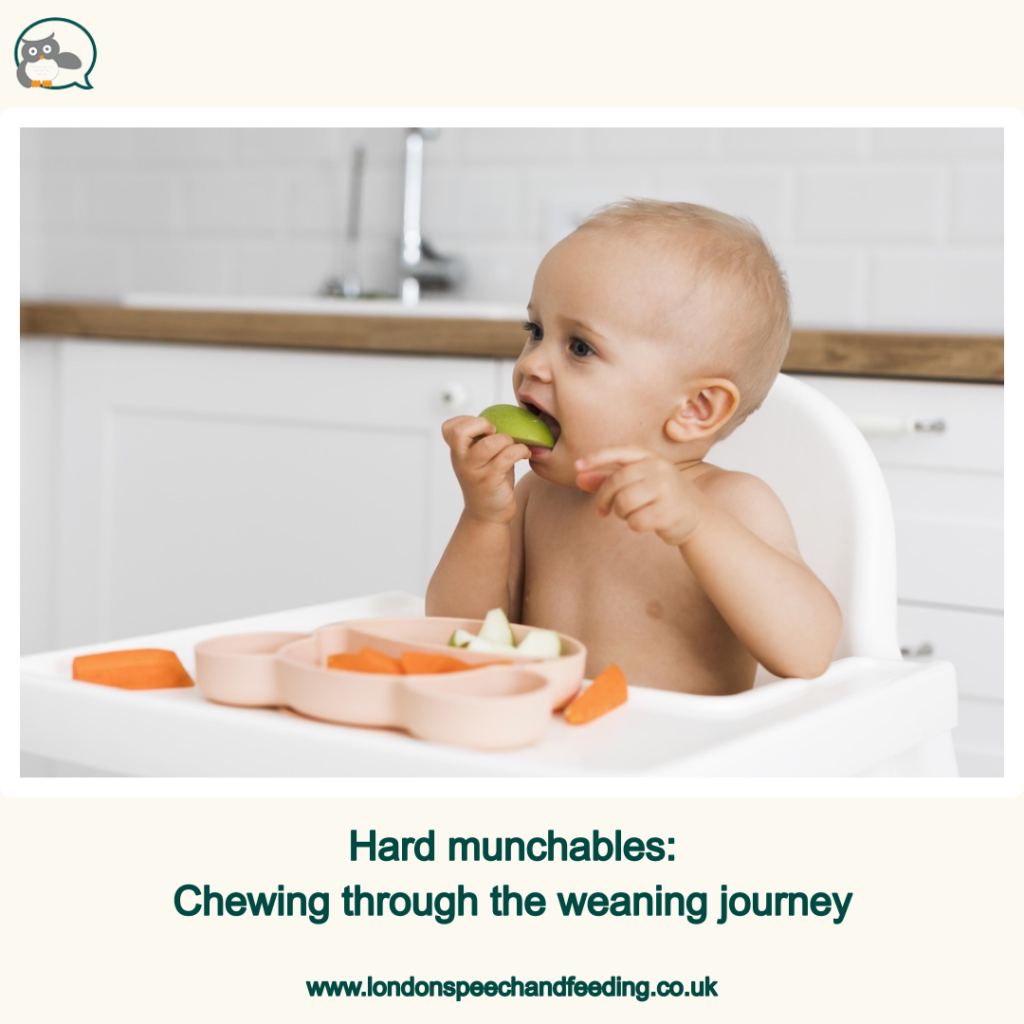
    Hard munchables: Chewing through the weaning journey

    As a Speech and Language Therapist with a specialism in paediatric feeding, I’m constantly looking for ways to support families in developing their little ones’ oral motor skills and fostering a positive relationship with food. While Baby-Led Weaning (BLW) has revolutionised how many families introduce solids, (see my previous blog in July 25) a concept that often sparks discussion and curiosity is the use of ‘hard munchables.’

    What are hard munchables?

    The term ‘hard munchables’ refers to specific types of firm non-digestible food items that are offered to babies for oral exploration and skill development, not for nutrition. These are typically foods that babies cannot bite off or swallow in large pieces due to their texture, but which provide resistance for chewing practice.

    The phrase was coined by Marsha Dunn Klein, M.Ed., OTR/L, Occupational Therapist and feeding therapist. Well known for her work in paediatric feeding she introduced and advocated for the concept of hard munchables as part of a therapeutic feeding approach, particularly for infants learning to manage textures and develop crucial oral motor skills.

    Common examples of hard munchables include:

    • Large, raw carrot sticks: Too hard to bite through, but great for gnawing.
    • Celery sticks: Like carrots, offering firm resistance.
    • Large, raw apple slices (peeled chunks): A firm, slightly sweet option.
    • A firm, uncut pear core: With the seeds removed.
    • Dried mango cheeks (hard, unsweetened varieties): These offer a fibrous texture.
    • A large, fully cooked but firm piece of meat (like a steak bone with some meat attached): The meat provides flavour and a bit of shreddable texture, while the bone is for gnawing.
    • Hard crusts of bread or breadsticks (very firm, without soft inner crumb): These can soften slightly with saliva but offer significant resistance.
    Image by Freepik

    It’s crucial to emphasise that hard munchables are not for consumption or nutrition. They are tools for oral motor development and should always be offered under strict, active supervision.

    How do hard munchables fit into weaning?

    While weaning (traditional or Baby-Led Weaning) introduces solid foods that a baby can eventually bite and swallow, hard munchables are complementary to the weaning phase. They enhance that phase by helping a child to develop hand dexterity, hand to mouth movement, and oral development.

    It’s important to differentiate: Weaning provides the digestible food for eating, while hard munchables provide the tool for skill practice. They are not substitutes for each other but can be used together under careful guidance.

    Pros and cons from a speech therapy perspective

    As an SLT, I see both the potential benefits and the necessary precautions when incorporating hard munchables.

    Pros:

    • Enhanced oral motor development: Hard munchables provide excellent resistance training for the jaw, helping to develop the strength, endurance, and coordination needed for efficient chewing. This is foundational for moving beyond purées and very soft textures.
    • Promotes lateralisation of the tongue: The act of moving the hard item from side to side in the mouth encourages the tongue to move independently of the jaw, a crucial skill for managing food and for speech sound production.
    • Preparation for more complex textures: By strengthening the oral musculature and refining chewing patterns, hard munchables can help babies transition more smoothly to lumpy and mixed textures.
    • Sensory exploration: They offer rich sensory input (tactile, proprioceptive) that can be beneficial for oral mapping and awareness, especially for babies who might be orally sensitive.

    Cons:

    • Choking risk: While the intention is for the baby not to bite off pieces, there is always a risk. Small pieces can break off, or a baby might accidentally bite off a larger chunk than he or she can manage. Active, vigilant supervision is non-negotiable.
    • Not a replacement for digestible solids: It’s vital to remember that hard munchables are for practice, not nutrition. They should complement, not replace, the introduction of varied, digestible solid foods.
    • Not suitable for all babies: Babies with certain developmental delays, oral motor deficits, or medical conditions might not be appropriate candidates for hard munchables without highly specialised guidance. For instance, babies with an exaggerated gag reflex might find them overwhelming.

    Key Considerations for Parents

    Here are my top recommendations:

    1. Consult with a professional: Always discuss this with your Paediatric Feeding SLT first before you introduce hard munchables. We can assess your baby’s individual readiness and guide you on safe practices.
    2. Strict supervision: Never leave your baby unsupervised with a hard munchable, even for a second. Your full attention is required.
    3. Appropriate size: Ensure the item is large enough that the baby cannot fit the whole thing in their mouth. It should extend well beyond their fist.
    4. No biting off: The goal is gnawing and scraping, not biting off pieces. If your baby is consistently breaking off chunks, stop using them.
    5. Focus on skill, not consumption: Reiterate to yourself that this is for practice, not for eating.

    In conclusion, hard munchables, when used appropriately and under guidance, can be a very valuable tool to support oral motor development during the weaning journey. However, always be safe and consult with a specialist to ensure your little one develops his or her feeding skills effectively and joyfully.

    Sonja McGeachie

    Highly Specialist Speech and Language Therapist

    Owner of The London Speech and Feeding Practice.


    Health Professions Council registered
    Royal College of Speech & Language Therapists Member
    Member of ASLTIP

    Find a speech and language therapist for your child in London. Are you concerned about your child’s speech, feeding or communication skills and don’t know where to turn? Please contact me and we can discuss how I can help you or visit my services page.


    References:

    Rapley, G., & Murkett, T. (2008). Baby-Led Weaning: The Essential Guide to Introducing Solid Foods. Vermilion.

    Morris, S. E., & Klein, M. D. (2000). Pre-feeding skills: A comprehensive resource for feeding development. Pro-Ed.

    1
  • ·

    Speech sounds: Expectations vs reality

    Sometimes our kids find it hard to listen to sounds in words and hearing the difference between sounds. This is an important skill which we call “sound awareness”. A lack of it can really impact on clear speech sounds production.

    Your child might be confusing similar sounding words. Or they might not notice that a TAT is not a CAT for a DOD is not a DOG. Often children with speech sound disorders or difficulties don’t tune into individual sounds or even syllables. Grow your knowledge to support your child.

    Read our latest blog on hearing the difference between sounds to develop speech sound production.

    Practice makes perfect

    There is a lot more to speech sound production than first meets the eye. Did you know that producing the correct speech sound at sentence level is the last piece to the communication puzzle? There’s a lot of practice before your child develops this last stage of speaking clearly. Your Speech and Language Therapist will start by determining if your child can hear the difference between the sound they are producing and the correct sound. So if your child says LIT instead of LICK we might contrast those two words by perhaps using a candle and a lollypop. Each time he/she says LICK they get to have a lick (or 3) on the lolly. But if they say LIT then we light up and blow out a candle. This way your child can see that there is a difference between those words and that the sounds we make actually matter. Fancy that!!

    We call this auditory awareness, which is essentially hearing the sounds in words. Don’t be surprised if you hear your child’s therapist model the sound a lot. This is to develop their awareness. The more your child hears a sound, the easier they will find production. Furthermore, your Speech and Language Therapist will work on phonemic awareness (sound structures) such as the difference between a sound (e.g. sh, is one sound) vs a syllable (e.g., shell has one syllable) vs total number of sounds in a word (shell has three sounds sh-e-ll ), like you can see in my little video clip.

    Once a child is able to produce a sound on its own and they can hear and identify how a short word is said correctly we can go and repeat lots of similar words with the sound at the beginning or end until it becomes automatic and new neuro pathways are laid in the child’s brain. From there we branch out into short phrases and then eventually sentences.

    Six tips to practise auditory discrimination for speech sound production

    1. Sit opposite your child so they can see your mouth or or sit next to the child and place a mirror in front of you so they can see and hear your production.
    2. Make it fun! Once they’ve identified the sounds in the word, play part of a game (e.g., pop up pirate, Jenga, something which allows plenty of turns).
    3. Use car journeys or walking to school to practise (e.g., oh I see a sheep, sh-ee-p, sh-ee-p has three sounds. Can you spot something beginning with /sh/?)
    4. Remember that spellings can differ (e.g., ‘chef’ and ‘shed’ both have the same initial sound).
    5. Talk about what you’re doing with your mouth (e.g., my lips are rounded for /sh/). Your Speech and Language Therapist will be able to support you with this.
    6. Make silly sentences using your child’s special sound (e.g., Sheep show shepherds shearing).

    At this stage you are not expecting your child to produce the sound. This is why it’s important that they continually hear an excellent model. If your child attempts speech sound production at any stage, this is to be encouraged as it’s a great opportunity to model the correct version.

    Contact me to develop your child’s speech sounds.


    Find a speech and language therapist for your child in London. Are you concerned about your child’s speech, feeding or communication skills and don’t know where to turn? Please contact me and we can discuss how I can help you or visit my services page.

    0