Something that keeps surprising me…
After thirty years of helping children with lisps, you’d think very little would still surprise me. And yet…
Every few weeks, a lovely, and well-informed parent will describe their five, six, or seven year-old’s slushy, sideways /S/ and then ask ‘So, how many sessions do we need to fix this? Perhaps five–six? ‘
And every time, I have to resist the urge to laugh, cry, and reach for the biscuits all at once. Because the honest answer, for an established lateral lisp in a school-aged child, is usually twenty sessions or more. Wait! Hear me out!…
‘Why so many?!’ … once you understand what’s actually going on inside your child’s mouth, the number 20+ does no longer sound outrageous and starts sounding rather reasonable.
First: not all lisps are equal
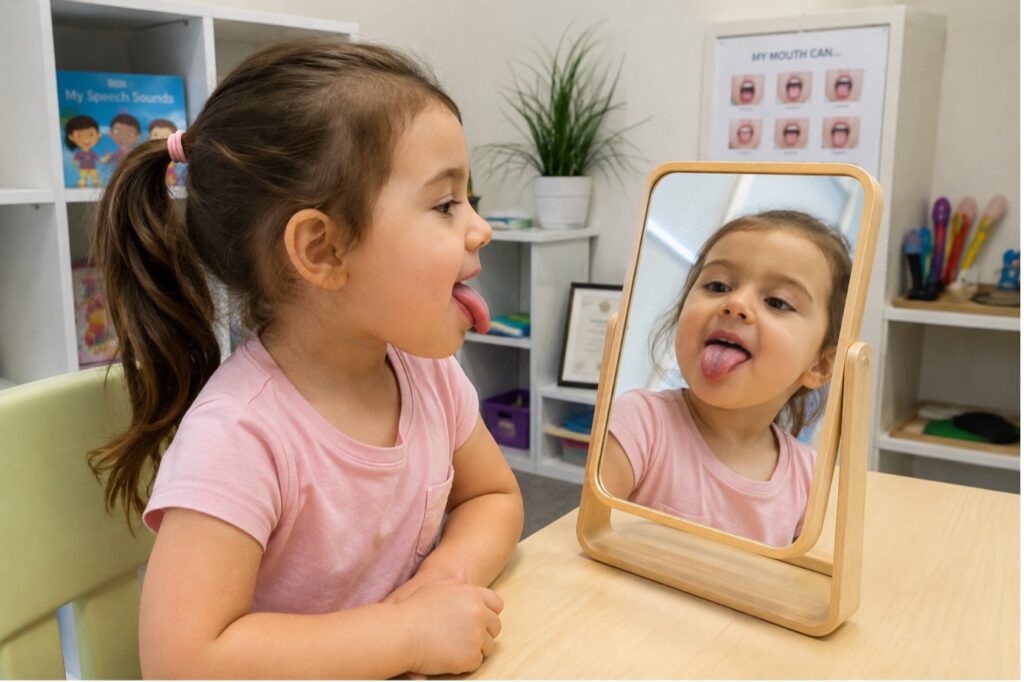
Most people picture a lisp as the gentle, even endearing /TH/ for /S/ — ‘thnake’ instead of ‘snake’. That’s an inter-dental lisp, where the tongue pokes forward between the teeth. It’s common, it’s developmentally normal in younger children, and this is the important bit, it’s usually visible. It’s still a bit tricky to correct at first but I often can show a child what to do, they can watch themselves in a mirror, and quite often we’re away. But it still takes a lot longer than parents think because just fixing the sound does not mean it will be produced correctly in normal, daily speech and conversation.
Lateral lisp
A lateral lisp on the other hand is an entirely different animal. Instead of the air flowing in a neat central stream down a groove in the middle of the tongue, it spills out over the sides, around the molars. The result is that wet, slushy, quality. It affects not just /S/ and /Z/, but very often /SH/, /CH/ and /J/ too which is a big chunk of English.
Here’s the snag: it’s happening where nobody can see it. There’s no mirror in the world that shows you the sides of your tongue as you are speaking, or chewing for that matter. We’re teaching a child to control a movement they can’t see, can’t easily feel, and have never once performed correctly in their life.
By five, six or even seven years old your child has said the /S/ sound about several hundred times a day, every day, for several years. It’s one of the most frequent sounds in English: it makes our plurals, our possessives, our verb endings. Every ‘cats’, ‘let’s’, ‘she runs’.
So we are now talking about a deeply ingrained motor habit, rehearsed tens of thousands of times, that now feels completely normal and correct to the child producing it. We’re not teaching a new skill onto a blank page; we’re overwriting a very strong habit. Think of a tennis player with a flawed serve who’s played for five years… You don’t fix that in a fortnight, and nobody expects you to.
The good news is: school children, seven-year-old and up, are brilliant at this work. They can self-monitor, they can practise independently, they can hear the difference. It just takes time.
The quiet culprit: where the tongue lives at rest…
Here’s the piece that most parents have never heard, and it explains a lot.
When the mouth is at rest, the tongue should sit up — tip resting lightly behind the top front teeth, body gently suctioned to the roof of the mouth, lips together, breathing through the nose.
Many children with a lateral lisp have a low, forward resting tongue posture. The tongue sits on the floor of the mouth, often with the lips slightly apart. This is frequently associated with a history of mouth breathing, blocked noses and allergies, enlarged tonsils or adenoids, prolonged dummy or thumb-sucking, and sometimes dental or orthodontic differences such as an open bite.
Why does this matter so much? Because a good /S/ requires the tongue’s sides to brace firmly against the upper back teeth to form that central channel. A tongue that spends 23 hours a day flopped on the floor of the mouth simply doesn’t have the habitual strength, position or awareness to do that on demand. We can teach a beautiful /S/ in the clinic — but if the tongue’s default setting is ‘down’, we’re swimming upstream all week.
So, for many children, part of the work is establishing a better resting posture alongside the sound itself. That’s foundational and it’s slow.
So what does twenty-plus sessions actually achieve?
Therapy for a lateral lisp moves through a strict hierarchy, and you cannot skip a rung:
- Auditory discrimination: Can they hear the difference? (Often, initially, no.)
- Eliciting the sound: Sometimes a single session, can be six.
- Stabilisation: Building consistency in isolation, then syllables, then single words (beginning, middle, end).
- Blends: Mastering challenging combinations like ‘spoon’, ‘street’, and ‘smile’.
- Sentences: Moving to phrases, full sentences, and structured conversation.
- Generalisation: Using it naturally with family, at school, when tired, or when telling a long story.
- Self-monitoring: Training them to catch and correct themselves without therapist intervention.
Rushing a level guarantees a collapse two levels later. I’ve never once regretted going slowly; I’ve frequently regretted going fast.
The bit that decides everything: home practice
Let me be blunt in a nice way 😊 The child who practises five to ten minutes a day, six days a week, will finish in half the time of the child who practises the night before their session.
An hour with me per week is roughly 1% of your child’s waking life. The other 99% is where habits are made or unmade. What I need at home is:
- Short and daily beats long and occasional: Five focused minutes, ideally at a consistent time.
- Practise only at the set level: If we’re on words, don’t leap to sentences. That’s how we go backwards.
- Give specific feedback: Say ‘that one was lovely and sharps or ‘that one slipped sideways, try again’.
- Hold back on everyday corrections: Don’t correct them in normal conversation until we’re ready.
- Record them occasionally: Children love hearing their own tangible progress.
The bottom line
I’m good at this. I’ve been doing it for thirty years and I love it. But I’m a therapist, not a magician, and the parents who get the best outcomes are the ones who view this as a partnership. When we work together—combining expert clinic guidance with steady, gentle practice at home, that ‘twenty-plus’ number isn’t a sentence. It’s simply the guideline to giving your child a clear, confident voice for the rest of their life.
Do get in touch with me. I would love to hear from you and help you and your child.

Sonja McGeachie
Highly Specialist Speech and Language Therapist
Owner of The London Speech and Feeding Practice.


Find a speech and language therapist for your child in London. Are you concerned about your child’s speech, feeding or communication skills and don’t know where to turn? Please contact me and we can discuss how I can help you or visit my services page.