Tongue-Tie: A complex issue requiring careful assessment

Tongue-tie, or ankyloglossia, is a condition where the lingual frenulum, the thin piece of tissue that connects the underside of the tongue to the floor of the mouth, is too short or tight. Tongue-tie is quite common in babies and is often not detected after birth. Tongue-tie can lead to a difficult start with breast feeding as it makes it very difficult for the baby to latch effectively.

In my clinical experience as a feeding therapist, I have seen many babies who were not able to latch well due to the frenulum being tight. In many cases an experienced feeding speech therapist/lactation consultant can really make a difference and help a new mum to latch the baby even though the tongue is tethered to the floor of the baby’s mouth. In some cases the frenulum can be divided and once this has been done, in some cases, feeding improves immediately or soon after the division. But this is not always the case. I have seen several babies who have had as many as four tongue-tie divisions and feeding was still difficult.

It is important to say that while tongue-tie can sometimes impact speech and feeding, it’s important to note that it’s not always the root cause of these difficulties. In recent years, there has been a surge of interest in tongue-tie division surgeries, with some cases being unnecessary. It’s crucial to understand the complexities of tongue-tie and the role of speech therapy in addressing related challenges.

The impact of tongue-tie on speech and feeding

When tongue-tie is severe, it can interfere with the tongue’s ability to move freely, affecting speech production and swallowing. Some common speech and feeding difficulties associated with tongue-tie include:

  • Feeding difficulties: Challenges with sucking, chewing, and swallowing.
  • Drooling: Excessive drooling due to difficulty controlling saliva.
  • Speech problems: Difficulty producing certain sounds, such as /l/, /r/, /t/, /s/ and /d/.

The importance of comprehensive assessment

Before considering any surgical intervention for tongue-tie, it’s essential to undergo a thorough evaluation by a qualified speech-language therapist (SLT). An SLT can assess the severity of the tongue-tie, its impact on speech and feeding, and determine if surgery is necessary.

  • Functional assessment: The SLT will assess the tongue’s range of motion, its impact on speech sounds, and the child’s overall oral motor skills.
  • Feeding evaluation: The SLT will observe the child’s feeding patterns and identify any difficulties related to tongue-tie.
  • Differential diagnosis: The SLT will rule out other potential causes of speech and feeding difficulties, such as apraxia of speech, dysarthria, or sensory processing disorders.

The role of speech therapy

Even in cases where tongue-tie is present, speech therapy can often be highly effective in addressing speech and feeding difficulties. Here’s how speech therapy can help:

  • Articulation therapy: Targeting specific speech sounds that may be affected by tongue-tie.
  • Childhood Apraxia of Speech (CAS): if the diagnosis by the SLT has shown that in fact the child has motor planning difficulties then there are very specific and effective treatment programmes that help with this and can make a real difference over time.
  • Feeding therapy: Strategies to improve swallowing, chewing, and oral-motor skills.
  • Sensory integration: Addressing underlying sensory processing issues that may contribute to feeding difficulties.

London Speech and Feeding Case Study: The importance of comprehensive assessment

One of my clients was initially diagnosed with tongue-tie and recommended for surgery at the age of eight years old. His speech had been perceived by parents and teachers as ‘mumbled and unclear’.

However, after a thorough evaluation, I was able to determine that the child’s primary issue was apraxia of speech, a neurological disorder that affects motor planning for speech. Parents decided to wait with surgery and trust my judgment and we proceeded with weekly intensive speech therapy to address motor planning difficulties around tricky sounds and words. I am delighted to say that the child’s speech has improved significantly, demonstrating the importance of comprehensive assessment and individualised treatment. He is no longer seen as a candidate for an operation, which would have been traumatic for him at his age and, as it turned out, entirely unnecessary.

Below is a short video clip of my working on the /l/ sound with this child.

Using the Gingo Puppet from GingoTalk

Conclusion

Tongue-tie is a complex issue that requires careful evaluation and individualised treatment. While surgery may certainly be necessary in some cases, it’s essential to consider the potential benefits and risks. Speech therapy can be a highly effective approach for addressing speech and feeding difficulties associated with tongue-tie, even in cases where surgery is still required. By working with a qualified speech-language therapist, parents can ensure that their child receives the best possible care and support.

Please feel free to contact me.

Sonja McGeachie

Early Intervention Speech and Language Therapist

Feeding and Dysphagia (Swallowing) Specialist The London Speech and Feeding Practice

The London Speech and Feeding Practice


Find a speech and language therapist for your child in London. Are you concerned about your child’s speech, feeding or communication skills and don’t know where to turn? Please contact me and we can discuss how I can help you or visit my services page.

1

Similar Posts

  • ·

    Unlocking language and thinking skills: The power of sequencing

    Sonja demonstrates the power of sequencing

    As speech and language therapists, we often use a variety of techniques to help children develop their communication and cognitive skills. One incredibly valuable tool in our toolkit is the use of sequencing activities. But what exactly is sequencing, and why is it so beneficial?

    What is sequencing?

    Sequencing, at its core, involves arranging items, events, or actions in a specific order. This could involve putting pictures in the correct order to tell a story, following the steps in a recipe, or understanding the order of daily routines like brushing teeth or getting dressed.

    The link between sequencing and language

    Sequencing is fundamental to language development and is quintessential to executive functioning skills in several ways:

    • Narrative skills: Storytelling, whether oral or written, relies heavily on sequencing. A child needs to understand the order of events (beginning, middle, end) to construct a coherent narrative.
    • Explanations and instructions: Providing clear explanations or instructions requires the ability to sequence information logically. For example, explaining how to play a game or how to get from one place to another. In the video clip below we are working on ‘how do make a sandwich’.
    • Vocabulary development: Sequencing helps children understand temporal words and phrases like ‘first,’ ‘then,’ ‘next,’ ‘before,’ and ‘after’.
    • Sentence structure: Constructing grammatically correct sentences often involves sequencing words in a specific order (e.g., subject-verb-object).

    Beyond language, sequencing plays a crucial role in developing executive functioning skills. These are higher-level cognitive skills that help us plan, organise, and manage our time and actions.

    Sequencing activities can help children improve in the following areas:

    • Planning and organisation: Sequencing tasks require children to think ahead, plan the steps involved, and organise them in a logical order.
    • Problem-solving: When they are faced with a problem, sequencing helps children break it down into smaller, more manageable steps.
    • Working memory: Holding information in mind and manipulating it, such as remembering the steps in a multi-step direction, is supported by sequencing skills.
    • Cognitive flexibility: Being able to adjust to changes in a sequence or think of alternative sequences promotes cognitive flexibility.

    Examples of sequencing activities

    Here are some practical examples of sequencing activities you can do with your child:

    • Picture sequencing: Use a set of picture cards to tell a short story or illustrate a process (e.g., making a sandwich, going to the park). Ask your child to arrange the cards in the correct order.
    • Story retelling: After reading a story, have your child retell it, focusing on the order of events.
    • Following instructions: Give your child multi-step instructions to follow (e.g., ‘First, get your shoes. Then, put on your coat. Next, go to the door.’).
    • Sequencing during play: Integrate sequencing into everyday play. For example, while building with blocks, talk about the steps: ‘First, we put this block here. Next, we add this one…’
    • Daily routines: Create visual schedules for daily routines, like getting ready for school or bedtime, to help children understand the sequence of events.
    • In the video clip below I am using an on-line language activity which is often fun for children as they can use their finger to swipe the pictures effortlessly into the right place and, if we realise at the end of the story that we have made a little error, we can then easily re-jig the pictures into their correct place.

    In conclusion

    Sequencing activities offer a powerful way to support children’s language development and enhance their executive functioning skills. By helping children understand and create order, we equip them with essential tools for communicating, learning, and navigating the world around them.

    Do get in touch via my contact form if you are concerned about your child’s development.

    Sonja McGeachie

    Highly Specialist Speech and Language Therapist

    Owner of The London Speech and Feeding Practice.


    Health Professions Council registered
    Royal College of Speech & Language Therapists Member
    Member of ASLTIP

    Find a speech and language therapist for your child in London. Are you concerned about your child’s speech, feeding or communication skills and don’t know where to turn? Please contact me and we can discuss how I can help you or visit my services page.

    1
  • · · ·

    Unlocking communication: My daily life with the Saltillo 88 Core Board

    Introduction

    As an AAC speech and language therapist who uses the Saltillo 88 Core board every day, I can tell you it’s more than just a communication tool. It’s a doorway to independence, connection, and expressing my students’ unique voice.

    What is the Saltillo 88 and why do I use this one?

    In this blog post, I want to share practical, real-world examples of how I integrate the Saltillo 88 into various daily activities, empowering my students and parents to learn to communicate.

    There are literally hundreds of core boards out there and I have tried many different ones over the years. Which one should I use with this particular client? Should I make up my own? (I have made up tons!) or should I use a ready-made one like the one below which is what this blog is about.

    For me the best ones are boards with a good number of core words (at least 60) so that the board is versatile and can be used across a range of activities. The board needs to have a range of pronouns, verbs, descriptors, prepositions and question words to be useful and to stimulate not just requesting but commenting and asking questions. Another consideration is: can the board easily be transferred to a more robust AAC system. Once my student is used to the symbols and where they are could we move to an electronic talker/device. And if this answer is ’yes’ then we have a great board to get started with.

    Below is a picture of the Saltillo 88.

    Saltillo 88 Core Board
    Saltillo 88 Core Board

    It has 88 words and I find it really does suit most activities. The same board and design is also then found on the TOUCHCHAT AAC device which can be a seamless transition for our learner.

    Let me dive into how core words/board or AAC can be used daily:

    1.  Getting dressed

    Whilst choosing clothes for your little one and getting them ready for the day you can use the following words: want, like, get, finish. Always pack the words into little phrases you can speak naturally when using a board. I have tried to show you phrases that you could use below.

    The words in bold are the core words on the board and the other words are just words you say whilst pointing to the core word.

    • Goal: Express choices, needs, and preferences about clothing.
    • Ideas:
      • ‘I want this one [specific item of clothing: ‘shirt’, ‘pants’]’
      • ‘I like that one [colour/type of clothing]’
      • ‘Help me [put/get it on/take off]’
      • ‘let’s get your socks now’
      • finished let’s go’ (when dressed)

    2. Having a shower/bath

    • Goal: Bath time tends to happen daily and so it lends itself to using the same useful phrases and words to chat about temperature preferences, to ask for toys or for washing routines.
    • Ideas:
      • ‘let’s go have a bath/shower’
      • ‘let’s turn on the tap/water’
      • now turn it off
      • ‘let’s get/have more toys/water/bubbles/tickles’
      • all gone, what’s next?’
      • ‘how about washing your hands/feet’
      • ‘let’s do that again’
      • ‘need some help?’
      • Stop it now, let’s do something different’

    3. Mealtimes

    • Goal: Mealtimes can be (or should be) enjoyable and motivating to ask for specific things we like, and commenting about our eating experiences.
    • Ideas:
      • ‘I want/give me [food item: ‘apple’, ‘bread’]/[drink item: ‘water’, ‘juice’]’
      • More foods/drinks/snacks’
      • All done
      • ‘that’s messy we like that (not)’
      • ‘Like’/‘Don’t like’
      • Big’/‘Little’
      • ‘this is so nice!’

    4. Playing

    • Goal: This is where it’s at for children of course and we can use our core words to chat and engage with our little learners.
    • Ideas:
      • ‘I want play’
      • Go’/‘Stop
      • More/again’
      • ‘not it’s my My turn/’it’s Your turn
      • ‘that’s a Big one!’/‘let’s do Little bubbles (describing toys)
      • ‘let me Open it for you (for boxes, doors in play)
      • ‘I See it’ (to draw attention)
      • Help me’ (with a tricky toy)

    5. Opening boxes/doors/etc

    • Goal: Most kids love opening boxes, doors and cabinets to see what there is to play with. Help your child to ask for what they want.
    • Ideas:
      • let’s Open that box/bag/zip/door’
      • get me a (toy) out of here’
      • ‘Let’s Take it out and see what it is?’
      • finished’ (when finished with the task)
      • ‘I want [what’s inside]’
      • ‘What’s next? Let’s see’

    Tips for using AAC effectively

    • Consistency is key: Emphasise using it regularly, even for small things.
    • Modelling: this is crucial, the adults need to use the board for all situations first and foremost before we can expect our child to be interested.
    • Patience: Communication takes time and practice.
    • Celebrate successes: Acknowledge every communicative attempt.
    • Make it accessible: Keep the board within easy reach at all times.

    Conclusion

    If you’re considering the Saltillo 88, or TouchChat, or are already using it, I hope these examples inspire you. It’s a journey of discovery, and every word communicated is a step towards a more connected and independent life. What are your favourite ways to use the Saltillo 88 or which core board do you love using? I would love to hear your comments and stories.

    Sonja McGeachie

    Highly Specialist Speech and Language Therapist

    Owner of The London Speech and Feeding Practice.


    Health Professions Council registered
    Royal College of Speech & Language Therapists Member
    Member of ASLTIP

    Find a speech and language therapist for your child in London. Are you concerned about your child’s speech, feeding or communication skills and don’t know where to turn? Please contact me and we can discuss how I can help you or visit my services page.
    2
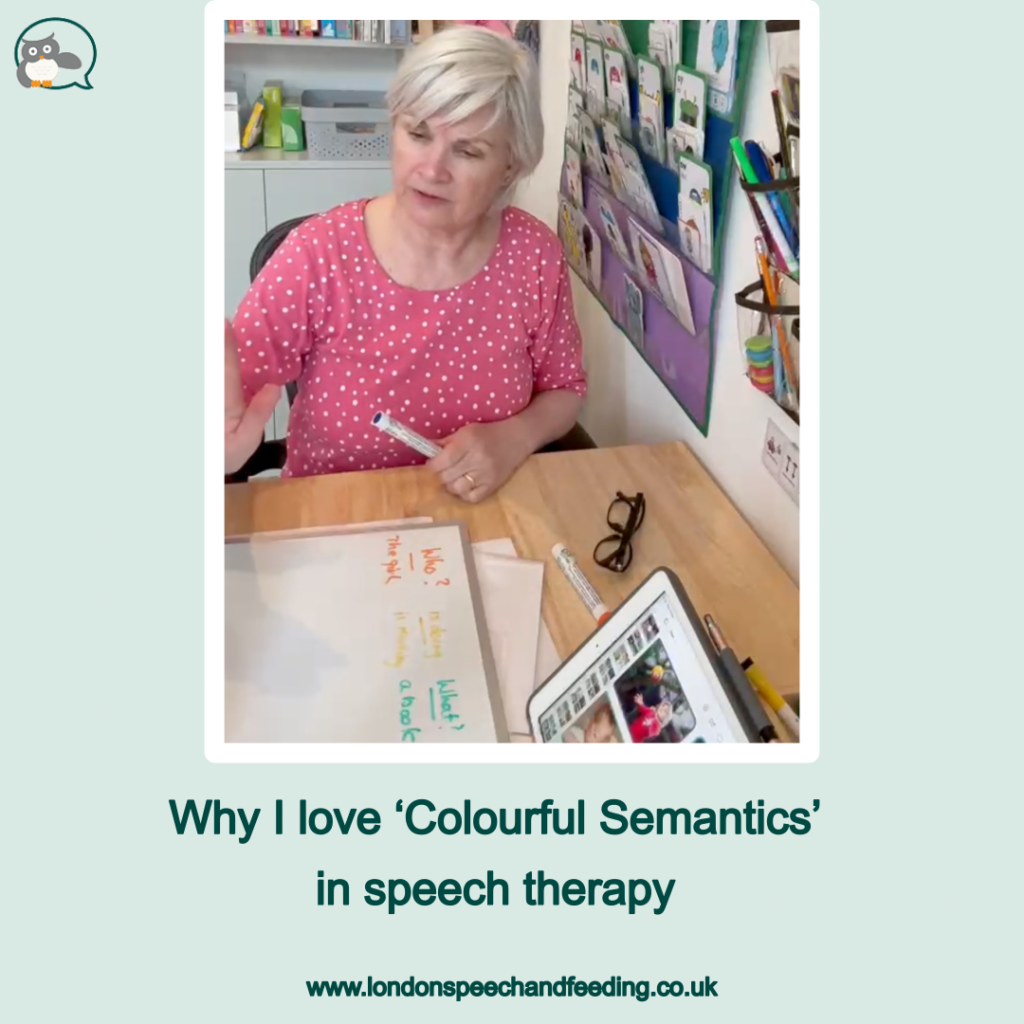
  • Why I love ‘Colourful Semantics’ in speech therapy

    One of the most common concerns parents bring to speech and language therapy is:
    ‘My child understands so much… but they struggle to put sentences together’.

    Some children use only single words.
    Others miss out key parts of sentences.
    Some mix up word order.
    Others find it difficult to answer questions or explain their ideas clearly.

    This is where one of my favourite therapy approaches can be incredibly powerful: Colourful Semantics.

    Colourful Semantics is a highly effective and evidence-informed way of supporting children to build stronger sentence structure, grammar, understanding, and expressive language skills.

    It is a visual approach to language development originally created by a UK Speech and Language Therapist, Alyson Bryan in 1997 to help children understand how sentences are organised.

    Different parts of a sentence are represented by different colours.

    For example:

    • Who? is orange.
    • What doing? is yellow.
    • What? is green.
    • Where? is blue.

    As children progress more colours are added:

    • To Whom? Is pink.
    • Adjectives (what like) is purple.
    • Time Phrase is brown.

    Using colours gives children a visual framework for building sentences in a way that feels structured, predictable, and achievable.

    Instead of language feeling abstract and overwhelming, children can see how sentences fit together.

    For many children, this is massively helpful as it gives structure and predictability.

    Why some children struggle with sentences

    Language development is incredibly complex.

    To build a sentence, we need to:

    • think of vocabulary
    • organise grammar
    • sequence words
    • understand meaning
    • remember sentence structure
    • physically say the words clearly enough to communicate

    That is a huge amount happening all at once.

    Some children may:

    • leave out verbs
    • miss pronouns
    • use immature grammar
    • struggle with word order
    • rely on very short phrases
    • find it difficult to expand beyond single words.

    For example:

    • ‘Boy jump’
    • ‘Him eating’
    • ‘Dog there’
    • ‘Want juice’.

    These children often know more than they can express.

    Colourful Semantics helps bridge that gap.

    Why visual supports matter

    Many children—especially those with language delays, developmental language disorder (DLD), autism, or social communication difficulties—benefit enormously from visual support.

    Visual systems reduce the processing load.

    Instead of relying only on spoken language, children are given an additional way to organise information.

    The colours act almost like ‘anchors’ for language.

    A child may begin to understand:

    • orange = who
    • yellow = action
    • green = object
    • blue = place.

    This makes sentence building more concrete and less overwhelming.

    It also supports children who struggle with:

    • attention
    • auditory memory
    • processing spoken language
    • sequencing
    • confidence using language independently.

    Supporting sentence expansion naturally

    One of the things I love most about Colourful Semantics is how flexible it is.

    It can be used:

    • in play
    • with books
    • during conversation
    • with picture scenes
    • in storytelling
    • during movement activities
    • within everyday routines.

    Therapy does not need to feel rigid or worksheet-heavy.

    Many children who usually avoid talking become much more willing to attempt longer sentences when they feel successful.

    Children often begin to use:

    • verbs more accurately
    • pronouns more consistently
    • better word order
    • improved sentence organisation
    • and more complete ideas.

    For example, instead of:

    • ‘Him running’

    A child may gradually move toward:

    • ‘He is running.’

    The colours help children understand the ‘jobs’ words have within a sentence.

    This is particularly useful for children who need explicit teaching of language structure rather than simply learning through exposure alone.

    Supporting children with speech difficulties too

    One thing I particularly value in therapy is approaches that support multiple communication areas at once.

    Colourful Semantics is excellent for this.

    While building sentences, we can also naturally target:

    • speech sounds
    • intelligibility
    • vocabulary
    • social communication
    • turn-taking
    • attention and listening
    • confidence speaking.

    For example, if a child is working on the /K/ sound, we might intentionally build sentences containing target words:

    • ‘The cat is coming.’
    • ‘The boy is kicking.’
    • ‘The duck is in the box.’

    This allows speech and language goals to work together rather than separately.

    Therapy becomes more functional, meaningful, and engaging.

    Building confidence through success

    One of the biggest barriers many children experience is not simply language difficulty. It is the emotional impact of struggling to communicate.

    Some children become frustrated.
    Others withdraw.
    Some stop attempting longer sentences altogether because communication feels too hard.

    Colourful Semantics can help rebuild confidence because it gives children a clear structure for success. That feeling matters enormously.

    When children feel successful, they participate more.
    They attempt more.
    They communicate more.

    And communication grows through communication.

    Why I use colourful semantics

    There is no single ‘magic’ therapy approach for every child.

    But Colourful Semantics remains one of the most versatile and effective tools I use because it can be adapted so beautifully to individual children.

    It supports:

    • early language
    • grammar
    • sentence structure
    • comprehension
    • expressive language
    • storytelling
    • confidence
    • functional communication.

    Most importantly, it helps children organise language in a way that finally starts to make sense to them.

    And when language starts to make sense, communication can truly begin to flourish.

    Contact me via my contact form if you would like me to work with your child.

    Sonja McGeachie

    Highly Specialist Speech and Language Therapist

    Owner of The London Speech and Feeding Practice.

    Reference

    Bryan A (1997) Colourful semantics. In: Chiat S, Law J, and Marshall J (eds) Language disorders in children and adults: psycholinguistic approaches to therapy. London: Whurr, 143–61.


    Health Professions Council registered
    Royal College of Speech & Language Therapists Member
    Member of ASLTIP

    Find a speech and language therapist for your child in London. Are you concerned about your child’s speech, feeding or communication skills and don’t know where to turn? Please contact me and we can discuss how I can help you or visit my services page.

    3
  • Language development

    Kids Speech Therapist London
    Language Development

    Books, Stories And Colourful Semantics

    Many of my students have difficulties telling stories. When looking at a book together, even books they love and have seen many times, they often struggle to understand what they are reading and cannot therefore retell the story in any sequence. A great method I often use with those students is called Colourful Semantics.

    What is Colourful Semantics?

    Colourful Semantics is an approach aimed at helping children develop grammar and meaning of phrases and sentences. We help children identify WHO is the subject in a story, what is he/she/it DOING to WHAT and WHERE. There are lots of colour coded stages but we tend to start with the basic 4:

    WHO = ORANGE

    DOING = YELLOW

    WHAT = GREEN

    WHERE = BLUE

    Once a student is accomplished at this level, we move on to different colour codes for describing words (adjectives), connecting words (with/together/and/therefore) feeling words (PINK), timing words (BROWN) eg. when, tomorrow, last week etc.

    Colourful Semantics is a really useful method and helps children to organise their sentences. It also helps me knowing how to guide a student in thinking about the story.

    The approach can be used with children with a range of Speech and Language Needs, such as:

    • Developmental Delay / Disorder
    • Autistic Spectrum Condition
    • Down Syndrome
    • Any other syndromes and related speech and language delays
    • General Literacy difficulties

    There are a wide range of benefits to using this approach and I use it in my therapeutic work with children of around 3 years plus. Below is a little video which shows how I use it with this student who has general language difficulties associated with Autism. One of the main benefits with this student is that seeing the Cue Cards helps her to use a much wider range of vocabulary than she would ordinarily generate. Her sentences are getting longer and she is more able to answer questions. In general, I find it useful to help with storytelling and to guide us through the story in a sequence.

    There are many on-line games these days that have incorporated the Colourful Semantics Approach. Once a child is familiar with the basic colour scheme then gradually the visual prompts can be reduced to using verbal prompts.


    Find a speech and language therapist for your child in London. Are you concerned about your child’s speech, feeding or communication skills and don’t know where to turn? Please contact me and we can discuss how I can help you or visit my services page.

  • ·

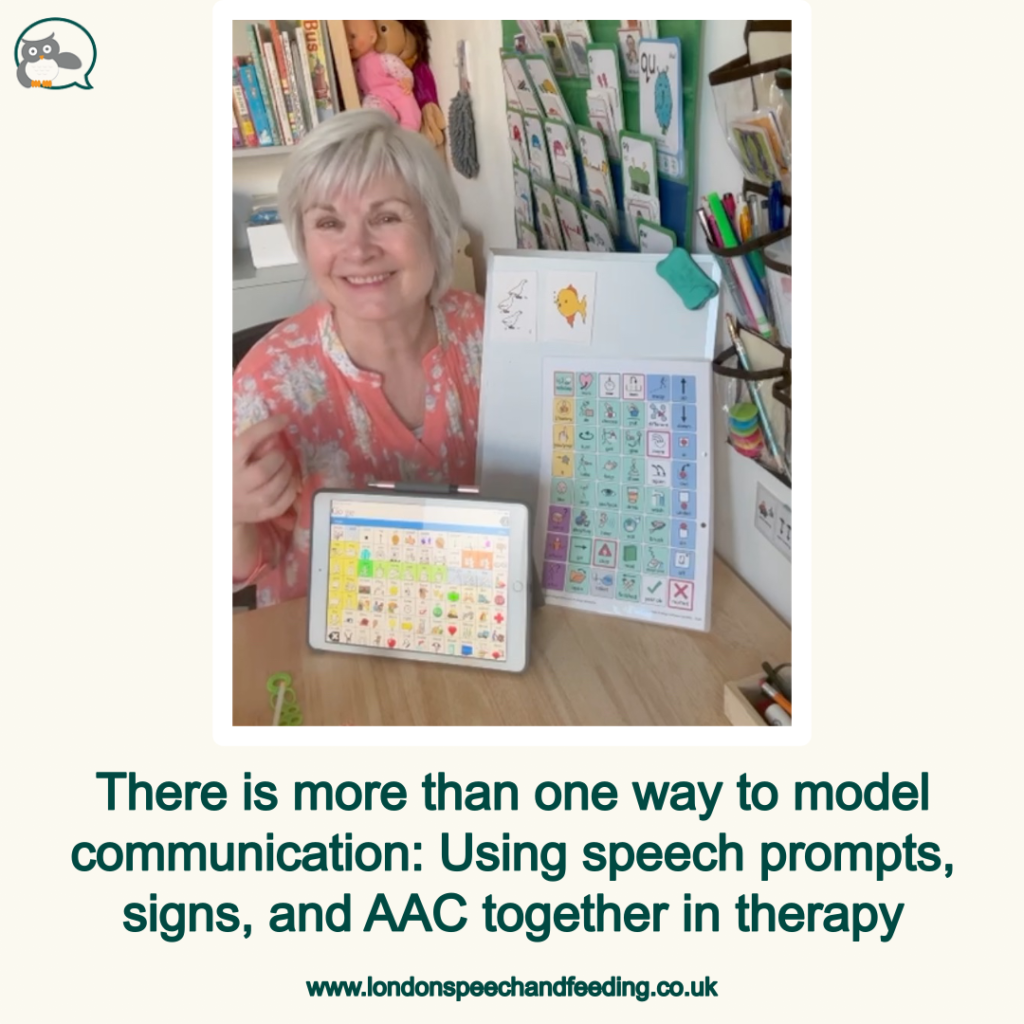
    There is more than one way to model communication: Using speech prompts, signs, and AAC together in therapy

    One of the most important things I have learned as a paediatric speech and language therapist is this:

    Children do not all learn communication in the same way.

    Some children learn best through listening.
    Some need visual support.
    Some need movement and gesture.
    Some benefit from symbols or technology.
    And many children need multiple supports together before communication truly starts to develop.

    That is why flexible, responsive therapy matters so much.

    In this short therapy clip, I model just two simple words:
    ‘Go’ and ‘Up’.

    But underneath those tiny moments is a combination of therapeutic strategies:

    • speech sound prompting
    • visual cueing
    • Makaton signing
    • AAC (Augmentative and Alternative Communication) modelling
    • repetition
    • motor planning support
    • language modelling
    • total communication principles.

    Communication is bigger than speech alone

    One of the biggest misconceptions about speech therapy is the idea that communication only ‘counts’ if a child says the word verbally.

    In reality, communication comes in many forms:

    • speech
    • gesture
    • facial expression
    • signing
    • pointing
    • symbols
    • body language
    • AAC.

    This is particularly true for children with:

    • developmental language disorder (DLD)
    • autism
    • motor speech difficulties
    • childhood apraxia of speech (CAS)
    • phonological difficulties
    • global developmental delay
    • complex communication needs.

    These children often need communication to be presented through multiple pathways at once.

    That is where total communication approaches become so powerful.

    This is important to know: this does not confuse children. In fact, for many children, it does the opposite. It creates clarity.

    Careful sound prompting helps bridge that gap.

    Research and clinical experience consistently show that signs often support spoken language development rather than hinder it.

    Research suggests that learning signs alongside spoken language does not hinder speech development and may support overall language acquisition, communication confidence, and vocabulary growth in many children.

    For many children, signs actually help speech emerge because they:

    • reduce communication pressure
    • build confidence
    • strengthen understanding of words.

    A child who can successfully communicate is far more likely to keep attempting interaction.

    The power of AAC and LAMP Words for Life

    In the clip, I also model language using an electronic AAC system: LAMP Words for Life.

    AAC stands for Augmentative and Alternative Communication.

    AAC includes any tool that supports communication beyond speech alone, including:

    • picture systems
    • symbol boards
    • communication books
    • speech-generating devices.

    LAMP Words for Life is one of my favourite AAC systems because it focuses on consistent motor patterns and meaningful language development. Because communication is not about achieving perfection. It is about connection.

    And when children are given multiple ways to express themselves, they often become more confident, more engaged, and more willing to interact with the world around them.

    That is the true power of total communication therapy.

    Contact me via my contact form if you would like me to work with your child.

    Sonja McGeachie

    Highly Specialist Speech and Language Therapist

    Owner of The London Speech and Feeding Practice.

    Reference

    Pontecorvo, Elana & Higgins, Michael & Mora, Joshua & Lieberman, Amy & Pyers, Jennie & Caselli, Naomi. (2023). Learning a Sign Language Does Not Hinder Acquisition of a Spoken Language. Journal of Speech, Language, and Hearing Research. 66. 1291-1308. DOI 10.1044/2022_JSLHR-22-00505.


    Health Professions Council registered
    Royal College of Speech & Language Therapists Member
    Member of ASLTIP

    Find a speech and language therapist for your child in London. Are you concerned about your child’s speech, feeding or communication skills and don’t know where to turn? Please contact me and we can discuss how I can help you or visit my services page.

    3
  • · ·

    Why ‘Prosody’ Matters in Childhood Apraxia of Speech (CAS)

    Prosody refers to the ‘music’ of speech — the rhythm, pitch, stress, and volume that convey meaning and emotion beyond the literal words themselves. Think about a monotone statement like ‘Really?’ compared to one with a rising inflection, expressing genuine curiosity.

    When I work with children on producing speech sound sequences, we focus on mastering individual sounds and then putting them together into target words. A crucial element that can significantly impact a child’s speech production is ‘prosody’.

    In CAS, where the difficulty lies in planning and executing the motor movements for speech, prosody can be a powerful tool for producing clearer words and phrases.

    Here’s why working on prosody is an essential tool in CAS speech therapy:

    1.  It aids Motor Learning:

    Apraxia of Speech means that the planning and execution of speech movements are impaired. When we use exaggerated intonation or stress patterns while modelling words, we are providing additional prosodic variation and, therefore, additional auditory cues. These cues often help my student to carry out the correct motor movements for a word or syllable sequence.

    For instance, I might say ‘ball’ with a high-pitched emphasis on the ‘b’ sound. This auditory cue might be more effective in guiding the child’s tongue placement than simply repeating the word without variation.

    In this little video clip I get my student to say the word ‘snuggle’ (since we were working on that particular sound sequence: snuggle, snout, snore and sneeze) with a high voice and then a lower voice ‘like a bear’ — again it provides that extra auditory cue, but, in addition, the fun aspect also helps to take away the intense focus on a tricky movement pattern.

    By now the new pathways have been laid through repeated practice and now automaticity takes over and without too much effort my student can suddenly produce a motor pattern. It’s magical when it happens and gives me such a thrill.

    2. It makes speech more engaging and natural sounding:

    Children with CAS often sound robotic or flat due to challenges with prosodic elements. By incorporating variations in pitch, volume, and rhythm during therapy, we can help achieve a more natural flow of speech

    3. It makes it easier to express our emotions:

    Children with CAS often struggle to express themselves emotionally; partly through the difficulty of producing clear words — period, but also in addition due to the difficulties or absence of musicality and rhythm in their speech.

    Therefore, it is so important to incorporate activities focused on practising different emotions with varied intonation patterns. This can really empower our students to put emotions into their words.

    Good words to practise are fun words like ‘Wow!’ or ‘Yeiih’ or power words and phrases like ‘No!’ or ‘Gimme that’ etc.

    Making Therapy Fun and Engaging:

    Speech therapy for CAS doesn’t have to be all drills and exercises (though to be fair sometimes we can’t quite get round to making each and every word huge fun though we try…).

    I aim to make all my sessions fun and have intrinsic rewards built into the speech practice where possible.

    Home practice tips:

    Therapy shouldn’t exist in a bubble. Working on prosody during sessions is crucial, but it’s equally important to integrate these skills into everyday interactions. Parents and caregivers can model appropriate prosody during playtime, story time, or even simple conversations. This consistent reinforcement helps our children to generalise their newfound skills and use them naturally in their daily lives.

    • Sing songs and rhymes: Songs naturally incorporate variations in pitch and rhythm. Singing familiar songs and creating silly rhymes can be a delightful way to practise prosody.
    • Use puppets and toys: Assign different voices and personalities to puppets or toys. This encourages children to experiment with pitch and volume to differentiate characters.
    • Read aloud with enthusiasm: Model expressive reading, varying your voice for different characters and emphasising key words. This makes reading time engaging and helps children understand the power of prosody.

    Please feel free to contact me if your child has speech sound difficulties. It is my passion. I love supporting children with apraxia.

    Sonja McGeachie

    Early Intervention Speech and Language Therapist

    Feeding and Dysphagia (Swallowing) Specialist The London Speech and Feeding Practice

    The London Speech and Feeding Practice


    Find a speech and language therapist for your child in London. Are you concerned about your child’s speech, feeding or communication skills and don’t know where to turn? Please contact me and we can discuss how I can help you or visit my services page.

    1