Speech Sound Challenges: A focus on /L/ and /Y/

| |

Have you ever thought about how difficult it can be to produce certain speech sounds? Some sounds are definitely trickier than others. This is especially true for children with speech sound disorders like Childhood Apraxia of Speech (CAS).

My student with CAS has been working hard on producing the /L/ sound especially when it was followed by an /O/ or /OO/ like, ‘log’ or ‘look’. We’ve practised lots and now that he’s got a good handle on /L/, he’s started replacing another difficult sound, /Y/, with it. So, ‘yes’ becomes ‘less’ and ‘yuck’ becomes ‘luck.’

This is a common pattern in speech development. Once a child masters a new sound, they may start using it in place of other sounds they find even more challenging.

Minimal Pair therapy

I use different evidence-based methods to help my students. And I often like to start out with phonemic awareness and then I move to contrasting the error sound with another sound to make completely different words. This approach is called ‘minimal pair’ therapy: both words are the same except for the initial/final sound which has the error sound, and this is contrasted with the correct sound.

Below is an example of this:

After we have worked on sound awareness, listening and becoming aware of small units of sound matter, then we can move to working on tongue placement and movement.

Tongue placement and movement to produce correct /L/ and /Y/ sounds

To produce these sounds correctly, the tongue needs to be in specific positions and make specific movements.

  • /L/ sound:
    • Tip of the tongue touches the alveolar ridge (the bony ridge behind your upper teeth)
    • Sides of the tongue are raised to the sides of the upper teeth
    • Airflow escapes through the sides of the tongue
  • /Y/ sound:
    • Tip of the tongue touches the roof of the mouth behind the alveolar ridge
    • Sides of the tongue are raised to the sides of the upper teeth
    • Airflow escapes through the centre of the mouth

I also use:

  • Auditory bombardment: Auditory bombardment is a technique that involves repeatedly listening to a target sound. This can help children to develop a better understanding of the sound and how to produce it.
  • Visual cues: Visual cues can be helpful for children who are having difficulty producing a particular sound. Here I use the image of a ‘standing tongue’ versus a ‘sitting tongue’.
  • Physical cues: I use my hands to show a ‘standing tongue’ for the /L/ versus a ‘sitting tongue’ for the /Y/. But what worked even better and sadly I don’t have the video clip for it:
  • Semantic cues: For example a picture of an ‘EAR’ to make the sound /Y/ so we shape the sound /EA/ to /Y/.
  • Parent involvement: Parents play an important role in their child’s speech sound development by providing opportunities for them to practise their speech sounds at home. This can be done through activities such as reading books, singing songs, and playing games.
  • Reinforcement: It is important to praise children for their efforts, even if they are not perfect. This will help them to feel motivated to keep practising. Important here for speech correction is concrete reinforcement: I feed back to my student what exactly they were doing correctly with their tongue or lips. Rather than saying ‘well done’, I mention what my student has just done with the tongue to change the sound: ‘I saw you lowered your tongue! That made a good /Y/’.

Another great way of reinforcing positively is to ask the student how they feel they have done? For the older ones I often ask them to self-rate their sound production out of 10. Then we can work towards the next incremental number upwards. This is very effective and gives the student control over their own work.

Please contact me if your child has speech sound difficulties.

Sonja McGeachie

Early Intervention Speech and Language Therapist

Feeding and Dysphagia (Swallowing) Specialist The London Speech and Feeding Practice

The London Speech and Feeding Practice


Find a speech and language therapist for your child in London. Are you concerned about your child’s speech, feeding or communication skills and don’t know where to turn? Please contact me and we can discuss how I can help you or visit my services page.

1

Similar Posts

  • ·

    The importance of child-led therapy

    Child-led therapy is essentially what it says, therapy sessions that are directed by your child. You may think how can my child’s Speech and Language Therapist focus on goals if sessions are led by my child.

    Let us explain…

    Your child will be more receptive and motivated to take part in therapy if they have some form of input. E.g., they can choose what toys they want to play with, or how they want to play with the resources available. If sessions are child-centred then they are much more likely to engage and reach their goals, making intervention valuable. They will also be able to regulate their emotions, and use movement to support their need for regulation. E.g., some children like to jump whilst others like to run. As Speech and Language Therapists we need to use what is meaningful to your child to get the most out of intervention. By focusing on child-led therapy, we can build trust, which will allow us, in time, to use new techniques and activities that your child may enjoy. We want children to be themselves, to show their true personality. Therapy is about enhancing their skills in their own individualised way and child-led therapy allows for this.

    This way of working may seem daunting to some, but it doesn’t have to feel this way. Parents often feel if they are prepared then activities may go smoother. It might be the case, but perhaps it doesn’t give your child the opportunity for spontaneity. We’d like to suggest something that may lead to some surprises. Put out an activity that is your child’s favourite and then a completely new activity. Remember these activities don’t have to be complicated. Often, the simpler the better!

    So, no need to plan, just place two activities out and see what happens! Look out for anything which surprises you, which activity did they prefer? Do they have any sensory preferences? The freedom of choice is a wonderful thing to explore. So, just go with the flow!

    The kind of activities that are useful for child-led play can include:

    • Hide and seek
    • Cooking or baking
    • An Exercise ball
    • Small world play
    • Pretend play
    • Musical instruments (you could even have a go at making your own)

    Child-led therapy is a very useful resource. We have it at our fingertips. We don’t need special resources. You just need yourselves and your child! Sometimes, child-led therapy can be tricky to put in place. It sounds easy but is much harder in reality. So, make sure you give it time and reflect on your experiences. Ask yourselves ‘what went well’, and ‘what could be improved’. E.g., perhaps you gave your child time to lead to begin with, but you didn’t give them enough time to think about their options during the activity.

    How can parents become more child-led in the home environment?

    • Pause and use silence. This gives your child the opportunity to lead.
    • It’s perfectly natural to want to talk. Afterall, this is how adults maintain conversations. If you find yourself talking too much, count to ten! This will allow your child time to respond or initiate in the conversation or interaction.
    • Move down to your child’s level. It’s much easier to see what’s going on if you’re at the same height.
    • Videoing you and your child can really help you to see where your strengths lie. You’ll also be able to make minor tweaks to improve your communication during child-led play.

    Contact Sonja for more advice on speech, language and communication during child-led play.


    Find a speech and language therapist for your child in London. Are you concerned about your child’s speech, feeding or communication skills and don’t know where to turn? Please contact me and we can discuss how I can help you or visit my services page.

    0
  • ·

    Supporting children and families living with verbal dyspraxia

    “It’s brill-i-ant, it’s brill-ant, it’s brillnt”

    Have you ever wondered why children may pronounce a word correctly one minute and in the next breath they struggle to say the same word? It’s equally as frustrating for you as it is for your child. The biggest question of all is WHY? Why does this happen and what causes it? Whilst there are many explanations. When it persists, it might be a condition called verbal dyspraxia.

    What is verbal dyspraxia

    Verbal dyspraxia is a neurological motor speech disorder that affects the coordination and planning of muscle movements that are needed for speech production. A child may have difficulty making the precise movements needed for speech, which may result in inconsistent and unintelligible speech. Children may also have trouble sequencing sounds and syllables, producing speech sounds accurately, and coordinating the movements of their articulators (e.g., lips, tongue, teeth, jaw). This can lead to a range of speech errors (including sound distortions, substitutions, omissions, and difficulty with rhythm and prosody).

    We know that these speech errors, and not being able to get a message across, can be frustrating for children with speech difficulties. Can you imagine talking and limited people understanding you? It’s so tough on children and the people trying to communicate with them.

    Creating a person-centred therapy plan is vital. This allows your child to stay motivated, as intervention is likely to be long term. This planning may include favourite words to use during their hobby or favourite activity, or person-centred goals such as ‘giving Alexa an instruction’.

    Children with verbal dyspraxia can have several different ways of producing words, which often makes it trickier for them as there’s no consistent pattern to work with. So, we’ve put together some top tips to support their communication and make their (and your) lives a little easier in the process.

    Ten ways to make communication easier for your child with verbal dyspraxia

    • Have a list of frequently used words and practise this set. Little and often is best!
    • Use cued articulation to support speech production (ask your Speech and Language Therapist for the gestures)
    • Give time and use active listening. This means showing interest and trying not to think about what is on your never ending ‘to do’ list
    • Reduce frustration in any way that you can. This might mean allowing your child to demonstrate using gestures rather than speech. You might also give top tips for other adults or children who communicate with your child when out and about
    • Talk about the structure of words with your child (i.e., there are two beats/syllables in this word)
    • Show the written form of the word to go alongside their production
    • Split down tasks, so that your child only has to respond to one question at a time, reducing their motor capacity
    • Recognise when your child is working well and when they may need support of an Alternative and Augmentative Communication device
    • Allow all environments to have the same training and equipment (i.e., at school, home, out and about)
    • Have regular periods in the day where your child can practise their specific words in different environments. This can be effective for children with verbal dyspraxia

    Do you still have questions? Contact Sonja for support.


    Find a speech and language therapist for your child in London. Are you concerned about your child’s speech, feeding or communication skills and don’t know where to turn? Please contact me and we can discuss how I can help you or visit my services page.

    0
  • Tele-Speechtherapy: Online, connected, and highly effective

    A different kind of therapy. Online, connected, and highly effective

    When parents first enquire about speech and language therapy, many assume it will happen face-to-face, in a clinic room, with a therapist sitting across from their child.

    So when therapy is offered online, it’s natural for questions to arise:

    Can this really work? Will my child engage? Will progress be slower?

    This short video offers a glimpse into what online therapy can look like: calm, interactive, relationship-based, and surprisingly effective.

    Online therapy is not ‘less than’ in the right circumstances

    Teletherapy is not suitable for every child in every situation. However, for many school-aged children, particularly those who enjoy conversation, technology, and shared activities, online therapy can be an excellent fit.

    The child you see in this video is around eight years old and was supported for a persistent lisp. Sessions were primarily online, with the occasional in-person appointment when helpful.

    What made the difference was not the screen. It was the combination of engagement, support, and consistency.

    Parent involvement changes everything

    One of the greatest strengths of online therapy is the way it naturally invites parents in.

    In this case, parents regularly joined the video sessions:

    • Listening in
    • Taking part when appropriate
    • Learning how to support practice gently between sessions

    This meant that therapy didn’t stay ‘on the screen’. Strategies carried over into everyday conversation, making progress faster and more meaningful.

    Speech sound therapy, including support for lisps, relies heavily on awareness, feedback, and confidence, all of which can be supported very effectively at home with the right guidance.

    Therapy through a screen can still be deeply relational

    A common concern is whether connection can truly be built online.

    In reality, many children feel more relaxed in their own home environment. They are often more willing to talk, experiment with sounds, and reflect on their speech when they feel comfortable and supported.

    Online sessions allow:

    • Shared focus and conversation
    • Clear visual feedback
    • Real-life practice in a familiar setting
    • Immediate parent support

    For some children, this actually enhances engagement rather than limits it.

    Real progress, real outcomes

    Over the course of approximately 12 online sessions, alongside a small number of in-person appointments, this child achieved resolution of their lisp.

    Progress was steady, positive, and confidence-building. Importantly, the child remained motivated and proud of their achievements throughout the process.

    While every child’s journey is different, this example highlights what is possible when:

    • The child is ready
    • Parents are involved
    • Therapy is tailored and collaborative

    If you’re considering online therapy

    If you’re unsure whether teletherapy could work for your child, it’s worth remembering that effective speech and language therapy is less about the room you’re in, and more about:

    • Relationship
    • Understanding
    • Consistency
    • Carryover into daily life

    For many families, online therapy offers flexibility, accessibility, and excellent outcomes especially when parents are active partners in the process.

    If you’re at the start of your child’s speech journey and wondering whether online therapy could be the right fit, I’m always happy to talk it through. Sometimes clarity begins with simply understanding what therapy can look like

    Teletherapy: Frequently Asked Questions

    Is online speech and language therapy really effective?

    Yes. For many children, particularly school-aged children, online therapy can be highly effective. Progress depends far more on engagement, consistency, and support than on physical location.

    What age does online therapy work best for?

    Teletherapy often works well for children from around six years and up, especially those who can attend to a screen, enjoy conversation, and follow simple instructions. That said, suitability is always considered individually and often a supportive adult is needed to help guide the child through the activities.

    Can speech sound work (such as a lisp) really be done online?

    Absolutely. Speech sound therapy relies on clear visual feedback, listening skills, and practice all of which can be supported very effectively online. Many children respond particularly well when practising in their own home environment.

    Do parents need to be involved in sessions?

    Parental involvement is strongly encouraged. Parents may sit in, join parts of the session, or support practice between appointments. This involvement often leads to quicker progress and better carryover into everyday speech.

    Will my child still build a relationship with the therapist?

    Yes. Strong therapeutic relationships can and do develop online. Many children feel more relaxed and confident communicating from home, which can actually enhance connection and learning.

    Is online therapy suitable for every child?

    Not in my experience. Some children benefit more from in-person support, or a combination of online and face-to-face sessions. A discussion and initial assessment help determine the best approach for each child.

    Sonja McGeachie

    Highly Specialist Speech and Language Therapist

    Owner of The London Speech and Feeding Practice.


    Health Professions Council registered
    Royal College of Speech & Language Therapists Member
    Member of ASLTIP

    Find a speech and language therapist for your child in London. Are you concerned about your child’s speech, feeding or communication skills and don’t know where to turn? Please contact me and we can discuss how I can help you or visit my services page.

    3
  • ·

    How can I incorporate AAC into my speech therapy sessions?

    Many parents are surprised when I bring AAC into a session, especially if they’ve come to see me primarily for speech sound work.

    They might wonder: ‘If we’re working on pronunciation, why are we using a communication device?’

    The simple answer is this: speech therapy is about communication first, and speech sounds second. Supporting a child’s ability to express themselves clearly and confidently is always the priority, and AAC can be a powerful tool alongside spoken speech.

    What do we mean by AAC?

    AAC stands for Augmentative and Alternative Communication.

    This can include:

    • A speech-generating device (such as LAMP Words for Life or GRID as I used in the photo below)
    • A communication app on a tablet
    • A symbol board or communication book
    • Gestures, signs, or visual supports

    AAC does not replace speech. Instead, it supports language development, reduces frustration, and builds communication success while speech skills are developing.

    Pretend Play using Speech and AAC in my clinic room

    But I mainly work on speech sounds… So how does AAC fit?

    Most of the children I see are working on:

    • Articulation difficulties
    • Phonological delay
    • Motor planning challenges (including apraxia/dyspraxia)
    • Unclear speech affecting confidence

    For these children, AAC isn’t a separate therapy. It’s simply woven naturally into what we are already doing.

    If a child brings their device to sessions, I actively include it. If they don’t yet use AAC but could benefit from visual or symbolic support, I may introduce simple options within activities.

    Using AAC to support speech practice

    Let’s say we are working on early speech targets like: ‘GO’.

    We might practise:

    • Saying the word verbally
    • Listening for the target sound
    • Using play (TOY TRAIN GOING ROUND A TRACK)

    Now we can extend this using AAC.

    On the device or communication board, we might model: ‘LET’S GO’ or ‘IT’s GOING up the hill’.

    This allows the child to:

    • Practise their speech sound target
    • Build a simple sentence
    • Experience successful communication even if speech is not fully clear yet

    All responses are valid and supported.

    AAC helps children communicate more than they can say

    Many children can understand and think in longer phrases than they can physically say.

    For example:

    • A child who verbally says single words may build longer phrases on AAC.
    • A child who struggles to plan speech movements may use AAC to communicate smoothly while still practising verbal attempts.
    • A child who becomes frustrated when misunderstood gains a reliable backup system.

    Rather than slowing speech progress, AAC often:

    • Reduces communication pressure
    • Increases participation in therapy
    • Encourages more attempts at speech
    • Supports language growth

    When children feel understood, they usually become more motivated to try speaking.

    There are no ‘prerequisites’ for AAC

    One of the biggest myths I hear is: ‘My child isn’t ready for AAC yet.’

    In reality, children do not need to:

    • Reach a certain speech level
    • Use pictures first
    • Prove they understand everything
    • Show immediate interest

    Instead, we presume competence and introduce AAC in meaningful, playful ways.

    That means:

    • Modelling words while blowing bubbles
    • Commenting during playdough activities
    • Choosing words during games
    • Building simple phrases in shared reading

    AAC should never feel like extra ‘work’. It’s simply another way to join in communication.

    My goal is always the same: to help each child communicate as clearly, confidently, and successfully as possible, using every helpful tool available.

    If your child uses AAC (or might benefit from it)

     Please feel free to:

    • Bring the device to sessions
    • Show me how your child currently uses it
    • Share advice from school or other therapists

    I am very happy to incorporate AAC into our work together so that speech practice, language development, and real communication all move forward hand-in-hand. Because ultimately, therapy isn’t just about producing perfect sounds. It’s about helping your child be heard and understood.

    If you’d like support or advice, please contact me and I can help guide the next steps.

    Sonja McGeachie

    Highly Specialist Speech and Language Therapist

    Owner of The London Speech and Feeding Practice.


      Health Professions Council registered
      Royal College of Speech & Language Therapists Member
      Member of ASLTIP

      Find a speech and language therapist for your child in London. Are you concerned about your child’s speech, feeding or communication skills and don’t know where to turn? Please contact me and we can discuss how I can help you or visit my services page.

      3
    • · ·

      Are the Gestalts I model easy to mix and match later on?

      Image by bearfotos on Freepik

      Here are some examples of great phrases and Gestalts that we could use:

      • Let’s get a banana / Let’s go out / Let’s play lego / Let’s go see daddy
      • That’s nice! / That’s really good! / That’s a green one / That’s a submarine
      • Need more help / Need a wee wee / Need that / Need to run
      • How about a biscuit / How about a cuddle / How about watching tv
      • We love bananas / We love a monkey / We love a cuddle

      Why or how could these examples be mixed and matched?

      You can see I have given several examples for each, that is how later a child can take one chunk (let’s) and add another (go out) or (need) + (go out).

      What about our own grammar? Should we be using grammatical phrases?

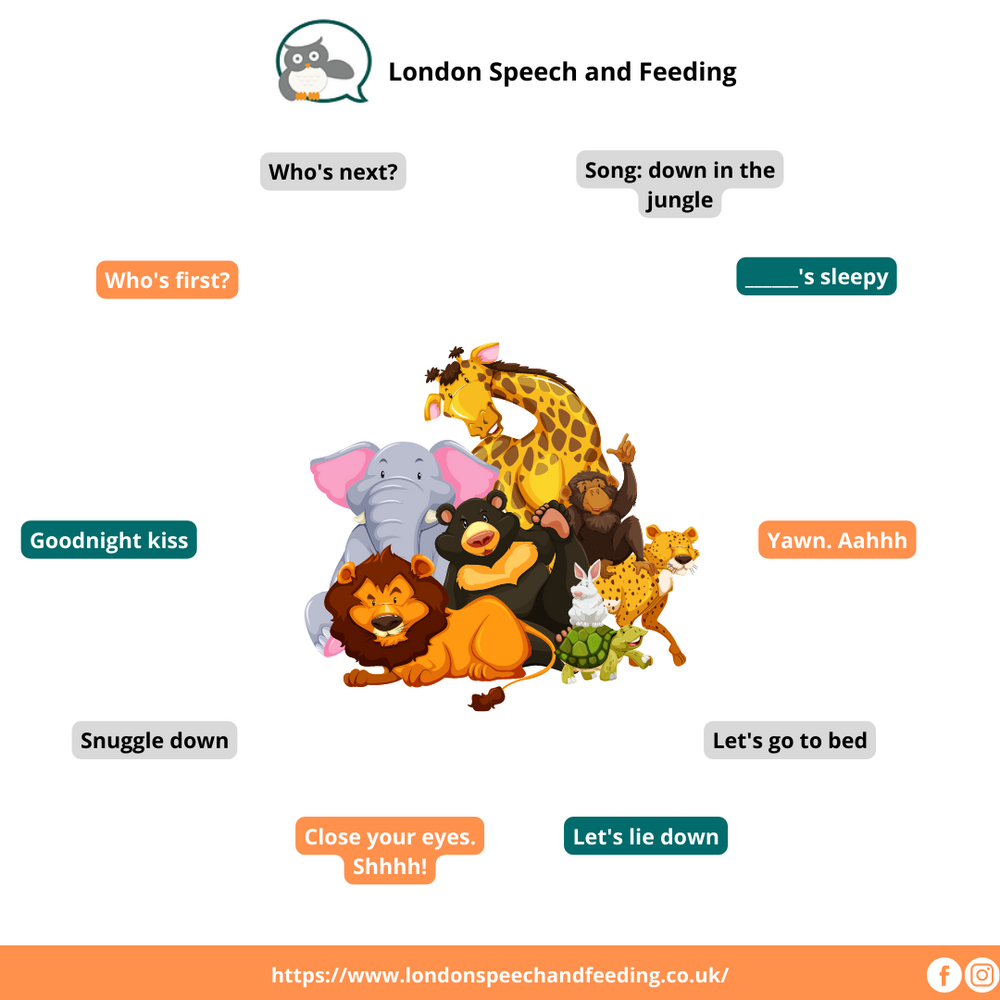
      In general for NLA 1 (Natural Language Acquisition stage 1) we want to use short phrases and keep them quite generic, something like:

      ‘Let’s go’ or ‘let’s play’ and pick 2-3 phrases per communicative function (see next point below).

      And if we are going to say longer sentences, for example: ‘let’s go and feed the ducks now’, then we should do so with good grammar and really varied intonation. It sometimes helps me to make up a little song/jingle on the spot that has a lot of intonation, more than I would perhaps use just by speaking.

      How many varied communicative functions do we cover with our modelling?

      We want to model a variety of Gestalts other than just requesting for example. In general, we are looking at our child having one or two Gestalts in the following areas before they are ready to move on into stage 2.

      These are the most common ones I see in my practice:

      • Requesting ‘want a banana/biscuit’ ‘Wanna play ball’
      • Transitioning: ‘what now?’ ‘what next?’
      • Ask for help: ‘need help’ ‘help me’ ‘mummy help’
      • Commenting: ‘it’s big’ ‘it’s red’ ‘it’s fast’ ‘too loud’
      • Speak up for self: ‘not that one’ ‘go now’ ‘stop it’

      Is the Gestalt I am modelling meaningful to my child?

      We don’t use all available Gestalts for every child. It has to be meaningful to the individual and has to match their interests. If our child is a big fan of feeding the ducks in the park then we can think about Gestalts like:

      • I see ducks!
      • They’re over there
      • Let’s feed them?
      • Let’s get some seeds
      • They’re coming!
      • They want food / They wanna eat!
      • That’s a big one
      • It’s so hungry
      • It loves the seeds!
      • No more! All done! Finished! Let’s go home

      What is my child actually trying to tell me?

      We have to be become word/phrase detectives! Is the phrase/script/Gestalt they are using right now actually meaning what they said or does it mean something else, and if so, what?

      Here is an example from my own personal experience in my practice:

      The little boy I was working/playing with was building a tall tower with blocks. When it finally fell with a great big bang he said in a sing-song voice ‘ring-a-ring-a roses’ … then he began to collect the blocks again to make a fresh tower. I sat there and thought: why ‘ring-a-ring-a roses’? What does that mean in this context? I then sang the song (silently) to myself with my detective hat on and realised as I came to the end that it finishes with ‘we all fall down’! it was a real AHA!!! moment for me as I saw right there what the meaning of his Gestalt was. He sang the first line of the song to say ‘all fall down!’

      So realising this I waited for the next tower to fall, and there it was again, he sang the first line of the song. I replied thus, copying him at first:

      ‘RING-A-RING-A ROSES – WE ALL FALL DOWN!…

      FALL DOWN

      WE LOVE IT FALLING DOWN.’

      The process to find what we should say is not always straight forward or easy at all, and often we don’t quite know in the moment what our child is trying to say. But we can try and get to know their interests and then gradually we do know more and more what the meaning behind the Gestalt is or could be.

      What pronouns should we use?

      This can be a tricky one.

      We don’t want to use language that uses the pronouns ‘you’ or ‘you’re’. The reason is that our child will likely copy us exactly as we have said it. Therefore, using pronouns ‘you’ and ‘you’re’ will then sound wrong.

      Always try to model language that is from the child’s perspective or in other words how they would say it if they could.

      Alternatively, you can model using WE or US. For example, if the child is tired, rather than saying ‘you are so tired’ model language from his or her point of view: ‘I’m tired’ or ‘let’s go have a lie down’.

      There is so much more to talk about. Stay tuned for a blog on NLA stage 2 coming soon.

      If you need help with your child, please do not hesitate to contact me.


      Find a speech and language therapist for your child in London. Are you concerned about your child’s speech, feeding or communication skills and don’t know where to turn? Please contact me and we can discuss how I can help you or visit my services page.
      0
    • · ·

      Baby-led weaning: Empowering little eaters from the start

      I had a mum ask me about Baby Led Weaning the other day. So I thought I would write a blog on all the useful questions she had and what we discussed as it may help lots of mums and dads out there.

      As a Paediatric Feeding SLT, one of the exciting developments in recent years is the growing interest in baby-led weaning (BLW). This approach to introducing solids has gained significant traction, and for good reason. It empowers infants to take the lead in their feeding journey, fostering a positive relationship with food and supporting important developmental milestones.

      What exactly is baby-led weaning?

      At its core, baby-led weaning is about offering your baby appropriately sized and textured solid foods from the very beginning, allowing him or her to self-feed. Instead of spoon-feeding purées, you present whole, soft foods that your baby can grasp, bring to his or her mouth, and explore at his or her own pace. This means no mashing, no blending, and no forcing spoons into reluctant mouths. It’s a fun, messy, and intuitive process that is led by your baby’s natural instincts.

      The genesis of baby-led weaning

      ‘Baby-led weaning’ was popularised by British health visitor Gill Rapley. In the early 2000s, Rapley observed that babies naturally develop the skills needed to self-feed and that traditional spoon-feeding might actually hinder this development. Her work, particularly her book Baby-Led Weaning: The Essential Guide to Introducing Solid Foods (co-authored with Tracey Murkett), published in 2008, brought BLW into the mainstream and provided a structured framework for parents. Her research and observations highlighted the benefits of trusting a baby’s innate ability to regulate his or her intake and explore different textures.

      What’s the deal?

      Implementing BLW is simpler than you might think, though it does require a shift in mindset. Here’s a breakdown of what it typically involves:

      • Readiness is key: The golden rule of BLW is to wait until your baby shows clear signs of readiness. This isn’t about age alone, but rather developmental milestones. Your baby should be at least six months old, able to sit unassisted, have good head and neck control, show an interest in food (e.g., reaching for yours), and have lost his or her tongue-thrust reflex (which pushes solids out of his or her mouth).
      • Offer finger foods: Start with soft, easily graspable foods cut into finger-sized sticks or spears. Think cooked sweet potato fries, steamed broccoli florets (soft enough to mash with gentle pressure), banana sticks, or avocado slices. The goal is for babies to be able to pick it up and get some into their mouth.
      • Embrace the mess: BLW is inherently messy, especially in the beginning. Food will be squished, dropped, and smeared. This is a crucial part of the learning process as babies explore textures, smells, and the properties of food. A wipeable mat under the highchair and a good bib are your best friends!
      • Observe, don’t interfere: Allow your baby to lead. He or she will decide what to eat, how much, and how quickly. Avoid putting food into his or her mouth or pressuring him or her to eat more. This respects his or her hunger and fullness cues, laying the foundation for healthy eating habits.
      • Continue breastmilk or formula: Until your baby is well-established on solids, breastmilk or formula remains his or her primary source of nutrition. Solids are for exploration, taste, and developing skills, gradually increasing in quantity over time.

      The benefits of baby-led weaning

      The advantages of BLW extend far beyond simply getting food into your baby. From a speech and feeding perspective, the benefits are compelling:

      • Develops oral motor skills: Chewing, gnawing, and manipulating various food textures are crucial for developing the muscles in the mouth, jaw, and tongue. This strengthens the oral motor skills necessary for speech development.
      • Enhances fine motor skills and hand-eye coordination: The act of grasping food, bringing it to the mouth, and coordinating these movements significantly refines fine motor skills and hand-eye coordination.
      • Promotes self-regulation and intuitive eating: By allowing babies to control their intake, BLW helps them tune into their own hunger and fullness cues, fostering a healthy relationship with food and reducing the likelihood of overeating.
      • Encourages adventurous eating: Exposure to a wide variety of tastes and textures from the outset can lead to less picky eating later. Babies are more likely to accept new foods when they have been in control of their exploration.
      • Facilitates family mealtimes: BLW integrates babies into family mealtimes from an early age, promoting social interaction and making mealtime a shared, enjoyable experience.

      When is baby-led weaning appropriate, and when not?

      While BLW offers numerous benefits, it’s not a one-size-fits-all approach.

      When BLW is appropriate:

      • When your baby meets all the developmental readiness signs: This is paramount for safety and success.
      • When you are comfortable with the mess and the learning curve: It requires patience and a relaxed attitude.
      • When you are committed to offering a variety of safe, appropriate foods.
      • When you are willing to learn about and practise safe food preparation to minimise choking hazards.

      When BLW might not be appropriate (or requires extra caution and professional guidance):

      • If your baby has a history of prematurity or significant developmental delays: His or her oral motor skills might not be sufficiently developed.
      • If your baby has certain medical conditions or anatomical differences (e.g., cleft palate, severe reflux, swallowing difficulties): These may necessitate a modified approach to feeding.
      • If there are significant feeding difficulties, aversion, or a history of choking incidents.
      • If you feel overly anxious about choking: While BLW, when done correctly, is not associated with a higher choking risk than traditional weaning, parental anxiety can impact the feeding experience. Education and consultation with a professional can help alleviate these concerns.

      A note on safety: Choking hazards

      It’s crucial to understand the difference between gagging and choking. Gagging is a natural reflex that helps prevent choking and is very common in BLW as babies learn to manage food in their mouths. Choking is silent and serious. To minimise choking risks:

      • Always supervise your baby closely during mealtimes.
      • Offer appropriately sized and textured foods. Avoid small, round, hard foods like whole grapes, nuts, popcorn, and large chunks of meat.
      • Ensure your baby is sitting upright and calm.
      • Educate yourself on infant CPR.

      Final thoughts

      Baby-led weaning is a wonderfully empowering approach that celebrates a baby’s natural abilities and fosters a positive and independent relationship with food. As Speech and Language Therapists we often see the positive impact it has on oral motor development, self-regulation, and overall feeding confidence. By understanding what it entails, when it’s appropriate, and prioritising safety, you can embark on this exciting journey with your little one, helping him or her become a confident and capable eater from the very first bite.

      If you would like help and support with weaning your baby whilst continuing to breastfeed then please get in touch!

      Sonja McGeachie

      Highly Specialist Speech and Language Therapist

      Owner of The London Speech and Feeding Practice.


      Health Professions Council registered
      Royal College of Speech & Language Therapists Member
      Member of ASLTIP

      Find a speech and language therapist for your child in London. Are you concerned about your child’s speech, feeding or communication skills and don’t know where to turn? Please contact me and we can discuss how I can help you or visit my services page.

      1