That adorable string of ‘ba-ba-ga-ga-ma-ma’ might sound like baby gibberish, but it’s actually a crucial milestone in your little one’s language development. Babbling or babble, as we call it, is far more than just cute baby noises. It’s a sequence of sounds that lays the foundation for future communication.
Image by freepik
What is babbling?
Babbling typically begins around six months of age, though the timing can vary slightly from baby to baby. It involves your baby experimenting with different sounds, stringing together consonants and vowels. You might hear them repeating sounds like:
‘Ba-ba’
‘Da-da’
‘Ma-ma’
‘Ga-ga’
As they progress, the babbling becomes more complex, with variations in pitch, rhythm, and intonation. It might even sound like they’re having a conversation with you!
Why is babbling so important?
Laying the groundwork for speech: Babbling is like a vocal workout for your baby. By practising these sounds, they’re strengthening the muscles in their mouth, tongue, and vocal cords that are essential for speech.
Developing phonological skills: Through babbling, babies begin to understand the sound patterns of their native language. They’re learning which sounds go together and how they’re used.
Enhancing social interaction: Babbling is a social activity. Babies often babble back and forth with their caregivers, which helps them learn about the give-and-take of communication.
Cognitive development: The act of babbling requires babies to use their brains in new ways. They’re learning to control their vocalisations, pay attention to the sounds they’re making, and connect those sounds to the responses they receive from others.
How can you encourage babbling?
Talk to your baby: Even though they can’t understand your words yet, talking to your baby exposes them to language and encourages them to respond with their own vocalisations.
Imitate their sounds: When your baby babbles, imitate them! This shows them that you’re paying attention and encourages them to keep ‘talking.’
Respond to their babbling: Treat your baby’s babbling as if it’s a real conversation. Respond with words, smiles, and gestures.
Play sound games: Make different sounds for your baby and encourage them to imitate you. This could include animal sounds, silly noises, or simple words.
Read to your baby: Even before they can understand the words, reading to your baby exposes them to the rhythm and sounds of language.
Sing songs: Singing is a fun and engaging way to introduce your baby to new sounds and words.
Use mirrors: Babies often enjoy watching themselves make sounds in a mirror.
Tactile stimulation: Gentle massage around the mouth and face can increase oral awareness and encourage vocalisations.
Vary textures: Offer different textured teethers.
Read books with sound effects: Choose books with animal sounds or other engaging noises.
Blow bubbles: The act of blowing and popping bubbles can encourage vocalisations.
Use visual aids: Show pictures of objects and say their names, emphasising the consonant sounds.
Use exaggerated facial expressions: When you make sounds, exaggerate your mouth movements to help your baby see how sounds are made.
Increase joint attention: Follow the child’s gaze and point to objects that they are looking at and say the name of the object.
When to seek help
If you notice that your baby is not babbling by eight months, it’s a good idea to talk to your speech and language therapist. You might also notice a lack of variation in tone when your child is making sounds, is your baby sounding a little ‘flat’ or monotonous? While every child develops at their own pace, a lack of babbling can sometimes indicate a developmental delay or hearing issue.
Remember, babbling is a gift. So, enjoy those precious moments of ‘baby talk’ and take comfort in knowing that your little one is on the path to becoming a chatterbox!
Do get in touch via my contact form if you are concerned about your child’s development or if you simply want some reassurance that your baby is developing well. We will be delighted to arrange a screening appointment for you and give you support and reassurance.
Sonja McGeachie
Highly Specialist Speech and Language Therapist
Owner of The London Speech and Feeding Practice.
Find a speech and language therapist for your child in London. Are you concerned about your child’s speech, feeding or communication skills and don’t know where to turn? Please contact me and we can discuss how I can help you or visit my services page.
What is Speech and Language Therapy (SLT) and what does a Speech Therapist do?
Speech and language therapists provide treatment, support and care for children and adults who have difficulties with communication, eating, drinking and swallowing. We help children and adults who have problems speaking and communicating.
How to find the perfect therapist for my child/client:
There are a huge number of speech and language difficulties, or feeding and swallowing problems that we can help with and the first thing to think about is what age group the person is you are seeking help for. Most SLT’s specialise in a range of disorders and treatments and they often treat specific age ranges. This could be, for instance, very young children up to 3 years, or school aged children, adolescents or just adults. Once you have narrowed it down to age and general area of difficulty you can then go and seek your perfect SLT match.
Generally it is my view that SLT’s with a narrow area of specialist interest are most likely to help you better if the problem you or your child/adult is having is significant and/or profound. For example, if your child has a very severe stutter/stammer but is otherwise developing fine and has good skills all round, then I would recommend to look for an SLT who only specialises in stammering/stuttering, or has only a small range of other specialist areas related to stammering , such as speech and language delay.
The reason is that it is a tall order for any professional to stay up to date with latest research, latest clinical developments and training for more than, say, five distinct areas of interest.
However, a more generalist Speech therapist who has lots of experience in many different areas could be a very good option for your child or adult who has more general speech and language delay in a number of areas, perhaps a global delay or a syndrome which means that their learning is delayed in general. It also means that your child might benefit from a Generalist SLT because they have many more tools in their SLT bag and your child might need a variety of approaches for several areas.
A good place to start is www.asltip.com which is the Association for Independent Speech and Language Therapists in the UK. Any SLT registered with ASLTIP will also be registered with the HCPC (Health Care Professionals Council), as well as RCSLT (Royal College of Speech and Language Therapists). These two important UK professional regulatory bodies ensure all its members are fully qualified, and are fully up to date with latest developments within their areas of work.
Here you can enter your post code and look for a therapist near you and you can look for specific problems such as stammering for example and narrow down your search. Most therapists have a website which you can then access too. I would recommend you speak to a few therapists on your list and then go with the person you had the best rapport with. You and the therapist will be spending a lot of time together and you will need to feel that you trust them and that you can relax into the process.
How I can help you:
I have 3 main areas of specialism:
Parent Child Interaction Coaching
This is an amazing way to help children with the following difficulties:
Social Communication Difficulties, Autistic Spectrum Disordersand
Speech and Language Delay – for children under the age of 4 years old, this is my preferred way of working because it is so very effective and proven to work. If your child is not developing words or not interacting, has reduced attention and listening and you feel is not progressing or, in fact even regressing, then this way of working is the best. For anyone wanting to read a bit more about the efficacy of this method, below are some research articles. You may also like to check out www.hanen.org which is the mainstay of my work and method when it comes to Parent-Interaction Coaching. You can also look at my latest blog, entitled: Tele-therapy, does it work?
In brief, what’s so great about Parent Coaching is that it empowers you the parent to help your child in daily life! This is where speech, language and social communication develop typically, in a naturalistic way and environment. Simple steps and strategies are discussed and demonstrated every week and you are encouraged to use these strategies with your child in daily routines: getting dressed, having breakfast, on the school run, whilst out in the park or shopping or simply playing at home or having dinner or bath time. Whatever your family routine happens to be, every strategy I teach you will help create a responsive communication environment; generally, if your child is able to develop speech then they will do so in direct response to your changed interaction style.
Speech Sound Disorders, Verbal Dyspraxia, Phonology and Articulation
I love working with children of all ages on developing their speech sounds. Whether your child has a lisp, or a couple of tricky sounds they simply cannot produce quite right, or perhaps your child is really unintelligible because he/she is having lots of different sound errors, making it really hard to understand them. I typically work on getting “most bang for your buck” , meaning I address the sounds that cause the most problems and, therefore, when they are fixed your child/person’s speech becomes that much clearer fairly quickly.
Feeding and Swallowing Difficulties
Having worked for over 20 years in NHS Child Development Clinics and Special Needs Schools I trained and worked with feeding and swallowing difficulties early on in my SLT career. I later trained as a Lactation Consultant and so I am well placed helping and support all types of Infant feeding, both breast or bottle, as well as toddler weaning. I aim to ensure that your little one swallows the right kind of foods and drinks for their abilities. I am experienced in managing and supporting children with physical needs and mobility problems, Cerebral Palsy, Down Syndrome or any other type of syndrome or presentation.
What does a speech therapy session look like?
All sessions differ slightly depending on the age of the child and the nature of the difficulties.
However, mostly our sessions look like FUN! After arrival and washing hands we tend to start off with the tricky work straight away whilst our child still has energy and the will to engage. So, for speech work we will focus on the target sounds first: this could be sitting at a table doing work sheets together, playing games using the target sound and really any type of activity that gives us around 70-100 repeats of the target pattern. For example, a child who is working towards saying a ‘K’ at the end of the word I will try and get around 100 productions of words like: pack/sack/lick/ pick/bike/lake and so on.
Then we often play a fun game where I might try for a ‘rhyming’ activity or other sound awareness type activities, for perhaps 10 minutes and within that time I aim to trial the next sound pattern we need to improve on; I will test which sound your child can do with help from me. During he last 10 minutes we might look at a book, again listening to and producing whatever sound we are working on. If I did not get 100 sounds earlier on in the session I will try and practice them now as part of the story. In total I aim to have about 40-45 minutes of activities, all aimed at the target sound we are working on.
What does a Coaching session look like?
During a Parent Coaching Session we meet online for about an hour and we discuss how the week has been for you trying out the strategies. Typically parents start off recalling what went well, what progress was made and what had been more tricky. We work through it all, and then follow on to the next strategies: I will show you examples and demonstrations of each strategy and I will get you to think about how you can use this with your child and in what situation you might use it. I will explain what we are doing and what the purpose is. You might want to write down what you are going to work on for the week. Over the course of about sessions we can cover all the major strategies that are proven to help kickstart spoken language and/or help your child to connect more with you. Through that connection spoken words most often develop.
Research Papers on the Efficacy of Parent Child Interaction Coaching
The It Takes Two to Talk Program has been shown to be effective in changing how parents interact with their children, and that children’s communication and language skills improve as a result.
Baumwell, L.B., Tamis-LeMonda, C.S. & Bornstein, M.H. (1997). Maternal verbal sensitivity and child language comprehension. Infant Behavior and Development, 20(2), 247-258.
Beckwith, L. & Cohen, S.E. (1989). Maternal responsiveness with preterm infants and later competency. In M.H. Bornstein (Ed.). Maternal responsiveness: Characteristics and consequences: New directions for child development (pp. 75-87). San Francisco: Jossey Bass.
Bronfenbrenner, U. (1974). Is early intervention effective? (Publication No. (CDH) 74-25). Washington, DC: Department of Health, Education, and Welfare, Office of Child Development.
Girolametto, L. (1988). Improving the social-conversational skills of developmentally delayed children: An intervention study. Journal of Speech and Hearing Disorders, 53, 156-167.
Sonja has been a real help for my 5 year old daughter. Due to her support, my daughter is now able to clearly and correctly enunciate ‘th’ ‘f’ and ’s’. She was also helpful in making positional changes to her seating to help her concentrate better and kept her engaged throughout all the lessons which is a feat in itself on zoom!
Helen, Mother of Catherine Age 5.
Find a speech and language therapist for your child in London. Are you concerned about your child’s speech, feeding or communication skills and don’t know where to turn? Please contact me and we can discuss how I can help you or visit my services page.
There are different types of LISPS. Let me explain:
A lisp is the difficulty making a clear ‘S’ and ‘Z’. Other sounds can also be affected by the tongue protruding too far forward and touching the upper teeth or the upper lip even. ‘T’ and ‘D’ can be produced with ‘too much tongue at the front’ and this can also have an impact on ‘CH’ and often also ‘SH’.
Interdental lisp
Protruding the tongue between the front teeth while attempting ‘S’ or ‘Z’ is referred to as interdental lisp; it can make the speech sound ‘muffled’ or ‘hissy’. Often, we associate a lisp with the person sounding a bit immature. The good news is that this type of lisp is the easiest to correct and, in my practice. I have a 100% success rate with this type of lisp.
Lateral lisp
In a lateral lisp the person produces the ‘S’ and ‘Z’ sounds with the air escaping over the sides of the tongue. This renders the ‘S’ as sounding ‘slushy’ or ‘wet’. This type of lisp is a bit harder to correct than the interdental lisp. In my experience this can be fixed but it might need a bit longer, more intensive therapy than the interdental lisp.
Palatal lisp
With a palatal lisp the ‘S’ sound is attempted with the tongue touching the palate, much further back than it should be. The ‘S’ sounds ‘windy’ and ‘hissy’. This is a quite rare lisp production but it is also not difficult to correct.
These types of speech difficulties come under the category of ‘speech delay of unknown origin’ and may persist into adolescence and adulthood as ‘residual errors‘.
Some thoughts on Treatment in general:
Lisps can be treated successfully by a Speech and Language Therapist. However, for the treatment to work well, a student needs to be able to cooperate and want to improve his or her speech. Lisp remediation entails a fair amount of repetitive work and very young children or unmotivated older children don’t make the best candidates for treatment for this reason. Often students present with other speech, language or social communication difficulties and here the lisp might not be the priority for treating. For example, it might be that due to a student’s Attention Deficit Disorder they are simply not able to focus on speech practice in their daily life.
When should treatment of lisp begin?
Waiting well past 4½ years is not advisable as the longer we wait and do nothing the stronger engrained the erroneous tongue/speech habit will become. The ‘right’ age for therapy for one child may be different from the ‘right’ age for another child even within the same family. So do make an appointment with a speech and language therapist to assess and see whether your child might be ready to start therapy.
Do lots of children lisp—is it normal?
Until the age of about 4–4.5 years old it can be a perfectly normal developmental phase for some children to have the interdental lisp. But when we see and hear a lateral or palatal lisp we ought to act and see a speech and language therapist for sure.
After the age of 4.5 or 5 years old most speech therapists would agree on at least having a look to see if treatment could be started. The longer we wait the harder it is to retrain the brain pathways to adopt new speech habits.
What happens during the first Speech and Language Consultation?
The first consultation takes about an hour and involves screening relevant areas of communicative function. We take a detailed history, examine the anatomy of the child’s mouth and tongue movements. We check for tongue tie, teeth formation, palate structure and function, as well as swallowing patterns.
Then we begin straight away to try and see if any of the alveolar sounds (T/D/L/N) can be produced correctly with the right tongue placement as that would be the starting point from where to shape a good, clear ‘S’ sound.
The first consultation usually ends with home practice being given, explained to parents and another appointment being made for follow up.
Therapy – what does a session look like?
Each therapy session consists of:
Listening to sounds, discriminating sounds, identifying sounds, listening to rhyming sounds, sound awareness. We call this Auditory discrimination of single sounds: can the student hear the difference between two words that are the same apart from the first sound: ‘sing’ and ‘thing’ or ‘sigh’ and ‘thigh’?
Sound production: using a variety of different prompts and cues we will teach how to physically make the new sound. Often, we work on making a NEW sound, instead of correcting the OLD one. We work on imitation of single sounds then gradually we try and make new sounds in short words, then longer words and then phrases and sentences.
Games! We play games and try and have fun in between listening and producing our new sounds to help students stay motivated and even enjoy the therapy session and process.
How long does it take to ‘fix up’ a lisp?
It tends to take about one term with weekly sessions to help a student make good ‘S’ sounds in phrases and sentences. If the student can do the home practice every day in between the weekly sessions, then in most cases I am able to pronounce the lisp as ‘fixed’ after about one term.
After that the student needs to practise, practise, practise, at home and in daily life to keep reminding themselves of their new skills and their new sound production.
It is a matter of reminding and wanting to get it right. Occasionally a student returns to me for another term of simply practising their skills together with me as they are finding it hard for any number of reasons to practise at home. But generally, 8/10 students will be fine after some 12–13 sessions and their speech will be perceived as perfectly typical by family and friends.
Find a speech and language therapist for your child in London. Are you concerned about your child’s speech, feeding or communication skills and don’t know where to turn? Please contact me and we can discuss how I can help you or visit my services page.
This is a surprisingly common speech error and it can be corrected really well in my experience. I have helped lots of children of all ages learn how to control their tongue movements and produce clear, sharp /S/ sounds and good /SH/ sounds.
Initial consideration
There are some factors which need to be considered before we can dive into therapy proper and these are they, in a nutshell:
The student is not currently displaying negative oral habits such as thumb sucking or excessive sucking on clothing. This is because thumb sucking exerts pressure on the teeth and therefore can, over time, push teeth out of their natural order/position.
The student does not have a restricted lingual frenulum or tongue tie which can cause at times restricted movements of the tongue (pending on how tight the frenulum is attaching the tongue to the base of the oral cavity); equally a labial frenulum or lip-tie can restrict lip movement and therefore physically restrict good speech sound production.
The student does not have enlarged tonsils as they can sometimes push a tongue forward and also cause open mouth posture and open mouth breathing.
The student’s motivation to change their speech pattern is high. (this is an important factor though with younger students I can get round this with a lot of fun games and good parental involvement!)
When I do an Oral Assessment of my student these are the first factors I want to look at and consider. Often I will refer to other agencies such as Orthodontists, dentists or ENT specialists to advise and help with some of these factors before we can get going. However, there are strategies that we can work on almost straight away.
Most of my Lisp students present with an open mouth posture: that is where the student has their mouth always slightly open for breathing. Over time the tongue starts to fall forward and rests on the front teeth or the bottom lip instead of finding a comfortable resting place either at the alveolar ridge (the bumpy spot behind the upper front teeth) or, alternatively, resting at the bottom of the mouth behind the lower front teeth.
Another common problem is that the tongue is not moving independently from the jaw and so is reluctant to pull back or lift up inside the mouth as the tongue is guided in movement by the jaw.
Combine those two factors and your tongue is not pulling back, or lifting up or doing very much at all without the jaw moving as well. This makes for unclear speech sounds, especially all the sounds we make at the front with our tongue or with our lips: /B/ /P/ /L/ /N/ and of course /S/ and /SH/ are particularly hard to make. We often also struggle with the /Y/ sound so ‘LELLOW’ instead of ‘yellow’.
Do not fear!
But no fear, these problems can be treated over time for sure! We often start with lip, tongue, and jaw exercises that help to move the tongue independently from the Jaw, our student learns that the tongue is a muscle and can be trained to do amazing acrobatic things in the mouth! WOW! It can actually pull back, lift up, and come down again all on its own!
We work on breathing, holding our breath for a bit then pushing it out and then holding it again.
And when it comes to the actual /S/ sound I often try and go a NEW route bypassing the Snake-Sound route if that is what had previously been tried and failed so that we can create completely new sound patterns in our brain and think about our sounds in a completely new way.
We then work on producing the sound /S/ on its own for a bit, at the end of words, then on either side of complimentary sounds, for instance : ‘EASY” – the sound patterns here are EEE-S–EE : the /EEE/ sound is complimentary to the /S/ sound as the tongue is at the right hight for the /S/ already once you have it in place for /EEE/ -……see?! EASY!
And gradually we work towards saying the /S/ sound clearly at the front of short words, then phrases and then sentences.
The process takes some time and it depends on how ready the student is. This varies of course hugely so I can never promise the exact number of sessions we will take to get that Lisp fixed. A lot depends on home practice in between sessions, and this is of course crucial to all therapy! Every day 15-20 mins practice is a good average time to aim for and when this is done it shortens the therapy block drastically.
I always give plenty of home work so there is never a chance of it getting boring or there being “nothing to do”!
Do contact me. I really enjoy working with this type of student and get a great kick out of FIXING THAT LISP!
Find a speech and language therapist for your child in London. Are you concerned about your child’s speech, feeding or communication skills and don’t know where to turn? Please contact me and we can discuss how I can help you or visit my services page.
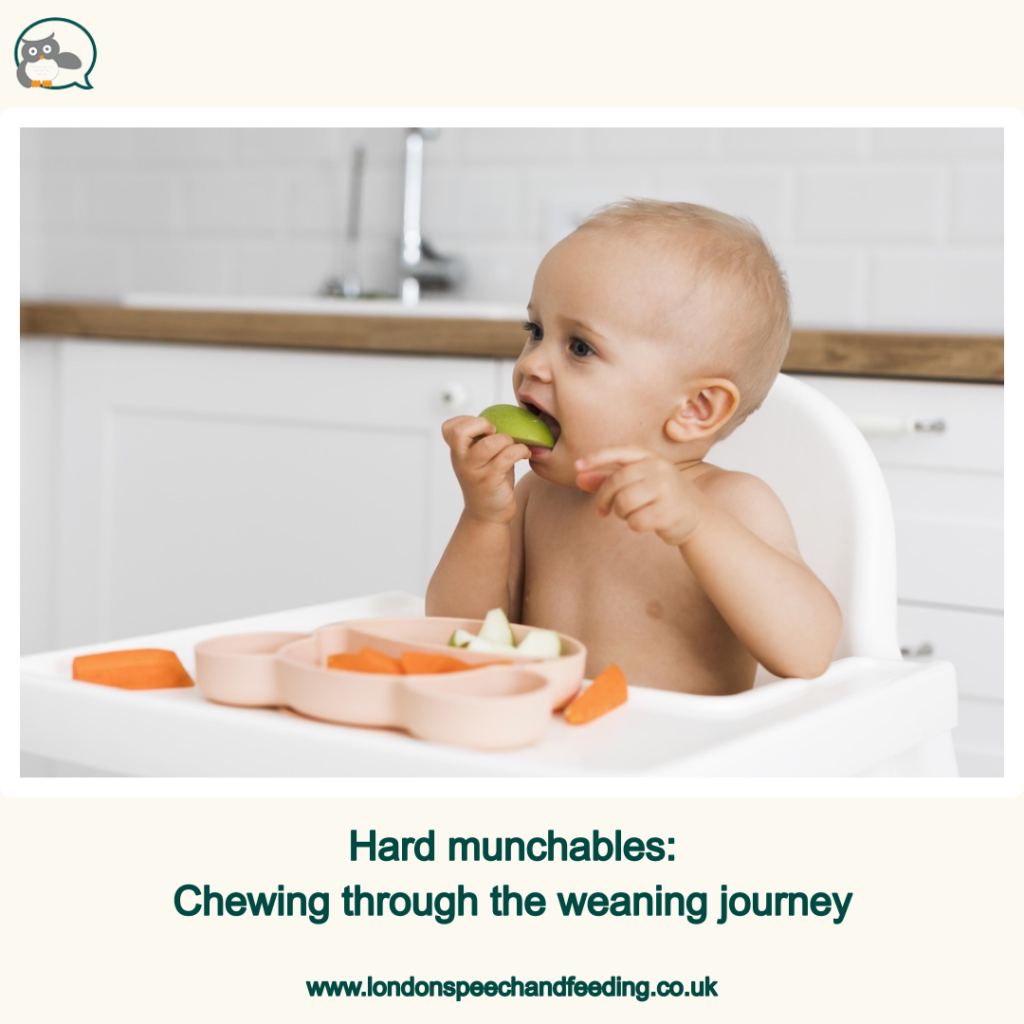
As a Speech and Language Therapist with a specialism in paediatric feeding, I’m constantly looking for ways to support families in developing their little ones’ oral motor skills and fostering a positive relationship with food. While Baby-Led Weaning (BLW) has revolutionised how many families introduce solids, (see my previous blog in July 25) a concept that often sparks discussion and curiosity is the use of ‘hard munchables.’
The term ‘hard munchables’ refers to specific types of firm non-digestible food items that are offered to babies for oral exploration and skill development, not for nutrition. These are typically foods that babies cannot bite off or swallow in large pieces due to their texture, but which provide resistance for chewing practice.
The phrase was coined by Marsha Dunn Klein, M.Ed., OTR/L, Occupational Therapist and feeding therapist. Well known for her work in paediatric feeding she introduced and advocated for the concept of hard munchables as part of a therapeutic feeding approach, particularly for infants learning to manage textures and develop crucial oral motor skills.
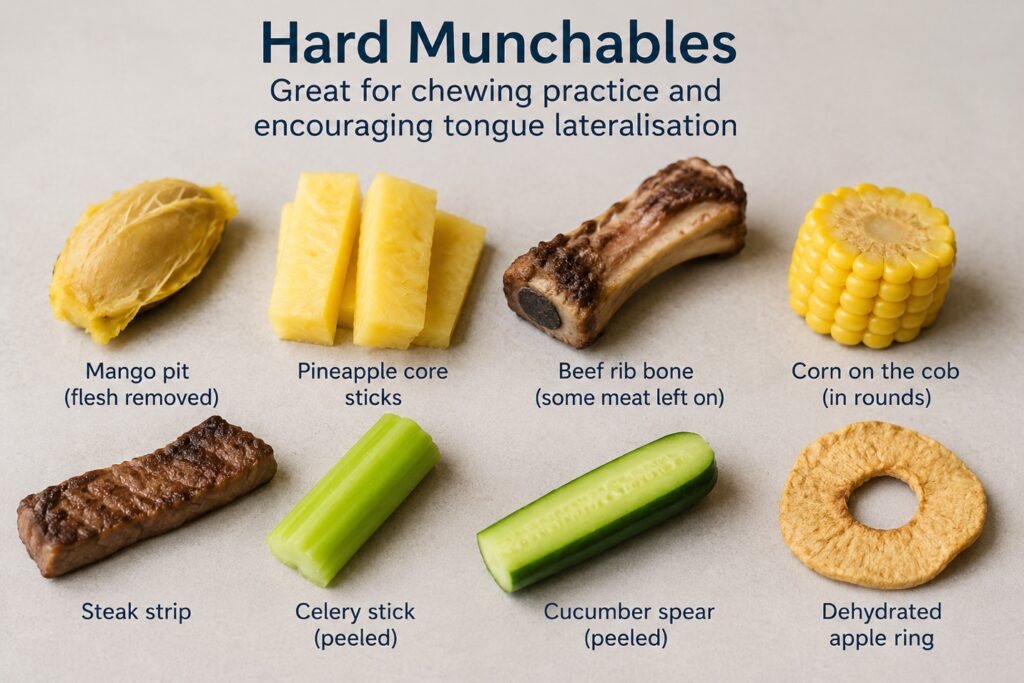
Common examples of hard munchables include:
Large, raw carrot sticks: Too hard to bite through, but great for gnawing.
Celery sticks: Like carrots, offering firm resistance.
Large, raw apple slices (peeled chunks): A firm, slightly sweet option.
A firm, uncut pear core: With the seeds removed.
Dried mango cheeks (hard, unsweetened varieties): These offer a fibrous texture.
A large, fully cooked but firm piece of meat (like a steak bone with some meat attached): The meat provides flavour and a bit of shreddable texture, while the bone is for gnawing.
Hard crusts of bread or breadsticks (very firm, without soft inner crumb): These can soften slightly with saliva but offer significant resistance.
Image by Freepik
It’s crucial to emphasise that hard munchables are not for consumption or nutrition. They are tools for oral motor development and should always be offered under strict, active supervision.
How do hard munchables fit into weaning?
While weaning (traditional or Baby-Led Weaning) introduces solid foods that a baby can eventually bite and swallow, hard munchables are complementary to the weaning phase. They enhance that phase by helping a child to develop hand dexterity, hand to mouth movement, and oral development.
It’s important to differentiate: Weaning provides the digestible food for eating, while hard munchables provide the tool for skill practice. They are not substitutes for each other but can be used together under careful guidance.
Pros and cons from a speech therapy perspective
As an SLT, I see both the potential benefits and the necessary precautions when incorporating hard munchables.
Pros:
Enhanced oral motor development: Hard munchables provide excellent resistance training for the jaw, helping to develop the strength, endurance, and coordination needed for efficient chewing. This is foundational for moving beyond purées and very soft textures.
Promotes lateralisation of the tongue: The act of moving the hard item from side to side in the mouth encourages the tongue to move independently of the jaw, a crucial skill for managing food and for speech sound production.
Preparation for more complex textures: By strengthening the oral musculature and refining chewing patterns, hard munchables can help babies transition more smoothly to lumpy and mixed textures.
Sensory exploration: They offer rich sensory input (tactile, proprioceptive) that can be beneficial for oral mapping and awareness, especially for babies who might be orally sensitive.
Cons:
Choking risk: While the intention is for the baby not to bite off pieces, there is always a risk. Small pieces can break off, or a baby might accidentally bite off a larger chunk than he or she can manage. Active, vigilant supervision is non-negotiable.
Not a replacement for digestible solids: It’s vital to remember that hard munchables are for practice, not nutrition. They should complement, not replace, the introduction of varied, digestible solid foods.
Not suitable for all babies: Babies with certain developmental delays, oral motor deficits, or medical conditions might not be appropriate candidates for hard munchables without highly specialised guidance. For instance, babies with an exaggerated gag reflex might find them overwhelming.
Key Considerations for Parents
Here are my top recommendations:
Consult with a professional: Always discuss this with your Paediatric Feeding SLT first before you introduce hard munchables. We can assess your baby’s individual readiness and guide you on safe practices.
Strict supervision: Never leave your baby unsupervised with a hard munchable, even for a second. Your full attention is required.
Appropriate size: Ensure the item is large enough that the baby cannot fit the whole thing in their mouth. It should extend well beyond their fist.
No biting off: The goal is gnawing and scraping, not biting off pieces. If your baby is consistently breaking off chunks, stop using them.
Focus on skill, not consumption: Reiterate to yourself that this is for practice, not for eating.
In conclusion, hard munchables, when used appropriately and under guidance, can be a very valuable tool to support oral motor development during the weaning journey. However, always be safe and consult with a specialist to ensure your little one develops his or her feeding skills effectively and joyfully.
Sonja McGeachie
Highly Specialist Speech and Language Therapist
Owner of The London Speech and Feeding Practice.
Find a speech and language therapist for your child in London. Are you concerned about your child’s speech, feeding or communication skills and don’t know where to turn? Please contact me and we can discuss how I can help you or visit my services page.
Does your child struggle to focus on toys or activities? Do they dart away as soon as you approach? You’re not alone!
The key to unlocking your child’s potential lies in following their lead. Let them guide the play session, and watch their engagement and focus soar.
Why Child-Led Play Works:
Empowerment: Children feel in control, sparking their curiosity and motivation.
Focused attention: They’ll stay engaged with activities for longer periods.
Reduced frustration: By stepping back and observing, you eliminate the pressure and stress that often comes with directed play.
How to Implement Child-Led Play:
Prepare the environment: Set out a limited selection of engaging toys.
Observe and wait: Sit back, watch, and listen to your child’s interests.
Embrace the moment: Resist the urge to direct or question; simply enjoy the process.
Remember: This simple approach can transform playtime and support your child’s development. Give it a try for a week and see the difference!
#OWLing #hanenmorethanwords
Observe, Wait, Listen. It’s a powerful formula for unlocking your child’s potential.
You will likely see:
Your child will stay put with any toy for longer whilst you are near them.
Your child will tolerate you being nearby and he/she won’t move away.
Your child will start giving you brief glances of enjoyment, or perhaps they will hand things to you, or they might take your hand and lead it to something that needs opening etc.
In other words, you will see that there suddenly is JOINT PLAY. Yes, granted it may not be according to your adult agenda, but there will be more togetherness than there was before. And this is the START of communication and social engagement.
USE Core words and a coreboard — to help your child understand the power of words
Core words are the building blocks of communication. Try using a coreboard like the one below, they are versatile and can be used in countless ways. By modelling these words naturally during play, you expose your child to their meaning and function in context. This approach is far more effective than isolated drill and practice, more powerful than flashcards!
Combining child-led play and AAC modelling creates a magic effect. To summarise:
Increased engagement: When you follow your child’s lead, they are more likely to be engaged and receptive to learning. This creates optimal conditions for introducing AAC core words.
Natural learning: By modelling AAC core words in the context of play, you help your child understand their meaning and purpose naturally. This fosters generalisation and spontaneous use.
Building relationships: Shared play experiences strengthen the bond between you and your child. This trust and connection are essential for successful communication.
Reduced pressure: Modelling AAC core words without expectation removes the pressure to produce language. This allows your child to explore communication at their own pace.
Expanded vocabulary: As your child becomes more comfortable with AAC, they will begin to incorporate core words into their own communication. This leads to vocabulary growth and increased independence.
Practical Tips
Observe and respond: Pay close attention to your child’s interests and actions. Respond to their cues with enthusiasm and support.
Keep it simple: Start with a few core words and gradually introduce new ones as your child’s skills develop.
Be patient: Language learning takes time. Celebrate small successes and avoid frustration.
Have fun: Remember, play is supposed to be enjoyable for both you and your child. Relax and have fun together!
Let’s say your child is playing with a pop-up toy like you see me do in the above photograph. Here, I followed my child’s lead by waiting to see what she wanted to do with the toy. You are now OWLING! (Observe Wait and Listen)
Once I noticed that there was repetitive opening of the flaps going on I then pointed to OPEN and MORE on the board, as I said: ‘let’s OPEN this one’ / let’s see MORE animals’ / ‘MORE cow! it says moo!’ ‘OPEN another one’ and so on.
Important to know, we are not expecting our child to respond verbally or with AAC, but we are providing language input and demonstrating how these words can be used with enthusiasm.
Naturally in time your child will look at the board and at your pointing and they will eventually want to copy you!
By incorporating these strategies into your daily interactions, you can create a supportive environment that fosters language development and communication growth. If you would like more guidance please get in touch and book in for a consultation, some individual therapy and/ or some parent coaching.
I look forward to supporting you. Please contact me and let’s see how.
Sonja McGeachie
Early Intervention Speech and Language Therapist
Feeding and Dysphagia (Swallowing) Specialist The London Speech and Feeding Practice
The London Speech and Feeding Practice
Find a speech and language therapist for your child in London. Are you concerned about your child’s speech, feeding or communication skills and don’t know where to turn? Please contact me and we can discuss how I can help you or visit my services page.
Angelman Syndrome (AS) is a complex neurological disorder that affects development. It’s caused by a missing or functionally incorrect gene (UBE3A) on chromosome 15. While AS is rare, understanding its characteristics is crucial for parents and caregivers.
What are the key characteristics of Angelman Syndrome?
Children with AS typically exhibit a range of unique characteristics, which can include:
Developmental delay: Significant delays in reaching developmental milestones, such as sitting, crawling, and walking.
Speech impairment: Limited or absent speech. Individuals with AS may use few or no words.
Movement and balance issues: Difficulties with coordination, balance, and movement, sometimes causing a jerky or unsteady gait.
Happy demeanour: Frequent smiling, laughter, and a generally happy, excitable personality.
Intellectual disability: Varying degrees of intellectual disability.
Seizures: Seizures are common and often begin in early childhood.
Sleep difficulties: Disrupted sleep patterns and difficulty falling asleep.
The role of Speech and Language Therapy
Speech development and social communication is significantly affected in Angelman Syndrome, and therefore, Speech and Language Therapy plays a vital role in helping individuals with AS to communicate. As Speech and Language Therapists (SLT) we can work with the child and family support any of the following:
Assess communication skills: We evaluate the child’s current communication abilities, including any vocalisations, gestures, or signs they may use. With younger children we do this through play and playful social games as well as observation of a child playing and interacting with their siblings or caregivers.
Develop alternative communication strategies: Since spoken language may be limited, SLTs can help the child learn other ways to communicate, such as nonverbal communication, e.g
Gestures: use of pointing, waving and miming certain activities.
More formal sign language: Teaching basic signs to express needs and wants.
Core boards: Using pictures and symbols to represent everyday common words, actions, and feelings.
Augmentative and Alternative Communication (AAC) devices: Providing electronic devices that can produce speech.
Encourage vocalisations: When words don’t readily develop, SLTs can encourage the child to make vocalisations and sounds, as these can be a form of communication.
Support language development: SLTs can work on understanding of language, even if expressive language is limited.
Educate and support families: SLTs provide families with strategies and techniques to support their child’s communication at home.
The importance of a multidisciplinary approach
Caring for a child with Angelman Syndrome requires a team effort. A multidisciplinary approach, involving various healthcare professionals, is essential to address the diverse needs of the individual. This team may include:
Paediatrician: Provides overall medical care and monitors the child’s health.
Physiotherapist: Helps with movement, balance, and coordination.
Occupational therapist: Works on daily living skills, such as feeding, dressing, and self-care.
Speech and Language Therapist: Addresses communication and language needs.
By working together, we can provide comprehensive care, address the unique challenges of Angelman Syndrome, and help the child reach their full potential.
Conclusion
Angelman Syndrome presents unique challenges and opportunities. With early diagnosis, appropriate interventions, and a strong multidisciplinary team, children with AS can make good progress and live fulfilling, joyful lives. As Speech Therapists we delight in supporting parents in their role in advocating for their child.
Find a speech and language therapist for your child in London. Are you concerned about your child’s speech, feeding or communication skills and don’t know where to turn? Please contact me and we can discuss how I can help you or visit my services page.