Dynamic assessment – Let’s look beyond the checklist

|
Dynamic assessment – Let’s look beyond the checklist
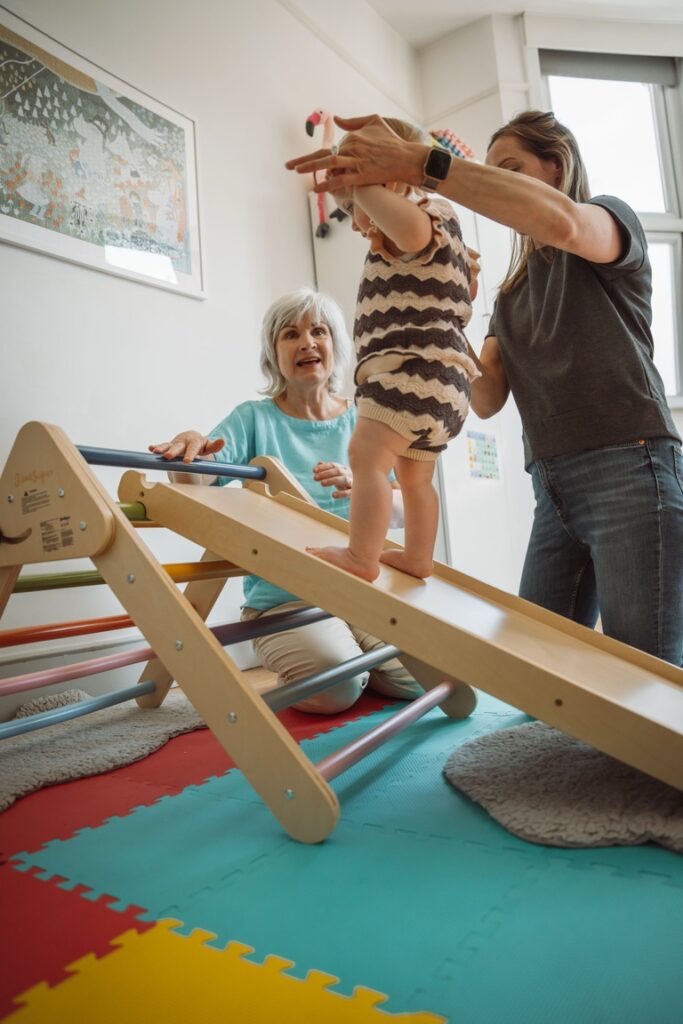
As a parent, you’re always observing your child, celebrating his or her milestones, and sometimes, wondering if he or she is quite on track. When it comes to speech, language, play, attention, and listening, these early years are a whirlwind of development! It’s natural to seek guidance if you have concerns, and that’s where a truly comprehensive assessment comes in.

But what exactly does ‘comprehensive’ mean, especially when it goes beyond a typical checklist? You can find any number of check lists online these days but whilst they can give you an overall idea of what a child is typically expected to do at any given age, it can also start leading you into a rabbit hole of anxiety of ‘what-iffery’.

At The London Speech and Feeding Practice I believe in something far more insightful than a static evaluation: Dynamic Assessment. Think of it as an in-depth, interactive investigation into your child’s unique communication landscape, exploring not just what he or she can do, but how he or she learns and why he or she might be facing challenges. This is so important.

What makes an assessment ‘dynamic’?

Imagine trying to understand a child’s personality by just looking at a single photograph. It gives you a glimpse, but it hardly tells the whole story. Traditional, formal assessments, while valuable, can sometimes be like that photograph – a snapshot of skills at one specific moment.

Dynamic assessment, on the other hand, is a living, breathing process. It’s called ‘dynamic’ because:

  • It’s interactive and responsive: It adapts to your child’s needs in real-time. It’s not about sticking rigidly to a pre-set schedule of tests. Instead, it’s about observing, gently prompting, and providing support to see how your child responds and learns. This allows me to understand his or her learning potential, not just his or her current performance.
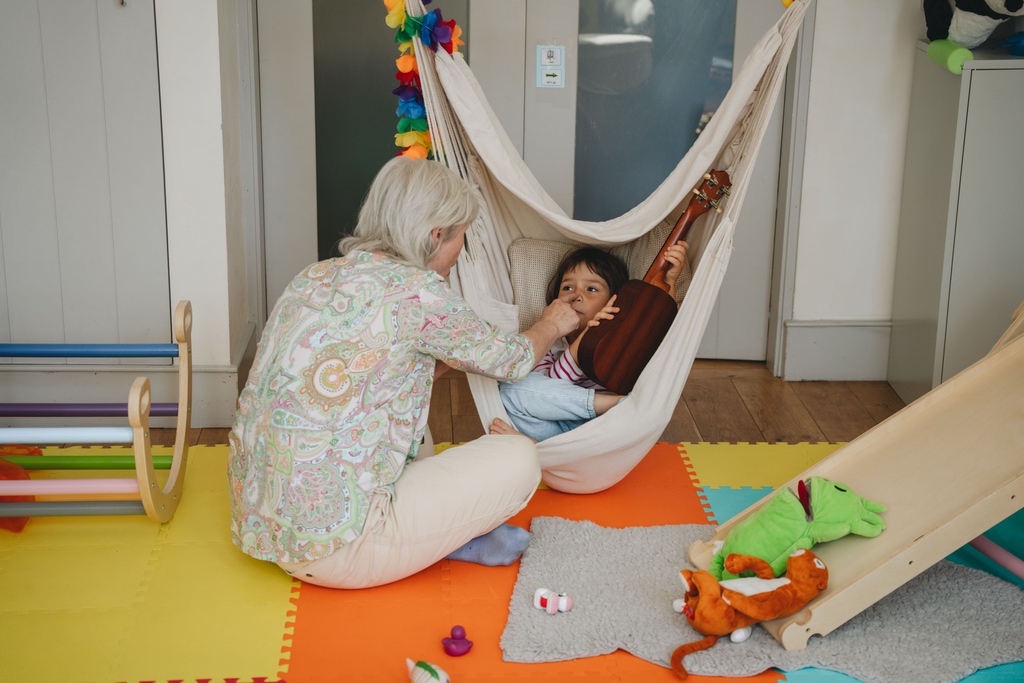
  • It’s holistic and multi-faceted: I look at the whole child. We delve deep into not just speech and language, but also his or her play skills (a crucial window into cognitive and social development), attention and listening abilities, and his or her social engagement. These areas are intricately linked, and a delay in one can often impact others.
  • It integrates multiple perspectives: Your insights as a parent are invaluable! Before we even meet, my comprehensive onboarding questionnaire gathers essential background. During the assessment, your feedback, observations, and comments are woven into the fabric of our session. You are the expert on your child, and your voice is central to forming a complete picture.
Dynamic assessment – Let’s look beyond the checklist

More than just ‘speech’: A deep dive into development

You might initially be concerned about your child’s speech sounds, or perhaps his or her ability to form sentences. These are vital areas, but my approach goes much further. I’m keen to understand:

  • The ‘why’ behind the ‘what’: Is a child struggling with language because of difficulties with understanding instructions (receptive language), or with expressing themselves (expressive language)? Are his or her attention skills impacting his or her ability to follow a conversation? Is his or her play demonstrating imaginative thought, or does he or she prefer more structured, repetitive activities? These nuances are critical.
  • Differential diagnosis: This is where the skill of an experienced clinician truly comes into its own. Through dynamic assessment, I can differentiate between a developmental delay (where a child is following a typical progression but at a slower pace) and a disorder (where his or her development is following an atypical pattern). This distinction is vital because it guides the type of support and intervention that will be most effective. Understanding the cause of the delay or disorder is paramount to creating a targeted, impactful therapy plan.

The art of observation

While I draw upon evidence-based practice as well as a formal, standardised assessment as well as my extensive clinical knowledge, I also rely heavily on the art of observation. From the moment your child walks into the room, I’m establishing rapport, engaging them in play, and creating a safe, fun environment. It’s through this genuine interaction – often without them even realising they’re being ‘assessed’ – that the most authentic insights emerge.

This is where the magic happens:

  • Building rapport: A child who feels comfortable and connected will show you so much more of his or her true abilities and personality. I pride myself on creating an atmosphere where children can relax and simply be themselves.
  • Play as a window: Play isn’t just fun; it’s a child’s natural language. It reveals his or her understanding of the world, his or her problem-solving skills, his or her social engagement, and his or her ability to use symbols and language.
  • Skilled interpretation: My years of experience allow me to see beyond surface-level behaviours and interpret the subtle cues that might indicate underlying strengths or challenges. This goes far beyond what any standardised test alone can capture.

Why choose a clinician who offers dynamic assessment?

In essence, a dynamic assessment provides a rich, nuanced, and truly personalised understanding of your child. It’s an investment in:

  • Accuracy: Leading to a more precise diagnosis and understanding of his or her unique profile.
  • Tailored support: Enabling the creation of highly individualised therapy goals that truly meet your child where he or she is and gently guide him or her forward.
  • Empowerment: You’ll leave with not just answers, but also practical strategies and a clear path forward, feeling confident and informed.

If you’re seeking a thorough, empathetic, and truly insightful assessment for your child’s communication development in London, I invite you to get in touch. Let’s work together to unlock your child’s full potential.

Sonja McGeachie

Highly Specialist Speech and Language Therapist

Owner of The London Speech and Feeding Practice.


Health Professions Council registered
Royal College of Speech & Language Therapists Member
Member of ASLTIP

Find a speech and language therapist for your child in London. Are you concerned about your child’s speech, feeding or communication skills and don’t know where to turn? Please contact me and we can discuss how I can help you or visit my services page.

1

Similar Posts

  • Getting down on their level: Why face-to-face play is a speech therapy superpower

    As parents, we spend a massive portion of our days multi-tasking. We are talking to our toddlers while washing dishes, shouting encouraging words from across the living room while folding laundry, or answering their questions from a few feet above them while walking through the supermarket. It is a completely natural dynamic, after all, the adult world happens up here, and their world happens down there.

    But when it comes to actively boosting your child’s speech and language development, one of the simplest, most profound changes you can make costs absolutely nothing and requires no special training.

    It is simply this: Get down on the floor, sit cross-legged, and get face-to-face.

    At London Speech and Feeding I call this physical positioning ‘face to face’. It is also one of the major ‘Hanen Programme’ Strategies. It completely reshapes how your child interacts with you, transforms how they process language, and turns ordinary playtime into an instant communication opportunity.

    Our mouth is the magic: Visual cueing and speech imitation

    When a child is learning to talk, they aren’t just listening to the sounds you make; they are watching how you make them.

    Speech is an incredibly complex motor skill. To say a single word, the brain must coordinate the lips, tongue, teeth, jaw, and vocal cords in a fraction of a second. When you speak to your child from a standing or even a seated chair position while they are on the floor, your mouth is entirely out of their direct line of sight. They miss the visual roadmap of speech.

    When you sit right in front of them at eye level:

    • They see mouth shapes: They can see how your lips round for an /OO/ sound, how your teeth touch your lip for an /F/ sound, or how wide your mouth opens for an /AH/.
    • They read facial expressions: Emotions give context to words. Seeing your eyes widen with excitement or your eyebrows lift in surprise helps them map meaning onto the vocabulary you are using.
    • They mimic naturally: By putting your face directly in your child’s field of vision, you make it infinitely easier for her or him to try and copy your oral movements.

    If you are working on a specific word like ‘pop’ while blowing bubbles or ‘more’ during snack time getting your face just a foot or two away from your child gives her or him the front-row seat she or he needs to learn the mechanics of that word.

    Unlocking joint attention: The foundation of all languages

    Before a child can say their first words, they need to master a milestone called joint attention.

    What is joint attention?

    It is the magic moment when a child looks at an object (like a toy train), looks up at you to share their excitement, and then looks back at the object. It is a three-way loop of shared experience.

    Without joint attention, communication cannot thrive. If a child is entirely hyper-focused on a toy and ignoring your presence, or if you are commenting on a book they aren’t looking at, true communication isn’t happening.

    When you get down on the floor on a play mat, you naturally insert yourself into their bubble. You aren’t a distant narrator anymore; you are a co-player. Being at their level makes it incredibly easy for their eyes to flick from the toy straight to your face. This shared gaze is the exact moment language takes root. It signals to the child, ‘We are experiencing this together, and this thing we are doing has a name.’

    The ‘wait and see’ technique

    Once you are down on the floor, the temptation is often to take over by pointing at everything, asking a million questions like ‘What’s that?’, ‘Is that a blue train?’, or somehow driving the play.

    Instead, the most powerful thing you can do at eye level is to practise the ‘Wait and See’ technique.

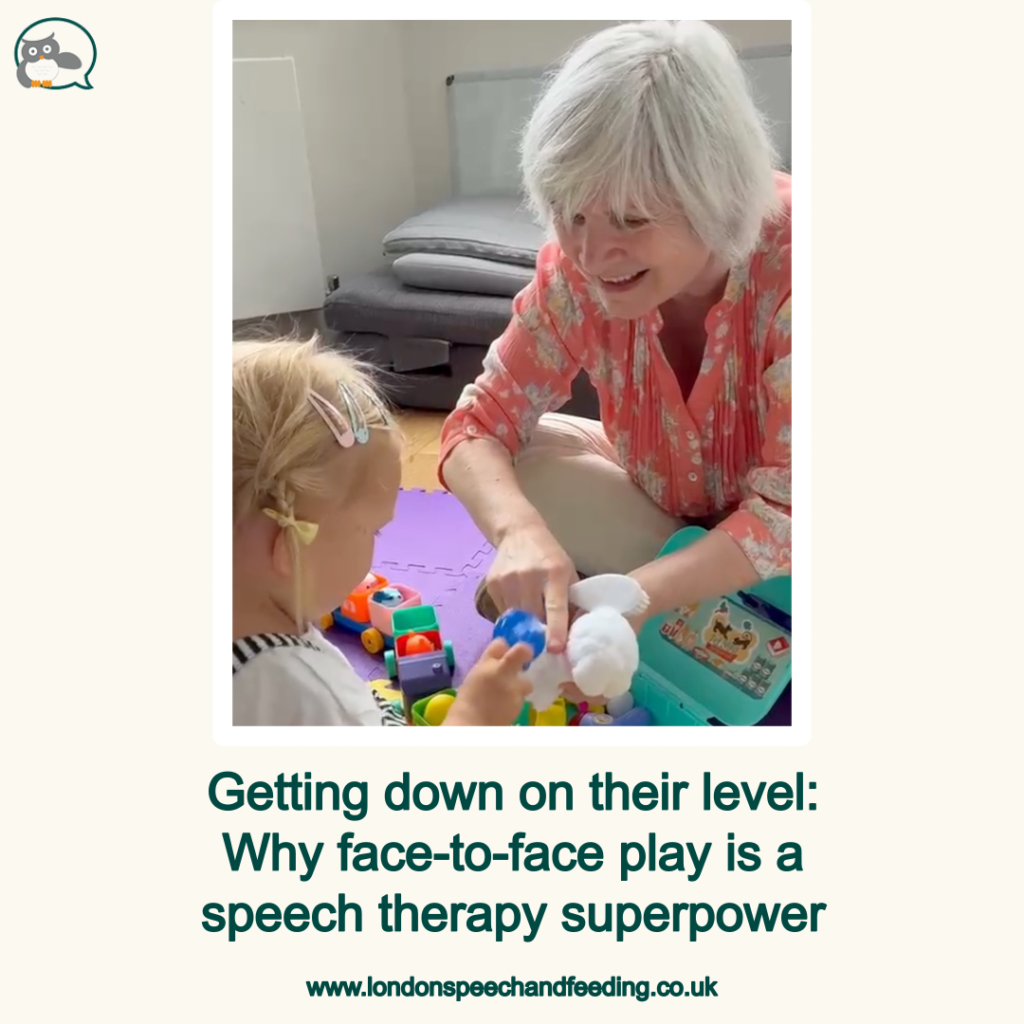
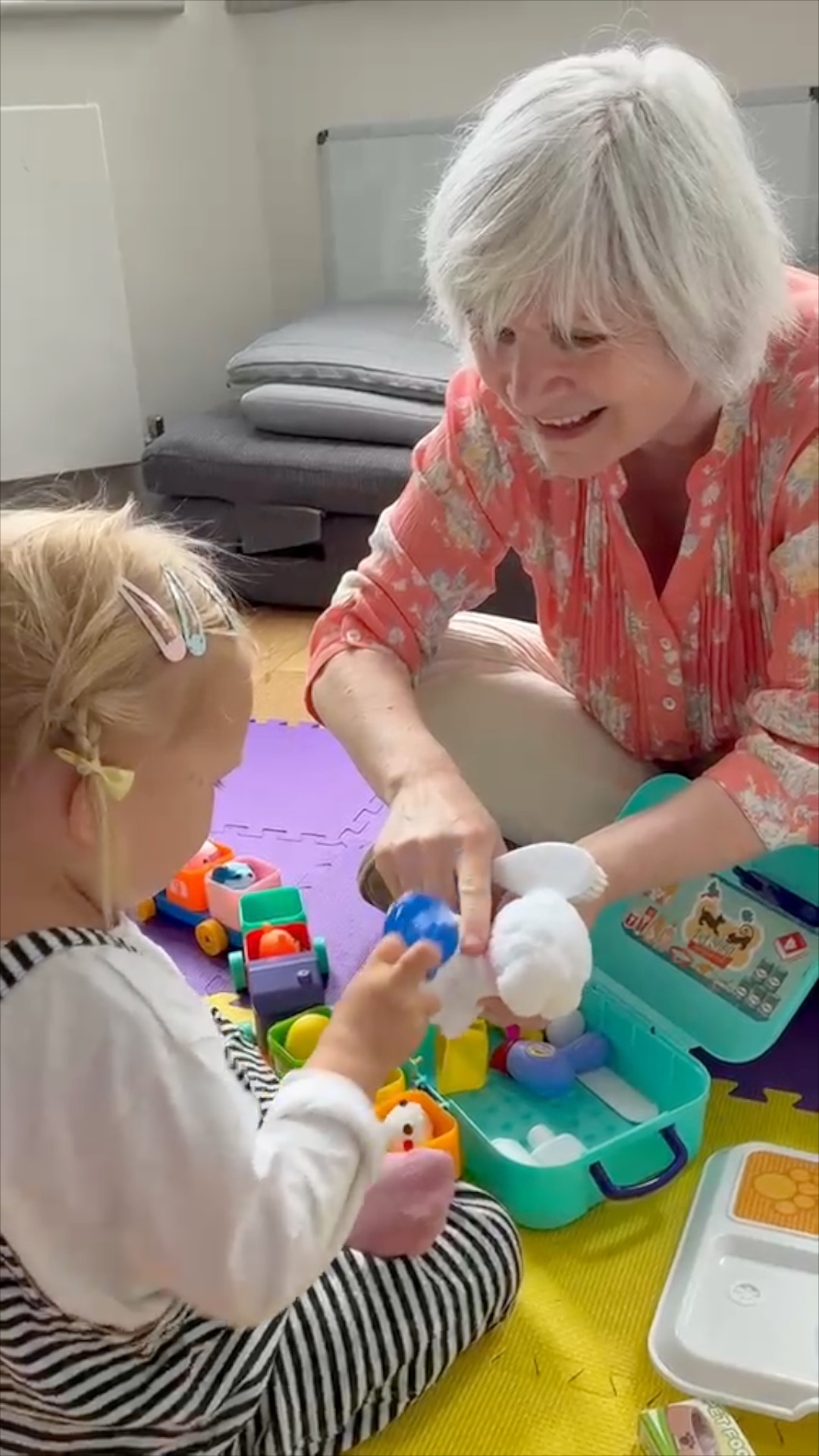
    In the video clip you can see this exact dynamic in action. Look at how I am sitting cross-legged on the mat, at eye level with the toddler. Notice how my hands are on the toy container, but my eyes are locked on the child. I am not forcing the interaction; instead, I am waiting.

    Here is how you can use this strategy at home:

    1. Set the stage: Get down on their level with a high-interest toy that requires help (like a wind-up toy, bubbles, or a tight-lidded box with toys inside).
    2. Create anticipation: Hold the object near your face or place your hands on it, but don’t open or activate it right away.
    3. Lean in and wait: Lean slightly forward, open your eyes wide, adopt an expectant facial expression, and completely pause. Count to five or ten in your head. Do not say anything.
    4. Capture the gaze: Wait for the exact moment your child looks up from the toy to meet your eyes, as if to say, ‘Well? Are you going to open it?’
    5. Reward the eye contact: The instant they make eye contact, deliver the language reward! Model a simple, functional word like ‘Open!’, ‘Go!’, or ‘Look!’ as you immediately do the action.

    By pausing and waiting at eye level, you create a ‘communication temptation’. The child learns that looking at you and engaging with your face is the key that unlocks the fun.

    Making it a daily habit

    You don’t need to spend hours a day sitting on the floor to see a difference. Start small by dedicating just 10 to 15 minutes of undivided, face-to-face play time each day. Turn off the television, put your phone in another room, get down on their level, and let them lead the play while you focus on being their visual communication partner.

    Whether you’re opening a little toy briefcase, pushing a plastic train along a track, or stacking blocks, remember: your face is the best toy in the room.

    Are you wondering if your toddler’s speech and language milestones are on track? At London Speech and Feeding I love helping families navigate early communication. Feel free to explore my services page and reach out directly to schedule a consultation.

    Sonja McGeachie

    Highly Specialist Speech and Language Therapist

    Owner of The London Speech and Feeding Practice.


    Health Professions Council registered
    Royal College of Speech & Language Therapists Member
    Member of ASLTIP

    Find a speech and language therapist for your child in London. Are you concerned about your child’s speech, feeding or communication skills and don’t know where to turn? Please contact me and we can discuss how I can help you or visit my services page.

    3
  • ·

    Baby-Led Weaning: A Speech and Language Therapist’s Take

    Let’s face it, introducing solids is a rollercoaster for parents. You’re bombarded with advice (solicited and otherwise) on purees, spoon-feeding, and the much-discussed ‘baby-led weaning’ (BLW). As a speech-language/feeding therapist I see the world through the lens of communication and development, as well as safe munching and swallowing. BLW can be a fantastic option for many little foodies. But is it right for yours? Let’s take a dive into the messy, hilarious world of toddler feeding.

    BLW in a nutshell

    Your baby, perched in their highchair, eyes wide with excitement and curiosity reaches out for a platter of food. He/She grabs a fat avocado slice, and curiously explore it with his/her lips, gums and tongue. He/She spits some of it out, mashes bits of it into his/her hair, there was a tiny swallow and the rest is smeared onto the high chair tray. Now he/she grabs a bit of the banana and rinse and repeat as before, except this one he/she keeps in his/her mouth for bit longer and takes a tiny bit more before the rest gets deposited into his/her bib.

    This, in a nutshell, is BLW! It’s all about letting your little one take the lead in exploring new foods, textures, and tastes. No spoon-feeding, just pure, messy, self-directed feeding fun.

    The pros of letting your little one loose on solids:

    • Motor Skills: BLW is a sensory party for developing motor skills. Picking up that slippery banana or gumming a chewy piece of toast strengthens those tiny hands and mouth muscles. These are the very skills they’ll need for future talking and chewing.
    • Texture Time: BLW exposes your baby to a variety of textures right from the start. Think soft, steamed broccoli florets or smooth, banana half-slices. This sensory exploration helps them develop an understanding of different textures in the world, which can translate to better oral motor skills needed for speech development.
    • Independence: BLW fosters a sense of self-feeding independence. Your toddler learns to control how much he/she eats and the pace of his/her meal. This can lead to better self-regulation later on, not just with food, but in other areas of his/her development too.
    • A wider variety of flavours: BLW encourages exposure to a wider variety of tastes and smells. Let your baby discover the sweetness of roasted sweet potato or the tang of mashed avocado! This early exploration can lead to less picky eating down the road.

    There are some valid concerns:

    • Gagging vs. Choking: One of the biggest concerns parents have about BLW is choking. However, gagging is a natural reflex that helps babies learn to move food safely around their mouths. Choking is much rarer, and with proper food selection and supervision, the risk is very low. The con here really is parental anxiety more than anything else and if you can overcome this then a bit of gagging is just fine and part of the process. Choking, again most children do choke occasionally a bit! Of course, close supervision and common sense is very important here.
    • It’s ever so messy!: Be prepared for mashed banana on the highchair tray, rogue peas flung across the room, and a general sense of chaos. But then again, this is an important part of the learning process! I would encourage you to embrace the mess (within reason and your personal tolerance level) and focus on the fun of exploration.
    • Nutritional Concerns: Some parents worry that babies won’t get enough nutrients with BLW. While it might take a while for them to master the art of self-feeding, a healthy child’s body is pretty good at self-regulating. Offer a variety of healthy options, and he/she will eventually get the hang of it.

    BLW: Is it right for your Little One?

    BLW isn’t a one-size-fits-all approach. Here are some things to consider:

    • Developmental Milestones: Babies should be able to sit up with good head control and show an interest in food before starting BLW.
    • General good health and absence of food intolerances, allergies, or other significant health issues which might dictatea more controlled feeding regime.
    • Gag Reflex: A strong gag reflex is a good sign. It shows your baby’s natural ability to move food safely around their mouth. If, however, your baby’s gag is overly sensitive and causes frequent bouts of vomiting please consult your health care professional for an assessment (GP, Paediatrician, Dietician, Speech and Language – Feeding Therapist).
    • Your Comfort Level: BLW requires a relaxed and patient approach. If you’re feeling stressed about the mess or potential choking hazards, it might not be the right fit for you.

    A final mouthful:

    BLW can be a fantastic way to introduce your baby to solids. It promotes exploration, independence, and a love for food. Remember, there’s no pressure to go all-in on BLW. You can always combine it with spoon-feeding or purees to find an approach that works for your family and your child. The most important thing is to create a positive and relaxed mealtime environment where your little one can explore the wonderful world of food at their own pace.

    P.S. As an SLT, I always recommend chatting with your health care professional. This way you can address any concerns you might have and ensure your baby is developmentally and physically on track for this exciting new chapter.

    Don’t hesitate to contact me!

    Sonja McGeachie

    Early Intervention Speech and Language Therapist

    Feeding and Dysphagia (Swallowing) Specialist The London Speech and Feeding Practice

    The London Speech and Feeding Practice


    Find a speech and language therapist for your child in London. Are you concerned about your child’s speech, feeding or communication skills and don’t know where to turn? Please contact me and we can discuss how I can help you or visit my services page.

    1
  • · ·

    Understanding phonological processes in 3–7-year-olds: What’s typical and when to seek help

    As a speech and language therapist, one of the most common questions I hear from parents is:

    ‘They can talk, but their speech still sounds immature. Is this normal?’

    Many children between the ages of three and seven use speech patterns that make their words sound different from adult speech. These patterns are known as phonological processes, and for younger children, they are a normal part of speech development.

    However, when these processes persist beyond the expected age, they can start to affect clarity, confidence and learning, especially once children enter school.

    This blog will help you understand:

    • what phonological processes are
    • which patterns are typical at different ages
    • and when it might be time to seek speech therapy support

    What are phonological processes?

    Phonological processes are patterns of sound simplification that children use while their speech system is developing.

    Instead of learning each sound one by one, children initially organise sounds into patterns that make speech easier to produce. This is a normal and efficient strategy for a developing brain.

    For example:

    • saying ‘tar’ instead of ‘car’
    • saying ‘poon’ instead of ‘spoon’
    • saying ‘bud’ instead of ‘bus’

    These are not ‘bad habits’. They are part of how speech develops.

    The key question is how long these patterns last.

    Common phonological processes (and when they usually disappear)

    Below are some of the most common processes parents notice in 3–7-year-olds.

    1. Final consonant deletion

    Leaving off the last sound in a word

    • ‘ca’ for cat, ‘da’ for dog
    • Typically resolved by 3–3½ years

    2. Fronting

    Replacing back sounds (k, g) with front sounds (t, d)

    • ‘tar’ for car, ‘do’ for go
    • Typically resolved by 3½–4 years

    3. Cluster reduction

    Omitting one sound in a consonant cluster

    • ‘poon’ for spoon, ‘top’ for stop
    • Typically resolves by 4–5 years (some clusters slightly later)

    4. Gliding

    Replacing /R/ or /L/ with /W/ or /Y/

    • ‘wabbit’ for rabbit, ‘yion’ for lion
    • Can be typical up to 5–6 years

    5. Weak syllable deletion

    Leaving out unstressed syllables

    • ‘nana’ for banana
    • Usually resolved by 4 years

    If these patterns continue past the expected age, speech can remain difficult to understand particularly for unfamiliar listeners such as teachers, peers, and also Auntie Karen or grandparents who visit once in a while.

    Why phonological processes matter in school-age children

    By the time children reach reception and Year 1, speech clarity becomes increasingly important.

    Persistent phonological difficulties can affect:

    • being understood by teachers and peers
    • phonics and early reading
    • spelling
    • confidence in speaking
    • willingness to participate in class

    Some children become aware that they ‘sound different’ and may speak less, avoid longer words, or become frustrated when misunderstood.

    What’s the difference between a delay and a disorder?

    This is an important distinction.

    • A phonological delay means a child is following the normal pattern of development, just more slowly.
    • A phonological disorder means the child is using atypical patterns, or continuing age-expected patterns well beyond when they should have resolved.

    A speech and language assessment helps identify:

    • which processes are present
    • how many are affecting speech
    • how consistent the errors are
    • and whether intervention is needed

    Signs it may be time to seek speech therapy

    You may want to seek professional advice if your child:

    • is 3½ years or older and still hard to understand
    • is understood well by family but not by others
    • becomes frustrated or avoids talking
    • has difficulty with phonics or spelling
    • uses several phonological processes at once
    • has not made progress despite time and encouragement

    Early support does not mean something is ‘wrong’. It simply helps speech development move forward more efficiently.Research consistently shows that unresolved phonological processes beyond the expected age can impact intelligibility, literacy and confidence (Dodd, 2014; Bowen, 2015).

    How speech therapy helps phonological development

    Phonological therapy is not about drilling individual sounds endlessly.

    Instead, therapy focuses on:

    • helping children recognise sound patterns
    • building awareness of contrasts (e.g. ‘tar’ vs ‘car’)
    • practising speech in meaningful, playful ways
    • supporting generalisation so progress carries into everyday speech

    For school-aged children, therapy is usually structured, motivating and highly targeted and progress can be very encouraging.

    A final reassurance

    Many children with phonological difficulties go on to develop clear, confident speech with the right support.

    If you’re unsure whether your child’s speech is ‘just a phase’ or something that needs attention, a professional assessment can give clarity and peace of mind.

    If you’d like support or advice, please contact me and I can help guide the next steps.

    Sonja McGeachie

    Highly Specialist Speech and Language Therapist

    Owner of The London Speech and Feeding Practice.

    Research references


    Health Professions Council registered
    Royal College of Speech & Language Therapists Member
    Member of ASLTIP

    Find a speech and language therapist for your child in London. Are you concerned about your child’s speech, feeding or communication skills and don’t know where to turn? Please contact me and we can discuss how I can help you or visit my services page.
    3
  • ·

    Transforming Mealtimes

    Speech Therpaist in London

    Transforming Mealtimes

    Below are two reviews I got from grateful clients over the past 4-6 weeks; this blog is more about how Feeding Therapy can help you than blowing my own trumpet…. though that said, it is always so nice and gratifying to hear when parents are happy and hopeful about their little one’s feeding journey. Feeding Therapy is a substantial part of my work as a Children’s Speech and Language Therapist. One of my specialist subjects is Autism and we find that many children on the Autism Spectrum are very specific about eating, and will often refuse a range of typical family foods in favour of a narrow range of foods/snacks.

    Mostly, feeding difficulties are a combination and complex cocktail of factors that have contributed to the current status quo: sure, there may have been some physical problems to start off with, such as reflux causing the baby discomfort, constipation, a very tight tongue tie or a swallowing problem caused by neurological difficulties and of course sensory processing difficulties are also very physical experiences. We always begin with a very thorough case history taking and information gathering, followed by an oral assessment and observation of the actual swallow to establish what might have been – or still might be – the cause for the feeding difficulties.

    In most of the cases I see in my practice, the original obvious cause is no longer present, especially with older children. So, if the swallowing is fine, the reflux is no longer present, the tongue was divided (twice!) why are they still not eating much, refusing to try new foods, only accept certain textures etc.

    The answer is extremely complex and multi-faceted and this little blog is not covering any factors in detail (we would be here all night) -I mentioned sensory processing difficulties earlier on. These are mostly still present but often not acknowledged or recognised by parents. And it is certainly the case that one of the contributors is parental anxiety; this tends to run very high and has been for many months, sometimes years. This in turn often leads to very tense and unpleasant, endlessly long meal times and many times children are force-fed several times a day in order to “get something down there” as otherwise they would probably starve themselves.

    Additionally, parents end up only offering a very narrow range of foods because that is all their child will eat. This ends up in a vicious cycle of children being fed porridge-style food for all meal times and of course they won’t progress to more mature foods if these mature foods are never on offer.

    In order to help address and disentangle some of the issues I often introduce the “Division of Responsibility in Feeding” as researched and recommended by Ellyn Satter (The Satter Feeding Dynamics Model)

    Here are the main points of her approach:

    Children have a natural ability with eating, they eat as much as they need and they grow in the way that is right for them and they learn to eat what their parents eat. (E Satter). The parent is responsible for WHAT the child eats, WHERE and WHEN the child eats. The child is responsible for HOW MUCH they eat or WHETHER to eat. Satter proposes that parents should guide their child’s transition from nipple feeding through semi-solids, then thick and lumpy foods to finger foods and then on to normal family meals.

    Please note: this model is only appropriate for children where the original physical cause is no longer present!

    Of course it’s not easy! It requires a huge shift in thinking about feeding and it requires to trust our children to know what is best for them. This is very big for most parents, as it is not how we were brought up and it is not commonly known that babies and children know what is good for them!

    However, it is certainly true that parents who follow this particular approach and make small, steady changes in the way the offer foods, and in the way they create family meal times differently, children make very nice, pleasing progress and over some months we often see remarkable positive changes.

    I like to work in a team and especially for this type of problem it is essential to have a multi-disciplinary approach. A knowledgeable dietician is an enormous plus in any feeding team as is of course a

    Paediatrician and/ or a Gastroenterologist and the most important people in the team are the parents!

    Feeding Therapy is all about collaboration and a ‘team around the child” approach. When we have this in place and there is trust amongst the team members then we make fantastic progress.

    Do get in touch with me if you would like some help with your tricky feeder.

    Lovely Reviews

    I visited London Speech and Feeding a couple of days ago with my 8-month-old granddaughter and her mother. Sonja made us feel comfortable and at ease from our first introductions. She was able to pinpoint my granddaughter’s mum’s anxiety around weaning very quickly. She not only gave her the tools to do this successfully, but also really encouraged my granddaughter’s mum and instilled confidence that she had everything she needed to make this sometimes-difficult transition without further anxiety.

    Sonja was very thorough in her initial assessment of my granddaughter’s physical milestones and her developing speech. My granddaughter felt very comfortable with Sonja and happily played along with her. Then came the big moment – trying out various foods! We were amazed to see just how easily my granddaughter, with Sonja’s expert encouragement, took to sampling the wonderful array of different delicious morsels Sonja had prepared for the session. My granddaughter even drank from a cup for the first time! Wonderful!

    Sonja then emailed a summary of the session and an extensive array of resources with suggestions for my granddaughter’s mum which she has now put into action. My granddaughter’s mum couldn’t thank Sonja enough for her caring attitude, extensive knowledge, and warm professionalism. I have no hesitation in recommending Sonja, she’s a fantastic Feeding Therapist!

    Sonja (and her lovely colleague, Sandra) were stupendous. I had brought my one-year-old son to see them as I was concerned that he wasn’t eating enough. They looked at his history and we ate together to make sure they had all the information they needed to give an accurate diagnosis. Whilst our outcome was that Henry was in fact doing brilliantly (and I just needed to chill out a bit!), I would imagine if there was something more serious going on, Sonja would make you feel just as supported and empowered as she did with us. Excellent follow-ups too. Money well spent for a bit of reassurance for a stressed out mama. Thank you, Sonja!


    Find a speech and language therapist for your child in London. Are you concerned about your child’s speech, feeding or communication skills and don’t know where to turn? Please contact me and we can discuss how I can help you or visit my services page.

  • · · ·

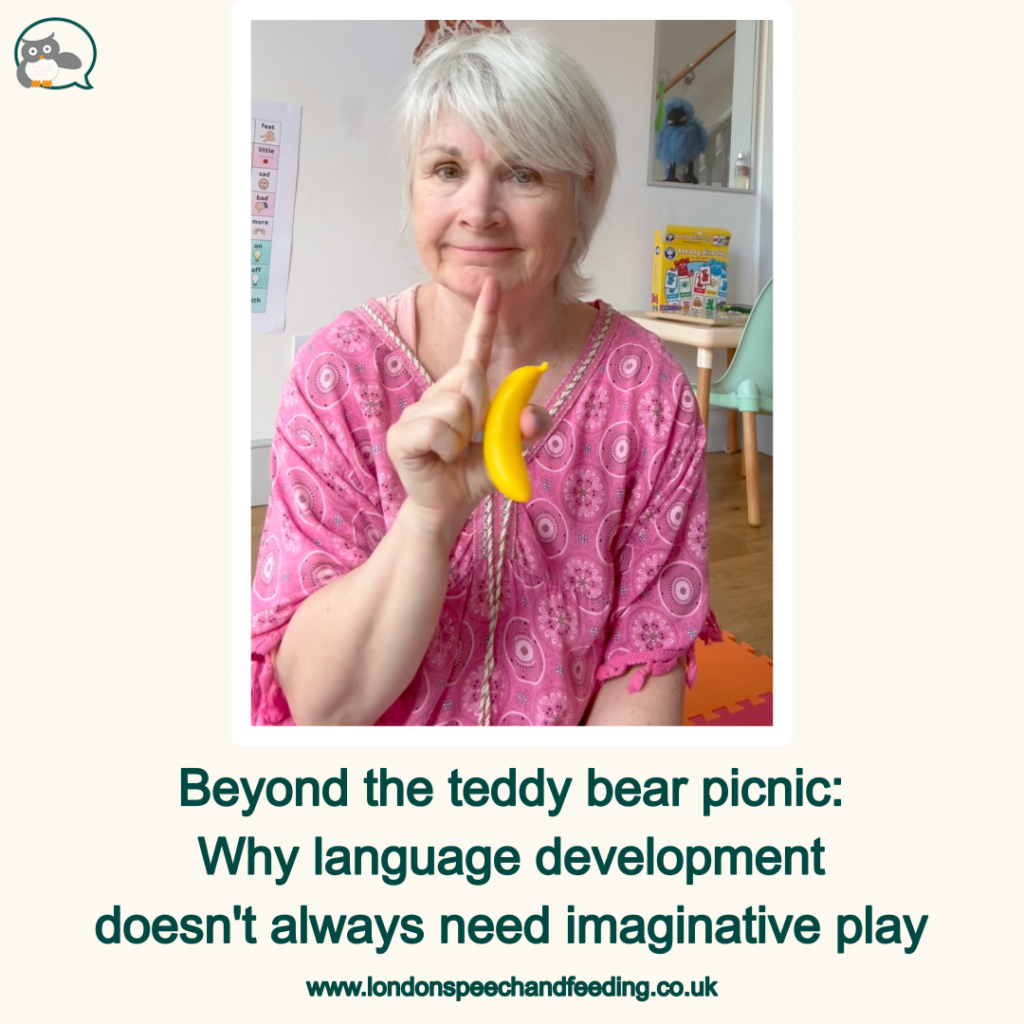
    Beyond the teddy bear picnic: Why language development doesn’t always need imaginative play

    As Speech and Language Therapists (SLTs), we are taught from day one that developmental milestones follow a predictable, linear path: first comes functional play, then symbolic and imaginative play (like pretending to feed a teddy bear or talking on a toy phone), and then comes conversational speech.

    But when working with language delayed children, I have seen something that completely contradicts those textbook charts.

    Many of my students have absolutely no interest in doll play, tea parties, or imaginary scenarios. Yet, as they mature, they still manage to develop robust, meaningful, and conversational language.

    How is this possible? And what does it mean for how we approach therapy?

    Redefining the ‘rules’ of play and language

    The idea that imaginative play is a strict prerequisite for language was built entirely on neurotypical developmental data. But neurodivergent brains don’t follow neurotypical roadmaps. That is not a deficit; it’s simply a different processing style.

    When Gestalt Language Processors bypass traditional imaginative play, they aren’t ‘missing’ a step. They are often using entirely different cognitive vehicles to build their language skills.

    The power of monotropic deep interests

    Video clip 2 lining up dinosaurs

    Many autistic individuals have a monotropic cognitive style, meaning they process the world through deep, single-focused passions (think trains, space, dinosaurs or ocean creatures).

    While a neurotypical child might practise social roles by pretending a doll is going to school, a neuro-diverse child practises language by categorising, analysing, and sharing facts about their deep interest. Their language is anchored in the concrete, fascinating reality of their passion, rather than fictional symbolic play.

    Gestalt Language Processing (GLP)

    A significant number of neuro-diverse children learn language in large ‘chunks’ or ‘gestalts’ (such as movie scripts, songs, or favourite phrases) rather than building sentences word-by-word.

    When a child scripts or uses echolalia, they are storing and mapping vast amounts of conversational data. They don’t need to pretend-feed a teddy bear to practise dialogue; they are actively processing the rhythm, intonation, and structural rules of speech through the media and phrases they love. As they grow, they learn to break these scripts apart to form original sentences.

    Structural play is learning play

    Just because a child is lining up dinosaurs or cars, stacking blocks, or spinning wheels instead of making them ‘talk’ doesn’t mean they aren’t learning. This functional and structural play builds crucial foundational skills like pattern recognition, cause-and-effect, and spatial awareness, all of which directly support cognitive and language development.

    Shifting Our Goals

    Meeting our children on their home turf: if that’s dinosaurs, let’s be creative with dinosaurs!

    If imaginative play isn’t the engine driving language, forcing it in the therapy room can quickly turn into an exercise in compliance rather than connection. Instead of trying to pull a child out of their world and into a neurotypical play model, we can meet them exactly where they are!

    Here are three affirming ways to turn deep interests into conversations:

    • Swap questions for comments (declarative language): Instead of interrogating a child about their play (‘What colour is that train? Where is it going?’) make pressure-free observations (‘Wow, that train is moving fast. Look at those wheels spin.’). This lowers conversational anxiety and models natural communication.
    • Bridge and expand: Use their favourite topic to introduce new ideas and concepts. If we love dinosaurs let’s see if dinos can climb up a ladder, slide down a half pipe into some water, then need drying before making footprints across a piece of paper…
    • Validate any scripts or echolalia and find out the EMOTION underlying it: If your child uses a quote from a favourite cartoon clip, let’s try and figure out in what context this phrase was said in the movie; what is the emotion in the movie when the character says this line? Is it upset? Is it joyful? Is it big surprise or a shock? Don’t dismiss it as meaningless. Acknowledge the emotion behind the script ‘You feel worried right now.’ This way we are showing our child that their unique way of communicating is heard and valued.

    So, to sum up:

    Imaginative play is just one way to learn language, not the only way.

    Let’s stop viewing a lack of pretend play as a barrier to communication, and free ourselves to see our children’s true strengths. By embracing their deep passions, we don’t just help them find their voice. We build a real connection that makes communication possible.

    Are you looking for neurodiversity-affirming speech and language support? Contact my clinic today to learn more about how I tailor my therapy to your child’s unique strengths.

    Sonja McGeachie

    Highly Specialist Speech and Language Therapist

    Owner of The London Speech and Feeding Practice.


    Health Professions Council registered
    Royal College of Speech & Language Therapists Member
    Member of ASLTIP

    Find a speech and language therapist for your child in London. Are you concerned about your child’s speech, feeding or communication skills and don’t know where to turn? Please contact me and we can discuss how I can help you or visit my services page.

    3
  • · ·

    The picky eater’s plate: Introducing solids to toddlers with ARFID

    Designed by Freepik

    Mealtimes can be a battleground for parents of picky eaters, especially toddlers with Avoidant/Restrictive Food Intake Disorder (ARFID). I see a great number of toddlers with Autism traits and many of my clients are picky eaters from mild to severe. Take a look at my blog for an outline of what the issues are and how to try and help.

    ARFID goes beyond typical ‘picky eating’ and can significantly impact a child’s growth, nutrition, and social-emotional well-being. If your toddler is resistant to trying new foods or has a very limited diet, here are some strategies to navigate the introduction of solids:

    1. Understand ARFID:

    ARFID is a diagnosable eating disorder characterised by:

    • Limited food variety: Eating only a small range of foods, often with specific textures or colours.
    • Fear of new foods: Intense anxiety or aversion to trying unfamiliar foods.
    • Sensory sensitivities: Heightened sensitivity to taste, smell, texture, or appearance of food.
    • Lack of interest in eating: May show little interest in food or mealtimes.

    2. Seek professional guidance:

    • Paediatrician and/or gastroenterologist: Rule out any underlying medical conditions.
    • Registered dietitian: Assess nutritional needs and create a balanced meal plan.
    • Speech and language therapist (SLT): If oral-motor skills or sensory sensitivities are contributing to feeding difficulties.
    • Occupational therapist (OT): If sensory processing challenges are affecting mealtime behaviours.
    • Child psychologist: If anxiety or emotional factors are contributing to ARFID.

    3. Strategies for introducing solids:

    • Start small: Introduce one new food at a time, in small amounts, alongside familiar favourites.
    • Patience is key: It can take multiple exposures (up to 10–15 times!) for a child to accept a new food. Don’t give up!
    • Positive reinforcement: Praise and encouragement for any interaction with the new food, even just touching or smelling it.
    • No pressure: Avoid forcing or pressuring the child to eat. This can create negative associations with food.
    • Make it fun: Present food in playful ways, use cookie cutters for fun shapes, or involve the child in food preparation.
    • Sensory exploration: Encourage exploration of food through touch, smell, and sight before tasting.
    • Role modelling: Show the child that you enjoy eating a variety of foods.
    • Use fun utensils: your child might like characters from ‘Frozen’ or ‘Dinosaurs’ or ‘Diggers’ there are a host of character-based cutlery and cups/plates to be had. Also, I really rate these two items very highly they are so good so I want to share these with you. Both are available online. But warning: the cup is outrageously expensive as it comes from the United States and is sold by a small scale company. But I feel this is cup very worth trying, I have had good results with this.
    • Gradual desensitisation: Start with foods that are similar in texture or taste to accepted foods, then gradually introduce more challenging options.
    • Food chaining: Introduce new foods that are similar in taste, texture, or appearance to accepted foods.

    4. Mealtime Environment:

    • Positive and relaxed: Create a calm and enjoyable mealtime atmosphere.
    • No distractions: Minimise distractions like TV or toys.
    • Consistent schedule: Offer meals and snacks at regular times.
    • Child-sized portions: Offer small, manageable portions to avoid overwhelming the child.
    • Involve the child: Let the child choose their utensils, plate, or cup.

    5. Remember:

    • Every child is different: What works for one child may not work for another.
    • Progress takes time: Be patient and celebrate small victories.
    • Focus on the positive: Praise any positive interaction with food.
    • Seek support: Connect with other parents or support groups.

    Introducing solids to toddlers with ARFID can be challenging, but with patience, persistence, and professional guidance, you can help your child develop a healthier relationship with food.

    Get in touch with me via my contact form if you need support

    Sonja McGeachie

    Early Intervention Speech and Language Therapist

    Feeding and Dysphagia (Swallowing) Specialist The London Speech and Feeding Practice

    The London Speech and Feeding Practice


    Find a speech and language therapist for your child in London. Are you concerned about your child’s speech, feeding or communication skills and don’t know where to turn? Please contact me and we can discuss how I can help you or visit my services page.

    1