Halloween without the tears: Supporting children through the Spooky Season

| |

For many families, Halloween is an exciting time filled with costumes, decorations, and sweets. But for children who are sensory sensitive, whether they’re autistic, have sensory processing differences, or simply find new experiences overwhelming, Halloween can feel like a night of chaos rather than fun.

The bright lights, unexpected noises, strange textures, and social pressure to ‘join in’ can quickly become too much. The good news? With some thoughtful planning and gentle support, you can make Halloween a positive and manageable experience for your child.

Understanding sensory overload

Sensory overload happens when a child’s brain receives more sensory input than it can process. This might mean:

  • Costumes that itch, squeeze, or feel strange on the skin.
  • Loud sounds like doorbells, fireworks, or shrieking decorations.
  • Crowds and unpredictability during trick-or-treating.
  • Strong smells or tastes from face paint or unfamiliar sweets.

When overloaded, children may cry, cover their ears, hide, run away, or ‘shut down.’ These reactions aren’t ‘bad behaviour’, they’re signs of distress. The goal isn’t to eliminate Halloween fun, but to adjust it to your child’s comfort level.

Step 1: Choose costumes wisely

Costumes are often the biggest trigger. Scratchy fabrics, tight seams, or masks that restrict breathing can be unbearable for some children.

Try these tips:

  • Go sensory-friendly: Use soft, breathable fabrics and remove tags. Many retailers now sell sensory-safe costumes.
  • Test it early: Let your child wear the outfit around the house before Halloween. If it’s too much, simplify — maybe themed pyjamas or a favourite T-shirt with Halloween accessories.
  • Skip the mask: Face paint can be equally challenging, always test on a small patch of skin first. A comfortable headband or hat might be enough to feel ‘in costume.’

Remember, participation doesn’t require perfection. Your child can still ‘be’ their favourite character without a full costume.

Step 2: Plan your Halloween environment

Before the big day, think about what parts of Halloween your child enjoys — and what might overwhelm them.

At home:

  • Keep decorations minimal and predictable. Avoid motion-activated sounds or flashing lights.
  • Practise knocking at your own front door or saying ‘trick or treat’ with a trusted adult.
  • Have a ‘quiet space’ ready, a cosy corner or room where your child can retreat if things get too intense.

If you’re going out:

  • Choose earlier, quieter times for trick-or-treating.
  • Visit a few familiar houses instead of the whole street.
  • Bring ear defenders or noise-cancelling headphones.
  • Have a clear exit plan if your child needs a break.

Sometimes, watching from the window and handing out sweets can be just as enjoyable! it still offers social participation without sensory overload.

Step 3: Prepare socially and emotionally

Halloween involves a lot of unexpected social interaction: strangers at the door, unfamiliar greetings, and different rules.

Help your child by:

  • Using visuals or stories: Read picture books about Halloween or make a short social story about what will happen.
  • Role-playing: Practise saying ‘Trick or treat!’ or handing out sweets in a fun, low-pressure way.
  • Labelling feelings: Explain that it’s okay to feel nervous or to take a break if something feels ‘too loud’ or ‘too much.’

Children feel safer when they know what to expect. Predictability reduces anxiety and makes participation more enjoyable.

Step 4: Rethink the treats

Not every child enjoys sweets; some dislike sticky textures or strong flavours. Offer non-food alternatives like stickers, glow sticks, or small toys.

If your child has feeding difficulties or oral sensitivities, it’s okay to opt out of the traditional treats entirely. They can still join in by giving treats or decorating treat bags instead.

It’s also helpful to prepare your child that others might offer sweets they don’t want. Practising polite ‘no thank you’ responses can make these moments easier. (check out my symbol download for children who struggle to speak)

Step 5: Celebrate your way

Halloween doesn’t have to look like anyone else’s version. Maybe your family watches a ‘not-too-scary’ film, carves pumpkins, or does a flashlight treasure hunt indoors. The goal is joyful connection, not conformity.

A calm, happy experience, even if it looks simple from the outside builds positive associations your child will carry into future celebrations.

In summary

Halloween can be full of sensory surprises, but with empathy, planning, and flexibility, it doesn’t have to end in tears.

The more you adapt to your child’s sensory needs, the more they learn that they are safe, understood, and included not just at Halloween, but in every celebration.

As with all things in speech and feeding development, progress starts with connection. When children feel regulated and supported, communication and confidence follow.

Sonja McGeachie

Highly Specialist Speech and Language Therapist

Owner of The London Speech and Feeding Practice.


Health Professions Council registered
Royal College of Speech & Language Therapists Member
Member of ASLTIP

Find a speech and language therapist for your child in London. Are you concerned about your child’s speech, feeding or communication skills and don’t know where to turn? Please contact me and we can discuss how I can help you or visit my services page.

2

Similar Posts

  • Using AAC – Augmentative and Alternative Communication for non-verbal and early verbal children

    Using a Core Vocabulary Board

    Your Speech Therapist might have been advising you to introduce words to your child with the help of a CORE BOARD. What on earth is she talking about and why would we want to do this, I hear you think – and in fact this is what I get asked a lot, as I often do recommend using Core Boards.

    Core boards belong to the category of Augmentative and Alternative Communication (AAC ) and they can be really useful for:

    • Children or adults who cannot speak at all or who are very hard to understand.
    • Children who are slow to speak and have difficulty expressing themselves verbally, due to genetic conditions as Down Syndrome, Verbal dyspraxia, Autism or any other learning difficulty that means a child is slow to develop speech.

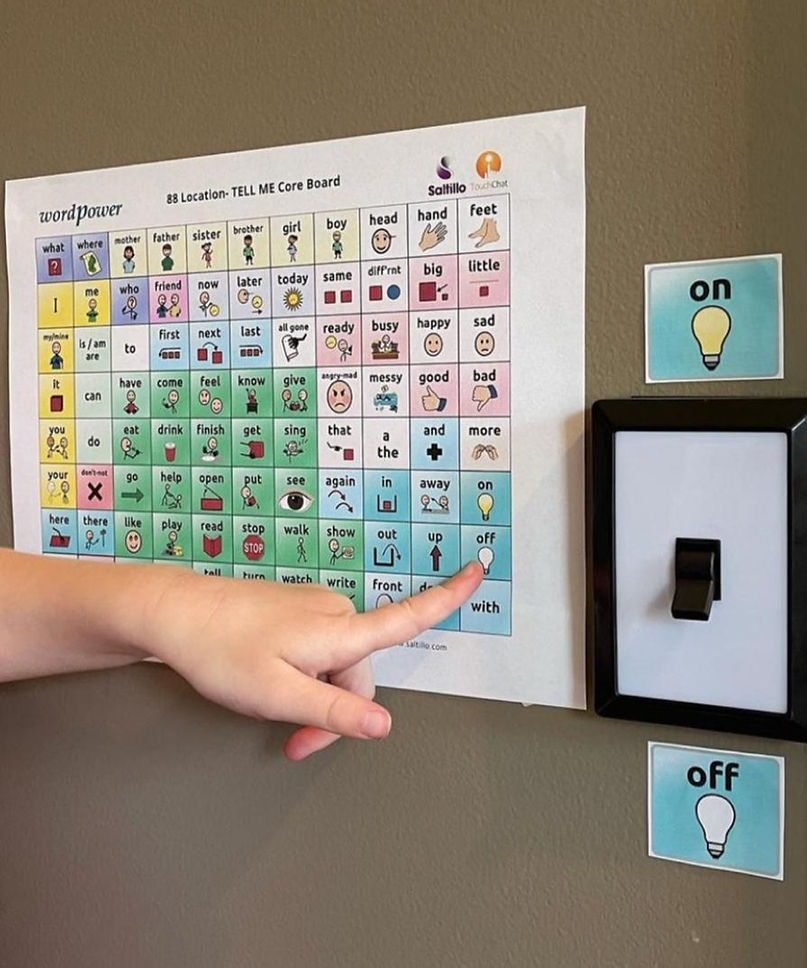
    Here is what a Core board might look like, in fact this is one that I love to use. It is made by Beautiful Speech Life, there are a ton of similar boards out there for free. I have also made my own, you can check it out on my Instagram feed.

    Using a Core Vocabulary Board

    What is Core Vocabulary/ Core words?

    Core vocabulary consists of the most common words used by children throughout a day. In 2003 Banajee and Dicarlo et al found that 50 % of pre-schoolers in their project used nine words consistently across their daily play and meal routines. These words are Core words and are typically the ones you can see on a board, like the one above.

    How To Use It

    Adults always first need to consistently model and show their child how to use a board. This is key! For example: Adult can point to “YOU” “WANT” ‘MORE” and then point to the cup of Water on the counter. Child could then reply either by shaking his/her head and/or pointing to “NOT” which also stands for “NO”. Then adult can point to “NOT” “MORE” and do an OK sign as well. Eventually Child can initiate a request and point to “I” “ WANT” “MORE” and then point to the cup on the counter.

    This is not as cumbersome or limited as it first sounds or appears. Here’s why: As adult you can talk normally and, of course, many words you are using will not be on this board. But some will be, and you will be surprised how many you can find when you start using it. So you could say quite normally: Hey lovely (name of your child) would YOU LIKE some MORE water? The words in capital are on the board which you can point to as you speak normally. Basically, you are showing/saying to your child: “We can speak and these are the pictures we can use to help us; We call this TOTAL COMMUNICATION, as communication is so much more than just words! Great communication can be silent, where we use our facial expression, our smile, our eyes, our hand gestures, body movements and yes, of course, words. But when words fail us, these boards are so helpful.

    This still does not answer your original question of: why would I want to do this, I want my child to talk!? You are a SPEECH Therapist, please help my child TALK, not point to pictures, that is not what I had in mind.

    Let Me Explain

    When speech is difficult for a child it doesn’t mean that there is nothing to talk about! Of course, we want all our children and all people to speak because it is the easiest and most effective way of communicating, no doubt! However, sometimes this is very hard for some children and whilst we are always working towards speech where possible, we also want to make sure that whilst figuring out how to speak, your child has a MEANS TO COMMUNICATE. Using a board like this might well be a temporary strategy but whilst you are using it and working on their speech you will find a reduction in tantrums and frustration as you child is able to express themselves more effectively.

    Often we find that as soon as we offer a CORE VOCABULARY like the above sample a child who has had no or very few words suddenly blossoms and starts to point to new words on the board and starts to PRACTICE USING THESE WORDS!! Practice makes perfect, right? Yes it totally does! There is lots of evidence that tells us that using Core Vocabulary Boards ENHANCE AND SUPPORT SPEECH PRODUCTION AND NOT HINDER IT. Using a board like this will only ever be helpful to your child and will never make your child “lazy” – too lazy to speak? NO SUCH THING!

    Here is what one of my parents says about the core board we use with her little boy:

    “the board has been a game changer, my son is a visual learner so it really helps to have the board as he associates communication so much easier this way. We have incorporated his twin sister who models it’s use and have definitely seen improvement in speech through its support and his frustration around being unable to verbally communicate at times has definitely lessened”

    K Connolly, Mother of Tom (aged 3.5 years).

    Reading and hearing this makes me so happy!

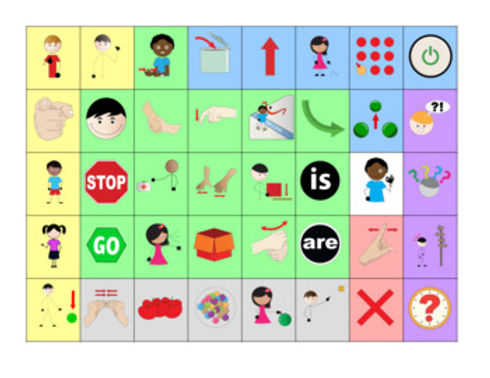
    In addition to general core board above I also sometimes use a Core Board that is specific to an activity, such as for example BLOWING BUBBLES. Below is an example of such a board, which you can use very nicely during a bubble blowing activity and sometimes it is a nice place to start for newcomers, this can be an easy introduction. You can download this and many similar boards on www.widgit.com for free!

    Using a Core Vocabulary Board

    There is so much more to say about AAC and using Coreboards, visit my Instagram you can find a bit more information on how I use them.


    Find a speech and language therapist for your child in London. Are you concerned about your child’s speech, feeding or communication skills and don’t know where to turn? Please contact me and we can discuss how I can help you or visit my services page.

  • ·

    Five ways to increase confidence and reduce frustration in children with speech and language and communication difficulties

    An orange speech bubble with a testimonial

    Your child’s speech, language and communication difficulties may impact their self-esteem. And they may show signs of increased frustration. You want them to be full of confidence, increasing their participation in school and fully engaging with their peers.

    1. Practise active listening

    Speech difficulties can mean that it’s more challenging to understand what your child says. It’s important to show that you’re paying attention, giving them time to express themselves. Focus on what your child says rather than how they are speaking. Remember to maintain eye contact, and actively listen. Active listening and giving time can be trickier than it sounds. I can provide strategies to support your active listening skills.

    2. Give other means and forms of communication

    Allowing children to express themselves in a variety of ways (e.g., gesture, signs, written, use descriptions to describe a word (e.g., sand – you find it out the beach, it can have pebbles on it, it’s not the sea), use of symbols or high-tech augmentative communication methods such as a computer). Using different ways is vital in reducing frustration and communicating their message. If you’re unsure of what other forms of communication you can use, please contact me for some top tips.

    3. Praise efforts

    Providing specific praise allows your child to understand what they’ve achieved. E.g., you could praise the way your child listens, or how they take turns, or their resilience (e.g., “I like the way you listened” or “good listening”). Think of different ways you could praise you child during different activities, so you are prepared with phrases that you can use.

    4. Have clear start and end points in activities

    Some children with speech, language and communication needs have difficulties with transitioning from one activity to another. They also have difficulties with changes in routine. This can add to their frustration and changes in behaviour. So, how do you show a clear start and end to an activity? You can have a visual timetable, or you could have ‘start’ and ‘finish’ boxes where you place all the materials in the box labelled ‘start’. And once the activity has finished, you put the items in the box labelled ’finished’. If you need support with transitions, please contact me.

    5. Use visuals

    Visuals can support your child to understand routine and spoken language. Visuals can range from symbols to online images, to photographs, or a combination. Explore which type of visuals work well for your children. Using visuals can be powerful if used correctly. Make the most of the opportunities that visuals can provide for your family.

    Increase confidence and reduce frustration in children with speech and language and communication difficulties today. Please feel free to contact me if you need any support or tips on maximising these opportunities.


    Find a speech and language therapist for your child in London. Are you concerned about your child’s speech, feeding or communication skills and don’t know where to turn? Please contact me and we can discuss how I can help you or visit my services page.

    1
  • · ·

    Hard munchables: Chewing through the weaning journey

    As a Speech and Language Therapist with a specialism in paediatric feeding, I’m constantly looking for ways to support families in developing their little ones’ oral motor skills and fostering a positive relationship with food. While Baby-Led Weaning (BLW) has revolutionised how many families introduce solids, (see my previous blog in July 25) a concept that often sparks discussion and curiosity is the use of ‘hard munchables.’

    What are hard munchables?

    The term ‘hard munchables’ refers to specific types of firm non-digestible food items that are offered to babies for oral exploration and skill development, not for nutrition. These are typically foods that babies cannot bite off or swallow in large pieces due to their texture, but which provide resistance for chewing practice.

    The phrase was coined by Marsha Dunn Klein, M.Ed., OTR/L, Occupational Therapist and feeding therapist. Well known for her work in paediatric feeding she introduced and advocated for the concept of hard munchables as part of a therapeutic feeding approach, particularly for infants learning to manage textures and develop crucial oral motor skills.

    Common examples of hard munchables include:

    • Large, raw carrot sticks: Too hard to bite through, but great for gnawing.
    • Celery sticks: Like carrots, offering firm resistance.
    • Large, raw apple slices (peeled chunks): A firm, slightly sweet option.
    • A firm, uncut pear core: With the seeds removed.
    • Dried mango cheeks (hard, unsweetened varieties): These offer a fibrous texture.
    • A large, fully cooked but firm piece of meat (like a steak bone with some meat attached): The meat provides flavour and a bit of shreddable texture, while the bone is for gnawing.
    • Hard crusts of bread or breadsticks (very firm, without soft inner crumb): These can soften slightly with saliva but offer significant resistance.
    Image by Freepik

    It’s crucial to emphasise that hard munchables are not for consumption or nutrition. They are tools for oral motor development and should always be offered under strict, active supervision.

    How do hard munchables fit into weaning?

    While weaning (traditional or Baby-Led Weaning) introduces solid foods that a baby can eventually bite and swallow, hard munchables are complementary to the weaning phase. They enhance that phase by helping a child to develop hand dexterity, hand to mouth movement, and oral development.

    It’s important to differentiate: Weaning provides the digestible food for eating, while hard munchables provide the tool for skill practice. They are not substitutes for each other but can be used together under careful guidance.

    Pros and cons from a speech therapy perspective

    As an SLT, I see both the potential benefits and the necessary precautions when incorporating hard munchables.

    Pros:

    • Enhanced oral motor development: Hard munchables provide excellent resistance training for the jaw, helping to develop the strength, endurance, and coordination needed for efficient chewing. This is foundational for moving beyond purées and very soft textures.
    • Promotes lateralisation of the tongue: The act of moving the hard item from side to side in the mouth encourages the tongue to move independently of the jaw, a crucial skill for managing food and for speech sound production.
    • Preparation for more complex textures: By strengthening the oral musculature and refining chewing patterns, hard munchables can help babies transition more smoothly to lumpy and mixed textures.
    • Sensory exploration: They offer rich sensory input (tactile, proprioceptive) that can be beneficial for oral mapping and awareness, especially for babies who might be orally sensitive.

    Cons:

    • Choking risk: While the intention is for the baby not to bite off pieces, there is always a risk. Small pieces can break off, or a baby might accidentally bite off a larger chunk than he or she can manage. Active, vigilant supervision is non-negotiable.
    • Not a replacement for digestible solids: It’s vital to remember that hard munchables are for practice, not nutrition. They should complement, not replace, the introduction of varied, digestible solid foods.
    • Not suitable for all babies: Babies with certain developmental delays, oral motor deficits, or medical conditions might not be appropriate candidates for hard munchables without highly specialised guidance. For instance, babies with an exaggerated gag reflex might find them overwhelming.

    Key Considerations for Parents

    Here are my top recommendations:

    1. Consult with a professional: Always discuss this with your Paediatric Feeding SLT first before you introduce hard munchables. We can assess your baby’s individual readiness and guide you on safe practices.
    2. Strict supervision: Never leave your baby unsupervised with a hard munchable, even for a second. Your full attention is required.
    3. Appropriate size: Ensure the item is large enough that the baby cannot fit the whole thing in their mouth. It should extend well beyond their fist.
    4. No biting off: The goal is gnawing and scraping, not biting off pieces. If your baby is consistently breaking off chunks, stop using them.
    5. Focus on skill, not consumption: Reiterate to yourself that this is for practice, not for eating.

    In conclusion, hard munchables, when used appropriately and under guidance, can be a very valuable tool to support oral motor development during the weaning journey. However, always be safe and consult with a specialist to ensure your little one develops his or her feeding skills effectively and joyfully.

    Sonja McGeachie

    Highly Specialist Speech and Language Therapist

    Owner of The London Speech and Feeding Practice.

    Health Professions Council registered
    Royal College of Speech & Language Therapists Member
    Member of ASLTIP

    Find a speech and language therapist for your child in London. Are you concerned about your child’s speech, feeding or communication skills and don’t know where to turn? Please contact me and we can discuss how I can help you or visit my services page.


    References:

    Rapley, G., & Murkett, T. (2008). Baby-Led Weaning: The Essential Guide to Introducing Solid Foods. Vermilion.

    Morris, S. E., & Klein, M. D. (2000). Pre-feeding skills: A comprehensive resource for feeding development. Pro-Ed.

    1
  • · ·

    When speech difficulties overlap: Helping children with phonological delay and childhood apraxia of speech

    One of the questions parents often ask is:

    ‘What kind of speech difficulty does my child have?’

    It’s a very understandable question. We often hear different terms such as phonological delay, articulation difficulties, or Childhood Apraxia of Speech (CAS), and it can be confusing.

    The reality is that many children don’t fit neatly into one single category.

    In fact, quite often I see children whose speech profile includes a mixture of difficulties. They might have some phonological patterns (where they substitute one sound for another) alongside challenges with motor speech planning, where coordinating the movements needed for speech is harder.

    When this happens, therapy needs to be flexible, responsive, and tailored to the child sitting in front of us.

    Example

    Recently I filmed a short clip from one of my therapy sessions which shows exactly how this works in practice.

    The child I was working with has difficulties with several speech sounds. Part of the challenge relates to a phonological pattern called fronting.

    Fronting is when sounds that should be made further back in the mouth (like /K/ or /G/) are produced further forward instead.

    At the same time, this child also shows signs of motor speech planning difficulty, which means the brain has to work harder to organise and sequence the movements of the tongue, lips and jaw for speech.

    This type of profile can sometimes overlap with characteristics seen in Childhood Apraxia of Speech (CAS).

    When difficulties overlap like this, therapy cannot rely on a single approach. Instead, it needs to draw on multiple evidence-based strategies.

    That is exactly what you see happening in the clip. We started out generalising the /K/ sound which until recently had been replaced by a /T/ sound. Whilst looking at a sound loaded picture of /K/ sounds we somehow got talking about a ‘dent’ (I don’t recall how we got there!) but the ‘dent’ was a ‘det’ and I decided to tackle this there and then because there are other great words that end in ‘nt’ like : ‘count’ ‘giant’ ‘point’ or ‘paint’.

    Using visual cues to support motor planning

    Speech is incredibly complex. For children with motor speech difficulties, the challenge is not only knowing what sound they want to say, but also how to move their mouth to produce it.

    This is where visual cues can be incredibly helpful.

    In the clip, you can see me using a whiteboard with pictures and simple visual prompts. These help to:

    • Focus attention on the target sound
    • Understand where the sound occurs in the word
    • Remember the sequence of sounds needed

    Visual supports can act almost like a map for the mouth, guiding children as they practise new speech movements.

    For children with motor planning difficulties, this type of cueing can make a huge difference.

    Why repetition of a single word (massed practice) is so important

    Another key feature you will notice in the clip is lots of repetition.

    This is very deliberate.

    When we are supporting children with motor speech challenges, the brain needs repeated opportunities to practise the correct movement patterns. Just like learning a musical instrument or a new sport, repetition helps the brain build stronger and more efficient pathways.

    In therapy we call this massed practice.

    Rather than saying a word only once or twice, we practise it many times in a structured way, helping the child stabilise the new speech pattern.

    But repetition alone is not enough. The child also needs to understand why the sound matters.

    Showing children that sounds change meaning

    This is where another powerful therapy approach comes in: minimal pairs.

    Minimal pairs are word pairs that differ by only one sound. For example:

    • debt
    • dent

    In the clip, I use these two words to help the child realise that the /N/ sound makes a meaningful difference.

    Without the /N/, the word becomes something else entirely.

    This approach helps children recognise that speech sounds are not random: they carry meaning. If a sound is missing or substituted, the message may change.

    Helping children notice these differences can be a very motivating moment in therapy. Suddenly the sound is no longer just an abstract exercise; it becomes part of real communication.

    Blending approaches for the best outcomes

    In this short therapy moment, I am combining:

    • Visual cueing

    • Motor speech practice

    • High repetition (massed practice)

    • Minimal pair contrasts

    • Listening and awareness of sound differences

    Each element supports a different part of the speech system.

    Some strategies help with motor planning, others support phonological awareness, and others build accuracy and consistency.

    Together they create a therapy session that is both structured and responsive.

    Every child’s speech journey is unique

    One of the most important things I want to convey is that speech development is not always straightforward.

    Two children may both struggle with speech sounds, yet the underlying reasons may be very different.

    This is why careful assessment is essential, and why therapy needs to stay flexible as we learn more about how a child’s speech system works.

    Sometimes a child needs more motor-based work.

    Sometimes the focus shifts towards phonological contrasts.

    Often, as in this example, the most effective therapy uses both.

    Small steps lead to big progress

    Every session helps us understand a little more about how a child’s speech system works and what support will help them move forward.

    And when the pieces start to come together, when a child realises that one tiny sound can change a whole word, that is when the real progress begins.

    If you are concerned about your child’s speech sounds, clarity of speech, or possible motor speech difficulties, early support can make a significant difference. A detailed assessment can help identify the nature of the difficulty and guide a therapy approach tailored to your child’s individual needs.

    Feel free to contact me on www.londonspeechandfeeding.co.uk

    Sonja McGeachie

    Highly Specialist Speech and Language Therapist

    Owner of The London Speech and Feeding Practice.


    Health Professions Council registered
    Royal College of Speech & Language Therapists Member
    Member of ASLTIP

    Find a speech and language therapist for your child in London. Are you concerned about your child’s speech, feeding or communication skills and don’t know where to turn? Please contact me and we can discuss how I can help you or visit my services page.

    Reference

    McNeill, B. C., Gillon, G. T., & Dodd, B. (2009). Effectiveness of an integrated phonological awareness approach for children with childhood apraxia of speech (CAS). Child Language Teaching and Therapy, 25(3), 341-366.

    3
  • Six ways to prepare your child for the Christmas festivities

    It feels like the Christmas festivities start earlier and earlier every year. This makes it harder for your child with communication difficulties to process what is happening. Whilst you can’t do anything about the events that happen around your child, you can start to put into practice strategies which may support them and allow them to regulate their emotions.

    Speech Therpaist in London
    Six ways to prepare your child for the Christmas festivities

    Explore six ideas here:

    1. Print off or buy a blank calendar to use at home

    You can start to write in activities out of the usual routine and add a picture to allow your child to understand what it’s about. You can also use it as a countdown to Christmas Day to try to prevent ‘how long’ questions.

    2. Make use of visual timetables

    These are useful in everyday settings and activities but also when change occurs.

    3. Be aware of any non-uniform days

    Days like ‘Christmas Jumper Day’ can make your child feel uncomfortable and may affect their behaviour. By giving yourself time, you can have conversations with your child’s teacher to find a more suitable alternative. For example, they can wear a Christmas t-shirt that they find more comfortable.

    4. Think about what will benefit your child

    Do they like being surrounded by people or do they prefer a quiet space on a 1:1 basis? Christmas activities often involve lots of group work in school (e.g., rehearsing for carol concerts or plays). They might prefer to pre-record their part in the Christmas play or create pieces of art which can be used. At home, they may prefer one guest visiting at a time, rather than all at once.

    5. Explore how your child is feeling

    It’s important to find out how your young person is feeling and how these impact on the activities of that day. It might be that your child doesn’t like surprises and the intensity of opening gifts is too much for them. They may prefer gifts to be left unwrapped and given throughout the day, rather than all at once.

    6. Consider sensory needs

    Ensure your young person has everything they need to meet their sensory needs. This can be e.g. noise cancelling headphones, fidget toys, or comforting items. These will particularly be helpful with routines changing, often with little notice. If at home, you may wish to not put lights on the Christmas tree if visual stimuli become too much.

    Remember clear communication between home, school and other family members is vital during this time. By having clear communication and expectations, your young person will feel more secure. And you can have a Christmas that is right for you and your family.


    Find a speech and language therapist for your child in London. Are you concerned about your child’s speech, feeding or communication skills and don’t know where to turn? Please contact me and we can discuss how I can help you or visit my services page.
  • Quick Overview Of How To Implement Those Early Hanen Speech And Language Strategies

    Quick Overview Of How To Implement Those Early Hanen Speech And Language Strategies

    First up try and get down at eye level or Face-to-Face with your child

    Try to sit so that your child can see you easily, i. e. your child does not have to look up to make eye contact with you. We call that Face to Face: try and sit opposite your child. This makes it easier for you to see facial expressions and therefore pick up nonverbal /pre-verbal communication. Now you can connect and share the moment with your child.

    OWL (Observe, Wait and Listen)

    Never skip this step as it prepares us for what happens next !

    Observe

    First, try and simply watch your child quietly and listen and observe what he/she says or does; you need to know what your little one is interested in. For example with this toy (pictured below) we could observe that your child loves the actual spinning of the marble, perhaps more than that noisy click-clacking down the run. Or perhaps he loves collecting the marble at the end and feeling it in his hand.

    You could start off with showing once how the marble goes down and say:“ look it goes round and round !” Then hold back and observe, without speaking, so that your child has time to explore the toy.

    Wait

    Just sit and avoid telling or showing your child what he or she could do with the toy. This gives your child an opportunity to explore and experiment.

    Listen

    Listen to what your child says, or look at your child’s non-verbal communication without interrupting. Your child will now feel and know that you are really present and that what they have to say is important. It’s best to avoid questions like, “What are you doing or “What’s this?” as that might be a lot of pressure when they don’t know what to say about that yet.

    Respond immediately by showing interest

    Once you have all the information from OWLing you can respond in the right way, for example: if she catches the marble at the end of the run and looks up with a smile or a sound you could respond with: you’ve got it! One marble in your hand! Nice playing!

    Now how to join in the play:

    First you can copy what your child is doing

    If your child puts the first marble at the top of the run you can take a turn and do exactly the same once his marble is done. Ideally you might have another marble run, perhaps a similar one, it does not have to be exactly the same! Once your child has put the first marble in you can do the exact same with your own marble on your run. Your child is likely to look at what you are doing and you might well see a smile on their face or perhaps she might say: look at mine!

    Next you can build on that

    You can respond with simple comments like: “Wow! Yes I am looking at yours now! It’s spinning on the red one lots! I love the noise!” Now wait once more to see what your child says or does.

    To summarise

    We are signalling to our child that we are really interested in what they are doing and saying so we can “collect” our child, i.e. bring him/her back into a joint interaction.

    Important

    We want to try and not direct our child but respond with interest and fun! This creates a lovely stage for interaction and joint play! And this leads in turn to practising conversation and ever more opportunities for great speech and language skills to emerge.

    Great activities we use in Speech and Language Therapy:

    • Any cause and effect toys like this Marble Run
    • Creative activities, such as mark making with crayons
    • Train tracks (building and running the trains)

    Find a speech and language therapist for your child in London. Are you concerned about your child’s speech, feeding or communication skills and don’t know where to turn? Please contact me and we can discuss how I can help you or visit my services page.