One of the most important things I have learned as a paediatric speech and language therapist is this:
Children do not all learn communication in the same way.
Some children learn best through listening. Some need visual support. Some need movement and gesture. Some benefit from symbols or technology. And many children need multiple supports together before communication truly starts to develop.
That is why flexible, responsive therapy matters so much.
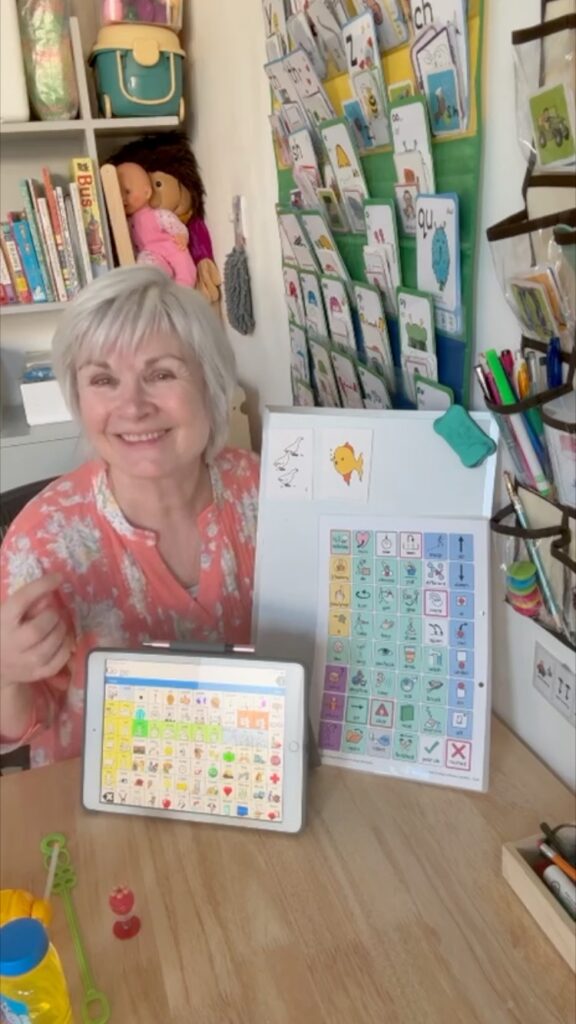
In this short therapy clip, I model just two simple words: ‘Go’ and ‘Up’.
But underneath those tiny moments is a combination of therapeutic strategies:
speech sound prompting
visual cueing
Makaton signing
AAC (Augmentative and Alternative Communication) modelling
repetition
motor planning support
language modelling
total communication principles.
Communication is bigger than speech alone
One of the biggest misconceptions about speech therapy is the idea that communication only ‘counts’ if a child says the word verbally.
In reality, communication comes in many forms:
speech
gesture
facial expression
signing
pointing
symbols
body language
AAC.
This is particularly true for children with:
developmental language disorder (DLD)
autism
motor speech difficulties
childhood apraxia of speech (CAS)
phonological difficulties
global developmental delay
complex communication needs.
These children often need communication to be presented through multiple pathways at once.
That is where total communication approaches become so powerful.
This is important to know: this does not confuse children. In fact, for many children, it does the opposite. It creates clarity.
Research suggests that learning signs alongside spoken language does not hinder speech development and may support overall language acquisition, communication confidence, and vocabulary growth in many children.
For many children, signs actually help speech emerge because they:
reduce communication pressure
build confidence
strengthen understanding of words.
A child who can successfully communicate is far more likely to keep attempting interaction.
The power of AAC and LAMP Words for Life
In the clip, I also model language using an electronic AAC system: LAMP Words for Life.
AAC stands for Augmentative and Alternative Communication.
AAC includes any tool that supports communication beyond speech alone, including:
picture systems
symbol boards
communication books
speech-generating devices.
LAMP Words for Life is one of my favourite AAC systems because it focuses on consistent motor patterns and meaningful language development. Because communication is not about achieving perfection. It is about connection.
And when children are given multiple ways to express themselves, they often become more confident, more engaged, and more willing to interact with the world around them.
That is the true power of total communication therapy.
Find a speech and language therapist for your child in London. Are you concerned about your child’s speech, feeding or communication skills and don’t know where to turn? Please contact me and we can discuss how I can help you or visit my services page.
That adorable string of ‘ba-ba-ga-ga-ma-ma’ might sound like baby gibberish, but it’s actually a crucial milestone in your little one’s language development. Babbling or babble, as we call it, is far more than just cute baby noises. It’s a sequence of sounds that lays the foundation for future communication.
Image by freepik
What is babbling?
Babbling typically begins around six months of age, though the timing can vary slightly from baby to baby. It involves your baby experimenting with different sounds, stringing together consonants and vowels. You might hear them repeating sounds like:
‘Ba-ba’
‘Da-da’
‘Ma-ma’
‘Ga-ga’
As they progress, the babbling becomes more complex, with variations in pitch, rhythm, and intonation. It might even sound like they’re having a conversation with you!
Why is babbling so important?
Laying the groundwork for speech: Babbling is like a vocal workout for your baby. By practising these sounds, they’re strengthening the muscles in their mouth, tongue, and vocal cords that are essential for speech.
Developing phonological skills: Through babbling, babies begin to understand the sound patterns of their native language. They’re learning which sounds go together and how they’re used.
Enhancing social interaction: Babbling is a social activity. Babies often babble back and forth with their caregivers, which helps them learn about the give-and-take of communication.
Cognitive development: The act of babbling requires babies to use their brains in new ways. They’re learning to control their vocalisations, pay attention to the sounds they’re making, and connect those sounds to the responses they receive from others.
How can you encourage babbling?
Talk to your baby: Even though they can’t understand your words yet, talking to your baby exposes them to language and encourages them to respond with their own vocalisations.
Imitate their sounds: When your baby babbles, imitate them! This shows them that you’re paying attention and encourages them to keep ‘talking.’
Respond to their babbling: Treat your baby’s babbling as if it’s a real conversation. Respond with words, smiles, and gestures.
Play sound games: Make different sounds for your baby and encourage them to imitate you. This could include animal sounds, silly noises, or simple words.
Read to your baby: Even before they can understand the words, reading to your baby exposes them to the rhythm and sounds of language.
Sing songs: Singing is a fun and engaging way to introduce your baby to new sounds and words.
Use mirrors: Babies often enjoy watching themselves make sounds in a mirror.
Tactile stimulation: Gentle massage around the mouth and face can increase oral awareness and encourage vocalisations.
Vary textures: Offer different textured teethers.
Read books with sound effects: Choose books with animal sounds or other engaging noises.
Blow bubbles: The act of blowing and popping bubbles can encourage vocalisations.
Use visual aids: Show pictures of objects and say their names, emphasising the consonant sounds.
Use exaggerated facial expressions: When you make sounds, exaggerate your mouth movements to help your baby see how sounds are made.
Increase joint attention: Follow the child’s gaze and point to objects that they are looking at and say the name of the object.
When to seek help
If you notice that your baby is not babbling by eight months, it’s a good idea to talk to your speech and language therapist. You might also notice a lack of variation in tone when your child is making sounds, is your baby sounding a little ‘flat’ or monotonous? While every child develops at their own pace, a lack of babbling can sometimes indicate a developmental delay or hearing issue.
Remember, babbling is a gift. So, enjoy those precious moments of ‘baby talk’ and take comfort in knowing that your little one is on the path to becoming a chatterbox!
Do get in touch via my contact form if you are concerned about your child’s development or if you simply want some reassurance that your baby is developing well. We will be delighted to arrange a screening appointment for you and give you support and reassurance.
Sonja McGeachie
Highly Specialist Speech and Language Therapist
Owner of The London Speech and Feeding Practice.
Find a speech and language therapist for your child in London. Are you concerned about your child’s speech, feeding or communication skills and don’t know where to turn? Please contact me and we can discuss how I can help you or visit my services page.
If you’ve found yourself wondering ‘Why can my child say a word one day, but not at all the next?’ it might be that your child has a motor speech difficulty. This means the challenge isn’t that your child doesn’t know what they want to say; it’s that their brain finds it harder to plan and coordinate the movements needed for clear speech. This speech difficulty is called Childhood Apraxia of Speech (CAS)
In this post, I’ll explain what CAS can look like in 2–5 year olds, what an assessment usually involves, and what you can start doing at home to support your child without turning life into ‘speech homework all day long’.
What is childhood apraxia of speech (CAS)?
Children with CAS often have lots to communicate about (and strong ideas!) but their speech may come out as:
Unclear
inconsistent
hard to ‘copy’ on demand
frustrating for them and for you
CAS is not caused by laziness and it is not a parenting issue. It is also not something children simply ‘grow out of’ without support. But with the right therapy approach, children can absolutely build clearer speech over time.
Many families come to me after months (or years) of being told:
‘She’ll talk when she is ready’
‘He’s just shy’
‘It’s probably a speech delay’
‘It’s normal for toddlers’
And sometimes it is a general delay. But sometimes it’s something more specific, like CAS.
There’s also been a huge rise in parents seeking information online, and CAS is often mentioned alongside speech sound difficulties such as:
phonological delay (pattern-based speech errors)
articulation difficulties (one sound that won’t come out clearly)
inconsistent speech disorder
These can look similar at first glance, which is why a specialist assessment matters.
Signs of childhood apraxia of speech in 2–5 year olds
Children develop speech at different rates, and not every unclear speaker has CAS. But here are some common features that may raise a flag, especially when you notice several together.
1) Inconsistent speech errors
Your child might say the same word in different ways:
‘banana’ → nana / baba / mana
‘daddy’ → gaga / daddy / dadi
This inconsistency is one of the biggest clues.
2) Difficulty copying words on request
Some children speak more easily in natural play, but when asked ‘Say ___’, they freeze or the word becomes much harder.
3) Limited sound repertoire
They may use only a small set of consonants (like /M/, /N/, /B/, /D/) and avoid others.
4) Vowel distortions
Many children with typical delays mainly struggle with consonants. But in CAS, vowels can also sound ‘off’ or change between attempts.
5) Speech that sounds effortful
You might notice your child:
pauses between sounds
tries multiple times
looks like they’re ‘searching’ for the right mouth movement
6) Longer words are much harder
‘Car’ might be easier than ‘carry’, and ‘carry’ easier than ‘caterpillar’.
7) Prosody differences (rhythm and stress)
Some children with CAS sound a little unusual in their speech rhythm, stress, or intonation.
8) Frustration or reduced confidence
When a child is frequently misunderstood, they may:
talk less
use gestures more
become upset when asked to repeat themselves
Important note: none of these signs alone prove CAS but they are a strong reason to seek a speech assessment rather than waiting.
CAS vs phonological delay vs articulation difficulty (quick guide)
These are some of the most common questions I hear.
If it’s mainly an articulation difficulty…
A child may consistently say one sound incorrectly (for example, ‘thun’ for ‘sun’- lisp- but everything else is developing well.
If it’s mainly a phonological delay…
You might notice clear patterns, like:
leaving off the ends of words (‘ca’ for ‘cat’)
swapping back sounds for front sounds (‘tar’ for ‘car’)
Patterns are often consistent and respond well to phonology-based therapy.
If it might be CAS…
Speech often feels less predictable, harder to imitate, and more impacted by word length and complexity.
If you’re unsure, that’s completely normal, and exactly why assessment matters.
What happens in a CAS assessment?
A high-quality speech assessment for possible CAS usually includes:
1) Parent discussion and developmental history
We talk about:
pregnancy and birth history (where relevant)
feeding history
early sounds and babbling
first words and how speech has progressed
family history of speech/language needs
2) A speech sound assessment
Your child might be shown pictures or play-based prompts so we can hear:
what sounds they can say
what they simplify
whether errors are consistent or inconsistent
3) An oral-motor and movement check
This isn’t about ‘strength’. It’s about coordination and planning. We look at how your child manages speech movements and transitions.
4) Stimulability testing
This means: how easily can your child learn a new sound or word with support?
For CAS, we often explore how they respond to:
slowed-down speech
visual cues
rhythm/tapping
short, simple syllable shapes
5) Functional communication and confidence
We look at how speech impacts daily life:
being understood at nursery
joining in with peers
asking for help
managing emotions when misunderstood
At the end, you should leave with:
a clear explanation of what we think is going on
a therapy plan
practical home strategies
realistic next steps
What parents can do at home
Here are CAS-friendly strategies you can start right away.
1) Choose ‘power words’
Pick 1–2 words that matter most in your child’s daily life, such as:
more
help
mummy
again
stop
open
These words are motivating and functional.
2) Keep it short and successful
For many children with CAS, the goal is quality over quantity.
Try five minutes a day rather than 30 minutes of struggle.
3) Support speech with rhythm
Some children benefit from:
tapping a beat on the table
clapping syllables
using a gentle ‘marching’ rhythm
This can help the brain organise the sequence of movements.
4) Celebrate approximations
If your child says ‘moh’ for ‘more’, that’s communication!
We want them to feel:
safe
understood
proud to try again
Confidence is a key part of progress.
A short parent story (anonymised)
One mum said to me:
‘We kept being told to wait. But I could see my child understood everything; they just couldn’t get the words out. Once we had an assessment and a plan, it felt like we finally knew what to do. The biggest change was his confidence. He started trying more.’
When should you seek support?
You don’t need to wait until school.
It’s worth getting an assessment if your child is:
hard to understand compared with peers
becoming frustrated or withdrawing from talking
inconsistent with words they used to say
struggling to imitate speech sounds
showing signs that match CAS
Early support can reduce stress for the whole family and help your child feel successful in communication.
Here’s how I can help:
✅ A detailed speech assessment (including whether CAS is likely)
✅ A clear therapy plan with realistic goals
✅ Practical home strategies you can use immediately
✅ Support for nurseries and schools (where needed)
✅ In-person sessions in North-West London and online options
Your child is communicating the best way they can, and with the right support, speech can become easier, clearer, and more confident.
Sonja McGeachie
Highly Specialist Speech and Language Therapist
Owner of The London Speech and Feeding Practice.
Find a speech and language therapist for your child in London. Are you concerned about your child’s speech, feeding or communication skills and don’t know where to turn? Please contact me and we can discuss how I can help you or visit my services page.
I am a neurodiversity affirming therapist and I love and endorse play-based therapy. I use it alongside a strengths-focused approach in all my sessions. Find out why we should use these transformative therapy methodologies in all our work and play with our children.
I always have a range of different toys and activities up my sleeve so that when one toy is no longer interesting, that’s fine. ‘Look here’s a new one, how about we try this one?’ When therapy feels like play, children are more likely to be engaged and attentive, which leads to better outcomes.
By using play as a context for Speech and Language Therapy we can create opportunities for children to use and practise their communication skills in a natural, real-life setting. This helps bridge the gap between the therapy room and everyday life.
Goals and targets
What about goals and targets I hear you say? Of course, as Speech and Language Therapists we always have our goals for any particular child. They can be speech goals (we want Bobbi to produce a ‘k’ sound at the end of words) or communication goals (we want Fatima to ask for something by pointing to it rather than grabbing it). And these goals can be achieved where there is a reciprocation and a positive, playful relationship between the adult and the child. That relationship comes through play and fun.
Play and fun
Play is how a child interacts and learns. If it’s fun, interesting, exciting or pleasurable then that is where the magic happens. And that is what we need to return to repeatedly and then see if we can fold our targets into the activity as we go.
As soon as we expect our child to do something and we try and shape their behaviours towards a certain outcome we no longer ‘play’. We are now in teaching mode, where we direct and where we are ‘in charge’. As a neurodiversity affirming therapist, I believe that all play is valid. We must not get into the trap of thinking that only functional play is valid, that there is only one way to play with that car ramp/puzzle/potato head. Our autistic children often need to play in a particular way to navigate their world and we must not try and stop that.
When we affirm and validate our child’s play and copy their play with enthusiasm and respect then, in my experience, all children regardless where they are on the neurodiversity spectrum will begin to engage with us, copy us, and learn how to communicate effectively about things that matter to them.
Play-based therapy allows therapists to tailor interventions to each child’s unique interests and abilities. This individualised approach increases the likelihood of success and progress.
Strengths-Focused Speech Therapy
Strengths-focused therapy emphasizes a child’s strengths and abilities rather than their deficits. It recognises that every person has unique strengths that can be harnessed to overcome challenges.
Focusing on strengths helps us build a positive self-image. This is especially important for children with communication disorders, as it can boost their confidence and self-esteem.
When we encourage children to play in ways that they enjoy and are good at they feel empowered and more in control of their lives and play. This can lead to increased motivation and a sense of ownership over their progress.
Now, imagine the powerful impact that can be achieved by combining play-based therapy and strengths-focused therapy in speech therapy sessions. This dynamic combination brings out the best of both worlds. It creates a therapeutic environment that is not only effective but also enjoyable for children and their families.
As Speech Therapists we can use the child’s strengths and interests as a foundation for play-based activities. This personalisation not only makes therapy more engaging but also more effective.
An example
Charlie, a 3-year-old with social communication challenges, had a deep interest in anything that spins. We used this strength and interest to create a variety of spinning activities. As he is allowed to engage in his spinners, we can practise lots of speech and language and provide great phrases alongside his interest and activities: Ready steady go! Stop! ‘another one’ ‘the red one’ ‘again again’ ‘I love it’ ‘it’s a spinner’ ‘Charlie loves this toy’ ‘it’s going fast’ ‘it’s so fun’ etc..
Over time Charlie started to copy some of these word models and then used them to create his own little phrases, such as ‘the blue one again’. When this occurred, we felt like celebrating because it had come naturally and appropriately to the situation without any coercion or direction. That is what communication is about! Well done Charlie!
Conclusion
Play-based and strengths-focused speech therapy approaches are powerful tools and by combining these approaches, we create a therapeutic environment that is not only effective but also enjoyable and empowering for our clients.
Contact me if you would like your child to have neurodiversity affirming speech and language therapy.
Find a speech and language therapist for your child in London. Are you concerned about your child’s speech, feeding or communication skills and don’t know where to turn? Please contact me and we can discuss how I can help you or visit my services page.
My baby isn’t babbling and developing speech – what can I do to support?
While every baby develops at their own pace, if your child isn’t babbling by nine months, it’s worth seeking help from an Early Intervention Health Professional, such as a doctor and a speech therapist. Don’t panic! There are many reasons for delayed babbling, and early intervention is key.
In the meantime, it is highly recommended that we talk, sing, and read to our baby often. Exaggerate sounds and expressions, and respond to their coos and smiles. This playful interaction helps stimulate their communication skills.
Below are some tips and tricks from my experience of working with babies and toddlers who need a little bit of help and support to develop.
The benefits of imitating your baby
Copying your baby’s sounds and gestures isn’t just silly fun, it’s a powerful learning tool! By mimicking their babbles and actions, you activate “mirror neurons” in their brain that help them connect sounds with meaning. This playful back-and-forth teaches turn-taking, a foundation for conversation. Plus, it encourages them to copy you, building their own language skills and social interaction abilities.
This is a nice clip on youtube showing how copying/imitating your baby looks like:
Here are some fun ways to imitate your baby:
Matchmaker: Grab two of the same, or two similar toys your child loves, like rainmakers or shakers. Give one to your baby and keep the other for yourself. When your child plays with his/her toy, mirror his/her actions with yours! This creates a fun, interactive game.
Face Time: Get down to your baby’s level, sitting opposite him/her on the floor or kneeling. This makes eye contact easy and encourages him/her to look at you during your playful imitation.
Be the Funniest You: Go all out with silly faces, exaggerated sounds, and big gestures. The goal is to capture your baby’s attention and make you irresistible to watch. This playful energy encourages him/her to interact and potentially imitate you back!
By incorporating these tips, you can turn imitation into a fun and engaging way to boost your baby’s communication skills. I have seen this happen numerous times over the past decades. It is very powerful, go ahead and try it! You cannot be silly and goofy enough!
Did you know that speech and language development starts with how we talk to our babies?
Adults naturally use a special way of speaking called motherese. It involves a higher pitch, slower pace, and exaggerated sounds compared to regular conversation. Sentences are simpler, with shorter words and repetition. This grabs babies’ attention, helps them distinguish sounds, and reinforces word meaning.
Imitation is a key part of motherese. We wait for our baby to make a sound or gesture, then playfully imitate it with exaggeration. Babies notice this right away and often respond with more vocalisations, creating a mini conversation. This back-and-forth teaches turn-taking, a foundation for future conversations.
By responding warmly and engaging in these playful interactions, we encourage our babies to keep exploring the world of communication. Talking, singing, reading and, of course, imitating, these simple actions can have a big impact on a baby’s language development.
Once your conversation is underway then try and keep it going for as long as possible. It’s a beautiful dance of turn-taking, even without words!
A last word on oxytocin
There’s evidence suggesting early non-verbal communication with your baby can increase a mother’s oxytocin levels, often called the ‘love hormone’. This hormone plays a key role in bonding and social connection. Positive interactions, touch, and stress reduction all contribute to oxytocin release, strengthening the mother–baby bond.
For parents of babies with extra needs
The stress of caring for a child with medical needs or developmental delays can be difficult. Stress can lower oxytocin levels, creating a cycle of sadness for both parent and child.
Breaking the cycle:
Knowledge is Power: Understanding the importance of communication can empower parents.
Seek Support: Speech therapists and other healthcare professionals can provide valuable guidance on communication strategies.
Start Small, Celebrate Big: Even small interactions can boost oxytocin. Focus on playful imitation and positive reinforcement. Remember, friends, family and healthcare professionals are there to encourage you.
This approach can help reverse the negative cycle and create a more positive and connected relationship between parent and child.
Feeding and Dysphagia (Swallowing) Specialist The London Speech and Feeding Practice
The London Speech and Feeding Practice
Find a speech and language therapist for your child in London. Are you concerned about your child’s speech, feeding or communication skills and don’t know where to turn? Please contact me and we can discuss how I can help you or visit my services page.
First up try and get down at eye level or Face-to-Face with your child
Try to sit so that your child can see you easily, i. e. your child does not have to look up to make eye contact with you. We call that Face to Face: try and sit opposite your child. This makes it easier for you to see facial expressions and therefore pick up nonverbal /pre-verbal communication. Now you can connect and share the moment with your child.
OWL (Observe, Wait and Listen)
Never skip this step as it prepares us for what happens next !
Observe
First, try and simply watch your child quietly and listen and observe what he/she says or does; you need to know what your little one is interested in. For example with this toy (pictured below) we could observe that your child loves the actual spinning of the marble, perhaps more than that noisy click-clacking down the run. Or perhaps he loves collecting the marble at the end and feeling it in his hand.
You could start off with showing once how the marble goes down and say:“ look it goes round and round !” Then hold back and observe, without speaking, so that your child has time to explore the toy.
Wait
Just sit and avoid telling or showing your child what he or she could do with the toy. This gives your child an opportunity to explore and experiment.
Listen
Listen to what your child says, or look at your child’s non-verbal communication without interrupting. Your child will now feel and know that you are really present and that what they have to say is important. It’s best to avoid questions like, “What are you doing or “What’s this?” as that might be a lot of pressure when they don’t know what to say about that yet.
Respond immediately by showing interest
Once you have all the information from OWLing you can respond in the right way, for example: if she catches the marble at the end of the run and looks up with a smile or a sound you could respond with: you’ve got it! One marble in your hand! Nice playing!
Now how to join in the play:
First you can copy what your child is doing
If your child puts the first marble at the top of the run you can take a turn and do exactly the same once his marble is done. Ideally you might have another marble run, perhaps a similar one, it does not have to be exactly the same! Once your child has put the first marble in you can do the exact same with your own marble on your run. Your child is likely to look at what you are doing and you might well see a smile on their face or perhaps she might say: look at mine!
Next you can build on that
You can respond with simple comments like: “Wow! Yes I am looking at yours now! It’s spinning on the red one lots! I love the noise!” Now wait once more to see what your child says or does.
To summarise
We are signalling to our child that we are really interested in what they are doing and saying so we can “collect” our child, i.e. bring him/her back into a joint interaction.
Important
We want to try and not direct our child but respond with interest and fun! This creates a lovely stage for interaction and joint play! And this leads in turn to practising conversation and ever more opportunities for great speech and language skills to emerge.
Great activities we use in Speech and Language Therapy:
Any cause and effect toys like this Marble Run
Creative activities, such as mark making with crayons
Train tracks (building and running the trains)
Find a speech and language therapist for your child in London. Are you concerned about your child’s speech, feeding or communication skills and don’t know where to turn? Please contact me and we can discuss how I can help you or visit my services page.
I want to talk about some concerns of SLTs, parents and increasingly autistic adults who explain to us how this communication method did not really work so well and why.
What is PECS in a nutshell:
PECS (Picture Exchange Communication System) is based on the idea of exchanging pictures in return for desired items. For more advanced users, it is used to communicate different functions such as emotions, comments, negations using the exchange of a sentence strip. It was founded on the principles of Applied Behavioural Analysis (ABA).
How does that look in practice?
In my experience, having been trained in the approach myself, the overall aim is eventually for the child to spontaneously go and get their picture book (PECS book), open it, look through a range of pages to select the correct picture of what they want to have or say, then go and find their communication partner, and finally place that picture onto the communication partner’s outstretched palm to be rewarded with an item or with a response of some sort. Or the child selects a range of pictures to create a little sentence, such as: ‘the blue fish swims in the sea’, ‘the red bird flies in the sky’ or ‘I see a red bird’ for example. This can be part of a structured table top activity.
The system follows a series of phases, starting from simple picture exchanges to eventually construction of sentences using symbols. PECS’s aim is to promote communication initiation and reduce frustration for those who struggle with speech.
So far so good one might say, why not? Before I go into the various concerns, I would want to add my own working experience with PECS, and whilst it is my opinion, I would say I have NEVER seen a working PECS book being used spontaneously!
My experience
I have seen attempts of stages 1 and 2 done quite well, in schools, and where people knew that I was coming in “to have a look at how PECS is working with child X”. Yes, in those instances an effort was made of course to try and show me how it worked. I must add that have never been very impressed. I cannot recall it used for any other items than: biscuits/quavers/crisps/ raisins and bubbles/puzzle pieces or spinners.
If we want to see a child trained to exchange for these items in a structured setting, i.e., the child sits at a little table with the adult sitting opposite enticing the child with one or other item, then yes that can be done successfully. I have seen children exchange 25 pictures with a crisp on it, for said crisp and they might have asked for another 25 of those crisps given half the chance. Yes. Good. But. I have yet to see a child go to their PECS book and go through all the motions that I mentioned above to get a crisp. In school they don’t need to: they know that crisps are only available when the PECS book is being practised. Otherwise, let’s be honest, it’s fruit at 10.30 am!
So, they don’t get a spontaneous opportunity to ask for highly motivating items as that is not how school works, is it? ‘SIR! Can I have a crisp?’ At 10.02am, in the middle of maths? Didn’t think so… So in reality this does not get practised in my experience.
A few concerns in no particular order:
Limited Generalisation
One issue often raised is the limited generalisation of skills learned through PECS. The structured nature of the program may result in a child only being able to communicate effectively within the specific contexts where they were taught to use the system (as I suggest above: crisps: yes, please let’s do the PECS for it). This limitation can pose challenges when trying to apply communication skills in new or unstructured/spontaneous situations.
Lack of Spontaneity
Critics suggest that PECS can sometimes lead to scripted and less spontaneous communication. This is also what I have observed. Since the method is designed to follow a structured progression, there is a concern that individuals might struggle to initiate communication outside of the established framework, potentially hindering their ability to engage in more natural interactions.
Narrow range of communication functions being practised
While PECS is quite successful in focusing on requesting and naming items, there are many other important communication functions, such as expressing emotions, asking questions, giving opinions or greetings for instance. We can argue that a communication core board where we have a whole range of different core words available lends itself much better to practising a range of communicative functions.
The Pictures are movable
They are attached to the book via Velcro. They are constantly being picked and exchanged and then returned to the book. This means that the pictures tend to be always in different places. This goes against the motor planning that takes place when one is learning a new skill: imagine you want to learn to touch type and the letters always move and are at different places? How can you be quick about finding a letter? You can never get to “automatic” with this type of approach.
Communication is not taught via behavioural means
Only if you say “banana” in the way that I dictate that you should will you get a piece of banana. Who does that? Nobody. Typically, child points to the counter where there is a banana and says: ‘ba’ or ‘ana’ and mother/carer will look over there and say ‘oh banana! You want a banana? Ok there you go have a piece.’ Or something like it. Mother will not say: ‘SAY BANANA or else you won’t get it.’ Child hears mum saying ‘Banana’ each time and with time will point and say ‘banana’ or ‘I want-a-nana’ or something. This is how communication is learned: through the adult modelling it cheerfully all day long and the child hearing it and then gradually copying it.
One other gripe I personally have but I am reliably informed by all my parents that they share this about PECS:
IT IS SO LABOUR INTENSIVE!
There are 10, 50, 100’s of little pictures that first of all need laminating… then velcroing, then finding and replacing. As I said above, it’s a constant moveable feast for one, but also you LOSE them. Yep. You want to find the picture for “trampoline”. ‘Where is it? I saw it yesterday… We had it outside when we practised you asking for the trampoline. I am sure we put it back? Where is it??? Ok. We need to print off a new one.’
It is also labour intensive for the first stage where you need to have TWO adults to ease the exchange (pick up and release of picture into the communication partner’s hand). Who has two adults available for what can be weeks until the child is able to pick up and release by themselves?
YEP. So it’s really not for me you can tell! I much prefer Core boards (see my previous post on using one) or electronic speech generating AAC devices like GRID, or LAMP or TOUCHCHAT. These are all great to use and there is good support out there for introducing these.
Finding a Balance
While the concerns surrounding the PECS approach are valid, it’s fair to note that the method also has some merits. There is anecdotal evidence of many individuals who have successfully improved their communication skills and quality of life through PECS. But, finding a balance between using PECS as a stepping stone and ensuring the development of more comprehensive and SPONTANEOUS communication is key.
As educators and therapists, we need to extend the focus beyond requesting and labelling by incorporating symbols that represent emotions, actions, and more complex ideas. This expansion encourages a broader range of communication functions. When the time is right, gradually transitioning from PECS to more advanced communication methods such as Core boards or electronic AAC tools and speech-generating devices is the way forward.
We want to value all communication equally and our approach ought to be playful and child-led and to focus on intrinsic motivation instead of extrinsic rewards and reinforcers.
If you have any questions or if you are looking for a therapist who endorses play-based and child-led therapy approaches, please do reach out.
Find a speech and language therapist for your child in London. Are you concerned about your child’s speech, feeding or communication skills and don’t know where to turn? Please contact me and we can discuss how I can help you or visit my services page.