Why tongue lateralisation matters: The hidden feeding skill that every toddler needs

|

When parents think about feeding milestones, they often focus on what their child is eating. Are they accepting lumps? Will they eat vegetables? Are they managing finger foods?

However, one of the most important skills happening behind the scenes is something many parents have never heard of: tongue lateralisation.

Tongue lateralisation simply means the tongue’s ability to move from side to side inside the mouth. Although this sounds like a small movement, it is one of the key building blocks for safe chewing, efficient eating and later speech development.

As a Speech and Language Therapist specialising in infant feeding, I frequently assess children who have delayed or absent tongue lateralisation. The encouraging news is that this skill can often be developed. But like many areas of development, there is an optimal window during which children learn it most naturally.

What does the tongue actually do during eating?

Eating is an incredibly complex process involving the lips, jaw, cheeks, tongue and swallowing muscles all working together.

For mature chewing, the tongue needs to:

  • move food from the centre of the mouth onto the back gums and molars
  • keep the food positioned while the jaw chews
  • collect scattered pieces of food from around the mouth
  • reform the chewed food into a single cohesive bolus
  • move that bolus safely to the middle of the tongue before swallowing.

Without good tongue lateralisation, food often stays in the middle or front of the mouth where it cannot be chewed effectively.

Children may compensate by:

  • swallowing pieces whole
  • mashing food with the front teeth only
  • relying on sucking instead of chewing
  • holding food in their cheeks
  • gagging frequently
  • refusing more challenging textures altogether.

These children are often described as ‘fussy eaters’, when in reality they may simply lack the oral motor skills needed to manage more advanced textures comfortably.

When should tongue lateralisation develop?

Tongue lateralisation begins to emerge during the second half of the first year of life as babies start exploring textured foods.

Between approximately 6 and 12 months, babies naturally begin learning to move food sideways towards their gums for early chewing. As molars develop during the second year, these movements become more refined and efficient.

This period represents an important developmental window because babies are biologically programmed to experiment with increasingly varied textures. Repeated opportunities to chew different foods strengthen the tongue, jaw and cheek muscles while building the complex movement patterns needed for mature eating.

If a child remains on smooth purées or very soft foods for too long, they may miss hundreds of opportunities to practise these essential movements.

Why does this developmental window matter?

Like learning to crawl, walk or ride a bicycle, oral motor skills develop through repeated practice.

Children who do not experience enough chewing opportunities during infancy can sometimes continue to rely on immature sucking and munching patterns well into toddlerhood.

This does not mean the opportunity is completely lost after infancy. Many toddlers can still learn tongue lateralisation successfully with the right support. However, the longer an immature pattern is used, the more established it becomes, making change more challenging.

That is why early assessment is so valuable.

Signs your toddler may have poor tongue lateralisation

You may notice your child:

  • chews mainly with the front teeth
  • bites but does not chew efficiently
  • keeps food in the centre of the mouth
  • pockets food in the cheeks
  • frequently spits out textured foods
  • gags on lumps
  • prefers soft foods
  • swallows before food has been adequately chewed
  • takes a very long time to finish meals.

Not every child showing these signs has an oral motor difficulty, but they do warrant further assessment.

How can we encourage tongue lateralisation?

The good news is that the tongue learns through experience.

One of the best ways to encourage side-to-side movement is by offering long, resistive foods that naturally encourage the tongue to move food towards the side gums for chewing. We also call them sometimes HARD MUNCHABLES – they look like on the following image.
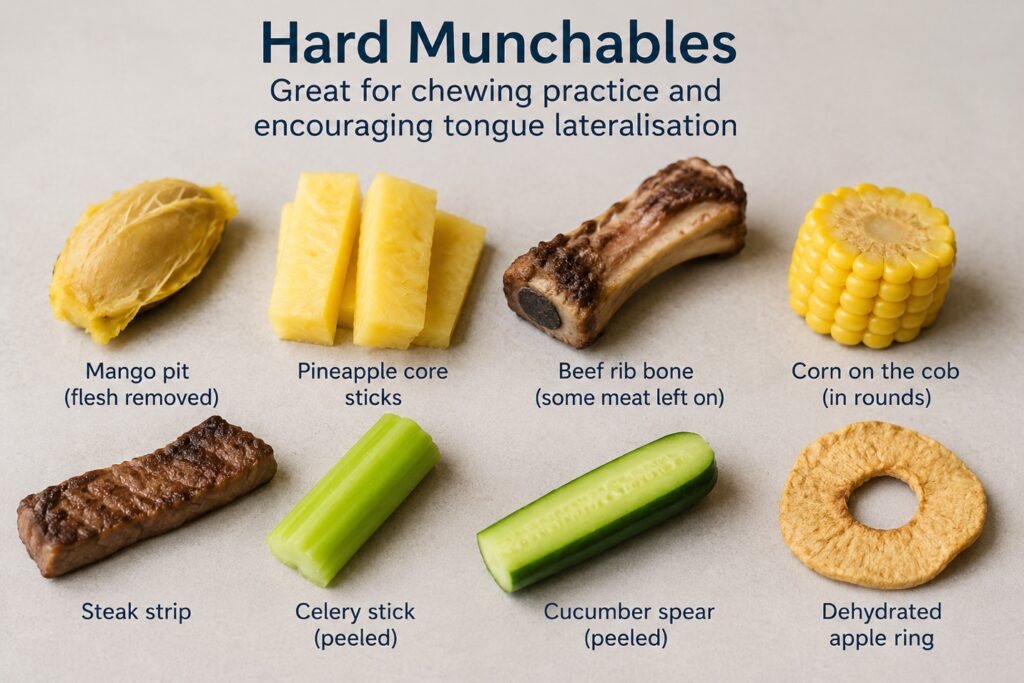
Hard munchablers

Examples include:

  • mango pits with most of the flesh removed
  • pineapple core strips
  • thick steak strips
  • cooked pork strips
  • peeled celery sticks
  • thick cucumber spears
  • roasted pepper strips
  • corn on the cob cut into manageable rounds
  • dehydrated apple rings
  • large clean cooked rib bones with a little meat remaining for supervised chewing practice.

These foods are not intended for children to consume large pieces quickly. Instead, they provide resistance that encourages the jaw, cheeks and tongue to work together while giving valuable sensory feedback.

A simple technique that can help

Some toddlers struggle because they never naturally move food to the side of their mouths.

In these cases, placing a long strip of food gently onto the side gums can sometimes trigger the chewing pattern automatically. This gives the tongue an opportunity to experience where chewing should occur.

This should always be done calmly, with the child sitting upright and under close adult supervision.

Every child develops differently

Some children are more likely to experience delayed tongue lateralisation than others.

This may include children who:

  • remained on purées for an extended period
  • have developmental delays
  • have low muscle tone
  • were born prematurely
  • have significant sensory processing differences
  • have experienced prolonged tube feeding or medical conditions affecting feeding.

A feeding assessment can identify whether tongue movement, jaw stability, sensory processing or another factor is contributing to the difficulty.

Early intervention makes a difference

One of the biggest misconceptions I hear is:

‘They’ll grow out of it.’

Some children do. Others don’t.

Without intervention, inefficient chewing patterns can persist for years, affecting food variety, mealtime confidence and nutritional intake. In some cases, immature oral motor patterns may also contribute to unclear speech production later on, although feeding and speech skills do not always develop at the same rate.

The earlier we identify a problem, the easier it usually is to help children develop more mature, efficient chewing patterns.

Final thoughts

Tongue lateralisation may not be a term many parents recognise, but it is one of the foundations of successful feeding.

By offering opportunities to chew a variety of safe textures during infancy, parents help build the complex tongue movements needed for efficient eating throughout childhood.

If your toddler still struggles with chewing, gags on textured foods, or seems unable to move food around their mouth, don’t simply wait and hope they will outgrow it. A comprehensive feeding assessment can identify exactly where the difficulty lies and provide practical strategies tailored to your child’s needs.

Sometimes a few small changes at the right time can make a lifetime of difference. Do get in touch with me. I would love to hear from you and help your little one develop good chewing skills and eating habits.

Sonja McGeachie

Highly Specialist Speech and Language Therapist

Owner of The London Speech and Feeding Practice.


Health Professions Council registered
Royal College of Speech & Language Therapists Member
Member of ASLTIP

Find a speech and language therapist for your child in London. Are you concerned about your child’s speech, feeding or communication skills and don’t know where to turn? Please contact me and we can discuss how I can help you or visit my services page.

3

Similar Posts

  • · ·

    LAMP Words for Life: A revolutionary AAC system

    Introduction

    When working with non-speaking or minimally speaking children the LAMP Words for Life AAC (Augmentative and Alternative Communication) system is my absolute go-to every time. For me it stands out as a revolutionary system that has transformed the lives of many of my non-speaking students. LAMP Words for Life is a ROBUST, comprehensive language-based AAC system and it is designed to help any user to express their thoughts, feelings, and needs effectively, thereby achieving maximal independence in their daily life. A winner!

    There is a whole host of AAC apps and systems out there and each has their own advantages and benefits for sure. I have tried a good number of other systems. I do also like certain features of other AAC systems for sure. For example GRID: I love the versatility of GRID and the ease of editing the system is fantastic.

    Why I think it works so well

    However, strangely I always return to LAMP when push comes to shove. I have thought very carefully about it and so here are my thoughts on why this is and why it works so well:

    1. Intuitive interface: LAMP Words for Life features are for me really user-friendly and it is easy to navigate and understand (this is very important for non-techy people). I think it makes sense and it is accessible to users of all ages and abilities. Yes the pictures are a little bit different to other symbol systems we use, especially here in the UK to be sure, and this is one of the reasons why it is good to have a variety of systems available, so that we can cater for students who are used to other symbols or do very well with specific symbol core boards. I have learned though that the pictures are not that important when using LAMP because the entire system is based on MOTOR PLANNING. And once one knows the motor plan to find a picture it is in our brain and we do not look at the picture any more. So, the motor plan to find a word is much more important when using LAMP than worrying about what the picture looks like.
    2. Comprehensive vocabulary: The system offers a vast vocabulary of words and phrases, covering a wide range of topics and contexts. This enables users to express themselves effectively on a variety of subjects. That said, almost every time I use LAMP there is a little word I need and it’s not on there. But that’s not a problem: for example, I was looking for ‘sunglasses’ the other day. Sure, there is ‘sun’ and ‘glasses’ but that would be two separate motor plans and for my student that would be too many for now, so it was very easy to quickly add the new word ‘sunglasses’ under ‘accessories’ or ‘beach wear’ — I added it within less than one minute. Likewise, there are a ton of words which cater for the US market, and I tend to change them to fit the UK vocabulary like ‘nappy’ for ‘diaper’. Or I delete them entirely if I feel my child will never need to use a certain word like ‘conference’ or ‘nun’. PS: should they get to a point of using the system as an adult independently then these words can surely be added again, or if my student ever moves to the US then the words can be changed back to US terms again without any problem.
    3. Grammar support: LAMP provides built-in grammar support, helping users construct grammatically correct sentences. This can be particularly beneficial for individuals with language processing difficulties. But what I love about the way LAMP is organised here is that, in contrast with other systems I have used, it does not PREDICT what you want to say, it lets the user decide and find the right grammatical structure. I appreciate this because, just like I hate my phone or email offering predictive text or offer corrections to my words, I really do not get the systems that offer automatically a grammar change which mostly I don’t want. Where that is the case, I am often confused and hindered in finding the correct wording. I love the simplicity of LAMP and at the same the complexity that can be achieved gradually with practice. LAMP is fully designed to enable a user to build up not only vocabulary but a full language system. On a course recently I was able to hear adult LAMP users speaking to the audience in full and quick grammatically well-rounded sentences on a host of topics.
    4. Customisation: LAMP can be customised to meet the individual needs of each user. This includes options for adjusting the vocabulary, layout, and accessibility features. It is not as easy to edit as GRID I will say and that can cause me a little bit of frustration at times, but on balance I still vastly prefer the system as a whole. It can also be customised quite well for Gestalt Language Processors. It takes a little bit of practice and thinking about how best to do this but I have found a way that works well which I demonstrate in the short video clip.
    5. Community support: LAMP Words for Life has a thriving community of users on Facebook and this is so valuable and inspiring. Therapists and families of LAMP users alike share experiences, provide resources, and offer encouragement. This can be a valuable source of support for both users and their families.
    6. Comprehensive support: LAMP Words for Life offers quick and thorough support services, including training, resources, and ongoing assistance. This is invaluable and reassuring for both users and caregivers.
    7. Research-based: The development of LAMP Words for Life is based on extensive research and evidence-based practices. This ensures that the system is grounded in sound scientific principles.

    Conclusion

    To conclude LAMP Words for Life is a powerful AAC which provides us with a means of effective communication, language development, and social interaction. Whether you are a parent of a non-speaking child or a speech therapist looking for innovative AAC solutions, LAMP Words for Life is worth exploring.

    Example on how to use AAC at story time

    Feel free to contact me if you need help with your child.

    Sonja McGeachie

    Early Intervention Speech and Language Therapist

    Feeding and Dysphagia (Swallowing) Specialist The London Speech and Feeding Practice

    The London Speech and Feeding Practice


    Find a speech and language therapist for your child in London. Are you concerned about your child’s speech, feeding or communication skills and don’t know where to turn? Please contact me and we can discuss how I can help you or visit my services page.

    1
  • ·

    Transforming Mealtimes

    Speech Therpaist in London

    Transforming Mealtimes

    Below are two reviews I got from grateful clients over the past 4-6 weeks; this blog is more about how Feeding Therapy can help you than blowing my own trumpet…. though that said, it is always so nice and gratifying to hear when parents are happy and hopeful about their little one’s feeding journey. Feeding Therapy is a substantial part of my work as a Children’s Speech and Language Therapist. One of my specialist subjects is Autism and we find that many children on the Autism Spectrum are very specific about eating, and will often refuse a range of typical family foods in favour of a narrow range of foods/snacks.

    Mostly, feeding difficulties are a combination and complex cocktail of factors that have contributed to the current status quo: sure, there may have been some physical problems to start off with, such as reflux causing the baby discomfort, constipation, a very tight tongue tie or a swallowing problem caused by neurological difficulties and of course sensory processing difficulties are also very physical experiences. We always begin with a very thorough case history taking and information gathering, followed by an oral assessment and observation of the actual swallow to establish what might have been – or still might be – the cause for the feeding difficulties.

    In most of the cases I see in my practice, the original obvious cause is no longer present, especially with older children. So, if the swallowing is fine, the reflux is no longer present, the tongue was divided (twice!) why are they still not eating much, refusing to try new foods, only accept certain textures etc.

    The answer is extremely complex and multi-faceted and this little blog is not covering any factors in detail (we would be here all night) -I mentioned sensory processing difficulties earlier on. These are mostly still present but often not acknowledged or recognised by parents. And it is certainly the case that one of the contributors is parental anxiety; this tends to run very high and has been for many months, sometimes years. This in turn often leads to very tense and unpleasant, endlessly long meal times and many times children are force-fed several times a day in order to “get something down there” as otherwise they would probably starve themselves.

    Additionally, parents end up only offering a very narrow range of foods because that is all their child will eat. This ends up in a vicious cycle of children being fed porridge-style food for all meal times and of course they won’t progress to more mature foods if these mature foods are never on offer.

    In order to help address and disentangle some of the issues I often introduce the “Division of Responsibility in Feeding” as researched and recommended by Ellyn Satter (The Satter Feeding Dynamics Model)

    Here are the main points of her approach:

    Children have a natural ability with eating, they eat as much as they need and they grow in the way that is right for them and they learn to eat what their parents eat. (E Satter). The parent is responsible for WHAT the child eats, WHERE and WHEN the child eats. The child is responsible for HOW MUCH they eat or WHETHER to eat. Satter proposes that parents should guide their child’s transition from nipple feeding through semi-solids, then thick and lumpy foods to finger foods and then on to normal family meals.

    Please note: this model is only appropriate for children where the original physical cause is no longer present!

    Of course it’s not easy! It requires a huge shift in thinking about feeding and it requires to trust our children to know what is best for them. This is very big for most parents, as it is not how we were brought up and it is not commonly known that babies and children know what is good for them!

    However, it is certainly true that parents who follow this particular approach and make small, steady changes in the way the offer foods, and in the way they create family meal times differently, children make very nice, pleasing progress and over some months we often see remarkable positive changes.

    I like to work in a team and especially for this type of problem it is essential to have a multi-disciplinary approach. A knowledgeable dietician is an enormous plus in any feeding team as is of course a

    Paediatrician and/ or a Gastroenterologist and the most important people in the team are the parents!

    Feeding Therapy is all about collaboration and a ‘team around the child” approach. When we have this in place and there is trust amongst the team members then we make fantastic progress.

    Do get in touch with me if you would like some help with your tricky feeder.

    Lovely Reviews

    I visited London Speech and Feeding a couple of days ago with my 8-month-old granddaughter and her mother. Sonja made us feel comfortable and at ease from our first introductions. She was able to pinpoint my granddaughter’s mum’s anxiety around weaning very quickly. She not only gave her the tools to do this successfully, but also really encouraged my granddaughter’s mum and instilled confidence that she had everything she needed to make this sometimes-difficult transition without further anxiety.

    Sonja was very thorough in her initial assessment of my granddaughter’s physical milestones and her developing speech. My granddaughter felt very comfortable with Sonja and happily played along with her. Then came the big moment – trying out various foods! We were amazed to see just how easily my granddaughter, with Sonja’s expert encouragement, took to sampling the wonderful array of different delicious morsels Sonja had prepared for the session. My granddaughter even drank from a cup for the first time! Wonderful!

    Sonja then emailed a summary of the session and an extensive array of resources with suggestions for my granddaughter’s mum which she has now put into action. My granddaughter’s mum couldn’t thank Sonja enough for her caring attitude, extensive knowledge, and warm professionalism. I have no hesitation in recommending Sonja, she’s a fantastic Feeding Therapist!

    Sonja (and her lovely colleague, Sandra) were stupendous. I had brought my one-year-old son to see them as I was concerned that he wasn’t eating enough. They looked at his history and we ate together to make sure they had all the information they needed to give an accurate diagnosis. Whilst our outcome was that Henry was in fact doing brilliantly (and I just needed to chill out a bit!), I would imagine if there was something more serious going on, Sonja would make you feel just as supported and empowered as she did with us. Excellent follow-ups too. Money well spent for a bit of reassurance for a stressed out mama. Thank you, Sonja!


    Find a speech and language therapist for your child in London. Are you concerned about your child’s speech, feeding or communication skills and don’t know where to turn? Please contact me and we can discuss how I can help you or visit my services page.

  • · ·

    Using AAC in daily life

    Communication is a fundamental human right, a bridge that connects us to the world and each other. For many, spoken language is the primary mode, but for individuals with complex communication needs, Augmentative and Alternative Communication (AAC) offers a powerful pathway to expression and connection. This guide will demystify AAC, highlight the crucial role of modelling, and provide practical examples of how low-tech AAC can be seamlessly integrated into everyday activities.

    What is AAC in a nutshell?

    AAC encompasses a wide range of tools and strategies that supplement or replace spoken language. It’s not about replacing speech, but rather about providing additional ways for individuals to communicate effectively. Think of it as a spectrum:

    • Unaided AAC: This involves using only your body, such as gestures, facial expressions, body language, and sign language.
    • Aided AAC: This involves external tools or devices. These can range from low-tech options like picture boards and communication books to high-tech speech-generating devices (SGDs) and apps on tablets.

    The beauty of AAC lies in its flexibility and personalisation. It empowers individuals to express their wants, needs, thoughts, and feelings, fostering independence and participation in all aspects of life.

    Modelling is KEY: Showing, not just telling

    Imagine trying to learn a new language without ever hearing it spoken. It would be incredibly difficult, right? The same principle applies to AAC. Modelling is the single most important strategy for teaching and supporting AAC users. It means actively using the AAC system yourself while talking, demonstrating how to navigate the system and express messages.

    Here’s why modelling is so vital:

    • It’s how we learn language: Typically developing children learn language by hearing it constantly around them. AAC users need the same immersion.
    • It reduces pressure: When you model, you’re not asking the individual to communicate, you’re just showing them how it’s done. This takes the pressure off and makes learning more enjoyable.
    • It expands vocabulary and concepts: By modelling a variety of words and phrases, you introduce new vocabulary and demonstrate how to combine symbols to create more complex messages.
    • It demonstrates purpose: Modelling shows that AAC is a functional and effective way to communicate, not just a set of pictures.

    So, how do you model? It’s simple: point to the symbols on the communication board or device as you speak the words. For example, if you say, ‘Time to eat breakfast,’ you might point to ‘time’, ‘eat’, and ‘breakfast’ on the board.

    Low-tech AAC in action: Everyday activities

    Low-tech AAC, such as communication boards, books, or single-page displays, is incredibly versatile and can be easily incorporated into daily routines. These can be as simple as printed pages with symbols, laminated for durability.

    Let’s explore how low-tech AAC can be used throughout a typical day, with examples of symbols:

    1. Getting ready for nursery

    Mornings can be busy, but they also offer rich communication opportunities. A ‘Getting Ready’ communication board can help sequence activities and offer choices.

    Activity example:

    ‘Time to get up!’ (point to GET UP). ‘What do you want to wear today, the blue shirt or the red shirt?’ (point to GET DRESSED) ‘Then, we brush teeth’ (point to TOOTHBRUSH) and so on.

    AAC mornings symbol examples

    2. Breakfast Time

    Mealtimes are perfect for making choices, expressing preferences, and commenting. A ‘Breakfast’ communication board can focus on food items, actions, and social comments.

    Example symbols:

    AAC meal times symbol examples

    Activity example:

    ‘What do you want to eat for breakfast?’ (point to EAT). ‘Do you want cereal or toast?’ (point to CEREAL or TOAST). If they finish their milk, you could say, ‘Are you ALL DONE or do you want MORE MILK?’ (point to symbols).

    3. Catching the Bus

    Even routine transitions like catching the bus can be communication rich. A small, portable ‘Travel’ board can be useful.

    Example symbols:

    AAC catching the bus symbol examples

    3. Being on the playground

    The playground is a dynamic environment perfect for commenting, requesting actions, and engaging in social play.

    AAC playground symbol examples

    Activity example:

    ‘Let’s PLAY!’ (point to PLAY). ‘Do you want to go on the SWING or the SLIDE?’ (point to symbols). If they are on the swing, you can say, ‘Do you want to go FAST or SLOW?’ (point to symbols) and ‘Push AGAIN!’ (point to PUSH) You can also model social language like ‘It’s MY TURN.’

    Beyond the symbols: Key takeaways

    • Consistency is key: Use AAC consistently across all environments and with all communication partners.
    • Be patient: Learning a new language takes time. Celebrate small successes.
    • Make it fun: Integrate AAC into play and enjoyable activities.
    • Follow the individual’s lead: Respond to all communication attempts, even if they are imperfect.

    In the video below I model how to integrate AAC into everyday activities with a few more examples and I discuss the difference between AAC and PECS.

    If you need some inspiration with using AAC or would like your child assessed for the right type of AAC then please get in touch.

    Sonja McGeachie

    Highly Specialist Speech and Language Therapist

    Owner of The London Speech and Feeding Practice.


    Health Professions Council registered
    Royal College of Speech & Language Therapists Member
    Member of ASLTIP

    Find a speech and language therapist for your child in London. Are you concerned about your child’s speech, feeding or communication skills and don’t know where to turn? Please contact me and we can discuss how I can help you or visit my services page.

    1
  • Getting down on their level: Why face-to-face play is a speech therapy superpower

    As parents, we spend a massive portion of our days multi-tasking. We are talking to our toddlers while washing dishes, shouting encouraging words from across the living room while folding laundry, or answering their questions from a few feet above them while walking through the supermarket. It is a completely natural dynamic, after all, the adult world happens up here, and their world happens down there.

    But when it comes to actively boosting your child’s speech and language development, one of the simplest, most profound changes you can make costs absolutely nothing and requires no special training.

    It is simply this: Get down on the floor, sit cross-legged, and get face-to-face.

    At London Speech and Feeding I call this physical positioning ‘face to face’. It is also one of the major ‘Hanen Programme’ Strategies. It completely reshapes how your child interacts with you, transforms how they process language, and turns ordinary playtime into an instant communication opportunity.

    Our mouth is the magic: Visual cueing and speech imitation

    When a child is learning to talk, they aren’t just listening to the sounds you make; they are watching how you make them.

    Speech is an incredibly complex motor skill. To say a single word, the brain must coordinate the lips, tongue, teeth, jaw, and vocal cords in a fraction of a second. When you speak to your child from a standing or even a seated chair position while they are on the floor, your mouth is entirely out of their direct line of sight. They miss the visual roadmap of speech.

    When you sit right in front of them at eye level:

    • They see mouth shapes: They can see how your lips round for an /OO/ sound, how your teeth touch your lip for an /F/ sound, or how wide your mouth opens for an /AH/.
    • They read facial expressions: Emotions give context to words. Seeing your eyes widen with excitement or your eyebrows lift in surprise helps them map meaning onto the vocabulary you are using.
    • They mimic naturally: By putting your face directly in your child’s field of vision, you make it infinitely easier for her or him to try and copy your oral movements.

    If you are working on a specific word like ‘pop’ while blowing bubbles or ‘more’ during snack time getting your face just a foot or two away from your child gives her or him the front-row seat she or he needs to learn the mechanics of that word.

    Unlocking joint attention: The foundation of all languages

    Before a child can say their first words, they need to master a milestone called joint attention.

    What is joint attention?

    It is the magic moment when a child looks at an object (like a toy train), looks up at you to share their excitement, and then looks back at the object. It is a three-way loop of shared experience.

    Without joint attention, communication cannot thrive. If a child is entirely hyper-focused on a toy and ignoring your presence, or if you are commenting on a book they aren’t looking at, true communication isn’t happening.

    When you get down on the floor on a play mat, you naturally insert yourself into their bubble. You aren’t a distant narrator anymore; you are a co-player. Being at their level makes it incredibly easy for their eyes to flick from the toy straight to your face. This shared gaze is the exact moment language takes root. It signals to the child, ‘We are experiencing this together, and this thing we are doing has a name.’

    The ‘wait and see’ technique

    Once you are down on the floor, the temptation is often to take over by pointing at everything, asking a million questions like ‘What’s that?’, ‘Is that a blue train?’, or somehow driving the play.

    Instead, the most powerful thing you can do at eye level is to practise the ‘Wait and See’ technique.

    In the video clip you can see this exact dynamic in action. Look at how I am sitting cross-legged on the mat, at eye level with the toddler. Notice how my hands are on the toy container, but my eyes are locked on the child. I am not forcing the interaction; instead, I am waiting.

    Here is how you can use this strategy at home:

    1. Set the stage: Get down on their level with a high-interest toy that requires help (like a wind-up toy, bubbles, or a tight-lidded box with toys inside).
    2. Create anticipation: Hold the object near your face or place your hands on it, but don’t open or activate it right away.
    3. Lean in and wait: Lean slightly forward, open your eyes wide, adopt an expectant facial expression, and completely pause. Count to five or ten in your head. Do not say anything.
    4. Capture the gaze: Wait for the exact moment your child looks up from the toy to meet your eyes, as if to say, ‘Well? Are you going to open it?’
    5. Reward the eye contact: The instant they make eye contact, deliver the language reward! Model a simple, functional word like ‘Open!’, ‘Go!’, or ‘Look!’ as you immediately do the action.

    By pausing and waiting at eye level, you create a ‘communication temptation’. The child learns that looking at you and engaging with your face is the key that unlocks the fun.

    Making it a daily habit

    You don’t need to spend hours a day sitting on the floor to see a difference. Start small by dedicating just 10 to 15 minutes of undivided, face-to-face play time each day. Turn off the television, put your phone in another room, get down on their level, and let them lead the play while you focus on being their visual communication partner.

    Whether you’re opening a little toy briefcase, pushing a plastic train along a track, or stacking blocks, remember: your face is the best toy in the room.

    Are you wondering if your toddler’s speech and language milestones are on track? At London Speech and Feeding I love helping families navigate early communication. Feel free to explore my services page and reach out directly to schedule a consultation.

    Sonja McGeachie

    Highly Specialist Speech and Language Therapist

    Owner of The London Speech and Feeding Practice.


    Health Professions Council registered
    Royal College of Speech & Language Therapists Member
    Member of ASLTIP

    Find a speech and language therapist for your child in London. Are you concerned about your child’s speech, feeding or communication skills and don’t know where to turn? Please contact me and we can discuss how I can help you or visit my services page.
    3
  • · ·

    Halloween without the tears: Supporting children through the Spooky Season

    For many families, Halloween is an exciting time filled with costumes, decorations, and sweets. But for children who are sensory sensitive, whether they’re autistic, have sensory processing differences, or simply find new experiences overwhelming, Halloween can feel like a night of chaos rather than fun.

    The bright lights, unexpected noises, strange textures, and social pressure to ‘join in’ can quickly become too much. The good news? With some thoughtful planning and gentle support, you can make Halloween a positive and manageable experience for your child.

    Understanding sensory overload

    Sensory overload happens when a child’s brain receives more sensory input than it can process. This might mean:

    • Costumes that itch, squeeze, or feel strange on the skin.
    • Loud sounds like doorbells, fireworks, or shrieking decorations.
    • Crowds and unpredictability during trick-or-treating.
    • Strong smells or tastes from face paint or unfamiliar sweets.

    When overloaded, children may cry, cover their ears, hide, run away, or ‘shut down.’ These reactions aren’t ‘bad behaviour’, they’re signs of distress. The goal isn’t to eliminate Halloween fun, but to adjust it to your child’s comfort level.

    Step 1: Choose costumes wisely

    Costumes are often the biggest trigger. Scratchy fabrics, tight seams, or masks that restrict breathing can be unbearable for some children.

    Try these tips:

    • Go sensory-friendly: Use soft, breathable fabrics and remove tags. Many retailers now sell sensory-safe costumes.
    • Test it early: Let your child wear the outfit around the house before Halloween. If it’s too much, simplify — maybe themed pyjamas or a favourite T-shirt with Halloween accessories.
    • Skip the mask: Face paint can be equally challenging, always test on a small patch of skin first. A comfortable headband or hat might be enough to feel ‘in costume.’

    Remember, participation doesn’t require perfection. Your child can still ‘be’ their favourite character without a full costume.

    Step 2: Plan your Halloween environment

    Before the big day, think about what parts of Halloween your child enjoys — and what might overwhelm them.

    At home:

    • Keep decorations minimal and predictable. Avoid motion-activated sounds or flashing lights.
    • Practise knocking at your own front door or saying ‘trick or treat’ with a trusted adult.
    • Have a ‘quiet space’ ready, a cosy corner or room where your child can retreat if things get too intense.

    If you’re going out:

    • Choose earlier, quieter times for trick-or-treating.
    • Visit a few familiar houses instead of the whole street.
    • Bring ear defenders or noise-cancelling headphones.
    • Have a clear exit plan if your child needs a break.

    Sometimes, watching from the window and handing out sweets can be just as enjoyable! it still offers social participation without sensory overload.

    Step 3: Prepare socially and emotionally

    Halloween involves a lot of unexpected social interaction: strangers at the door, unfamiliar greetings, and different rules.

    Help your child by:

    • Using visuals or stories: Read picture books about Halloween or make a short social story about what will happen.
    • Role-playing: Practise saying ‘Trick or treat!’ or handing out sweets in a fun, low-pressure way.
    • Labelling feelings: Explain that it’s okay to feel nervous or to take a break if something feels ‘too loud’ or ‘too much.’

    Children feel safer when they know what to expect. Predictability reduces anxiety and makes participation more enjoyable.

    Step 4: Rethink the treats

    Not every child enjoys sweets; some dislike sticky textures or strong flavours. Offer non-food alternatives like stickers, glow sticks, or small toys.

    If your child has feeding difficulties or oral sensitivities, it’s okay to opt out of the traditional treats entirely. They can still join in by giving treats or decorating treat bags instead.

    It’s also helpful to prepare your child that others might offer sweets they don’t want. Practising polite ‘no thank you’ responses can make these moments easier. (check out my symbol download for children who struggle to speak)

    Step 5: Celebrate your way

    Halloween doesn’t have to look like anyone else’s version. Maybe your family watches a ‘not-too-scary’ film, carves pumpkins, or does a flashlight treasure hunt indoors. The goal is joyful connection, not conformity.

    A calm, happy experience, even if it looks simple from the outside builds positive associations your child will carry into future celebrations.

    In summary

    Halloween can be full of sensory surprises, but with empathy, planning, and flexibility, it doesn’t have to end in tears.

    The more you adapt to your child’s sensory needs, the more they learn that they are safe, understood, and included not just at Halloween, but in every celebration.

    As with all things in speech and feeding development, progress starts with connection. When children feel regulated and supported, communication and confidence follow.

    Sonja McGeachie

    Highly Specialist Speech and Language Therapist

    Owner of The London Speech and Feeding Practice.


    Health Professions Council registered
    Royal College of Speech & Language Therapists Member
    Member of ASLTIP

    Find a speech and language therapist for your child in London. Are you concerned about your child’s speech, feeding or communication skills and don’t know where to turn? Please contact me and we can discuss how I can help you or visit my services page.
    2
  • · · · ·

    Holiday disruptions & New Year routines: How to support your child’s feeding, communication and regulation over the festive season

    Holiday disruptions & New Year routines

    The festive season is a wonderful time for many families, but for children with feeding challenges, sensory differences, or autism traits, December can feel overwhelming. Changes in routine, busier environments, travel, new foods, disrupted sleep, and well-meaning relatives giving ‘advice’ can all affect a child’s feeding, communication and overall regulation.

    As a speech and language therapist specialising in Early Years, I see the same pattern each year: children often make progress during the term, only to struggle in late December when everything becomes unpredictable. The good news? With a bit of preparation, children can not only cope better, but they can actually make significant developmental gains during the holidays.

    This blog will help you feel confident, supported and prepared for the transition from ‘festive mode’ to a smoother, regulated start in January.

    1. Why routines matter so much. Especially now

    Young children thrive on predictability. For neurodivergent children or those with sensory, feeding or communication needs, routine isn’t just helpful: it’s the backbone of emotional regulation.

    In December, typical patterns change:

    • Mealtimes shift or become irregular
    • Bedtime slides
    • New foods appear
    • Loud social gatherings overwhelm
    • Travel disrupts naps and comfort routines
    • Therapies pause
    • Childcare closes

    Any one of these can lead to feeding refusals, more meltdowns, increased stimming, reduced communication attempts or regression in speech sounds.

    It’s simply the nervous system responding to too much change.

    2. Protecting feeding progress during holiday mealtimes

    My last blog and insta post have a nice social story on festive meals. They are often the trickiest part of the season for families I support. Children with sensory-based feeding challenges, or ARFID traits may find holiday foods completely unfamiliar and challenging.

    What helps:

    • Offer one ‘safe food’ at every meal
    • Keep portion sizes tiny
    • Use the ‘buffet rule’
    • Rehearse tricky moments

    3. Supporting communication when routines are disrupted

    Holiday time actually offers more opportunities for communication, just in different ways.

    Strategies:

    • Slow down and follow your child’s lead
    • Use everyday routines as language opportunities
    • Keep AAC going even if casually

    4. Understanding holiday ‘regressions’ and know they’re temporary

    This is almost always due to nervous system overload. Children don’t truly ‘lose’ skills; they temporarily prioritise regulation over learning.

    5. A gentle January reset: How to start the New Year smoothly

    • Re-establish predictability early
    • Return to preferred foods
    • Book early support if needed
    • Focus on regulation first

    Sonja McGeachie

    Highly Specialist Speech and Language Therapist

    Owner of The London Speech and Feeding Practice.


    Health Professions Council registered
    Royal College of Speech & Language Therapists Member
    Member of ASLTIP

    Find a speech and language therapist for your child in London. Are you concerned about your child’s speech, feeding or communication skills and don’t know where to turn? Please contact me and we can discuss how I can help you or visit my services page.
    Reference:

    Bronson, M. (2000). Self-regulation in early childhood. Guilford Press.

    2