Unlocking connection: Why the Hanen ‘More Than Words®’ approach works (BEST online!!)

| |

As a Speech and Language Therapist, one of the most rewarding parts of my job isn’t just working on speech sounds or vocabulary lists. It’s helping parents truly connect with their autistic children.

Recently, I had a 1-hour initial online session with the parent of a 7-year-old boy. In just 75 minutes, we achieved a massive breakthrough in perspective, all without parents setting foot into my traditional clinic setting or me visiting them at home.

I had been sent some video footage of their child along with detailed parent questionnaire and both gave me so much information from which I then worked online with the parent.

Here is a glimpse into what the Hanen More Than Words® approach is, how I structure my initial sessions, and why doing this work online with parents is often far more powerful than traditional therapy.

What is the Hanen More Than Words® approach?

The Hanen More Than Words® programme is an evidence-based framework designed specifically for parents of autistic children or children with social communication difficulties. Rather than treating communication as a clinical ‘lesson’ taught by a therapist, Hanen empowers parents to become their child’s primary communication partner. It focuses on turning everyday interactions, routines, and play into natural opportunities for a child to build connection, express themselves, and initiate communication at their own pace.

How I structure the first session: Reframing expectations

When parents first come to speech therapy, they often arrive with understandable anxiety and big, sometimes overwhelming, expectations. My primary goal in session one is to take those expectations, reframe them into realistic, hopeful goals, and establish a clear baseline of where we are right now.

To do this, I use the Hanen Social Communication Checklist.

In my session with any parent this tool is always a game-changer. Today, for example, it allowed us to celebrate every single achievement our child has already made, while highlighting the specific micro-skills we want to consolidate next. Instead of focusing on ‘fixing’ speech, our baseline focused on three functional social goals:

  • Responding to comments from others.
  • Initiating his own comments, requests, or questions (in whatever way he can).
  • Taking a single, natural conversational turn, even if that turn takes time to come.

Why online therapy for Hanen works so well

People often ask me: ‘Can speech therapy really be effective over Zoom?’

My answer is an emphatic yes. And for Hanen, online is often superior to a clinic.

In a clinic, a child is in an unfamiliar environment with a new adult, which can feel demanding or artificial. Online, the child stays in their safe, natural home environment. I get to coach the parent directly in real time, giving them immediate tools they can use every single day. In just one hour online today with one parent, for example, we got a massive amount of foundational work done without causing a single moment of stress for the child.

Key takeaways: The power of silence, OWL, and agenda-free fun

If you are looking to support an autistic child’s social communication at home, here are the core principles we put into home practice after our first session:

1. Embrace the power of O.W.L. (Observe, Wait, Listen)

We live in a fast-paced world where adults feel compelled to fill every quiet moment with questions (‘What’s that?’, ‘What colour is the car?’). Hanen flips this script.

  • Observe: Step back and see what truly captures your child’s interest.
  • Wait: Be comfortable with silence. Give your child the extra time they need to process their thoughts and formulate a response.
  • Listen: Pay attention to every sound, gesture, or attempt at communication.

2. Become a buddy, not a teacher

Try to play alongside your child the way another 5-to-7-year-old peer would. A peer doesn’t quiz, direct, or lecture; they do their own thing nearby, make occasional fun comments, and signal that they simply enjoy being together. Shift your role from communication director to play buddy.

3. Comment naturally. Don’t ‘state the obvious’

Once you master silence, narration should feel natural, spontaneous, and genuine.

  • Avoid: Pointing out things they already know just to test them (e.g., ‘That’s a blue car!’).
  • Try: Generic, enthusiastic reactions that invite connection without demanding a answer (e.g., ‘Whoa, look at that!’, ‘Goodness!’, ‘Hey, that’s cool!’).

4. Have fun with no agenda

School and daily routines carry a lot of demands for a 7-year-old. Take time every day to simply join your child’s world and have fun with zero clinical agenda. Laughter and genuine connection are the ultimate foundations for all communication.

Interested in learning how the Hanen programme can support your family? Get in touch today to learn more about our online parent coaching sessions.

Sonja McGeachie

Sonja McGeachie

Highly Specialist Speech and Language Therapist

Owner of The London Speech and Feeding Practice.


Health Professions Council registered
Royal College of Speech & Language Therapists Member
Member of ASLTIP

Find a speech and language therapist for your child in London. Are you concerned about your child’s speech, feeding or communication skills and don’t know where to turn? Please contact me and we can discuss how I can help you or visit my services page.

3

Similar Posts

  • · · ·

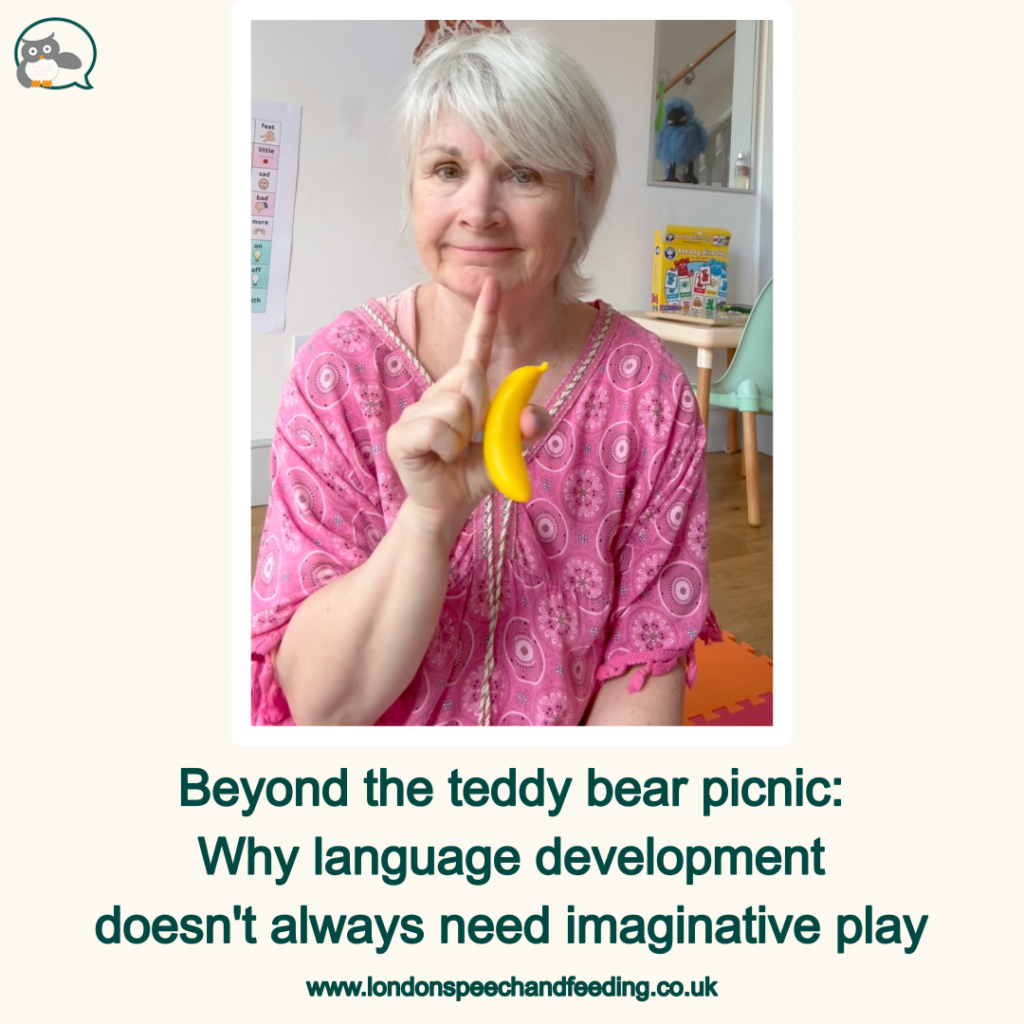
    Beyond the teddy bear picnic: Why language development doesn’t always need imaginative play

    As Speech and Language Therapists (SLTs), we are taught from day one that developmental milestones follow a predictable, linear path: first comes functional play, then symbolic and imaginative play (like pretending to feed a teddy bear or talking on a toy phone), and then comes conversational speech.

    But when working with language delayed children, I have seen something that completely contradicts those textbook charts.

    Many of my students have absolutely no interest in doll play, tea parties, or imaginary scenarios. Yet, as they mature, they still manage to develop robust, meaningful, and conversational language.

    How is this possible? And what does it mean for how we approach therapy?

    Redefining the ‘rules’ of play and language

    The idea that imaginative play is a strict prerequisite for language was built entirely on neurotypical developmental data. But neurodivergent brains don’t follow neurotypical roadmaps. That is not a deficit; it’s simply a different processing style.

    When Gestalt Language Processors bypass traditional imaginative play, they aren’t ‘missing’ a step. They are often using entirely different cognitive vehicles to build their language skills.

    The power of monotropic deep interests

    Video clip 2 lining up dinosaurs

    Many autistic individuals have a monotropic cognitive style, meaning they process the world through deep, single-focused passions (think trains, space, dinosaurs or ocean creatures).

    While a neurotypical child might practise social roles by pretending a doll is going to school, a neuro-diverse child practises language by categorising, analysing, and sharing facts about their deep interest. Their language is anchored in the concrete, fascinating reality of their passion, rather than fictional symbolic play.

    Gestalt Language Processing (GLP)

    A significant number of neuro-diverse children learn language in large ‘chunks’ or ‘gestalts’ (such as movie scripts, songs, or favourite phrases) rather than building sentences word-by-word.

    When a child scripts or uses echolalia, they are storing and mapping vast amounts of conversational data. They don’t need to pretend-feed a teddy bear to practise dialogue; they are actively processing the rhythm, intonation, and structural rules of speech through the media and phrases they love. As they grow, they learn to break these scripts apart to form original sentences.

    Structural play is learning play

    Just because a child is lining up dinosaurs or cars, stacking blocks, or spinning wheels instead of making them ‘talk’ doesn’t mean they aren’t learning. This functional and structural play builds crucial foundational skills like pattern recognition, cause-and-effect, and spatial awareness, all of which directly support cognitive and language development.

    Shifting Our Goals

    Meeting our children on their home turf: if that’s dinosaurs, let’s be creative with dinosaurs!

    If imaginative play isn’t the engine driving language, forcing it in the therapy room can quickly turn into an exercise in compliance rather than connection. Instead of trying to pull a child out of their world and into a neurotypical play model, we can meet them exactly where they are!

    Here are three affirming ways to turn deep interests into conversations:

    • Swap questions for comments (declarative language): Instead of interrogating a child about their play (‘What colour is that train? Where is it going?’) make pressure-free observations (‘Wow, that train is moving fast. Look at those wheels spin.’). This lowers conversational anxiety and models natural communication.
    • Bridge and expand: Use their favourite topic to introduce new ideas and concepts. If we love dinosaurs let’s see if dinos can climb up a ladder, slide down a half pipe into some water, then need drying before making footprints across a piece of paper…
    • Validate any scripts or echolalia and find out the EMOTION underlying it: If your child uses a quote from a favourite cartoon clip, let’s try and figure out in what context this phrase was said in the movie; what is the emotion in the movie when the character says this line? Is it upset? Is it joyful? Is it big surprise or a shock? Don’t dismiss it as meaningless. Acknowledge the emotion behind the script ‘You feel worried right now.’ This way we are showing our child that their unique way of communicating is heard and valued.

    So, to sum up:

    Imaginative play is just one way to learn language, not the only way.

    Let’s stop viewing a lack of pretend play as a barrier to communication, and free ourselves to see our children’s true strengths. By embracing their deep passions, we don’t just help them find their voice. We build a real connection that makes communication possible.

    Are you looking for neurodiversity-affirming speech and language support? Contact my clinic today to learn more about how I tailor my therapy to your child’s unique strengths.

    Sonja McGeachie

    Highly Specialist Speech and Language Therapist

    Owner of The London Speech and Feeding Practice.

    Health Professions Council registered
    Royal College of Speech & Language Therapists Member
    Member of ASLTIP

    Find a speech and language therapist for your child in London. Are you concerned about your child’s speech, feeding or communication skills and don’t know where to turn? Please contact me and we can discuss how I can help you or visit my services page.

    3
  • · ·

    LAMP Words for Life: A revolutionary AAC system

    Introduction

    When working with non-speaking or minimally speaking children the LAMP Words for Life AAC (Augmentative and Alternative Communication) system is my absolute go-to every time. For me it stands out as a revolutionary system that has transformed the lives of many of my non-speaking students. LAMP Words for Life is a ROBUST, comprehensive language-based AAC system and it is designed to help any user to express their thoughts, feelings, and needs effectively, thereby achieving maximal independence in their daily life. A winner!

    There is a whole host of AAC apps and systems out there and each has their own advantages and benefits for sure. I have tried a good number of other systems. I do also like certain features of other AAC systems for sure. For example GRID: I love the versatility of GRID and the ease of editing the system is fantastic.

    Why I think it works so well

    However, strangely I always return to LAMP when push comes to shove. I have thought very carefully about it and so here are my thoughts on why this is and why it works so well:

    1. Intuitive interface: LAMP Words for Life features are for me really user-friendly and it is easy to navigate and understand (this is very important for non-techy people). I think it makes sense and it is accessible to users of all ages and abilities. Yes the pictures are a little bit different to other symbol systems we use, especially here in the UK to be sure, and this is one of the reasons why it is good to have a variety of systems available, so that we can cater for students who are used to other symbols or do very well with specific symbol core boards. I have learned though that the pictures are not that important when using LAMP because the entire system is based on MOTOR PLANNING. And once one knows the motor plan to find a picture it is in our brain and we do not look at the picture any more. So, the motor plan to find a word is much more important when using LAMP than worrying about what the picture looks like.
    2. Comprehensive vocabulary: The system offers a vast vocabulary of words and phrases, covering a wide range of topics and contexts. This enables users to express themselves effectively on a variety of subjects. That said, almost every time I use LAMP there is a little word I need and it’s not on there. But that’s not a problem: for example, I was looking for ‘sunglasses’ the other day. Sure, there is ‘sun’ and ‘glasses’ but that would be two separate motor plans and for my student that would be too many for now, so it was very easy to quickly add the new word ‘sunglasses’ under ‘accessories’ or ‘beach wear’ — I added it within less than one minute. Likewise, there are a ton of words which cater for the US market, and I tend to change them to fit the UK vocabulary like ‘nappy’ for ‘diaper’. Or I delete them entirely if I feel my child will never need to use a certain word like ‘conference’ or ‘nun’. PS: should they get to a point of using the system as an adult independently then these words can surely be added again, or if my student ever moves to the US then the words can be changed back to US terms again without any problem.
    3. Grammar support: LAMP provides built-in grammar support, helping users construct grammatically correct sentences. This can be particularly beneficial for individuals with language processing difficulties. But what I love about the way LAMP is organised here is that, in contrast with other systems I have used, it does not PREDICT what you want to say, it lets the user decide and find the right grammatical structure. I appreciate this because, just like I hate my phone or email offering predictive text or offer corrections to my words, I really do not get the systems that offer automatically a grammar change which mostly I don’t want. Where that is the case, I am often confused and hindered in finding the correct wording. I love the simplicity of LAMP and at the same the complexity that can be achieved gradually with practice. LAMP is fully designed to enable a user to build up not only vocabulary but a full language system. On a course recently I was able to hear adult LAMP users speaking to the audience in full and quick grammatically well-rounded sentences on a host of topics.
    4. Customisation: LAMP can be customised to meet the individual needs of each user. This includes options for adjusting the vocabulary, layout, and accessibility features. It is not as easy to edit as GRID I will say and that can cause me a little bit of frustration at times, but on balance I still vastly prefer the system as a whole. It can also be customised quite well for Gestalt Language Processors. It takes a little bit of practice and thinking about how best to do this but I have found a way that works well which I demonstrate in the short video clip.
    5. Community support: LAMP Words for Life has a thriving community of users on Facebook and this is so valuable and inspiring. Therapists and families of LAMP users alike share experiences, provide resources, and offer encouragement. This can be a valuable source of support for both users and their families.
    6. Comprehensive support: LAMP Words for Life offers quick and thorough support services, including training, resources, and ongoing assistance. This is invaluable and reassuring for both users and caregivers.
    7. Research-based: The development of LAMP Words for Life is based on extensive research and evidence-based practices. This ensures that the system is grounded in sound scientific principles.

    Conclusion

    To conclude LAMP Words for Life is a powerful AAC which provides us with a means of effective communication, language development, and social interaction. Whether you are a parent of a non-speaking child or a speech therapist looking for innovative AAC solutions, LAMP Words for Life is worth exploring.

    Example on how to use AAC at story time

    Feel free to contact me if you need help with your child.

    Sonja McGeachie

    Early Intervention Speech and Language Therapist

    Feeding and Dysphagia (Swallowing) Specialist The London Speech and Feeding Practice

    The London Speech and Feeding Practice


    Find a speech and language therapist for your child in London. Are you concerned about your child’s speech, feeding or communication skills and don’t know where to turn? Please contact me and we can discuss how I can help you or visit my services page.

    1
  • ·

    Discover how Attention Autism can support your Autistic child’s communication

    “I’ve got something in my bag, in my bag, in my bag,

    I’ve got something in my bag,

    what it is”

    You might be wondering why your Speech and Language Therapist is singing this song and then presenting items from a zipped-up bag. Let me take you through stage one of this evidence-based approach.

    There are many aims of ‘bucket or bag time’. During stage one, you are simply engaging your child’s attention (whilst also exposing them to language). It’s important to remember that you are not forcing your child to say or do anything. The idea is that the items in the bag or bucket ‘offers an irresistible invitation to learn’ (Gina Davies, 2020).

    You don’t need ‘special’ expensive toys. Use what you have at home. It might be that you have some bubbles, a wind-up toy. You might have some foil that you can roll up into a ball, or a balloon. Keep these items for ‘bucket time’. This means that your child is likely to be excited and motivated for the activity. The only stipulation is that these items must be highly motivating and must be the most exciting thing in the room. You’ll want to cover up any distractions.

    So, you have your items and your opaque zipped bag, next you’ll want to put the items into the bag ensuring the zip is closed. The zip is important as it increases suspense and excitement as your child cannot see inside. You can also comment when unzipping ‘open bag’ using the signs ‘open’ + ‘bag’ to support your child’s understanding. Your Speech and Language Therapist can help with any Makaton signs that are unknown. The idea of this activity is that the item isn’t touched by your child. This can seem a little odd or feel “mean” but there is a reason for this: we want our child to look at us as well as the object or toy. As soon as we allow our child to touch and play with that toy their attention will go to the toy alone and we won’t get JOINT attention or engagement. This is the reason why we SHOW interesting things for a brief moment and then put these items back into the bag or bucket and out comes the next item. If your child wants to grab the toy and gets upset, then they may not be quite ready for this approach.

    Next, we sing the song (as above) and unzip the bag taking out one of the items. The use of pausing is important. Pause after the song: does your child try to use gesture or sound? You can also use this opportunity to model short phrases, ideally one or two words such “it’s a spinner! Wow… so many colours”. After a couple of turns, repeat the process and pull out a different item. We tend not to sing the song each time for the next item. Just sing it at the beginning and then get on with producing the amazing, wonderful things in your bag. No hard and fast rules though, apart from “don’t let the child touch the toys”.

    The biggest factor here is that you and your child enjoy the activity together. Have lots of fun!!

    Keep up to date with our latest blogs to explore more stages of Attention Autism.

    If you need speech, language or communication support or advice, I am always here to help.


    Find a speech and language therapist for your child in London. Are you concerned about your child’s speech, feeding or communication skills and don’t know where to turn? Please contact me and we can discuss how I can help you or visit my services page.

    0
  • · ·

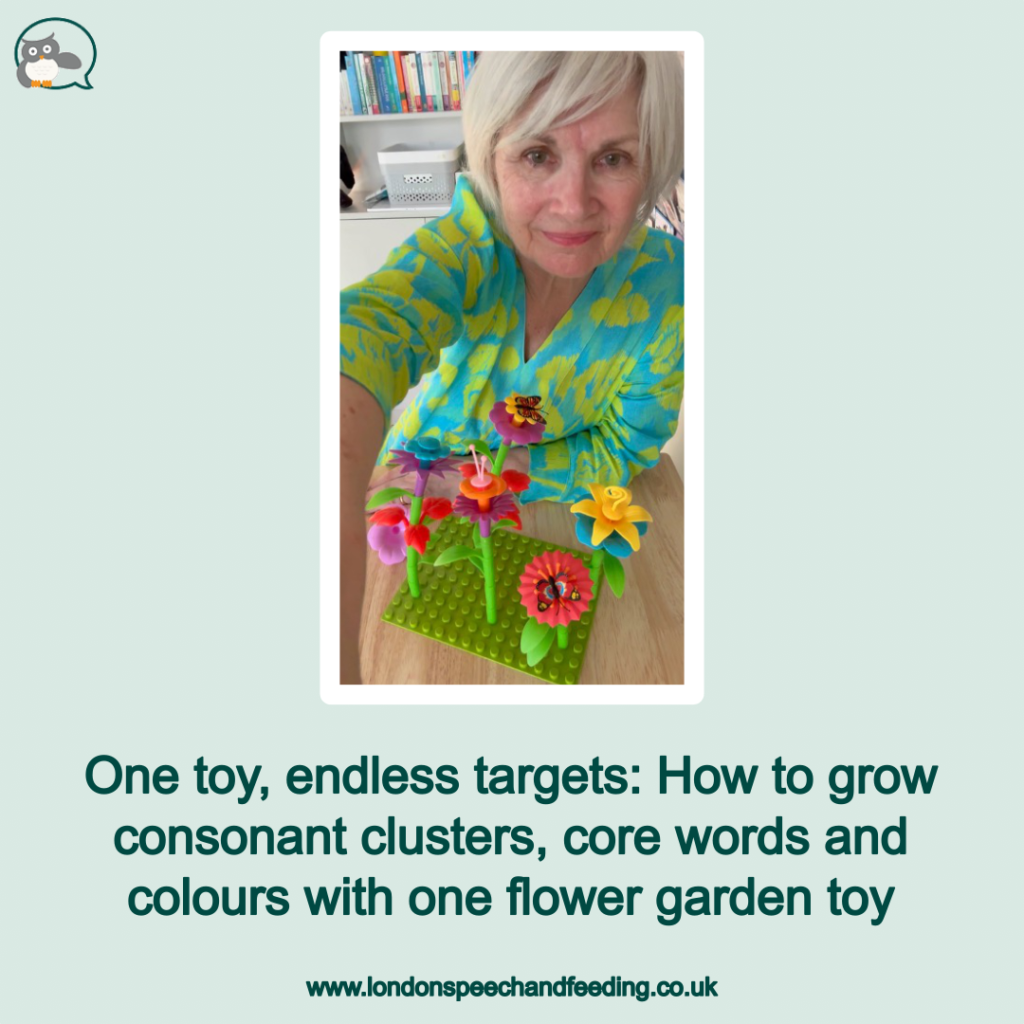
    One toy, endless targets: How to grow consonant clusters, core words and colours with one flower garden toy

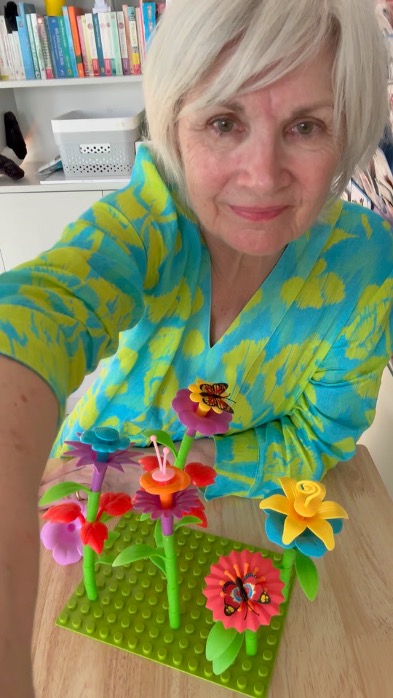
    Sonja McGeachie with the build-a-flower garden toy

    If you’ve been following me for a while you already know my absolute favourite rule for speech therapy: let the toy work for you. You don’t need an entire cabinet full of different flashcards or games to target a massive range of speech goals (though truth be told I do have 4 cabinets! What am I saying…) but often I find that sticking to one highly engaging, open-ended toy reduces a child’s cognitive load, keeps them firmly planted in play, and gives you dozens of natural opportunities for high-repetition practice. It also reduced my cognitive load!

    In today’s post we are looking at a classic: The build-a-flower garden toy. A link is here: https://www.amazon.co.uk/Fivejoy-Flower-Garden-Building.

    This vibrant, stacking toy isn’t just great for fine motor skills. It is an absolute goldmine for speech therapy. While it is incredible for targeting tricky consonant clusters (blends) like /ST/, /SP/, /SPR/, /FL/, /BL/, and /GR/, it is equally powerful for building functional core vocabulary.

    1. Digging deep with /ST/

    Let’s start building our garden.

    Stem & stalk: ‘Look at this long stem!’ or ‘Can you put the stem in?’ or ‘do you want the green or the red stem’?

    • Stuck: If a piece is a little tight to push down, it’s a brilliant opportunity for a natural exclamation: ‘Oh no, it’s stuck! Help me!’
    • Stand: Once it’s secure, you can celebrate: ‘it can stand up now!’
    • 👉 Core word integration: Use this setup stage to practise ANOTHER ONE. As you hold the base pieces, wait for the child to use their words or AAC device to request, ‘I want another one!’ before handing over the next stem.

    2. Sowing seeds with /SP/ and /SPR/

    Every good gardener needs the right equipment and a close eye for detail. We can introduce tools and descriptive language to hit our /SP/ and triple-blend /SPR/ targets.

    • Spade: Grab a toy shovel or pretend to use one. ‘Let’s dig a hole with the spade.’
    • Spot: Point to the holes on the base. ‘Find a good spot for this flower.’
    • Sprout: Talk about the little green pieces: ‘Look at the little sprout!’
    • 👉 Core word integration: Build on spontaneous requesting here. If they are eyeing a specific piece, model a full phrase like: ‘I WANT THE PINK ONE.’

    3. /FL/ and fine motor actions

    Now, we can start adding the colourful petals.

    • Flower: This is your high-frequency word for the entire activity. ‘Put the green/blue/pink flower on top.’
    • Flat & flutter: ‘This piece is flat on the ground,’ or ‘The butterfly flutters by!’
    • 👉 Core word integration: This stage is perfect for teaching directional actions. Every time they stack a petal onto a stem, model the core phrase: ‘PUT IT ON!’

    4. Blending it all together with /BL/

    Building a garden is a fantastic sensory experience because of the vivid colours. We can lean heavily into the /BL/ sound by focusing on colour selection and the action of growth.

    • Blue & bloom: ‘Should we use a blue flower?’ and ‘Watch it bloom!’
    • Blade & blend: Point out the blades of grass and talk about how we blend all the colours together.
    • 👉 Core word integration: Don’t just focus on putting the toy together, taking it apart is half the fun! If a child places a piece they don’t want, or when it’s time to clean up, model: ‘TAKE IT OFF.’

    5. Working the /GR/

    Finally, we look at the environment supporting our garden. The /GR/ blend can be targeted by looking downward at the base of our toy setup.

    • Green: Nearly every stem and base piece in this toy is a vibrant shade of green.
    • Grass & ground: ‘Put the base down on the ground.’ ‘Look at the green grass.’
    • 👉 Core word integration: Combine your /GR/ blend with a powerful core phrase. As you pull a stem upward slowly or stack the petals higher and higher, chant together: ‘MAKE IT GROW! Grow, grow, grow!’

    Maximise your repetitions in play

    The beauty of the flower garden toy is its repetitive nature. Because a child builds multiple flowers, you aren’t just saying a word or a phrase once, you have the potential to repeat it 10, 15, or 20 times in a single sitting without the child losing interest.

    By layering structural speech sounds (like blends) over functional communication phrases (like core words), we give children words they can use across their entire day.

    What toy would you like to see us target next in our series? Let me know in the comments on Instagram, and don’t forget to swipe through the carousel there to save these word lists for your next playtime!

    If you are concerned about your child’s speech, please do not hesitate to get in touch. I would love to help you find some answers.

    Sonja McGeachie

    Highly Specialist Speech and Language Therapist

    Owner of The London Speech and Feeding Practice.


    Health Professions Council registered
    Royal College of Speech & Language Therapists Member
    Member of ASLTIP

    Find a speech and language therapist for your child in London. Are you concerned about your child’s speech, feeding or communication skills and don’t know where to turn? Please contact me and we can discuss how I can help you or visit my services page.
    3
  • · ·

    My child is hard to understand at school age. Should I be concerned?

    Many parents notice speech errors when their children are toddlers. At that stage it often feels quite normal. Young children are still learning the sounds of their language, and those early mispronunciations can be very endearing.

    But as children grow older, parents sometimes begin to wonder:

    ‘Should my child still be speaking like this?’

    A common concern I hear from families is that their child is still difficult to understand even after starting school. Sometimes it is a parent who notices it first. Other times it is a teacher who gently mentions that classmates occasionally struggle to understand what a child is saying.

    When this happens, parents naturally wonder whether it is something their child will grow out of, or whether some extra support might help.

    When should children’s speech be clear?

    Children learn speech sounds gradually over several years. Some sounds develop earlier, while others take longer to master.

    By the time children reach five to six years of age, most of their speech should be clear enough for unfamiliar adults to understand. There may still be a few tricky sounds developing (such as /R/ or /TH/), but overall speech should be fairly easy to follow.

    If a child is frequently difficult to understand at school age, it can sometimes indicate that a speech sound difficulty has persisted beyond the stage when it would normally resolve on its own.

    Why some children remain hard to understand

    There are several reasons why speech clarity may still be developing in older children.

    Phonological patterns

    Some children continue to use speech patterns that are typical of younger children. For example:

    • saying ‘tat’ instead of ‘cat’
    • saying ‘doe’ instead of ‘go’
    • leaving sounds out of words

    These patterns are called phonological processes. They are a normal part of early speech development, but when they persist into the school years they can make speech difficult for others to understand.

    Difficulty producing specific sounds

    Other children may have difficulty producing certain individual sounds clearly. This might include sounds such as:

    • /S/
    • /SH/
    • /R/
    • /TH/

    These difficulties are called articulation difficulties.

    A child might understand exactly what they want to say but find it hard to produce the sound accurately with their tongue, lips or airflow.

    Motor speech planning challenges

    For some children, the difficulty lies in the planning and coordination of the movements needed for speech.

    Speech requires very precise timing between the tongue, lips, jaw and breath. If the brain finds it difficult to organise these movements consistently, speech can sound unclear or inconsistent.

    In some cases this may relate to Childhood Apraxia of Speech, although only a full assessment can determine this.

    Why clarity matters for school-age children

    Speech clarity becomes particularly important once children start school.

    At this stage, children are:

    • Answering questions in class
    • Talking with friends
    • Reading aloud
    • Developing confidence in communication

    When speech is difficult to understand, children sometimes become more hesitant to speak, particularly in group situations.

    This can affect confidence and participation, even when the child has lots of ideas they would like to share.

    The good news: speech can improve

    The encouraging news is that speech sound difficulties can often improve significantly with the right support.

    Speech therapy focuses on helping children:

    • Learn how sounds are produced
    • Practise accurate speech movements
    • Understand how sounds change meaning in words
    • Build consistency through structured practice

    Different children benefit from different therapy approaches. Some need support with phonological patterns, while others benefit from more motor-based practice that strengthens speech coordination.

    Often therapy combines several strategies to support the child’s individual speech profile.

    When to seek advice

    If your child is already at school and you find that people outside the family often struggle to understand them, it can be helpful to seek advice from a speech and language therapist.

    A detailed assessment can help identify:

    • Which sounds are causing difficulty
    • Whether patterns such as fronting or sound substitutions are present
    • Whether motor planning challenges may be contributing
    • Which therapy approach is likely to be most effective

    Early support can help children develop clearer speech and greater confidence in communication.

    Every child’s speech journey is different

    Speech development is not the same for every child. Some children master speech sounds quickly, while others need a little more guidance along the way.

    The important thing is that support is available when children need it.

    With the right strategies and practice, many children make excellent progress and develop speech that is clearer, more confident and easier for others to understand. If you are concerned about your child’s speech clarity or ongoing speech sound errors, a speech and language assessment can help identify the underlying difficulty and guide the most appropriate support.

    Feel free to contact me on my contact page.

    Sonja McGeachie

    Highly Specialist Speech and Language Therapist

    Owner of The London Speech and Feeding Practice.


    Health Professions Council registered
    Royal College of Speech & Language Therapists Member
    Member of ASLTIP

    Find a speech and language therapist for your child in London. Are you concerned about your child’s speech, feeding or communication skills and don’t know where to turn? Please contact me and we can discuss how I can help you or visit my services page.

    3
  • ·

    Principles of motor learning in childhood apraxia of speech: A guide for parents and therapists

    Image by Freepik

    Childhood Apraxia of Speech (CAS) is a complex neurological disorder that affects a child’s ability to plan and coordinate the movements necessary for speech production. Children with CAS often have difficulty with articulation, prosody, and fluency, making it challenging for them to communicate effectively. While there is no cure for CAS, speech and language therapy can significantly improve a child’s communication skills and overall quality of life. Understanding the principles of motor learning is crucial for both parents and speech therapists to support children with CAS on their speech journey.

    What is MOTOR LEARNING?

    Motor learning refers to the process of acquiring and refining new skills through practice and experience. This applies to all aspects of movement, including speech production. The brain constantly receives sensory information about the movements being made and adjusts them based on the desired outcome. A breakdown or interruption of this process can make it difficult for children to plan, sequence, and coordinate the intricate movements involved in speech.

    What key principles do we use in speech and language therapy for motor learning?

    • Task Specificity: Speech Therapy activities that directly target the specific speech sounds or skills your child is working on. For example, if your child is struggling with /p/, practising isolated /p/ sounds, words with /p/, and phrases with /p/ would be most beneficial.
    • Massed vs. Distributed Practice: We consider the optimal amount and distribution of practice sessions throughout the day. Massed practice involves concentrated practice in a single session, while distributed practice spreads practice sessions throughout the day. The best approach depends on the individual child’s learning style and attention span.
    • Feedback: We provide clear and immediate feedback to help your child understand the accuracy and effectiveness of their attempts. This feedback can be auditory, visual, or touch based.
    • Error Correction: We aim to gently correct errors so that we can help your child refine their movements and avoid developing bad habits. The focus is on providing specific cues and guidance rather than simply pointing out mistakes.
    • Variety and Progression: We gradually introduce new challenges and variations in speech therapy activities to prevent plateaus and maintain motivation.
    • Motivation and Engagement: A big part of our work is to make therapy sessions fun and engaging to keep your child motivated and actively participating. We use games, songs, and activities that your child enjoys while incorporating targeted practice opportunities.

    What about home work?

    Yes we need your help and here are some examples of how this could look:

    • Task Specificity: During story time, focus on practising target sounds present in the story. Have your child repeat words or phrases containing the sound and encourage them to identify the sound in other words.
    • Massed vs. Distributed Practice: Instead of one long practice session, try shorter, more frequent sessions throughout the day. This can help maintain focus and prevent fatigue. It is recommended to go for 100 repetitions of the target sound per day, every day in between the sessions. We can decide together how you can best do that through either massed or distributed practice. We can decide after the session.
    • Feedback: Use a mirror to provide visual feedback on lip and tongue placement during sound production. Record the child’s speech and play it back to help them self-monitor their accuracy.

    I quite like this mirror below but any table top mirror will work as long as it is not too small. Your child should see their whole face easily.

    tabletop mirror
    • Error Correction: If the child makes an error, gently model the correct sound or movement without shaming or criticising. Provide specific cues such as ‘lips together’ for /p/ or ‘tongue up’ for /t/.
    • Variety and Progression: We will guide you on exactly what words to practise so this is something you need not worry about.
    • Motivation and Engagement: Use games, songs, and activities that your child enjoys. Play a game of ‘I Spy’ focusing on words with the target sound or create silly sentences with the sound to make practice fun.

    Let’s work together!

    It is crucial for parents, therapists, and other caregivers to work collaboratively to ensure a consistent and comprehensive approach to supporting your child’s speech development. Speech and Language Therapists can provide guidance and resources on implementing these principles at home, while parents can share observations and progress updates to inform therapy sessions.

    Remember, every child with CAS learns at their own pace. By understanding and applying the principles of motor learning, parents and speech therapists can create a supportive and stimulating environment that empowers children with CAS to reach their full communication potential.

    Do get in touch if you would like some in-person or on-line 1:1 support with this. It can be overwhelming to figure it all out alone.


    Find a speech and language therapist for your child in London. Are you concerned about your child’s speech, feeding or communication skills and don’t know where to turn? Please contact me and we can discuss how I can help you or visit my services page.

    2