Key or tea? Starting with listening: Minimal pairs for little ones

|

If your little one asks for a ‘tup of tea’ or tells you the ‘tar’ is outside, you’re hearing one of the most common speech patterns in young children. In this third blog for November, I’m sharing some video clips of a lovely session (shared with her mum’s kind permission) where we take the very first steps of working on it, by listening.
What is ‘fronting’?

As children learn to talk, they simplify words that are tricky to say. Speech therapists call these simplifications phonological processes. They’re a normal part of development, and most of them fade away on their own as children grow.

Fronting is one of these processes. Sounds that should be made at the back of the mouth, like /K/ and /G/, are made at the front instead, as /T/ and /D/. So:

  • key becomes tea.
  • car becomes tar.
  • go becomes doe.

The child isn’t being lazy or careless. To them, ‘key’ and ‘tea’ may sound almost the same, or they may not yet have worked out that the difference matters.

Should I be worried at three?

(shared with kind parental consent)

The child in my video is three and a half years old. Many of her early speech patterns have already come a long way but fronting is still hanging on.

At this age, that is not usually a big worry. Fronting often resolves by around three and a half, and lots of children simply grow out of it. But there is also no harm at all in gently helping a child start to notice the sounds at the beginning of words. It’s playful, it’s quick, and it lays foundations that help whether therapy is needed later.

Why start with listening?

Before a child can say a sound differently, it helps if they can hear that it is different. This skill is called auditory discrimination: being able to tell two similar sounds apart.

If a child hears ‘key’ and ‘tea’ as the same word, asking them to say ‘key’ properly is a bit like asking them to fix a mistake they can’t see. So we often begin by tuning their ears in first.

What are minimal pairs?

A minimal pair is two words that differ by just one sound, where that one sound changes the meaning. For example:

  • key / tea
  • car / tar
  • cap / tap
  • cold / told.

Minimal pairs are powerful because they show the child that sounds matter. If I say ‘tea’ when I mean ‘key’, I won’t get into the house! That small change in sound gives you a completely different thing. For a child who fronts, minimal pairs put the /K/ and /T/ sounds side by side so the difference becomes something they can notice and, over time, use.

What you’ll see in my video

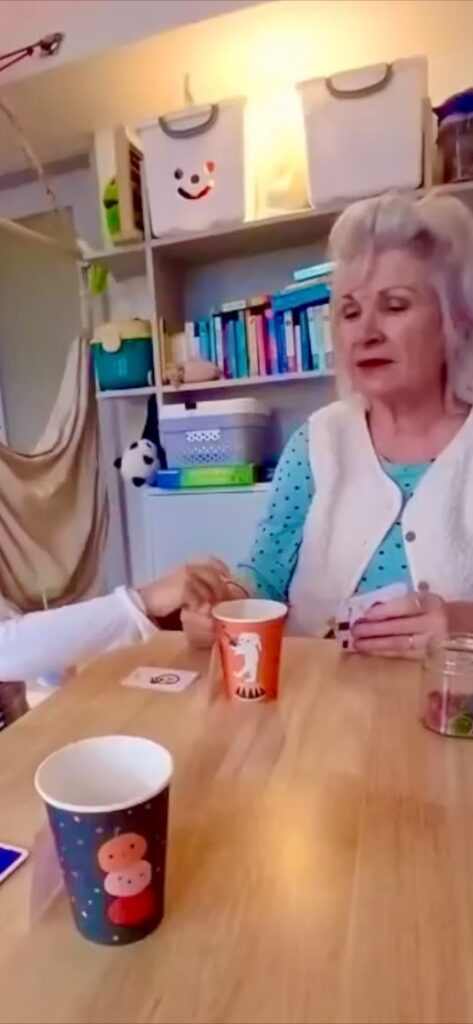
In the clips I have two cups on the table:

  • one with a picture of a key
  • one with a picture of a teabag.

I say one of the words, for example ‘key’, and the child posts a chip into the matching cup. Then I say ‘tea’, and she finds the other cup. It’s simple, hands-on, and children usually love the posting part.

Why I’m not ‘testing’

It’s important to explain what’s happening at this early stage. I’m not testing whether she can tell the two words apart. She is only just learning how the game works.

Right now she is learning that:

  • Each cup belongs to one word.
  • She needs to listen to what I say before she chooses.
  • The beginning of a word is worth paying attention to.

So, if she puts a chip in the ‘wrong’ cup, that’s fine. I simply say the word again, show her the right cup, and carry on. There’s no pressure and no ‘wrong’. The aim is awareness: helping her start to notice that ‘key’ and ‘tea’ are two different words that sound different at the beginning.

Once she understands the game, we can make it a bit harder: mixing up the order, adding more pairs, and eventually checking whether she can reliably hear the difference. Later still, we swap roles, and she tells me which cup to post in. That’s when she discovers that she needs to say ‘key’ clearly for me to get it right!

When to seek advice

It’s worth speaking to a speech and language therapist if:

  • Fronting is still strong after about three and a half.
  • Your child is hard for others to understand.
  • Your child seems frustrated when they aren’t understood.
  • You have any other worries about their speech or language and fronting is part of other errors.

You don’t need to ‘wait and see’ if something doesn’t feel right. Early, playful support can make a real difference.

If you’d like to talk about your child’s speech, please get in touch via my contact page, I look forward to hearing from you.

Sonja McGeachie

Sonja McGeachie

Highly Specialist Speech and Language Therapist

Owner of The London Speech and Feeding Practice.


Health Professions Council registered
Royal College of Speech & Language Therapists Member
Member of ASLTIP

Find a speech and language therapist for your child in London. Are you concerned about your child’s speech, feeding or communication skills and don’t know where to turn? Please contact me and we can discuss how I can help you or visit my services page.

3

Similar Posts

  • Why imitation is a powerful strategy to support social communication

    Before reading this blog, it’s important to understand what we mean by ‘social communication’ and ‘imitation’. Social communication is more complex than it first appears. It refers to many aspects of communication such as body language, voice, conversational skills, social ‘rules’ (such as being polite and using manners), interpersonal skills (such as developing friendships), and emotional literacy (such as appropriacy and developing self-awareness). Imitation refers to the simple act of copying.

    You may have noticed that your child has difficulties in some of the areas mentioned above. They might be less responsive to you and appear to be quite happy in their own world. Whilst we do not want to change their unique characteristics, we do need to prepare them for future experiences, and what is socially acceptable.

    How will copying my child develop their social communication?

    1. If your child is already engaged with a certain activity, they are already interested and motivated. You’re not competing for their attention.
    2. Both yours and your child’s attention is on the same activity which makes imitating for you (as the parent) easier.
    3. Studies have demonstrated that when a parent imitates a child, they are more likely to look at the adult.
    4. Imitation not only supports eye contact but supports facial expressions (such as smiling), may increase vocalisations, and encourages your child to sit closer to you.
    5. Children learn through trial and error. They may start to try to perform new actions to gain their parents attention. Let your child lead the play!!

    How do I start imitating my child?

    1. Start with observing them. Take the time just to watch. You don’t need to make notes. Sit back and observe their actions, movements, and sounds they make.
    2. Wait for your child’s reaction when they realise you are copying their actions. Remember they may not notice, you don’t need to remind them, simply copy them again.
    3. Having the same set up as your child allows them to feel in control. So, you may have two sets of the same activity rather than copying using their set of toys.

    This may sound daunting, but it doesn’t have to be. Start with a ten-minute time frame where you choose to copy your child. This is where you can practise your imitation strategy. Ten minutes a day is far more effective than an hour every two weeks. You may feel self-conscious but trust the process. Build your confidence, whilst exposing your child’s to increased language and communication, enabling them to develop vital social communication skills.

    Look at the video above to watch the strategy in action!

    Support is only a click away. I’m here to help.


    Find a speech and language therapist for your child in London. Are you concerned about your child’s speech, feeding or communication skills and don’t know where to turn? Please contact me and we can discuss how I can help you or visit my services page.

    0
  • ·

    Does my child need a myofunctional therapist? Lisps, tongue posture and oral function explained

    Have you ever been told that if your child’s lisp or /R/ sound isn’t improving after months of speech therapy, you should see a myofunctional therapist?

    The short answer is: possibly, but not automatically. Whether it will help depends on what is behind your child’s difficulty, and finding that out is exactly what a thorough assessment is for.

    I’m a Speech and Language Therapist with nearly 30 years’ experience in speech sound disorders, feeding and swallowing, and I have additional training in myofunctional therapy. Looking at how the mouth works has been an intrinsic part of my assessments for many years, so I’d like to explain what that involves and when it matters.

    What is myofunctional therapy?

    Myofunctional therapy (often called orofacial myofunctional therapy, or OMT) is about how the muscles of the mouth and face work. It overlaps with what speech and feeding therapists call oro-motor function, although OMT looks more specifically at things like resting posture, breathing and swallowing patterns. Depending on the therapist’s training and your child’s needs, it may include:

    • tongue movement, resting posture and positioning
    • lip closure and resting posture
    • jaw movement and coordination
    • oral habits, such as thumb sucking or dummy use
    • swallowing patterns
    • how oral function, feeding and speech affect one another.

    Some children have difficulties across several of these areas. Others have one specific speech sound difficulty and no wider problem with how their mouth works.

    Signs it may be worth having your child’s oral function checked

    You might want an assessment if your child:

    • has a lisp or a tricky /R/ that hasn’t changed with therapy
    • often has their mouth hanging open at rest
    • pushes their tongue forward against or between their teeth when speaking or swallowing (sometimes called tongue thrust)
    • is still dribbling or drooling after 18 months
    • finds chewing difficult, or struggles to move their tongue up, out or from side to side
    • breathes mostly through their mouth.

    If you are worried about tongue-tie, I can assess how your child’s tongue moves for speech and feeding. If a medical or dental opinion is needed, I will explain why, advise you on who to see and work alongside them, for example an ENT consultant or paediatric dentist.

    What does a comprehensive assessment look at?

    When a child has a speech sound difficulty, I look at their speech alongside how their mouth is built and how it works. Depending on the concern, that may include:

    • jaw: how steady it is, and how well it moves and coordinates with the lips and tongue
    • teeth and mouth structure: the position of the teeth, the bite, the palate and anything structural that may be relevant
    • lips: closure, movement and resting posture
    • tongue: how well it moves in different directions, where it rests and whether it pushes forward
    • swallowing: relevant aspects of how your child swallows and where the tongue sits
    • palate and voice: anything that may need further investigation, such as concerns about how the palate is working or an unusually nasal sound
    • habits and breathing: things like thumb sucking or mouth breathing, and any signs that a medical or dental check may be needed.

    Not every child needs every part of this. The questions we are trying to answer guide what I look at and what happens next.

    For example, a child with a lisp may find it hard to coordinate the tongue placement needed for an /S/ sound. They may rest their tongue low in the mouth, or they may have spent years making the /S/ sound with the tongue between the teeth. By looking at how the mouth moves, along with habits and history such as thumb sucking, I can understand what may be contributing and plan therapy accordingly.

    The findings help decide whether your child needs direct speech therapy, further assessment, a different approach, or input from another professional such as an ENT consultant, dentist or orthodontist. Assessment isn’t simply about spotting something that looks unusual. It is about understanding what it means for your child and deciding what, if anything, needs to be done. This kind of clinical reasoning is a natural, daily part of my work as a Speech and Language Therapist.

    What if my child isn’t making progress in speech therapy?

    If your child has been attending therapy for weeks or months without meaningful progress, it is reasonable to ask for a review. In my practice I monitor progress from one session to the next, and if things aren’t moving, I would rather review the plan than simply carry on with the same approach.

    Sometimes a child needs more time. Sometimes the approach needs to change. Sometimes we need more information or another professional’s input. Sometimes therapy needs to pause while an underlying issue is looked into.

    Whichever it is, you can expect a clear explanation of what we are working towards and how progress will be reviewed. A lack of progress should always prompt a review of the plan.

    Does myofunctional therapy help with speech difficulties?

    Sometimes. Some children have speech sound difficulties alongside differences in how their mouth works, which is why I assess both and consider whether they are related. A different tongue posture, an open-mouth resting posture or an unusual swallowing pattern is always worth noting, but it is not automatically the cause of a lisp or another speech sound disorder.

    For speech sound disorders, treatment should be chosen to match the nature of the speech difficulty and be supported by evidence. The routine use of non-speech oral-motor exercises, meaning exercises that don’t involve practising speech sounds, to improve speech is not supported by the available evidence (the Cochrane review of non-speech oral-motor treatment – Lee & Gibbon, 2015).

    That doesn’t mean work on oral function is never appropriate. The important question is what we are trying to achieve. If the aim is clearer speech, therapy needs to work on the speech itself, with plenty of practice of the relevant sounds, syllables and words. If your child also has a separate difficulty with feeding, swallowing or another aspect of oral function, such as resting posture, that may need its own assessment and targeted therapy. This is why I combine evidence-based speech practice with myofunctional assessment and therapy where a child’s oral function needs it, and I will always explain the aim and the reasoning behind what I recommend.

    Choosing the right therapist for your child

    Whoever you choose, I would encourage you to ask who will be treating your child, what their training covers and whether they are well placed to meet your child’s particular needs. Good clinical practice includes recognising the limits of your own expertise and referring on or working with others when appropriate. No practitioner should feel they have to manage every part of a child’s difficulties alone.

    When the main concern is your child’s speech sounds, speech clarity or expressive language, I would recommend starting with an experienced Speech and Language Therapist whose expertise matches your child’s needs. If that therapist also has additional training in myofunctional therapy, so much the better. You can check that any Speech and Language Therapist is registered using the HCPC online register, and it is always fine to ask about a practitioner’s original qualification, clinical experience and the scope of their training.

    So that you know who would be working with your child, here is a little about my own training: I am an HCPC-registered Speech and Language Therapist (BSc Clinical Communication Sciences, Royal Central School of Speech and Drama, 1996) with nearly 30 years’ experience, a postgraduate diploma in dysphagia (2000) and certification in the SOS Approach to Feeding (2018) and Orofacial Myofunctional Disorders training in 2026. I also completed IBCLC lactation consultant certification in 2019 (since lapsed, 2024) and worked as a neonatal Speech and Language Therapist and Lactation Consultant at Barnet Hospital in 2019–2020.

    Next steps

    If your child has a lisp, a tricky /R/, an open-mouth resting posture, a tongue thrust, dribbling or difficulty chewing, I would be happy to look at the whole picture. I assess speech and oral function together, and if your child needs a dentist, orthodontist or ENT consultant, I will tell you.

    You can find out more on my Speech and Feeding Difficulties page, or get in touch to arrange an assessment. If you’re not sure whether your child needs one, contact me and we can talk it through.

    Sonja McGeachie

    Sonja McGeachie

    Highly Specialist Speech and Language Therapist

    Owner of The London Speech and Feeding Practice.

    Health Professions Council registered
    Royal College of Speech & Language Therapists Member
    Member of ASLTIP

    Find a speech and language therapist for your child in London. Are you concerned about your child’s speech, feeding or communication skills and don’t know where to turn? Please contact me and we can discuss how I can help you or visit my services page.

    Reference

    Lee AS-Y, Gibbon FE. Non-speech oral motor treatment for children with developmental speech sound disorders. Cochrane Database of Systematic Reviews 2015, Issue 3. Art. No.: CD009383. DOI: 10.1002/14651858.CD009383.pub2.

    3
  • · · ·

    Beyond the teddy bear picnic: Why language development doesn’t always need imaginative play

    As Speech and Language Therapists (SLTs), we are taught from day one that developmental milestones follow a predictable, linear path: first comes functional play, then symbolic and imaginative play (like pretending to feed a teddy bear or talking on a toy phone), and then comes conversational speech.

    But when working with language delayed children, I have seen something that completely contradicts those textbook charts.

    Many of my students have absolutely no interest in doll play, tea parties, or imaginary scenarios. Yet, as they mature, they still manage to develop robust, meaningful, and conversational language.

    How is this possible? And what does it mean for how we approach therapy?

    Redefining the ‘rules’ of play and language

    The idea that imaginative play is a strict prerequisite for language was built entirely on neurotypical developmental data. But neurodivergent brains don’t follow neurotypical roadmaps. That is not a deficit; it’s simply a different processing style.

    When Gestalt Language Processors bypass traditional imaginative play, they aren’t ‘missing’ a step. They are often using entirely different cognitive vehicles to build their language skills.

    The power of monotropic deep interests

    Video clip 2 lining up dinosaurs

    Many autistic individuals have a monotropic cognitive style, meaning they process the world through deep, single-focused passions (think trains, space, dinosaurs or ocean creatures).

    While a neurotypical child might practise social roles by pretending a doll is going to school, a neuro-diverse child practises language by categorising, analysing, and sharing facts about their deep interest. Their language is anchored in the concrete, fascinating reality of their passion, rather than fictional symbolic play.

    Gestalt Language Processing (GLP)

    A significant number of neuro-diverse children learn language in large ‘chunks’ or ‘gestalts’ (such as movie scripts, songs, or favourite phrases) rather than building sentences word-by-word.

    When a child scripts or uses echolalia, they are storing and mapping vast amounts of conversational data. They don’t need to pretend-feed a teddy bear to practise dialogue; they are actively processing the rhythm, intonation, and structural rules of speech through the media and phrases they love. As they grow, they learn to break these scripts apart to form original sentences.

    Structural play is learning play

    Just because a child is lining up dinosaurs or cars, stacking blocks, or spinning wheels instead of making them ‘talk’ doesn’t mean they aren’t learning. This functional and structural play builds crucial foundational skills like pattern recognition, cause-and-effect, and spatial awareness, all of which directly support cognitive and language development.

    Shifting Our Goals

    Meeting our children on their home turf: if that’s dinosaurs, let’s be creative with dinosaurs!

    If imaginative play isn’t the engine driving language, forcing it in the therapy room can quickly turn into an exercise in compliance rather than connection. Instead of trying to pull a child out of their world and into a neurotypical play model, we can meet them exactly where they are!

    Here are three affirming ways to turn deep interests into conversations:

    • Swap questions for comments (declarative language): Instead of interrogating a child about their play (‘What colour is that train? Where is it going?’) make pressure-free observations (‘Wow, that train is moving fast. Look at those wheels spin.’). This lowers conversational anxiety and models natural communication.
    • Bridge and expand: Use their favourite topic to introduce new ideas and concepts. If we love dinosaurs let’s see if dinos can climb up a ladder, slide down a half pipe into some water, then need drying before making footprints across a piece of paper…
    • Validate any scripts or echolalia and find out the EMOTION underlying it: If your child uses a quote from a favourite cartoon clip, let’s try and figure out in what context this phrase was said in the movie; what is the emotion in the movie when the character says this line? Is it upset? Is it joyful? Is it big surprise or a shock? Don’t dismiss it as meaningless. Acknowledge the emotion behind the script ‘You feel worried right now.’ This way we are showing our child that their unique way of communicating is heard and valued.

    So, to sum up:

    Imaginative play is just one way to learn language, not the only way.

    Let’s stop viewing a lack of pretend play as a barrier to communication, and free ourselves to see our children’s true strengths. By embracing their deep passions, we don’t just help them find their voice. We build a real connection that makes communication possible.

    Are you looking for neurodiversity-affirming speech and language support? Contact my clinic today to learn more about how I tailor my therapy to your child’s unique strengths.

    Sonja McGeachie

    Highly Specialist Speech and Language Therapist

    Owner of The London Speech and Feeding Practice.


    Health Professions Council registered
    Royal College of Speech & Language Therapists Member
    Member of ASLTIP

    Find a speech and language therapist for your child in London. Are you concerned about your child’s speech, feeding or communication skills and don’t know where to turn? Please contact me and we can discuss how I can help you or visit my services page.

    3
  • · ·

    The picky eater’s plate: Introducing solids to toddlers with ARFID

    Designed by Freepik

    Mealtimes can be a battleground for parents of picky eaters, especially toddlers with Avoidant/Restrictive Food Intake Disorder (ARFID). I see a great number of toddlers with Autism traits and many of my clients are picky eaters from mild to severe. Take a look at my blog for an outline of what the issues are and how to try and help.

    ARFID goes beyond typical ‘picky eating’ and can significantly impact a child’s growth, nutrition, and social-emotional well-being. If your toddler is resistant to trying new foods or has a very limited diet, here are some strategies to navigate the introduction of solids:

    1. Understand ARFID:

    ARFID is a diagnosable eating disorder characterised by:

    • Limited food variety: Eating only a small range of foods, often with specific textures or colours.
    • Fear of new foods: Intense anxiety or aversion to trying unfamiliar foods.
    • Sensory sensitivities: Heightened sensitivity to taste, smell, texture, or appearance of food.
    • Lack of interest in eating: May show little interest in food or mealtimes.

    2. Seek professional guidance:

    • Paediatrician and/or gastroenterologist: Rule out any underlying medical conditions.
    • Registered dietitian: Assess nutritional needs and create a balanced meal plan.
    • Speech and language therapist (SLT): If oral-motor skills or sensory sensitivities are contributing to feeding difficulties.
    • Occupational therapist (OT): If sensory processing challenges are affecting mealtime behaviours.
    • Child psychologist: If anxiety or emotional factors are contributing to ARFID.

    3. Strategies for introducing solids:

    • Start small: Introduce one new food at a time, in small amounts, alongside familiar favourites.
    • Patience is key: It can take multiple exposures (up to 10–15 times!) for a child to accept a new food. Don’t give up!
    • Positive reinforcement: Praise and encouragement for any interaction with the new food, even just touching or smelling it.
    • No pressure: Avoid forcing or pressuring the child to eat. This can create negative associations with food.
    • Make it fun: Present food in playful ways, use cookie cutters for fun shapes, or involve the child in food preparation.
    • Sensory exploration: Encourage exploration of food through touch, smell, and sight before tasting.
    • Role modelling: Show the child that you enjoy eating a variety of foods.
    • Use fun utensils: your child might like characters from ‘Frozen’ or ‘Dinosaurs’ or ‘Diggers’ there are a host of character-based cutlery and cups/plates to be had. Also, I really rate these two items very highly they are so good so I want to share these with you. Both are available online. But warning: the cup is outrageously expensive as it comes from the United States and is sold by a small scale company. But I feel this is cup very worth trying, I have had good results with this.
    • Gradual desensitisation: Start with foods that are similar in texture or taste to accepted foods, then gradually introduce more challenging options.
    • Food chaining: Introduce new foods that are similar in taste, texture, or appearance to accepted foods.

    4. Mealtime Environment:

    • Positive and relaxed: Create a calm and enjoyable mealtime atmosphere.
    • No distractions: Minimise distractions like TV or toys.
    • Consistent schedule: Offer meals and snacks at regular times.
    • Child-sized portions: Offer small, manageable portions to avoid overwhelming the child.
    • Involve the child: Let the child choose their utensils, plate, or cup.

    5. Remember:

    • Every child is different: What works for one child may not work for another.
    • Progress takes time: Be patient and celebrate small victories.
    • Focus on the positive: Praise any positive interaction with food.
    • Seek support: Connect with other parents or support groups.

    Introducing solids to toddlers with ARFID can be challenging, but with patience, persistence, and professional guidance, you can help your child develop a healthier relationship with food.

    Get in touch with me via my contact form if you need support

    Sonja McGeachie

    Early Intervention Speech and Language Therapist

    Feeding and Dysphagia (Swallowing) Specialist The London Speech and Feeding Practice

    The London Speech and Feeding Practice


    Find a speech and language therapist for your child in London. Are you concerned about your child’s speech, feeding or communication skills and don’t know where to turn? Please contact me and we can discuss how I can help you or visit my services page.
    1
  • ·

    Let’s relax about making EYE CONTACT already…

    There’s been a long tradition with teaching staff and with Speech and Language Therapists working in schools that eye contact should be a goal. It is well known that Autistic individuals (whether that be children or adults) mostly avoid eye contact. Whilst it’s part of the way we communicate, it shouldn’t be used as a necessity for an individual who feels that it is uncomfortable. Whilst it does show that you’re listening and showing an interest, it’s not a fair expectation for neurodiverse children.

    Autistic children can find making and maintaining eye contact physically and emotionally uncomfortable as well as unnatural. It adds an extra layer of stress and has been reported to increase distractions rather than reduce them. Children who engage in conversations in their own way (i.e., with reduced eye contact) are not shown to suffer with schooling, work, or social interaction.

    By having fun through meaningful activities, I often experience that ‘BINGO’ moment (a phrase coined by Alex @meaningfulspeech) where the child is enjoying themselves and naturally makes eye contact. There is no demand on them, they are in a fun, engaging environment which suit their strengths and supports their needs.

    Following this, I often reflect on this question ‘Should we make eye contact as a goal?’

    It very much depends on the situation. If it places more demands on the child and becomes stressful. Then no. There are many strategies we can use which gain eye contact without placing extra demands on the child. We need to be mindful to adapt the environment and not place neurotypical expectations to meet the needs of neurodiverse children.

    How can you encourage eye contact without demand?

    • If you’re using toys, try holding them up to your eye level.
    • You can adjust your position, try sitting face to face during play.
    • Always get down to your child’s level. This might mean that you lay on the floor if your child is positioned in this way.
    • During play, waiting is extremely powerful. Before a key part of the activity, wait and see if your child looks at you. Remember silence is golden!
    • The best way I find is: do something unusual during play. It might be that you spray shaving foam with the lid still on. Or you bring out a wow toy and make it spin/light up or make a noise. A balloon can be good – see video clip. Use the excitement of the activity, and wait to see if you achieve that ‘BINGO’ moment.
    • Create opportunities when there are no toys involved such as during ‘tickles’ or ‘hide and seek’. Autistic children find it difficult to shift their attention between a toy and an adult. So by removing one option, you’re setting them up to succeed.

    Remember, it takes practice and time for you to develop these skills. Try one at a time and experiment, see which works best for your child. If you need speech, language or communication support or advice, I am always here to help.


    Find a speech and language therapist for your child in London. Are you concerned about your child’s speech, feeding or communication skills and don’t know where to turn? Please contact me and we can discuss how I can help you or visit my services page.
    0
  • ·

    Discover how Attention Autism can support your Autistic child’s communication

    “I’ve got something in my bag, in my bag, in my bag,

    I’ve got something in my bag,

    what it is”

    You might be wondering why your Speech and Language Therapist is singing this song and then presenting items from a zipped-up bag. Let me take you through stage one of this evidence-based approach.

    There are many aims of ‘bucket or bag time’. During stage one, you are simply engaging your child’s attention (whilst also exposing them to language). It’s important to remember that you are not forcing your child to say or do anything. The idea is that the items in the bag or bucket ‘offers an irresistible invitation to learn’ (Gina Davies, 2020).

    You don’t need ‘special’ expensive toys. Use what you have at home. It might be that you have some bubbles, a wind-up toy. You might have some foil that you can roll up into a ball, or a balloon. Keep these items for ‘bucket time’. This means that your child is likely to be excited and motivated for the activity. The only stipulation is that these items must be highly motivating and must be the most exciting thing in the room. You’ll want to cover up any distractions.

    So, you have your items and your opaque zipped bag, next you’ll want to put the items into the bag ensuring the zip is closed. The zip is important as it increases suspense and excitement as your child cannot see inside. You can also comment when unzipping ‘open bag’ using the signs ‘open’ + ‘bag’ to support your child’s understanding. Your Speech and Language Therapist can help with any Makaton signs that are unknown. The idea of this activity is that the item isn’t touched by your child. This can seem a little odd or feel “mean” but there is a reason for this: we want our child to look at us as well as the object or toy. As soon as we allow our child to touch and play with that toy their attention will go to the toy alone and we won’t get JOINT attention or engagement. This is the reason why we SHOW interesting things for a brief moment and then put these items back into the bag or bucket and out comes the next item. If your child wants to grab the toy and gets upset, then they may not be quite ready for this approach.

    Next, we sing the song (as above) and unzip the bag taking out one of the items. The use of pausing is important. Pause after the song: does your child try to use gesture or sound? You can also use this opportunity to model short phrases, ideally one or two words such “it’s a spinner! Wow… so many colours”. After a couple of turns, repeat the process and pull out a different item. We tend not to sing the song each time for the next item. Just sing it at the beginning and then get on with producing the amazing, wonderful things in your bag. No hard and fast rules though, apart from “don’t let the child touch the toys”.

    The biggest factor here is that you and your child enjoy the activity together. Have lots of fun!!

    Keep up to date with our latest blogs to explore more stages of Attention Autism.

    If you need speech, language or communication support or advice, I am always here to help.


    Find a speech and language therapist for your child in London. Are you concerned about your child’s speech, feeding or communication skills and don’t know where to turn? Please contact me and we can discuss how I can help you or visit my services page.

    0