What is FRONTING?

Kids Speech Therapist London

Does your child say “Dough” instead of “Go”? Or “Tea” instead of “Key”? Do you hear a /Sh/ instead of an /S/ does “see” sound more like “she”?

We Speechies call this a Fronting Pattern which means that a sound that should be produced at the back of the throat with the back of the tongue, like K or G , is said at the front of the mouth with the tip of the tongue, like a T or a D or SH. When this happens speech can be really hard to make out because these sounds are literally everywhere in everyday sentences. Just think how many K’s and G’s we hear in a simple sentence?

For example, I heard my little student say earlier today: “I know what game we can play in your garden? It’s the one with cones and rings and cushions! I know where it is I can get it.”

But it sounded like:

“I know what DAME we DAN play in the DARDEN! It’s the one with TONES and rings and TUSHIONS! I know where it is I TAN DED it.”

If that sounds familiar to you, here is a little overview of what we can do about it:

First up it’s always good to start with general speech sounds awareness: does a child hear syllables and intonation? Do they know words that rhyme? Can they follow or copy a simple beat with a drum? Can they listen and hear quiet sounds and loud sounds and can they copy those? Can they follow mouth and tongue movements:, for example : stick out your tongue, lick your lips, click your tongue, blow raspberries?

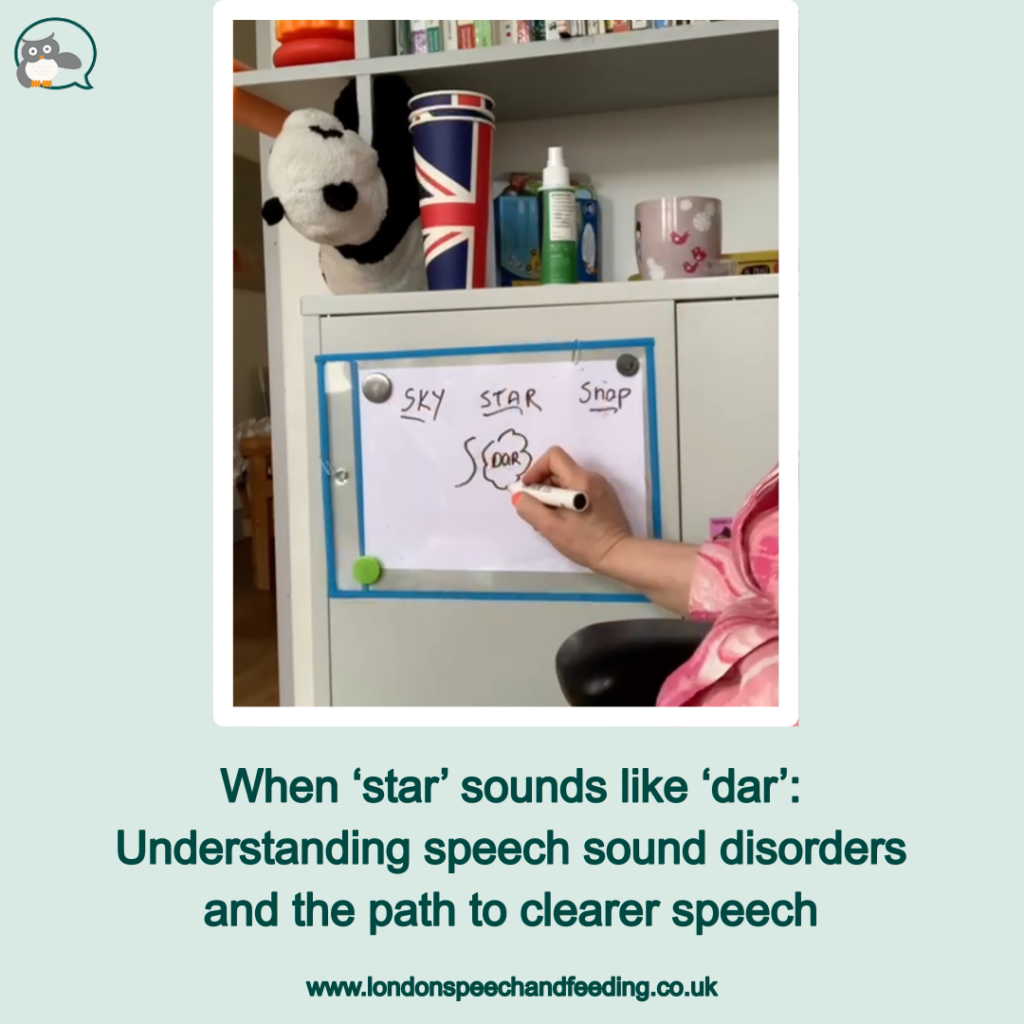
Then it really helps to talk about BACK and FRONT of things and to draw attention to the back of the mouth and the back of the tongue and the front tip of the tongue and how sounds are made in the mouth. I often use a puppet to show this or a model of a mouth like this one here in the picture.

Next we try and listen to words starting with a BACK sounds like a K or a G , and I read out a list of words with those sounds: COW, CORE, CAT, CONE, KEY etc or ARK, EEK, OAK, ACHE…

Or GOO GUY GUM GONE

After that we try and see if a student can actually produce a single sound like a K or a G just by itself. If they can, that’s a really great start and if they can’t I help them to produce one – over a few sessions we usually get there. We call this Sound production in isolation.

Once a child can produce a sound correctly, on its own, we try and start working on very simple words that are really powerful like “GO”!!!!! in a motivating game or “CAR” for little ones who love a car racing track.

Now that we have established the back sounds and are using it in short words, we can gradually re-train brain pathways and oral- motor/movement pathways to use these new sounds in many words and then short phrases. That can take time!! This is called generalisation and it is not uncommon for it to take up a whole year for fluent speech to be error-free .

Why does it take so long? Being able to produce a correct and clear K or G sound does not mean it will be used easily. Our brain pathways are fixated or habituated to the error sound. It takes time for habits to change. A child might be able to hear the word TIGER with a G in the middle and she knows that it is not a TIDER but when saying it her tongue automatically moves forward rather than lifts up at the back. It’s a bit like a person who has a rounded back: the brain knows to stand upright and how not to slouch, but when we don’t focus on it, ooops we have slouched again because that is what we are comfortable doing and our body moves with our habit.

It takes effort and motivation to change our movement patterns and that includes our tongue and lip patterns! We usually get there through a huge variety of games and practice. Lots and lots of repetition is key as is motivation to change.

Parents and carers are crucial in the success of Speech Therapy!

We need your feedback at home, the regular short and sweet exercises, the constant positive encouragement and great modelling of speech sounds. We often find that parents are tuned into their child’s error sounds and can understand them much better than anyone else. This is great of course in many ways, however, it also means that the child has less motivation to change: if mummy understands me then my world is ok.

I will give you a short outline of what different speech therapy models I use in my practice, be it in clinic face to face or on-line in my future blogs soon.


Find a speech and language therapist for your child in London. Are you concerned about your child’s speech, feeding or communication skills and don’t know where to turn? Please contact me and we can discuss how I can help you or visit my services page.

Similar Posts

  • What is Speech and Language Therapy (SLT) and what does a Speech Therapist do?

    Kids Speech Therapist London
    What is Speech and Language Therapy (SLT) and what does a Speech Therapist do?

    Speech and language therapists provide treatment, support and care for children and adults who have difficulties with communication, eating, drinking and swallowing. We help children and adults who have problems speaking and communicating.

    How to find the perfect therapist for my child/client:

    There are a huge number of speech and language difficulties, or feeding and swallowing problems that we can help with and the first thing to think about is what age group the person is you are seeking help for. Most SLT’s specialise in a range of disorders and treatments and they often treat specific age ranges. This could be, for instance, very young children up to 3 years, or school aged children, adolescents or just adults. Once you have narrowed it down to age and general area of difficulty you can then go and seek your perfect SLT match.

    Generally it is my view that SLT’s with a narrow area of specialist interest are most likely to help you better if the problem you or your child/adult is having is significant and/or profound. For example, if your child has a very severe stutter/stammer but is otherwise developing fine and has good skills all round, then I would recommend to look for an SLT who only specialises in stammering/stuttering, or has only a small range of other specialist areas related to stammering , such as speech and language delay.

    The reason is that it is a tall order for any professional to stay up to date with latest research, latest clinical developments and training for more than, say, five distinct areas of interest.

    However, a more generalist Speech therapist who has lots of experience in many different areas could be a very good option for your child or adult who has more general speech and language delay in a number of areas, perhaps a global delay or a syndrome which means that their learning is delayed in general. It also means that your child might benefit from a Generalist SLT because they have many more tools in their SLT bag and your child might need a variety of approaches for several areas.

    A good place to start is www.asltip.com which is the Association for Independent Speech and Language Therapists in the UK. Any SLT registered with ASLTIP will also be registered with the HCPC (Health Care Professionals Council), as well as RCSLT (Royal College of Speech and Language Therapists). These two important UK professional regulatory bodies ensure all its members are fully qualified, and are fully up to date with latest developments within their areas of work.

    Here you can enter your post code and look for a therapist near you and you can look for specific problems such as stammering for example and narrow down your search. Most therapists have a website which you can then access too. I would recommend you speak to a few therapists on your list and then go with the person you had the best rapport with. You and the therapist will be spending a lot of time together and you will need to feel that you trust them and that you can relax into the process.

    How I can help you:

    I have 3 main areas of specialism:

    Parent Child Interaction Coaching

    Parent Child Interaction Coaching

    This is an amazing way to help children with the following difficulties:

    • Social Communication Difficulties, Autistic Spectrum Disorders and
    • Speech and Language Delay – for children under the age of 4 years old, this is my preferred way of working because it is so very effective and proven to work. If your child is not developing words or not interacting, has reduced attention and listening and you feel is not progressing or, in fact even regressing, then this way of working is the best. For anyone wanting to read a bit more about the efficacy of this method, below are some research articles. You may also like to check out www.hanen.org which is the mainstay of my work and method when it comes to Parent-Interaction Coaching. You can also look at my latest blog, entitled: Tele-therapy, does it work?

    In brief, what’s so great about Parent Coaching is that it empowers you the parent to help your child in daily life! This is where speech, language and social communication develop typically, in a naturalistic way and environment. Simple steps and strategies are discussed and demonstrated every week and you are encouraged to use these strategies with your child in daily routines: getting dressed, having breakfast, on the school run, whilst out in the park or shopping or simply playing at home or having dinner or bath time. Whatever your family routine happens to be, every strategy I teach you will help create a responsive communication environment; generally, if your child is able to develop speech then they will do so in direct response to your changed interaction style.

    Speech Sound Disorders, Verbal Dyspraxia, Phonology and Articulation

    Speech Sound Disorders, Verbal Dyspraxia, Phonology and Articulation

    I love working with children of all ages on developing their speech sounds. Whether your child has a lisp, or a couple of tricky sounds they simply cannot produce quite right, or perhaps your child is really unintelligible because he/she is having lots of different sound errors, making it really hard to understand them. I typically work on getting “most bang for your buck” , meaning I address the sounds that cause the most problems and, therefore, when they are fixed your child/person’s speech becomes that much clearer fairly quickly.

    Feeding and Swallowing Difficulties

    Feeding and Swallowing Difficulties

    Having worked for over 20 years in NHS Child Development Clinics and Special Needs Schools I trained and worked with feeding and swallowing difficulties early on in my SLT career. I later trained as a Lactation Consultant and so I am well placed helping and support all types of Infant feeding, both breast or bottle, as well as toddler weaning. I aim to ensure that your little one swallows the right kind of foods and drinks for their abilities. I am experienced in managing and supporting children with physical needs and mobility problems, Cerebral Palsy, Down Syndrome or any other type of syndrome or presentation.

    What does a speech therapy session look like?

    All sessions differ slightly depending on the age of the child and the nature of the difficulties.

    However, mostly our sessions look like FUN! After arrival and washing hands we tend to start off with the tricky work straight away whilst our child still has energy and the will to engage. So, for speech work we will focus on the target sounds first: this could be sitting at a table doing work sheets together, playing games using the target sound and really any type of activity that gives us around 70-100 repeats of the target pattern. For example, a child who is working towards saying a ‘K’ at the end of the word I will try and get around 100 productions of words like: pack/sack/lick/ pick/bike/lake and so on.

    Then we often play a fun game where I might try for a ‘rhyming’ activity or other sound awareness type activities, for perhaps 10 minutes and within that time I aim to trial the next sound pattern we need to improve on; I will test which sound your child can do with help from me. During he last 10 minutes we might look at a book, again listening to and producing whatever sound we are working on. If I did not get 100 sounds earlier on in the session I will try and practice them now as part of the story. In total I aim to have about 40-45 minutes of activities, all aimed at the target sound we are working on.

    What does a Coaching session look like?

    During a Parent Coaching Session we meet online for about an hour and we discuss how the week has been for you trying out the strategies. Typically parents start off recalling what went well, what progress was made and what had been more tricky. We work through it all, and then follow on to the next strategies: I will show you examples and demonstrations of each strategy and I will get you to think about how you can use this with your child and in what situation you might use it. I will explain what we are doing and what the purpose is. You might want to write down what you are going to work on for the week. Over the course of about sessions we can cover all the major strategies that are proven to help kickstart spoken language and/or help your child to connect more with you. Through that connection spoken words most often develop.

    Research Papers on the Efficacy of Parent Child Interaction Coaching

    Research Papers on the Efficacy of Parent Child Interaction Coaching

    • The It Takes Two to Talk Program has been shown to be effective in changing how parents interact with their children, and that children’s communication and language skills improve as a result.
    • Baumwell, L.B., Tamis-LeMonda, C.S. & Bornstein, M.H. (1997). Maternal verbal sensitivity and child language comprehension. Infant Behavior and Development, 20(2), 247-258.
    • Beckwith, L. & Cohen, S.E. (1989). Maternal responsiveness with preterm infants and later competency. In M.H. Bornstein (Ed.). Maternal responsiveness: Characteristics and consequences: New directions for child development (pp. 75-87). San Francisco: Jossey Bass.
    • Bronfenbrenner, U. (1974). Is early intervention effective? (Publication No. (CDH) 74-25). Washington, DC: Department of Health, Education, and Welfare, Office of Child Development.
    • Girolametto, L. (1988). Improving the social-conversational skills of developmentally delayed children: An intervention study. Journal of Speech and Hearing Disorders, 53, 156-167.

    Sonja has been a real help for my 5 year old daughter. Due to her support, my daughter is now able to clearly and correctly enunciate ‘th’ ‘f’ and ’s’. She was also helpful in making positional changes to her seating to help her concentrate better and kept her engaged throughout all the lessons which is a feat in itself on zoom!

    Helen, Mother of Catherine Age 5.

    Find a speech and language therapist for your child in London. Are you concerned about your child’s speech, feeding or communication skills and don’t know where to turn? Please contact me and we can discuss how I can help you or visit my services page.

  • · ·

    Why ‘Prosody’ Matters in Childhood Apraxia of Speech (CAS)

    Prosody refers to the ‘music’ of speech — the rhythm, pitch, stress, and volume that convey meaning and emotion beyond the literal words themselves. Think about a monotone statement like ‘Really?’ compared to one with a rising inflection, expressing genuine curiosity.

    When I work with children on producing speech sound sequences, we focus on mastering individual sounds and then putting them together into target words. A crucial element that can significantly impact a child’s speech production is ‘prosody’.

    In CAS, where the difficulty lies in planning and executing the motor movements for speech, prosody can be a powerful tool for producing clearer words and phrases.

    Here’s why working on prosody is an essential tool in CAS speech therapy:

    1.  It aids Motor Learning:

    Apraxia of Speech means that the planning and execution of speech movements are impaired. When we use exaggerated intonation or stress patterns while modelling words, we are providing additional prosodic variation and, therefore, additional auditory cues. These cues often help my student to carry out the correct motor movements for a word or syllable sequence.

    For instance, I might say ‘ball’ with a high-pitched emphasis on the ‘b’ sound. This auditory cue might be more effective in guiding the child’s tongue placement than simply repeating the word without variation.

    In this little video clip I get my student to say the word ‘snuggle’ (since we were working on that particular sound sequence: snuggle, snout, snore and sneeze) with a high voice and then a lower voice ‘like a bear’ — again it provides that extra auditory cue, but, in addition, the fun aspect also helps to take away the intense focus on a tricky movement pattern.

    By now the new pathways have been laid through repeated practice and now automaticity takes over and without too much effort my student can suddenly produce a motor pattern. It’s magical when it happens and gives me such a thrill.

    2. It makes speech more engaging and natural sounding:

    Children with CAS often sound robotic or flat due to challenges with prosodic elements. By incorporating variations in pitch, volume, and rhythm during therapy, we can help achieve a more natural flow of speech

    3. It makes it easier to express our emotions:

    Children with CAS often struggle to express themselves emotionally; partly through the difficulty of producing clear words — period, but also in addition due to the difficulties or absence of musicality and rhythm in their speech.

    Therefore, it is so important to incorporate activities focused on practising different emotions with varied intonation patterns. This can really empower our students to put emotions into their words.

    Good words to practise are fun words like ‘Wow!’ or ‘Yeiih’ or power words and phrases like ‘No!’ or ‘Gimme that’ etc.

    Making Therapy Fun and Engaging:

    Speech therapy for CAS doesn’t have to be all drills and exercises (though to be fair sometimes we can’t quite get round to making each and every word huge fun though we try…).

    I aim to make all my sessions fun and have intrinsic rewards built into the speech practice where possible.

    Home practice tips:

    Therapy shouldn’t exist in a bubble. Working on prosody during sessions is crucial, but it’s equally important to integrate these skills into everyday interactions. Parents and caregivers can model appropriate prosody during playtime, story time, or even simple conversations. This consistent reinforcement helps our children to generalise their newfound skills and use them naturally in their daily lives.

    • Sing songs and rhymes: Songs naturally incorporate variations in pitch and rhythm. Singing familiar songs and creating silly rhymes can be a delightful way to practise prosody.
    • Use puppets and toys: Assign different voices and personalities to puppets or toys. This encourages children to experiment with pitch and volume to differentiate characters.
    • Read aloud with enthusiasm: Model expressive reading, varying your voice for different characters and emphasising key words. This makes reading time engaging and helps children understand the power of prosody.

    Please feel free to contact me if your child has speech sound difficulties. It is my passion. I love supporting children with apraxia.

    Sonja McGeachie

    Early Intervention Speech and Language Therapist

    Feeding and Dysphagia (Swallowing) Specialist The London Speech and Feeding Practice

    The London Speech and Feeding Practice


    Find a speech and language therapist for your child in London. Are you concerned about your child’s speech, feeding or communication skills and don’t know where to turn? Please contact me and we can discuss how I can help you or visit my services page.

    1
  • ·

    Milestones of autistic children: Crawling, walking, and talking

    For all children every milestone achieved is a testament to the unique and intricate process unfolding within each young mind. For autistic children, this journey may present a distinct pattern, with some reaching developmental milestones like crawling, walking, and talking later than their neurotypical peers. Let’s have a look into the fascinating realm of Autism and explore why some autistic children might crawl, walk, and talk later, shedding light on the underlying factors contributing to this unique way of developing.

    1. Individual Pacing:

    Child development is not a one-size-fits-all journey. Each child, whether neurotypical or autistic, has a unique timeline for achieving milestones. Autistic children, like any other children, follow their own pacing. This individual rhythm might lead them to focus on one set of skills before they progress to others. Like some neurotypical children might focus on talking earlier than walking, autistic children might prioritise other areas before crawling or talking.

    2. Neurodevelopmental Complexity:

    The human brain is a remarkable entity, with a bewildering array of interconnected processes that lead to us achieving our developmental milestones. Autistic children often have variations in “neural wiring”, which can impact the balance between gross motor skills (crawling, walking) and fine motor skills. Speech and language acquisition falls under fine motor skills and may be momentarily disrupted due to the divergent neurological pathways at play in autism.

    2. Sensory Processing Differences:

    One of the hallmarks of autism is altered sensory processing. Autistic children often experience sensory stimuli differently than their neurotypical peers. This heightened or diminished sensitivity can influence a child’s desire or ability to engage in activities like crawling and walking. The sensation of movement while crawling or walking, for instance, might be overwhelming for some autistic children, causing them to either avoid or delay these activities.

    3. Visual-Spatial Abilities:

    Autistic children and adults frequently display excellent visual-spatial abilities. This strength might lead some children to focus more on activities that engage these skills, potentially delaying their engagement with activities like walking or talking. As they navigate their environment and process information visually, they might naturally invest more time in activities that stimulate this particular cognitive ability and strength.

    4. Communication Challenges:

    For many autistic children, speaking can be a really complex and difficult endeavour. Communication delays are a common feature of autism. This can affect both receptive and expressive language development. While some children might be physically capable of crawling or walking, they may not yet have the tools to communicate their desires and intentions. This leads to a temporary focus on non-speaking forms of expression. This does not mean that they do not communicate at all. But autistic individuals often start out using jargoning or echolalia as a form of communication as well as behaviours and physical forms of communication.

    5. Executive Functioning and Motor Skills:

    Executive functioning, or abilities for planning, organising, and carrying out tasks, can vary in autistic children. These skills are crucial for activities like crawling, walking, and talking, which need coordination and planning. About 40% of autistic persons have a motor planning difficulty.

    6. Intense Interests and Routines:

    Autistic children often develop intense interests in specific subjects, sometimes to the exclusion of other activities. These interests might become their primary mode of engagement. They might side-line milestones like crawling, walking, or talking. The mostly rigid adherence to routines and preferences might cause them to allocate more time to their preferred activities. This delays their engagement with other developmental tasks.

    How can Speech and Language Therapy help:

    Support and Intervention:

    Early intervention and regular Speech and Language Therapy play a pivotal role in the developmental journey of autistic children. Therapies tailored to individual needs can aid in bridging the gaps between milestones. Occupational therapy, for example, can help address sensory sensitivities and motor skill challenges that might impact crawling and walking. Speech therapy can help communication development, gradually bridging the gap between non-verbal expressions and spoken language.

    For example, we now know that echolalia or jargoning of longer phrases with intonation, repeating scripts from favourite tv shows or songs have many meanings and communicative functions. For example, a child who utters long strings of echolalic utterances, often difficult to understand, might want to do any one of the following:

    • Comment
    • greet
    • ask a question
    • make a request
    • express surprise
    • negate something.

    We now understand that the way to support a child with echolalia is to acknowledge all utterances and try and find out what the meaning is behind these scripts. This is very supportive. Over time it will lead a child to move on to understanding and saying more clear and self-generated language. For more information about this Natural Language Acquisition here are some other great websites for you to look at:

    Conclusion

    In conclusion, the journey of an autistic child’s development is a testament to the uniqueness and complexity of the human mind. The delays or differences in achieving milestones like crawling, walking, and talking can be attributed to a range of factors, including

    • neurodevelopmental intricacies,
    • sensory processing variations,
    • and communication challenges.

    It’s crucial to recognise that these delays are not indicative of a lack of potential, but rather a manifestation of the intricate interplay between an autistic child’s strengths and challenges. By embracing these differences and providing tailored support, we can help each autistic child unfold their potential at their own pace.

    Do get in touch if you would like to book an appointment where we can explore how to help your child develop and thrive

    Do get in touch if you would like to book an appointment where we can explore how to help your child develop and thrive


    Find a speech and language therapist for your child in London. Are you concerned about your child’s speech, feeding or communication skills and don’t know where to turn? Please contact me and we can discuss how I can help you or visit my services page.

    0
  • ·

    Principles of motor learning in childhood apraxia of speech: A guide for parents and therapists

    Image by Freepik

    Childhood Apraxia of Speech (CAS) is a complex neurological disorder that affects a child’s ability to plan and coordinate the movements necessary for speech production. Children with CAS often have difficulty with articulation, prosody, and fluency, making it challenging for them to communicate effectively. While there is no cure for CAS, speech and language therapy can significantly improve a child’s communication skills and overall quality of life. Understanding the principles of motor learning is crucial for both parents and speech therapists to support children with CAS on their speech journey.

    What is MOTOR LEARNING?

    Motor learning refers to the process of acquiring and refining new skills through practice and experience. This applies to all aspects of movement, including speech production. The brain constantly receives sensory information about the movements being made and adjusts them based on the desired outcome. A breakdown or interruption of this process can make it difficult for children to plan, sequence, and coordinate the intricate movements involved in speech.

    What key principles do we use in speech and language therapy for motor learning?

    • Task Specificity: Speech Therapy activities that directly target the specific speech sounds or skills your child is working on. For example, if your child is struggling with /p/, practising isolated /p/ sounds, words with /p/, and phrases with /p/ would be most beneficial.
    • Massed vs. Distributed Practice: We consider the optimal amount and distribution of practice sessions throughout the day. Massed practice involves concentrated practice in a single session, while distributed practice spreads practice sessions throughout the day. The best approach depends on the individual child’s learning style and attention span.
    • Feedback: We provide clear and immediate feedback to help your child understand the accuracy and effectiveness of their attempts. This feedback can be auditory, visual, or touch based.
    • Error Correction: We aim to gently correct errors so that we can help your child refine their movements and avoid developing bad habits. The focus is on providing specific cues and guidance rather than simply pointing out mistakes.
    • Variety and Progression: We gradually introduce new challenges and variations in speech therapy activities to prevent plateaus and maintain motivation.
    • Motivation and Engagement: A big part of our work is to make therapy sessions fun and engaging to keep your child motivated and actively participating. We use games, songs, and activities that your child enjoys while incorporating targeted practice opportunities.

    What about home work?

    Yes we need your help and here are some examples of how this could look:

    • Task Specificity: During story time, focus on practising target sounds present in the story. Have your child repeat words or phrases containing the sound and encourage them to identify the sound in other words.
    • Massed vs. Distributed Practice: Instead of one long practice session, try shorter, more frequent sessions throughout the day. This can help maintain focus and prevent fatigue. It is recommended to go for 100 repetitions of the target sound per day, every day in between the sessions. We can decide together how you can best do that through either massed or distributed practice. We can decide after the session.
    • Feedback: Use a mirror to provide visual feedback on lip and tongue placement during sound production. Record the child’s speech and play it back to help them self-monitor their accuracy.

    I quite like this mirror below but any table top mirror will work as long as it is not too small. Your child should see their whole face easily.

    tabletop mirror
    • Error Correction: If the child makes an error, gently model the correct sound or movement without shaming or criticising. Provide specific cues such as ‘lips together’ for /p/ or ‘tongue up’ for /t/.
    • Variety and Progression: We will guide you on exactly what words to practise so this is something you need not worry about.
    • Motivation and Engagement: Use games, songs, and activities that your child enjoys. Play a game of ‘I Spy’ focusing on words with the target sound or create silly sentences with the sound to make practice fun.

    Let’s work together!

    It is crucial for parents, therapists, and other caregivers to work collaboratively to ensure a consistent and comprehensive approach to supporting your child’s speech development. Speech and Language Therapists can provide guidance and resources on implementing these principles at home, while parents can share observations and progress updates to inform therapy sessions.

    Remember, every child with CAS learns at their own pace. By understanding and applying the principles of motor learning, parents and speech therapists can create a supportive and stimulating environment that empowers children with CAS to reach their full communication potential.

    Do get in touch if you would like some in-person or on-line 1:1 support with this. It can be overwhelming to figure it all out alone.


    Find a speech and language therapist for your child in London. Are you concerned about your child’s speech, feeding or communication skills and don’t know where to turn? Please contact me and we can discuss how I can help you or visit my services page.

    2
  • · ·

    LAMP Words for Life: A revolutionary AAC system

    Introduction

    When working with non-speaking or minimally speaking children the LAMP Words for Life AAC (Augmentative and Alternative Communication) system is my absolute go-to every time. For me it stands out as a revolutionary system that has transformed the lives of many of my non-speaking students. LAMP Words for Life is a ROBUST, comprehensive language-based AAC system and it is designed to help any user to express their thoughts, feelings, and needs effectively, thereby achieving maximal independence in their daily life. A winner!

    There is a whole host of AAC apps and systems out there and each has their own advantages and benefits for sure. I have tried a good number of other systems. I do also like certain features of other AAC systems for sure. For example GRID: I love the versatility of GRID and the ease of editing the system is fantastic.

    Why I think it works so well

    However, strangely I always return to LAMP when push comes to shove. I have thought very carefully about it and so here are my thoughts on why this is and why it works so well:

    1. Intuitive interface: LAMP Words for Life features are for me really user-friendly and it is easy to navigate and understand (this is very important for non-techy people). I think it makes sense and it is accessible to users of all ages and abilities. Yes the pictures are a little bit different to other symbol systems we use, especially here in the UK to be sure, and this is one of the reasons why it is good to have a variety of systems available, so that we can cater for students who are used to other symbols or do very well with specific symbol core boards. I have learned though that the pictures are not that important when using LAMP because the entire system is based on MOTOR PLANNING. And once one knows the motor plan to find a picture it is in our brain and we do not look at the picture any more. So, the motor plan to find a word is much more important when using LAMP than worrying about what the picture looks like.
    2. Comprehensive vocabulary: The system offers a vast vocabulary of words and phrases, covering a wide range of topics and contexts. This enables users to express themselves effectively on a variety of subjects. That said, almost every time I use LAMP there is a little word I need and it’s not on there. But that’s not a problem: for example, I was looking for ‘sunglasses’ the other day. Sure, there is ‘sun’ and ‘glasses’ but that would be two separate motor plans and for my student that would be too many for now, so it was very easy to quickly add the new word ‘sunglasses’ under ‘accessories’ or ‘beach wear’ — I added it within less than one minute. Likewise, there are a ton of words which cater for the US market, and I tend to change them to fit the UK vocabulary like ‘nappy’ for ‘diaper’. Or I delete them entirely if I feel my child will never need to use a certain word like ‘conference’ or ‘nun’. PS: should they get to a point of using the system as an adult independently then these words can surely be added again, or if my student ever moves to the US then the words can be changed back to US terms again without any problem.
    3. Grammar support: LAMP provides built-in grammar support, helping users construct grammatically correct sentences. This can be particularly beneficial for individuals with language processing difficulties. But what I love about the way LAMP is organised here is that, in contrast with other systems I have used, it does not PREDICT what you want to say, it lets the user decide and find the right grammatical structure. I appreciate this because, just like I hate my phone or email offering predictive text or offer corrections to my words, I really do not get the systems that offer automatically a grammar change which mostly I don’t want. Where that is the case, I am often confused and hindered in finding the correct wording. I love the simplicity of LAMP and at the same the complexity that can be achieved gradually with practice. LAMP is fully designed to enable a user to build up not only vocabulary but a full language system. On a course recently I was able to hear adult LAMP users speaking to the audience in full and quick grammatically well-rounded sentences on a host of topics.
    4. Customisation: LAMP can be customised to meet the individual needs of each user. This includes options for adjusting the vocabulary, layout, and accessibility features. It is not as easy to edit as GRID I will say and that can cause me a little bit of frustration at times, but on balance I still vastly prefer the system as a whole. It can also be customised quite well for Gestalt Language Processors. It takes a little bit of practice and thinking about how best to do this but I have found a way that works well which I demonstrate in the short video clip.
    5. Community support: LAMP Words for Life has a thriving community of users on Facebook and this is so valuable and inspiring. Therapists and families of LAMP users alike share experiences, provide resources, and offer encouragement. This can be a valuable source of support for both users and their families.
    6. Comprehensive support: LAMP Words for Life offers quick and thorough support services, including training, resources, and ongoing assistance. This is invaluable and reassuring for both users and caregivers.
    7. Research-based: The development of LAMP Words for Life is based on extensive research and evidence-based practices. This ensures that the system is grounded in sound scientific principles.

    Conclusion

    To conclude LAMP Words for Life is a powerful AAC which provides us with a means of effective communication, language development, and social interaction. Whether you are a parent of a non-speaking child or a speech therapist looking for innovative AAC solutions, LAMP Words for Life is worth exploring.

    Example on how to use AAC at story time

    Feel free to contact me if you need help with your child.

    Sonja McGeachie

    Early Intervention Speech and Language Therapist

    Feeding and Dysphagia (Swallowing) Specialist The London Speech and Feeding Practice

    The London Speech and Feeding Practice


    Find a speech and language therapist for your child in London. Are you concerned about your child’s speech, feeding or communication skills and don’t know where to turn? Please contact me and we can discuss how I can help you or visit my services page.
    1
  • ·

    Discover more about Verbal Dyspraxia

    What is Verbal Dyspraxia?

    Apraxia or dyspraxia is a difficulty in motor planning, which sometimes can be seen in both gross and fine motor skills, as well as speech. Gross motor refers to difficulties in coordinating the whole body (e.g., bumping into things frequently, often falling over hurting themselves or others through being “clumsy” or unsteady). Fine motor movements refer to smaller, more precise movements (e.g., difficulties doing anything with their hands such as holding a spoon or pen).

    Verbal dyspraxia

    In Dyspraxia of Speech, instead of seeing a coordinated smooth way of talking, we see the articulators (tongue, lips, cheeks) and voice coordinating very smoothly. The voice can be very quiet or very loud. Muscle tone can be weaker at times. Speech sounds are very unintelligible, with a flat voice that can sound forced. It may be that the timings of verbalisation appear random and that children can say a certain word once and never again. This is often what we hear from parents.

    It is interesting to note that many of our autistic clients are either non-speaking or are reluctant speakers. Sometimes they say a word once and then never again. Others say lots of words but the words are very hard to make out. Did you know that about 40% of autistic people have verbal dyspraxia? (Richard, 1997). Because the problem is one of motor planning, not of automatic motor execution, once a plan has become automatic, it is easier to get back to it and this is why we often see repetitive patterns that can be called ‘stims’ (Marge Blanc, 2004).

    How can Speech and Language Therapy help?

    Children with verbal dyspraxia can make great progress!

    We provide frequent and appropriate speech movement opportunities and with time and the right support, children will move forward and begin to speak more fluently and with greater intelligibility. It is important to know this can take time.

    We provide Oral Motor Therapy using a variety of approaches to practise breathing, vocalising on the outbreath, and sequencing our speech movements.

    We design carefully tailored programmes focusing on words that have a lot of power (e.g., NO, GO, UP, IN, OUT, LET’S GO, STOP).

    We offer shared enjoyment, and laughter. This helps a child find their voice. Other ways of finding our voices include singing or humming, or even yelling/shouting!

    The most difficult phase of verbal dyspraxia is initiation, that is to start talking, to start producing a word. Frequent “automatic” repetition supports children with initiation because it removes the element of “thinking to start”. I often ask a child to repeat a word 5-10 times (with rewards at the end. A little game works well). You can see that with repetition the act of initiating is taken out of the equation as you are “on a roll “as it were.

    Once a child starts to find their voice, we will be able to hear them talk lot… And if we give them credit and presume that what they are saying has meaning, we will find in time that their words become clearer and more intelligible. If we listen carefully, we can detect real words and phrases.

    For more tips and support, please get in touch!


    Find a speech and language therapist for your child in London. Are you concerned about your child’s speech, feeding or communication skills and don’t know where to turn? Please contact me and we can discuss how I can help you or visit my services page.

    0