Early Intervention SLP

  • · · · ·

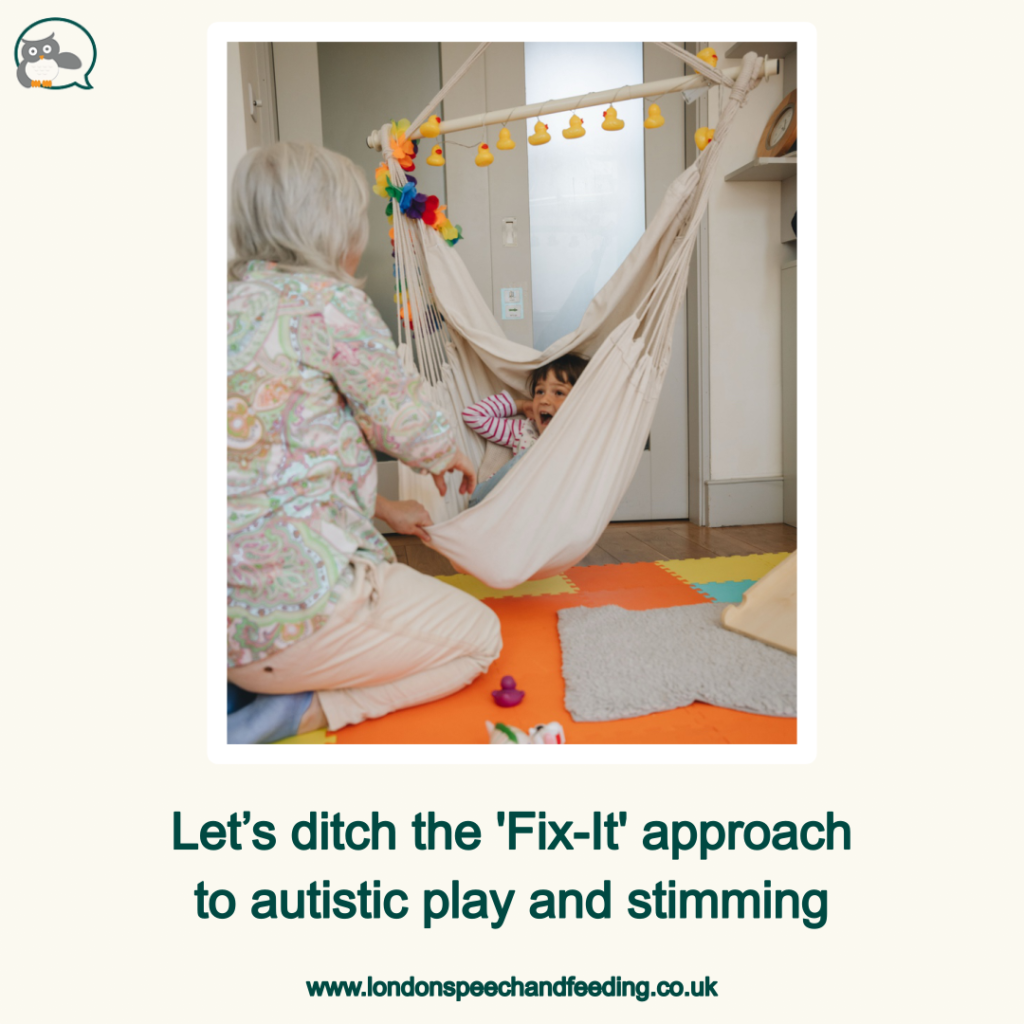
    Let’s ditch the ‘Fix-It’ approach to autistic play and stimming

    Let’s ditch the 'Fix-It' approach to autistic play and stimming

    December is often presented as a time of perfect, reciprocal play. Children are supposed to be unwrapping toys, sharing, and engaging in imaginative scenarios with family. But for parents of young autistic children, this high-pressure, socially demanding period can often feel like a battleground.

    If you’ve been told to interrupt your child’s stimming, push for eye contact, or force them to play ‘functionally’ with toys, it’s time to take a deep breath. Those traditional approaches are not only stressful—they often miss the point of your child’s communication.

    As a neurodiversity-affirming Speech and Language Therapist, I want to encourage you this December: You are allowed to follow your child’s lead, validate his or her unique interests, and trust that his or her play and movement are profoundly meaningful.

    1. Stimming: not a distraction, but a regulator 💡

    Stimming is short for self-stimulatory behaviour and includes repetitive movements or sounds like hand flapping, humming, rocking, finger flicking, or repeating phrases (called echolalia).

    For years, parents were incorrectly advised to block or eliminate these behaviours. The neurodiversity-affirming view tells us the exact opposite: Stimming is a vital and essential tool for your child’s self-regulation.

    Think of stimming as an internal volume dial:

    • Too loud/overwhelmed: Your child may stim to reduce incoming sensory input (e.g., rocking to ground himself or herself in a busy room).
    • Too quiet/under-stimulated: Your child may stim to increase sensory input and focus (e.g., running back and forth to maintain alertness).

    The shift: validate, don’t block

    Instead of saying, ‘Stop flapping your hands’, try to understand the message behind the movement.

    • Observe: When does the stimming happen? Is it before a meltdown? When your child excited? When your child is bored?
    • Validate: Name the need, not just the behaviour. You might say, ‘I see your body needs to move fast right now. That helps you calm down!’
    • Co-regulate: If the stim is unsafe (e.g., head-banging), help your child find a safer, alternative stim that meets the same sensory need (e.g., pushing hard against a wall, squeezing a stress ball).

    By validating your child’s need to regulate, you are building trust, reducing anxiety, and teaching him or her critical self-awareness.

    2. Autistic play: Meaningful, even if it’s monologue

    The traditional idea of ‘good play’ often involves turn-taking, pretending, and specific toy functions (e.g., pushing a train around a track). When an autistic child spends 30 minutes lining up cars, spinning their wheels, or scripting whole scenes from a favourite movie, it can often be dismissed as non-functional or repetitive.

    In neurodiversity-affirming practice, we recognise that autistic play is authentic play. These activities are crucial for learning, deep focus, and imaginative development.

    • Lining up toys may be an exploration of patterns, visual organisation, and order.
    • Spinning wheels may be a deep interest in cause-and-effect and visual sensory input.
    • Scripting is often a way to process language, regulate emotions, and practise complex social situations in a safe, controlled way.

    Make a change: Join your child’s world, don’t drag them to yours.

    Stop trying to force the ‘right’ way to play. Instead, try these neuro-affirming strategies:

    1. Be a co-regulator, not a director: If your child is lining up cars, sit down next to him or her. Instead of moving a car, try handing him or her another car to line up. Focus on the shared interest rather than forcing interaction.
    2. Narrate (don’t question): Avoid constantly asking, ‘What are you doing?’ or ‘What does this car say?’ This puts pressure on your child to perform. Instead, narrate your observations using his or her interest: ‘I see you made a long, straight line of red cars. Look at all the wheels spinning!’
    3. Validate the interest: Show genuine appreciation for your child’s focus. ‘Wow, you know so much about how magnets stick together! That’s incredible.’

    3. The communication revolution: Honouring gestalt language processing 

    Many young autistic children communicate in ways that don’t fit the traditional model of building language word-by-word. Many use Gestalt Language Processing (GLP).

    A gestalt language processor learns language in chunks or scripts (e.g., ‘what’s-in-there?’ or ‘ready-go!’). These chunks (or gestalts) are not random; they are often tied to an emotional memory or meaning. Over time, the child breaks down these big chunks into individual words then learns to recombine those words creatively.

    If your child repeats movie phrases or whole sentences that seem unrelated, he or she is likely a gestalt language processor!

    Affirm the script, then model something useful.

    1. Affirm the script: When your child says a script, respond to the meaning or emotion behind it, not the literal words. If he or she says, ‘We’re going to need a bigger boat’, and he or she is looking at a messy toy pile, he or she may be trying to express overwhelm or a need for help. You can affirm: ‘That pile is too big! I can help you move it.’
    2. Model new ‘mix and match’ scripts: To help your child move from whole scripts to single words, you can model shorter, slightly changed versions of the script, also called ‘mitigated gestalts’. If they say, ‘I want to go home now’, you might model, ‘Let’s go home, now’ or ‘I wanna go home’.

    By honouring your child’s communication style, you validate his or her experience and naturally support his or her path to language development—a core part of neurodiversity-affirming SLT.

    Your December gift to your little one:

    This December, stop trying to make your child fit into a neurotypical box. Instead, make your home a safe space where he or she can be his or her authentic selves.

    Prioritise regulation and connection over compliance.

    Trust that when your child is regulated, his or her communication, learning, and engagement will flourish naturally. This is the true gift of neurodiversity-affirming practice.

    Download and print my neuro-affirming quick reference guide and keep this guide handy on your fridge and/or in your child’s play area for a quick reminder to prioritise connection over conformity.

    Sonja McGeachie

    Highly Specialist Speech and Language Therapist

    Owner of The London Speech and Feeding Practice.


    Health Professions Council registered
    Royal College of Speech & Language Therapists Member
    Member of ASLTIP

    Find a speech and language therapist for your child in London. Are you concerned about your child’s speech, feeding or communication skills and don’t know where to turn? Please contact me and we can discuss how I can help you or visit my services page.

    2
  • · ·

    The power of imitation in supporting children with autism

    Image by Freepik

    Imitation, the act of mirroring someone else’s actions, gestures, sounds, or words, is a fundamental skill that plays a crucial role in human development. It’s how babies learn to wave ‘bye-bye’, how toddlers pick up new words, and how children acquire social skills. But for children with autism imitation can be a significant challenge and understanding why it’s important and how to foster it becomes a key focus for parents, educators, and speech and language therapists.

    Why is imitation important?

    Imitation is a building block for a wide range of developmental skills:

    • Social interaction: Imitation is the foundation of social reciprocity. When a child imitates, he or she is engaging in a shared experience, connecting with another person, and learning to take turns in social exchanges.
    • Communication development: Imitation is closely linked to language acquisition. Children often imitate sounds and words before they can produce them independently. Imitation also helps them understand the meaning of gestures and facial expressions, which are vital for nonverbal communication.
    • Cognitive development: Imitation plays a role in problem-solving, learning new skills, and understanding cause and effect. By imitating actions, children explore their environment and learn how things work.
    • Emotional development: Imitation helps children understand and share emotions. When a child imitates a smile, he or she may begin to understand the feeling of happiness.

    Imitation challenges in autism

    Many children with autism face challenges with imitation, which can affect their development in these key areas. These challenges can manifest in different ways:

    • Difficulty imitating motor actions: Children with autism may struggle to imitate simple motor movements, such as clapping hands, waving, or playing ‘peek-a-boo’.
    • Limited vocal imitation: Imitating sounds, words, and phrases can be difficult for some children with autism, which can impact their speech development.
    • Challenges with social imitation: Imitating social cues, such as facial expressions, gestures, and body language, can be particularly challenging for children with autism, affecting their ability to engage in social interactions.

    Why do children with autism struggle with imitation?

    The exact reasons for imitation difficulties in autism are complex and not fully understood. However, several factors may contribute:

    • Neurological differences: Research suggests that differences in brain structure and function, particularly in areas involved in social perception and motor control, may play a role.
    • Sensory processing differences: Some children with autism may have sensory differences that make it difficult to attend to and process the movements or sounds they are expected to imitate.
    • Attention and motivation: Challenges with attention, focus, and social motivation can also affect a child’s ability to engage in imitation.

    How to foster imitation in children with autism

    Fortunately, imitation skills can be developed and improved through targeted interventions and strategies. Here are some approaches that I use in my practice as a speech and language therapist working with autistic children and their families:

    • Create a playful and engaging environment: Children are more likely to imitate when they are having fun and feel motivated. I use toys, games, and activities that the child enjoys.
    • Start with simple imitation: Begin by imitating simple motor movements that the child is already capable of and gradually introduce more complex actions.
    • Imitate the child first: As the Hanen Program emphasises, imitating the child’s actions, sounds, and words can encourage him or her to interact and communicate more.
    • Use visual supports: Visual aids, such as pictures, photos or videos, can help children with autism understand what is expected of them and make imitation easier.
    • Break down complex actions: Divide complex actions into smaller, more manageable steps. For example, to teach a child to brush their teeth, break it down into steps like ‘pick up toothbrush’, ‘put toothpaste on brush’, and ‘move brush on teeth’.
    • Reinforce imitation attempts: Provide positive reinforcement, such as praise, smiles, or preferred activities, when the child attempts to imitate, even if the imitation is not perfect.
    • Integrate imitation into daily routines: Incorporate imitation into everyday activities, such as imitating sounds during playtime, imitating gestures during songs, or imitating actions during self-care routines.

    The role of speech therapy

    Speech-language therapists play a crucial role in helping children with autism develop imitation skills, particularly in the areas of vocal and verbal imitation. As part of my therapeutic role, I offer the following:

    • Assessing a child’s imitation abilities.
    • Developing individualised therapy plans to target specific imitation goals.
    • Using a variety of techniques to encourage vocal imitation.
    • Working with parents and caregivers to provide strategies and support for promoting imitation at home.

    Summary

    Imitation is a fundamental skill that is essential for social, communication, cognitive, and emotional development. While children with autism may face challenges with imitation, it is a skill that can be developed and improved with targeted interventions and support. By understanding the importance of imitation and using effective strategies to foster it, parents, educators, and therapists can make a significant difference in the lives of children with autism, helping them to connect with others, learn new skills, and reach their full potential.

    Do get in touch via my contact form if you have any question or need help with supporting your little one.

    Sonja McGeachie

    Highly Specialist Speech and Language Therapist

    Owner of The London Speech and Feeding Practice.

    Health Professions Council registered
    Royal College of Speech & Language Therapists Member
    Member of ASLTIP

    Find a speech and language therapist for your child in London. Are you concerned about your child’s speech, feeding or communication skills and don’t know where to turn? Please contact me and we can discuss how I can help you or visit my services page.

    1
  • · ·

    Speech Sound Challenges: A focus on /L/ and /Y/

    Have you ever thought about how difficult it can be to produce certain speech sounds? Some sounds are definitely trickier than others. This is especially true for children with speech sound disorders like Childhood Apraxia of Speech (CAS).

    My student with CAS has been working hard on producing the /L/ sound especially when it was followed by an /O/ or /OO/ like, ‘log’ or ‘look’. We’ve practised lots and now that he’s got a good handle on /L/, he’s started replacing another difficult sound, /Y/, with it. So, ‘yes’ becomes ‘less’ and ‘yuck’ becomes ‘luck.’

    This is a common pattern in speech development. Once a child masters a new sound, they may start using it in place of other sounds they find even more challenging.

    Minimal Pair therapy

    I use different evidence-based methods to help my students. And I often like to start out with phonemic awareness and then I move to contrasting the error sound with another sound to make completely different words. This approach is called ‘minimal pair’ therapy: both words are the same except for the initial/final sound which has the error sound, and this is contrasted with the correct sound.

    Below is an example of this:

    After we have worked on sound awareness, listening and becoming aware of small units of sound matter, then we can move to working on tongue placement and movement.

    Tongue placement and movement to produce correct /L/ and /Y/ sounds

    To produce these sounds correctly, the tongue needs to be in specific positions and make specific movements.

    • /L/ sound:
      • Tip of the tongue touches the alveolar ridge (the bony ridge behind your upper teeth)
      • Sides of the tongue are raised to the sides of the upper teeth
      • Airflow escapes through the sides of the tongue
    • /Y/ sound:
      • Tip of the tongue touches the roof of the mouth behind the alveolar ridge
      • Sides of the tongue are raised to the sides of the upper teeth
      • Airflow escapes through the centre of the mouth

    I also use:

    • Auditory bombardment: Auditory bombardment is a technique that involves repeatedly listening to a target sound. This can help children to develop a better understanding of the sound and how to produce it.
    • Visual cues: Visual cues can be helpful for children who are having difficulty producing a particular sound. Here I use the image of a ‘standing tongue’ versus a ‘sitting tongue’.
    • Physical cues: I use my hands to show a ‘standing tongue’ for the /L/ versus a ‘sitting tongue’ for the /Y/. But what worked even better and sadly I don’t have the video clip for it:
    • Semantic cues: For example a picture of an ‘EAR’ to make the sound /Y/ so we shape the sound /EA/ to /Y/.
    • Parent involvement: Parents play an important role in their child’s speech sound development by providing opportunities for them to practise their speech sounds at home. This can be done through activities such as reading books, singing songs, and playing games.
    • Reinforcement: It is important to praise children for their efforts, even if they are not perfect. This will help them to feel motivated to keep practising. Important here for speech correction is concrete reinforcement: I feed back to my student what exactly they were doing correctly with their tongue or lips. Rather than saying ‘well done’, I mention what my student has just done with the tongue to change the sound: ‘I saw you lowered your tongue! That made a good /Y/’.

    Another great way of reinforcing positively is to ask the student how they feel they have done? For the older ones I often ask them to self-rate their sound production out of 10. Then we can work towards the next incremental number upwards. This is very effective and gives the student control over their own work.

    Please contact me if your child has speech sound difficulties.

    Sonja McGeachie

    Early Intervention Speech and Language Therapist

    Feeding and Dysphagia (Swallowing) Specialist The London Speech and Feeding Practice

    The London Speech and Feeding Practice


    Find a speech and language therapist for your child in London. Are you concerned about your child’s speech, feeding or communication skills and don’t know where to turn? Please contact me and we can discuss how I can help you or visit my services page.

    1
  • · ·

    Speech sounds practice at home

    Speech therapists use a variety of tools to help children master specific sounds, and then the students are sent home with some practice sheets to use daily. Parents are able to observe what we do in the session, but I know that back at home three days later they can’t quite remember what it was all about and how to do the practice.

    Here I explain the importance of visual cues, finger shapes, pictures, and semantic prompts (fancy speech therapy term for word clues!). By understanding these tools, you can turn practice time into a fun and engaging experience for both of you.

    Why Visual Cues matter?

    Imagine learning a new language just by listening. It’s tough, right? Young children learning new speech sounds face a similar challenge. Visual cues act like flashcards for their minds, giving them a clear picture of how to position their mouth and tongue.

    • Mirrors: Encourage your child to watch your face (and theirs) in the mirror as you make the sound together. This helps them see the tongue placement and lip movements required.
    • Mouth pictures: Speech therapy sheets often have pictures of mouths making specific sounds. Point to the picture and explain how the tongue and lips look, then have your child try to imitate it.
    • Your face is the best cue! Don’t underestimate the power of your own face. Over-enunciate the sound and let your child observe your mouth movements. Watch this little video clip where I am teaching the /SH/ sound to my little student. You cannot see him but we are both sitting on the floor opposite one another so that he can see me easily.

    Finger fun: making sounds with our hands

    Finger shapes are another powerful tool in my speech therapy arsenal. Think of them as fun reminders of how to position the tongue.

    • ‘Open Wide’ fingers: For sounds like /AH/ and /OH/, hold your fingers wide apart, mimicking an open mouth.
    • ‘Tongue Up’ fingers: For sounds like /T/ and /D/, touch the tip of your thumb to your other fingers, creating a little ‘wall’ like the tongue tip touches the teeth ridge.
    • ‘Snake Tongue’ fingers: For the /S/ sound, wiggle your pinky finger to represent the snake-like tongue tip.
    • In this little video clip I am demonstrating the C-shape moving forward which I had taught my child, showing how the windy sound (/SH/) travels forward with lips open and slightly pursed.

    Bringing sounds to life with pictures

    Pictures serve as visual prompts to connect the sound with a familiar word.

    • Video clip: I am using the WINDY SOUND picture and the FLAT TYRE sound picture to represent /SH/ and /S/ respectively
    • Point and Say: Point to each picture and say the word clearly, emphasising the target sound. Encourage your child to repeat.

    Unlocking sounds with semantic prompts

    Semantic prompts are fancy words for clues that help your child guess the target sound. They can be simple questions or descriptive words.

    • ‘Can you feel the wind whooshing?’ (/SH/)
    • Think of tyre going flat, or a balloon losing air, or a train coming to a slow halt (/S/)

    Practice makes progress, but fun makes it funnier!

    Remember, the key is to keep practice sessions light and engaging. Here are some extra tips:

    • Short and sweet: Stick to short practice times (5-10 minutes) to avoid frustration.
    • Make it a routine: Integrate practice time into your daily routine, like after breakfast or before bedtime.
    • Positive reinforcement: Celebrate your child’s efforts with praise and high fives!
    • Make it multisensory: Incorporate sensory activities like blowing bubbles for /F/ or feeling the wind for /SH/.

    Parents you’re a vital part of your child’s speech development, and together we can make huge progress quickly.

    Please contact me if your child has speech sound difficulties.

    Sonja McGeachie

    Early Intervention Speech and Language Therapist

    Feeding and Dysphagia (Swallowing) Specialist The London Speech and Feeding Practice

    The London Speech and Feeding Practice


    Find a speech and language therapist for your child in London. Are you concerned about your child’s speech, feeding or communication skills and don’t know where to turn? Please contact me and we can discuss how I can help you or visit my services page.

    1
  • · ·

    How can we support babbling and early speech development? SLT tricks and tips

    My baby isn’t babbling and developing speech – what can I do to support?

    While every baby develops at their own pace, if your child isn’t babbling by nine months, it’s worth seeking help from an Early Intervention Health Professional, such as a doctor and a speech therapist. Don’t panic! There are many reasons for delayed babbling, and early intervention is key.

    In the meantime, it is highly recommended that we talk, sing, and read to our baby often. Exaggerate sounds and expressions, and respond to their coos and smiles. This playful interaction helps stimulate their communication skills.

    Below are some tips and tricks from my experience of working with babies and toddlers who need a little bit of help and support to develop.

    The benefits of imitating your baby

    Copying your baby’s sounds and gestures isn’t just silly fun, it’s a powerful learning tool! By mimicking their babbles and actions, you activate “mirror neurons” in their brain that help them connect sounds with meaning. This playful back-and-forth teaches turn-taking, a foundation for conversation. Plus, it encourages them to copy you, building their own language skills and social interaction abilities.

    This is a nice clip on youtube showing how copying/imitating your baby looks like:

    Here are some fun ways to imitate your baby:

    • Matchmaker: Grab two of the same, or two similar toys your child loves, like rainmakers or shakers. Give one to your baby and keep the other for yourself. When your child plays with his/her toy, mirror his/her actions with yours! This creates a fun, interactive game.
    • Face Time: Get down to your baby’s level, sitting opposite him/her on the floor or kneeling. This makes eye contact easy and encourages him/her to look at you during your playful imitation.
    • Be the Funniest You: Go all out with silly faces, exaggerated sounds, and big gestures. The goal is to capture your baby’s attention and make you irresistible to watch. This playful energy encourages him/her to interact and potentially imitate you back!

    By incorporating these tips, you can turn imitation into a fun and engaging way to boost your baby’s communication skills. I have seen this happen numerous times over the past decades. It is very powerful, go ahead and try it! You cannot be silly and goofy enough!

    Great toy ideas:

    Did you know that speech and language development starts with how we talk to our babies?

    Adults naturally use a special way of speaking called motherese. It involves a higher pitch, slower pace, and exaggerated sounds compared to regular conversation. Sentences are simpler, with shorter words and repetition. This grabs babies’ attention, helps them distinguish sounds, and reinforces word meaning.

    Imitation is a key part of motherese. We wait for our baby to make a sound or gesture, then playfully imitate it with exaggeration. Babies notice this right away and often respond with more vocalisations, creating a mini conversation. This back-and-forth teaches turn-taking, a foundation for future conversations.

    By responding warmly and engaging in these playful interactions, we encourage our babies to keep exploring the world of communication. Talking, singing, reading and, of course, imitating, these simple actions can have a big impact on a baby’s language development.

    Once your conversation is underway then try and keep it going for as long as possible. It’s a beautiful dance of turn-taking, even without words!

    A last word on oxytocin

    There’s evidence suggesting early non-verbal communication with your baby can increase a mother’s oxytocin levels, often called the ‘love hormone’. This hormone plays a key role in bonding and social connection. Positive interactions, touch, and stress reduction all contribute to oxytocin release, strengthening the mother–baby bond.

    For parents of babies with extra needs

    The stress of caring for a child with medical needs or developmental delays can be difficult. Stress can lower oxytocin levels, creating a cycle of sadness for both parent and child.

    Breaking the cycle:

    1. Knowledge is Power: Understanding the importance of communication can empower parents.
    2. Seek Support: Speech therapists and other healthcare professionals can provide valuable guidance on communication strategies.
    3. Start Small, Celebrate Big: Even small interactions can boost oxytocin. Focus on playful imitation and positive reinforcement. Remember, friends, family and healthcare professionals are there to encourage you.

    This approach can help reverse the negative cycle and create a more positive and connected relationship between parent and child.

    I hope this is helpful! Don’t hesitate to reach out with any questions.

    Kind regards

    Sonja McGeachie

    Early Intervention Speech and Language Therapist

    Feeding and Dysphagia (Swallowing) Specialist The London Speech and Feeding Practice

    The London Speech and Feeding Practice


    Find a speech and language therapist for your child in London. Are you concerned about your child’s speech, feeding or communication skills and don’t know where to turn? Please contact me and we can discuss how I can help you or visit my services page.

    1
  • · · ·

    Autism – Benefits of Early Assessment and Intervention

    I think my child might be autistic – how can we help?
    Image by macrovector on Freepik

    Consulting a Specialist Speech and Language Therapist can help you in several ways: assessment, informal and formal observation, discussion and advice, onward referrals, direct intervention, parent coaching, educational support and much more, all geared towards supporting you the parents, and helping your child to flourish and thrive.

    First up, we can help you with assessment and advice: with a wealth of expertise in observing childrens’ play and communication, as well as knowledge of the latest research we can see a child’s strengths and areas of struggle very quickly indeed.

    Within a short space of time, we can identify the areas we need to focus on and start guiding you towards helping your child to connect, respond, react and feel better.

    Early detection is key

    If autism is detected in infancy, then therapy can take full advantage of the brain’s plasticity. It is hard to diagnose Autism before 18 months but there are early signs we know to look out for. Let’s have a brief look at the sorts of things we look at.

    The earliest signs of Autism involve more of an absence of typical behaviours and not the presence of atypical ones.

    • Often the earliest signs are that a baby is very quiet and undemanding. Some babies don’t respond to being cuddled or spoken to. Baby is being described as a ‘good baby, so quiet, no trouble at all’.
    • Baby is very object focused: he/she may look for long periods of time at a red spot/twinkly item further away, at the corner of the room for example.
    • Baby does not make eye contact: we can often see that a baby looks at your glasses for example instead of ‘connecting’ with your eyes.
    • At around 4 months we should see a baby copying adults’ facial expressions and some body movements, gestures and then increasingly cooing sounds we make; babies who were later diagnosed with autism were not seen to be doing this.
    • Baby does not respond with smiles by about 6 months.
    • By about 9 months, baby does not share sounds in a back-and-forth fashion.
    • By about 12 months baby does not respond/turn their heads when their name is called.
    • By around 16 months we have no spoken words; perhaps we hear sounds that sound like ‘speech’ but we cannot make out what the sounds are.
    • By about 24 months we see no meaningful two-word combinations that are self-generated by the toddler. We might see some copying of single words.

    24 months plus:

    • Our child is not interested in other children or people and seems unaware of others in the same room/play area.
    • Our child prefers to play alone, and dislikes being touched, held or cuddled.
    • He/she does not share an interest or draw attention to their own achievements e.g., ‘daddy look I got a dog’.
    • We can see our child not being aware that others are talking to them.
    • We see very little creative pretend play.
    • In the nursery our child might be rough with other children, pushing, pinching or scratching, biting sometimes; or our child might simply not interact with others and be unable to sit in a circle when asked to.

    What sort of speech and language difficulties might we see?

    Our child might do any of the following:

    • have no speech at all, but uses body movements to request things, takes adults by the hand
    • repeat the same word or phrase over and over; sometimes straight away after we have said it or sometimes hours later
    • repeat phrases and songs from adverts or videos, nursery rhymes or what dad says every day when he gets back from work etc.
    • copy our way of intonation
    • not understand questions – and respond by repeating the question just asked:
      • adult: Do you want apple? child: do you want apple?
    • not understand directions or only high frequency directions in daily life
    • avoid eye contact or sometimes ‘stares’
    • lack of pointing or other gestures

    Common behaviours:

    • Hand flapping
    • Rocking back-and-forth
    • Finger flicking or wriggling/moving
    • Lining up items/toys
    • Wheel spinning, spinning around self
    • Flicking lights on and off, or other switches
    • Running back-and-forth in the room, needing to touch each wall/door
    • Loud screaming when excited
    • Bashing ears when frustrated or excited
    • Atypical postures or walking, tip toeing, can be falling over easily, uncoordinated
    • Can be hyper sensitive to noises, smells, textures, foods, clothing, hair cutting, washing etc.
    • Being rigid and inflexible, needing to stick to routines, unable to transition into new environments
    • Food sensitivity, food avoidance, food phobias

    I mentioned this to be a ‘brief’ look at the areas and it is: each topic is looked at very deeply and each area is multi-facetted therefore a diagnosis is rarely arrived at very quickly. We want to make sure we have covered all aspects and have got to know your child very well before coming to conclusions.

    Early detection is key, because we want to start helping your child to make progress as quickly as is possible. If you feel /know that your child is delayed in their speech and language development and you would like a professional opinion then please do contact me, I look forward to supporting you. It is important to know at this point, that if your child only has one or two of the above aspects it may mean that your child is simply delayed for reasons other than Autism and if that is the case, we will be able to help you iron out a few areas of need so that your child can go on thriving.

    If you need help with your child, please do not hesitate to contact me.


    Find a speech and language therapist for your child in London. Are you concerned about your child’s speech, feeding or communication skills and don’t know where to turn? Please contact me and we can discuss how I can help you or visit my services page.

    1