Neurodiversity Affirming

  • ·

    How can I incorporate AAC into my speech therapy sessions?

    Many parents are surprised when I bring AAC into a session, especially if they’ve come to see me primarily for speech sound work.

    They might wonder: ‘If we’re working on pronunciation, why are we using a communication device?’

    The simple answer is this: speech therapy is about communication first, and speech sounds second. Supporting a child’s ability to express themselves clearly and confidently is always the priority, and AAC can be a powerful tool alongside spoken speech.

    What do we mean by AAC?

    AAC stands for Augmentative and Alternative Communication.

    This can include:

    • A speech-generating device (such as LAMP Words for Life or GRID as I used in the photo below)
    • A communication app on a tablet
    • A symbol board or communication book
    • Gestures, signs, or visual supports

    AAC does not replace speech. Instead, it supports language development, reduces frustration, and builds communication success while speech skills are developing.

    Pretend Play using Speech and AAC in my clinic room

    But I mainly work on speech sounds… So how does AAC fit?

    Most of the children I see are working on:

    • Articulation difficulties
    • Phonological delay
    • Motor planning challenges (including apraxia/dyspraxia)
    • Unclear speech affecting confidence

    For these children, AAC isn’t a separate therapy. It’s simply woven naturally into what we are already doing.

    If a child brings their device to sessions, I actively include it. If they don’t yet use AAC but could benefit from visual or symbolic support, I may introduce simple options within activities.

    Using AAC to support speech practice

    Let’s say we are working on early speech targets like: ‘GO’.

    We might practise:

    • Saying the word verbally
    • Listening for the target sound
    • Using play (TOY TRAIN GOING ROUND A TRACK)

    Now we can extend this using AAC.

    On the device or communication board, we might model: ‘LET’S GO’ or ‘IT’s GOING up the hill’.

    This allows the child to:

    • Practise their speech sound target
    • Build a simple sentence
    • Experience successful communication even if speech is not fully clear yet

    All responses are valid and supported.

    AAC helps children communicate more than they can say

    Many children can understand and think in longer phrases than they can physically say.

    For example:

    • A child who verbally says single words may build longer phrases on AAC.
    • A child who struggles to plan speech movements may use AAC to communicate smoothly while still practising verbal attempts.
    • A child who becomes frustrated when misunderstood gains a reliable backup system.

    Rather than slowing speech progress, AAC often:

    • Reduces communication pressure
    • Increases participation in therapy
    • Encourages more attempts at speech
    • Supports language growth

    When children feel understood, they usually become more motivated to try speaking.

    There are no ‘prerequisites’ for AAC

    One of the biggest myths I hear is: ‘My child isn’t ready for AAC yet.’

    In reality, children do not need to:

    • Reach a certain speech level
    • Use pictures first
    • Prove they understand everything
    • Show immediate interest

    Instead, we presume competence and introduce AAC in meaningful, playful ways.

    That means:

    • Modelling words while blowing bubbles
    • Commenting during playdough activities
    • Choosing words during games
    • Building simple phrases in shared reading

    AAC should never feel like extra ‘work’. It’s simply another way to join in communication.

    My goal is always the same: to help each child communicate as clearly, confidently, and successfully as possible, using every helpful tool available.

    If your child uses AAC (or might benefit from it)

     Please feel free to:

    • Bring the device to sessions
    • Show me how your child currently uses it
    • Share advice from school or other therapists

    I am very happy to incorporate AAC into our work together so that speech practice, language development, and real communication all move forward hand-in-hand. Because ultimately, therapy isn’t just about producing perfect sounds. It’s about helping your child be heard and understood.

    If you’d like support or advice, please contact me and I can help guide the next steps.

    Sonja McGeachie

    Highly Specialist Speech and Language Therapist

    Owner of The London Speech and Feeding Practice.


      Health Professions Council registered
      Royal College of Speech & Language Therapists Member
      Member of ASLTIP

      Find a speech and language therapist for your child in London. Are you concerned about your child’s speech, feeding or communication skills and don’t know where to turn? Please contact me and we can discuss how I can help you or visit my services page.

      3
    • · ·

      Your child’s communication journey

      Understanding our neurodiversity-affirming, child-led approach

      Welcome to a different kind of therapy!

      Your child’s communication journey

      The start of a new year often brings fresh hope, and sometimes fresh worries, for parents supporting their child’s communication. I am always genuinely excited to begin a new journey with children and their families, and I know that, for many parents, this kind of therapy may look very different from what they were expecting.

      Parents (and children!) are often surprised to discover that our sessions are playful, joyful, and intentionally low-pressure. You won’t see demands for eye contact, sitting still, or being told to ‘do it this way’ or ‘put the red square there’. Instead, you’ll see your child being met exactly where they are.

      For families who have previously experienced more adult-led or behaviour-based approaches including Applied Behaviour Therapy, this difference can feel unfamiliar at first. Because of that, I want to take a moment to prepare you for what child-led, neurodiversity-affirming therapy looks like, so you can feel confident, comfortable, and reassured from day one.

      Why doesn’t child-led therapy look like ‘traditional’ therapy?

      Many people picture speech and language therapy as sitting at a table, using flashcards, or practising words through repetition. While those approaches can work well for some children, they are often not effective or appropriate for many neurodivergent children—including children with autistic profiles, ADHD, or demand-sensitive nervous systems.

      Our approach is grounded in a simple and powerful truth:

      Children learn best when they feel safe, motivated, and emotionally connected.

      When a child’s nervous system feels calm and secure, learning becomes possible. When a child feels pressured or controlled, communication often shuts down, even if they can speak.

      🎯 Our purpose: Communication through connection

      Our goal is not simply to help your child say more words. Our goals go deeper and are built on strong foundations:

      • Trust and regulation: We focus on building a trusting relationship where your child feels safe, understood, and emotionally regulated. A calm nervous system is the starting point for all communication.
      • Motivation: We follow your child’s intrinsic motivation, the things they naturally enjoy to make communication meaningful, joyful, and purposeful.
      • Spontaneous communication: We create opportunities for your child to communicate because they want to, not because they are asked or instructed to.

      🧸 What to expect in a session

      Our sessions are intentionally child-led and often look very much like play.

      FeatureWhat it looks likeWhy we do this
      Minimal toysWe usually offer just 3–4 carefully chosen activities (such as bubbles, blocks, or sensory play).Less is more. Fewer choices reduce overwhelm and help children focus on what genuinely interests them.
      Child choosesYour child decides what to play with and how to engage.This immediately establishes us as a safe, non-demanding partner and increases motivation.
      The therapist’s roleWe join your child’s play, observing closely and responding naturally.We model language, share attention, and reflect your child’s experiences in a way that feels natural and supportive.
      No pressure or demandsThere are no ‘must-do’ tasks. If your child wants to spin, crash, line up toys, or repeat an activity, we follow.Reducing demands lowers anxiety and supports communication, particularly for children with demand-sensitive profiles.

      Is this really effective?

      It’s completely natural to wonder, ‘Are they just playing?’ The answer is yes, and very intentionally so.

      Our sessions are guided by nearly 30 years of speech and language therapy experience, alongside clear, achievable goals tailored to each individual child. Play is a child’s natural language and their most powerful learning tool.

      Within play, we are constantly creating opportunities to:

      • Build joint attention (sharing focus and interest)
      • Model language at the right level
      • Encourage back-and-forth communication
      • Develop a deep, authentic connection

      If your child has struggled to engage or communicate in more structured or demand-heavy settings, this child-led approach is often the key to unlocking their potential.

      💛 What this might look like at home

      You may notice that when pressure is reduced:

      • Your child begins communicating more during everyday routines
      • Language emerges through play, movement, or shared enjoyment
      • Communication feels more natural and less forced

      Small moments could be a shared smile, a look, a sound, a gesture. All matter. These are the building blocks of meaningful communication.

      📚 Resources for parents

      If you’d like to explore these ideas further, you may find the following helpful:

      I look forward to meeting you and your child. Please bring any questions, uncertainties, or curiosities to our first session, there is no such thing as a silly question. This is a journey we take together. Contact me via my contact form.

      Sonja McGeachie

      Highly Specialist Speech and Language Therapist

      Owner of The London Speech and Feeding Practice.

      Health Professions Council registered
      Royal College of Speech & Language Therapists Member
      Member of ASLTIP

      Find a speech and language therapist for your child in London. Are you concerned about your child’s speech, feeding or communication skills and don’t know where to turn? Please contact me and we can discuss how I can help you or visit my services page.

      3
    • · · · ·

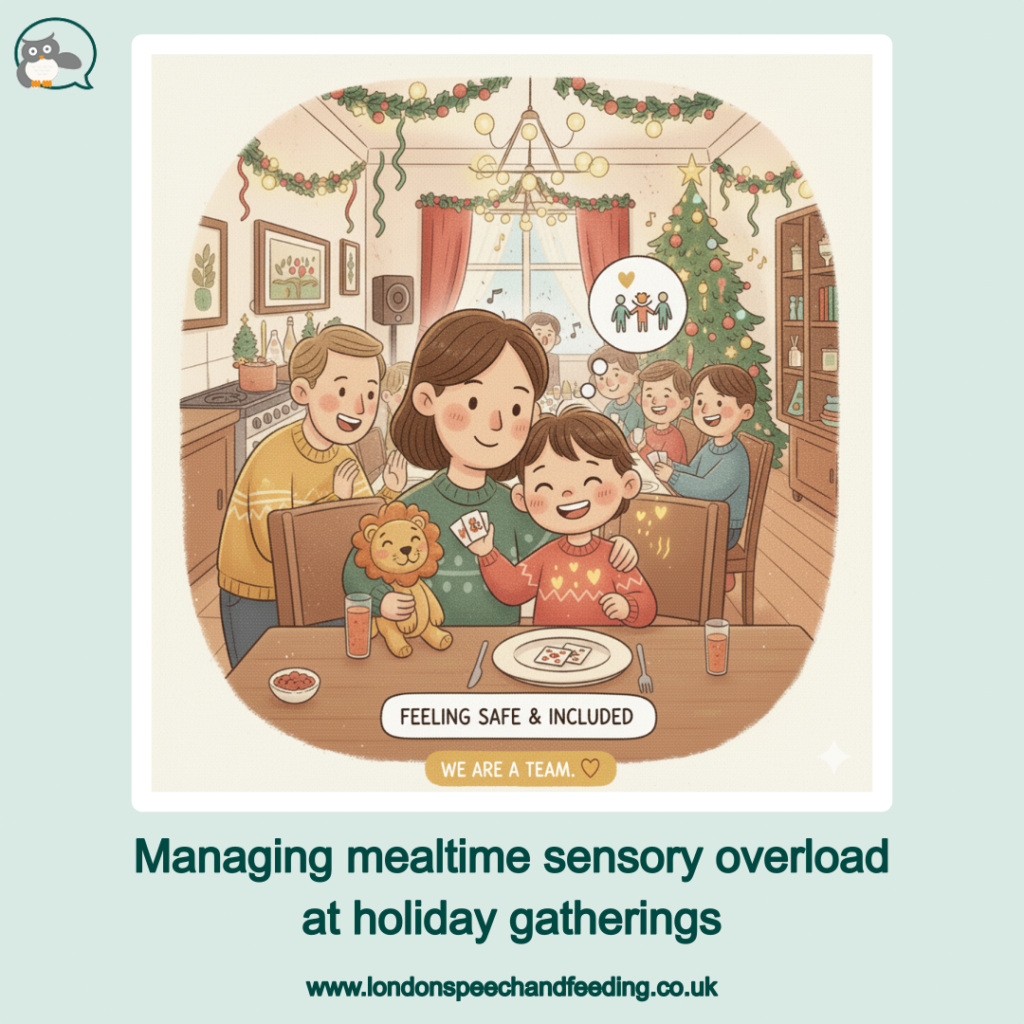
      Managing mealtime sensory overload at holiday gatherings: Supporting children with allergies and feeding differences

      Managing mealtime sensory overload at holiday gatherings: Supporting children with allergies and feeding differences

      Holiday meals are meant to be joyful and something we all look forward to. But for many children and their families, these occasions can be overwhelming and be the cause of dread and worry. The combination of new smells, unfamiliar foods, loud environments, social expectations, and allergy anxieties can quickly turn what should be a festive time into a stressful one.

      For parents of children with sensory processing differences, selective eating challenges, or food allergies, holiday gatherings often require careful planning and a big dose of tolerance and compassion. The good news is that with awareness and a few gentle strategies, you can support your child to feel safe, regulated, and included during festive meals without pressure, tears, or discomfort.

      Let’s explore how to make holiday mealtimes calmer, safer, and more connected this season.

      🎄 Why holiday meals feel so overwhelming

      Holiday gatherings usually combine several sensory triggers all at once:

      • Noisy, chaotic rooms
      • Strong smells from a mix of foods we don’t normally cook
      • Multiple conversations happening at once
      • Bright lights, Christmas décor, flickering candles
      • Unfamiliar foods with unexpected textures
      • Expectations to ‘try everything’ or ‘enjoy it’s sooo good!’
      • New environments, seating arrangements, or routines

      For children with sensory sensitivities, this can feel like a tidal wave of input. Research shows that children who are sensory-sensitive often have heightened responses to smell, taste, and texture, which may lead to avoidance or distress at mealtimes (Cermak, Curtin, & Bandini, 2010).

      Add food allergies into the picture and anxiety increases even further for both children and parents. A 2020 study by DunnGalvin et al. found that children with food allergies experience significantly higher stress in shared eating environments, especially when food preparation or contamination risk is hard to control.

      So, if your child becomes tearful, shuts down, or refuses to sit at the festive table, it isn’t ‘bad behaviour.’ It’s sensory overload, heightened vigilance, or discomfort communicating through their body.

      🌟 Preparing your child for a calmer festive meal

      Preparation is especially important for sensory-sensitive or allergy-aware children. Here’s how to set them up for success:

      1. Offer predictability through previewing

      Before the event, show your child pictures of:

      • where you’re going
      • who will be there
      • the types of foods that might be served
      • where they might sit

      A visual schedule or social story can help reduce anxiety and give your child a sense of control.

      2. Pack safe foods without apology

      If your child has allergies or selective eating, bring:

      • ‘Safe foods’ you know they will eat
      • Backup snacks
      • A separate (their own) plate, if needed
      • Emergency medication

      Announce clear, firm boundaries such as:

      ‘Ok people, these are Jamie’s safe foods — we’ll stick with these today.’ This will help relatives understand without pressure or judgement.

      3. Choose seating that supports sensory regulation

      If possible, seat your child:

      • at the end of the table
      • near a familiar adult
      • away from the kitchen (strong smells)
      • away from noise clusters
      • give them their favourite toy or fidget whilst waiting

      Let them take breaks when needed. This isn’t ‘rude,’ it’s self-regulation.

      🍽️ Supporting children during the meal

      1. Focus on connection, not consumption

      The holidays are not the time to expand your child’s food range. Keeping mealtimes low-pressure actually supports long-term progress.

      In fact, the research is clear: pressuring children to eat decreases acceptance and increases refusal (Galloway et al., 2006).

      So instead of ‘Just try it!’ try:

      • ‘You don’t have to eat it, you can look at it.’
      • ‘You’re in charge of what goes in your mouth.’
      • ‘You can keep your safe foods on your plate.’

      2. Protect your child’s allergy safety

      Holiday meals often include:

      • cross-contamination risks
      • shared utensils
      • buffets
      • homemade dishes without ingredient lists

      Use gentle but firm scripts:

      • ‘Because of Ellie’s allergies, we’ll keep her plate separate.’
      • ‘We’ll serve her food ourselves to make sure she stays safe.’

      Confidence in your boundary helps others respect it.

      3. Manage sensory load in real time

      Offer:

      • headphones
      • a small chew or fidget toy
      • a designated ‘calm corner’
      • time outside for fresh air
      • a predictable signal for breaks (e.g., a hand squeeze or card)

      Remember, sensory regulation is healthcare, not ‘giving in.’

      4. Model calm eating

      Children learn most from watching.

      Slow, happy bites and relaxed facial expressions tell the nervous system: ‘This environment is safe’.

      💛 What to say to well-meaning relatives

      Families often have big feelings about food. You can prepare nice phrases like:

      • ‘We’re focusing on helping him feel safe around food today.’
      • ‘She has allergies, so we’re sticking to our plan.’
      • ‘We’re avoiding pressure because it helps him eat better long term.’
      • ‘We’re celebrating together, eating is not the goal today.’

      Setting expectations ahead of time can reduce awkward moments later.

      🎁 The bigger picture: It’s about safety, not ‘picky eating’

      Children with allergies, sensory differences, or feeding challenges aren’t trying to be difficult. They are trying to stay safe, regulated, and comfortable.

      Your calm presence, gentle boundaries, and preparation create the conditions for a holiday that feels peaceful, not pressured.

      Sonja McGeachie

      Highly Specialist Speech and Language Therapist

      Owner of The London Speech and Feeding Practice.


      Health Professions Council registered
      Royal College of Speech & Language Therapists Member
      Member of ASLTIP

      Find a speech and language therapist for your child in London. Are you concerned about your child’s speech, feeding or communication skills and don’t know where to turn? Please contact me and we can discuss how I can help you or visit my services page.

      📚Research References

      Cermak, S. A., Curtin, C., & Bandini, L. G. (2010). Food selectivity and sensory sensitivity in children with autism spectrum disorders. Journal of the American Dietetic Association, 110(2), 238–246.

      DunnGalvin, A. et al. (2020). APPEAL-2: A pan-European qualitative study to explore the burden of peanut-allergic children, teenagers and their caregivers. Clinical & Experimental Allergy, 50(11), 1238–1248.

      Galloway, A. T., Fiorito, L. M., Francis, L. A., & Birch, L. L. (2006). ‘Finish your soup!’ Counterproductive effects of pressuring children to eat on intake and affect. Appetite, 46(3), 318–323.

      2
    • · · · ·

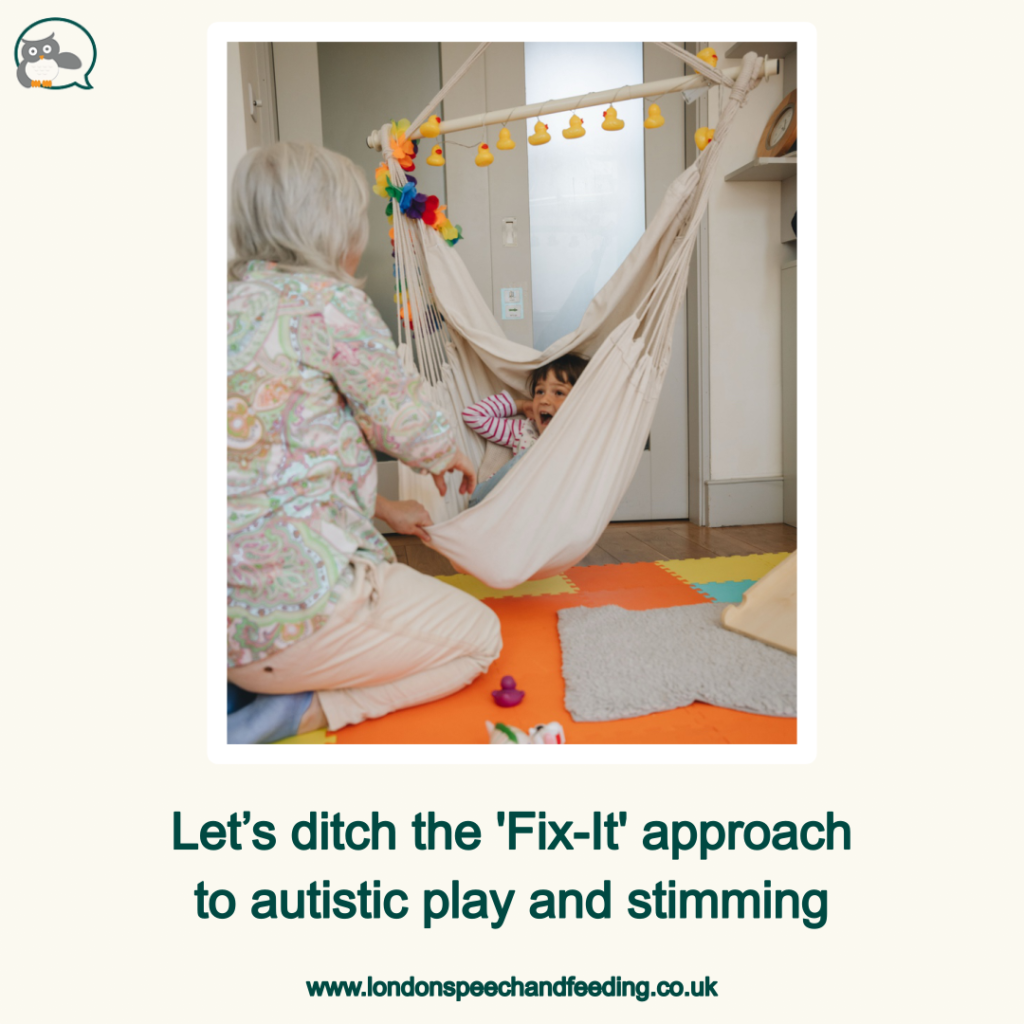
      Let’s ditch the ‘Fix-It’ approach to autistic play and stimming

      Let’s ditch the 'Fix-It' approach to autistic play and stimming

      December is often presented as a time of perfect, reciprocal play. Children are supposed to be unwrapping toys, sharing, and engaging in imaginative scenarios with family. But for parents of young autistic children, this high-pressure, socially demanding period can often feel like a battleground.

      If you’ve been told to interrupt your child’s stimming, push for eye contact, or force them to play ‘functionally’ with toys, it’s time to take a deep breath. Those traditional approaches are not only stressful—they often miss the point of your child’s communication.

      As a neurodiversity-affirming Speech and Language Therapist, I want to encourage you this December: You are allowed to follow your child’s lead, validate his or her unique interests, and trust that his or her play and movement are profoundly meaningful.

      1. Stimming: not a distraction, but a regulator 💡

      Stimming is short for self-stimulatory behaviour and includes repetitive movements or sounds like hand flapping, humming, rocking, finger flicking, or repeating phrases (called echolalia).

      For years, parents were incorrectly advised to block or eliminate these behaviours. The neurodiversity-affirming view tells us the exact opposite: Stimming is a vital and essential tool for your child’s self-regulation.

      Think of stimming as an internal volume dial:

      • Too loud/overwhelmed: Your child may stim to reduce incoming sensory input (e.g., rocking to ground himself or herself in a busy room).
      • Too quiet/under-stimulated: Your child may stim to increase sensory input and focus (e.g., running back and forth to maintain alertness).

      The shift: validate, don’t block

      Instead of saying, ‘Stop flapping your hands’, try to understand the message behind the movement.

      • Observe: When does the stimming happen? Is it before a meltdown? When your child excited? When your child is bored?
      • Validate: Name the need, not just the behaviour. You might say, ‘I see your body needs to move fast right now. That helps you calm down!’
      • Co-regulate: If the stim is unsafe (e.g., head-banging), help your child find a safer, alternative stim that meets the same sensory need (e.g., pushing hard against a wall, squeezing a stress ball).

      By validating your child’s need to regulate, you are building trust, reducing anxiety, and teaching him or her critical self-awareness.

      2. Autistic play: Meaningful, even if it’s monologue

      The traditional idea of ‘good play’ often involves turn-taking, pretending, and specific toy functions (e.g., pushing a train around a track). When an autistic child spends 30 minutes lining up cars, spinning their wheels, or scripting whole scenes from a favourite movie, it can often be dismissed as non-functional or repetitive.

      In neurodiversity-affirming practice, we recognise that autistic play is authentic play. These activities are crucial for learning, deep focus, and imaginative development.

      • Lining up toys may be an exploration of patterns, visual organisation, and order.
      • Spinning wheels may be a deep interest in cause-and-effect and visual sensory input.
      • Scripting is often a way to process language, regulate emotions, and practise complex social situations in a safe, controlled way.

      Make a change: Join your child’s world, don’t drag them to yours.

      Stop trying to force the ‘right’ way to play. Instead, try these neuro-affirming strategies:

      1. Be a co-regulator, not a director: If your child is lining up cars, sit down next to him or her. Instead of moving a car, try handing him or her another car to line up. Focus on the shared interest rather than forcing interaction.
      2. Narrate (don’t question): Avoid constantly asking, ‘What are you doing?’ or ‘What does this car say?’ This puts pressure on your child to perform. Instead, narrate your observations using his or her interest: ‘I see you made a long, straight line of red cars. Look at all the wheels spinning!’
      3. Validate the interest: Show genuine appreciation for your child’s focus. ‘Wow, you know so much about how magnets stick together! That’s incredible.’

      3. The communication revolution: Honouring gestalt language processing 

      Many young autistic children communicate in ways that don’t fit the traditional model of building language word-by-word. Many use Gestalt Language Processing (GLP).

      A gestalt language processor learns language in chunks or scripts (e.g., ‘what’s-in-there?’ or ‘ready-go!’). These chunks (or gestalts) are not random; they are often tied to an emotional memory or meaning. Over time, the child breaks down these big chunks into individual words then learns to recombine those words creatively.

      If your child repeats movie phrases or whole sentences that seem unrelated, he or she is likely a gestalt language processor!

      Affirm the script, then model something useful.

      1. Affirm the script: When your child says a script, respond to the meaning or emotion behind it, not the literal words. If he or she says, ‘We’re going to need a bigger boat’, and he or she is looking at a messy toy pile, he or she may be trying to express overwhelm or a need for help. You can affirm: ‘That pile is too big! I can help you move it.’
      2. Model new ‘mix and match’ scripts: To help your child move from whole scripts to single words, you can model shorter, slightly changed versions of the script, also called ‘mitigated gestalts’. If they say, ‘I want to go home now’, you might model, ‘Let’s go home, now’ or ‘I wanna go home’.

      By honouring your child’s communication style, you validate his or her experience and naturally support his or her path to language development—a core part of neurodiversity-affirming SLT.

      Your December gift to your little one:

      This December, stop trying to make your child fit into a neurotypical box. Instead, make your home a safe space where he or she can be his or her authentic selves.

      Prioritise regulation and connection over compliance.

      Trust that when your child is regulated, his or her communication, learning, and engagement will flourish naturally. This is the true gift of neurodiversity-affirming practice.

      Download and print my neuro-affirming quick reference guide and keep this guide handy on your fridge and/or in your child’s play area for a quick reminder to prioritise connection over conformity.

      Sonja McGeachie

      Highly Specialist Speech and Language Therapist

      Owner of The London Speech and Feeding Practice.


      Health Professions Council registered
      Royal College of Speech & Language Therapists Member
      Member of ASLTIP

      Find a speech and language therapist for your child in London. Are you concerned about your child’s speech, feeding or communication skills and don’t know where to turn? Please contact me and we can discuss how I can help you or visit my services page.
      2
    • · ·

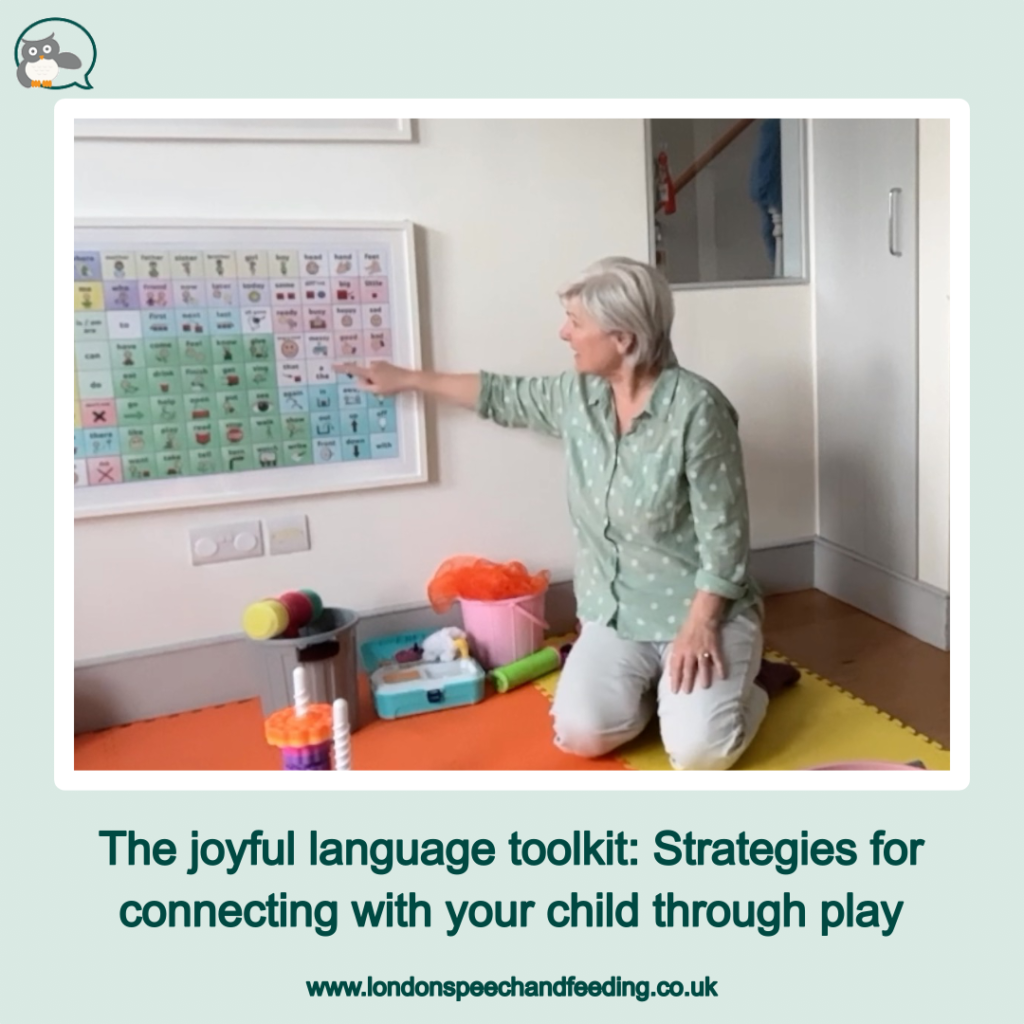
      The joyful language toolkit: Strategies for connecting with your child through play

      As parents and therapists, we all want to help our children communicate. But sometimes, the process can feel like ‘work’. If I had a penny for every parent saying ‘I find it so boring!’… Ok hang in… what if I told you the most effective therapy happens when it doesn’t look like therapy at all?

      My approach centres on connection, enthusiasm, and multi-sensory engagement. We don’t just teach words; we teach the joy of using them. These strategies can be used whether your child is speaking, using a core board, or communicating in his or her own unique way.

      Some of my favourite strategies

      Today I want to share a few of my favourite strategies to turn everyday interactions into powerful communication opportunities regardless of why or how big a delay your child is having.

      1. Facial expressions & exaggeration: Use an exaggerated facial expression to show surprise (wide eyes!), excitement (big smile!), or confusion (a crinkled brow!). Your face is a powerful teaching tool. I am always talking like a clown in my sessions. I can announce that I have also a normal speaking voice outside my clinic room! 😊
      2. Using your voice with intonation: Your voice is music! Use a singsong or ‘tuneful’ repeat to make words stand out. For example, ‘It’s a BIIIG ball!’ or ‘Let’s GO-O-O!’. Again think: clown!!
      3. Hands and body to show: Use gestures, hands, and body movements to demonstrate. Say ‘OPEN’ while pulling your hands apart, or ‘UP’ while raising the toy high above your head.
      4. Elongating our words: Stretching out key sounds or words gives them emphasis and more time for your child to process. ‘Criiiinkley’ ‘tiiickleyyyy’
      5. Core board & language modelling:
        • Model the core board with joy: Don’t just point: point with energy!
        • Model the core board repeatedly throughout the activity, showing genuine excitement. This demonstrates the board is a joyful tool, not homework.
        • Pointing to the core board: When you say a core word, point to the corresponding symbol. You are showing your child, ‘My words live here, and your words can too’.
      6. Describing it for your child: Help your child build his or her vocabulary by providing rich sensory language. ‘It’s squishy’, ‘It’s very noisy’, or ‘It’s so smooth’.
      7. Catchy phrases: Repetitive, positive phrases create a sense of shared fun. Use them consistently: ‘Oh, that’s a nice one!’ or ‘We like that!
      8. Following your child’s Interest: Put down your agenda and follow your child’s lead. If they pick up a block, talk about the block. This ensures they are engaged and ready to learn.
      9. Allowing for pauses: This is critical! After you made a comment, allow for a significant pause (count to five in your head) for your child to fill. The silence creates a powerful opportunity for them to initiate communication.
      10. Copying your child’s sounds: If he or she makes a sound (‘buh!’), you make the sound back! Copying your child’s sounds shows him or her ‘I hear you, and your communication is important’.
      11. Lots of repetition: Hearing a word many times in meaningful contexts is how we learn! Repeat key phrases and core words throughout the activity. Repetition is the key to retention.
      12. Getting turns: Explicitly teach and celebrate getting turns in a game. ‘My turn! Your turn!’ This is a foundational social and communication skill.
      13. Using tidy up as a teaching activity: Turn cleanup into a fun game! It’s a goldmine for core words like PUT IN, ALL DONE, HELP, and MORE. For example, ‘Let’s PUT IN the red block! Yay!’
      14. Using exaggerated repeats: When your child tries a sound or word, give it back with exaggerated, tuneful repeats.

      Try out all or even just a few of these strategies, and I can promise you, you’re not just encouraging language; you’re building a joyful, reciprocal relationship based on genuine communication!

      Which strategy are you excited to try first? Let me know in the comments!

      If I can help you with any of the above, if you want to practise these a bit more, I would love to help you!

      Sonja McGeachie

      Highly Specialist Speech and Language Therapist

      Owner of The London Speech and Feeding Practice.


      Health Professions Council registered
      Royal College of Speech & Language Therapists Member
      Member of ASLTIP

      Find a speech and language therapist for your child in London. Are you concerned about your child’s speech, feeding or communication skills and don’t know where to turn? Please contact me and we can discuss how I can help you or visit my services page.

      2