Ages and Stages: 0–3 months

| |

What do we offer our babies from 0–3 months old? What toys? What are the best early activities for our baby to develop? I get asked this a lot so here are my suggestions.

You are the best toy

You the parent or the caregiver are the BEST toy a baby could have in the first three months. The most important thing is to talk and sing to your baby, to look and hold your baby and offer your face and voice! Use sing song intonation as much as you can, and as often as possible. We know that babies respond really well to interesting voices, singing or funny sounds. Use your facial expressions!

It is important to encourage early turn taking: leave pauses in between what you say or sing to allow your baby to respond to you. Once you see any signs of your baby responding you continue as if you are having a conversation.

Visual Stimulation

We know that baby’s eyesight still needs to develop in those first months and that a newborn can only distinguish light, shapes and faces. And their distance vision is blurry in the first month. A baby can see up to 15 cm away and this is roughly the distance between the feeders’ face when bottle or breastfeeding the baby.

Black and white

Your baby can see black and white and some shades of grey. So, in the first month you really will need no toys at all other than your face and your voice, your smile, giggle and your hands! Of course, there are a range of black and white visual toys available these days like the ones below. But if you are on a budget, I would say you don’t need those.

From the second to third month a baby can begin to follow objects with their eyes. They recognise a familiar face and now they start reaching for things. Their colour vision is also gradually improving.

Baby gym

One of the best early toys is a ‘baby gym’ where bright and colourful toys dangle off foam padded arches. You can sometimes get ones with a mirror hanging off one of the arches or a mirror sewn into the mat. This is useful as baby likes to look at his/her face at around three months old and this can also be great for tummy time. If you are on a budget this would be the one toy, I would recommend you to get.

If there is no mirror on your baby gym you could get a mirror toy. There are lots out there, this one is a good example. I would probably get a mirror toy that has other sensory components attached so you get more value for money, i.e., three toys in one.

O-ball

Another great toy to get around 2–3 month is an O-ball for easy grasping, bright colours, very lightweight.

Sounds

Lovely early toys are sound makers, bells or rain makers. Some very light weight bells can be attached to your baby’s ankles and they ring every time your baby moves his/her legs. This is a nice and easy introduction to early cause and effect understanding.

Peek-a-boo

A great early game is Peek-a Boo and you could complement your hands hiding your eyes with some nice lightweight pieces of material like a piece of organza veil fabric for example. An added benefit is that later on baby can try and grasp the materials and pull them out of the container.

Music

Music is very important. Turn on the radio to classical or any easy listening station you like. If nothing else you could sing of course! And do not worry about not hitting the right notes your baby won’t judge you (until they are about three years old!)

After three months

At the end of three months your baby is likely to show you the following:

  • makes cooing and early babbling sounds
  • seems to know your face
  • smiles at you socially
  • cries for different needs: hungry, bored, needing attention, looking for you
  • opens and closes hands to try and grasp items
  • takes swipes at dangling
  • kicks his/her legs
  • looks at faces and toys, lights
  • turns his/her head towards sounds
  • starts to understand the world around him/her.

Don’t panic!

But don’t panic at all if you feel your baby has not quite mastered any of those stages. Chances are they are doing so very soon. If you are worried, please do come and bring your baby to our clinic for a screen and we will give you plenty of assurance and ideas on how to help your baby move forward.

On a final note, Early Intervention is key and bringing your baby for a one-off consultation to a speech and language specialist is always a great idea, just to get ideas, to see that baby is on track and to help baby develop.

The earlier you bring your baby the better. Chances are one consultation is all you need and perhaps a six-monthly review to just stay nicely on track.

Look out for my next Ages and Stages from three to six months old!

I look forward to seeing you! Get in touch with me via my contact form.

Sonja McGeachie

Early Intervention Speech and Language Therapist

Feeding and Dysphagia (Swallowing) Specialist The London Speech and Feeding Practice

The London Speech and Feeding Practice


Find a speech and language therapist for your child in London. Are you concerned about your child’s speech, feeding or communication skills and don’t know where to turn? Please contact me and we can discuss how I can help you or visit my services page.

1

Similar Posts

  • ·

    Answers to very common questions I get as a Feeding Therapist

    What are hunger cues in newborn babies? How do we recognise when our baby is hungry? How often should we feed our baby?

    These are very common questions I get as a Feeding Therapist. And so I thought I would write a blog on it.

    A mother holding her baby on one arm in her lap while holding a cup
    Image by Freepik

    First-time parents’ journey

    First-time parents often imagine that feeding, particularly breastfeeding, will be an easy and natural process without too many problems. It can be a rude awakening to find that feeding our newborn is not at all easy and can be fraught with complications. It is fair to say that in most cases by the time our baby is about eight weeks old most mums have got the hang of feeding, either by breast and/or bottle, and things are falling into place.

    But until that time it can be a difficult journey:

    • getting to know one’s baby,
    • getting to know their feeding rhythm,
    • falling in with it,
    • TRUSTING that baby knows what they need and knows when they have had enough,
    • TRUSTING and not going crazy with going down an on-line rabbit hole of information and guidance mostly unnecessary and often quite simply FALSE!

    Many mums I have met set out with the best intentions to breastfeed for as long as possible. However, they arrive in my clinic anxious and often have given up with the breast; now we are on bottle feeds and things are still very tricky for several reasons. There are too many reasons for this blog to cover but I thought I would start with the basics and ‘reading hunger cues’ is one of those early basics.

    Reading hunger cues

    So let’s dive in:

    Newborns communicate hunger through a variety of cues. Here are some early signs to look for:

    • Early hunger cues: These are the best times to respond to baby’s hunger for a more peaceful feeding. Look for things like:
      • Becoming more alert and active
      • Turning head from side to side in the cot
      • Rooting (turning their head towards your breast or a bottle, especially when stroked on the cheek)
      • Putting hands/fists to mouth
      • Sucking on fists or lips
      • Opening and closing mouth, smacking sounds
    TOP TIP: THIS IS WHERE YOU SHOULD GET READY TO FEED. Breast or bottle. Either way get ready. We do not want our baby to get into later hunger cues, which are below:
    • Later hunger cues: If we miss the early cues, babies will progress to more insistent hunger cues. These include:
      • Fussiness or whimpering
      • Rapid sucking motions
      • Increased squirming
      • Head bobbing

    Generally, remember that we do not want our baby to cry for their food. Because once they are riled and cry they are not relaxed enough to latch, especially when latching is hard!

    Feeding on demand vs. scheduled feeds

    We now know and have researched how babies are fed best and safest, how weight gain is ensured best, both for breastfed and bottle-fed babies.

    It’s generally recommended to feed on demand—unless your baby is tube-fed or has some other pressing health concerns or is failing to thrive.

    What are the benefits of on demand feeding?

    • We need to respond to baby’s individual needs and hunger cues because every person is unique!
    • Babies need to learn and regulate their own hunger and satiation cycles
    • Promotes better weight gain and growth
    • Leads to more peaceful feeding experiences

    Scheduling can come later

    A loose schedule might emerge naturally when your baby is around 2–3 months old, but it’s best to follow your baby’s lead.

    Tips:

    • Some newborns may feed every 2–3 hours, while others go longer stretches. Pay attention to your baby’s cues and feeding habits.
    • Crying is a late hunger cue, and frequent crying can make feeding more difficult. Responding to earlier cues is best.
    • If you have concerns about your baby’s feeding patterns or weight gain, consult with a Speech and Language Therapist/Dysphagia Therapist and/or Lactation Consultant.

    Check out these useful resources on  the topic of Demand Feeding:

    Do get in touch if you would like some in-person or on-line 1:1 support with this. It can be overwhelming to figure it all out alone.


    Find a speech and language therapist for your child in London. Are you concerned about your child’s speech, feeding or communication skills and don’t know where to turn? Please contact me and we can discuss how I can help you or visit my services page.

    1
  • ·

    Correcting a lisp

    Correcting A Lisp

    This is a surprisingly common speech error and it can be corrected really well in my experience. I have helped lots of children of all ages learn how to control their tongue movements and produce clear, sharp /S/ sounds and good /SH/ sounds.

    Initial consideration

    There are some factors which need to be considered before we can dive into therapy proper and these are they, in a nutshell:

    1. The student is not currently displaying negative oral habits such as thumb sucking or excessive sucking on clothing. This is because thumb sucking exerts pressure on the teeth and therefore can, over time, push teeth out of their natural order/position.
    2. The student does not have a restricted lingual frenulum or tongue tie which can cause at times restricted movements of the tongue (pending on how tight the frenulum is attaching the tongue to the base of the oral cavity); equally a labial frenulum or lip-tie can restrict lip movement and therefore physically restrict good speech sound production.
    3. The student does not have enlarged tonsils as they can sometimes push a tongue forward and also cause open mouth posture and open mouth breathing.
    4. The student’s motivation to change their speech pattern is high. (this is an important factor though with younger students I can get round this with a lot of fun games and good parental involvement!)

    When I do an Oral Assessment of my student these are the first factors I want to look at and consider. Often I will refer to other agencies such as Orthodontists, dentists or ENT specialists to advise and help with some of these factors before we can get going. However, there are strategies that we can work on almost straight away.

    Most of my Lisp students present with an open mouth posture: that is where the student has their mouth always slightly open for breathing. Over time the tongue starts to fall forward and rests on the front teeth or the bottom lip instead of finding a comfortable resting place either at the alveolar ridge (the bumpy spot behind the upper front teeth) or, alternatively, resting at the bottom of the mouth behind the lower front teeth.

    Another common problem is that the tongue is not moving independently from the jaw and so is reluctant to pull back or lift up inside the mouth as the tongue is guided in movement by the jaw.

    Combine those two factors and your tongue is not pulling back, or lifting up or doing very much at all without the jaw moving as well. This makes for unclear speech sounds, especially all the sounds we make at the front with our tongue or with our lips: /B/ /P/ /L/ /N/ and of course /S/ and /SH/ are particularly hard to make. We often also struggle with the /Y/ sound so ‘LELLOW’ instead of ‘yellow’.

    Do not fear!

    But no fear, these problems can be treated over time for sure! We often start with lip, tongue, and jaw exercises that help to move the tongue independently from the Jaw, our student learns that the tongue is a muscle and can be trained to do amazing acrobatic things in the mouth! WOW! It can actually pull back, lift up, and come down again all on its own!

    We work on breathing, holding our breath for a bit then pushing it out and then holding it again.

    And when it comes to the actual /S/ sound I often try and go a NEW route bypassing the Snake-Sound route if that is what had previously been tried and failed so that we can create completely new sound patterns in our brain and think about our sounds in a completely new way.

    We then work on producing the sound /S/ on its own for a bit, at the end of words, then on either side of complimentary sounds, for instance : ‘EASY” – the sound patterns here are EEE-S–EE : the /EEE/ sound is complimentary to the /S/ sound as the tongue is at the right hight for the /S/ already once you have it in place for /EEE/ -……see?! EASY!

    And gradually we work towards saying the /S/ sound clearly at the front of short words, then phrases and then sentences.

    The process takes some time and it depends on how ready the student is. This varies of course hugely so I can never promise the exact number of sessions we will take to get that Lisp fixed. A lot depends on home practice in between sessions, and this is of course crucial to all therapy! Every day 15-20 mins practice is a good average time to aim for and when this is done it shortens the therapy block drastically.

    I always give plenty of home work so there is never a chance of it getting boring or there being “nothing to do”!

    Do contact me. I really enjoy working with this type of student and get a great kick out of FIXING THAT LISP!


    Find a speech and language therapist for your child in London. Are you concerned about your child’s speech, feeding or communication skills and don’t know where to turn? Please contact me and we can discuss how I can help you or visit my services page.

  • Using AAC – Augmentative and Alternative Communication for non-verbal and early verbal children

    Using a Core Vocabulary Board

    Your Speech Therapist might have been advising you to introduce words to your child with the help of a CORE BOARD. What on earth is she talking about and why would we want to do this, I hear you think – and in fact this is what I get asked a lot, as I often do recommend using Core Boards.

    Core boards belong to the category of Augmentative and Alternative Communication (AAC ) and they can be really useful for:

    • Children or adults who cannot speak at all or who are very hard to understand.
    • Children who are slow to speak and have difficulty expressing themselves verbally, due to genetic conditions as Down Syndrome, Verbal dyspraxia, Autism or any other learning difficulty that means a child is slow to develop speech.

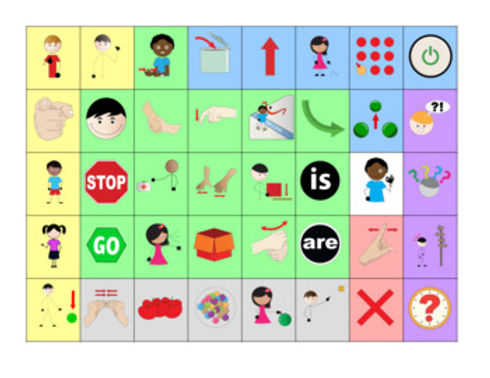
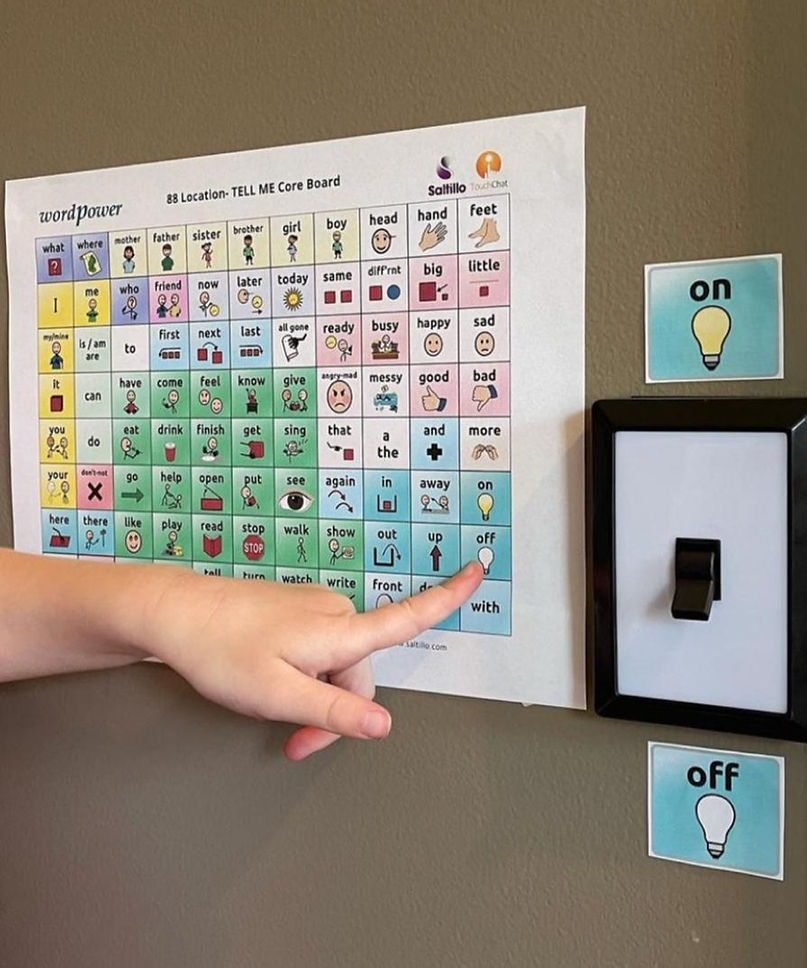
    Here is what a Core board might look like, in fact this is one that I love to use. It is made by Beautiful Speech Life, there are a ton of similar boards out there for free. I have also made my own, you can check it out on my Instagram feed.

    Using a Core Vocabulary Board

    What is Core Vocabulary/ Core words?

    Core vocabulary consists of the most common words used by children throughout a day. In 2003 Banajee and Dicarlo et al found that 50 % of pre-schoolers in their project used nine words consistently across their daily play and meal routines. These words are Core words and are typically the ones you can see on a board, like the one above.

    How To Use It

    Adults always first need to consistently model and show their child how to use a board. This is key! For example: Adult can point to “YOU” “WANT” ‘MORE” and then point to the cup of Water on the counter. Child could then reply either by shaking his/her head and/or pointing to “NOT” which also stands for “NO”. Then adult can point to “NOT” “MORE” and do an OK sign as well. Eventually Child can initiate a request and point to “I” “ WANT” “MORE” and then point to the cup on the counter.

    This is not as cumbersome or limited as it first sounds or appears. Here’s why: As adult you can talk normally and, of course, many words you are using will not be on this board. But some will be, and you will be surprised how many you can find when you start using it. So you could say quite normally: Hey lovely (name of your child) would YOU LIKE some MORE water? The words in capital are on the board which you can point to as you speak normally. Basically, you are showing/saying to your child: “We can speak and these are the pictures we can use to help us; We call this TOTAL COMMUNICATION, as communication is so much more than just words! Great communication can be silent, where we use our facial expression, our smile, our eyes, our hand gestures, body movements and yes, of course, words. But when words fail us, these boards are so helpful.

    This still does not answer your original question of: why would I want to do this, I want my child to talk!? You are a SPEECH Therapist, please help my child TALK, not point to pictures, that is not what I had in mind.

    Let Me Explain

    When speech is difficult for a child it doesn’t mean that there is nothing to talk about! Of course, we want all our children and all people to speak because it is the easiest and most effective way of communicating, no doubt! However, sometimes this is very hard for some children and whilst we are always working towards speech where possible, we also want to make sure that whilst figuring out how to speak, your child has a MEANS TO COMMUNICATE. Using a board like this might well be a temporary strategy but whilst you are using it and working on their speech you will find a reduction in tantrums and frustration as you child is able to express themselves more effectively.

    Often we find that as soon as we offer a CORE VOCABULARY like the above sample a child who has had no or very few words suddenly blossoms and starts to point to new words on the board and starts to PRACTICE USING THESE WORDS!! Practice makes perfect, right? Yes it totally does! There is lots of evidence that tells us that using Core Vocabulary Boards ENHANCE AND SUPPORT SPEECH PRODUCTION AND NOT HINDER IT. Using a board like this will only ever be helpful to your child and will never make your child “lazy” – too lazy to speak? NO SUCH THING!

    Here is what one of my parents says about the core board we use with her little boy:

    “the board has been a game changer, my son is a visual learner so it really helps to have the board as he associates communication so much easier this way. We have incorporated his twin sister who models it’s use and have definitely seen improvement in speech through its support and his frustration around being unable to verbally communicate at times has definitely lessened”

    K Connolly, Mother of Tom (aged 3.5 years).

    Reading and hearing this makes me so happy!

    In addition to general core board above I also sometimes use a Core Board that is specific to an activity, such as for example BLOWING BUBBLES. Below is an example of such a board, which you can use very nicely during a bubble blowing activity and sometimes it is a nice place to start for newcomers, this can be an easy introduction. You can download this and many similar boards on www.widgit.com for free!

    Using a Core Vocabulary Board

    There is so much more to say about AAC and using Coreboards, visit my Instagram you can find a bit more information on how I use them.


    Find a speech and language therapist for your child in London. Are you concerned about your child’s speech, feeding or communication skills and don’t know where to turn? Please contact me and we can discuss how I can help you or visit my services page.
  • Speech sound disorders

    Kids Speech Therapist London
    Speech Sound Disorders

    Treatment Approaches – A Typical Session

    There are various great ways to treat speech sound disorders and I use all the approaches available selectively; I decide what works with each individual child and I also vary the approach depending on the child’s frame of mind at any given time during my session.

    Some of the approaches are more “drill-based” and require a child to be able to pay attention and really participate actively in the therapy, and this is what I am showing you today with this video clip.

    My little student here has been working with me for some time and from only saying a handful of words which were not very easy to understand he has come a long way. He does have some features of Verbal Dyspraxia which I shall briefly outline here:

    • Making sounds in general is a struggle, especially when asked to copy certain sounds, example: ‘can you say: a ee ou oo?”
    • Repeating sound sequences or words sequences is hard, for example: “say p-t-k in sequence” or “say fish chips fish chips fish chips
    • When saying the same word again and again, different mistakes can be heard
    • Intonation difficulties: speech sounds monotonous
    • Vocabulary is very limited

    Some therapy approaches are more play based, for example the Core Word method: here we pick a few words at a time which are very significant to the child and therefore highly motivating to try and say. These could be characters of Pokemon or Minecraft for example, or simple words like “GO!”

    When you watch the video you will see that I use a lot of visual prompting, such as showing him where the tongue is moving to or from. I do this with my index finger and this approach is called Tactile Cueing or “Cued Articulation”. Part of the approach is to give a visual prompt and then reduce the prompt as the learner is more able to produce the correct sounds. Once he can produce the sound on its own, we quickly move to the sound within a word.

    I do mix and match my approaches and in fact here I am drilling but I also use the Core Word which for him (YELLOW) — it’s his favourite colour and I happen to have quite a few good games where a YELLOW something or other can be asked for….. WHO KNEW!? 🙂


    Find a speech and language therapist for your child in London. Are you concerned about your child’s speech, feeding or communication skills and don’t know where to turn? Please contact me and we can discuss how I can help you or visit my services page.
  • · ·

    Explaining pronoun reversal: A window into gestalt language processing

    Explaining pronoun reversal: A window into gestalt language processing

    Have you noticed your child referring to themselves as ‘you’, or calling you ‘me’? This seemingly confusing mix-up of pronouns, known as pronoun reversal, often raises concerns for parents. Below I outline why your child does this and want to reassure you that it is to do with his or her unique language learning style.

    Gestalt language processing: Learning in chunks

    Many children, particularly those on the autism spectrum, use a gestalt language processing approach. Unlike analytic language processors who learn individual words and build sentences, gestalt language processors learn language in whole ‘chunks’ or ‘gestalts’. Think of these gestalts as pre-packaged scripts they pick up from their environment — phrases, sentences, even snippets of songs or movie lines.

    As Marge Blanc, author of Natural language acquisition on the autism spectrum, explains, ‘When a child picks up an entire gestalt (script), he’s got the pronoun of the original speaker. So ‘pronoun reversal’ is nothing more than that.’

    So your child is simply repeating what they’ve heard, without yet understanding the individual word meanings or grammatical functions.

    Imagine your child hearing ‘You want a rice cake?’ repeated frequently. They might then use this phrase to express their own desire for a rice cake, even though it doesn’t grammatically fit. So they are thinking and saying ‘You want a rice cake?’ and the meaning of this phrase is: ‘I want a rice cake’. This isn’t a sign of confusion, but a natural step in their language development. They’re working with the tools they have: the scripts they’ve acquired.

    How can we support their natural language journey

    Instead of trying to ‘correct’ pronoun usage, our role as caregivers and speech therapists is to support the child’s natural language progression. Here’s how we can do this:

    1. Learn about their gestalt stage and run with it: In the early stages (1–3) of gestalt language development, correcting pronouns can be counterproductive. These children are still processing language as whole units, not individual words. Direct corrections can lead to frustration and hinder their natural language exploration.
    2. Patience and trust: Gestalt language processing follows a predictable, albeit sometimes non-linear, path. By understanding their current stage, we can provide targeted support. Language sampling and scoring, guided by the Natural Language Acquisition framework, help us pinpoint their stage and tailor our approach.
    3. Model language strategically: In the early stages, avoid using pronouns like ‘you’ and ‘you’re’. Instead, model language from the child’s perspective or use joint perspectives. For example, instead of ‘Are you thirsty?’, try ‘I’m thirsty!’ or ‘Let’s get some water’,

    The big picture: Language unfolds naturally

    Pronoun reversal is a stepping stone, not a stumbling block. As gestalt language processors progress, they begin to break down these gestalts into smaller units and develop their own self-generated language. This is when their understanding and use of pronouns naturally emerge.

    By shifting our perspective from ‘error correction’ to ‘developmental support’, we create a nurturing environment for these children to thrive. We empower them to navigate their unique language journey, ultimately leading to more meaningful and independent communication.

    So, to summarise:

    • Pronoun reversal is a typical characteristic of early-stage gestalt language processing.
    • Focus on modelling language from the child’s perspective or a joint perspective.
    • Avoid correcting pronouns in the early stages.
    • Trust the process and support the child’s natural language development.

    Let’s celebrate the diverse ways our children learn to communicate and empower them to find their unique voice!

    If you have any questions or would like some help with understanding your little gestalt language learner, please get in touch with me via my contact form.

    Sonja McGeachie

    Highly Specialist Speech and Language Therapist

    Owner of The London Speech and Feeding Practice.


    Health Professions Council registered
    Royal College of Speech & Language Therapists Member
    Member of ASLTIP

    Find a speech and language therapist for your child in London. Are you concerned about your child’s speech, feeding or communication skills and don’t know where to turn? Please contact me and we can discuss how I can help you or visit my services page.

    1
  • Discover the secrets to applying for an Education and Healthcare Plan

    Bubble speech with a testimonial

    Navigating the education and healthcare system isn’t easy, which you’re all too familiar with. You want what’s best for your child so that they can thrive. This isn’t about achieving top grades in class or getting into a top set in a subject. It’s allowing independence, being able to make developmentally appropriate choices and giving them a voice, allowing them to be heard.

    You may be at the start of your journey or going through the process of applying for an Education and Healthcare Plan (EHCP). You feel lost and have minimal confidence in the system, and every question you ask feels like it’s challenging every belief you have. But you know you must carry on. You worry that your child’s EHCP will be rejected and that this will prevent them from achieving their potential. You’re aware of the importance to put forward your child’s case and advocate for them. What the panel don’t see is that you have your child’s best interests in mind every single minute of every single day. Fighting for their needs is tough on your family.

    Let me guide you through some of the most frequently asked questions, allowing you to feel more confident in the process and how together we can make a difference to your child’s future.

    1. What is an EHCP?

    An EHCP is a legal binding document which provides support for children up until the age of 25. These are for children who require more support than the provision given through Special Educational Needs.

    2. Why is an EHCP used?

    An EHCP is used to help you get the correct support for your child, so they can achieve their potential, and improve the quality of their learning. It also allows support for the family.

    3. What is the role of a Speech and Language Therapist in the process of applying for an EHCP?

    The role of a Speech and Language Therapist is to assess your child’s speech, language, and communication. It forms part of the plan to see what extra support is needed to access their education and reach their full potential. A report will be formulated and identify any limitations in your child’s communication profile and how these impact on their education.

    4. What areas does an EHCP cover?

    The EHCP document is very detailed to demonstrate what support your child needs and is likely to need. There are 11 sections (A-K). It covers the following:

    • A – An overview of the child to include your child’s interests and wishes.
    • B – A detailed explanation of your child’s needs which includes their cognition and learning ability, communication and interaction skills, social, emotional, and mental health and sensory and physical disabilities.
    • C – The healthcare needs of your child which may include physical or mental health difficulties, difficulties with eating, anxiety, and epilepsy.
    • D – The social care needs of your child such as being able to take part in activities outside of school.
    • E – This section collates all the information and discusses the outcomes which are based on the assessment (which includes educational aims such as success in education or participation).
    • F – Section F details the provision required to meet their needs.
    • G – Section G is where you’ll need information about their learning difficulty or disability which may include information about equipment or medication (e.g., software or a specialist wheelchair).
    • H – You’ll provide details on social care for your child (such as activities attended outside of school or any short breaks). This is also the section to write about the support you get at home as a family.
    • I – Section I should give details on the education setting your child attends.
    • J – This section contains information about finances you will receive to get the support your child needs.
    • K – The final section contains all the supporting documentation (such as assessments, reports, and advice).

    Together we can achieve support

    Whilst this may seem daunting, it is necessary to gain the support your child requires. I will guide you through the process, step by step, so you feel confident in the application that you submit on your child’s behalf. This document supports your child’s future.

    Let’s break down the barriers and allow your child to learn and flourish. It’s their time to be independent.

    Support is only a click away. I’m here to help.


    Find a speech and language therapist for your child in London. Are you concerned about your child’s speech, feeding or communication skills and don’t know where to turn? Please contact me and we can discuss how I can help you or visit my services page.

    1