Are the Gestalts I model easy to mix and match later on?

| |
Image by bearfotos on Freepik

Here are some examples of great phrases and Gestalts that we could use:

  • Let’s get a banana / Let’s go out / Let’s play lego / Let’s go see daddy
  • That’s nice! / That’s really good! / That’s a green one / That’s a submarine
  • Need more help / Need a wee wee / Need that / Need to run
  • How about a biscuit / How about a cuddle / How about watching tv
  • We love bananas / We love a monkey / We love a cuddle

Why or how could these examples be mixed and matched?

You can see I have given several examples for each, that is how later a child can take one chunk (let’s) and add another (go out) or (need) + (go out).

What about our own grammar? Should we be using grammatical phrases?

In general for NLA 1 (Natural Language Acquisition stage 1) we want to use short phrases and keep them quite generic, something like:

‘Let’s go’ or ‘let’s play’ and pick 2-3 phrases per communicative function (see next point below).

And if we are going to say longer sentences, for example: ‘let’s go and feed the ducks now’, then we should do so with good grammar and really varied intonation. It sometimes helps me to make up a little song/jingle on the spot that has a lot of intonation, more than I would perhaps use just by speaking.

How many varied communicative functions do we cover with our modelling?

We want to model a variety of Gestalts other than just requesting for example. In general, we are looking at our child having one or two Gestalts in the following areas before they are ready to move on into stage 2.

These are the most common ones I see in my practice:

  • Requesting ‘want a banana/biscuit’ ‘Wanna play ball’
  • Transitioning: ‘what now?’ ‘what next?’
  • Ask for help: ‘need help’ ‘help me’ ‘mummy help’
  • Commenting: ‘it’s big’ ‘it’s red’ ‘it’s fast’ ‘too loud’
  • Speak up for self: ‘not that one’ ‘go now’ ‘stop it’

Is the Gestalt I am modelling meaningful to my child?

We don’t use all available Gestalts for every child. It has to be meaningful to the individual and has to match their interests. If our child is a big fan of feeding the ducks in the park then we can think about Gestalts like:

  • I see ducks!
  • They’re over there
  • Let’s feed them?
  • Let’s get some seeds
  • They’re coming!
  • They want food / They wanna eat!
  • That’s a big one
  • It’s so hungry
  • It loves the seeds!
  • No more! All done! Finished! Let’s go home

What is my child actually trying to tell me?

We have to be become word/phrase detectives! Is the phrase/script/Gestalt they are using right now actually meaning what they said or does it mean something else, and if so, what?

Here is an example from my own personal experience in my practice:

The little boy I was working/playing with was building a tall tower with blocks. When it finally fell with a great big bang he said in a sing-song voice ‘ring-a-ring-a roses’ … then he began to collect the blocks again to make a fresh tower. I sat there and thought: why ‘ring-a-ring-a roses’? What does that mean in this context? I then sang the song (silently) to myself with my detective hat on and realised as I came to the end that it finishes with ‘we all fall down’! it was a real AHA!!! moment for me as I saw right there what the meaning of his Gestalt was. He sang the first line of the song to say ‘all fall down!’

So realising this I waited for the next tower to fall, and there it was again, he sang the first line of the song. I replied thus, copying him at first:

‘RING-A-RING-A ROSES – WE ALL FALL DOWN!…

FALL DOWN

WE LOVE IT FALLING DOWN.’

The process to find what we should say is not always straight forward or easy at all, and often we don’t quite know in the moment what our child is trying to say. But we can try and get to know their interests and then gradually we do know more and more what the meaning behind the Gestalt is or could be.

What pronouns should we use?

This can be a tricky one.

We don’t want to use language that uses the pronouns ‘you’ or ‘you’re’. The reason is that our child will likely copy us exactly as we have said it. Therefore, using pronouns ‘you’ and ‘you’re’ will then sound wrong.

Always try to model language that is from the child’s perspective or in other words how they would say it if they could.

Alternatively, you can model using WE or US. For example, if the child is tired, rather than saying ‘you are so tired’ model language from his or her point of view: ‘I’m tired’ or ‘let’s go have a lie down’.

There is so much more to talk about. Stay tuned for a blog on NLA stage 2 coming soon.

If you need help with your child, please do not hesitate to contact me.


Find a speech and language therapist for your child in London. Are you concerned about your child’s speech, feeding or communication skills and don’t know where to turn? Please contact me and we can discuss how I can help you or visit my services page.

0

Similar Posts

  • · ·

    Speech prompts and strategies I use in Speech Sound Therapy

    This particular student has a mild motor planning difficulty and six weeks ago he came to me with a very strong lisp. In addition to the lisp he is struggling to produce a number of sounds, SH and L on its own and all the clusters (FL/BL/KL/PL) but also CH together with some vowel difficulties.

    The prompts are a mix partially from the DTTC (Dynamic Temporal and Tactile Cueing) model by Dr Edythe Strand as well as phonological models I have learned over the years, and some of them are my own.

    Visual/picture prompts and Images

    Here I use the ‘Flat Tyre’ Sound, to offer as an image for a new S sound and the ‘Tick Tock’ Sound for a new image of the T sound. Both cards are from the Bjorem Speech Sound Deck, which I love and use almost daily.

    Gestural Cues

    I like to use all the ‘cued articulation’ hand cues by Jane Passy for consonants and fricatives. Here we use our fingers and hand to illustrate what our tongue does, and we also show whether a sound is voiced or voiceless. When I use one finger it is voiceless (k/f/s/p) and when I use two fingers for the same cue it means that the voice needs to be turned on: (g/v/z/b/n/m). For vowels I like to use Pam Marshalla’s cue system.

    Simultaneous production

    We say the word together.

    Direct imitation

    I say the word and my student copies me directly.

    Imitation after a delay

    I say the word and then after a little wait my student says the word.

    Spontaneous production

    My student has now learned to say the word by him/herself.

    Offering feedback

    It sounds like… I just heard… I didn’t hear the first sound there? Can you try again?

    Letting the student reflect

    By just shaking my head or by looking quizzical so that my student realises something didn’t quite go right.

    Postitive reinforcement

    ‘Yes that was it, do it again, nice one…’

    Cognitive reframing

    This is a technique where we identify different semantic cues and metaphors or imagery cues, so instead of teaching or focusing on a sound we try out viewing each syllable from a different point of view.

    For example: ‘yellow’. I have had great success with this one: we start with just saying ‘yeah yeah yeah’. I might make a little joke and say something like ‘imagine your mum says tidy your bedroom, what do you say or what do you think?’ Answer: ‘yeah yeah yeah’. Then we practice ‘low’ together, I might blow some bubbles high and low and we talk about ‘low’. And then we put ‘Yeah’ and ‘Low’ together and now we have YELLOW!! It might at first still sound a bit odd, like ‘yea-low’ but we soon shape that up and have the real word.

    Each student is different and having a great rapport is crucial to our success.

    Then a little game break after some 7–10 or so repetitions and always trying to finish on a positive note.

    What game breaks do I use:

    Very quick ones! Students can post something, place a counter in a game, take out a Jenga block from the tower, pop in a counter for ‘connect 4’, stick a sword into the Pop the Pirate barrel or add a couple of Lego blocks to something they are building.

    I hope this is helpful, please contact me for any questions.

    Sonja McGeachie

    Early Intervention Speech and Language Therapist

    Feeding and Dysphagia (Swallowing) Specialist The London Speech and Feeding Practice

    The London Speech and Feeding Practice


    Find a speech and language therapist for your child in London. Are you concerned about your child’s speech, feeding or communication skills and don’t know where to turn? Please contact me and we can discuss how I can help you or visit my services page.

    1
  • ·

    Correcting a lisp

    Correcting A Lisp

    This is a surprisingly common speech error and it can be corrected really well in my experience. I have helped lots of children of all ages learn how to control their tongue movements and produce clear, sharp /S/ sounds and good /SH/ sounds.

    Initial consideration

    There are some factors which need to be considered before we can dive into therapy proper and these are they, in a nutshell:

    1. The student is not currently displaying negative oral habits such as thumb sucking or excessive sucking on clothing. This is because thumb sucking exerts pressure on the teeth and therefore can, over time, push teeth out of their natural order/position.
    2. The student does not have a restricted lingual frenulum or tongue tie which can cause at times restricted movements of the tongue (pending on how tight the frenulum is attaching the tongue to the base of the oral cavity); equally a labial frenulum or lip-tie can restrict lip movement and therefore physically restrict good speech sound production.
    3. The student does not have enlarged tonsils as they can sometimes push a tongue forward and also cause open mouth posture and open mouth breathing.
    4. The student’s motivation to change their speech pattern is high. (this is an important factor though with younger students I can get round this with a lot of fun games and good parental involvement!)

    When I do an Oral Assessment of my student these are the first factors I want to look at and consider. Often I will refer to other agencies such as Orthodontists, dentists or ENT specialists to advise and help with some of these factors before we can get going. However, there are strategies that we can work on almost straight away.

    Most of my Lisp students present with an open mouth posture: that is where the student has their mouth always slightly open for breathing. Over time the tongue starts to fall forward and rests on the front teeth or the bottom lip instead of finding a comfortable resting place either at the alveolar ridge (the bumpy spot behind the upper front teeth) or, alternatively, resting at the bottom of the mouth behind the lower front teeth.

    Another common problem is that the tongue is not moving independently from the jaw and so is reluctant to pull back or lift up inside the mouth as the tongue is guided in movement by the jaw.

    Combine those two factors and your tongue is not pulling back, or lifting up or doing very much at all without the jaw moving as well. This makes for unclear speech sounds, especially all the sounds we make at the front with our tongue or with our lips: /B/ /P/ /L/ /N/ and of course /S/ and /SH/ are particularly hard to make. We often also struggle with the /Y/ sound so ‘LELLOW’ instead of ‘yellow’.

    Do not fear!

    But no fear, these problems can be treated over time for sure! We often start with lip, tongue, and jaw exercises that help to move the tongue independently from the Jaw, our student learns that the tongue is a muscle and can be trained to do amazing acrobatic things in the mouth! WOW! It can actually pull back, lift up, and come down again all on its own!

    We work on breathing, holding our breath for a bit then pushing it out and then holding it again.

    And when it comes to the actual /S/ sound I often try and go a NEW route bypassing the Snake-Sound route if that is what had previously been tried and failed so that we can create completely new sound patterns in our brain and think about our sounds in a completely new way.

    We then work on producing the sound /S/ on its own for a bit, at the end of words, then on either side of complimentary sounds, for instance : ‘EASY” – the sound patterns here are EEE-S–EE : the /EEE/ sound is complimentary to the /S/ sound as the tongue is at the right hight for the /S/ already once you have it in place for /EEE/ -……see?! EASY!

    And gradually we work towards saying the /S/ sound clearly at the front of short words, then phrases and then sentences.

    The process takes some time and it depends on how ready the student is. This varies of course hugely so I can never promise the exact number of sessions we will take to get that Lisp fixed. A lot depends on home practice in between sessions, and this is of course crucial to all therapy! Every day 15-20 mins practice is a good average time to aim for and when this is done it shortens the therapy block drastically.

    I always give plenty of home work so there is never a chance of it getting boring or there being “nothing to do”!

    Do contact me. I really enjoy working with this type of student and get a great kick out of FIXING THAT LISP!


    Find a speech and language therapist for your child in London. Are you concerned about your child’s speech, feeding or communication skills and don’t know where to turn? Please contact me and we can discuss how I can help you or visit my services page.
  • Language development

    Kids Speech Therapist London
    Language Development

    Books, Stories And Colourful Semantics

    Many of my students have difficulties telling stories. When looking at a book together, even books they love and have seen many times, they often struggle to understand what they are reading and cannot therefore retell the story in any sequence. A great method I often use with those students is called Colourful Semantics.

    What is Colourful Semantics?

    Colourful Semantics is an approach aimed at helping children develop grammar and meaning of phrases and sentences. We help children identify WHO is the subject in a story, what is he/she/it DOING to WHAT and WHERE. There are lots of colour coded stages but we tend to start with the basic 4:

    WHO = ORANGE

    DOING = YELLOW

    WHAT = GREEN

    WHERE = BLUE

    Once a student is accomplished at this level, we move on to different colour codes for describing words (adjectives), connecting words (with/together/and/therefore) feeling words (PINK), timing words (BROWN) eg. when, tomorrow, last week etc.

    Colourful Semantics is a really useful method and helps children to organise their sentences. It also helps me knowing how to guide a student in thinking about the story.

    The approach can be used with children with a range of Speech and Language Needs, such as:

    • Developmental Delay / Disorder
    • Autistic Spectrum Condition
    • Down Syndrome
    • Any other syndromes and related speech and language delays
    • General Literacy difficulties

    There are a wide range of benefits to using this approach and I use it in my therapeutic work with children of around 3 years plus. Below is a little video which shows how I use it with this student who has general language difficulties associated with Autism. One of the main benefits with this student is that seeing the Cue Cards helps her to use a much wider range of vocabulary than she would ordinarily generate. Her sentences are getting longer and she is more able to answer questions. In general, I find it useful to help with storytelling and to guide us through the story in a sequence.

    There are many on-line games these days that have incorporated the Colourful Semantics Approach. Once a child is familiar with the basic colour scheme then gradually the visual prompts can be reduced to using verbal prompts.


    Find a speech and language therapist for your child in London. Are you concerned about your child’s speech, feeding or communication skills and don’t know where to turn? Please contact me and we can discuss how I can help you or visit my services page.

  • · · ·

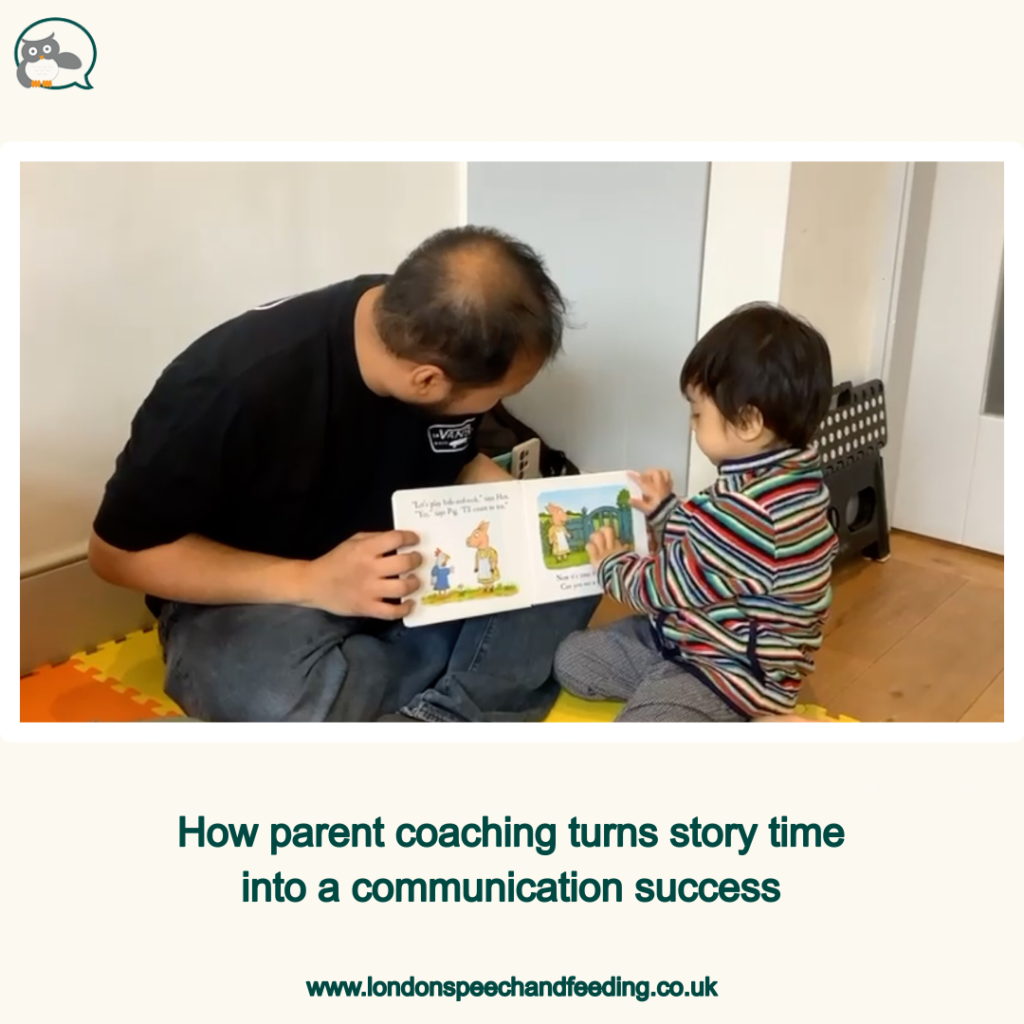
    How parent coaching turns story time into a communication success

    We often hear from parents who are trying their best to connect with their child, especially when reading books, but are met with frustration. They’ll say, ‘I read the book exactly as it’s written, but my child can’t focus for very long and just runs off!’ or ‘my child just flicks through the pages then turns it upside down and runs off with it’ or similar.

    It’s a common story. Traditional reading—going through the text from cover-to-cover—has its place of course, but for little ones with a language delay or autism it can move too quickly and place all the focus on the book’s words, not on the interaction.

    But what if I told you that story time could become one of the most fun and productive times for your child’s communication development?

    Watch the fantastic little video clip above! You can see the pure joy and connection between this dad and his son. This is the same family who, just a few weeks ago, felt defeated when trying to read a book, with their child quickly losing interest and leaving the reading/book corner.

    What changed?

    The power of parent coaching and Hanen principles

    The difference you see in the video is the direct result of parent interaction therapy, or parent coaching, based on the internationally recognised Hanen principles.

    I didn’t ‘fix’ the child. Instead, I coached the parents in a few simple, powerful strategies that completely changed the dynamic of their interaction. Instead of being a time for teaching and instruction, story time became a back-and-forth conversation.

    Here are the four major transformations that coaching helped this family achieve:

    1. From reader to play partner

    Before coaching, the parents felt their job was to read the text and to teach the words in it to their child. Now, their job is to follow their child’s lead. They learned to Observe, Wait, and Listen (OWL). If the child points to the tree or the badger on the page, the parent talks about the tree or the badger.

    The result

    The child is now initiating and leading the conversation! He is sharing what he finds interesting, which makes him feel powerful and keeps him deeply engaged.

    2. Building connection and attention

    When parents focus solely on reading, they often forget to make frequent eye contact and use animated facial expressions. The principles taught them to put the text aside and prioritise connection.

    The result

    Our little boy is looking at his dad more frequently, making great eye contact, and clearly having fun! When the interaction is fun, the child’s attention span naturally lengthens, allowing him to attend to the book and the interaction for a much longer time.

    3. Creating opportunities for communication

    The parents learned simple ways to prompt communication without pressure. They stopped asking knowledge-based questions (‘What colour is that? Or point to the pig!’), which can feel like a test.

    Instead, they learned to use techniques like ‘Saying less and pausing’ or ‘copying their little one’s echolalia ‘, signalling that they are very interested in what he is saying and that his communication matters!

    The result

    The child is now spontaneously using strings of sounds and gestures to communicate his needs and interests, knowing and enjoying his parents’ enthusiastic responses.

    This video is a testament to the fact that you are your child’s best therapist. With the right tools and coaching, you can transform everyday routines, like reading a book, into the most joyful and effective communication sessions.

    4. Acknowledging and interpreting echolalia

    In the video, you may hear the little boy repeat a phrase from the book or from what his dad just said. This is called echolalia, and for a long time, it was often dismissed or discouraged.

    However, a core principle of our parent coaching is that echolalia is communication. For children who are ‘Gestalt Language Processors,’ these memorised phrases (or ‘gestalts’) are their building blocks of language.

    The key is not to stop the repetition, but to become a ‘language detective’ and ‘interpreter’!

    By modelling the correct, first-person phrase right after the echo, parents/caregivers are teaching a child how to break down the ‘chunk’ and use the individual words functionally. They are showing their child: ‘I heard you. Your communication makes sense to me.’

    This strategy is a game-changer because it:

    1. Validates the child’s communication: It honours the child’s natural way of learning language, which boosts their confidence and willingness to communicate.
    2. Facilitates language development: It provides the child with the next step—a meaningful, functional phrase—to move them from repeating language to generating their own spontaneous sentences.

    Look at the child’s face again in the video. When his dad acknowledges and interprets his communication, you see that spark of joy and connection—that’s the moment when true, functional language learning happens!

    Ready to unlock the potential in your family’s story time? Contact me to learn more about our parent coaching programs.

    Sonja McGeachie

    Highly Specialist Speech and Language Therapist

    Owner of The London Speech and Feeding Practice.


    Health Professions Council registered
    Royal College of Speech & Language Therapists Member
    Member of ASLTIP

    Find a speech and language therapist for your child in London. Are you concerned about your child’s speech, feeding or communication skills and don’t know where to turn? Please contact me and we can discuss how I can help you or visit my services page.

    2
  • · · · ·

    What to do when words don’t come fast enough

    What to do when words don’t come fast enough

    When children find talking hard, parents often face a difficult question: ‘Should we wait and keep encouraging speech? Or introduce something like AAC?’

    AAC (Augmentative and Alternative Communication) can sound intimidating, but it simply means any way we support or replace spoken words, from simple gestures and picture boards to high-tech speech-generating devices. Far from ‘giving up on speech,’ AAC often becomes the bridge that helps children find their voice, in whatever form that takes.

    💡 What is AAC, really?

    AAC is a spectrum of tools and strategies that help people express themselves when speaking is difficult. It might include:

    • Low-tech supports: Gestures, key word signs (like Makaton), picture symbols, or printed boards
    • High-tech systems: Apps on tablets that speak aloud when pictures or words are tapped

    AAC is not just for children who will never talk. It’s for anyone whose speech isn’t meeting their communication needs right now.

    🤔 When to introduce AAC

    There’s a common myth that you should only try AAC after ‘exhausting’ other speech therapy options. In fact, AAC can be introduced at any stage, even alongside speech development.

    Here are some helpful signs that AAC might support your child:

    • Your child understands much more than they can say.
    • They rely on gestures, sounds, or behaviour to communicate.
    • They become frustrated trying to express themselves.
    • You find yourself ‘reading their mind’ to interpret needs.
    • Speech progress feels slow or inconsistent.

    If you recognise these patterns, AAC isn’t a ‘last resort’. It’s a communication support, not a replacement for speech.

    Recent research consistently shows that AAC does not stop children from talking. In fact, it can encourage speech to develop. A 2024 systematic review and meta-analysis published in the Journal of Autism and Developmental Disorders found that children who received interventions combining naturalistic developmental behavioural approaches with aided AAC showed improved language outcomes, and that AAC ‘does not negatively impact speech development and may even facilitate spoken language growth’ (Smith et al., 2024).

    🌉 How AAC supports speech development

    Speech and AAC aren’t competing paths: they’re parallel tracks that often feed each other.

    Here’s how AAC helps speech grow:

    1. Reduces frustration: When a child can express their needs, they’re more relaxed and ready to learn.
    2. Provides a visual model: Seeing symbols or words while hearing spoken language strengthens understanding and word recall.
    3. Builds consistent language structure: AAC systems follow the same grammar and word order as speech, helping children internalise how sentences work.
    4. Encourages turn-taking and social connection: AAC lets children join conversations even before speech is fluent, giving them more practice in real communication.

    AAC is not ‘giving up on speech’. It’s giving a child more ways to succeed while speech continues to develop.

    🧩 How to introduce AAC gently and effectively

    1. Start small and meaningful: Begin with a few key messages your child wants to say, not just what adults want to hear. Think ‘I want’, ‘stop’, ‘help’, ‘more’, ‘all done’, ‘no’, ‘again’. These are powerful words for real interaction and autonomy.
    2. Model, model, model: The most important part of AAC success is modelling—using the system yourself as you talk. For example: ‘You want banana 🍌’ and you tap the ‘want’ and ‘banana’ symbols. Children need to see and hear AAC used naturally before they try it themselves.
    3. Use it throughout the day: AAC isn’t a therapy tool to take out once a week. It’s a living part of communication. Model a few words during mealtimes, play, and routines. The more consistently it’s embedded, the more fluent both you and your child will become.
    4. Keep it accessible: If using a device or picture board, make sure it’s always nearby. If it’s in a bag or drawer, it can’t be used in real moments.
    5. Celebrate all communication: If your child points, signs, uses a sound, or taps a symbol, it all counts. Respond warmly and naturally to reinforce communication in any form.

    🧠 What parents often worry about

    • ‘Won’t AAC stop them from talking?’: No. Research shows AAC use either has no negative effect on speech or leads to increased spoken output (Smith et al., 2024). When children feel understood, their motivation to communicate grows.
    • ‘What if I model it wrong?’: There’s no perfect way to start. Your effort and consistency matter far more than accuracy.
    • ‘Will they get ‘stuck’ using pictures?’:  Some children do continue using AAC long-term; others move naturally toward more spoken language. The goal is always functional communication, not replacing one form with another.

    🪞 Bringing AAC into daily life

    Here are a few simple, parent-friendly ideas:

    • Create visual spaces: Post symbols or core words on the fridge, mirror, or play area.
    • Narrate routines: Use AAC during toothbrushing, dressing, or mealtimes; consistent contexts build understanding.
    • Pair speech and touch: Always say the word aloud when you point to or tap a symbol.
    • Involve siblings and friends: Model how they can respond to AAC too. ‘Oh, you said go! Let’s go fast!’
    • Use shared books and songs: Pause and model key words in stories or songs.

    🌱 The takeaway

    AAC doesn’t mean giving up on speech; it means opening more doors to communication. When words don’t come easily, AAC gives children a way to connect, share, and be heard.

    It helps parents move from guessing to understanding, and gives children the power to express themselves on their own terms.

    If you’re unsure where to start, reach out to a speech and language therapist experienced in AAC. Together, you can find a system that fits your child’s strengths, build confidence in modelling, and help every word (spoken or tapped) feel like a step forward.

    And download and print my one page summary.

    Because when communication is possible, everything else begins to grow.

    Sonja McGeachie

    Highly Specialist Speech and Language Therapist

    Owner of The London Speech and Feeding Practice.

    📚 Reference

    Smith, K., et al. (2024). The Effect of Naturalistic Developmental Behavioral Interventions and Aided AAC on the Language Development of Children on the Autism Spectrum with Minimal Speech: A Systematic Review and Meta‑Analysis. Journal of Autism and Developmental Disorders, 55, 3078–3099. https://doi.org/10.1007/s10803-024-06382-7


    Health Professions Council registered
    Royal College of Speech & Language Therapists Member
    Member of ASLTIP

    Find a speech and language therapist for your child in London. Are you concerned about your child’s speech, feeding or communication skills and don’t know where to turn? Please contact me and we can discuss how I can help you or visit my services page.

    2
  • · · ·

    The joy of container play: Exploring play development and understanding of how things work

    Have you heard the term ‘Container play’? I use this very often with children in my sessions as it is so versatile and an enjoyable activity that can be done in parallel with a child or together. Container play is a powerful tool for fostering development in young children, especially those with developmental delays. This seemingly mundane activity provides a rich environment for sensory exploration, motor skill development, and cognitive growth.

    What is container play?

    Container play involves children interacting with various containers—boxes, buckets, bowls, cups, various bags, etc.—and filling, emptying, and transferring objects within and between them. Objects can include literally anything: small beads, bead chains, table tennis balls, wooden pegs, dinosaurs or any other little person toy, blocks of varying sizes, sand, water, or any other safe material. Larger containers obviously take larger items: socks, stuffed animals, bigger balls, bigger blocks etc really the choices are endless.

    Benefits for children with developmental delays:

    Sensory exploration:

    • Touch: Children explore different textures and temperatures of containers and objects.
    • Sight: They observe how objects look inside and outside the containers, how light reflects off them, and how colours change.
    • Sound: They listen to the sounds of objects clinking, rattling, and splashing.
    • Proprioception: Filling and emptying containers helps develop body awareness and spatial awareness.

    For neurodivergent children who might have sensory regulation difficulties, consider the following adaptions to accommodate your child’s sensory needs:

    • Over-stimulation: For children who are easily overstimulated, start with simple setups using a limited number of containers and objects. Gradually increase the complexity as they tolerate it.
    • Under-stimulation: For children who seek sensory input, provide a variety of textures and materials, such as sand, water, slime, or beans.
    • Temperature: Offer a variety of temperature options. Some children may enjoy warm water or cool sand.
    • Lighting: Adjust the lighting to create a calming or stimulating environment.
    • Focus on one sense at a time: Initially, focus on one sensory aspect, such as the feel of sand or the sound of water.
    • Weighted containers: Use heavy containers filled with rice or beans to provide deep pressure input.
    • Fidget toys: Incorporate fidget toys into the activity to provide sensory input and help with self-regulation.
    • Tactile exploration: Encourage exploration of different textures using objects with varying surfaces.

    Fine motor skill development:

    • Hand-eye coordination: Scooping, pouring, and transferring objects require precise hand-eye coordination.
    • Pincer grasp: Picking up small objects helps develop fine motor skills like the pincer grasp.
    • Strength and dexterity: Manipulating containers and objects strengthens hand muscles and improves dexterity. Opening and closing containers can be a huge area of interest; how does the top screw back on, or off?

    Cognitive development:

    • Cause and effect: Children learn that their actions (e.g., pouring water or sand) have consequences (e.g., the water spills).
    • Spatial awareness: They develop an understanding of concepts like inside, outside, full, empty, and over/under; also how big is the vessel and how much goes in before it’s full or spills over. How small is the vessel opening and what do I need to do to get the beads into the container.
    • Problem-solving: Children learn to solve problems, such as how to get an object out of a narrow container or how to transfer water without spilling.

    Social and emotional development:

    • Communication: Container play can encourage communication as children interact with others, sharing toys and commenting on their actions. Asking for help to open and close a container is often a great opportunity to practise ‘help me’ or ‘open it’
    • Turn-taking: Sharing containers and materials helps children learn to take turns and cooperate.
    • Sensory regulation: For children with sensory sensitivities, container play can be a calming and self-regulating activity.

    Tips for engaging children in container play:

    • Create a safe and inviting environment. A shower curtain on the floor makes things easier for tidy up afterwards. And it allows for spillages.
    • Provide a variety of containers: Use different sizes, shapes, and materials. Use containers that are visually interesting and pleasing, perhaps a festive biscuit tin, or a tin that looks like train engine. Use see-through containers at first which make the filling and emptying more obvious. This is important for children who have no previous experience with this type of play and need to ‘warm up’ to it. Once a child loves and is used to container play you can go wild with all types of containers.
    • Offer a variety of objects: Include balls, blocks, sand, water, and other age-appropriate materials.
    • Join in the fun! Start off the process, show your child what the joy of the activity is for yourself, how fun it is to fill and empty containers, provide enough containers for your child to start playing alongside you, and comment on their actions.
    • Follow your child’s lead: Allow them to explore and experiment at their own pace.
    • Adapt activities: Adjust the level of challenge based on your child’s abilities and interests.

    Container play is a simple yet powerful tool that can support the overall development of young children, especially those with developmental delays. By providing a rich and engaging sensory experience, container play can help children build essential skills in motor, cognitive, social, and emotional domains.

    If you have any questions or would like to have more in-depths demonstration of this or other play styles for your child please contact me.

    I look forward to hearing from you.

    Sonja McGeachie

    Early Intervention Speech and Language Therapist

    Feeding and Dysphagia (Swallowing) Specialist The London Speech and Feeding Practice

    The London Speech and Feeding Practice


    Find a speech and language therapist for your child in London. Are you concerned about your child’s speech, feeding or communication skills and don’t know where to turn? Please contact me and we can discuss how I can help you or visit my services page.

    1