Holiday disruptions & New Year routines: How to support your child’s feeding, communication and regulation over the festive season

| | | |
Holiday disruptions & New Year routines

The festive season is a wonderful time for many families, but for children with feeding challenges, sensory differences, or autism traits, December can feel overwhelming. Changes in routine, busier environments, travel, new foods, disrupted sleep, and well-meaning relatives giving ‘advice’ can all affect a child’s feeding, communication and overall regulation.

As a speech and language therapist specialising in Early Years, I see the same pattern each year: children often make progress during the term, only to struggle in late December when everything becomes unpredictable. The good news? With a bit of preparation, children can not only cope better, but they can actually make significant developmental gains during the holidays.

This blog will help you feel confident, supported and prepared for the transition from ‘festive mode’ to a smoother, regulated start in January.

1. Why routines matter so much. Especially now

Young children thrive on predictability. For neurodivergent children or those with sensory, feeding or communication needs, routine isn’t just helpful: it’s the backbone of emotional regulation.

In December, typical patterns change:

  • Mealtimes shift or become irregular
  • Bedtime slides
  • New foods appear
  • Loud social gatherings overwhelm
  • Travel disrupts naps and comfort routines
  • Therapies pause
  • Childcare closes

Any one of these can lead to feeding refusals, more meltdowns, increased stimming, reduced communication attempts or regression in speech sounds.

It’s simply the nervous system responding to too much change.

2. Protecting feeding progress during holiday mealtimes

My last blog and insta post have a nice social story on festive meals. They are often the trickiest part of the season for families I support. Children with sensory-based feeding challenges, or ARFID traits may find holiday foods completely unfamiliar and challenging.

What helps:

  • Offer one ‘safe food’ at every meal
  • Keep portion sizes tiny
  • Use the ‘buffet rule’
  • Rehearse tricky moments

3. Supporting communication when routines are disrupted

Holiday time actually offers more opportunities for communication, just in different ways.

Strategies:

  • Slow down and follow your child’s lead
  • Use everyday routines as language opportunities
  • Keep AAC going even if casually

4. Understanding holiday ‘regressions’ and know they’re temporary

This is almost always due to nervous system overload. Children don’t truly ‘lose’ skills; they temporarily prioritise regulation over learning.

5. A gentle January reset: How to start the New Year smoothly

  • Re-establish predictability early
  • Return to preferred foods
  • Book early support if needed
  • Focus on regulation first

Sonja McGeachie

Highly Specialist Speech and Language Therapist

Owner of The London Speech and Feeding Practice.


Health Professions Council registered
Royal College of Speech & Language Therapists Member
Member of ASLTIP

Find a speech and language therapist for your child in London. Are you concerned about your child’s speech, feeding or communication skills and don’t know where to turn? Please contact me and we can discuss how I can help you or visit my services page.

Reference:

Bronson, M. (2000). Self-regulation in early childhood. Guilford Press.

2

Similar Posts

  • · · ·

    The quiet power: Why silence and responsiveness boost communication in children with delays

    The quiet power: Why silence and responsiveness boost communication in children with delays
    Supplied by Sonja McGeachie, Practice Owner

    As parents and caregivers, our natural instinct when interacting with a child, especially one who struggles with communication, is often to fill every silence. We might ask lots of questions, offer constant commentary, or try to prompt him or her to speak. Our hearts are in the right place. We want to help him or her communicate! However, for children with language delays or those on the autism spectrum, this well-intentioned approach can sometimes inadvertently create more pressure and fewer opportunities for them to truly initiate and develop their own communication skills.

    What if I told you that one of the most powerful tools in your communication toolkit is often silence? And that responding to your child, rather than always initiating, can unlock incredible potential?

    Let’s explore why these seemingly simple strategies are so profoundly beneficial.

    The unspoken benefits of silence

    In our fast-paced world, silence can feel awkward, but for a child who is processing language differently, it’s a gift:

    1. Time to process: Children with language delays often need more time to process what they hear and to formulate their own thoughts or responses. When we bombard them with words, we don’t give their brains the crucial milliseconds they need to catch up. A pause of 5–10 seconds can make all the difference.
    2. Reduces pressure: Constant questioning or prompting can feel like a test. Silence removes this pressure, creating a more relaxed environment where the child feels safe to communicate without fear of being ‘wrong’ or rushed.
    3. Creates opportunity to initiate: If you’re always talking, when does your child get a turn to start the conversation? Silence opens up a space for him or her to initiate, whether it’s through a sound, a gesture, eye contact, or a word. This is vital for developing spontaneous communication.
    4. Encourages independent thinking: When a child is given space, he or she is more likely to try to figure things out himself or herself. This fosters problem-solving skills and reduces reliance on adult prompts.
    5. Prevents overwhelm (especially for ASD): Many children on the autism spectrum can be sensitive to auditory input. A constant stream of language can be overwhelming, leading to withdrawal or challenging behaviours. Strategic pauses can help them regulate and engage more effectively.

    The power of responding (not just initiating)

    Think of a tennis match: if only one person serves, it’s not a game. Communication is a rally, a back-and-forth exchange. When you primarily respond to your child’s communication attempts, you’re teaching him or her the rhythm of conversation:

    1. Follow the child’s lead: This is a cornerstone of effective language intervention, famously championed by programs like Hanen’s ‘It Takes Two to Talk’. When you respond to what your child is already interested in or doing, the interaction becomes immediately relevant and motivating for him or her.
    2. Validates his or her attempts: Every sound, gesture, glance, or partial word your child offers is a communication attempt. By responding to it, you’re telling him or her, ‘I see you. I hear you. Your communication matters.’ This builds immense confidence and encourages him or her to try again.
    3. Builds confidence and motivation: When a child feels understood and successful in his or her communication, he or she are more likely to communicate more often. It’s a positive feedback loop.
    4. Teaches turn-taking naturally: By taking your turn after his or hers, you model the natural flow of conversation. He or she learns that communication is a shared activity, not a one-sided lecture.
    5. Makes interactions meaningful: When you respond to his or her interests, you’re talking about things that are inherently motivating to him or her. This makes the language you use more easily understood and remembered.

    Practical strategies for parents: Observe, Wait, Listen (OWL)

    The Hanen Centre’s ‘Observe, Wait, Listen’ (OWL) strategy perfectly encapsulates these principles:

    • Observe: Watch your child closely. What is he or she looking at? What is he or she doing? What sounds is he or she making? What gestures is he or she using?
    • Wait: After you’ve observed, wait. Give him or her time. Resist the urge to jump in with a question or comment immediately. Count to five (or even ten) in your head. This silence is an invitation for him or her to communicate.
    • Listen: When he or she does communicate (in any way!), listen intently. Try to understand his or her message or intent.

    Beyond OWL – More tips:

    • Reduce questions, increase comments: Instead of ‘What’s that?’ try ‘Oh, a big red ball!’ or ‘The car is going fast!’ Comments provide language models without demanding a verbal response.
    • Expand, don’t just prompt: If your child says ‘Car’, you could respond with ‘Yes, That’s a big car!’ or ‘It’s really fast!’ You’re building on his or her communication with a slightly richer language model.
    • Create opportunities for communication: Place desired items slightly out of reach. This creates a natural reason for your child to communicate his or her wants (e.g., reaching, pointing, vocalising).
    • Respond to all communication: Don’t just wait for words. If your child points, look where he or she is pointing and comment. If he or she makes a sound, imitate it or respond with a related word.

    In summary

    Embracing silence and prioritising responsiveness might feel counterintuitive at first, especially when you’re eager for your child to talk. However, these powerful strategies create a nurturing, low-pressure environment that encourages spontaneous communication, builds confidence, and truly meets your child where he or she is. By giving your child the space and the meaningful responses he or she needs, you’re laying a strong foundation for his or her communication journey.

    Try incorporating these ‘quiet powers’ into your daily interactions and watch your child’s communication blossom.

    Sonja McGeachie

    Highly Specialist Speech and Language Therapist

    Owner of The London Speech and Feeding Practice.


    Health Professions Council registered
    Royal College of Speech & Language Therapists Member
    Member of ASLTIP

    Find a speech and language therapist for your child in London. Are you concerned about your child’s speech, feeding or communication skills and don’t know where to turn? Please contact me and we can discuss how I can help you or visit my services page.

    1
  • ·

    Principles of Motor Learning in Childhood Apraxia of Speech (CAS)

    We use powerful motor learning principles to help children with CAS (Childhood Apraxia of Speech) learn how to produce better, clearer speech sounds in words, phrases and sentences.

    What are these principles?

    Principle 1: MASSED PRACTICE

    This is where you see a child for lots of sessions in a shorter period of time, so for instance six weeks of three times weekly for 30 minutes.

    This leads to motor performance or automaticity.

    Principle 2. DISTRIBUTED PRACTICE

    This is what I use, as most of my clients are not able to come and see me that often on a weekly basis. It is hard to travel in London and life is hectic. So I favour one session a week over say a term or two terms and a session is usually 45 minutes long.

    This leads to improved Motor Learning and good generalisation.

    During either Massed or Distributed Practice, we choose between 4 variables:

    Principle 3: Constant vs Variable

    Principle 4: Blocked vs Random

    To explain:

    Constant Practice is where we repeat the practice of a small handful of target words.

    We practise the same target sound in the same word position, e.g. at the beginning of a word: ‘bee’, ‘bye’, ‘bow’, ‘baa’ or ‘key’, ‘car’, ‘cow’, ‘Kaye’ etc.

    We keep the rate, pitch and intonation constant.

    Variable Practice is where we vary the rate, volume, pitch and intonation of the targets

    We use a larger number of sounds, and words that are motivating to say for the child.

    For example, if a child loves Peppa Pig then I might choose the words: ‘Peppa’, ‘Daddy Pig’, ‘George’, ‘Mummy Pig’ and a couple of other favourite characters. My child might struggle with a number of sound sequences there but we will target them one by one.

    We can also select simpler words like ‘cape’ and ‘cake’ or ‘tick’ and ‘tip’.

    Blocked Practice is where we practise one target word for say five minutes then we move to another target word for the next five minutes and then we revert back to the first target word again and so on, so blocks of practice.

    Random Practice means we practise several target words at the same time.

    How do I decide on what to use?

    Good question!

    I always opt for distributed practice (weekly for up to 45 minutes).

    Within that, I tend to find it most successful to start out with constant practice when a child is finding a certain sound sequence really hard and we need to just ‘nail it’. Bearing in mind I only pick sounds that my student can actually make in isolation, so we are not working on articulation! (where we focus on trying to elicit single sounds correctly – or even at all sometimes) Here in CAS work, we are working with sounds the student can make but is having trouble to add together, into a sequence that is needed to make a word sound right.

    As soon as I feel we have some traction I will go to variable practice, i.e. I pick words that are either funny or interesting for the child and it can be a slightly larger number.

    I tend to use blocked practice in the beginning or when working on vowels. That’s because it is more important we get our vowels right. They carry a word and are very important for overall speech intelligibility. Once we are on a roll, I tend to go more for random practice.

    Example

    Here in the video clip, we try and work the /e/ vowel in short words likes ‘bell’, ’fell’, ‘dell’, ‘sell’, ‘smell’ and I am using an AAC device to give a child’s voice as auditory feedback as well as using the PROMPT approach to help my student shape his vowels.

    So this is:

    1. Distributed (1 x week for 45 minutes)
    2. Constant – we are practising the /e/ vowel in the same position in six different words
    3. Blocked – we did this: several repetitions of each word and after the sixth we moved to another sound, and then later we came back to this.

    Please feel free to contact me if your child has speech sound difficulties. It is my passion. I love supporting children with apraxia.

    Sonja McGeachie

    Early Intervention Speech and Language Therapist

    Feeding and Dysphagia (Swallowing) Specialist The London Speech and Feeding Practice

    The London Speech and Feeding Practice


    Find a speech and language therapist for your child in London. Are you concerned about your child’s speech, feeding or communication skills and don’t know where to turn? Please contact me and we can discuss how I can help you or visit my services page.

    1
  • ·

    Let’s relax about making EYE CONTACT already…

    There’s been a long tradition with teaching staff and with Speech and Language Therapists working in schools that eye contact should be a goal. It is well known that Autistic individuals (whether that be children or adults) mostly avoid eye contact. Whilst it’s part of the way we communicate, it shouldn’t be used as a necessity for an individual who feels that it is uncomfortable. Whilst it does show that you’re listening and showing an interest, it’s not a fair expectation for neurodiverse children.

    Autistic children can find making and maintaining eye contact physically and emotionally uncomfortable as well as unnatural. It adds an extra layer of stress and has been reported to increase distractions rather than reduce them. Children who engage in conversations in their own way (i.e., with reduced eye contact) are not shown to suffer with schooling, work, or social interaction.

    By having fun through meaningful activities, I often experience that ‘BINGO’ moment (a phrase coined by Alex @meaningfulspeech) where the child is enjoying themselves and naturally makes eye contact. There is no demand on them, they are in a fun, engaging environment which suit their strengths and supports their needs.

    Following this, I often reflect on this question ‘Should we make eye contact as a goal?’

    It very much depends on the situation. If it places more demands on the child and becomes stressful. Then no. There are many strategies we can use which gain eye contact without placing extra demands on the child. We need to be mindful to adapt the environment and not place neurotypical expectations to meet the needs of neurodiverse children.

    How can you encourage eye contact without demand?

    • If you’re using toys, try holding them up to your eye level.
    • You can adjust your position, try sitting face to face during play.
    • Always get down to your child’s level. This might mean that you lay on the floor if your child is positioned in this way.
    • During play, waiting is extremely powerful. Before a key part of the activity, wait and see if your child looks at you. Remember silence is golden!
    • The best way I find is: do something unusual during play. It might be that you spray shaving foam with the lid still on. Or you bring out a wow toy and make it spin/light up or make a noise. A balloon can be good – see video clip. Use the excitement of the activity, and wait to see if you achieve that ‘BINGO’ moment.
    • Create opportunities when there are no toys involved such as during ‘tickles’ or ‘hide and seek’. Autistic children find it difficult to shift their attention between a toy and an adult. So by removing one option, you’re setting them up to succeed.

    Remember, it takes practice and time for you to develop these skills. Try one at a time and experiment, see which works best for your child. If you need speech, language or communication support or advice, I am always here to help.


    Find a speech and language therapist for your child in London. Are you concerned about your child’s speech, feeding or communication skills and don’t know where to turn? Please contact me and we can discuss how I can help you or visit my services page.

    0
  • ·

    Four Ways to Progress your Child’s Language and Build Confidence

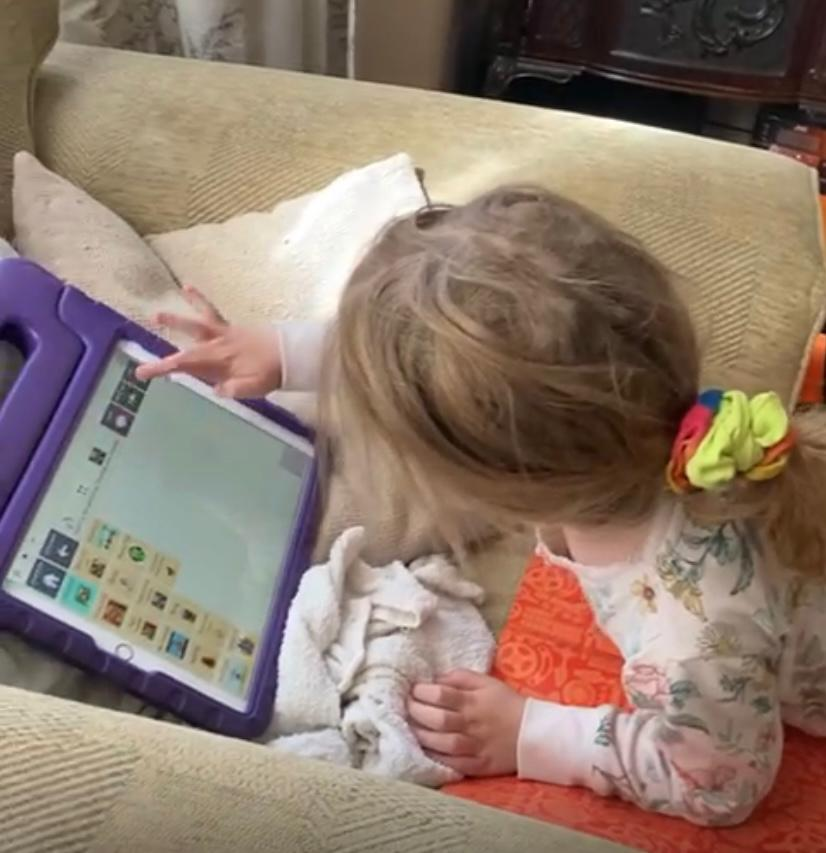
    A child is using a tablet

    Watching your child’s confidence grow as their language develops is something you dream of. You feel helpless, you watch your child repeat language over and over and this concerns you. You know you should be supporting their communication development, but you feel stuck. You’ve reached the point where you don’t know where to turn to for support. Accessing the knowledge of a Speech and Language Therapist is a great place to start.

    Here are four ways to support your child’s language:

    1. Provide great communication models that include scripts or “gestalts”

    Instead of commenting with single words like “apple” or two word phrases e.g., “want apple”, it is more beneficial to comment with small sentences or scripts such as “let’s eat an apple”, “I want an apple mummy”, “I want more apple please” or “I’m hungry daddy.”

    These are phrases that include more intonation and rhythm (top tip: ensure you do use appropriate intonation and rhythm), and your child is likely to pick up those phrases and copy them much more easily than single words or two-word phrases.

    2. Offer a robust Alternative and Augmentative Communication (AAC) device

    There are many examples of AAC devices such as ‘Lamp for Life’ or ‘Grid Smartbox’. It’s vital that you consult a Speech and Language Therapist with a specialism within this area of communication. You want your child to be able to communicate their wants and needs. Furthermore, their communication buttons need to be tailored to your child’s interests so they are motivated to use them (e.g. if your child likes Thomas the Tank Engine, you may wish to program in specific phrases such as “I want to watch Thomas the Tank Engine”. It is also important that the devices are suitable for your child’s physical and emotional stage of development.

    3. Learn to be a word detective

    Listen to your child’s echolalia (or repetitions) and try to understand what they mean. Their communication is often meaningful around a previous experience. For example, one of my students says, “bang my head” and that actually means “I want to play that tickling game again” (where I banged my head the other day).

    4. Take turns with your child and copy their scripts

    This shows you are listening actively and value their attempts at language. We all love it when someone is actively listening and trying to decode what we are saying.

    Take heart and try not to worry. You’re doing the best you can. Your child is more than likely a Gestalt Processing Learner and so they are moving through very defined stages. Echolalia (repetition) is the first of many, so you have an exciting journey ahead watching your little one’s language grow and develop.

    Reduce your child’s frustration and build their confidence today.

    Contact me here for speech and language advice and AAC support


    Find a speech and language therapist for your child in London. Are you concerned about your child’s speech, feeding or communication skills and don’t know where to turn? Please contact me and we can discuss how I can help you or visit my services page.

  • ·

    Unlocking language and thinking skills: The power of sequencing

    Sonja demonstrates the power of sequencing

    As speech and language therapists, we often use a variety of techniques to help children develop their communication and cognitive skills. One incredibly valuable tool in our toolkit is the use of sequencing activities. But what exactly is sequencing, and why is it so beneficial?

    What is sequencing?

    Sequencing, at its core, involves arranging items, events, or actions in a specific order. This could involve putting pictures in the correct order to tell a story, following the steps in a recipe, or understanding the order of daily routines like brushing teeth or getting dressed.

    The link between sequencing and language

    Sequencing is fundamental to language development and is quintessential to executive functioning skills in several ways:

    • Narrative skills: Storytelling, whether oral or written, relies heavily on sequencing. A child needs to understand the order of events (beginning, middle, end) to construct a coherent narrative.
    • Explanations and instructions: Providing clear explanations or instructions requires the ability to sequence information logically. For example, explaining how to play a game or how to get from one place to another. In the video clip below we are working on ‘how do make a sandwich’.
    • Vocabulary development: Sequencing helps children understand temporal words and phrases like ‘first,’ ‘then,’ ‘next,’ ‘before,’ and ‘after’.
    • Sentence structure: Constructing grammatically correct sentences often involves sequencing words in a specific order (e.g., subject-verb-object).

    Beyond language, sequencing plays a crucial role in developing executive functioning skills. These are higher-level cognitive skills that help us plan, organise, and manage our time and actions.

    Sequencing activities can help children improve in the following areas:

    • Planning and organisation: Sequencing tasks require children to think ahead, plan the steps involved, and organise them in a logical order.
    • Problem-solving: When they are faced with a problem, sequencing helps children break it down into smaller, more manageable steps.
    • Working memory: Holding information in mind and manipulating it, such as remembering the steps in a multi-step direction, is supported by sequencing skills.
    • Cognitive flexibility: Being able to adjust to changes in a sequence or think of alternative sequences promotes cognitive flexibility.

    Examples of sequencing activities

    Here are some practical examples of sequencing activities you can do with your child:

    • Picture sequencing: Use a set of picture cards to tell a short story or illustrate a process (e.g., making a sandwich, going to the park). Ask your child to arrange the cards in the correct order.
    • Story retelling: After reading a story, have your child retell it, focusing on the order of events.
    • Following instructions: Give your child multi-step instructions to follow (e.g., ‘First, get your shoes. Then, put on your coat. Next, go to the door.’).
    • Sequencing during play: Integrate sequencing into everyday play. For example, while building with blocks, talk about the steps: ‘First, we put this block here. Next, we add this one…’
    • Daily routines: Create visual schedules for daily routines, like getting ready for school or bedtime, to help children understand the sequence of events.
    • In the video clip below I am using an on-line language activity which is often fun for children as they can use their finger to swipe the pictures effortlessly into the right place and, if we realise at the end of the story that we have made a little error, we can then easily re-jig the pictures into their correct place.

    In conclusion

    Sequencing activities offer a powerful way to support children’s language development and enhance their executive functioning skills. By helping children understand and create order, we equip them with essential tools for communicating, learning, and navigating the world around them.

    Do get in touch via my contact form if you are concerned about your child’s development.

    Sonja McGeachie

    Highly Specialist Speech and Language Therapist

    Owner of The London Speech and Feeding Practice.


    Health Professions Council registered
    Royal College of Speech & Language Therapists Member
    Member of ASLTIP

    Find a speech and language therapist for your child in London. Are you concerned about your child’s speech, feeding or communication skills and don’t know where to turn? Please contact me and we can discuss how I can help you or visit my services page.

    1
  • ·

    Speech sounds: Expectations vs reality

    Sometimes our kids find it hard to listen to sounds in words and hearing the difference between sounds. This is an important skill which we call “sound awareness”. A lack of it can really impact on clear speech sounds production.

    Your child might be confusing similar sounding words. Or they might not notice that a TAT is not a CAT for a DOD is not a DOG. Often children with speech sound disorders or difficulties don’t tune into individual sounds or even syllables. Grow your knowledge to support your child.

    Read our latest blog on hearing the difference between sounds to develop speech sound production.

    Practice makes perfect

    There is a lot more to speech sound production than first meets the eye. Did you know that producing the correct speech sound at sentence level is the last piece to the communication puzzle? There’s a lot of practice before your child develops this last stage of speaking clearly. Your Speech and Language Therapist will start by determining if your child can hear the difference between the sound they are producing and the correct sound. So if your child says LIT instead of LICK we might contrast those two words by perhaps using a candle and a lollypop. Each time he/she says LICK they get to have a lick (or 3) on the lolly. But if they say LIT then we light up and blow out a candle. This way your child can see that there is a difference between those words and that the sounds we make actually matter. Fancy that!!

    We call this auditory awareness, which is essentially hearing the sounds in words. Don’t be surprised if you hear your child’s therapist model the sound a lot. This is to develop their awareness. The more your child hears a sound, the easier they will find production. Furthermore, your Speech and Language Therapist will work on phonemic awareness (sound structures) such as the difference between a sound (e.g. sh, is one sound) vs a syllable (e.g., shell has one syllable) vs total number of sounds in a word (shell has three sounds sh-e-ll ), like you can see in my little video clip.

    Once a child is able to produce a sound on its own and they can hear and identify how a short word is said correctly we can go and repeat lots of similar words with the sound at the beginning or end until it becomes automatic and new neuro pathways are laid in the child’s brain. From there we branch out into short phrases and then eventually sentences.

    Six tips to practise auditory discrimination for speech sound production

    1. Sit opposite your child so they can see your mouth or or sit next to the child and place a mirror in front of you so they can see and hear your production.
    2. Make it fun! Once they’ve identified the sounds in the word, play part of a game (e.g., pop up pirate, Jenga, something which allows plenty of turns).
    3. Use car journeys or walking to school to practise (e.g., oh I see a sheep, sh-ee-p, sh-ee-p has three sounds. Can you spot something beginning with /sh/?)
    4. Remember that spellings can differ (e.g., ‘chef’ and ‘shed’ both have the same initial sound).
    5. Talk about what you’re doing with your mouth (e.g., my lips are rounded for /sh/). Your Speech and Language Therapist will be able to support you with this.
    6. Make silly sentences using your child’s special sound (e.g., Sheep show shepherds shearing).

    At this stage you are not expecting your child to produce the sound. This is why it’s important that they continually hear an excellent model. If your child attempts speech sound production at any stage, this is to be encouraged as it’s a great opportunity to model the correct version.

    Contact me to develop your child’s speech sounds.


    Find a speech and language therapist for your child in London. Are you concerned about your child’s speech, feeding or communication skills and don’t know where to turn? Please contact me and we can discuss how I can help you or visit my services page.

    0