It feels like the Christmas festivities start earlier and earlier every year. This makes it harder for your child with communication difficulties to process what is happening. Whilst you can’t do anything about the events that happen around your child, you can start to put into practice strategies which may support them and allow them to regulate their emotions.
Six ways to prepare your child for the Christmas festivities
Explore six ideas here:
1. Print off or buy a blank calendar to use at home
You can start to write in activities out of the usual routine and add a picture to allow your child to understand what it’s about. You can also use it as a countdown to Christmas Day to try to prevent ‘how long’ questions.
2. Make use of visual timetables
These are useful in everyday settings and activities but also when change occurs.
3. Be aware of any non-uniform days
Days like ‘Christmas Jumper Day’ can make your child feel uncomfortable and may affect their behaviour. By giving yourself time, you can have conversations with your child’s teacher to find a more suitable alternative. For example, they can wear a Christmas t-shirt that they find more comfortable.
4. Think about what will benefit your child
Do they like being surrounded by people or do they prefer a quiet space on a 1:1 basis? Christmas activities often involve lots of group work in school (e.g., rehearsing for carol concerts or plays). They might prefer to pre-record their part in the Christmas play or create pieces of art which can be used. At home, they may prefer one guest visiting at a time, rather than all at once.
5. Explore how your child is feeling
It’s important to find out how your young person is feeling and how these impact on the activities of that day. It might be that your child doesn’t like surprises and the intensity of opening gifts is too much for them. They may prefer gifts to be left unwrapped and given throughout the day, rather than all at once.
6. Consider sensory needs
Ensure your young person has everything they need to meet their sensory needs. This can be e.g. noise cancelling headphones, fidget toys, or comforting items. These will particularly be helpful with routines changing, often with little notice. If at home, you may wish to not put lights on the Christmas tree if visual stimuli become too much.
Remember clear communication between home, school and other family members is vital during this time. By having clear communication and expectations, your young person will feel more secure. And you can have a Christmas that is right for you and your family.
Find a speech and language therapist for your child in London. Are you concerned about your child’s speech, feeding or communication skills and don’t know where to turn? Please contact me and we can discuss how I can help you or visit my services page.
Have you heard the term ‘Container play’? I use this very often with children in my sessions as it is so versatile and an enjoyable activity that can be done in parallel with a child or together. Container play is a powerful tool for fostering development in young children, especially those with developmental delays. This seemingly mundane activity provides a rich environment for sensory exploration, motor skill development, and cognitive growth.
What is container play?
Container play involves children interacting with various containers—boxes, buckets, bowls, cups, various bags, etc.—and filling, emptying, and transferring objects within and between them. Objects can include literally anything: small beads, bead chains, table tennis balls, wooden pegs, dinosaurs or any other little person toy, blocks of varying sizes, sand, water, or any other safe material. Larger containers obviously take larger items: socks, stuffed animals, bigger balls, bigger blocks etc really the choices are endless.
Benefits for children with developmental delays:
Sensory exploration:
Touch: Children explore different textures and temperatures of containers and objects.
Sight: They observe how objects look inside and outside the containers, how light reflects off them, and how colours change.
Sound: They listen to the sounds of objects clinking, rattling, and splashing.
Proprioception: Filling and emptying containers helps develop body awareness and spatial awareness.
For neurodivergent children who might have sensory regulation difficulties, consider the following adaptions to accommodate your child’s sensory needs:
Over-stimulation: For children who are easily overstimulated, start with simple setups using a limited number of containers and objects. Gradually increase the complexity as they tolerate it.
Under-stimulation: For children who seek sensory input, provide a variety of textures and materials, such as sand, water, slime, or beans.
Temperature: Offer a variety of temperature options. Some children may enjoy warm water or cool sand.
Lighting: Adjust the lighting to create a calming or stimulating environment.
Focus on one sense at a time: Initially, focus on one sensory aspect, such as the feel of sand or the sound of water.
Weighted containers: Use heavy containers filled with rice or beans to provide deep pressure input.
Fidget toys: Incorporate fidget toys into the activity to provide sensory input and help with self-regulation.
Tactile exploration: Encourage exploration of different textures using objects with varying surfaces.
Pincer grasp: Picking up small objects helps develop fine motor skills like the pincer grasp.
Strength and dexterity: Manipulating containers and objects strengthens hand muscles and improves dexterity. Opening and closing containers can be a huge area of interest; how does the top screw back on, or off?
Cognitive development:
Cause and effect: Children learn that their actions (e.g., pouring water or sand) have consequences (e.g., the water spills).
Spatial awareness: They develop an understanding of concepts like inside, outside, full, empty, and over/under; also how big is the vessel and how much goes in before it’s full or spills over. How small is the vessel opening and what do I need to do to get the beads into the container.
Problem-solving: Children learn to solve problems, such as how to get an object out of a narrow container or how to transfer water without spilling.
Social and emotional development:
Communication: Container play can encourage communication as children interact with others, sharing toys and commenting on their actions. Asking for help to open and close a container is often a great opportunity to practise ‘help me’ or ‘open it’
Turn-taking: Sharing containers and materials helps children learn to take turns and cooperate.
Sensory regulation: For children with sensory sensitivities, container play can be a calming and self-regulating activity.
Tips for engaging children in container play:
Create a safe and inviting environment. A shower curtain on the floor makes things easier for tidy up afterwards. And it allows for spillages.
Provide a variety of containers: Use different sizes, shapes, and materials. Use containers that are visually interesting and pleasing, perhaps a festive biscuit tin, or a tin that looks like train engine. Use see-through containers at first which make the filling and emptying more obvious. This is important for children who have no previous experience with this type of play and need to ‘warm up’ to it. Once a child loves and is used to container play you can go wild with all types of containers.
Offer a variety of objects: Include balls, blocks, sand, water, and other age-appropriate materials.
Join in the fun! Start off the process, show your child what the joy of the activity is for yourself, how fun it is to fill and empty containers, provide enough containers for your child to start playing alongside you, and comment on their actions.
Follow your child’s lead: Allow them to explore and experiment at their own pace.
Adapt activities: Adjust the level of challenge based on your child’s abilities and interests.
Container play is a simple yet powerful tool that can support the overall development of young children, especially those with developmental delays. By providing a rich and engaging sensory experience, container play can help children build essential skills in motor, cognitive, social, and emotional domains.
If you have any questions or would like to have more in-depths demonstration of this or other play styles for your child please contact me.
I look forward to hearing from you.
Sonja McGeachie
Early Intervention Speech and Language Therapist
Feeding and Dysphagia (Swallowing) Specialist The London Speech and Feeding Practice
The London Speech and Feeding Practice
Find a speech and language therapist for your child in London. Are you concerned about your child’s speech, feeding or communication skills and don’t know where to turn? Please contact me and we can discuss how I can help you or visit my services page.
The world can be a beautiful and stimulating place, but for individuals with Sensory Processing difficulties (SPD), it can also be overwhelming and even painful. Everyday sights, sounds, smells, touches, and tastes can be amplified to uncomfortable or even unbearable levels. This can lead to anxiety, meltdowns, and a constant feeling of being on edge.
One important coping mechanism for SPD is containment. Containment strategies are techniques that help individuals manage their sensory experiences and create a sense of calm and safety.
Understanding containment needs:
Containment needs vary greatly from person to person. Some individuals might find comfort in deep pressure, while others might crave quiet and solitude.
Common containment strategies:
Here are some examples of containment strategies that can be helpful for individuals with SPD:
Deep pressure: This can involve activities like wearing weighted vests, using weighted blankets, getting firm hugs, or applying deep pressure massage.
Movement: Engaging in rhythmic movements like rocking, swinging, or jumping can be calming for some individuals.
Proprioceptive input: Activities that involve proprioception, the sense of body awareness, can be grounding. Examples include yoga, stretching, and proprioceptive toys like chewy necklaces or fidget spinners.
Visual calming: Utilising calming visuals like nature scenes, dimmed lights, or fidget toys with visual patterns can provide a sense of peace.
Auditory modifications: Noise-blocking headphones, earplugs, or white noise machines can help block out distracting or overwhelming sounds.
Oral motor activities: Chewing gum, crunchy snacks, or chewy toys can provide sensory input and help regulate emotions.
Sensory bottles: Watching calming visuals move within a liquid-filled bottle can be visually stimulating and promote focus.
Creating a safe space: Having a designated quiet area at home or school where individuals can retreat to self-regulate can be invaluable. This space should be free from clutter and overwhelming stimuli and can include calming sensory items.
Additional tips:
Be patient and understanding: It takes time and practice to find what works best for each individual. Be patient with yourself or your child as you explore different strategies.
Consistency is key: Once you find effective strategies, use them consistently in different settings to create a sense of predictability and comfort.
Communicate openly: Talk to teachers, caregivers, and others about individual needs and how they can support containment strategies.
Celebrate progress: No matter how small, acknowledge and celebrate successes in managing sensory experiences.
Remember:
Containment is not about suppressing sensory experiences altogether. It’s about creating a sense of control and reducing overwhelming sensations to a manageable level. By exploring different strategies and working with a qualified professional, individuals with SPD can develop the tools they need to navigate the world and experience life to the fullest.
Do get in touch if you would like some in-person or on-line 1:1 support with this. It can be overwhelming to figure it all out alone.
Find a speech and language therapist for your child in London. Are you concerned about your child’s speech, feeding or communication skills and don’t know where to turn? Please contact me and we can discuss how I can help you or visit my services page.
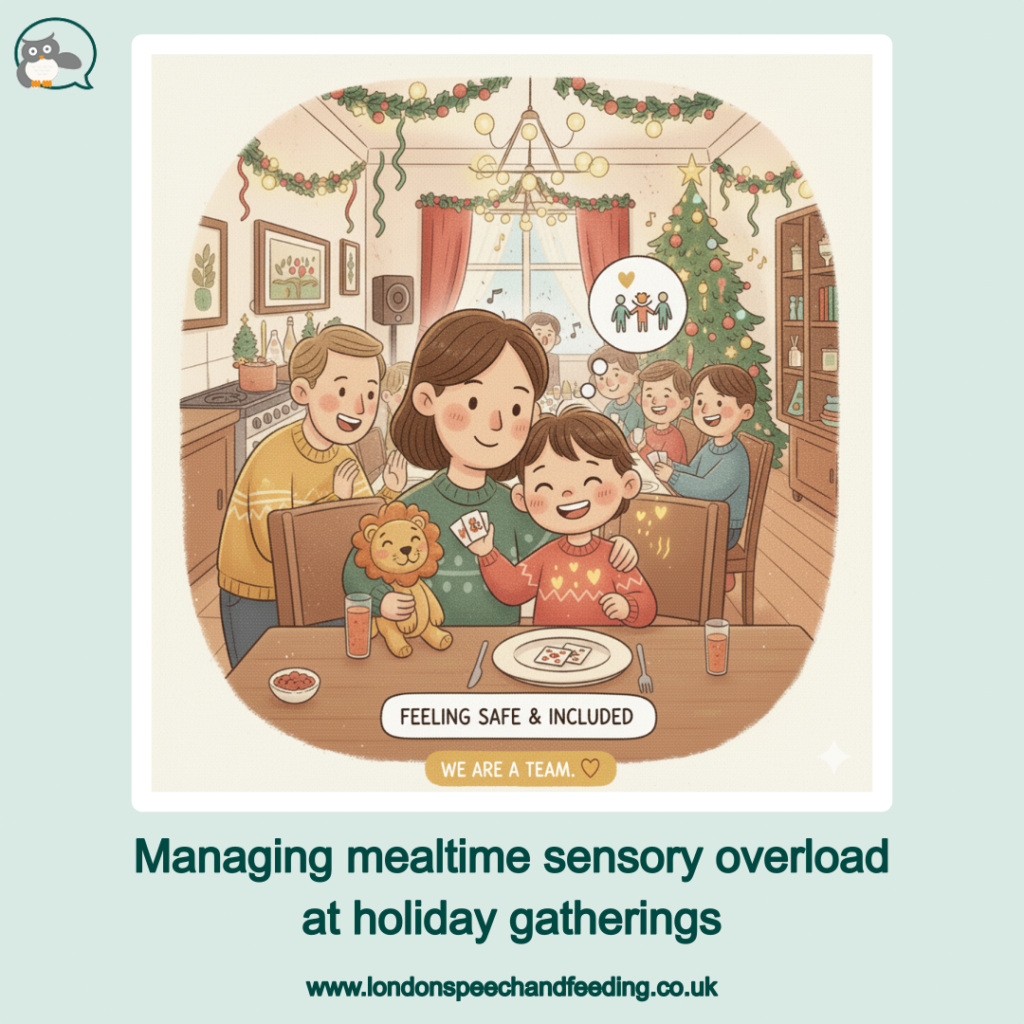
Holiday meals are meant to be joyful and something we all look forward to. But for many children and their families, these occasions can be overwhelming and be the cause of dread and worry. The combination of new smells, unfamiliar foods, loud environments, social expectations, and allergy anxieties can quickly turn what should be a festive time into a stressful one.
For parents of children with sensory processing differences, selective eating challenges, or food allergies, holiday gatherings often require careful planning and a big dose of tolerance and compassion. The good news is that with awareness and a few gentle strategies, you can support your child to feel safe, regulated, and included during festive meals without pressure, tears, or discomfort.
Let’s explore how to make holiday mealtimes calmer, safer, and more connected this season.
🎄 Why holiday meals feel so overwhelming
Holiday gatherings usually combine several sensory triggers all at once:
Noisy, chaotic rooms
Strong smells from a mix of foods we don’t normally cook
Expectations to ‘try everything’ or ‘enjoy it’s sooo good!’
New environments, seating arrangements, or routines
For children with sensory sensitivities, this can feel like a tidal wave of input. Research shows that children who are sensory-sensitive often have heightened responses to smell, taste, and texture, which may lead to avoidance or distress at mealtimes (Cermak, Curtin, & Bandini, 2010).
Add food allergies into the picture and anxiety increases even further for both children and parents. A 2020 study by DunnGalvin et al. found that children with food allergies experience significantly higher stress in shared eating environments, especially when food preparation or contamination risk is hard to control.
So, if your child becomes tearful, shuts down, or refuses to sit at the festive table, it isn’t ‘bad behaviour.’ It’s sensory overload, heightened vigilance, or discomfort communicating through their body.
🌟 Preparing your child for a calmer festive meal
Preparation is especially important for sensory-sensitive or allergy-aware children. Here’s how to set them up for success:
1. Offer predictability through previewing
Before the event, show your child pictures of:
where you’re going
who will be there
the types of foods that might be served
where they might sit
A visual schedule or social story can help reduce anxiety and give your child a sense of control.
2. Pack safe foods without apology
If your child has allergies or selective eating, bring:
‘Safe foods’ you know they will eat
Backup snacks
A separate (their own) plate, if needed
Emergency medication
Announce clear, firm boundaries such as:
‘Ok people, these are Jamie’s safe foods — we’ll stick with these today.’ This will help relatives understand without pressure or judgement.
3. Choose seating that supports sensory regulation
If possible, seat your child:
at the end of the table
near a familiar adult
away from the kitchen (strong smells)
away from noise clusters
give them their favourite toy or fidget whilst waiting
Let them take breaks when needed. This isn’t ‘rude,’ it’s self-regulation.
🍽️ Supporting children during the meal
1. Focus on connection, not consumption
The holidays are not the time to expand your child’s food range. Keeping mealtimes low-pressure actually supports long-term progress.
In fact, the research is clear: pressuring children to eat decreases acceptance and increases refusal (Galloway et al., 2006).
So instead of ‘Just try it!’ try:
‘You don’t have to eat it, you can look at it.’
‘You’re in charge of what goes in your mouth.’
‘You can keep your safe foods on your plate.’
2. Protect your child’s allergy safety
Holiday meals often include:
cross-contamination risks
shared utensils
buffets
homemade dishes without ingredient lists
Use gentle but firm scripts:
‘Because of Ellie’s allergies, we’ll keep her plate separate.’
‘We’ll serve her food ourselves to make sure she stays safe.’
Confidence in your boundary helps others respect it.
3. Manage sensory load in real time
Offer:
headphones
a small chew or fidget toy
a designated ‘calm corner’
time outside for fresh air
a predictable signal for breaks (e.g., a hand squeeze or card)
Remember, sensory regulation is healthcare, not ‘giving in.’
4. Model calm eating
Children learn most from watching.
Slow, happy bites and relaxed facial expressions tell the nervous system: ‘This environment is safe’.
💛 What to say to well-meaning relatives
Families often have big feelings about food. You can prepare nice phrases like:
‘We’re focusing on helping him feel safe around food today.’
‘She has allergies, so we’re sticking to our plan.’
‘We’re avoiding pressure because it helps him eat better long term.’
‘We’re celebrating together, eating is not the goal today.’
Setting expectations ahead of time can reduce awkward moments later.
🎁 The bigger picture: It’s about safety, not ‘picky eating’
Children with allergies, sensory differences, or feeding challenges aren’t trying to be difficult. They are trying to stay safe, regulated, and comfortable.
Your calm presence, gentle boundaries, and preparation create the conditions for a holiday that feels peaceful, not pressured.
Sonja McGeachie
Highly Specialist Speech and Language Therapist
Owner of The London Speech and Feeding Practice.
Find a speech and language therapist for your child in London. Are you concerned about your child’s speech, feeding or communication skills and don’t know where to turn? Please contact me and we can discuss how I can help you or visit my services page.
You (as parents) often describe yourselves as being under constant pressure and stress when looking after your children and young people with Special Educational Needs and Disabilities (SEND). You may find going out to do the simplest of tasks a challenge. And you will try to avoid social situations out of fear and anxiety. One of the most important factors to you is having like-minded people who understand your position as a parent with a young person with additional needs. Let’s look at some of the challenges you face and how I can support you and your family.
1. Challenging behaviour and going out to the shops
When your child displays challenging behaviour and won’t go into a shop without buying a toy that they insist on having, it can be tough on your family. You see people around you staring as you try to manage the situation. They do not understand the pressures you face, or that the simplest of tasks are a huge challenge.
I can support you by giving strategies to use when out and about. I know that using visuals is important for your child. They may not understand or take in language when they are in a heightened state of anxiety or feeling overwhelmed. You could print pictures of the places you’re going to and put them on an easily accessible chain. Then you could use that chain when out and about at the shops. You may want to introduce a visual timetable at home. That way your child or young person understands where they are going. This may lessen their anxiety and subsequent behaviour.
2. Your child is not able to communicate their needs to an unfamiliar communication partner
When your child has difficulty communicating to an unfamiliar person it can be hard to manage. You feel yourself explaining your situation repeatedly. I can provide your child with individualised strategies or communication aids which support your child to communicate with both familiar and unfamiliar communication partners. We’ll work together to find which communication methods work in different situations and how your child will use these to help their independence.
3. Being overwhelmed
Your child or young person may easily be overwhelmed which may contribute to behaviour changes. I’ll work with your family to understand what the behaviour means, looking at what happened before and what happened afterwards. We’ll not only look at the behaviour but at the environment as well. This can inform how you can support your child or young person in the future, to reduce sensory stimuli (if needed) and for them to feel emotionally regulated.
4. People avoid engaging with you
One of the hardest things as a parent is for others to avoid you. You see them crossing the street because they don’t know what to say to you. All you want is them to accept you, to maintain your identity as a person and not as a SEND parent. I can support you emotionally. I can give you advice on local support networks where you can find other parents in a similar situation.
We know the stresses that being a parent with a child with SEND comes with. Please know I am always here to support you, to find solutions so that when you’re next out and about. Your experience will be a little easier and you’ll feel less isolated.
Find a speech and language therapist for your child in London. Are you concerned about your child’s speech, feeding or communication skills and don’t know where to turn? Please contact me and we can discuss how I can help you or visit my services page.
We are all aware that Autism is on a spectrum. By the very nature of this, it means that every child will present differently, so an individualised approach is required. We need to remember to use a child’s strengths to support their needs. By using a person-centred approach, you’ll see your child’s literacy develop and thrive.
I hear many parents concerns about literacy as well as communication. Will they be able to read, write and spell? How will they manage their literacy independently? The questions are endless, so let’s look at how you can support your child’s literacy skills and how together we can provide a scaffold to them becoming independent learners.
The one thing we know is that Autistic children are visual learners. They succeed by us sharing pictures and demonstrating how the narrative is shown.
Start reading to your child at an early age. You can never start too early. This creates a love for books and supports vital pre-literacy skills (such as increasing vocabulary, following narratives, awareness of sounds in words, and letter recognition and awareness). By supporting pre-literacy skills, you’re starting the process to create confident young readers.
There are many ways to use books. You can narrate the story using different voices and tones to increase interest. You can do this even if your child isn’t interested. They are still listening and learning vital skills. You may even ask and answer questions and voice the skills that they will need for internal monitoring.
Use their interests to select appropriate reading material. In addition, you can then create questions on the book and provide a scaffold to support your child with the answer.
Use technology to spark their interest in reading. Demonstrate how they can read online. This is often successful as it becomes an individual activity as opposed to needing social interaction.
Provide them with a choice of texts (e.g., would you like ‘Perfectly Norman or when things get too loud’) rather than an open-ended question such as ‘What book would you like to read?’
Write key pieces of information down on paper. Research suggests that Autistic learners understand written text better than speech.
You could have a ‘word of the day’ from chosen reading material that you explore together.
Reading aloud to your child can have many benefits which include understanding vocabulary to how the book is read, with appropriate intonation.
I highly recommend the boom decks as they are a great resource!
The ethos at London Speech and Feeding:
“If they can’t learn in the way we teach, then we teach the way they learn”
Find a speech and language therapist for your child in London. Are you concerned about your child’s speech, feeding or communication skills and don’t know where to turn? Please contact me and we can discuss how I can help you or visit my services page.
Many parents notice speech errors when their children are toddlers. At that stage it often feels quite normal. Young children are still learning the sounds of their language, and those early mispronunciations can be very endearing.
But as children grow older, parents sometimes begin to wonder:
‘Should my child still be speaking like this?’
A common concern I hear from families is that their child is still difficult to understand even after starting school. Sometimes it is a parent who notices it first. Other times it is a teacher who gently mentions that classmates occasionally struggle to understand what a child is saying.
When this happens, parents naturally wonder whether it is something their child will grow out of, or whether some extra support might help.
When should children’s speech be clear?
Children learn speech sounds gradually over several years. Some sounds develop earlier, while others take longer to master.
By the time children reach five to six years of age, most of their speech should be clear enough for unfamiliar adults to understand. There may still be a few tricky sounds developing (such as /R/ or /TH/), but overall speech should be fairly easy to follow.
If a child is frequently difficult to understand at school age, it can sometimes indicate that a speech sound difficulty has persisted beyond the stage when it would normally resolve on its own.
Why some children remain hard to understand
There are several reasons why speech clarity may still be developing in older children.
Phonological patterns
Some children continue to use speech patterns that are typical of younger children. For example:
saying ‘tat’ instead of ‘cat’
saying ‘doe’ instead of ‘go’
leaving sounds out of words
These patterns are called phonological processes. They are a normal part of early speech development, but when they persist into the school years they can make speech difficult for others to understand.
Difficulty producing specific sounds
Other children may have difficulty producing certain individual sounds clearly. This might include sounds such as:
/S/
/SH/
/R/
/TH/
These difficulties are called articulation difficulties.
A child might understand exactly what they want to say but find it hard to produce the sound accurately with their tongue, lips or airflow.
Motor speech planning challenges
For some children, the difficulty lies in the planning and coordination of the movements needed for speech.
Speech requires very precise timing between the tongue, lips, jaw and breath. If the brain finds it difficult to organise these movements consistently, speech can sound unclear or inconsistent.
In some cases this may relate to Childhood Apraxia of Speech, although only a full assessment can determine this.
Why clarity matters for school-age children
Speech clarity becomes particularly important once children start school.
At this stage, children are:
Answering questions in class
Talking with friends
Reading aloud
Developing confidence in communication
When speech is difficult to understand, children sometimes become more hesitant to speak, particularly in group situations.
This can affect confidence and participation, even when the child has lots of ideas they would like to share.
The good news: speech can improve
The encouraging news is that speech sound difficulties can often improve significantly with the right support.
Speech therapy focuses on helping children:
Learn how sounds are produced
Practise accurate speech movements
Understand how sounds change meaning in words
Build consistency through structured practice
Different children benefit from different therapy approaches. Some need support with phonological patterns, while others benefit from more motor-based practice that strengthens speech coordination.
Often therapy combines several strategies to support the child’s individual speech profile.
When to seek advice
If your child is already at school and you find that people outside the family often struggle to understand them, it can be helpful to seek advice from a speech and language therapist.
A detailed assessment can help identify:
Which sounds are causing difficulty
Whether patterns such as fronting or sound substitutions are present
Whether motor planning challenges may be contributing
Which therapy approach is likely to be most effective
Early support can help children develop clearer speech and greater confidence in communication.
Every child’s speech journey is different
Speech development is not the same for every child. Some children master speech sounds quickly, while others need a little more guidance along the way.
The important thing is that support is available when children need it.
With the right strategies and practice, many children make excellent progress and develop speech that is clearer, more confident and easier for others to understand. If you are concerned about your child’s speech clarity or ongoing speech sound errors, a speech and language assessment can help identify the underlying difficulty and guide the most appropriate support.
Find a speech and language therapist for your child in London. Are you concerned about your child’s speech, feeding or communication skills and don’t know where to turn? Please contact me and we can discuss how I can help you or visit my services page.