There are various great ways to treat speech sound disorders and I use all the approaches available selectively; I decide what works with each individual child and I also vary the approach depending on the child’s frame of mind at any given time during my session.
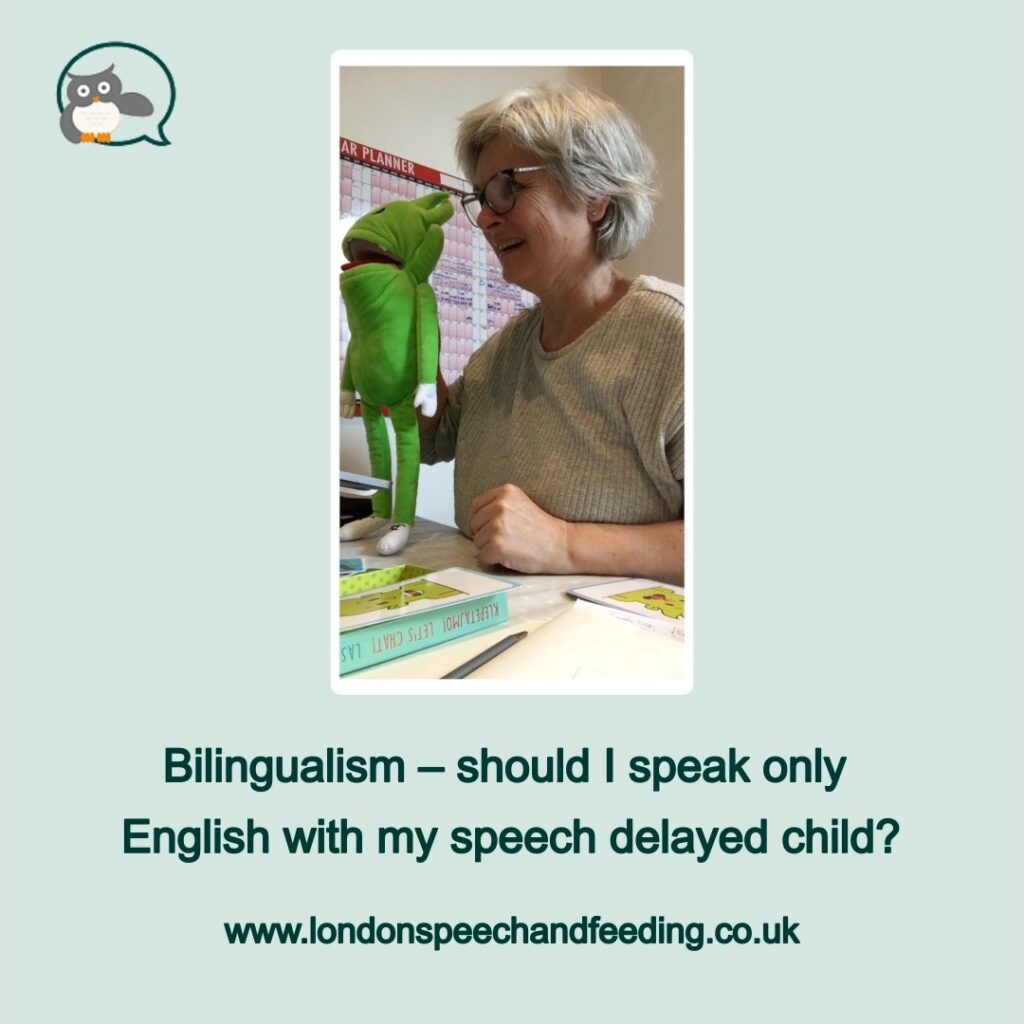
Some of the approaches are more “drill-based” and require a child to be able to pay attention and really participate actively in the therapy, and this is what I am showing you today with this video clip.
My little student here has been working with me for some time and from only saying a handful of words which were not very easy to understand he has come a long way. He does have some features of Verbal Dyspraxia which I shall briefly outline here:
Making sounds in general is a struggle, especially when asked to copy certain sounds, example: ‘can you say: a ee ou oo?”
Repeating sound sequences or words sequences is hard, for example: “say p-t-k in sequence” or “say fish chips fish chips fish chips
When saying the same word again and again, different mistakes can be heard
Intonation difficulties: speech sounds monotonous
Vocabulary is very limited
Some therapy approaches are more play based, for example the Core Word method: here we pick a few words at a time which are very significant to the child and therefore highly motivating to try and say. These could be characters of Pokemon or Minecraft for example, or simple words like “GO!”
When you watch the video you will see that I use a lot of visual prompting, such as showing him where the tongue is moving to or from. I do this with my index finger and this approach is called Tactile Cueing or “Cued Articulation”. Part of the approach is to give a visual prompt and then reduce the prompt as the learner is more able to produce the correct sounds. Once he can produce the sound on its own, we quickly move to the sound within a word.
I do mix and match my approaches and in fact here I am drilling but I also use the Core Word which for him (YELLOW) — it’s his favourite colour and I happen to have quite a few good games where a YELLOW something or other can be asked for….. WHO KNEW!? 🙂
Find a speech and language therapist for your child in London. Are you concerned about your child’s speech, feeding or communication skills and don’t know where to turn? Please contact me and we can discuss how I can help you or visit my services page.
Communication skills are critical in all areas of communication throughout childhood and into adulthood. They are needed for understanding, narrating, making predictions and to develop social skills, for example in understanding everyday language or talking in the classroom or socialising with peers. Children with communication needs can experience low self-esteem, potential behavioural difficulties, lower school attendance and attainment.
Communication skills have a strong impact on literacy. Let’s look at some of the facts:
50% of children with language delays also have challenges with literacy (Burns et al, 1999).
73% of poor readers in year three had a history of difficulties with phonemic awareness (the ability to hear, identify and manipulate sounds) or spoken language in pre-school (Catts et al, 1999).
The effect of expressive language on spelling and reading
The ability to read is very much dependent on competent language skills. Furthermore, a limited vocabulary will also have an impact on literacy skills. The more we know about a word, the easier it is to retrieve, recall, understand and use. So, if a young person has a poorer vocabulary, it’s likely that they will not have the same decoding skills as a peer with a richer set of vocabulary. By decoding we mean the ability to apply knowledge of letter-sound relationships including pronunciation of words. Decoding is a vital skill used in literacy.
Whilst learning to read is a key skill, it’s important to remember that a solid foundation is needed for success. We need to ensure that no steps are missed, otherwise there will be gaps in knowledge.
As your child moves further through the education system, they will be “reading to learn”. This is where young people with poorer language skills may show literacy difficulties (for example, reading comprehensions become more challenging, and their expressive language skills impact on their written abilities).
When should I seek advice or support?
Always seek the advice from a qualified professional such as a Speech and Language Therapist. You need appropriate advice for the age and stage of your child’s development and early intervention is of course key to success. It is never too late to ask for advice. The earlier you seek support, the better the outcome for your child in all areas (language, literacy, and emotional well-being).
Have you still got unanswered questions? Contact me here and we can have a look at your child’s phonemic awareness, auditory processing skills, verbal understanding and assess his/her ability and likelihood of reading and literacy struggles. If we find that your child has dyslexia I can refer on to a specialist colleague who can help you further.
Find a speech and language therapist for your child in London. Are you concerned about your child’s speech, feeding or communication skills and don’t know where to turn? Please contact me and we can discuss how I can help you or visit my services page.
We all have the right and want to express thoughts, feelings, and needs. For non-speaking or minimally speaking children, finding an avenue to communicate effectively can be a challenging journey. Parents are often at a loss as to where to start. Sometimes a little bit of Makaton signing has been used here and there but we mostly find that gradually signing fades as parents feel that it just doesn’t seem to get copied and used by the children.
They live and breathe their system
This is where we need to pick up the pieces and start again: because all successful families where children start using their boards or their electronic AAC (Augmentative and Alternative Communication) systems do this one thing: THEY LIVE AND BREATHE THEIR SYSTEM.
They have boards in every single room of the house;
They have a board in the car, attached to the side of car door so their child can point to it as they need to;
They have a smaller board in their handbag/rucksack when out and about;
They have a board for shopping and attach it to the shopping trolley;
They are never ever without their board.
Because they realise that a child should never be without their mouths to speak, should never be without a means to speak. They use their own board to model and the child has always access to their board to model back or to just look.
This is where success begins
Success begins at consistent and joyful use of the board/AAC system throughout the entire day. If we think about it, doesn’t it make sense? Of course, it does! We talk to our child for the first two years of their life continuously wherever we are and our child is continuously encouraged to use their mouths for talking in all situations.
Same goes for Signing: Makaton or any other sign system is a very powerful means to aid communication and I certainly advocate and use it in practice. Though much like words, signs are very elusive and temporary—as soon as the sign has been made it is gone and no longer present. Same with words of course. This can be difficult for people who need longer to process information.
The beauty of symbols or photographs is that they are permanent: they don’t vanish, they stay and with the core board they stay in the same place! This is very reassuring. We can learn where a symbol is and we can be assured that it will still be there the next time we look at the board.
It has 48 cells and we can see the most frequently used core words on here, words that we use 80% of the day when talking with our non-speaking/minimally speaking children, younger children and children with cognitive delay. We keep our sentences short and we say phrases pertaining to their daily lives;
Let’s GET your toy
PUT it here, PUT it away, PUT it IN
Let’s READ a book
UP you get
WANT some MORE?
That’s GOOD isn’t it?
Let’s OPEN the box and LOOK
And so on… All these phrases can be aided with the above board. Your child will learn OVER TIME and OVER CONTINUOUS USE where GET/PUT/MORE/WANT/IN—where these symbols are. For children who are slow to process this is so helpful, to have a visual representation of what has just been said. It aids understanding in the first place. Gradually as a child starts to copy they will point to powerful symbols themselves and if they want to speak they can also speak of course:
A child might point to WANT + MORE and then say with their mouths: BANANA!
Board examples
Here are some other boards I have made specifically for daily situations and preferences of some of my students. Here is one for toileting:
And another one:
These boards incorporate high-frequency and versatile words, enabling us to make little sentences.
Building Language and Literacy Skills
AAC Core Boards are not just tools for immediate communication. They also play a pivotal role in language and literacy development. By using these boards, non-speaking children engage with words and symbols, reinforcing their understanding of language structure and grammar.
Over time they naturally absorb language patterns, laying the foundation for improved literacy skills.
Customisation for Individual Needs
Every non-speaking child is unique, and their communication needs can vary significantly. AAC Core Boards are designed with this diversity in mind. The boards can be adapted to include specific vocabulary relevant to the child’s daily life, interests, and activities. This personalisation ensures that the AAC Core Board is a true reflection of the child’s personality and needs, making communication more engaging and effective.
Collaboration between AAC Core Boards and Speech Therapy
While AAC Core Boards are an incredible tool, they are only used effectively by the non-speaking child when the board is used BY ALL COMMUNICATION PARTNERS around the child.
Again, I know I am being repetitive here, but the board needs to be used and modelled by the adults constantly in the first place and for a period of time before we can expect our children to take an interest and use the boards themselves. Think how long it typically takes for a child to learn their first word: around a year! During that time the adults talk constantly to their child without hesitation or expectation! The same goes for introducing this new way of communicating.
Collaborating with your child’s speech-language therapist (SLT) ensures that your child receives the right guidance in using the AAC system. SLTs can assess your child’s communication abilities, recommend appropriate boards and provide guidance on how to best implement them.
Conclusion
For non-speaking children, AAC Core Boards are bridges to their world.
These boards foster language development, social interaction, and personal expression. AAC Core Boards offer a beacon of hope, helping non-speaking children break through communication barriers and thrive in a world that is waiting to hear their voices. Boards are simple for anyone to use and understand. Have a go! You will be surprised how lovely it is to use a board with ease and once your child sees you do this, you have a chance for your child to start copying you…and express something! HOW ABOUT THAT! I look forward to hearing your stories!
The London Speech and Feeding Practice
Find a speech and language therapist for your child in London. Are you concerned about your child’s speech, feeding or communication skills and don’t know where to turn? Please contact me and we can discuss how I can help you or visit my services page.
Bilingualism is a beautiful aspect of our diverse world. Growing up in a bi- or multi-lingual household is a wonderful gift, allowing children to communicate with a broader range of people and access many cultures.
My own two children grew up in a bilingual German-English speaking household. They have both been so enriched by this experience, not only language- and learning-wise but of course also culturally: their world has always been so open and colourful. Growing up in inner London and having their German family and mum’s friends as well, this has been a wonderful experience. Both my boys speak German well (not quite like native speakers but like very good second language speakers) and both have very easily learned 3rd and 4th languages additionally when in secondary school.
Whilst bilingualism has untold benefits, it’s not uncommon for bilingual children to take slightly longer to reach certain speech milestones. This should not be automatically mistaken for speech disorders but rather seen as a natural part of bilingual language development.
Bilingualism and speech delays
Sometimes, of course, we do see speech delays or disorders where a child’s speech development lags significantly behind their peers. We often see a delay in both languages equally, making it extra hard for to communicate effectively. BUT PLEASE KNOW the family speaking in multi-lingual languages never caused the delay/disorder!
If there is a delay or a disorder any number of other reasons could have caused it, such as:
hearing impairments,
reduced phonological awareness,
sensory processing issues,
reduced attention and reduced joint attention,
neuro-developmental delays or difficulties,
general or specific learning difficulties
or sometimes other genetic factors.
So, to say that the difficulty is due to a child being exposed to several languages is a red herring. (no offence to herrings!)
Speech therapy
Speech therapy can be powerful to help bilingual /multilingual children with speech delays unlock their full linguistic potential. By providing individualised assessments, targeted interventions, and involving families, speech therapy can bridge the gap between speech delays and bilingualism. It’s essential for the therapist and parents to work together to support the children in their unique linguistic journeys, helping them communicate effectively and thrive in both of their languages.
Image by Freepik
Speak your home language at home
Many parents report that they worry about speaking their home language at home and instead they have been focusing on just speaking English at home. They now rarely use their home language with their child. They fear that speaking a language other than English with their child will cause further delay and hinder their progress. All parents want the best for their child and often parents fear that their child won’t fit in or will be seen as ‘different’. So we can understand why parents feel that the English language is the only one worth having.
But the opposite is the case: it is crucial to speak in both languages freely, both at home and outside the home! Both languages will benefit your child, no matter what the delay or difficulty is. Acquiring a ‘mother tongue’ or native language is absolutely vital for children to have a good, solid linguistic grounding on which to build other languages. Bilingual children may mix languages during speaking and parents may equally mix their languages. This does not hinder language development and is a natural part of linguistic development.
Speak freely and naturally
What is far more important than the question: ‘which language should I say this in?’ Instead think: ‘let me speak freely and naturally, let me respond naturally, in good intonation and let communication flow freely to the child.’
Speech therapy can be a crucial resource for bilingual or multilingual children and their families.
We work on targeted interventions to address speech and language difficulties, helping your child develop essential communication skills. For home practice between therapy sessions, we can recommend tailored treatment plans to help you help your child in daily life. Our input could be focusing on articulation, phonological awareness, attention and listening, vocabulary development and grammar.
Family support is crucial in speech therapy. We like to work closely with parents to provide guidance and strategies for fostering language development in both languages at home.
If you have any worries about your child being delayed in a bilingual or multilingual household do get in touch and we will be happy to support you in your journey.
Find a speech and language therapist for your child in London. Are you concerned about your child’s speech, feeding or communication skills and don’t know where to turn? Please contact me and we can discuss how I can help you or visit my services page.
That adorable string of ‘ba-ba-ga-ga-ma-ma’ might sound like baby gibberish, but it’s actually a crucial milestone in your little one’s language development. Babbling or babble, as we call it, is far more than just cute baby noises. It’s a sequence of sounds that lays the foundation for future communication.
Image by freepik
What is babbling?
Babbling typically begins around six months of age, though the timing can vary slightly from baby to baby. It involves your baby experimenting with different sounds, stringing together consonants and vowels. You might hear them repeating sounds like:
‘Ba-ba’
‘Da-da’
‘Ma-ma’
‘Ga-ga’
As they progress, the babbling becomes more complex, with variations in pitch, rhythm, and intonation. It might even sound like they’re having a conversation with you!
Why is babbling so important?
Laying the groundwork for speech: Babbling is like a vocal workout for your baby. By practising these sounds, they’re strengthening the muscles in their mouth, tongue, and vocal cords that are essential for speech.
Developing phonological skills: Through babbling, babies begin to understand the sound patterns of their native language. They’re learning which sounds go together and how they’re used.
Enhancing social interaction: Babbling is a social activity. Babies often babble back and forth with their caregivers, which helps them learn about the give-and-take of communication.
Cognitive development: The act of babbling requires babies to use their brains in new ways. They’re learning to control their vocalisations, pay attention to the sounds they’re making, and connect those sounds to the responses they receive from others.
How can you encourage babbling?
Talk to your baby: Even though they can’t understand your words yet, talking to your baby exposes them to language and encourages them to respond with their own vocalisations.
Imitate their sounds: When your baby babbles, imitate them! This shows them that you’re paying attention and encourages them to keep ‘talking.’
Respond to their babbling: Treat your baby’s babbling as if it’s a real conversation. Respond with words, smiles, and gestures.
Play sound games: Make different sounds for your baby and encourage them to imitate you. This could include animal sounds, silly noises, or simple words.
Read to your baby: Even before they can understand the words, reading to your baby exposes them to the rhythm and sounds of language.
Sing songs: Singing is a fun and engaging way to introduce your baby to new sounds and words.
Use mirrors: Babies often enjoy watching themselves make sounds in a mirror.
Tactile stimulation: Gentle massage around the mouth and face can increase oral awareness and encourage vocalisations.
Vary textures: Offer different textured teethers.
Read books with sound effects: Choose books with animal sounds or other engaging noises.
Blow bubbles: The act of blowing and popping bubbles can encourage vocalisations.
Use visual aids: Show pictures of objects and say their names, emphasising the consonant sounds.
Use exaggerated facial expressions: When you make sounds, exaggerate your mouth movements to help your baby see how sounds are made.
Increase joint attention: Follow the child’s gaze and point to objects that they are looking at and say the name of the object.
When to seek help
If you notice that your baby is not babbling by eight months, it’s a good idea to talk to your speech and language therapist. You might also notice a lack of variation in tone when your child is making sounds, is your baby sounding a little ‘flat’ or monotonous? While every child develops at their own pace, a lack of babbling can sometimes indicate a developmental delay or hearing issue.
Remember, babbling is a gift. So, enjoy those precious moments of ‘baby talk’ and take comfort in knowing that your little one is on the path to becoming a chatterbox!
Do get in touch via my contact form if you are concerned about your child’s development or if you simply want some reassurance that your baby is developing well. We will be delighted to arrange a screening appointment for you and give you support and reassurance.
Sonja McGeachie
Highly Specialist Speech and Language Therapist
Owner of The London Speech and Feeding Practice.
Find a speech and language therapist for your child in London. Are you concerned about your child’s speech, feeding or communication skills and don’t know where to turn? Please contact me and we can discuss how I can help you or visit my services page.
Does your child struggle to focus on toys or activities? Do they dart away as soon as you approach? You’re not alone!
The key to unlocking your child’s potential lies in following their lead. Let them guide the play session, and watch their engagement and focus soar.
Why Child-Led Play Works:
Empowerment: Children feel in control, sparking their curiosity and motivation.
Focused attention: They’ll stay engaged with activities for longer periods.
Reduced frustration: By stepping back and observing, you eliminate the pressure and stress that often comes with directed play.
How to Implement Child-Led Play:
Prepare the environment: Set out a limited selection of engaging toys.
Observe and wait: Sit back, watch, and listen to your child’s interests.
Embrace the moment: Resist the urge to direct or question; simply enjoy the process.
Remember: This simple approach can transform playtime and support your child’s development. Give it a try for a week and see the difference!
#OWLing #hanenmorethanwords
Observe, Wait, Listen. It’s a powerful formula for unlocking your child’s potential.
You will likely see:
Your child will stay put with any toy for longer whilst you are near them.
Your child will tolerate you being nearby and he/she won’t move away.
Your child will start giving you brief glances of enjoyment, or perhaps they will hand things to you, or they might take your hand and lead it to something that needs opening etc.
In other words, you will see that there suddenly is JOINT PLAY. Yes, granted it may not be according to your adult agenda, but there will be more togetherness than there was before. And this is the START of communication and social engagement.
USE Core words and a coreboard — to help your child understand the power of words
Core words are the building blocks of communication. Try using a coreboard like the one below, they are versatile and can be used in countless ways. By modelling these words naturally during play, you expose your child to their meaning and function in context. This approach is far more effective than isolated drill and practice, more powerful than flashcards!
Combining child-led play and AAC modelling creates a magic effect. To summarise:
Increased engagement: When you follow your child’s lead, they are more likely to be engaged and receptive to learning. This creates optimal conditions for introducing AAC core words.
Natural learning: By modelling AAC core words in the context of play, you help your child understand their meaning and purpose naturally. This fosters generalisation and spontaneous use.
Building relationships: Shared play experiences strengthen the bond between you and your child. This trust and connection are essential for successful communication.
Reduced pressure: Modelling AAC core words without expectation removes the pressure to produce language. This allows your child to explore communication at their own pace.
Expanded vocabulary: As your child becomes more comfortable with AAC, they will begin to incorporate core words into their own communication. This leads to vocabulary growth and increased independence.
Practical Tips
Observe and respond: Pay close attention to your child’s interests and actions. Respond to their cues with enthusiasm and support.
Keep it simple: Start with a few core words and gradually introduce new ones as your child’s skills develop.
Be patient: Language learning takes time. Celebrate small successes and avoid frustration.
Have fun: Remember, play is supposed to be enjoyable for both you and your child. Relax and have fun together!
Let’s say your child is playing with a pop-up toy like you see me do in the above photograph. Here, I followed my child’s lead by waiting to see what she wanted to do with the toy. You are now OWLING! (Observe Wait and Listen)
Once I noticed that there was repetitive opening of the flaps going on I then pointed to OPEN and MORE on the board, as I said: ‘let’s OPEN this one’ / let’s see MORE animals’ / ‘MORE cow! it says moo!’ ‘OPEN another one’ and so on.
Important to know, we are not expecting our child to respond verbally or with AAC, but we are providing language input and demonstrating how these words can be used with enthusiasm.
Naturally in time your child will look at the board and at your pointing and they will eventually want to copy you!
By incorporating these strategies into your daily interactions, you can create a supportive environment that fosters language development and communication growth. If you would like more guidance please get in touch and book in for a consultation, some individual therapy and/ or some parent coaching.
I look forward to supporting you. Please contact me and let’s see how.
Sonja McGeachie
Early Intervention Speech and Language Therapist
Feeding and Dysphagia (Swallowing) Specialist The London Speech and Feeding Practice
The London Speech and Feeding Practice
Find a speech and language therapist for your child in London. Are you concerned about your child’s speech, feeding or communication skills and don’t know where to turn? Please contact me and we can discuss how I can help you or visit my services page.
There are many truths and myths out there that I’d like to explain to prevent misunderstanding. This will enable you to support your child by seeking the correct information.
Why not have a look at the following statements and decide if you think they are true or false?
Flashcards will fix my child’s speech, language, and communication needs.
Singing to my child will not help their language development.
My child communicates in a variety of ways not just through speech.
Learning another language is good for my child.
Now let’s explore these statements in more detail.
1. Flashcards will fix my child’s speech, language and communication needs – False
To develop your child’s communication skills, you’ll want your child to generalise their skills across multiple areas. I would highly recommend staying away from flashcards if they are only teaching ‘rote learning’. Children need to explore the world through play. However if you’re looking at cards, talking about them and having meaningful conversations, and your child is enjoying it, then there potentially is a use for flashcards. But at London Speech and Feeding, we love innovative activities that your child is fully immersed in.
2. Singing to my child will not help their language development – False
Singing introduces your child to rhyme, and repetition amongst many other benefits. It allows them to attend and listen to you as their caregiver and develop the vital stages of early communication. Singing slows down language so your child becomes more aware of the relationship between letters and sounds. You’re also supporting your child’s oral fluency as well as their memory. Furthermore, you’ll often be face to face with your child singing which allows them to see your facial expressions, lip patterns and eye contact (to name a few).
3. My child communicates in a variety of ways not just through speech – True
Communication is much more than just talking. So, it’s true that communication happens in a variety of ways. Think about it. If you didn’t talk and you wanted to convey a message of frustration, you may show different facial expressions, body language; you may point at something which has caused your frustration. We can communicate through a variety of means (some of which include symbols, gestures, hand signals, and pictures). Can you think of any other ways in which you communicate to others?
4. Learning another language is good for my child – True
Current evidence suggests that speaking another language to your child is a positive. It allows your child to interact with different members of the family or with their friends. ASHA suggests that children who speak two languages fluently often learn new vocabulary easier and find categorisation simpler. Bilingual children have been shown to understand the needs of their communication partner. In addition, increased vocabulary may support better understanding. There are no negative factors about learning more than one language. We would recommend that, whatever language(s) your child is learning, they have a good model of that language, so they learn best practice.
Always seek the advice from a qualified Speech and Language Therapist if you’re unsure of how your child’s speech, language and communication is developing, as there are lots of information online that aren’t always accurate.
I’m always happy to support your family to increase your knowledge and understanding.
Find a speech and language therapist for your child in London. Are you concerned about your child’s speech, feeding or communication skills and don’t know where to turn? Please contact me and we can discuss how I can help you or visit my services page.