When ‘star’ sounds like ‘dar’: Understanding speech sound disorders and the path to clearer speech

If your child says ‘dar’ instead of ‘star’, you might be wondering if they will simply outgrow it or if they require specialised support. While ‘cluster reduction’—dropping one of the sounds in a blend—is a normal part of learning to talk, we typically expect these sounds to lock into place by age four years. If these errors persist as a child approaches school age, it often signals a speech sound delay that may now no longer pass without help. As a Speech and Language Therapist, I specialise in helping children bridge this gap using evidence-based techniques like backward chaining.

This isn’t about constant correction; it’s about providing the right clinical scaffolding to move a child from ‘frustrated’ to ‘fluent’ before they hit those critical early school years.

Dropping sounds from words is a common feature of speech sound difficulties, and while it can look small on the surface, it can have a big impact on how clearly a child is understood. In this short video clip, I’m working with a child on an /ST/ sound cluster, demonstrating how I use an evidence-based speech therapy technique called backward chaining to help children build clearer speech with confidence.

What’s actually happening when a child drops the ‘S’?

Clusters like /ST/, /SP/, and /SK/ are tricky. They require:

  • precise timing
  • careful airflow
  • and the ability to blend sounds smoothly

For many children, especially those with speech sound difficulties, this is a big ask.

So instead of hearing:

‘star’

we might hear:

‘tar’ or ‘dar’

This isn’t laziness or refusal. It’s the child simplifying the word to make it manageable.

Why I don’t start by saying ‘say star’

Telling a child to ‘just add the S’ rarely works.

Instead, I meet them where they are already successful.

In this clip, the child can already say ‘dar’ clearly. That’s our starting point.

Backward chaining: building speech from success

Backward chaining means we:

  1. Start with the part of the word the child can already say
  2. Gradually add the missing sound
  3. Keep the child feeling successful at every step

So rather than jumping straight to ‘star’, we:

  • secure the ending
  • gently introduce the /S/
  • and blend it in a way that feels achievable

This approach reduces frustration, builds confidence, and helps the sound stick not just in the therapy room, but out in the real world.

Why this matters beyond one word

This isn’t just about saying ‘star’.

It’s about:

  • teaching the mouth a new movement pattern
  • giving the brain time to organise the sound sequence
  • and helping the child feel capable, not corrected

When therapy feels safe and successful, children are far more likely to generalise their new sounds into everyday speech.

Speech therapy works best when children feel supported not tested.

If your child struggles with speech clarity

If your child:

  • drops sounds from words
  • avoids longer or trickier words
  • or becomes frustrated when they’re not understood

This is the kind of work I do every day building speech step by step, in a way that respects each child’s pace and strengths.

Support can be gentle, effective, and empowering.

If you’d like to learn more about how speech therapy can support your child, you’re always welcome to get in touch.

Sonja McGeachie

Highly Specialist Speech and Language Therapist

Owner of The London Speech and Feeding Practice.


Health Professions Council registered
Royal College of Speech & Language Therapists Member
Member of ASLTIP

Find a speech and language therapist for your child in London. Are you concerned about your child’s speech, feeding or communication skills and don’t know where to turn? Please contact me and we can discuss how I can help you or visit my services page.

3

Similar Posts

  • The art of selective care: My journey as a semi-retired private therapist

    Welcome!

    Hello, and welcome. I’m writing this today to share a bit about my professional journey, a journey that has evolved over many years from a bustling, full-schedule practice to a more intentional, deeply fulfilling semi-retired life. This shift wasn’t born out of a desire to slow down, but rather an understanding of what truly matters: my time, your time, and the quality of the work we do together.

    For decades, I poured my energy into a full calendar, helping as many families as I possibly could. It was a wonderful, demanding, and rewarding time. I learned so much, grew immensely as a professional, and had the privilege of witnessing countless moments of breakthrough and success. But over recent months, I began to realise that the most impactful work wasn’t about quantity; it was about quality. It was about giving my whole, undivided attention to a select few, creating an environment where true progress could flourish.

    Change

    This realisation led to a significant change in my practice. I am now at a point in my career where my time is both valuable and precious. It is no longer a commodity to be filled, but a resource to be invested wisely. This doesn’t just apply to my personal life, but to my professional life as well. I’ve chosen to be more selective about the clients I see, and this selectivity is rooted in a single, powerful question: ‘Who can I truly, profoundly help?’

    I believe that successful therapy is a partnership. It requires commitment, trust, and a genuine connection between therapist and client. When I take on a new family, I am not just filling a slot in my schedule; I am making a deep commitment to them. I am dedicating a part of my precious time and decades of expertise to their child’s success. This is why I am now focusing on who I can really work with: families who are equally invested in the process, who understand that progress is a team effort, and who are ready to engage fully in the journey.

    My fees reflect this deep investment. You will find that my rates are higher than those of many other therapists, and I want to be transparent about why. It’s a reflection of the extensive experience I bring to the table. I have spent years honing my skills, navigating complex cases, and developing a unique, effective approach to speech, language and feeding challenges. This is not just a job for me. It is my life’s work, and I honour the value of that expertise and the time I dedicate to each family.

    I want to ensure that every minute you spend with me is productive, focused, and truly transformative. Therefore, I provide a ‘boutique style’ of care. Think of it as an exclusive, personalised experience where every detail is considered and your needs are at the forefront. You won’t feel like you’re just another appointment on a long list. You will feel that you have my full, undivided attention, as if you were my only client.

    This means less time spent on administrative tasks and more time dedicated to preparing for your sessions, reflecting on our progress, and providing you with the most thoughtful, tailored support possible. It means an environment of calm and focused expertise, where we can truly dive deep into the specific challenges and build a clear, effective path forward.

    New perspective

    For parents reading this, I hope this provides a new perspective. Choosing a therapist for your child is one of the most important decisions you can make. It’s about finding not just a professional, but a partner. I want you to feel that, if we choose to work together, you are entering into a unique partnership where your child’s growth is my singular focus.

    In this next chapter of my career, I am prioritising passion over pace, depth over breadth, and meaningful connections over a packed schedule. I am here to work with families who are ready for a truly collaborative and transformative experience. If you are seeking a level of care that goes beyond the standard, an approach that is both highly experienced and deeply personal, I would be honoured to speak with you.

    Sonja McGeachie

    Highly Specialist Speech and Language Therapist

    Owner of The London Speech and Feeding Practice.

    Health Professions Council registered
    Royal College of Speech & Language Therapists Member
    Member of ASLTIP

    Find a speech and language therapist for your child in London. Are you concerned about your child’s speech, feeding or communication skills and don’t know where to turn? Please contact me and we can discuss how I can help you or visit my services page.

    1
  • · ·

    Using AAC during play with your child

    Playtime! It’s a magic time for exploration, learning, and connection.

    If your child is struggling to use words with his/her mouth, we can always use a robust Augmentative and Alternative Communication (AAC) device to help find their words. We know that using such a device does never stop or delay children to speak with their mouths. On the contrary it helps, enormously!

    Can playtime still be a blast? Absolutely! In fact, incorporating AAC into play can be a powerful way to boost communication skills, build confidence, and create a truly inclusive play experience. Here’s how to make it happen, with a focus on core words and core scripts for our GLP’s (the building blocks of communication used by everyone). In this video I am using the core word ‘IN’ and ‘MORE’.

    The Magic of Core Words

    Core words are the most frequently used words in everyday communication. They might be verbs like ‘want’, ‘more’, ‘go’, or ‘stop’, or adjectives like ‘happy’, ‘sad’, and ‘hot’. These words are the foundation for building sentences and expressing needs and desires. They’re perfect for children using AAC because they’re simple to understand and use.

    Let’s Play! Here’s How

    1. Choose Your AAC System

    Many options exist! It could be a low-tech picture board with core words, such as the one you see pasted on my cabinet door in the background, or it can be a dedicated AAC app on your tablet. Here I am using the GRID app but I also love using others, such as LAMP Words for Life.

    2. Make it Fun and Functional

    No pressure! Integrate your AAC system seamlessly into your play routine. Here are some ideas:

    • Car/trains: Use core words to describe what the cars are doing: (‘down’, ‘go’, ‘stop’, ‘again’ ‘fast’ ‘slow’).
    • Dress-up: Use core words to choose clothes (‘want’, ‘hat’, ‘shoes’).
    • Tea Party: Use core words to ask for and share (‘more’, ‘juice’, ‘give’).
    • Building Blocks: Use core words to describe what you’re building (‘tall’, ‘big’, ‘house’).
    • Dolls/Stuffed Animals: Use core words to act out scenarios (‘sleep’, ‘eat’, ‘cry’).
    • Arts and Crafts: Use core words to describe colours (‘red’, ‘blue’), actions (‘draw’, ‘paint’), and feelings (‘happy’, ‘sad’).

    If your child is a Gestalt Language Processor you will want to model meaningful, fun scripts instead of single words! As above, but use phrases:

    • Car/trains: Use scripts to describe what the cars are doing: (‘it’s going down’, ‘let’s go’, ‘make it stop’, ‘want it again’, ‘that was fast’, ‘it’s so slow’).
    • Dress-up: Use scripts to choose clothes (‘I’m gonna wear this’ ‘that’s a lovely hat’, ‘let’s choose shoes’).
    • Tea Party: Use scripts to ask for and share (‘I want more’, ‘more juice’, ‘give me this’).
    • Building Blocks: Use scripts to describe what you’re building (‘a tall one’, ‘that’s so big’, ‘it’s a house’).
    • Dolls/Stuffed Animals: Use scripts to act out scenarios (‘it’s time to sleep’, ‘let’s eat’, ‘he’s crying’).
    • Arts and Crafts: Use scripts to describe colours (‘a red crayon’), actions (‘let’s draw’, ‘I’m gonna paint’), and feelings (‘I’m happy’, ‘that’s so sad’).

    3. Model, Model, Model

    This is key! As you play, constantly model using your child’s AAC system.

    • Point to the picture or word or script you’re using.
    • Speak clearly and slowly while pointing.
    • When using core words for either Analytical or Gestalt Language Processors, try using good phrases. For example, instead of just saying ‘juice’, say, ‘you want more juice?’

    4. Make it a Team Effort

    Get everyone involved! Encourage siblings, grandparents, and caregivers to use the AAC system with your child during playtime. The more consistent the approach, the faster your child will learn and feel confident using their voice.

    5. Celebrate Progress, Big and Small!

    Every step counts! Acknowledge and celebrate your child’s efforts, whether it’s reaching for their AAC system or successfully using a core word. This positive reinforcement will keep them motivated.

    Remember

    • Playtime should be fun, not stressful. Don’t force your child to use their AAC system. Let them lead the way and follow their interests.
    • Every child develops at their own pace. Celebrate your child’s unique communication journey.
    • Seek professional help when needed. Your SLT can provide tailored strategies and resources to support your child’s development.

    By incorporating AAC and core words into playtime, you’re not just fostering communication; you’re creating a space for your child to thrive, explore, and build strong connections.

    So, grab those toys, power up your AAC system, and get ready for a playtime adventure filled with fun, connection and, therefore, communication!

    Don’t hesitate to contact me!

    Sonja McGeachie

    Early Intervention Speech and Language Therapist

    Feeding and Dysphagia (Swallowing) Specialist The London Speech and Feeding Practice

    The London Speech and Feeding Practice


    Find a speech and language therapist for your child in London. Are you concerned about your child’s speech, feeding or communication skills and don’t know where to turn? Please contact me and we can discuss how I can help you or visit my services page.

    1
  • · ·

    Ten games to support communication in primary school aged children

    When parents visit me with their child, their stress is palpable. Often parents don’t relish or even expect to be asked to practise strategies at home with their child between sessions. Let alone to practise whilst on holiday. I understand that you don’t necessarily want anything extra added to your daily ‘to do’ lists. This is why we try our best to incorporate all speech and language therapy practice into children’s daily activities.

    For example:

    1. during bath time;
    2. mealtimes;
    3. getting ready for bedtime;
    4. story time
    5. yes, playtime!

    These are activities that all parents will engage with anyway, so it seems to make sense to incorporate both. This is to avoid adding extra pressure on parents’ already stressful and time-poor daily lives. I am hoping my blog will come in handy, especially for the summer holidays.

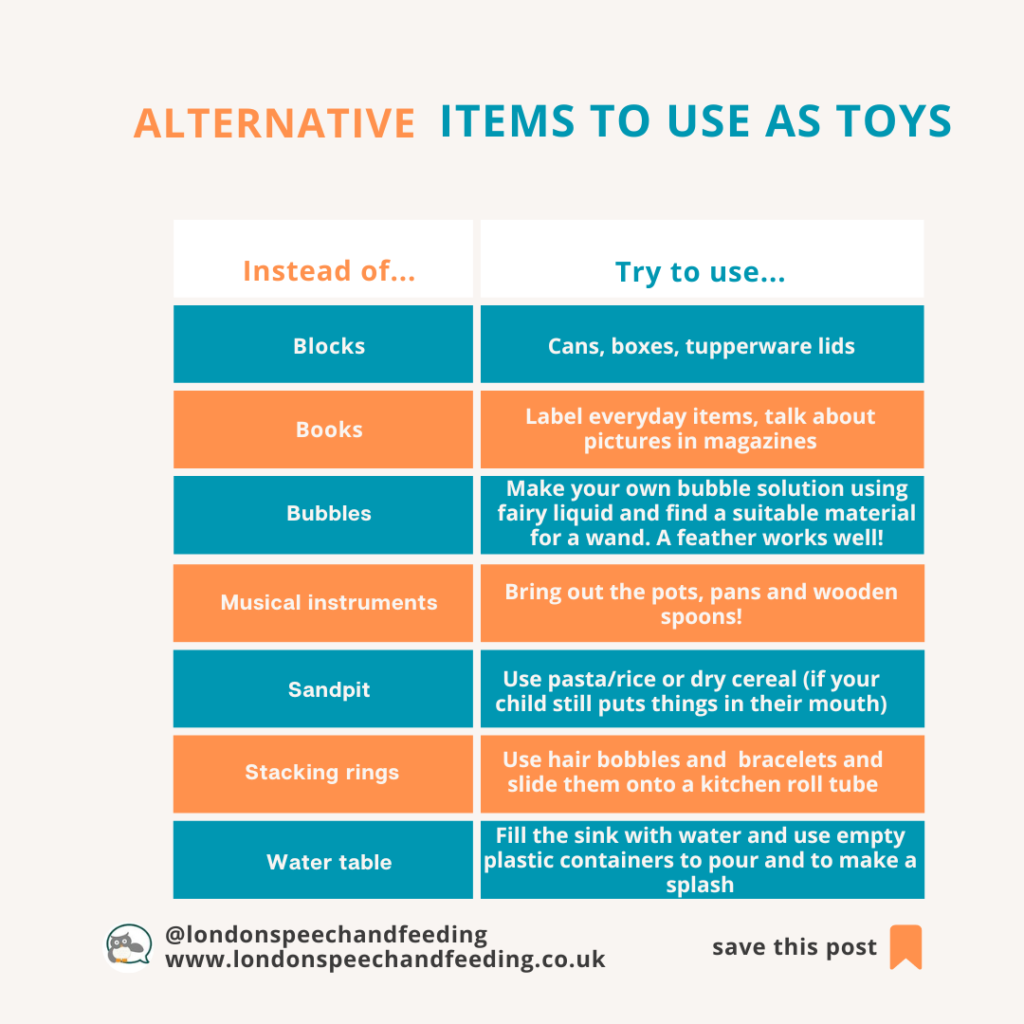
    On holiday you are unlikely to have your usual games and toys with you – so here is a nice little list of things you can use instead of traditional games and toys:

    If you can think of any other alternatives on holiday and would like to tell me about them, I would love to see your comments below. We can never have too many holiday games!!

    If you are at home over the summer and you do have some games in the cupboard you might want to dust these ones down or buy one or two new ones (if you want to).

    Most games have multiple uses, and it’s always best to adapt a game to match your child’s interests and what motivates them.

    So let’s start…

    1. Pop up pirate: pop a sword into the barrel and watch the pirate pop up randomly. Practise social skills, speech sounds, expressive language (e.g., put a sword on a picture, say the word/sentence then pick up the sword and push it into the barrel).
    2. Word games such as ‘ISpy’, ‘I went to the shop and I bought…’, ‘describe a person and guess who they are’: perfect for when you’re on the move, whether travelling or walking. You can play this anywhere and still support speech, language and communication. You could play ISpy using your child’s special sound, or ‘I went to the shop and bought all things beginning with [insert special sound here]’.
    3. Shopping list: Orchard game is a game to practise categorising. We explain the analogy of the brain being like a filing cabinet. If information is all in the correct place, it’s easier to find, retrieve and use. You can also practise specific speech sounds in this activity. You could also put the words in a sentence to add more of an expressive language element.
    4. Wiggly worms: this Orchard game is all about phonological (awareness of sounds) awareness. Matching a letter with the word. You can also practise the sounds in the words (e.g, g-o-l-d = gold; m-a-ke = make). Talk about the elements, e.g., ‘g-o-l-d’ has 4 sounds, 1 syllable; ‘m-a-ke has 3 sounds, one syllable. You can talk about what words rhyme with the different words and what makes a rhyming word (i.e., the middle and end sounds remain the same).
    5. Sound detectives: this Orchard game allows children to identify sounds. It also has an app (if your child prefers a tech-way of learning). Children identify the sound then they can add the picture card to their path and become closer to being a successful detective. This game can also support memory skills.
    6. Conversation cubes: throw the dice and start building a story. You can also create and use ‘colourful semantics’ sentence strips to support expressive (spoken) language as support to build the narrative.
    7. Think words: ‘name it, press it, pass it’. A great game to expand word knowledge. You can talk about the words at the end of each round exploring semantic (meanings) and phonemic (sounds) links. Your child can also develop social skills (such as attention, listening and turn-taking).
    8. Poo bingo: this is perfectly disgusting but equally fun for kids of about 3.5 years plus – if your child’s target is to practise /p/ sound this is the one for you. You can also learn all about the different animal’s poo, which I am sure you have always wanted to do!! The more we know about a word, the easier it is to store, retrieve and use. Yes, even talking about poo can help!! Also, it’s great for our visual learners.
    9. Simon says: a game that can be played indoors or outdoors. Parents can take turns being “Simon” and give various commands that your child must follow. This means that your child can practise their receptive (understanding of) language as well as their expressive language, speech sounds and social skills (such as turn-taking and initiating).
    10. Ker-plunk: this is perfect for practising your child’s special sound. Repetition is very important, but also can be monotonous, so finding a game that they enjoy is vital. Take turns to pull out a stick. Next, your child can either say their special sound or word (depending on what stage they are at) or hear a good model from other players.

    Do you still have questions? Contact Sonja for support.


    Find a speech and language therapist for your child in London. Are you concerned about your child’s speech, feeding or communication skills and don’t know where to turn? Please contact me and we can discuss how I can help you or visit my services page.

    0
  • · ·

    LAMP Words for Life: A revolutionary AAC system

    Introduction

    When working with non-speaking or minimally speaking children the LAMP Words for Life AAC (Augmentative and Alternative Communication) system is my absolute go-to every time. For me it stands out as a revolutionary system that has transformed the lives of many of my non-speaking students. LAMP Words for Life is a ROBUST, comprehensive language-based AAC system and it is designed to help any user to express their thoughts, feelings, and needs effectively, thereby achieving maximal independence in their daily life. A winner!

    There is a whole host of AAC apps and systems out there and each has their own advantages and benefits for sure. I have tried a good number of other systems. I do also like certain features of other AAC systems for sure. For example GRID: I love the versatility of GRID and the ease of editing the system is fantastic.

    Why I think it works so well

    However, strangely I always return to LAMP when push comes to shove. I have thought very carefully about it and so here are my thoughts on why this is and why it works so well:

    1. Intuitive interface: LAMP Words for Life features are for me really user-friendly and it is easy to navigate and understand (this is very important for non-techy people). I think it makes sense and it is accessible to users of all ages and abilities. Yes the pictures are a little bit different to other symbol systems we use, especially here in the UK to be sure, and this is one of the reasons why it is good to have a variety of systems available, so that we can cater for students who are used to other symbols or do very well with specific symbol core boards. I have learned though that the pictures are not that important when using LAMP because the entire system is based on MOTOR PLANNING. And once one knows the motor plan to find a picture it is in our brain and we do not look at the picture any more. So, the motor plan to find a word is much more important when using LAMP than worrying about what the picture looks like.
    2. Comprehensive vocabulary: The system offers a vast vocabulary of words and phrases, covering a wide range of topics and contexts. This enables users to express themselves effectively on a variety of subjects. That said, almost every time I use LAMP there is a little word I need and it’s not on there. But that’s not a problem: for example, I was looking for ‘sunglasses’ the other day. Sure, there is ‘sun’ and ‘glasses’ but that would be two separate motor plans and for my student that would be too many for now, so it was very easy to quickly add the new word ‘sunglasses’ under ‘accessories’ or ‘beach wear’ — I added it within less than one minute. Likewise, there are a ton of words which cater for the US market, and I tend to change them to fit the UK vocabulary like ‘nappy’ for ‘diaper’. Or I delete them entirely if I feel my child will never need to use a certain word like ‘conference’ or ‘nun’. PS: should they get to a point of using the system as an adult independently then these words can surely be added again, or if my student ever moves to the US then the words can be changed back to US terms again without any problem.
    3. Grammar support: LAMP provides built-in grammar support, helping users construct grammatically correct sentences. This can be particularly beneficial for individuals with language processing difficulties. But what I love about the way LAMP is organised here is that, in contrast with other systems I have used, it does not PREDICT what you want to say, it lets the user decide and find the right grammatical structure. I appreciate this because, just like I hate my phone or email offering predictive text or offer corrections to my words, I really do not get the systems that offer automatically a grammar change which mostly I don’t want. Where that is the case, I am often confused and hindered in finding the correct wording. I love the simplicity of LAMP and at the same the complexity that can be achieved gradually with practice. LAMP is fully designed to enable a user to build up not only vocabulary but a full language system. On a course recently I was able to hear adult LAMP users speaking to the audience in full and quick grammatically well-rounded sentences on a host of topics.
    4. Customisation: LAMP can be customised to meet the individual needs of each user. This includes options for adjusting the vocabulary, layout, and accessibility features. It is not as easy to edit as GRID I will say and that can cause me a little bit of frustration at times, but on balance I still vastly prefer the system as a whole. It can also be customised quite well for Gestalt Language Processors. It takes a little bit of practice and thinking about how best to do this but I have found a way that works well which I demonstrate in the short video clip.
    5. Community support: LAMP Words for Life has a thriving community of users on Facebook and this is so valuable and inspiring. Therapists and families of LAMP users alike share experiences, provide resources, and offer encouragement. This can be a valuable source of support for both users and their families.
    6. Comprehensive support: LAMP Words for Life offers quick and thorough support services, including training, resources, and ongoing assistance. This is invaluable and reassuring for both users and caregivers.
    7. Research-based: The development of LAMP Words for Life is based on extensive research and evidence-based practices. This ensures that the system is grounded in sound scientific principles.

    Conclusion

    To conclude LAMP Words for Life is a powerful AAC which provides us with a means of effective communication, language development, and social interaction. Whether you are a parent of a non-speaking child or a speech therapist looking for innovative AAC solutions, LAMP Words for Life is worth exploring.

    Example on how to use AAC at story time

    Feel free to contact me if you need help with your child.

    Sonja McGeachie

    Early Intervention Speech and Language Therapist

    Feeding and Dysphagia (Swallowing) Specialist The London Speech and Feeding Practice

    The London Speech and Feeding Practice


    Find a speech and language therapist for your child in London. Are you concerned about your child’s speech, feeding or communication skills and don’t know where to turn? Please contact me and we can discuss how I can help you or visit my services page.

    1
  • · ·

    Hard munchables: Chewing through the weaning journey

    As a Speech and Language Therapist with a specialism in paediatric feeding, I’m constantly looking for ways to support families in developing their little ones’ oral motor skills and fostering a positive relationship with food. While Baby-Led Weaning (BLW) has revolutionised how many families introduce solids, (see my previous blog in July 25) a concept that often sparks discussion and curiosity is the use of ‘hard munchables.’

    What are hard munchables?

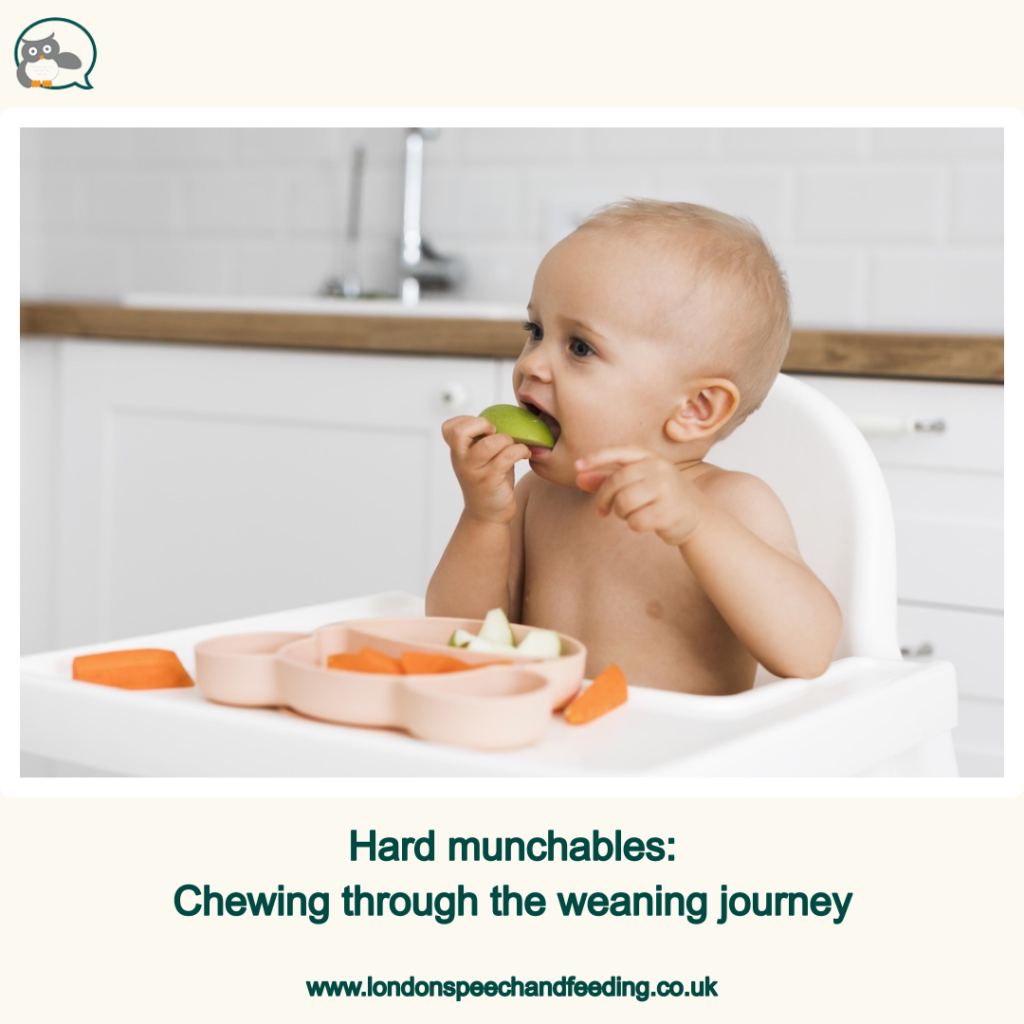
    The term ‘hard munchables’ refers to specific types of firm non-digestible food items that are offered to babies for oral exploration and skill development, not for nutrition. These are typically foods that babies cannot bite off or swallow in large pieces due to their texture, but which provide resistance for chewing practice.

    The phrase was coined by Marsha Dunn Klein, M.Ed., OTR/L, Occupational Therapist and feeding therapist. Well known for her work in paediatric feeding she introduced and advocated for the concept of hard munchables as part of a therapeutic feeding approach, particularly for infants learning to manage textures and develop crucial oral motor skills.

    Common examples of hard munchables include:

    • Large, raw carrot sticks: Too hard to bite through, but great for gnawing.
    • Celery sticks: Like carrots, offering firm resistance.
    • Large, raw apple slices (peeled chunks): A firm, slightly sweet option.
    • A firm, uncut pear core: With the seeds removed.
    • Dried mango cheeks (hard, unsweetened varieties): These offer a fibrous texture.
    • A large, fully cooked but firm piece of meat (like a steak bone with some meat attached): The meat provides flavour and a bit of shreddable texture, while the bone is for gnawing.
    • Hard crusts of bread or breadsticks (very firm, without soft inner crumb): These can soften slightly with saliva but offer significant resistance.
    Image by Freepik

    It’s crucial to emphasise that hard munchables are not for consumption or nutrition. They are tools for oral motor development and should always be offered under strict, active supervision.

    How do hard munchables fit into weaning?

    While weaning (traditional or Baby-Led Weaning) introduces solid foods that a baby can eventually bite and swallow, hard munchables are complementary to the weaning phase. They enhance that phase by helping a child to develop hand dexterity, hand to mouth movement, and oral development.

    It’s important to differentiate: Weaning provides the digestible food for eating, while hard munchables provide the tool for skill practice. They are not substitutes for each other but can be used together under careful guidance.

    Pros and cons from a speech therapy perspective

    As an SLT, I see both the potential benefits and the necessary precautions when incorporating hard munchables.

    Pros:

    • Enhanced oral motor development: Hard munchables provide excellent resistance training for the jaw, helping to develop the strength, endurance, and coordination needed for efficient chewing. This is foundational for moving beyond purées and very soft textures.
    • Promotes lateralisation of the tongue: The act of moving the hard item from side to side in the mouth encourages the tongue to move independently of the jaw, a crucial skill for managing food and for speech sound production.
    • Preparation for more complex textures: By strengthening the oral musculature and refining chewing patterns, hard munchables can help babies transition more smoothly to lumpy and mixed textures.
    • Sensory exploration: They offer rich sensory input (tactile, proprioceptive) that can be beneficial for oral mapping and awareness, especially for babies who might be orally sensitive.

    Cons:

    • Choking risk: While the intention is for the baby not to bite off pieces, there is always a risk. Small pieces can break off, or a baby might accidentally bite off a larger chunk than he or she can manage. Active, vigilant supervision is non-negotiable.
    • Not a replacement for digestible solids: It’s vital to remember that hard munchables are for practice, not nutrition. They should complement, not replace, the introduction of varied, digestible solid foods.
    • Not suitable for all babies: Babies with certain developmental delays, oral motor deficits, or medical conditions might not be appropriate candidates for hard munchables without highly specialised guidance. For instance, babies with an exaggerated gag reflex might find them overwhelming.

    Key Considerations for Parents

    Here are my top recommendations:

    1. Consult with a professional: Always discuss this with your Paediatric Feeding SLT first before you introduce hard munchables. We can assess your baby’s individual readiness and guide you on safe practices.
    2. Strict supervision: Never leave your baby unsupervised with a hard munchable, even for a second. Your full attention is required.
    3. Appropriate size: Ensure the item is large enough that the baby cannot fit the whole thing in their mouth. It should extend well beyond their fist.
    4. No biting off: The goal is gnawing and scraping, not biting off pieces. If your baby is consistently breaking off chunks, stop using them.
    5. Focus on skill, not consumption: Reiterate to yourself that this is for practice, not for eating.

    In conclusion, hard munchables, when used appropriately and under guidance, can be a very valuable tool to support oral motor development during the weaning journey. However, always be safe and consult with a specialist to ensure your little one develops his or her feeding skills effectively and joyfully.

    Sonja McGeachie

    Highly Specialist Speech and Language Therapist

    Owner of The London Speech and Feeding Practice.


    Health Professions Council registered
    Royal College of Speech & Language Therapists Member
    Member of ASLTIP

    Find a speech and language therapist for your child in London. Are you concerned about your child’s speech, feeding or communication skills and don’t know where to turn? Please contact me and we can discuss how I can help you or visit my services page.


    References:

    Rapley, G., & Murkett, T. (2008). Baby-Led Weaning: The Essential Guide to Introducing Solid Foods. Vermilion.

    Morris, S. E., & Klein, M. D. (2000). Pre-feeding skills: A comprehensive resource for feeding development. Pro-Ed.

    1
  • · ·

    My child won’t eat! What can we do to help?

    Image by freepik

    I get lots of enquiries about this topic, parents up and down the country struggle to feed their children. Mealtimes with toddlers can sometimes feel like a war zone!

    Reasons

    The reasons for food refusal are many and very varied. Perhaps your child was born prematurely and had lots of tubes and things sticking to his or her face? Or maybe your child had gastro-oesophageal reflux and this caused pain every time he or she swallowed. Some children have motor problems so it was hard to coordinate swallowing with breathing and caused frustration and anxiety? Many children have sensory integration difficulties and these make it difficult for them to grasp all the different textures and colours they are eating.

    When I take a case history for a new feeding client, I always try to first establish how the child learned not to feed/eat. I use the word ‘learned’ here with intent as eating is a learned behaviour. We tend to think that it must just be instinctive and natural but this is not the case. Instinct is a small part of the very beginning of feeding, in that a baby naturally roots for the breast but this only works out well and leads to more natural ‘instinctive’ feeding if that initial instinct is not interrupted or impacted on negatively by any of the above reasons.

    So just as a baby learns to eat or drink the milk it can also learn not to do so. The baby can learn to avoid eating in order to bypass discomfort, or — and this is another important factor — in order to gain more positive attention from the caregiver!

    Research shows that we learn about food in two ways:

    1. A connection is made between a food and a physical reaction. This needs to happen only once and it can stick: think about feeling sick after a binge on a certain food/drink… You won’t want to go near that very food again for some time, if ever! If a certain food causes pain then that connection can be made quickly and we won’t want to touch this food again.
    2.  We learn through reinforcement and punishment:
    1. Reinforcement:
    • If we get praised for eating our plate with a pudding, then we tend to eat more to get the pudding.
    • Equally if granny sits with us for hours at the table reading us a story because we do not eat or don’t eat much/quickly, we will continue this because we want granny to keep reading for us.
    1. Punishment can work in two ways:
    • Child gets punished for not eating and will eat more to avoid punishment.
    • Child eats less as the fear of punishment is so unpleasant and leads to total lack of appetite.

    As speech therapists we do not endorse any of those above strategies because none of them give us the desired effect.

    What do we want to achieve? We want our children to eat naturally, with enjoyment. We don’t want them to over eat, to binge eat, or to starve themselves. Eating needs to become a joyful, natural and organic behaviour if our child is to be healthy and thrive.

    Recommendations

    Here are three top recommendations I make regularly with good effect:

    1. Structure: have a routine at mealtimes, eating at the table, in the same room with our favourite utensils. Always helping in food preparation, perhaps setting out the table placemats etc, and then tidying up — taking the plate to the kitchen counter, scraping left overs into the recycle bin can be part of this. This way we can introduce repetition to our food/eating learning.
    • Positioning: the right chair with a good footrest, supporting our child’s trunk well, and facilitating our child eating at the table (instead of sitting in a high chair with a tray) is one of my first and favourite tips. I do favour a Tripp Trapp style chair (I have no association with that company).

    Tube fed children ought to also sit at the table with the rest of the family and first of all be offered foods and drinks to handle or play with. Some tube fed children are able to eat a small amount of pureed foods and they ought to be offered this first before being topped up with their tube feeds, whilst sitting down. Lying down for your tube feed is not a normal way of eating. Tube feed infants should be offered a pacifier whilst being tube fed and be in an upright position so that they start having an association between getting full/feeling satiated and their mouth.

    • Sociability: I encourage family mealtimes, or at least the caregiver eating with their child together, so that the child is able to copy and observe what normal eating looks like. We need to be super positive about eating and food consumption so that our child can see and copy this. If the parent is a fussy eater then this may cause the child to copy exactly the same behaviour. Many parents who come to me with their fussy children are themselves also picky about food.

    There are many other tips and strategies and I will be more than pleased to assist, please contact me.

    Sonja McGeachie

    Early Intervention Speech and Language Therapist

    Feeding and Dysphagia (Swallowing) Specialist The London Speech and Feeding Practice

    The London Speech and Feeding Practice


    Find a speech and language therapist for your child in London. Are you concerned about your child’s speech, feeding or communication skills and don’t know where to turn? Please contact me and we can discuss how I can help you or visit my services page.
    1