Why Imitation is so Important

|
Target Activities and Games For Kids

Why imitation is so important and how can speech and language therapy help children who struggle to imitate?

Imitation or copying starts in early infancy. When we observe a young baby and his parent or familiar adult we can see clearly and frequently that the baby will be intently looking at adult’s face and try to copy their facial expressions, smiles and all those funny baby sounds we often make with young babies.

These sounds are called “motherese” and are the beginnings of a little conversation between the parent and the baby. The “conversation can go back and forth for a long time and include sounds, as well as facial expressions.

A little later on, once the baby can crawl and sit up unaided the copying then goes on to include toys and objects. Mum or Dad will show their toddler how to use a drum or how to put a little train on the wooden tracks and the toddler will try and copy this. They may not succeed and be a little clumsy perhaps but the act of copying anything and everything their favourite adult does is typically seen throughout the day.

We all know and have laughed at mums or dads saying; ssshhh don’t say that in front of the baby he/she will copy you, watch your mouth! (as dad is swearing at the broken radiator….)

This imitation goes on for years and includes eventually of course little words, more words, putting words together and then creating sentences, all the while our toddler is listening to how their adults speak, not only what they say but how they say it. This is how dialects and accents can be transmitted easily from parent /family to child.

Copying in Children with Autism

We know that children with autism often struggle to imitate. We see children on the spectrum typically having great difficulty to copy adults or children; this can be seen in very reduced play with their peers in nursery for example.

Children with autism tend to have reduced joint attention and engagement with others and need to develop the ability and awareness to copy others in order to then engage more jointly with others.

Speech and Language Therapy can help with Parent Child Interaction work and Coaching, here is how:

During my coaching work with parents I teach step by step how to help a child who struggles to imitate:

We look at all the researched skills and actions that adults can take to help their little one to copy, starting with close observation of their child’s interests, then following and including their child’s play and copying/imitating their child in how they play. I teach steps in a graduated way so that it is easy to see the progress and joyful to have the results at the end.

The results are clear to see over time: our children on the spectrum learn to imitate actions, with objects and gestures, then sounds and words. Alongside this increased imitation skill the child can then develop more joint attention and engagement.

I would always recommend Parent Child Interaction Training as a first port of call as we learn so many great techniques which are well researched by the Hanen Programme, www.hanen.org. Do drop me a line if you would like to find out more.


Find a speech and language therapist for your child in London. Are you concerned about your child’s speech, feeding or communication skills and don’t know where to turn? Please contact me and we can discuss how I can help you or visit my services page.

Similar Posts

  • · ·

    Speech prompts and strategies I use in Speech Sound Therapy

    This particular student has a mild motor planning difficulty and six weeks ago he came to me with a very strong lisp. In addition to the lisp he is struggling to produce a number of sounds, SH and L on its own and all the clusters (FL/BL/KL/PL) but also CH together with some vowel difficulties.

    The prompts are a mix partially from the DTTC (Dynamic Temporal and Tactile Cueing) model by Dr Edythe Strand as well as phonological models I have learned over the years, and some of them are my own.

    Visual/picture prompts and Images

    Here I use the ‘Flat Tyre’ Sound, to offer as an image for a new S sound and the ‘Tick Tock’ Sound for a new image of the T sound. Both cards are from the Bjorem Speech Sound Deck, which I love and use almost daily.

    Gestural Cues

    I like to use all the ‘cued articulation’ hand cues by Jane Passy for consonants and fricatives. Here we use our fingers and hand to illustrate what our tongue does, and we also show whether a sound is voiced or voiceless. When I use one finger it is voiceless (k/f/s/p) and when I use two fingers for the same cue it means that the voice needs to be turned on: (g/v/z/b/n/m). For vowels I like to use Pam Marshalla’s cue system.

    Simultaneous production

    We say the word together.

    Direct imitation

    I say the word and my student copies me directly.

    Imitation after a delay

    I say the word and then after a little wait my student says the word.

    Spontaneous production

    My student has now learned to say the word by him/herself.

    Offering feedback

    It sounds like… I just heard… I didn’t hear the first sound there? Can you try again?

    Letting the student reflect

    By just shaking my head or by looking quizzical so that my student realises something didn’t quite go right.

    Postitive reinforcement

    ‘Yes that was it, do it again, nice one…’

    Cognitive reframing

    This is a technique where we identify different semantic cues and metaphors or imagery cues, so instead of teaching or focusing on a sound we try out viewing each syllable from a different point of view.

    For example: ‘yellow’. I have had great success with this one: we start with just saying ‘yeah yeah yeah’. I might make a little joke and say something like ‘imagine your mum says tidy your bedroom, what do you say or what do you think?’ Answer: ‘yeah yeah yeah’. Then we practice ‘low’ together, I might blow some bubbles high and low and we talk about ‘low’. And then we put ‘Yeah’ and ‘Low’ together and now we have YELLOW!! It might at first still sound a bit odd, like ‘yea-low’ but we soon shape that up and have the real word.

    Each student is different and having a great rapport is crucial to our success.

    Then a little game break after some 7–10 or so repetitions and always trying to finish on a positive note.

    What game breaks do I use:

    Very quick ones! Students can post something, place a counter in a game, take out a Jenga block from the tower, pop in a counter for ‘connect 4’, stick a sword into the Pop the Pirate barrel or add a couple of Lego blocks to something they are building.

    I hope this is helpful, please contact me for any questions.

    Sonja McGeachie

    Early Intervention Speech and Language Therapist

    Feeding and Dysphagia (Swallowing) Specialist The London Speech and Feeding Practice

    The London Speech and Feeding Practice


    Find a speech and language therapist for your child in London. Are you concerned about your child’s speech, feeding or communication skills and don’t know where to turn? Please contact me and we can discuss how I can help you or visit my services page.

    1
  • ·

    How can I incorporate AAC into my speech therapy sessions?

    Many parents are surprised when I bring AAC into a session, especially if they’ve come to see me primarily for speech sound work.

    They might wonder: ‘If we’re working on pronunciation, why are we using a communication device?’

    The simple answer is this: speech therapy is about communication first, and speech sounds second. Supporting a child’s ability to express themselves clearly and confidently is always the priority, and AAC can be a powerful tool alongside spoken speech.

    What do we mean by AAC?

    AAC stands for Augmentative and Alternative Communication.

    This can include:

    • A speech-generating device (such as LAMP Words for Life or GRID as I used in the photo below)
    • A communication app on a tablet
    • A symbol board or communication book
    • Gestures, signs, or visual supports

    AAC does not replace speech. Instead, it supports language development, reduces frustration, and builds communication success while speech skills are developing.

    Pretend Play using Speech and AAC in my clinic room

    But I mainly work on speech sounds… So how does AAC fit?

    Most of the children I see are working on:

    • Articulation difficulties
    • Phonological delay
    • Motor planning challenges (including apraxia/dyspraxia)
    • Unclear speech affecting confidence

    For these children, AAC isn’t a separate therapy. It’s simply woven naturally into what we are already doing.

    If a child brings their device to sessions, I actively include it. If they don’t yet use AAC but could benefit from visual or symbolic support, I may introduce simple options within activities.

    Using AAC to support speech practice

    Let’s say we are working on early speech targets like: ‘GO’.

    We might practise:

    • Saying the word verbally
    • Listening for the target sound
    • Using play (TOY TRAIN GOING ROUND A TRACK)

    Now we can extend this using AAC.

    On the device or communication board, we might model: ‘LET’S GO’ or ‘IT’s GOING up the hill’.

    This allows the child to:

    • Practise their speech sound target
    • Build a simple sentence
    • Experience successful communication even if speech is not fully clear yet

    All responses are valid and supported.

    AAC helps children communicate more than they can say

    Many children can understand and think in longer phrases than they can physically say.

    For example:

    • A child who verbally says single words may build longer phrases on AAC.
    • A child who struggles to plan speech movements may use AAC to communicate smoothly while still practising verbal attempts.
    • A child who becomes frustrated when misunderstood gains a reliable backup system.

    Rather than slowing speech progress, AAC often:

    • Reduces communication pressure
    • Increases participation in therapy
    • Encourages more attempts at speech
    • Supports language growth

    When children feel understood, they usually become more motivated to try speaking.

    There are no ‘prerequisites’ for AAC

    One of the biggest myths I hear is: ‘My child isn’t ready for AAC yet.’

    In reality, children do not need to:

    • Reach a certain speech level
    • Use pictures first
    • Prove they understand everything
    • Show immediate interest

    Instead, we presume competence and introduce AAC in meaningful, playful ways.

    That means:

    • Modelling words while blowing bubbles
    • Commenting during playdough activities
    • Choosing words during games
    • Building simple phrases in shared reading

    AAC should never feel like extra ‘work’. It’s simply another way to join in communication.

    My goal is always the same: to help each child communicate as clearly, confidently, and successfully as possible, using every helpful tool available.

    If your child uses AAC (or might benefit from it)

     Please feel free to:

    • Bring the device to sessions
    • Show me how your child currently uses it
    • Share advice from school or other therapists

    I am very happy to incorporate AAC into our work together so that speech practice, language development, and real communication all move forward hand-in-hand. Because ultimately, therapy isn’t just about producing perfect sounds. It’s about helping your child be heard and understood.

    If you’d like support or advice, please contact me and I can help guide the next steps.

    Sonja McGeachie

    Highly Specialist Speech and Language Therapist

    Owner of The London Speech and Feeding Practice.


      Health Professions Council registered
      Royal College of Speech & Language Therapists Member
      Member of ASLTIP

      Find a speech and language therapist for your child in London. Are you concerned about your child’s speech, feeding or communication skills and don’t know where to turn? Please contact me and we can discuss how I can help you or visit my services page.

      3
    • ·

      How to use Attention Autism to develop language and communication

      Now you’ve read Attention Autism (part one), you are familiar with the concept of ‘bucket time’ and the benefits it has to offer your child. It’s time to explore all the different stages. In sessions, it can be noisy and with so much to take in, you may want something to refer to. If you’re in need of a helping hand or memory jogger for stage two, read on…

      Knowing what stage your child is working at is vital. Every stage has different aims to develop and enhance functional communication. So being familiar with your child’s goals ensures you can continue to practise at home. If you’re unsure of their goals, please ask your Speech and Language Therapist.

      With all speech, language and communication goals, the aim is always to generalise skills from therapy settings to home and nursery or school life. This generalisation period will take time. Please try to stick with the plan. You will experience the benefits for your child, and it’ll make family life a little easier.

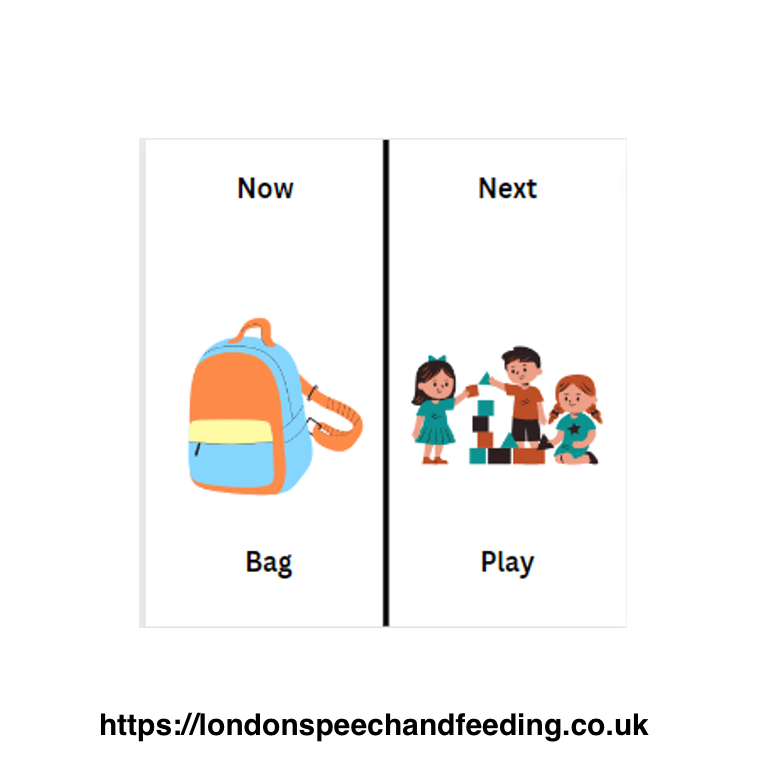
      You may remember that Autistic children thrive on visuals. Let’s use their strengths to support their communication needs. It is a good idea at the start of the activity to have a visual for what’s happening now and what will happen next. If you’re anything like me, you’ll grab a pen and paper or a whiteboard and whiteboard pen, and will doodle away! You don’t need fancy photos.

      On the left is a bag with Now written above it and Bag below. On the right are three children playing with Net written above and Play written below.

      The attention builder

      Stage two of the Attention Autism approach is called “the attention builder”. The clue is in the name, your child’s goal is to keep focused on the activity for a longer period. The duration will be different for every child, but it’s useful to time their attention, so you can report progress back to your therapist.

      Parents are often worried about doing something wrong. If it all goes a bit pear-shaped or not as you expected, don’t panic! This is the time to ask yourself, did my child have fun? Did they engage in the activity? It’s very helpful to reflect on the experience. What could you do that would make the activity easier for your child to access? (For example, did you set up the activity before your child entered the room? This would allow for a smoother session, so that waiting time was minimal.)

      Three ideas for stage two activities

      There are so many ideas out there, which at times can feel overwhelming. I’m always looking for the easiest options to present to you to reduce overwhelm and allow it to feel manageable.

      Remember this is about having fun. Your child’s communication will benefit from you relaxing and having this structured approach.

      Here are our three top ideas for stage two attention Autism activities:

      1. Flour castles

      You’ll need:

      • Container, cup or glass
      • Flour
      • Sheet (for the table/floor) (optional)

      This is a fun-filled activity to try. But it can get a little messy!

      Fill a small glass, cup or container with flour and flip the cup over to build flour castles. It’s great to engage your child especially with the “Splat” at the end.

      2. Paint balls

      Another activity which is a little bit cleaner is ‘Paint balls’.

      You’ll need:

      • Tray, container
      • Paint
      • Rubber balls or marbles
      • Paper (optional)

      First dip the marbles into the paint, then drop into the container and roll it around to make a pattern. You could always make a pattern on some paper.

      I love to use everyday objects in therapy, so when I came across this next idea, it was added to the list. It’s simple, effective, not to mention clean!

      3. Skittles

      You’ll need:

      • A packet of skittles
      • Warm water
      • Plate

      You’ll need to create a circle of skittles around the edge of the plate. Then add small amounts of warm water to the plate and watch the rainbow of colours appear.

      These activities offer a sequence to build and sustain your child’s attention. Remember the key is to have fun. Create meaningful interactions that your child cannot miss! If they can learn to hold their attention, they can learn to use functional skills.

      Now you’ve got ideas for stage two activities. Go ahead and carry them out.

      Have fun!

      If you need speech, language or communication support or advice, I am always here to help.


      Find a speech and language therapist for your child in London. Are you concerned about your child’s speech, feeding or communication skills and don’t know where to turn? Please contact me and we can discuss how I can help you or visit my services page.

      0
    • The tricky /R/: Mastering tongue placement for clear speech

      The /R/ sound is notoriously challenging for many children (and even some adults!). It’s one of the most complex sounds in the English language, with various pronunciations depending on its position in a word. If your child is struggling with their /R/s, you’re not alone. As Speech and Language Therapists (SLTs), we frequently work on this sound, and a key component of our therapy is focusing on proper tongue placement.

      Why is the /R/ so difficult?

      The /R/ sound requires precise coordination of the tongue, jaw, and lips. Unlike sounds like /P/ or /B/ that involve simple lip movements, the /R/ involves intricate tongue movements and tension. There are also different ways to produce the /R/ sound, which adds to the complexity:

      • Retroflex /R/: The tongue tip curls up and back towards the roof of the mouth.
      • Bunched /R/: The body of the tongue bunches up towards the roof of the mouth, while the tongue tip remains down.

      The importance of tongue placement

      Regardless of which /R/ variation is being targeted, accurate tongue placement is crucial. Even a slight deviation can result in a distorted or inaccurate sound. That’s why SLTs dedicate significant time to teaching and practising tongue positioning.

      Speech therapy techniques: Focusing on the tongue

      Here’s a glimpse into how I address /R/ sound difficulties, with a focus on tongue placement:

      • Visual aids:
        • Mirrors: I use a mirror to help children see their tongue movements and make adjustments.
        • Tongue diagrams and models: These visual tools provide a clear representation of where the tongue should be positioned.
      • Tactile cues:
        • Tongue depressors: These can be used to gently guide the tongue into the correct position.
        • Food-grade tools: Sometimes, I use flavoured tongue depressors or other tools to provide tactile feedback and increase awareness of tongue placement.
      • Auditory discrimination:
        • I help children distinguish between correct and incorrect /R/ sounds.
        • I use auditory cues and verbal feedback to reinforce proper pronunciation.
      • Exercises and drills:
        • Tongue strengthening exercises: Strengthening the tongue muscles can improve control and coordination.
        • Tongue placement drills: We practise positioning the tongue in the desired location and holding it there.
        • Sound approximation techniques: Sometimes we use other sounds to help approximate the /R/ sound. For example, I use the /L/ sound, to help achieve the correct tongue placement. Once my child has found the /L/ sound it is then a matter of pulling back just slightly to get a good /R/.
      • Contextual practice:
        • Once the child can produce the /R/ sound in isolation, we gradually introduce it into syllables, words, phrases, and sentences.
        • We also practise the /R/ sound in different contexts, such as at the beginning, middle, and end of words.

      Tips for Parents:

      • Be patient and supportive: Learning the /R/ sound takes time and practice.
      • Practise regularly: Short, frequent practice sessions are more effective than long, infrequent ones.
      • Make it fun! Use games, stories, and other engaging activities to keep your child motivated.
      • Work with an SLT: A qualified SLT can provide personalised guidance and support.

      In conclusion:

      The /R/ sound can be challenging, but with targeted speech therapy and a focus on tongue placement, most children can achieve clear and accurate pronunciation.

      I hope this blog post is helpful!

      Get in touch with me via my contact form if you need support

      Sonja McGeachie

      Early Intervention Speech and Language Therapist

      Feeding and Dysphagia (Swallowing) Specialist The London Speech and Feeding Practice

      The London Speech and Feeding Practice


      Find a speech and language therapist for your child in London. Are you concerned about your child’s speech, feeding or communication skills and don’t know where to turn? Please contact me and we can discuss how I can help you or visit my services page.

      1
    • · ·

      Using AAC in daily life

      Communication is a fundamental human right, a bridge that connects us to the world and each other. For many, spoken language is the primary mode, but for individuals with complex communication needs, Augmentative and Alternative Communication (AAC) offers a powerful pathway to expression and connection. This guide will demystify AAC, highlight the crucial role of modelling, and provide practical examples of how low-tech AAC can be seamlessly integrated into everyday activities.

      What is AAC in a nutshell?

      AAC encompasses a wide range of tools and strategies that supplement or replace spoken language. It’s not about replacing speech, but rather about providing additional ways for individuals to communicate effectively. Think of it as a spectrum:

      • Unaided AAC: This involves using only your body, such as gestures, facial expressions, body language, and sign language.
      • Aided AAC: This involves external tools or devices. These can range from low-tech options like picture boards and communication books to high-tech speech-generating devices (SGDs) and apps on tablets.

      The beauty of AAC lies in its flexibility and personalisation. It empowers individuals to express their wants, needs, thoughts, and feelings, fostering independence and participation in all aspects of life.

      Modelling is KEY: Showing, not just telling

      Imagine trying to learn a new language without ever hearing it spoken. It would be incredibly difficult, right? The same principle applies to AAC. Modelling is the single most important strategy for teaching and supporting AAC users. It means actively using the AAC system yourself while talking, demonstrating how to navigate the system and express messages.

      Here’s why modelling is so vital:

      • It’s how we learn language: Typically developing children learn language by hearing it constantly around them. AAC users need the same immersion.
      • It reduces pressure: When you model, you’re not asking the individual to communicate, you’re just showing them how it’s done. This takes the pressure off and makes learning more enjoyable.
      • It expands vocabulary and concepts: By modelling a variety of words and phrases, you introduce new vocabulary and demonstrate how to combine symbols to create more complex messages.
      • It demonstrates purpose: Modelling shows that AAC is a functional and effective way to communicate, not just a set of pictures.

      So, how do you model? It’s simple: point to the symbols on the communication board or device as you speak the words. For example, if you say, ‘Time to eat breakfast,’ you might point to ‘time’, ‘eat’, and ‘breakfast’ on the board.

      Low-tech AAC in action: Everyday activities

      Low-tech AAC, such as communication boards, books, or single-page displays, is incredibly versatile and can be easily incorporated into daily routines. These can be as simple as printed pages with symbols, laminated for durability.

      Let’s explore how low-tech AAC can be used throughout a typical day, with examples of symbols:

      1. Getting ready for nursery

      Mornings can be busy, but they also offer rich communication opportunities. A ‘Getting Ready’ communication board can help sequence activities and offer choices.

      Activity example:

      ‘Time to get up!’ (point to GET UP). ‘What do you want to wear today, the blue shirt or the red shirt?’ (point to GET DRESSED) ‘Then, we brush teeth’ (point to TOOTHBRUSH) and so on.

      AAC mornings symbol examples

      2. Breakfast Time

      Mealtimes are perfect for making choices, expressing preferences, and commenting. A ‘Breakfast’ communication board can focus on food items, actions, and social comments.

      Example symbols:

      AAC meal times symbol examples

      Activity example:

      ‘What do you want to eat for breakfast?’ (point to EAT). ‘Do you want cereal or toast?’ (point to CEREAL or TOAST). If they finish their milk, you could say, ‘Are you ALL DONE or do you want MORE MILK?’ (point to symbols).

      3. Catching the Bus

      Even routine transitions like catching the bus can be communication rich. A small, portable ‘Travel’ board can be useful.

      Example symbols:

      AAC catching the bus symbol examples

      3. Being on the playground

      The playground is a dynamic environment perfect for commenting, requesting actions, and engaging in social play.

      AAC playground symbol examples

      Activity example:

      ‘Let’s PLAY!’ (point to PLAY). ‘Do you want to go on the SWING or the SLIDE?’ (point to symbols). If they are on the swing, you can say, ‘Do you want to go FAST or SLOW?’ (point to symbols) and ‘Push AGAIN!’ (point to PUSH) You can also model social language like ‘It’s MY TURN.’

      Beyond the symbols: Key takeaways

      • Consistency is key: Use AAC consistently across all environments and with all communication partners.
      • Be patient: Learning a new language takes time. Celebrate small successes.
      • Make it fun: Integrate AAC into play and enjoyable activities.
      • Follow the individual’s lead: Respond to all communication attempts, even if they are imperfect.

      In the video below I model how to integrate AAC into everyday activities with a few more examples and I discuss the difference between AAC and PECS.

      If you need some inspiration with using AAC or would like your child assessed for the right type of AAC then please get in touch.

      Sonja McGeachie

      Highly Specialist Speech and Language Therapist

      Owner of The London Speech and Feeding Practice.


      Health Professions Council registered
      Royal College of Speech & Language Therapists Member
      Member of ASLTIP

      Find a speech and language therapist for your child in London. Are you concerned about your child’s speech, feeding or communication skills and don’t know where to turn? Please contact me and we can discuss how I can help you or visit my services page.
      1
    • What is FRONTING?

      Kids Speech Therapist London

      Does your child say “Dough” instead of “Go”? Or “Tea” instead of “Key”? Do you hear a /Sh/ instead of an /S/ does “see” sound more like “she”?

      We Speechies call this a Fronting Pattern which means that a sound that should be produced at the back of the throat with the back of the tongue, like K or G , is said at the front of the mouth with the tip of the tongue, like a T or a D or SH. When this happens speech can be really hard to make out because these sounds are literally everywhere in everyday sentences. Just think how many K’s and G’s we hear in a simple sentence?

      For example, I heard my little student say earlier today: “I know what game we can play in your garden? It’s the one with cones and rings and cushions! I know where it is I can get it.”

      But it sounded like:

      “I know what DAME we DAN play in the DARDEN! It’s the one with TONES and rings and TUSHIONS! I know where it is I TAN DED it.”

      If that sounds familiar to you, here is a little overview of what we can do about it:

      First up it’s always good to start with general speech sounds awareness: does a child hear syllables and intonation? Do they know words that rhyme? Can they follow or copy a simple beat with a drum? Can they listen and hear quiet sounds and loud sounds and can they copy those? Can they follow mouth and tongue movements:, for example : stick out your tongue, lick your lips, click your tongue, blow raspberries?

      Then it really helps to talk about BACK and FRONT of things and to draw attention to the back of the mouth and the back of the tongue and the front tip of the tongue and how sounds are made in the mouth. I often use a puppet to show this or a model of a mouth like this one here in the picture.

      Next we try and listen to words starting with a BACK sounds like a K or a G , and I read out a list of words with those sounds: COW, CORE, CAT, CONE, KEY etc or ARK, EEK, OAK, ACHE…

      Or GOO GUY GUM GONE

      After that we try and see if a student can actually produce a single sound like a K or a G just by itself. If they can, that’s a really great start and if they can’t I help them to produce one – over a few sessions we usually get there. We call this Sound production in isolation.

      Once a child can produce a sound correctly, on its own, we try and start working on very simple words that are really powerful like “GO”!!!!! in a motivating game or “CAR” for little ones who love a car racing track.

      Now that we have established the back sounds and are using it in short words, we can gradually re-train brain pathways and oral- motor/movement pathways to use these new sounds in many words and then short phrases. That can take time!! This is called generalisation and it is not uncommon for it to take up a whole year for fluent speech to be error-free .

      Why does it take so long? Being able to produce a correct and clear K or G sound does not mean it will be used easily. Our brain pathways are fixated or habituated to the error sound. It takes time for habits to change. A child might be able to hear the word TIGER with a G in the middle and she knows that it is not a TIDER but when saying it her tongue automatically moves forward rather than lifts up at the back. It’s a bit like a person who has a rounded back: the brain knows to stand upright and how not to slouch, but when we don’t focus on it, ooops we have slouched again because that is what we are comfortable doing and our body moves with our habit.

      It takes effort and motivation to change our movement patterns and that includes our tongue and lip patterns! We usually get there through a huge variety of games and practice. Lots and lots of repetition is key as is motivation to change.

      Parents and carers are crucial in the success of Speech Therapy!

      We need your feedback at home, the regular short and sweet exercises, the constant positive encouragement and great modelling of speech sounds. We often find that parents are tuned into their child’s error sounds and can understand them much better than anyone else. This is great of course in many ways, however, it also means that the child has less motivation to change: if mummy understands me then my world is ok.

      I will give you a short outline of what different speech therapy models I use in my practice, be it in clinic face to face or on-line in my future blogs soon.


      Find a speech and language therapist for your child in London. Are you concerned about your child’s speech, feeding or communication skills and don’t know where to turn? Please contact me and we can discuss how I can help you or visit my services page.

    Leave a Reply

    Your email address will not be published. Required fields are marked *