Five ways to increase confidence and reduce frustration in children with speech and language and communication difficulties
|
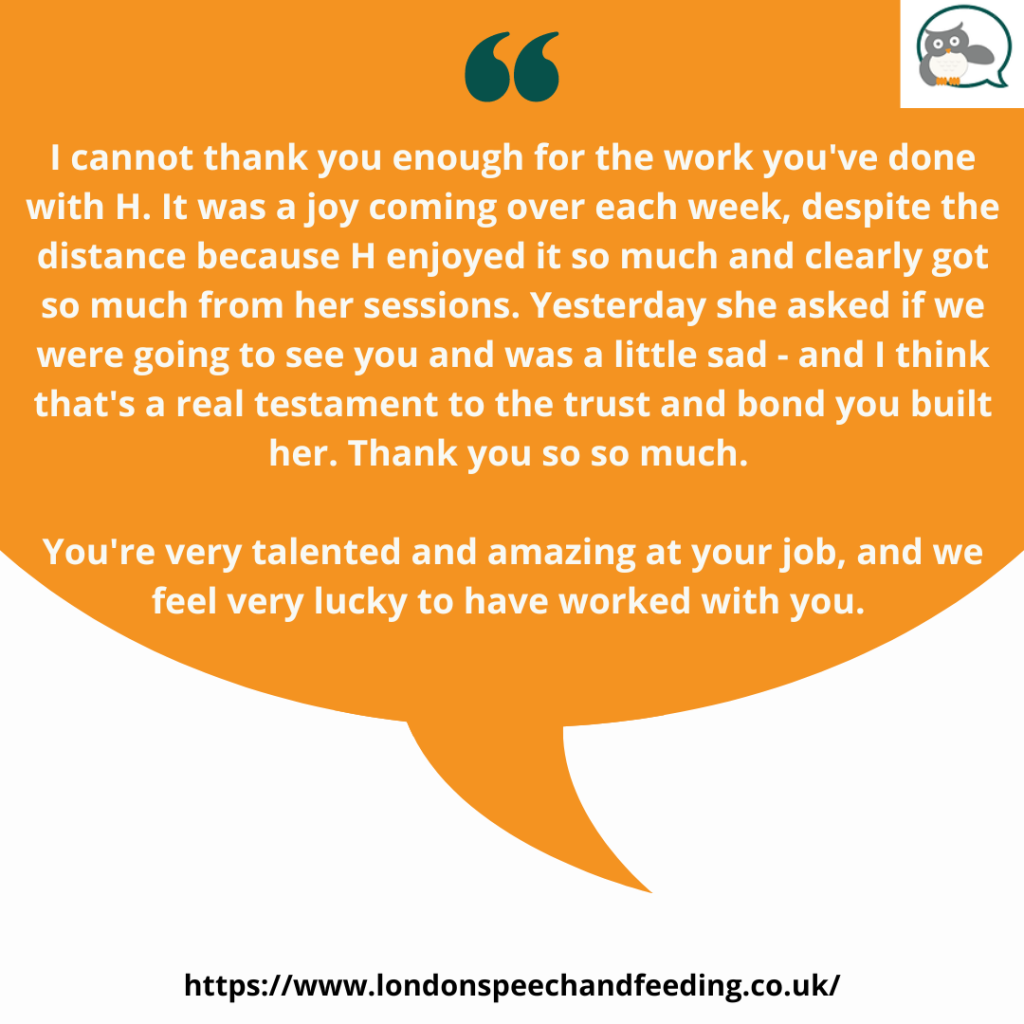
An orange speech bubble with a testimonial

Your child’s speech, language and communication difficulties may impact their self-esteem. And they may show signs of increased frustration. You want them to be full of confidence, increasing their participation in school and fully engaging with their peers.

1. Practise active listening

Speech difficulties can mean that it’s more challenging to understand what your child says. It’s important to show that you’re paying attention, giving them time to express themselves. Focus on what your child says rather than how they are speaking. Remember to maintain eye contact, and actively listen. Active listening and giving time can be trickier than it sounds. I can provide strategies to support your active listening skills.

2. Give other means and forms of communication

Allowing children to express themselves in a variety of ways (e.g., gesture, signs, written, use descriptions to describe a word (e.g., sand – you find it out the beach, it can have pebbles on it, it’s not the sea), use of symbols or high-tech augmentative communication methods such as a computer). Using different ways is vital in reducing frustration and communicating their message. If you’re unsure of what other forms of communication you can use, please contact me for some top tips.

3. Praise efforts

Providing specific praise allows your child to understand what they’ve achieved. E.g., you could praise the way your child listens, or how they take turns, or their resilience (e.g., “I like the way you listened” or “good listening”). Think of different ways you could praise you child during different activities, so you are prepared with phrases that you can use.

4. Have clear start and end points in activities

Some children with speech, language and communication needs have difficulties with transitioning from one activity to another. They also have difficulties with changes in routine. This can add to their frustration and changes in behaviour. So, how do you show a clear start and end to an activity? You can have a visual timetable, or you could have ‘start’ and ‘finish’ boxes where you place all the materials in the box labelled ‘start’. And once the activity has finished, you put the items in the box labelled ’finished’. If you need support with transitions, please contact me.

5. Use visuals

Visuals can support your child to understand routine and spoken language. Visuals can range from symbols to online images, to photographs, or a combination. Explore which type of visuals work well for your children. Using visuals can be powerful if used correctly. Make the most of the opportunities that visuals can provide for your family.

Increase confidence and reduce frustration in children with speech and language and communication difficulties today. Please feel free to contact me if you need any support or tips on maximising these opportunities.


Find a speech and language therapist for your child in London. Are you concerned about your child’s speech, feeding or communication skills and don’t know where to turn? Please contact me and we can discuss how I can help you or visit my services page.
1

Similar Posts

  • ·

    Understanding Angelman Syndrome: A guide for parents

    Angelman Syndrome (AS) is a complex neurological disorder that affects development. It’s caused by a missing or functionally incorrect gene (UBE3A) on chromosome 15. While AS is rare, understanding its characteristics is crucial for parents and caregivers.

    What are the key characteristics of Angelman Syndrome?

    Children with AS typically exhibit a range of unique characteristics, which can include:

    • Developmental delay: Significant delays in reaching developmental milestones, such as sitting, crawling, and walking.
    • Speech impairment: Limited or absent speech. Individuals with AS may use few or no words.
    • Movement and balance issues: Difficulties with coordination, balance, and movement, sometimes causing a jerky or unsteady gait.
    • Happy demeanour: Frequent smiling, laughter, and a generally happy, excitable personality.
    • Intellectual disability: Varying degrees of intellectual disability.
    • Seizures: Seizures are common and often begin in early childhood.
    • Sleep difficulties: Disrupted sleep patterns and difficulty falling asleep.

    The role of Speech and Language Therapy

    Speech development and social communication is significantly affected in Angelman Syndrome, and therefore, Speech and Language Therapy plays a vital role in helping individuals with AS to communicate. As Speech and Language Therapists (SLT) we can work with the child and family support any of the following:

    • Assess communication skills: We evaluate the child’s current communication abilities, including any vocalisations, gestures, or signs they may use. With younger children we do this through play and playful social games as well as observation of a child playing and interacting with their siblings or caregivers.
    • Develop alternative communication strategies: Since spoken language may be limited, SLTs can help the child learn other ways to communicate, such as nonverbal communication, e.g
      • Gestures: use of pointing, waving and miming certain activities.
      • More formal sign language: Teaching basic signs to express needs and wants.
      • Core boards: Using pictures and symbols to represent everyday common words, actions, and feelings.
      • Augmentative and Alternative Communication (AAC) devices: Providing electronic devices that can produce speech.
    • Encourage vocalisations: When words don’t readily develop, SLTs can encourage the child to make vocalisations and sounds, as these can be a form of communication.
    • Support language development: SLTs can work on understanding of language, even if expressive language is limited.
    • Educate and support families: SLTs provide families with strategies and techniques to support their child’s communication at home.

    The importance of a multidisciplinary approach

    Caring for a child with Angelman Syndrome requires a team effort. A multidisciplinary approach, involving various healthcare professionals, is essential to address the diverse needs of the individual. This team may include:

    • Paediatrician: Provides overall medical care and monitors the child’s health.
    • Physiotherapist: Helps with movement, balance, and coordination.
    • Occupational therapist: Works on daily living skills, such as feeding, dressing, and self-care.
    • Speech and Language Therapist: Addresses communication and language needs.

    By working together, we can provide comprehensive care, address the unique challenges of Angelman Syndrome, and help the child reach their full potential.

    Conclusion

    Angelman Syndrome presents unique challenges and opportunities. With early diagnosis, appropriate interventions, and a strong multidisciplinary team, children with AS can make good progress and live fulfilling, joyful lives. As Speech Therapists we delight in supporting parents in their role in advocating for their child.

    Do get in touch via my contact form if you are concerned about your child’s development.

    Sonja McGeachie

    Highly Specialist Speech and Language Therapist

    Owner of The London Speech and Feeding Practice.


    Health Professions Council registered
    Royal College of Speech & Language Therapists Member
    Member of ASLTIP

    Find a speech and language therapist for your child in London. Are you concerned about your child’s speech, feeding or communication skills and don’t know where to turn? Please contact me and we can discuss how I can help you or visit my services page.

    1
  • · ·

    Explaining pronoun reversal: A window into gestalt language processing

    Explaining pronoun reversal: A window into gestalt language processing

    Have you noticed your child referring to themselves as ‘you’, or calling you ‘me’? This seemingly confusing mix-up of pronouns, known as pronoun reversal, often raises concerns for parents. Below I outline why your child does this and want to reassure you that it is to do with his or her unique language learning style.

    Gestalt language processing: Learning in chunks

    Many children, particularly those on the autism spectrum, use a gestalt language processing approach. Unlike analytic language processors who learn individual words and build sentences, gestalt language processors learn language in whole ‘chunks’ or ‘gestalts’. Think of these gestalts as pre-packaged scripts they pick up from their environment — phrases, sentences, even snippets of songs or movie lines.

    As Marge Blanc, author of Natural language acquisition on the autism spectrum, explains, ‘When a child picks up an entire gestalt (script), he’s got the pronoun of the original speaker. So ‘pronoun reversal’ is nothing more than that.’

    So your child is simply repeating what they’ve heard, without yet understanding the individual word meanings or grammatical functions.

    Imagine your child hearing ‘You want a rice cake?’ repeated frequently. They might then use this phrase to express their own desire for a rice cake, even though it doesn’t grammatically fit. So they are thinking and saying ‘You want a rice cake?’ and the meaning of this phrase is: ‘I want a rice cake’. This isn’t a sign of confusion, but a natural step in their language development. They’re working with the tools they have: the scripts they’ve acquired.

    How can we support their natural language journey

    Instead of trying to ‘correct’ pronoun usage, our role as caregivers and speech therapists is to support the child’s natural language progression. Here’s how we can do this:

    1. Learn about their gestalt stage and run with it: In the early stages (1–3) of gestalt language development, correcting pronouns can be counterproductive. These children are still processing language as whole units, not individual words. Direct corrections can lead to frustration and hinder their natural language exploration.
    2. Patience and trust: Gestalt language processing follows a predictable, albeit sometimes non-linear, path. By understanding their current stage, we can provide targeted support. Language sampling and scoring, guided by the Natural Language Acquisition framework, help us pinpoint their stage and tailor our approach.
    3. Model language strategically: In the early stages, avoid using pronouns like ‘you’ and ‘you’re’. Instead, model language from the child’s perspective or use joint perspectives. For example, instead of ‘Are you thirsty?’, try ‘I’m thirsty!’ or ‘Let’s get some water’,

    The big picture: Language unfolds naturally

    Pronoun reversal is a stepping stone, not a stumbling block. As gestalt language processors progress, they begin to break down these gestalts into smaller units and develop their own self-generated language. This is when their understanding and use of pronouns naturally emerge.

    By shifting our perspective from ‘error correction’ to ‘developmental support’, we create a nurturing environment for these children to thrive. We empower them to navigate their unique language journey, ultimately leading to more meaningful and independent communication.

    So, to summarise:

    • Pronoun reversal is a typical characteristic of early-stage gestalt language processing.
    • Focus on modelling language from the child’s perspective or a joint perspective.
    • Avoid correcting pronouns in the early stages.
    • Trust the process and support the child’s natural language development.

    Let’s celebrate the diverse ways our children learn to communicate and empower them to find their unique voice!

    If you have any questions or would like some help with understanding your little gestalt language learner, please get in touch with me via my contact form.

    Sonja McGeachie

    Highly Specialist Speech and Language Therapist

    Owner of The London Speech and Feeding Practice.


    Health Professions Council registered
    Royal College of Speech & Language Therapists Member
    Member of ASLTIP

    Find a speech and language therapist for your child in London. Are you concerned about your child’s speech, feeding or communication skills and don’t know where to turn? Please contact me and we can discuss how I can help you or visit my services page.

    1
  • · ·

    Childhood Apraxia of Speech: Signs and first steps (2–5 years)

    If you’ve found yourself wondering ‘Why can my child say a word one day, but not at all the next?’ it might be that your child has a motor speech difficulty. This means the challenge isn’t that your child doesn’t know what they want to say; it’s that their brain finds it harder to plan and coordinate the movements needed for clear speech. This speech difficulty is called Childhood Apraxia of Speech (CAS)

    Sonja showing power words on a board

    In this post, I’ll explain what CAS can look like in 2–5 year olds, what an assessment usually involves, and what you can start doing at home to support your child without turning life into ‘speech homework all day long’.

    What is childhood apraxia of speech (CAS)?

    Children with CAS often have lots to communicate about (and strong ideas!) but their speech may come out as:

    • Unclear
    • inconsistent
    • hard to ‘copy’ on demand
    • frustrating for them and for you

    CAS is not caused by laziness and it is not a parenting issue. It is also not something children simply ‘grow out of’ without support. But with the right therapy approach, children can absolutely build clearer speech over time.

    If you’d like to read more about verbal dyspraxia, you may also find this helpful: Supporting children and families living with verbal dyspraxia.

    Why is CAS such a big topic right now?

    Many families come to me after months (or years) of being told:

    • ‘She’ll talk when she is ready’
    • ‘He’s just shy’
    • ‘It’s probably a speech delay’
    • ‘It’s normal for toddlers’

    And sometimes it is a general delay. But sometimes it’s something more specific, like CAS.

    There’s also been a huge rise in parents seeking information online, and CAS is often mentioned alongside speech sound difficulties such as:

    • phonological delay (pattern-based speech errors)
    • articulation difficulties (one sound that won’t come out clearly)
    • inconsistent speech disorder

    These can look similar at first glance, which is why a specialist assessment matters.

    Signs of childhood apraxia of speech in 2–5 year olds

    Children develop speech at different rates, and not every unclear speaker has CAS. But here are some common features that may raise a flag, especially when you notice several together.

    1) Inconsistent speech errors

    Your child might say the same word in different ways:

    • ‘banana’ → nana / baba / mana
    • ‘daddy’ → gaga / daddy / dadi

    This inconsistency is one of the biggest clues.

    2) Difficulty copying words on request

    Some children speak more easily in natural play, but when asked ‘Say ___’, they freeze or the word becomes much harder.

    3) Limited sound repertoire

    They may use only a small set of consonants (like /M/, /N/, /B/, /D/) and avoid others.

    4) Vowel distortions

    Many children with typical delays mainly struggle with consonants. But in CAS, vowels can also sound ‘off’ or change between attempts.

    5) Speech that sounds effortful

    You might notice your child:

    • pauses between sounds
    • tries multiple times
    • looks like they’re ‘searching’ for the right mouth movement

    6) Longer words are much harder

    ‘Car’ might be easier than ‘carry’, and ‘carry’ easier than ‘caterpillar’.

    7) Prosody differences (rhythm and stress)

    Some children with CAS sound a little unusual in their speech rhythm, stress, or intonation.

    8) Frustration or reduced confidence

    When a child is frequently misunderstood, they may:

    • talk less
    • use gestures more
    • become upset when asked to repeat themselves

    Important note: none of these signs alone prove CAS but they are a strong reason to seek a speech assessment rather than waiting.

    CAS vs phonological delay vs articulation difficulty (quick guide)

    These are some of the most common questions I hear.

    If it’s mainly an articulation difficulty…

    A child may consistently say one sound incorrectly (for example, ‘thun’ for ‘sun’- lisp- but everything else is developing well.

    If it’s mainly a phonological delay…

    You might notice clear patterns, like:

    • leaving off the ends of words (‘ca’ for ‘cat’)
    • swapping back sounds for front sounds (‘tar’ for ‘car’)

    Patterns are often consistent and respond well to phonology-based therapy.

    If it might be CAS…

    Speech often feels less predictable, harder to imitate, and more impacted by word length and complexity.

    If you’re unsure, that’s completely normal, and exactly why assessment matters.

    What happens in a CAS assessment?

    A high-quality speech assessment for possible CAS usually includes:

    1) Parent discussion and developmental history

    We talk about:

    • pregnancy and birth history (where relevant)
    • feeding history
    • early sounds and babbling
    • first words and how speech has progressed
    • family history of speech/language needs

    2) A speech sound assessment

    Your child might be shown pictures or play-based prompts so we can hear:

    • what sounds they can say
    • what they simplify
    • whether errors are consistent or inconsistent

    3) An oral-motor and movement check

    This isn’t about ‘strength’. It’s about coordination and planning. We look at how your child manages speech movements and transitions.

    4) Stimulability testing

    This means: how easily can your child learn a new sound or word with support?

    For CAS, we often explore how they respond to:

    • slowed-down speech
    • visual cues
    • rhythm/tapping
    • short, simple syllable shapes

    5) Functional communication and confidence

    We look at how speech impacts daily life:

    • being understood at nursery
    • joining in with peers
    • asking for help
    • managing emotions when misunderstood

    At the end, you should leave with:

    • a clear explanation of what we think is going on
    • a therapy plan
    • practical home strategies
    • realistic next steps

    What parents can do at home

    Here are CAS-friendly strategies you can start right away.

    1) Choose ‘power words’

    Pick 1–2 words that matter most in your child’s daily life, such as:

    • more
    • help
    • mummy
    • again
    • stop
    • open

    These words are motivating and functional.

    2) Keep it short and successful

    For many children with CAS, the goal is quality over quantity.

    Try five minutes a day rather than 30 minutes of struggle.

    3) Support speech with rhythm

    Some children benefit from:

    • tapping a beat on the table
    • clapping syllables
    • using a gentle ‘marching’ rhythm

    This can help the brain organise the sequence of movements.

    4) Celebrate approximations

    If your child says ‘moh’ for ‘more’, that’s communication!

    We want them to feel:

    • safe
    • understood
    • proud to try again

    Confidence is a key part of progress.

    A short parent story (anonymised)

    One mum said to me:

    ‘We kept being told to wait. But I could see my child understood everything; they just couldn’t get the words out. Once we had an assessment and a plan, it felt like we finally knew what to do. The biggest change was his confidence. He started trying more.’

    When should you seek support?

    You don’t need to wait until school.

    It’s worth getting an assessment if your child is:

    • hard to understand compared with peers
    • becoming frustrated or withdrawing from talking
    • inconsistent with words they used to say
    • struggling to imitate speech sounds
    • showing signs that match CAS

    Early support can reduce stress for the whole family and help your child feel successful in communication.

    Here’s how I can help:

    ✅ A detailed speech assessment (including whether CAS is likely)

    ✅ A clear therapy plan with realistic goals

    ✅ Practical home strategies you can use immediately

    ✅ Support for nurseries and schools (where needed)

    ✅ In-person sessions in North-West London and online options

    Book your consultation here.

    Final gentle reminder

    You are not overreacting. Trust your instincts.

    Your child is communicating the best way they can, and with the right support, speech can become easier, clearer, and more confident.

    Sonja McGeachie

    Highly Specialist Speech and Language Therapist

    Owner of The London Speech and Feeding Practice.


    Health Professions Council registered
    Royal College of Speech & Language Therapists Member
    Member of ASLTIP

    Find a speech and language therapist for your child in London. Are you concerned about your child’s speech, feeding or communication skills and don’t know where to turn? Please contact me and we can discuss how I can help you or visit my services page.
    3
  • ·

    Let’s live and breathe AAC

    We all have the right and want to express thoughts, feelings, and needs. For non-speaking or minimally speaking children, finding an avenue to communicate effectively can be a challenging journey. Parents are often at a loss as to where to start. Sometimes a little bit of Makaton signing has been used here and there but we mostly find that gradually signing fades as parents feel that it just doesn’t seem to get copied and used by the children.

    They live and breathe their system

    This is where we need to pick up the pieces and start again: because all successful families where children start using their boards or their electronic AAC (Augmentative and Alternative Communication) systems do this one thing: THEY LIVE AND BREATHE THEIR SYSTEM.

    • They have boards in every single room of the house;
    • They have a board in the car, attached to the side of car door so their child can point to it as they need to;
    • They have a smaller board in their handbag/rucksack when out and about;
    • They have a board for shopping and attach it to the shopping trolley;
    • They are never ever without their board.

    Because they realise that a child should never be without their mouths to speak, should never be without a means to speak. They use their own board to model and the child has always access to their board to model back or to just look.

    This is where success begins

    Success begins at consistent and joyful use of the board/AAC system throughout the entire day. If we think about it, doesn’t it make sense? Of course, it does! We talk to our child for the first two years of their life continuously wherever we are and our child is continuously encouraged to use their mouths for talking in all situations.

    Same goes for Signing: Makaton or any other sign system is a very powerful means to aid communication and I certainly advocate and use it in practice. Though much like words, signs are very elusive and temporary—as soon as the sign has been made it is gone and no longer present. Same with words of course. This can be difficult for people who need longer to process information.

    The beauty of symbols or photographs is that they are permanent: they don’t vanish, they stay and with the core board they stay in the same place! This is very reassuring. We can learn where a symbol is and we can be assured that it will still be there the next time we look at the board.

    AAC core board

    Here is a picture of a core board:

    AAC board

    You can download this and other boards for free on the Saltillo Word Power website.

    It has 48 cells and we can see the most frequently used core words on here, words that we use 80% of the day when talking with our non-speaking/minimally speaking children, younger children and children with cognitive delay. We keep our sentences short and we say phrases pertaining to their daily lives;

    • Let’s GET your toy
    • PUT it here, PUT it away, PUT it IN
    • Let’s READ a book
    • UP you get
    • WANT some MORE?
    • That’s GOOD isn’t it?
    • Let’s OPEN the box and LOOK

    And so on… All these phrases can be aided with the above board. Your child will learn OVER TIME and OVER CONTINUOUS USE where GET/PUT/MORE/WANT/IN—where these symbols are. For children who are slow to process this is so helpful, to have a visual representation of what has just been said. It aids understanding in the first place. Gradually as a child starts to copy they will point to powerful symbols themselves and if they want to speak they can also speak of course:

    A child might point to WANT + MORE and then say with their mouths: BANANA!

    Board examples

    Here are some other boards I have made specifically for daily situations and preferences of some of my students. Here is one for toileting:

    AAC toileting board

    And another one:

    These boards incorporate high-frequency and versatile words, enabling us to make little sentences.

    Building Language and Literacy Skills

    AAC Core Boards are not just tools for immediate communication. They also play a pivotal role in language and literacy development. By using these boards, non-speaking children engage with words and symbols, reinforcing their understanding of language structure and grammar.

    Over time they naturally absorb language patterns, laying the foundation for improved literacy skills.

    Customisation for Individual Needs

    Every non-speaking child is unique, and their communication needs can vary significantly. AAC Core Boards are designed with this diversity in mind. The boards can be adapted to include specific vocabulary relevant to the child’s daily life, interests, and activities. This personalisation ensures that the AAC Core Board is a true reflection of the child’s personality and needs, making communication more engaging and effective.

    Collaboration between AAC Core Boards and Speech Therapy

    While AAC Core Boards are an incredible tool, they are only used effectively by the non-speaking child when the board is used BY ALL COMMUNICATION PARTNERS around the child.

    Again, I know I am being repetitive here, but the board needs to be used and modelled by the adults constantly in the first place and for a period of time before we can expect our children to take an interest and use the boards themselves. Think how long it typically takes for a child to learn their first word: around a year! During that time the adults talk constantly to their child without hesitation or expectation! The same goes for introducing this new way of communicating.

    Collaborating with your child’s speech-language therapist (SLT) ensures that your child receives the right guidance in using the AAC system. SLTs can assess your child’s communication abilities, recommend appropriate boards and provide guidance on how to best implement them.

    Conclusion

    For non-speaking children, AAC Core Boards are bridges to their world.

    These boards foster language development, social interaction, and personal expression. AAC Core Boards offer a beacon of hope, helping non-speaking children break through communication barriers and thrive in a world that is waiting to hear their voices. Boards are simple for anyone to use and understand. Have a go! You will be surprised how lovely it is to use a board with ease and once your child sees you do this, you have a chance for your child to start copying you…and express something! HOW ABOUT THAT! I look forward to hearing your stories!

    The London Speech and Feeding Practice


    Find a speech and language therapist for your child in London. Are you concerned about your child’s speech, feeding or communication skills and don’t know where to turn? Please contact me and we can discuss how I can help you or visit my services page.

    1
  • · ·

    LAMP Words for Life: A revolutionary AAC system

    Introduction

    When working with non-speaking or minimally speaking children the LAMP Words for Life AAC (Augmentative and Alternative Communication) system is my absolute go-to every time. For me it stands out as a revolutionary system that has transformed the lives of many of my non-speaking students. LAMP Words for Life is a ROBUST, comprehensive language-based AAC system and it is designed to help any user to express their thoughts, feelings, and needs effectively, thereby achieving maximal independence in their daily life. A winner!

    There is a whole host of AAC apps and systems out there and each has their own advantages and benefits for sure. I have tried a good number of other systems. I do also like certain features of other AAC systems for sure. For example GRID: I love the versatility of GRID and the ease of editing the system is fantastic.

    Why I think it works so well

    However, strangely I always return to LAMP when push comes to shove. I have thought very carefully about it and so here are my thoughts on why this is and why it works so well:

    1. Intuitive interface: LAMP Words for Life features are for me really user-friendly and it is easy to navigate and understand (this is very important for non-techy people). I think it makes sense and it is accessible to users of all ages and abilities. Yes the pictures are a little bit different to other symbol systems we use, especially here in the UK to be sure, and this is one of the reasons why it is good to have a variety of systems available, so that we can cater for students who are used to other symbols or do very well with specific symbol core boards. I have learned though that the pictures are not that important when using LAMP because the entire system is based on MOTOR PLANNING. And once one knows the motor plan to find a picture it is in our brain and we do not look at the picture any more. So, the motor plan to find a word is much more important when using LAMP than worrying about what the picture looks like.
    2. Comprehensive vocabulary: The system offers a vast vocabulary of words and phrases, covering a wide range of topics and contexts. This enables users to express themselves effectively on a variety of subjects. That said, almost every time I use LAMP there is a little word I need and it’s not on there. But that’s not a problem: for example, I was looking for ‘sunglasses’ the other day. Sure, there is ‘sun’ and ‘glasses’ but that would be two separate motor plans and for my student that would be too many for now, so it was very easy to quickly add the new word ‘sunglasses’ under ‘accessories’ or ‘beach wear’ — I added it within less than one minute. Likewise, there are a ton of words which cater for the US market, and I tend to change them to fit the UK vocabulary like ‘nappy’ for ‘diaper’. Or I delete them entirely if I feel my child will never need to use a certain word like ‘conference’ or ‘nun’. PS: should they get to a point of using the system as an adult independently then these words can surely be added again, or if my student ever moves to the US then the words can be changed back to US terms again without any problem.
    3. Grammar support: LAMP provides built-in grammar support, helping users construct grammatically correct sentences. This can be particularly beneficial for individuals with language processing difficulties. But what I love about the way LAMP is organised here is that, in contrast with other systems I have used, it does not PREDICT what you want to say, it lets the user decide and find the right grammatical structure. I appreciate this because, just like I hate my phone or email offering predictive text or offer corrections to my words, I really do not get the systems that offer automatically a grammar change which mostly I don’t want. Where that is the case, I am often confused and hindered in finding the correct wording. I love the simplicity of LAMP and at the same the complexity that can be achieved gradually with practice. LAMP is fully designed to enable a user to build up not only vocabulary but a full language system. On a course recently I was able to hear adult LAMP users speaking to the audience in full and quick grammatically well-rounded sentences on a host of topics.
    4. Customisation: LAMP can be customised to meet the individual needs of each user. This includes options for adjusting the vocabulary, layout, and accessibility features. It is not as easy to edit as GRID I will say and that can cause me a little bit of frustration at times, but on balance I still vastly prefer the system as a whole. It can also be customised quite well for Gestalt Language Processors. It takes a little bit of practice and thinking about how best to do this but I have found a way that works well which I demonstrate in the short video clip.
    5. Community support: LAMP Words for Life has a thriving community of users on Facebook and this is so valuable and inspiring. Therapists and families of LAMP users alike share experiences, provide resources, and offer encouragement. This can be a valuable source of support for both users and their families.
    6. Comprehensive support: LAMP Words for Life offers quick and thorough support services, including training, resources, and ongoing assistance. This is invaluable and reassuring for both users and caregivers.
    7. Research-based: The development of LAMP Words for Life is based on extensive research and evidence-based practices. This ensures that the system is grounded in sound scientific principles.

    Conclusion

    To conclude LAMP Words for Life is a powerful AAC which provides us with a means of effective communication, language development, and social interaction. Whether you are a parent of a non-speaking child or a speech therapist looking for innovative AAC solutions, LAMP Words for Life is worth exploring.

    Example on how to use AAC at story time

    Feel free to contact me if you need help with your child.

    Sonja McGeachie

    Early Intervention Speech and Language Therapist

    Feeding and Dysphagia (Swallowing) Specialist The London Speech and Feeding Practice

    The London Speech and Feeding Practice


    Find a speech and language therapist for your child in London. Are you concerned about your child’s speech, feeding or communication skills and don’t know where to turn? Please contact me and we can discuss how I can help you or visit my services page.

    1
  • · ·

    Chaining: A powerful tool for phonological development

    Understanding chaining

    Chaining is a therapeutic technique I like to use in my speech therapy work with children who have Childhood Apraxia of Speech (CAS) or phonological speech sound difficulties. It helps to break down a complex target behaviour into smaller, more manageable steps. By systematically teaching and reinforcing each step, I can help my students achieve their communication goals.

    There are two types of chaining: Forward and backward chaining

    Today I am going to show and talk about backward chaining. This technique involves starting with the last step and working backward to the first. This approach can be particularly effective for children with persistent speech sound difficulties where combining consonants into clusters, such as /BL/ or /FR/ or /SHR/ is very difficult.

    Backward chaining allows my student to experience immediate success and build his confidence.

    In my video I show you how I applied backward chaining to the words ‘Shriek’, ‘Shrub’, ‘Shrimp’ etc

    My student struggles with both the /SH/ and the /R/ sounds and we have been working on both sounds for some weeks now. He has mild Childhood Apraxia of Speech and he has difficulties with coordinating his tongue movements, breathing and using his jaw effectively to make words. His sound repertoire has grown a lot since we started working together last year. Today in this session I show you how we pulled both the sound /SH/ together with /REEK/ to make ‘SHRIEK’. I love using the pictures and therapy materials from Adventures in Speech Pathology.

    This is also part of the Complexity approach which I will explain in a separate blog post.

    • Step 1 (not shown in the video): I explain what the word means; I find that when my student understands what a word means he is much better at saying it. It increases his confidence and motivation to say a word that he knows the meaning of. Often this student does not tell me that he does not know what a word means, so I always remind myself to check that out first.
    • Step 2 (not shown in the video): We do a little rhyming game and think about what any one word rhymes with: ‘Shriek’ – ‘meek’, ‘weak’, ‘seek’.
    • Step 3: I show my student that there are two parts to this word /reek/ and the sound /SH/.
    • Step 3: We practise the easier part: /reek/ /reek/ /reek/.
    • Step 4: We add the /SH/ sound and pull it together to make our target word ‘Shriek’.

    /REEK/ /REEK/ /REEK/ + /SH/ = ‘SHRIEK’
    /RUB/ /RUB/ /RUB/ + /SH/ = ‘SHRUB’
    /RUG/ /RUG/ /RUG/ + /SH/ = ‘SHRUG’

    By breaking down the word into smaller, manageable steps, my student can focus on each syllable individually, get that right and then gradually build up to the full word. This approach can help to reduce frustration and increase motivation.

    Forward chaining

    Forward chaining is the same process but in reverse: we start with the front sound or syllable and work forward towards the next/last part of the word:

    /SH/ + /REEK/ = ‘SHRIEK’
    /SH/ + /RUB/ = ‘SHRUB’
    /SH/ + /RUG/ = ‘SHRUG’

    Benefits of chaining

    • Increased motivation: By starting with the last step, my student experiences success, which boosts his motivation to continue trying to say the word and trying other words.
    • Reduced frustration: Breaking down the target behaviour into smaller steps can make the task less overwhelming, reducing frustration and anxiety.
    • Improved confidence: As the little learner masters each of the step, his confidence and self-esteem increases. Again, this leads to increased motivation.
    • Faster learning: By focusing on the final step first, and practising lots of chaining (forward and backward), a student can quickly learn to generalise to other words.

    Backward chaining (and forward chaining) is a really great tool for teaching complex speech sounds and words to children with phonological disorders.

    Watch out for my next blog which is all about the complexity approach in Phonology.

    Do get in touch if your child has a speech sound disorder, I would love to help.

    Any questions or need help with supporting your little one’s language please contact me via my contact form, or you could also check out www.hanen.org for advice and lots of inspiration.

    Sonja McGeachie

    Early Intervention Speech and Language Therapist

    Feeding and Dysphagia (Swallowing) Specialist The London Speech and Feeding Practice

    The London Speech and Feeding Practice


    Find a speech and language therapist for your child in London. Are you concerned about your child’s speech, feeding or communication skills and don’t know where to turn? Please contact me and we can discuss how I can help you or visit my services page.

    1