Explore how Intensive Interaction develops Autistic children’s communication

|

Intensive Interaction is an approach that I might suggest for your child. Here is an overview of this approach to increase your knowledge. There are a range of approaches that overlap and having trained in them all I use them all interchangeably to tailor to each child individually. This approach is particularly good for children who work mostly to their own agenda and find it hard to engage with others.

So, what is Intensive Interaction?

According to its founder, Hewett (1980), the approach “involves mirroring a person’s actions, sounds and facial expressions.” This allows your child to recognise and form communication between themselves and another, in a fun, play-based setting. Attention and listening are the fundamentals to speech and language development. By using the Intensive Interaction approach, we can increase the time your child can attend for and with another person. We are working towards a child enjoying another person’s presence. We are hoping to make gains with playing together with a child, taking turns and achieving reciprocity. That is the platform which we need to start with to build communication, language, words and perhaps even speech.

There are many aspects that this approach supports:

  • such as using facial expressions
  • being in the presence of other people
  • having a shared space
  • attending to others
  • recognising and using non-verbal behaviours (e.g., gestures)
  • making sounds/noises (vocalisations) that have meaning
  • and eye contact. Although, we must be careful when suggesting ‘improving’ the use of eye contact. For some individuals making eye contact can be physically painful. So be aware that we are not making our children ‘look’ we are encouraging their natural behaviour.

Who benefits from Intensive Interaction?

Children with more complex communication and learning delay can benefit from the Intensive Interaction approach. Each session can be adapted to the needs of the individual and the sessions can be designed to use the whole or part of the approach. It is especially useful for children who are finding it hard to engage in any way socially with another person. Autistic children who tend to work to their own agenda often benefit from this approach.

How is Intensive Interaction implemented?

You need to have an environment that your child is comfortable in, and to be able to come down to their level so that you can see each other. This is why I often visit children in their own homes to ensure that they are comfortable and that they can withdraw for periods of time if they need to as well.

Ensure your child knows you’re there and you are 100% present. This is very important. I would recommend that you put your phone away for some 10 minutes or so and give your undivided attention to your child for that period of time.

Waiting

Waiting is very important: we need to give your child time to process what is happening around them. After waiting for a response, you might want to start copying any gestures they use, any facial expressions they make, or perhaps imitate any sounds. You’ll want to continue with this for a few minutes to see if the communication between you and your child changes. Remember always take the cues from your child; if they communicate a message with you, respond. It might be that they are ready to finish and that they’ve shown this by walking away or signing.

Giving your child a way to respond is vital. We can use visuals to support their communication. We can create ‘yes’ and ‘no’ symbols so they can use them in a functional way.

A top tip in these sessions is to use mirrors, so that your child can see and begin to recognise their own facial expressions.

There are other programmes that overlap with Intensive Interaction such as Hanen with following your child’s lead and the Gina Davies Curiosity Programme.

Now you know a bit about Intensive Interaction, why not book a call to discuss how we can support your Autistic child’s communication using this evidence-based approach.


Find a speech and language therapist for your child in London. Are you concerned about your child’s speech, feeding or communication skills and don’t know where to turn? Please contact me and we can discuss how I can help you or visit my services page.
0

Similar Posts

  • Quick Overview Of How To Implement Those Early Hanen Speech And Language Strategies

    Quick Overview Of How To Implement Those Early Hanen Speech And Language Strategies

    First up try and get down at eye level or Face-to-Face with your child

    Try to sit so that your child can see you easily, i. e. your child does not have to look up to make eye contact with you. We call that Face to Face: try and sit opposite your child. This makes it easier for you to see facial expressions and therefore pick up nonverbal /pre-verbal communication. Now you can connect and share the moment with your child.

    OWL (Observe, Wait and Listen)

    Never skip this step as it prepares us for what happens next !

    Observe

    First, try and simply watch your child quietly and listen and observe what he/she says or does; you need to know what your little one is interested in. For example with this toy (pictured below) we could observe that your child loves the actual spinning of the marble, perhaps more than that noisy click-clacking down the run. Or perhaps he loves collecting the marble at the end and feeling it in his hand.

    You could start off with showing once how the marble goes down and say:“ look it goes round and round !” Then hold back and observe, without speaking, so that your child has time to explore the toy.

    Wait

    Just sit and avoid telling or showing your child what he or she could do with the toy. This gives your child an opportunity to explore and experiment.

    Listen

    Listen to what your child says, or look at your child’s non-verbal communication without interrupting. Your child will now feel and know that you are really present and that what they have to say is important. It’s best to avoid questions like, “What are you doing or “What’s this?” as that might be a lot of pressure when they don’t know what to say about that yet.

    Respond immediately by showing interest

    Once you have all the information from OWLing you can respond in the right way, for example: if she catches the marble at the end of the run and looks up with a smile or a sound you could respond with: you’ve got it! One marble in your hand! Nice playing!

    Now how to join in the play:

    First you can copy what your child is doing

    If your child puts the first marble at the top of the run you can take a turn and do exactly the same once his marble is done. Ideally you might have another marble run, perhaps a similar one, it does not have to be exactly the same! Once your child has put the first marble in you can do the exact same with your own marble on your run. Your child is likely to look at what you are doing and you might well see a smile on their face or perhaps she might say: look at mine!

    Next you can build on that

    You can respond with simple comments like: “Wow! Yes I am looking at yours now! It’s spinning on the red one lots! I love the noise!” Now wait once more to see what your child says or does.

    To summarise

    We are signalling to our child that we are really interested in what they are doing and saying so we can “collect” our child, i.e. bring him/her back into a joint interaction.

    Important

    We want to try and not direct our child but respond with interest and fun! This creates a lovely stage for interaction and joint play! And this leads in turn to practising conversation and ever more opportunities for great speech and language skills to emerge.

    Great activities we use in Speech and Language Therapy:

    • Any cause and effect toys like this Marble Run
    • Creative activities, such as mark making with crayons
    • Train tracks (building and running the trains)

    Find a speech and language therapist for your child in London. Are you concerned about your child’s speech, feeding or communication skills and don’t know where to turn? Please contact me and we can discuss how I can help you or visit my services page.

  • · ·

    Support your autistic child’s communication by learning the stages of Gestalt Language Processing

    If your child is using echolalia and/or has a diagnosis of autism, then your child’s way of processing language is most likely different to the classic way children typically learn language. We call this process Natural Language Acquisition or Gestalt Language Processing.

    Speech Therpaist in London
    Step by Step guide to Gestalt Learning

    Let’s explore the following stages of Gestalt Processing:

    Stage 1: communicative use of whole language gestalts

    (e.g., “let’s get out of here”)

    Children and young people in this stage use echolalia. They need to hear more gestalts or scripts. So, your job is to model, model, model and to use functional language that your child can repeat back.

    Stage 2: mitigated into chunks and re-combining these chunks

    (e.g., “let’s get” + “some more”) and (e.g., “let’s get” + “out of here”)

    This is when you take parts of gestalts or phrases and then combine it with other parts.

    Stage 3: further mitigation (single words recombining words, formulating two-word phrases)

    (e.g., “get…more”)

    They are going beyond their gestalts. Furthermore, they may begin to label different objects.

    Stage 4: formulating first sentences

    (e.g., “let’s get more toys”)

    You may see more grammatical errors during this phase as they are creating unique sentences. Please don’t worry about this, it means they are playing and experimenting with language. As communication partners, you could model the correct form of the sentence.

    Stages 5 & 6: formulating more complex sentences

    (e.g., “how long do you want to play inside for?”)

    You can see that language learning is a process, that is trialled and tested, used in different contexts for children to be able to learn and use language appropriately.

    My next blog will give you activities ideas and how you might use them specifically with a Gestalt Language Processor.

    Remember early intervention is vital. So, if you have any concerns, please seek the advice of a Speech and Language Therapist.

    Contact me, Specialist Speech and Language Therapist Sonja here.

    Find a speech and language therapist for your child in London. Are you concerned about your child’s speech, feeding or communication skills and don’t know where to turn? Please contact me and we can discuss how I can help you or visit my services page.

  • · ·

    Understanding phonological processes in 3–7-year-olds: What’s typical and when to seek help

    As a speech and language therapist, one of the most common questions I hear from parents is:

    ‘They can talk, but their speech still sounds immature. Is this normal?’

    Many children between the ages of three and seven use speech patterns that make their words sound different from adult speech. These patterns are known as phonological processes, and for younger children, they are a normal part of speech development.

    However, when these processes persist beyond the expected age, they can start to affect clarity, confidence and learning, especially once children enter school.

    This blog will help you understand:

    • what phonological processes are
    • which patterns are typical at different ages
    • and when it might be time to seek speech therapy support

    What are phonological processes?

    Phonological processes are patterns of sound simplification that children use while their speech system is developing.

    Instead of learning each sound one by one, children initially organise sounds into patterns that make speech easier to produce. This is a normal and efficient strategy for a developing brain.

    For example:

    • saying ‘tar’ instead of ‘car’
    • saying ‘poon’ instead of ‘spoon’
    • saying ‘bud’ instead of ‘bus’

    These are not ‘bad habits’. They are part of how speech develops.

    The key question is how long these patterns last.

    Common phonological processes (and when they usually disappear)

    Below are some of the most common processes parents notice in 3–7-year-olds.

    1. Final consonant deletion

    Leaving off the last sound in a word

    • ‘ca’ for cat, ‘da’ for dog
    • Typically resolved by 3–3½ years

    2. Fronting

    Replacing back sounds (k, g) with front sounds (t, d)

    • ‘tar’ for car, ‘do’ for go
    • Typically resolved by 3½–4 years

    3. Cluster reduction

    Omitting one sound in a consonant cluster

    • ‘poon’ for spoon, ‘top’ for stop
    • Typically resolves by 4–5 years (some clusters slightly later)

    4. Gliding

    Replacing /R/ or /L/ with /W/ or /Y/

    • ‘wabbit’ for rabbit, ‘yion’ for lion
    • Can be typical up to 5–6 years

    5. Weak syllable deletion

    Leaving out unstressed syllables

    • ‘nana’ for banana
    • Usually resolved by 4 years

    If these patterns continue past the expected age, speech can remain difficult to understand particularly for unfamiliar listeners such as teachers, peers, and also Auntie Karen or grandparents who visit once in a while.

    Why phonological processes matter in school-age children

    By the time children reach reception and Year 1, speech clarity becomes increasingly important.

    Persistent phonological difficulties can affect:

    • being understood by teachers and peers
    • phonics and early reading
    • spelling
    • confidence in speaking
    • willingness to participate in class

    Some children become aware that they ‘sound different’ and may speak less, avoid longer words, or become frustrated when misunderstood.

    What’s the difference between a delay and a disorder?

    This is an important distinction.

    • A phonological delay means a child is following the normal pattern of development, just more slowly.
    • A phonological disorder means the child is using atypical patterns, or continuing age-expected patterns well beyond when they should have resolved.

    A speech and language assessment helps identify:

    • which processes are present
    • how many are affecting speech
    • how consistent the errors are
    • and whether intervention is needed

    Signs it may be time to seek speech therapy

    You may want to seek professional advice if your child:

    • is 3½ years or older and still hard to understand
    • is understood well by family but not by others
    • becomes frustrated or avoids talking
    • has difficulty with phonics or spelling
    • uses several phonological processes at once
    • has not made progress despite time and encouragement

    Early support does not mean something is ‘wrong’. It simply helps speech development move forward more efficiently.Research consistently shows that unresolved phonological processes beyond the expected age can impact intelligibility, literacy and confidence (Dodd, 2014; Bowen, 2015).

    How speech therapy helps phonological development

    Phonological therapy is not about drilling individual sounds endlessly.

    Instead, therapy focuses on:

    • helping children recognise sound patterns
    • building awareness of contrasts (e.g. ‘tar’ vs ‘car’)
    • practising speech in meaningful, playful ways
    • supporting generalisation so progress carries into everyday speech

    For school-aged children, therapy is usually structured, motivating and highly targeted and progress can be very encouraging.

    A final reassurance

    Many children with phonological difficulties go on to develop clear, confident speech with the right support.

    If you’re unsure whether your child’s speech is ‘just a phase’ or something that needs attention, a professional assessment can give clarity and peace of mind.

    If you’d like support or advice, please contact me and I can help guide the next steps.

    Sonja McGeachie

    Highly Specialist Speech and Language Therapist

    Owner of The London Speech and Feeding Practice.

    Research references


    Health Professions Council registered
    Royal College of Speech & Language Therapists Member
    Member of ASLTIP

    Find a speech and language therapist for your child in London. Are you concerned about your child’s speech, feeding or communication skills and don’t know where to turn? Please contact me and we can discuss how I can help you or visit my services page.

    3
  • ·

    What Is Echolalia And Does It Have A Function? How Can Speech Therapy Help With Echolalia?

    What Is Echolalia And Does It Have A Function? How Can Speech Therapy Help With Echolalia?

    Echolalia is a term used when assessing or treating children with Autism. The term refers to the repetition or echoing of utterances, either our own or others’. It can also be echoing phrases heard on television, advertising jingles or catchy repeat phrases used in tv programmes or nursery rhymes and songs. Whilst we all use echolalia occasionally and it can be observed in typically developing children, we tend not to see/hear it beyond the age of 2.5 years old. Children with ASD, however, do use echolalia often into late childhood.

    There are generally two types of Echolalia:

    Immediate echolalia

    Here the repeated phrases or words are produced immediately after someone has spoken the original words or within two conversational turns of the original utterance.

    Delayed echolalia

    The repeat echoing of the original utterance occurs sometime later, more than two conversational turns or with a much longer time delay. Due to the delay it can be hard to interpret the meaning of the echolalic utterance as it may refer to something that happened long ago and in a different context to the originally utterance.

    (Stiegler, 2015, Fay 1967, Blanc 2014)

    There are other unconventional speech behaviours which include:

    • Perseveration of Speech – persistent repetition of speech
    • Repetitive questioning – persisting even though answers were given
    • Vocalisations such as: humming, whistling, clicking, squealing etc.

    Much research has gone into the meaning and treatment of Echolalia and the following list consists of possible functions that have been identified:

    • Information sharing
    • Responding to answers
    • Labelling
    • Drawing attention to self
    • Protesting
    • Requesting
    • Giving instructions
    • Self-regulation, calming

    (Stiegler 2015, Prizant 1983)

    Echolalia does have a function and is part of the Gestalt Learning Process (where longer units of speech are memorised and then used as a whole without the individual words being meaningful).

    As a Speech and Language Therapist I promote sound and proven Intervention based on the Hanen Programme which helps provide a highly facilitative Interaction Style and I will tell you a bit more in my next blog how the “More Than Words” approach can help children with echolalia move through their Gestalt Learning into more analytic processing of language, grammar and meaning.


    Find a speech and language therapist for your child in London. Are you concerned about your child’s speech, feeding or communication skills and don’t know where to turn? Please contact me and we can discuss how I can help you or visit my services page.
  • · ·

    Creating your calm: containment strategies for Sensory Processing Difficulties

    The world can be a beautiful and stimulating place, but for individuals with Sensory Processing difficulties (SPD), it can also be overwhelming and even painful. Everyday sights, sounds, smells, touches, and tastes can be amplified to uncomfortable or even unbearable levels. This can lead to anxiety, meltdowns, and a constant feeling of being on edge.

    One important coping mechanism for SPD is containment. Containment strategies are techniques that help individuals manage their sensory experiences and create a sense of calm and safety.

    Understanding containment needs:

    Containment needs vary greatly from person to person. Some individuals might find comfort in deep pressure, while others might crave quiet and solitude.

    Common containment strategies:

    Here are some examples of containment strategies that can be helpful for individuals with SPD:

    • Deep pressure: This can involve activities like wearing weighted vests, using weighted blankets, getting firm hugs, or applying deep pressure massage.
    • Movement: Engaging in rhythmic movements like rocking, swinging, or jumping can be calming for some individuals.
    • Proprioceptive input: Activities that involve proprioception, the sense of body awareness, can be grounding. Examples include yoga, stretching, and proprioceptive toys like chewy necklaces or fidget spinners.
    • Visual calming: Utilising calming visuals like nature scenes, dimmed lights, or fidget toys with visual patterns can provide a sense of peace.
    • Auditory modifications: Noise-blocking headphones, earplugs, or white noise machines can help block out distracting or overwhelming sounds.
    • Oral motor activities: Chewing gum, crunchy snacks, or chewy toys can provide sensory input and help regulate emotions.
    • Sensory bottles: Watching calming visuals move within a liquid-filled bottle can be visually stimulating and promote focus.
    • Creating a safe space: Having a designated quiet area at home or school where individuals can retreat to self-regulate can be invaluable. This space should be free from clutter and overwhelming stimuli and can include calming sensory items.

    Additional tips:

    • Be patient and understanding: It takes time and practice to find what works best for each individual. Be patient with yourself or your child as you explore different strategies.
    • Consistency is key: Once you find effective strategies, use them consistently in different settings to create a sense of predictability and comfort.
    • Communicate openly: Talk to teachers, caregivers, and others about individual needs and how they can support containment strategies.
    • Celebrate progress: No matter how small, acknowledge and celebrate successes in managing sensory experiences.

    Remember:

    Containment is not about suppressing sensory experiences altogether. It’s about creating a sense of control and reducing overwhelming sensations to a manageable level. By exploring different strategies and working with a qualified professional, individuals with SPD can develop the tools they need to navigate the world and experience life to the fullest.

    Do get in touch if you would like some in-person or on-line 1:1 support with this. It can be overwhelming to figure it all out alone.


    Find a speech and language therapist for your child in London. Are you concerned about your child’s speech, feeding or communication skills and don’t know where to turn? Please contact me and we can discuss how I can help you or visit my services page.
    1
  • Speech sound disorders

    Kids Speech Therapist London
    Speech Sound Disorders

    Treatment Approaches – A Typical Session

    There are various great ways to treat speech sound disorders and I use all the approaches available selectively; I decide what works with each individual child and I also vary the approach depending on the child’s frame of mind at any given time during my session.

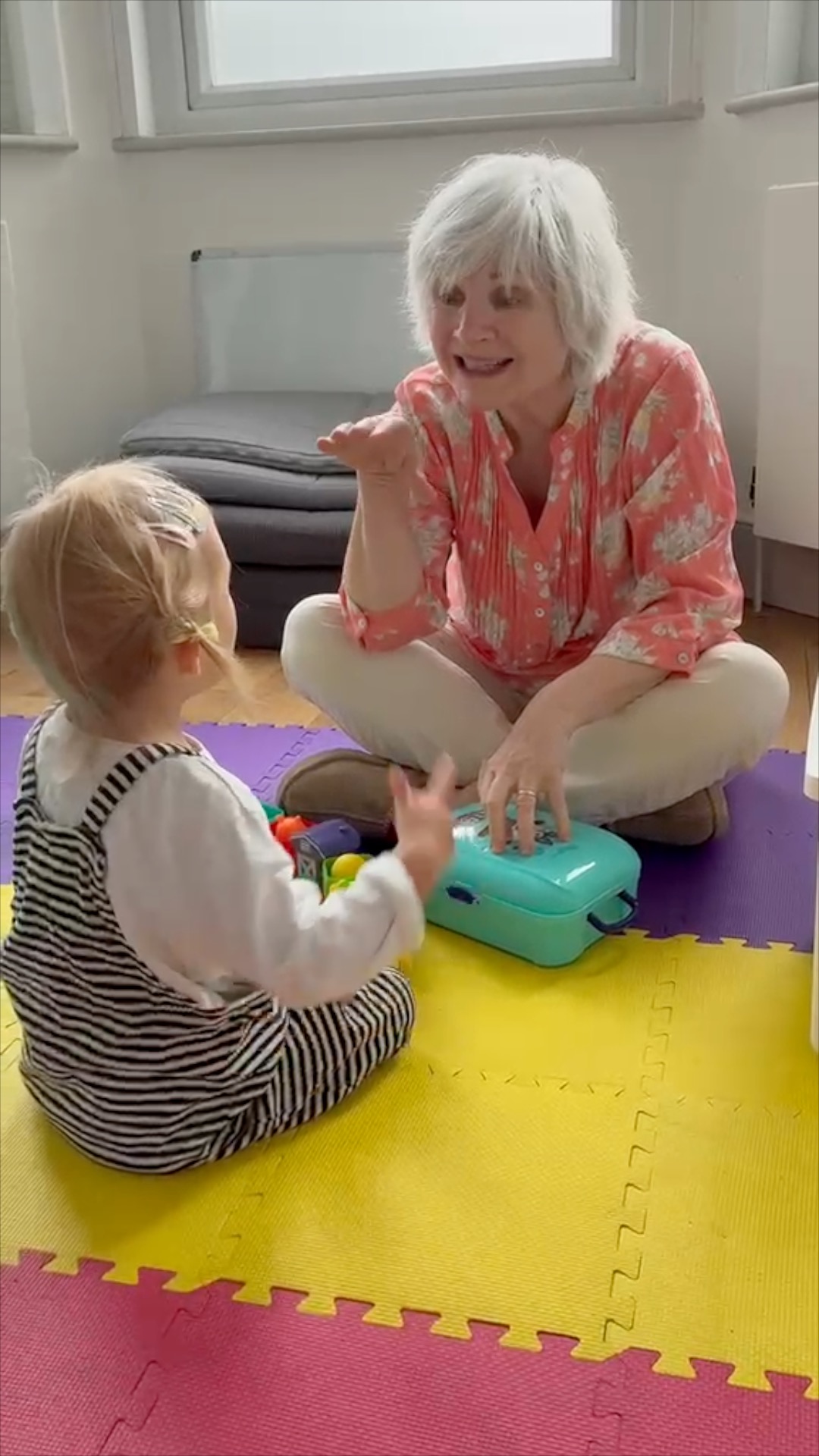
    Some of the approaches are more “drill-based” and require a child to be able to pay attention and really participate actively in the therapy, and this is what I am showing you today with this video clip.

    My little student here has been working with me for some time and from only saying a handful of words which were not very easy to understand he has come a long way. He does have some features of Verbal Dyspraxia which I shall briefly outline here:

    • Making sounds in general is a struggle, especially when asked to copy certain sounds, example: ‘can you say: a ee ou oo?”
    • Repeating sound sequences or words sequences is hard, for example: “say p-t-k in sequence” or “say fish chips fish chips fish chips
    • When saying the same word again and again, different mistakes can be heard
    • Intonation difficulties: speech sounds monotonous
    • Vocabulary is very limited

    Some therapy approaches are more play based, for example the Core Word method: here we pick a few words at a time which are very significant to the child and therefore highly motivating to try and say. These could be characters of Pokemon or Minecraft for example, or simple words like “GO!”

    When you watch the video you will see that I use a lot of visual prompting, such as showing him where the tongue is moving to or from. I do this with my index finger and this approach is called Tactile Cueing or “Cued Articulation”. Part of the approach is to give a visual prompt and then reduce the prompt as the learner is more able to produce the correct sounds. Once he can produce the sound on its own, we quickly move to the sound within a word.

    I do mix and match my approaches and in fact here I am drilling but I also use the Core Word which for him (YELLOW) — it’s his favourite colour and I happen to have quite a few good games where a YELLOW something or other can be asked for….. WHO KNEW!? 🙂


    Find a speech and language therapist for your child in London. Are you concerned about your child’s speech, feeding or communication skills and don’t know where to turn? Please contact me and we can discuss how I can help you or visit my services page.