Target activities and games

|
Target Activities and Games For Kids

Target Activities and Games

AMAZINGLY EASY Activities that we can do at home and in the clinic to help our children practise those targets!

I bet you have wondered what amazing things are done by a therapist in the clinic that you could not possibly do at home…? Well, if so I am here to tell you that you will be absolutely fine with just a few select toys and games and you will be able to get those targets done in a jiffy!

What we clinicians do very well and what you probably can’t do yourself is formulate and design the targets that are important for your child to practice. Once we have assessed or reviewed your child’s progress and needs we can then design the perfect next step of targets for you.

So for example, we have decided your little one needs to be practicing their ‘r’ sounds at the beginning of short words. We decided that based on our clinical expertise and our assessment and we have already worked with your child and managed to get this tricky ‘r’ sound just about right on its own. Now we are ready for short word practice.

It has been researched that in order for the brain pathways to re-shape or reform we need to get about 100 words in per day of our target sound. That sounds like quite a lot, right? But actually….. it’s not that bad. After all you only need to say 5-7 words about 20 times and hey presto that’s about 80-100 words.

So here are some simple games I use in my clinic all the time and these games are easily available online or in your local toy shops and this is how to do them:

Pop the Pirate

Pop the Pirate, sooo good and popular:

Lay out your target words which you will have been given by your speech therapist and put a few swords on each word.

Each time your child picks up a sword they will need to say the target word 5 x, like:

rip rip rip rip rip or run run run run run just like that in a row, bish bash bosh.

Then they can stick the sword into the barrel. Onto the next sword which they can pick and then again

race race race race race and stick in another sword

So with this little lot I put out 5 target words and 3 swords on each.

You will therefore get…… 15 words per picture, and that makes….75 words , there that is nearly all you need to do.

If you then do another little game like this one:

Magnetic board game

This is a Magnetic Board game, and they are suddenly EVERYWHERE. But you could also just take a baking sheet and some fridge magnet you might have kicking about.

Same principle as before, but now since this is your SECOND game of the day and you have already got 75 targets under your belt you only need to do one more round of 5 target words each:

Each time your child picks up a magnet piece they will say the target word 5 more times:

Ray ray ray ray ray and DONE you will now at the end of this short round have 105!! target words done with just two little fun games.

How good is this? Your child won’t hardly notice that they are in fact doing their speech therapy homework.

You’re welcome 🙂

Get in touch if you would like me to help finding good targets for your child to work on. They can be speech and/or language targets with this game method.


Find a speech and language therapist for your child in London. Are you concerned about your child’s speech, feeding or communication skills and don’t know where to turn? Please contact me and we can discuss how I can help you or visit my services page.

Similar Posts

  • · ·

    The Hanen Program® – The beauty of the ‘4 S’

    One of my favourite pieces of advice I give to parents is the ‘4 S’, a strategy coined by the Hanen Program® which I teach, particularly the ‘More than Words’ programme which is designed for and aimed at parents of children with Social Communication Difficulties or Autism. It is honestly one of those golden nuggets that I use myself in my practice and I highly recommend it to all my parents. There is something about terms like the ‘4 S’ that is easy to recall and therefore use.

    Introduction

    The ‘4 S’ is a strategy that helps to clarify the words we use with our children so that they can notice us, hear us and understand what we are saying.

    Research shows that we use on average 120-200 words per minute during everyday conversation. That’s a lot! And our children who are still learning to communicate are often bombarded with endless speech coming at them all day long. If we take into account that many of our students are Gestalt Language Processors, we can see that picking out relevant chunks of what we are saying is not at all easy, and this contributes to our children’s delays.

    So let’s look at the ‘4 S’

    1. The first one is SAY LESS

    This means we should use shorter, simpler sentences with good grammar, for example, something like: ‘let’s get ready, time to put our shoes on’ instead of what we might be saying: ‘come on then darling, let’s put your shoes on we need to get going it’s dark outside’ or similar.

    Good grammar helps to give clues about what words mean and how they are used in sentences. So, instead of ‘shoes on’ say ‘let’s put our shoes on’.

    2. The second one is STRESS

    I hear you think ‘I am stressed!‘. – NO! here it means ‘highlight’. We use our voice to highlight the important words in our sentence or phrase. For example, when you say ‘this banana is so yummy’ you can stress the word ‘yummy’ by saying it a bit louder and you can make a gesture, like rubbing your tummy as you say it.

    3. The third one is GO SLOW

    This means to speak a bit slower than you normally would and add pauses. By slowing down the pace of our speaking we give our child time to think and understand what we are saying. When we allow for pauses after we have spoken, we are inviting our child to say something in response.

    4. The last one is SHOW

    Always remember to show actions, gestures, objects, and point to pictures while speaking to help support your child’s understanding. We can show our child what words mean by pointing to things or holding up objects whilst describing or talking about them.

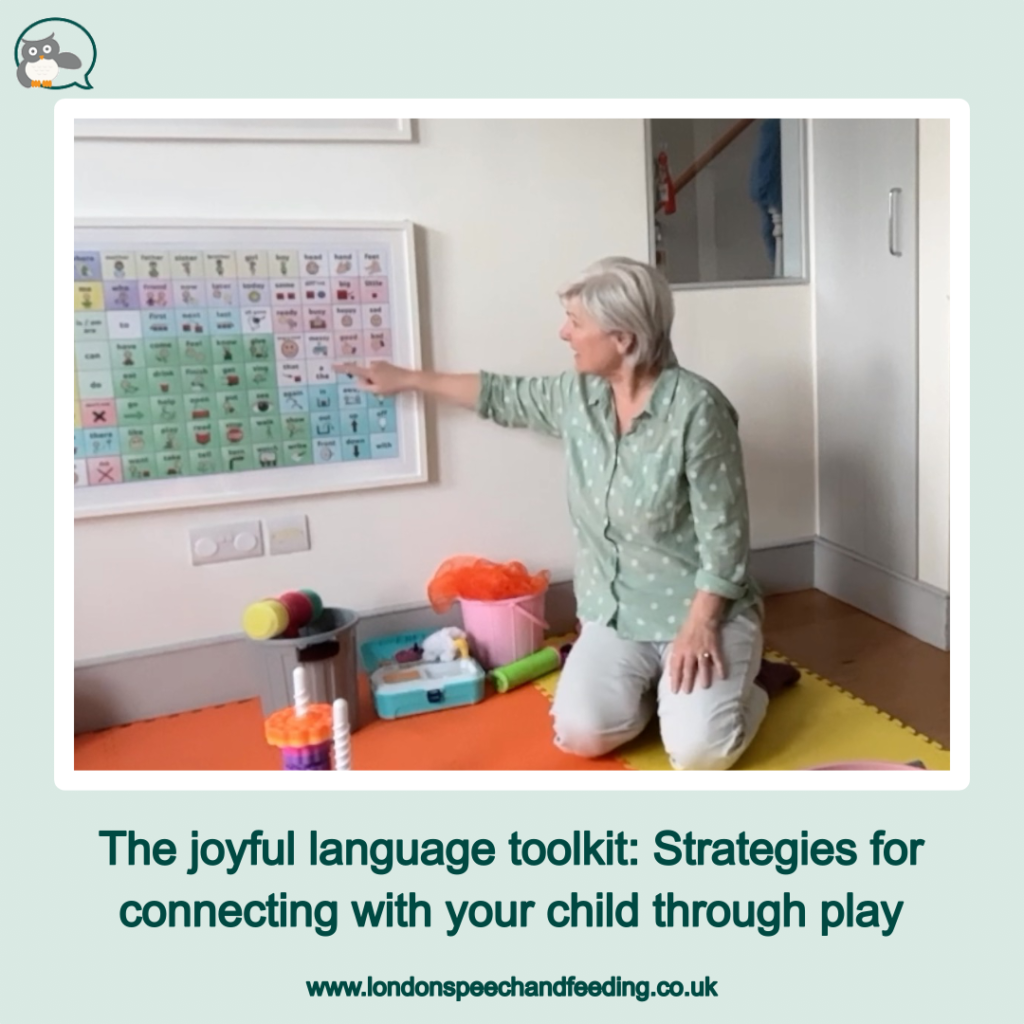
    At this point I would also like to recommend the use of Core Boards, and particularly Electronic AAC devices, such as LAMP Words for Life or PODD. I have written about this in other blogs but can always be persuaded to say a bit more on the matter… 😊 It is such a big help to have an AAC talker available for both the child and the adult so we can find words and pictures to help support the words we are saying.

    For example, today when reading a book like The Hungry Caterpillar (so good!) I used my LAMP AAC talker to make comments as we were looking at the pages together with my student. Example: ‘Look! He is eating more cake he is very hungry’ using my AAC talker I was able to supplement my speech and at the same time I was inviting my minimally speaking child to press a button or two and reply with ‘cake!’ which they would not have said with their mouth otherwise.

    5. It does say ‘4 S’ but really it should be ‘5’ except the fifth is not an ‘S’

    The fifth is REPEAT.

    Repeat words and phrases often throughout the day. When learning a language we all need to hear words and phrases several times and in different situations before we can understand, remember, and then eventually use them. Our children are ‘new language learners’ and so we can apply the same principles that we would when learning a new foreign language ourselves.

    Any questions or need help with supporting your little one’s language please contact me via my contact form, or you could also check out www.hanen.org for advice and lots of inspiration.

    Sonja McGeachie

    Early Intervention Speech and Language Therapist

    Feeding and Dysphagia (Swallowing) Specialist The London Speech and Feeding Practice

    The London Speech and Feeding Practice


    Find a speech and language therapist for your child in London. Are you concerned about your child’s speech, feeding or communication skills and don’t know where to turn? Please contact me and we can discuss how I can help you or visit my services page.

    1
  • · ·

    Your child’s communication journey

    Understanding our neurodiversity-affirming, child-led approach

    Welcome to a different kind of therapy!

    Your child’s communication journey

    The start of a new year often brings fresh hope, and sometimes fresh worries, for parents supporting their child’s communication. I am always genuinely excited to begin a new journey with children and their families, and I know that, for many parents, this kind of therapy may look very different from what they were expecting.

    Parents (and children!) are often surprised to discover that our sessions are playful, joyful, and intentionally low-pressure. You won’t see demands for eye contact, sitting still, or being told to ‘do it this way’ or ‘put the red square there’. Instead, you’ll see your child being met exactly where they are.

    For families who have previously experienced more adult-led or behaviour-based approaches including Applied Behaviour Therapy, this difference can feel unfamiliar at first. Because of that, I want to take a moment to prepare you for what child-led, neurodiversity-affirming therapy looks like, so you can feel confident, comfortable, and reassured from day one.

    Why doesn’t child-led therapy look like ‘traditional’ therapy?

    Many people picture speech and language therapy as sitting at a table, using flashcards, or practising words through repetition. While those approaches can work well for some children, they are often not effective or appropriate for many neurodivergent children—including children with autistic profiles, ADHD, or demand-sensitive nervous systems.

    Our approach is grounded in a simple and powerful truth:

    Children learn best when they feel safe, motivated, and emotionally connected.

    When a child’s nervous system feels calm and secure, learning becomes possible. When a child feels pressured or controlled, communication often shuts down, even if they can speak.

    🎯 Our purpose: Communication through connection

    Our goal is not simply to help your child say more words. Our goals go deeper and are built on strong foundations:

    • Trust and regulation: We focus on building a trusting relationship where your child feels safe, understood, and emotionally regulated. A calm nervous system is the starting point for all communication.
    • Motivation: We follow your child’s intrinsic motivation, the things they naturally enjoy to make communication meaningful, joyful, and purposeful.
    • Spontaneous communication: We create opportunities for your child to communicate because they want to, not because they are asked or instructed to.

    🧸 What to expect in a session

    Our sessions are intentionally child-led and often look very much like play.

    FeatureWhat it looks likeWhy we do this
    Minimal toysWe usually offer just 3–4 carefully chosen activities (such as bubbles, blocks, or sensory play).Less is more. Fewer choices reduce overwhelm and help children focus on what genuinely interests them.
    Child choosesYour child decides what to play with and how to engage.This immediately establishes us as a safe, non-demanding partner and increases motivation.
    The therapist’s roleWe join your child’s play, observing closely and responding naturally.We model language, share attention, and reflect your child’s experiences in a way that feels natural and supportive.
    No pressure or demandsThere are no ‘must-do’ tasks. If your child wants to spin, crash, line up toys, or repeat an activity, we follow.Reducing demands lowers anxiety and supports communication, particularly for children with demand-sensitive profiles.

    Is this really effective?

    It’s completely natural to wonder, ‘Are they just playing?’ The answer is yes, and very intentionally so.

    Our sessions are guided by nearly 30 years of speech and language therapy experience, alongside clear, achievable goals tailored to each individual child. Play is a child’s natural language and their most powerful learning tool.

    Within play, we are constantly creating opportunities to:

    • Build joint attention (sharing focus and interest)
    • Model language at the right level
    • Encourage back-and-forth communication
    • Develop a deep, authentic connection

    If your child has struggled to engage or communicate in more structured or demand-heavy settings, this child-led approach is often the key to unlocking their potential.

    💛 What this might look like at home

    You may notice that when pressure is reduced:

    • Your child begins communicating more during everyday routines
    • Language emerges through play, movement, or shared enjoyment
    • Communication feels more natural and less forced

    Small moments could be a shared smile, a look, a sound, a gesture. All matter. These are the building blocks of meaningful communication.

    📚 Resources for parents

    If you’d like to explore these ideas further, you may find the following helpful:

    I look forward to meeting you and your child. Please bring any questions, uncertainties, or curiosities to our first session, there is no such thing as a silly question. This is a journey we take together. Contact me via my contact form.

    Sonja McGeachie

    Highly Specialist Speech and Language Therapist

    Owner of The London Speech and Feeding Practice.


    Health Professions Council registered
    Royal College of Speech & Language Therapists Member
    Member of ASLTIP

    Find a speech and language therapist for your child in London. Are you concerned about your child’s speech, feeding or communication skills and don’t know where to turn? Please contact me and we can discuss how I can help you or visit my services page.

    3
  • · ·

    Neurodiversity affirming Speech and Language Therapy

    Introduction

    I am a neurodiversity affirming therapist and I love and endorse play-based therapy. I use it alongside a strengths-focused approach in all my sessions. Find out why we should use these transformative therapy methodologies in all our work and play with our children.

    I always have a range of different toys and activities up my sleeve so that when one toy is no longer interesting, that’s fine. ‘Look here’s a new one, how about we try this one?’ When therapy feels like play, children are more likely to be engaged and attentive, which leads to better outcomes.

    By using play as a context for Speech and Language Therapy we can create opportunities for children to use and practise their communication skills in a natural, real-life setting. This helps bridge the gap between the therapy room and everyday life.

    Goals and targets

    What about goals and targets I hear you say? Of course, as Speech and Language Therapists we always have our goals for any particular child. They can be speech goals (we want Bobbi to produce a ‘k’ sound at the end of words) or communication goals (we want Fatima to ask for something by pointing to it rather than grabbing it). And these goals can be achieved where there is a reciprocation and a positive, playful relationship between the adult and the child. That relationship comes through play and fun.

    Play and fun

    Play is how a child interacts and learns. If it’s fun, interesting, exciting or pleasurable then that is where the magic happens. And that is what we need to return to repeatedly and then see if we can fold our targets into the activity as we go.

    As soon as we expect our child to do something and we try and shape their behaviours towards a certain outcome we no longer ‘play’. We are now in teaching mode, where we direct and where we are ‘in charge’. As a neurodiversity affirming therapist, I believe that all play is valid. We must not get into the trap of thinking that only functional play is valid, that there is only one way to play with that car ramp/puzzle/potato head. Our autistic children often need to play in a particular way to navigate their world and we must not try and stop that.

    When we affirm and validate our child’s play and copy their play with enthusiasm and respect then, in my experience, all children regardless where they are on the neurodiversity spectrum will begin to engage with us, copy us, and learn how to communicate effectively about things that matter to them.

    Play-based therapy allows therapists to tailor interventions to each child’s unique interests and abilities. This individualised approach increases the likelihood of success and progress.

    Strengths-Focused Speech Therapy

    Strengths-focused therapy emphasizes a child’s strengths and abilities rather than their deficits. It recognises that every person has unique strengths that can be harnessed to overcome challenges.

    Focusing on strengths helps us build a positive self-image. This is especially important for children with communication disorders, as it can boost their confidence and self-esteem.

    When we encourage children to play in ways that they enjoy and are good at they feel empowered and more in control of their lives and play. This can lead to increased motivation and a sense of ownership over their progress.

    Now, imagine the powerful impact that can be achieved by combining play-based therapy and strengths-focused therapy in speech therapy sessions. This dynamic combination brings out the best of both worlds. It creates a therapeutic environment that is not only effective but also enjoyable for children and their families.

    As Speech Therapists we can use the child’s strengths and interests as a foundation for play-based activities. This personalisation not only makes therapy more engaging but also more effective.

    An example

    Charlie, a 3-year-old with social communication challenges, had a deep interest in anything that spins. We used this strength and interest to create a variety of spinning activities. As he is allowed to engage in his spinners, we can practise lots of speech and language and provide great phrases alongside his interest and activities: Ready steady go! Stop! ‘another one’ ‘the red one’ ‘again again’ ‘I love it’ ‘it’s a spinner’ ‘Charlie loves this toy’ ‘it’s going fast’ ‘it’s so fun’ etc..

    Over time Charlie started to copy some of these word models and then used them to create his own little phrases, such as ‘the blue one again’. When this occurred, we felt like celebrating because it had come naturally and appropriately to the situation without any coercion or direction. That is what communication is about! Well done Charlie!

    Conclusion

    Play-based and strengths-focused speech therapy approaches are powerful tools and by combining these approaches, we create a therapeutic environment that is not only effective but also enjoyable and empowering for our clients.

    Contact me if you would like your child to have neurodiversity affirming speech and language therapy.


    Find a speech and language therapist for your child in London. Are you concerned about your child’s speech, feeding or communication skills and don’t know where to turn? Please contact me and we can discuss how I can help you or visit my services page.
    0
  • Quick Overview Of How To Implement Those Early Hanen Speech And Language Strategies

    Quick Overview Of How To Implement Those Early Hanen Speech And Language Strategies

    First up try and get down at eye level or Face-to-Face with your child

    Try to sit so that your child can see you easily, i. e. your child does not have to look up to make eye contact with you. We call that Face to Face: try and sit opposite your child. This makes it easier for you to see facial expressions and therefore pick up nonverbal /pre-verbal communication. Now you can connect and share the moment with your child.

    OWL (Observe, Wait and Listen)

    Never skip this step as it prepares us for what happens next !

    Observe

    First, try and simply watch your child quietly and listen and observe what he/she says or does; you need to know what your little one is interested in. For example with this toy (pictured below) we could observe that your child loves the actual spinning of the marble, perhaps more than that noisy click-clacking down the run. Or perhaps he loves collecting the marble at the end and feeling it in his hand.

    You could start off with showing once how the marble goes down and say:“ look it goes round and round !” Then hold back and observe, without speaking, so that your child has time to explore the toy.

    Wait

    Just sit and avoid telling or showing your child what he or she could do with the toy. This gives your child an opportunity to explore and experiment.

    Listen

    Listen to what your child says, or look at your child’s non-verbal communication without interrupting. Your child will now feel and know that you are really present and that what they have to say is important. It’s best to avoid questions like, “What are you doing or “What’s this?” as that might be a lot of pressure when they don’t know what to say about that yet.

    Respond immediately by showing interest

    Once you have all the information from OWLing you can respond in the right way, for example: if she catches the marble at the end of the run and looks up with a smile or a sound you could respond with: you’ve got it! One marble in your hand! Nice playing!

    Now how to join in the play:

    First you can copy what your child is doing

    If your child puts the first marble at the top of the run you can take a turn and do exactly the same once his marble is done. Ideally you might have another marble run, perhaps a similar one, it does not have to be exactly the same! Once your child has put the first marble in you can do the exact same with your own marble on your run. Your child is likely to look at what you are doing and you might well see a smile on their face or perhaps she might say: look at mine!

    Next you can build on that

    You can respond with simple comments like: “Wow! Yes I am looking at yours now! It’s spinning on the red one lots! I love the noise!” Now wait once more to see what your child says or does.

    To summarise

    We are signalling to our child that we are really interested in what they are doing and saying so we can “collect” our child, i.e. bring him/her back into a joint interaction.

    Important

    We want to try and not direct our child but respond with interest and fun! This creates a lovely stage for interaction and joint play! And this leads in turn to practising conversation and ever more opportunities for great speech and language skills to emerge.

    Great activities we use in Speech and Language Therapy:

    • Any cause and effect toys like this Marble Run
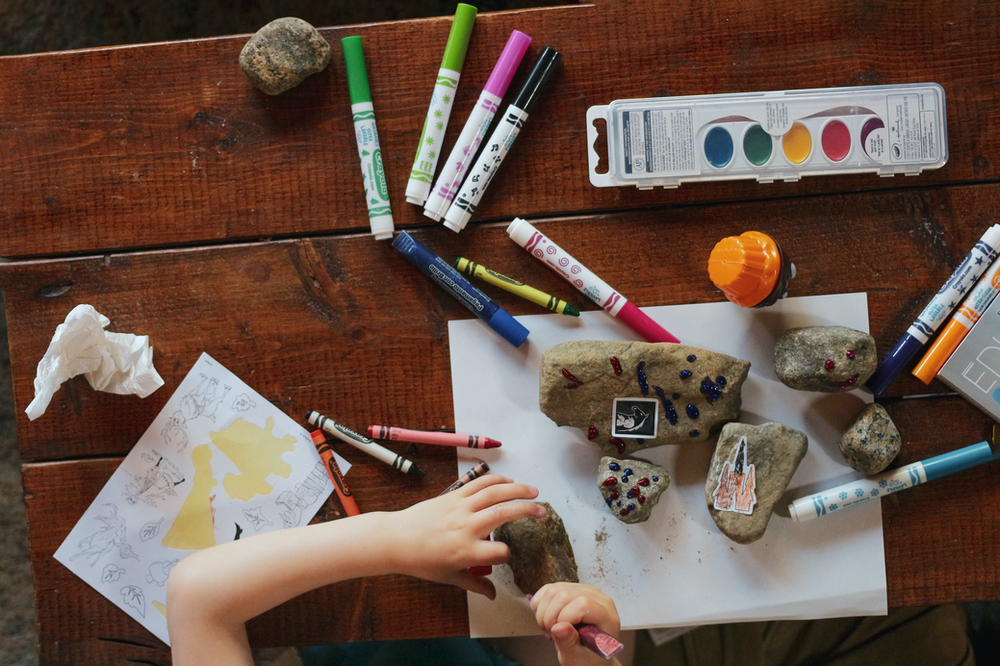
    • Creative activities, such as mark making with crayons
    • Train tracks (building and running the trains)

    Find a speech and language therapist for your child in London. Are you concerned about your child’s speech, feeding or communication skills and don’t know where to turn? Please contact me and we can discuss how I can help you or visit my services page.

  • · · · ·

    Holiday disruptions & New Year routines: How to support your child’s feeding, communication and regulation over the festive season

    Holiday disruptions & New Year routines

    The festive season is a wonderful time for many families, but for children with feeding challenges, sensory differences, or autism traits, December can feel overwhelming. Changes in routine, busier environments, travel, new foods, disrupted sleep, and well-meaning relatives giving ‘advice’ can all affect a child’s feeding, communication and overall regulation.

    As a speech and language therapist specialising in Early Years, I see the same pattern each year: children often make progress during the term, only to struggle in late December when everything becomes unpredictable. The good news? With a bit of preparation, children can not only cope better, but they can actually make significant developmental gains during the holidays.

    This blog will help you feel confident, supported and prepared for the transition from ‘festive mode’ to a smoother, regulated start in January.

    1. Why routines matter so much. Especially now

    Young children thrive on predictability. For neurodivergent children or those with sensory, feeding or communication needs, routine isn’t just helpful: it’s the backbone of emotional regulation.

    In December, typical patterns change:

    • Mealtimes shift or become irregular
    • Bedtime slides
    • New foods appear
    • Loud social gatherings overwhelm
    • Travel disrupts naps and comfort routines
    • Therapies pause
    • Childcare closes

    Any one of these can lead to feeding refusals, more meltdowns, increased stimming, reduced communication attempts or regression in speech sounds.

    It’s simply the nervous system responding to too much change.

    2. Protecting feeding progress during holiday mealtimes

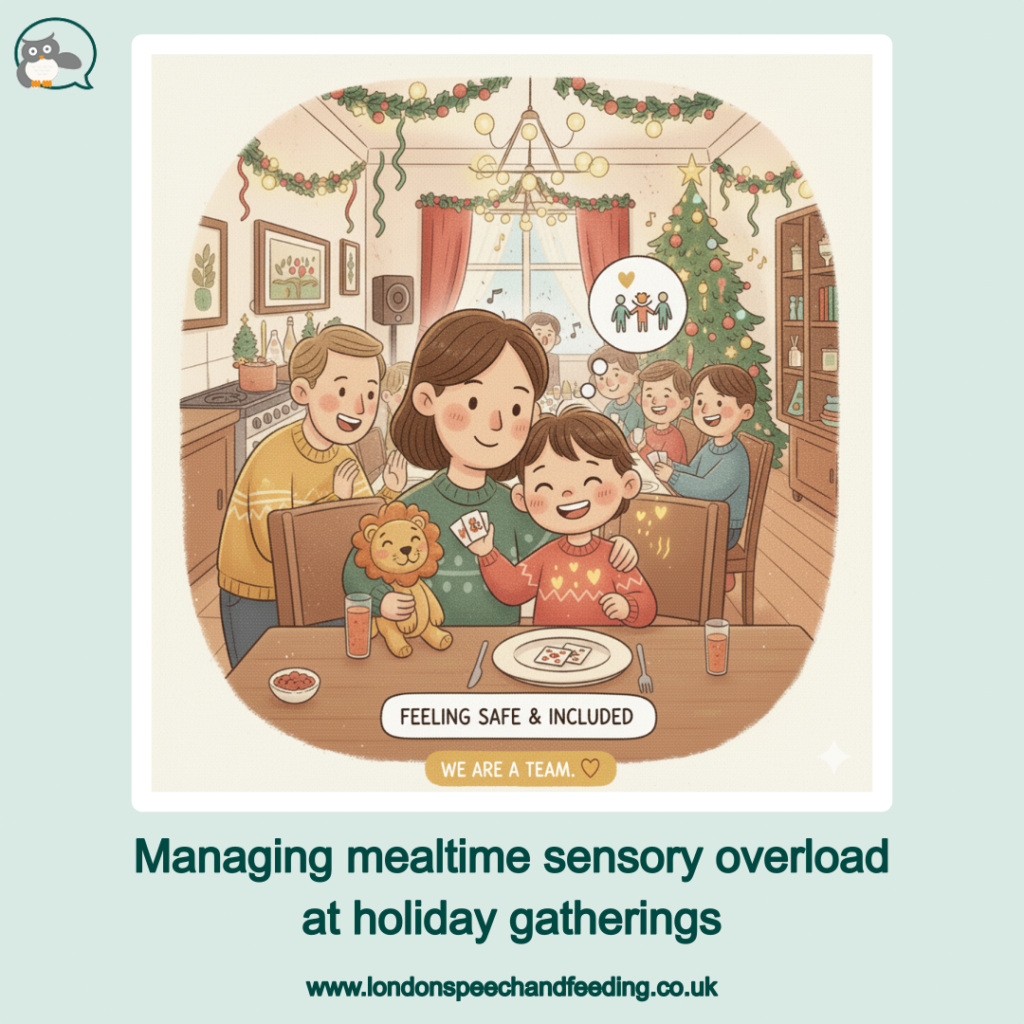
    My last blog and insta post have a nice social story on festive meals. They are often the trickiest part of the season for families I support. Children with sensory-based feeding challenges, or ARFID traits may find holiday foods completely unfamiliar and challenging.

    What helps:

    • Offer one ‘safe food’ at every meal
    • Keep portion sizes tiny
    • Use the ‘buffet rule’
    • Rehearse tricky moments

    3. Supporting communication when routines are disrupted

    Holiday time actually offers more opportunities for communication, just in different ways.

    Strategies:

    • Slow down and follow your child’s lead
    • Use everyday routines as language opportunities
    • Keep AAC going even if casually

    4. Understanding holiday ‘regressions’ and know they’re temporary

    This is almost always due to nervous system overload. Children don’t truly ‘lose’ skills; they temporarily prioritise regulation over learning.

    5. A gentle January reset: How to start the New Year smoothly

    • Re-establish predictability early
    • Return to preferred foods
    • Book early support if needed
    • Focus on regulation first

    Sonja McGeachie

    Highly Specialist Speech and Language Therapist

    Owner of The London Speech and Feeding Practice.


    Health Professions Council registered
    Royal College of Speech & Language Therapists Member
    Member of ASLTIP

    Find a speech and language therapist for your child in London. Are you concerned about your child’s speech, feeding or communication skills and don’t know where to turn? Please contact me and we can discuss how I can help you or visit my services page.
    Reference:

    Bronson, M. (2000). Self-regulation in early childhood. Guilford Press.

    2
  • ·

    Discover how Attention Autism can support your Autistic child’s communication

    “I’ve got something in my bag, in my bag, in my bag,

    I’ve got something in my bag,

    what it is”

    You might be wondering why your Speech and Language Therapist is singing this song and then presenting items from a zipped-up bag. Let me take you through stage one of this evidence-based approach.

    There are many aims of ‘bucket or bag time’. During stage one, you are simply engaging your child’s attention (whilst also exposing them to language). It’s important to remember that you are not forcing your child to say or do anything. The idea is that the items in the bag or bucket ‘offers an irresistible invitation to learn’ (Gina Davies, 2020).

    You don’t need ‘special’ expensive toys. Use what you have at home. It might be that you have some bubbles, a wind-up toy. You might have some foil that you can roll up into a ball, or a balloon. Keep these items for ‘bucket time’. This means that your child is likely to be excited and motivated for the activity. The only stipulation is that these items must be highly motivating and must be the most exciting thing in the room. You’ll want to cover up any distractions.

    So, you have your items and your opaque zipped bag, next you’ll want to put the items into the bag ensuring the zip is closed. The zip is important as it increases suspense and excitement as your child cannot see inside. You can also comment when unzipping ‘open bag’ using the signs ‘open’ + ‘bag’ to support your child’s understanding. Your Speech and Language Therapist can help with any Makaton signs that are unknown. The idea of this activity is that the item isn’t touched by your child. This can seem a little odd or feel “mean” but there is a reason for this: we want our child to look at us as well as the object or toy. As soon as we allow our child to touch and play with that toy their attention will go to the toy alone and we won’t get JOINT attention or engagement. This is the reason why we SHOW interesting things for a brief moment and then put these items back into the bag or bucket and out comes the next item. If your child wants to grab the toy and gets upset, then they may not be quite ready for this approach.

    Next, we sing the song (as above) and unzip the bag taking out one of the items. The use of pausing is important. Pause after the song: does your child try to use gesture or sound? You can also use this opportunity to model short phrases, ideally one or two words such “it’s a spinner! Wow… so many colours”. After a couple of turns, repeat the process and pull out a different item. We tend not to sing the song each time for the next item. Just sing it at the beginning and then get on with producing the amazing, wonderful things in your bag. No hard and fast rules though, apart from “don’t let the child touch the toys”.

    The biggest factor here is that you and your child enjoy the activity together. Have lots of fun!!

    Keep up to date with our latest blogs to explore more stages of Attention Autism.

    If you need speech, language or communication support or advice, I am always here to help.


    Find a speech and language therapist for your child in London. Are you concerned about your child’s speech, feeding or communication skills and don’t know where to turn? Please contact me and we can discuss how I can help you or visit my services page.

    0

Leave a Reply

Your email address will not be published. Required fields are marked *