Many of my students have difficulties telling stories. When looking at a book together, even books they love and have seen many times, they often struggle to understand what they are reading and cannot therefore retell the story in any sequence. A great method I often use with those students is called Colourful Semantics.
What is Colourful Semantics?
Colourful Semantics is an approach aimed at helping children develop grammar and meaning of phrases and sentences. We help children identify WHO is the subject in a story, what is he/she/it DOING to WHAT and WHERE. There are lots of colour coded stages but we tend to start with the basic 4:
WHO = ORANGE
DOING = YELLOW
WHAT = GREEN
WHERE = BLUE
Once a student is accomplished at this level, we move on to different colour codes for describing words (adjectives), connecting words (with/together/and/therefore) feeling words (PINK), timing words (BROWN) eg. when, tomorrow, last week etc.
Colourful Semantics is a really useful method and helps children to organise their sentences. It also helps me knowing how to guide a student in thinking about the story.
The approach can be used with children with a range of Speech and Language Needs, such as:
Developmental Delay / Disorder
Autistic Spectrum Condition
Down Syndrome
Any other syndromes and related speech and language delays
General Literacy difficulties
There are a wide range of benefits to using this approach and I use it in my therapeutic work with children of around 3 years plus. Below is a little video which shows how I use it with this student who has general language difficulties associated with Autism. One of the main benefits with this student is that seeing the Cue Cards helps her to use a much wider range of vocabulary than she would ordinarily generate. Her sentences are getting longer and she is more able to answer questions. In general, I find it useful to help with storytelling and to guide us through the story in a sequence.
There are many on-line games these days that have incorporated the Colourful Semantics Approach. Once a child is familiar with the basic colour scheme then gradually the visual prompts can be reduced to using verbal prompts.
Find a speech and language therapist for your child in London. Are you concerned about your child’s speech, feeding or communication skills and don’t know where to turn? Please contact me and we can discuss how I can help you or visit my services page.
If you’ve found yourself wondering ‘Why can my child say a word one day, but not at all the next?’ it might be that your child has a motor speech difficulty. This means the challenge isn’t that your child doesn’t know what they want to say; it’s that their brain finds it harder to plan and coordinate the movements needed for clear speech. This speech difficulty is called Childhood Apraxia of Speech (CAS)
In this post, I’ll explain what CAS can look like in 2–5 year olds, what an assessment usually involves, and what you can start doing at home to support your child without turning life into ‘speech homework all day long’.
What is childhood apraxia of speech (CAS)?
Children with CAS often have lots to communicate about (and strong ideas!) but their speech may come out as:
Unclear
inconsistent
hard to ‘copy’ on demand
frustrating for them and for you
CAS is not caused by laziness and it is not a parenting issue. It is also not something children simply ‘grow out of’ without support. But with the right therapy approach, children can absolutely build clearer speech over time.
Many families come to me after months (or years) of being told:
‘She’ll talk when she is ready’
‘He’s just shy’
‘It’s probably a speech delay’
‘It’s normal for toddlers’
And sometimes it is a general delay. But sometimes it’s something more specific, like CAS.
There’s also been a huge rise in parents seeking information online, and CAS is often mentioned alongside speech sound difficulties such as:
phonological delay (pattern-based speech errors)
articulation difficulties (one sound that won’t come out clearly)
inconsistent speech disorder
These can look similar at first glance, which is why a specialist assessment matters.
Signs of childhood apraxia of speech in 2–5 year olds
Children develop speech at different rates, and not every unclear speaker has CAS. But here are some common features that may raise a flag, especially when you notice several together.
1) Inconsistent speech errors
Your child might say the same word in different ways:
‘banana’ → nana / baba / mana
‘daddy’ → gaga / daddy / dadi
This inconsistency is one of the biggest clues.
2) Difficulty copying words on request
Some children speak more easily in natural play, but when asked ‘Say ___’, they freeze or the word becomes much harder.
3) Limited sound repertoire
They may use only a small set of consonants (like /M/, /N/, /B/, /D/) and avoid others.
4) Vowel distortions
Many children with typical delays mainly struggle with consonants. But in CAS, vowels can also sound ‘off’ or change between attempts.
5) Speech that sounds effortful
You might notice your child:
pauses between sounds
tries multiple times
looks like they’re ‘searching’ for the right mouth movement
6) Longer words are much harder
‘Car’ might be easier than ‘carry’, and ‘carry’ easier than ‘caterpillar’.
7) Prosody differences (rhythm and stress)
Some children with CAS sound a little unusual in their speech rhythm, stress, or intonation.
8) Frustration or reduced confidence
When a child is frequently misunderstood, they may:
talk less
use gestures more
become upset when asked to repeat themselves
Important note: none of these signs alone prove CAS but they are a strong reason to seek a speech assessment rather than waiting.
CAS vs phonological delay vs articulation difficulty (quick guide)
These are some of the most common questions I hear.
If it’s mainly an articulation difficulty…
A child may consistently say one sound incorrectly (for example, ‘thun’ for ‘sun’- lisp- but everything else is developing well.
If it’s mainly a phonological delay…
You might notice clear patterns, like:
leaving off the ends of words (‘ca’ for ‘cat’)
swapping back sounds for front sounds (‘tar’ for ‘car’)
Patterns are often consistent and respond well to phonology-based therapy.
If it might be CAS…
Speech often feels less predictable, harder to imitate, and more impacted by word length and complexity.
If you’re unsure, that’s completely normal, and exactly why assessment matters.
What happens in a CAS assessment?
A high-quality speech assessment for possible CAS usually includes:
1) Parent discussion and developmental history
We talk about:
pregnancy and birth history (where relevant)
feeding history
early sounds and babbling
first words and how speech has progressed
family history of speech/language needs
2) A speech sound assessment
Your child might be shown pictures or play-based prompts so we can hear:
what sounds they can say
what they simplify
whether errors are consistent or inconsistent
3) An oral-motor and movement check
This isn’t about ‘strength’. It’s about coordination and planning. We look at how your child manages speech movements and transitions.
4) Stimulability testing
This means: how easily can your child learn a new sound or word with support?
For CAS, we often explore how they respond to:
slowed-down speech
visual cues
rhythm/tapping
short, simple syllable shapes
5) Functional communication and confidence
We look at how speech impacts daily life:
being understood at nursery
joining in with peers
asking for help
managing emotions when misunderstood
At the end, you should leave with:
a clear explanation of what we think is going on
a therapy plan
practical home strategies
realistic next steps
What parents can do at home
Here are CAS-friendly strategies you can start right away.
1) Choose ‘power words’
Pick 1–2 words that matter most in your child’s daily life, such as:
more
help
mummy
again
stop
open
These words are motivating and functional.
2) Keep it short and successful
For many children with CAS, the goal is quality over quantity.
Try five minutes a day rather than 30 minutes of struggle.
3) Support speech with rhythm
Some children benefit from:
tapping a beat on the table
clapping syllables
using a gentle ‘marching’ rhythm
This can help the brain organise the sequence of movements.
4) Celebrate approximations
If your child says ‘moh’ for ‘more’, that’s communication!
We want them to feel:
safe
understood
proud to try again
Confidence is a key part of progress.
A short parent story (anonymised)
One mum said to me:
‘We kept being told to wait. But I could see my child understood everything; they just couldn’t get the words out. Once we had an assessment and a plan, it felt like we finally knew what to do. The biggest change was his confidence. He started trying more.’
When should you seek support?
You don’t need to wait until school.
It’s worth getting an assessment if your child is:
hard to understand compared with peers
becoming frustrated or withdrawing from talking
inconsistent with words they used to say
struggling to imitate speech sounds
showing signs that match CAS
Early support can reduce stress for the whole family and help your child feel successful in communication.
Here’s how I can help:
✅ A detailed speech assessment (including whether CAS is likely)
✅ A clear therapy plan with realistic goals
✅ Practical home strategies you can use immediately
✅ Support for nurseries and schools (where needed)
✅ In-person sessions in North-West London and online options
Your child is communicating the best way they can, and with the right support, speech can become easier, clearer, and more confident.
Sonja McGeachie
Highly Specialist Speech and Language Therapist
Owner of The London Speech and Feeding Practice.
Find a speech and language therapist for your child in London. Are you concerned about your child’s speech, feeding or communication skills and don’t know where to turn? Please contact me and we can discuss how I can help you or visit my services page.
AMAZINGLY EASY Activities that we can do at home and in the clinic to help our children practise those targets!
I bet you have wondered what amazing things are done by a therapist in the clinic that you could not possibly do at home…? Well, if so I am here to tell you that you will be absolutely fine with just a few select toys and games and you will be able to get those targets done in a jiffy!
What we clinicians do very well and what you probably can’t do yourself is formulate and design the targets that are important for your child to practice. Once we have assessed or reviewed your child’s progress and needs we can then design the perfect next step of targets for you.
So for example, we have decided your little one needs to be practicing their ‘r’ sounds at the beginning of short words. We decided that based on our clinical expertise and our assessment and we have already worked with your child and managed to get this tricky ‘r’ sound just about right on its own. Now we are ready for short word practice.
It has been researched that in order for the brain pathways to re-shape or reform we need to get about 100 words in per day of our target sound. That sounds like quite a lot, right? But actually….. it’s not that bad. After all you only need to say 5-7 words about 20 times and hey presto that’s about 80-100 words.
So here are some simple games I use in my clinic all the time and these games are easily available online or in your local toy shops and this is how to do them:
Pop the Pirate
Pop the Pirate, sooo good and popular:
Lay out your target words which you will have been given by your speech therapist and put a few swords on each word.
Each time your child picks up a sword they will need to say the target word 5 x, like:
rip rip rip rip rip or run run run run run just like that in a row, bish bash bosh.
Then they can stick the sword into the barrel. Onto the next sword which they can pick and then again
race race race race race and stick in another sword
So with this little lot I put out 5 target words and 3 swords on each.
You will therefore get…… 15 words per picture, and that makes….75 words , there that is nearly all you need to do.
If you then do another little game like this one:
Magnetic board game
This is a Magnetic Board game, and they are suddenly EVERYWHERE. But you could also just take a baking sheet and some fridge magnet you might have kicking about.
Same principle as before, but now since this is your SECOND game of the day and you have already got 75 targets under your belt you only need to do one more round of 5 target words each:
Each time your child picks up a magnet piece they will say the target word 5 more times:
Ray ray ray ray ray and DONE you will now at the end of this short round have 105!! target words done with just two little fun games.
How good is this? Your child won’t hardly notice that they are in fact doing their speech therapy homework.
You’re welcome 🙂
Get in touch if you would like me to help finding good targets for your child to work on. They can be speech and/or language targets with this game method.
Find a speech and language therapist for your child in London. Are you concerned about your child’s speech, feeding or communication skills and don’t know where to turn? Please contact me and we can discuss how I can help you or visit my services page.
We often hear from parents who are trying their best to connect with their child, especially when reading books, but are met with frustration. They’ll say, ‘I read the book exactly as it’s written, but my child can’t focus for very long and just runs off!’ or ‘my child just flicks through the pages then turns it upside down and runs off with it’ or similar.
It’s a common story. Traditional reading—going through the text from cover-to-cover—has its place of course, but for little ones with a language delay or autism it can move too quickly and place all the focus on the book’s words, not on the interaction.
But what if I told you that story time could become one of the most fun and productive times for your child’s communication development?
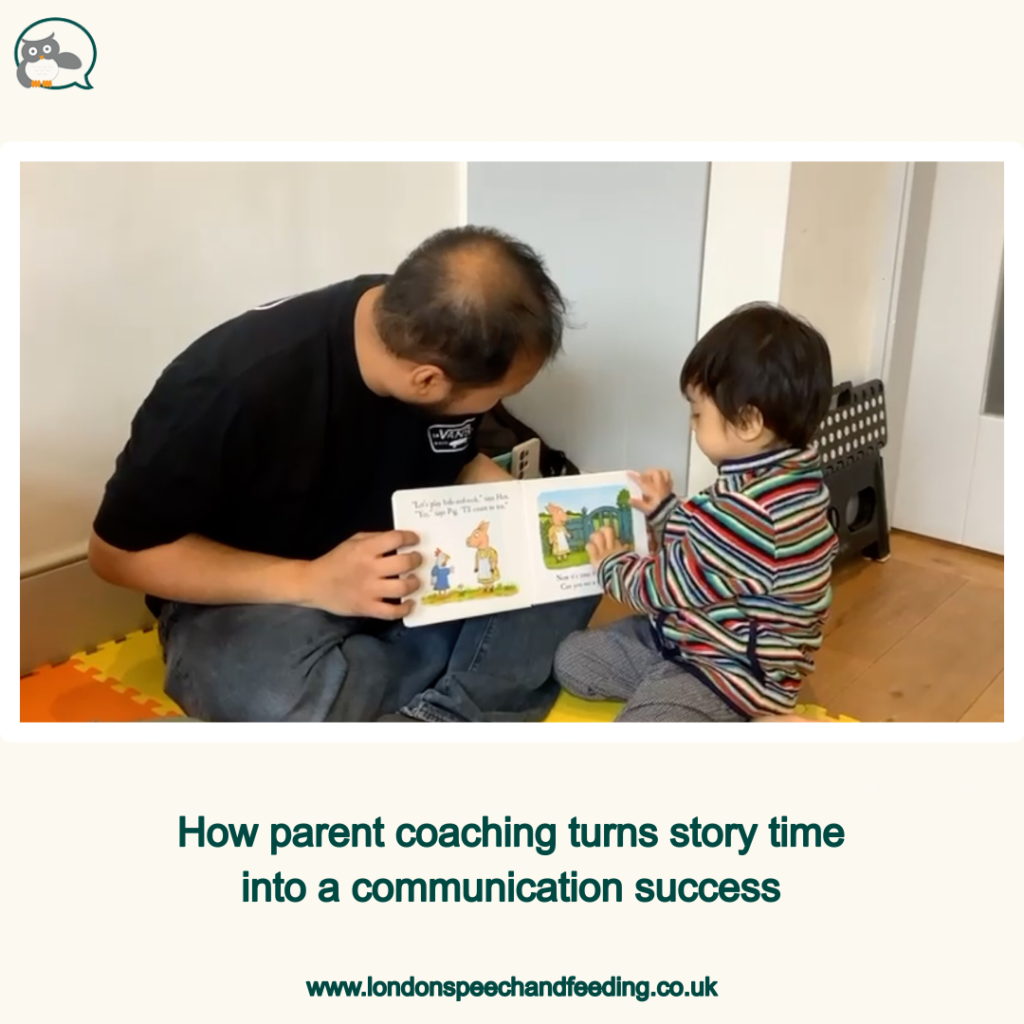
Watch the fantastic little video clip above! You can see the pure joy and connection between this dad and his son. This is the same family who, just a few weeks ago, felt defeated when trying to read a book, with their child quickly losing interest and leaving the reading/book corner.
What changed?
The power of parent coaching and Hanen principles
The difference you see in the video is the direct result of parent interaction therapy, or parent coaching, based on the internationally recognised Hanen principles.
I didn’t ‘fix’ the child. Instead, I coached the parents in a few simple, powerful strategies that completely changed the dynamic of their interaction. Instead of being a time for teaching and instruction, story time became a back-and-forth conversation.
Here are the four major transformations that coaching helped this family achieve:
1. From reader to play partner
Before coaching, the parents felt their job was to read the text and to teach the words in it to their child. Now, their job is to follow their child’s lead. They learned to Observe, Wait, and Listen (OWL). If the child points to the tree or the badger on the page, the parent talks about the tree or the badger.
The result
The child is now initiating and leading the conversation! He is sharing what he finds interesting, which makes him feel powerful and keeps him deeply engaged.
2. Building connection and attention
When parents focus solely on reading, they often forget to make frequent eye contact and use animated facial expressions. The principles taught them to put the text aside and prioritise connection.
The result
Our little boy is looking at his dad more frequently, making great eye contact, and clearly having fun! When the interaction is fun, the child’s attention span naturally lengthens, allowing him to attend to the book and the interaction for a much longer time.
3. Creating opportunities for communication
The parents learned simple ways to prompt communication without pressure. They stopped asking knowledge-based questions (‘What colour is that? Or point to the pig!’), which can feel like a test.
Instead, they learned to use techniques like ‘Saying less and pausing’ or ‘copying their little one’s echolalia ‘, signalling that they are very interested in what he is saying and that his communication matters!
The result
The child is now spontaneously using strings of sounds and gestures to communicate his needs and interests, knowing and enjoying his parents’ enthusiastic responses.
This video is a testament to the fact that you are your child’s best therapist. With the right tools and coaching, you can transform everyday routines, like reading a book, into the most joyful and effective communication sessions.
4. Acknowledging and interpreting echolalia
In the video, you may hear the little boy repeat a phrase from the book or from what his dad just said. This is called echolalia, and for a long time, it was often dismissed or discouraged.
However, a core principle of our parent coaching is that echolalia is communication. For children who are ‘Gestalt Language Processors,’ these memorised phrases (or ‘gestalts’) are their building blocks of language.
The key is not to stop the repetition, but to become a ‘language detective’ and ‘interpreter’!
By modelling the correct, first-person phrase right after the echo, parents/caregivers are teaching a child how to break down the ‘chunk’ and use the individual words functionally. They are showing their child: ‘I heard you. Your communication makes sense to me.’
This strategy is a game-changer because it:
Validates the child’s communication: It honours the child’s natural way of learning language, which boosts their confidence and willingness to communicate.
Facilitates language development: It provides the child with the next step—a meaningful, functional phrase—to move them from repeating language to generating their own spontaneous sentences.
Look at the child’s face again in the video. When his dad acknowledges and interprets his communication, you see that spark of joy and connection—that’s the moment when true, functional language learning happens!
Ready to unlock the potential in your family’s story time? Contact me to learn more about our parent coaching programs.
Sonja McGeachie
Highly Specialist Speech and Language Therapist
Owner of The London Speech and Feeding Practice.
Find a speech and language therapist for your child in London. Are you concerned about your child’s speech, feeding or communication skills and don’t know where to turn? Please contact me and we can discuss how I can help you or visit my services page.
Imitation, the act of mirroring someone else’s actions, gestures, sounds, or words, is a fundamental skill that plays a crucial role in human development. It’s how babies learn to wave ‘bye-bye’, how toddlers pick up new words, and how children acquire social skills. But for children with autism imitation can be a significant challenge and understanding why it’s important and how to foster it becomes a key focus for parents, educators, and speech and language therapists.
Why is imitation important?
Imitation is a building block for a wide range of developmental skills:
Social interaction: Imitation is the foundation of social reciprocity. When a child imitates, he or she is engaging in a shared experience, connecting with another person, and learning to take turns in social exchanges.
Communication development: Imitation is closely linked to language acquisition. Children often imitate sounds and words before they can produce them independently. Imitation also helps them understand the meaning of gestures and facial expressions, which are vital for nonverbal communication.
Cognitive development: Imitation plays a role in problem-solving, learning new skills, and understanding cause and effect. By imitating actions, children explore their environment and learn how things work.
Emotional development: Imitation helps children understand and share emotions. When a child imitates a smile, he or she may begin to understand the feeling of happiness.
Imitation challenges in autism
Many children with autism face challenges with imitation, which can affect their development in these key areas. These challenges can manifest in different ways:
Difficulty imitating motor actions: Children with autism may struggle to imitate simple motor movements, such as clapping hands, waving, or playing ‘peek-a-boo’.
Limited vocal imitation: Imitating sounds, words, and phrases can be difficult for some children with autism, which can impact their speech development.
Challenges with social imitation: Imitating social cues, such as facial expressions, gestures, and body language, can be particularly challenging for children with autism, affecting their ability to engage in social interactions.
Why do children with autism struggle with imitation?
The exact reasons for imitation difficulties in autism are complex and not fully understood. However, several factors may contribute:
Neurological differences: Research suggests that differences in brain structure and function, particularly in areas involved in social perception and motor control, may play a role.
Sensory processing differences: Some children with autism may have sensory differences that make it difficult to attend to and process the movements or sounds they are expected to imitate.
Attention and motivation: Challenges with attention, focus, and social motivation can also affect a child’s ability to engage in imitation.
How to foster imitation in children with autism
Fortunately, imitation skills can be developed and improved through targeted interventions and strategies. Here are some approaches that I use in my practice as a speech and language therapist working with autistic children and their families:
Create a playful and engaging environment: Children are more likely to imitate when they are having fun and feel motivated. I use toys, games, and activities that the child enjoys.
Start with simple imitation: Begin by imitating simple motor movements that the child is already capable of and gradually introduce more complex actions.
Imitate the child first: As the Hanen Program emphasises, imitating the child’s actions, sounds, and words can encourage him or her to interact and communicate more.
Use visual supports: Visual aids, such as pictures, photos or videos, can help children with autism understand what is expected of them and make imitation easier.
Break down complex actions: Divide complex actions into smaller, more manageable steps. For example, to teach a child to brush their teeth, break it down into steps like ‘pick up toothbrush’, ‘put toothpaste on brush’, and ‘move brush on teeth’.
Reinforce imitation attempts: Provide positive reinforcement, such as praise, smiles, or preferred activities, when the child attempts to imitate, even if the imitation is not perfect.
Integrate imitation into daily routines: Incorporate imitation into everyday activities, such as imitating sounds during playtime, imitating gestures during songs, or imitating actions during self-care routines.
The role of speech therapy
Speech-language therapists play a crucial role in helping children with autism develop imitation skills, particularly in the areas of vocal and verbal imitation. As part of my therapeutic role, I offer the following:
Assessing a child’s imitation abilities.
Developing individualised therapy plans to target specific imitation goals.
Using a variety of techniques to encourage vocal imitation.
Working with parents and caregivers to provide strategies and support for promoting imitation at home.
Summary
Imitation is a fundamental skill that is essential for social, communication, cognitive, and emotional development. While children with autism may face challenges with imitation, it is a skill that can be developed and improved with targeted interventions and support. By understanding the importance of imitation and using effective strategies to foster it, parents, educators, and therapists can make a significant difference in the lives of children with autism, helping them to connect with others, learn new skills, and reach their full potential.
Find a speech and language therapist for your child in London. Are you concerned about your child’s speech, feeding or communication skills and don’t know where to turn? Please contact me and we can discuss how I can help you or visit my services page.
If your child’s speech is difficult to understand, it can feel tempting to focus straight away on individual sounds: those tricky /S/, /K/, or /SH/ sounds that just won’t come out clearly.
But in therapy, we don’t always start there.
When a child is very difficult to understand, and I have ruled out that the underlying cause is motor-based, I often opt for the Cycles Phonological Approach. This is helpful for those kids where we can feel like we don’t know where to start! The Cycles Approach helps to generate a broad overall increase in speech clarity by sequentially targeting a variety of speech patterns over the course of 8–10 weeks.
So rather than working on one sound until it’s ‘fixed,’ we:
Work on patterns (not just individual sounds)
Target each pattern for a short period of time
Then cycle to the next one
And come back around again later
This mirrors how speech development naturally happens: gradually, with increasing accuracy over time.
Why don’t we start by fixing erroneous sounds straight away?
To use a metaphor, if a child doesn’t have a strong syllable structure, working on individual sounds is like decorating a house that doesn’t have solid walls yet.
Many children with speech sound difficulties:
Drop syllables (e.g. ‘banana’ → ‘nana’)
Simplify longer words
Struggle to maintain rhythm and stress patterns
So, before we refine speech sounds, we need to build the framework of speech.
Why syllables come first in every cycle
In the Cycles Approach, we always begin with 2- and 3-syllable words, even if that’s not the main concern.
Why?
Because syllable awareness supports:
Speech clarity (intelligibility)
Word structure and sequencing
Prosody (rhythm and stress)
Motor planning for longer words
Without this, even perfectly produced sounds can still be hard to understand in real speech.
What do ‘2 and 3 beats’ mean?
When we talk about ‘beats’ we mean syllables you can clap.
Try it:
‘Table’ → ta-ble (2 beats 👏👏)
‘Banana’ → ba-na-na (3 beats 👏👏👏)
In therapy, we help children:
Hear the beats
Feel the rhythm
Produce the full word (without dropping parts)
What this looks like in therapy
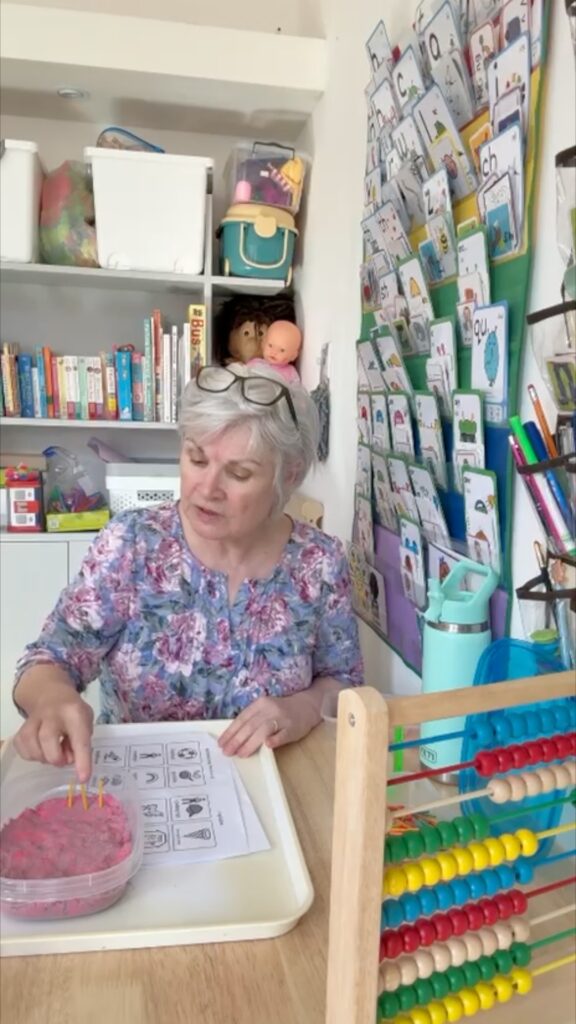
In my sessions, this part of the cycle is active, visual, and repetitive.
You might see me using:
👏 Clapping or tapping out syllables
🧩 Using visual supports or blocks for each beat
🎲 Play-based repetition of target words
🎯 High-frequency practice (lots of turns!)
I also keep the focus on success and flow, rather than correction.
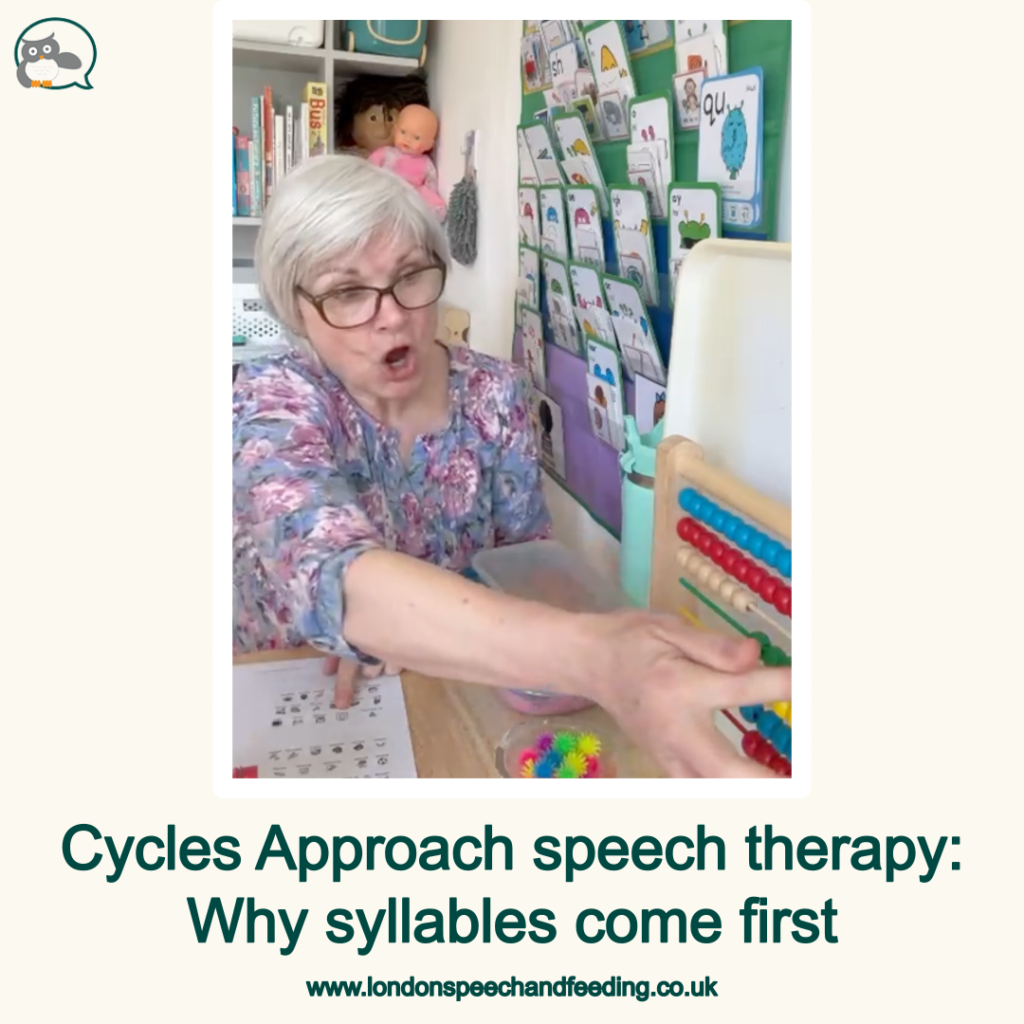
If you’re watching the video clip I’ve shared here, you’ll notice:
I’m not over-correcting every sound
I’m prioritising getting the whole word out
I’m building rhythm, confidence, and consistency
Why this stage is so powerful
It can look simple, but it’s doing a lot of heavy lifting.
Working on syllables helps children:
Say longer words more clearly
Reduce ‘mumbling’ or collapsing of words
Improve overall intelligibility quickly
Prepare for more precise sound work later
Often, parents notice early wins like:
✨ ‘They’re easier to understand already’
✨ ‘They’re saying longer words!’
✨ ‘They’re more confident speaking’
And that’s before we’ve even fully targeted specific sounds.
But will my child still learn their sounds?
Yes. Absolutely.
The Cycles Approach is structured so that after syllables, we move into:
Early developing sounds
Then more complex patterns (like fronting or clusters)
And importantly, we come back around again.
Nothing is missed. It’s just sequenced in a way that supports success.
A different way of thinking about progress
One of the biggest mindset shifts with the Cycles Approach is this:
👉 We’re not aiming for perfection straight away
👉 We’re aiming for gradual system-wide change
That means:
Your child doesn’t need to ‘master’ something before moving on
Progress builds across cycles
Speech becomes clearer over time, not overnight
So, to sum up
Starting with syllables might seem unexpected but it’s one of the most powerful foundations we can give a child whose speech is hard to understand.
By building rhythm, structure, and confidence first, we make everything that comes next more effective.
If your child is starting speech therapy and you notice we’re clapping words like ‘banana’ or ‘elephant’, there’s a very good reason for it.
We’re not going backwards.
We’re building from the ground up.
We’re making later sound work more effective and more likely to generalise into everyday talking.
Next steps:
If you’re concerned about your child’s speech clarity or wondering whether they might benefit from a structured approach like this, feel free to get in touch. I offer individualised assessments and therapy plans tailored to each child’s speech profile whether that’s early sound development, phonology, or motor speech difficulties.
Sonja McGeachie
Highly Specialist Speech and Language Therapist
Owner of The London Speech and Feeding Practice.
Find a speech and language therapist for your child in London. Are you concerned about your child’s speech, feeding or communication skills and don’t know where to turn? Please contact me and we can discuss how I can help you or visit my services page.
Parent FAQ section
Why is my child practising words like ‘banana’ instead of sounds like /K/ or /S/?
Because your child first needs to be able to hold and produce the full shape of a word. If they’re dropping syllables (e.g. ‘banana’ → ‘nana’), working on individual sounds won’t carry over into real speech. We build the structure first, then refine the sounds.
What if my child can already say some long words?
That’s great. But we’re looking for consistency and clarity across many words, not just a few familiar ones. This stage helps stabilise that skill so it becomes reliable in everyday talking.
How long will we stay on syllables?
Usually, this is a short but important phase within each cycle. We revisit it regularly, but we also move on to other patterns (like specific sounds or sound processes) within the same therapy block.
Will this delay my child learning their sounds?
No. In fact, it often speeds things up overall. Once the syllable structure is in place, children are much more able to use correct sounds in longer words and sentences.
What can I do at home?
Keep it simple and playful:
Clap out words together (e.g. ‘el-e-phant’)
Emphasise full words naturally in conversation
Repeat back what your child says with the full structure (without pressure)
Consistency and exposure matter more than correction.
My child gets frustrated. Will this help?
Yes. Many children become frustrated when they’re not understood. Improving syllable structure often leads to quick wins in clarity, which can boost confidence and reduce that frustration.
Building clearer speech: Why we practise syllables first
What are syllables?
Syllables are the ‘beats’ in words.
‘Table’ = 2 beats (ta-ble)
‘Banana’ = 3 beats (ba-na-na)
Why is my child working on this?
If your child:
Drops parts of words (‘banana’ → ‘nana’)
Mumbles longer words
Is hard to understand
…then we need to build the structure of words first.
This helps your child:
✔ Say longer words clearly
✔ Be easier to understand
✔ Feel more confident speaking
What does this look like in therapy?
We practise:
Clapping or tapping out beats 👏
Saying full words with rhythm
Repeating target words through play
Using visuals or actions to support learning
How you can help at home
Keep it light and playful, little and often!
Try this:
Clap words together أثناء play (e.g. toys, food, animals)
Model full words naturally (‘Yes, ba-na-na!’)
Repeat and expand what your child says
Example:
Child: ‘nana’
You: ‘Yes! Ba-na-na‘
Important to know
This is a key first step in speech therapy
We will move on to sounds—but this helps them stick
Small changes here can make a big difference in clarity
Tongue-tie, or ankyloglossia, is a condition where the lingual frenulum, the thin piece of tissue that connects the underside of the tongue to the floor of the mouth, is too short or tight. Tongue-tie is quite common in babies and is often not detected after birth. Tongue-tie can lead to a difficult start with breast feeding as it makes it very difficult for the baby to latch effectively.
In my clinical experience as a feeding therapist, I have seen many babies who were not able to latch well due to the frenulum being tight. In many cases an experienced feeding speech therapist/lactation consultant can really make a difference and help a new mum to latch the baby even though the tongue is tethered to the floor of the baby’s mouth. In some cases the frenulum can be divided and once this has been done, in some cases, feeding improves immediately or soon after the division. But this is not always the case. I have seen several babies who have had as many as four tongue-tie divisions and feeding was still difficult.
It is important to say that while tongue-tie can sometimes impact speech and feeding, it’s important to note that it’s not always the root cause of these difficulties. In recent years, there has been a surge of interest in tongue-tie division surgeries, with some cases being unnecessary. It’s crucial to understand the complexities of tongue-tie and the role of speech therapy in addressing related challenges.
The impact of tongue-tie on speech and feeding
When tongue-tie is severe, it can interfere with the tongue’s ability to move freely, affecting speech production and swallowing. Some common speech and feeding difficulties associated with tongue-tie include:
Feeding difficulties: Challenges with sucking, chewing, and swallowing.
Drooling: Excessive drooling due to difficulty controlling saliva.
Speech problems: Difficulty producing certain sounds, such as /l/, /r/, /t/, /s/ and /d/.
The importance of comprehensive assessment
Before considering any surgical intervention for tongue-tie, it’s essential to undergo a thorough evaluation by a qualified speech-language therapist (SLT). An SLT can assess the severity of the tongue-tie, its impact on speech and feeding, and determine if surgery is necessary.
Functional assessment: The SLT will assess the tongue’s range of motion, its impact on speech sounds, and the child’s overall oral motor skills.
Feeding evaluation: The SLT will observe the child’s feeding patterns and identify any difficulties related to tongue-tie.
Differential diagnosis: The SLT will rule out other potential causes of speech and feeding difficulties, such as apraxia of speech, dysarthria, or sensory processing disorders.
The role of speech therapy
Even in cases where tongue-tie is present, speech therapy can often be highly effective in addressing speech and feeding difficulties. Here’s how speech therapy can help:
Articulation therapy: Targeting specific speech sounds that may be affected by tongue-tie.
Childhood Apraxia of Speech (CAS): if the diagnosis by the SLT has shown that in fact the child has motor planning difficulties then there are very specific and effective treatment programmes that help with this and can make a real difference over time.
Feeding therapy: Strategies to improve swallowing, chewing, and oral-motor skills.
Sensory integration: Addressing underlying sensory processing issues that may contribute to feeding difficulties.
London Speech and Feeding Case Study: The importance of comprehensive assessment
One of my clients was initially diagnosed with tongue-tie and recommended for surgery at the age of eight years old. His speech had been perceived by parents and teachers as ‘mumbled and unclear’.
However, after a thorough evaluation, I was able to determine that the child’s primary issue was apraxia of speech, a neurological disorder that affects motor planning for speech. Parents decided to wait with surgery and trust my judgment and we proceeded with weekly intensive speech therapy to address motor planning difficulties around tricky sounds and words. I am delighted to say that the child’s speech has improved significantly, demonstrating the importance of comprehensive assessment and individualised treatment. He is no longer seen as a candidate for an operation, which would have been traumatic for him at his age and, as it turned out, entirely unnecessary.
Below is a short video clip of my working on the /l/ sound with this child.
Tongue-tie is a complex issue that requires careful evaluation and individualised treatment. While surgery may certainly be necessary in some cases, it’s essential to consider the potential benefits and risks. Speech therapy can be a highly effective approach for addressing speech and feeding difficulties associated with tongue-tie, even in cases where surgery is still required. By working with a qualified speech-language therapist, parents can ensure that their child receives the best possible care and support.
Feeding and Dysphagia (Swallowing) Specialist The London Speech and Feeding Practice
The London Speech and Feeding Practice
Find a speech and language therapist for your child in London. Are you concerned about your child’s speech, feeding or communication skills and don’t know where to turn? Please contact me and we can discuss how I can help you or visit my services page.