Submucous cleft palate: What is it and how does it impact on speech?

Submucous cleft palate: What is it and how does it impact on speech?
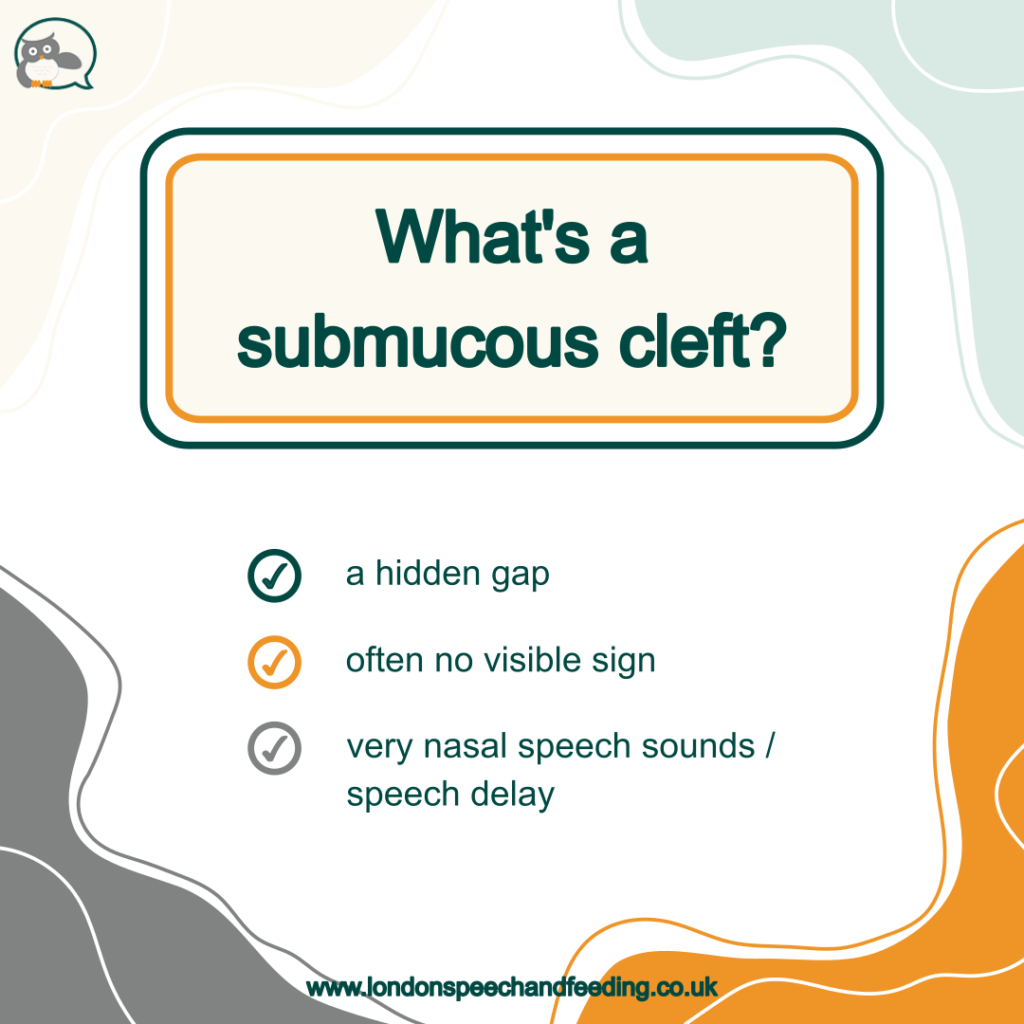
What exactly is a submucous cleft palate?

A submucous cleft palate (SMCP) is much less obvious than its counterparts, cleft of lip and/or palate, and can profoundly impact a child’s speech development. It leads to often extreme hyper nasal speech and difficulty with producing many sounds (/K/ /G/ /T/ /D/ /P/ /B/ /S/ /Z/ /F/ /V/).

In short, the muscles and bone of the soft palate, and sometimes the hard palate, do not fuse completely during foetal development and the mucous membrane that lines the roof of the mouth remains intact, effectively camouflaging the underlying muscular and bony deficit.

So, while the surface of the palate appears normal, the essential muscle and functions responsible for sealing off the nasal cavity from the oral cavity during speech are compromised. This cleft (or lack of muscle) can be seen as a bluish midline discoloration of the soft palate, often a bifid (split) uvula, and at times a notch in the posterior border of the hard palate can be felt upon palpation. However, these signs aren’t always present or easily discernible, contributing to the difficulty arriving at a diagnosis.

Diagnosing a submucous cleft palate is often akin to searching for a needle in a haystack, especially for the untrained eye. Unlike overt clefts that are visually apparent at birth, an SMCP can go undiagnosed for years, sometimes well into childhood or even adolescence. Paediatricians and even ENT surgeons have been known to miss it during routine checks due to the intact mucosal lining. Parents might notice their child’s speech sounds ‘different’ or ‘nasal’ but struggle to pinpoint the cause. Children might undergo extensive speech therapy without a proper diagnosis, as the underlying structural issue continues to hinder progress.

My experience as a speech therapist in private practice:

Over my years of practice, I have encountered several children presenting with persistent hyper-nasal speech and significant difficulties producing plosive and fricative sounds.

It has been incredibly rewarding, though at times challenging, to successfully diagnose SMCP in a number of these children. My approach often involves:

  • a meticulous oral motor examination,
  • careful listening for the specific qualities of hypernasality,
  • and a deep understanding of the physiological requirements for clear speech sound production.

When I suspect an SMCP, I refer these children to Great Ormond Street Hospital where a fantastic multidisciplinary team, typically including ENT surgeons and a specialist speech-language therapist can conduct more definitive assessments. These assessments often involve instrumental analyses such as videofluoroscopy or nasoendoscopy, which provide objective measures of velopharyngeal function and visual confirmation of the anatomical deficit.

The path to resolution: surgery, therapy, and successful outcomes

Surgery

The journey for these children, once diagnosed, often involves surgical intervention. It’s not uncommon for children with SMCP to undergo multiple operations to achieve optimal velopharyngeal closure. These procedures aim to reconstruct or augment the velopharyngeal mechanism, enabling it to effectively separate the oral and nasal cavities during speech. The specific surgical approach depends on the individual child’s anatomy and the severity of the velopharyngeal insufficiency. It’s a testament to the skill of these specialised surgeons that such intricate repairs can be performed with remarkable success.

Speech therapy

Following surgery these children embark on the crucial phase of speech therapy. While surgery addresses the structural problem, speech therapy helps a child learn to utilise their newly improved anatomy. It involves intensive work on developing oral airflow, establishing correct articulatory placement, and reducing learned compensatory strategies that have developed due to the original structural deficit. It is immensely gratifying to witness the transformation. Children who once struggled to produce basic sounds, whose speech was difficult to understand, gradually develop clear speech.

Next steps?

If you’re a parent concerned about your child’s speech and feeding, you’re not alone. The journey can feel confusing, but professional guidance can make all the difference. Never hesitate to have a second opinion when you have that niggling feeling that there is something that has not yet been explored. At London Speech and Feeding I specialise in being thorough and thinking outside the box.

I am here to provide the support you need. Reach out to schedule a consultation and take the first step towards helping your child communicate and thrive.

Sonja McGeachie

Highly Specialist Speech and Language Therapist

Owner of The London Speech and Feeding Practice.


Health Professions Council registered
Royal College of Speech & Language Therapists Member
Member of ASLTIP

Find a speech and language therapist for your child in London. Are you concerned about your child’s speech, feeding or communication skills and don’t know where to turn? Please contact me and we can discuss how I can help you or visit my services page.

1

Similar Posts

  • · ·

    LAMP Words for Life: A revolutionary AAC system

    Introduction

    When working with non-speaking or minimally speaking children the LAMP Words for Life AAC (Augmentative and Alternative Communication) system is my absolute go-to every time. For me it stands out as a revolutionary system that has transformed the lives of many of my non-speaking students. LAMP Words for Life is a ROBUST, comprehensive language-based AAC system and it is designed to help any user to express their thoughts, feelings, and needs effectively, thereby achieving maximal independence in their daily life. A winner!

    There is a whole host of AAC apps and systems out there and each has their own advantages and benefits for sure. I have tried a good number of other systems. I do also like certain features of other AAC systems for sure. For example GRID: I love the versatility of GRID and the ease of editing the system is fantastic.

    Why I think it works so well

    However, strangely I always return to LAMP when push comes to shove. I have thought very carefully about it and so here are my thoughts on why this is and why it works so well:

    1. Intuitive interface: LAMP Words for Life features are for me really user-friendly and it is easy to navigate and understand (this is very important for non-techy people). I think it makes sense and it is accessible to users of all ages and abilities. Yes the pictures are a little bit different to other symbol systems we use, especially here in the UK to be sure, and this is one of the reasons why it is good to have a variety of systems available, so that we can cater for students who are used to other symbols or do very well with specific symbol core boards. I have learned though that the pictures are not that important when using LAMP because the entire system is based on MOTOR PLANNING. And once one knows the motor plan to find a picture it is in our brain and we do not look at the picture any more. So, the motor plan to find a word is much more important when using LAMP than worrying about what the picture looks like.
    2. Comprehensive vocabulary: The system offers a vast vocabulary of words and phrases, covering a wide range of topics and contexts. This enables users to express themselves effectively on a variety of subjects. That said, almost every time I use LAMP there is a little word I need and it’s not on there. But that’s not a problem: for example, I was looking for ‘sunglasses’ the other day. Sure, there is ‘sun’ and ‘glasses’ but that would be two separate motor plans and for my student that would be too many for now, so it was very easy to quickly add the new word ‘sunglasses’ under ‘accessories’ or ‘beach wear’ — I added it within less than one minute. Likewise, there are a ton of words which cater for the US market, and I tend to change them to fit the UK vocabulary like ‘nappy’ for ‘diaper’. Or I delete them entirely if I feel my child will never need to use a certain word like ‘conference’ or ‘nun’. PS: should they get to a point of using the system as an adult independently then these words can surely be added again, or if my student ever moves to the US then the words can be changed back to US terms again without any problem.
    3. Grammar support: LAMP provides built-in grammar support, helping users construct grammatically correct sentences. This can be particularly beneficial for individuals with language processing difficulties. But what I love about the way LAMP is organised here is that, in contrast with other systems I have used, it does not PREDICT what you want to say, it lets the user decide and find the right grammatical structure. I appreciate this because, just like I hate my phone or email offering predictive text or offer corrections to my words, I really do not get the systems that offer automatically a grammar change which mostly I don’t want. Where that is the case, I am often confused and hindered in finding the correct wording. I love the simplicity of LAMP and at the same the complexity that can be achieved gradually with practice. LAMP is fully designed to enable a user to build up not only vocabulary but a full language system. On a course recently I was able to hear adult LAMP users speaking to the audience in full and quick grammatically well-rounded sentences on a host of topics.
    4. Customisation: LAMP can be customised to meet the individual needs of each user. This includes options for adjusting the vocabulary, layout, and accessibility features. It is not as easy to edit as GRID I will say and that can cause me a little bit of frustration at times, but on balance I still vastly prefer the system as a whole. It can also be customised quite well for Gestalt Language Processors. It takes a little bit of practice and thinking about how best to do this but I have found a way that works well which I demonstrate in the short video clip.
    5. Community support: LAMP Words for Life has a thriving community of users on Facebook and this is so valuable and inspiring. Therapists and families of LAMP users alike share experiences, provide resources, and offer encouragement. This can be a valuable source of support for both users and their families.
    6. Comprehensive support: LAMP Words for Life offers quick and thorough support services, including training, resources, and ongoing assistance. This is invaluable and reassuring for both users and caregivers.
    7. Research-based: The development of LAMP Words for Life is based on extensive research and evidence-based practices. This ensures that the system is grounded in sound scientific principles.

    Conclusion

    To conclude LAMP Words for Life is a powerful AAC which provides us with a means of effective communication, language development, and social interaction. Whether you are a parent of a non-speaking child or a speech therapist looking for innovative AAC solutions, LAMP Words for Life is worth exploring.

    Example on how to use AAC at story time

    Feel free to contact me if you need help with your child.

    Sonja McGeachie

    Early Intervention Speech and Language Therapist

    Feeding and Dysphagia (Swallowing) Specialist The London Speech and Feeding Practice

    The London Speech and Feeding Practice


    Find a speech and language therapist for your child in London. Are you concerned about your child’s speech, feeding or communication skills and don’t know where to turn? Please contact me and we can discuss how I can help you or visit my services page.

    1
  • Language development

    Kids Speech Therapist London
    Language Development

    Books, Stories And Colourful Semantics

    Many of my students have difficulties telling stories. When looking at a book together, even books they love and have seen many times, they often struggle to understand what they are reading and cannot therefore retell the story in any sequence. A great method I often use with those students is called Colourful Semantics.

    What is Colourful Semantics?

    Colourful Semantics is an approach aimed at helping children develop grammar and meaning of phrases and sentences. We help children identify WHO is the subject in a story, what is he/she/it DOING to WHAT and WHERE. There are lots of colour coded stages but we tend to start with the basic 4:

    WHO = ORANGE

    DOING = YELLOW

    WHAT = GREEN

    WHERE = BLUE

    Once a student is accomplished at this level, we move on to different colour codes for describing words (adjectives), connecting words (with/together/and/therefore) feeling words (PINK), timing words (BROWN) eg. when, tomorrow, last week etc.

    Colourful Semantics is a really useful method and helps children to organise their sentences. It also helps me knowing how to guide a student in thinking about the story.

    The approach can be used with children with a range of Speech and Language Needs, such as:

    • Developmental Delay / Disorder
    • Autistic Spectrum Condition
    • Down Syndrome
    • Any other syndromes and related speech and language delays
    • General Literacy difficulties

    There are a wide range of benefits to using this approach and I use it in my therapeutic work with children of around 3 years plus. Below is a little video which shows how I use it with this student who has general language difficulties associated with Autism. One of the main benefits with this student is that seeing the Cue Cards helps her to use a much wider range of vocabulary than she would ordinarily generate. Her sentences are getting longer and she is more able to answer questions. In general, I find it useful to help with storytelling and to guide us through the story in a sequence.

    There are many on-line games these days that have incorporated the Colourful Semantics Approach. Once a child is familiar with the basic colour scheme then gradually the visual prompts can be reduced to using verbal prompts.


    Find a speech and language therapist for your child in London. Are you concerned about your child’s speech, feeding or communication skills and don’t know where to turn? Please contact me and we can discuss how I can help you or visit my services page.

  • · ·

    Navigating the exciting 9–18 months journey: Your baby’s communication milestones

    Between 9 and 18 months, your little one undergoes a remarkable transformation, blossoming from a curious explorer into a budding communicator. This period is filled with exciting milestones in speech, language, and social development. Let’s delve into what you can expect.

    9–12 months: The world opens up

    Communication takes flight

    • Babbling becomes more complex with a wider range of sounds. By babbling we mean syllables like: pa ga ka ma da and then ‘baba’ gohgoh’. First we hear one and two syllables together and then longer and longer strings! This is so exciting!
    • First words! One day around the 12 months–14 months mark we hear a first word! My older son’s first word was ‘Licht’ which is the German word for ‘light’ as literally every time I carried him along the corridors in our home, I pointed out the light switches to him and turned them off and on a few times. And each time I said ‘Licht!’ and it stuck! PS: sadly I cannot remember what my younger son’s first word was… poor second and third babies they just have to muddle along and call loudly to get noticed!
    • Understanding grows! Baby now understands simple instructions like ‘where is your ball’ and responds by looking to the ball across the room!

    Social butterflies

    • Your baby now starts to show interest in other children, and may try to copy their actions. Now we are getting proper traction with simple social games like peek-a-boo and patty-cake. Whilst your baby is generally interested in other people and children he or she may show separation anxiety when mum or dad or other familiar person suddenly leaves the room and they feel alone with strangers.

    Fine motor skills

    • Pincer grasp develops. This is where your child puts an index finger to the thumb in order to pick up of small objects, hold them and transfer them to either a box, back on the floor or into the other hand.
    • Your baby may start to explore objects by banging, shaking, and mouthing.

    12–15 months: Words are taking shape

    • Language explosion: From our early words we now suddenly see baby’s vocabulary expanding, with new words added each week. I would highly recommend parents keep a little journal of all the words they hear. If nothing else this is a wonderful aide-memoire for years down the road when you might like to reminisce about the first ten words. I promise you otherwise you won’t recall! (especially for second and third babies; I would do this now, had I the time again).
    • Understanding grows:
      • By about 15 months our baby can follow simple two-step instructions like ‘Go get your shoes and bring them here.’
      • Begins to understand the concept of ‘no.’ and that’s a very useful thing. Though before you breathe a sigh of relief… your toddler may well show you that he is understanding a ‘no’ though he may not stop doing what he is doing or come down off the table!
    • Playtime gets interactive:
      • Now we engage in more complex play, such as stacking blocks, pretending to eat with a spoon, and imitating actions.
      • Many toddlers now start showing an interest in picture books.

    15–18 months: Communication blossoms

    • Words combine: Towards 18 months or around about then your toddler may start to put two words together, such as ‘more milk’ or ‘bye-bye dada.’
    • Gestures and sounds: Now we also use gestures to communicate, such as pointing, shaking head ‘no,’ and waving ‘bye-bye.’
    • Exploration and curiosity:
      • Your toddler is now EVERYWHERE! Turn your back and he or she is gone! Your toddler now shows a strong sense of curiosity and explores their environment with enthusiasm.
    • Copying
    • Look out for actions and gestures your toddler will copy such as clapping hands or patting a cushion or banging a spoon on the table .

    Remember

    • Every child develops at his or her own pace.
    • These are just general guidelines, and some children may reach certain milestones earlier or later than others.
    • If you have any concerns about your child’s development, please consult with your speech and language therapist. We are always keen to hear from parents and happy to help promote all those lovely early skills.

    General tips to encourage communication if you feel your child needs a little more help

    • Talk, talk, talk! Engage in frequent chatting with your child.
    • Listen to your child: Allow for periods of silence when playing with your child to allow them to say something or make sounds which you can then copy and respond to.
    • Read aloud regularly. Use books with simple words and pictures.
    • Play interactive games: Hickory Dickory Dock, Row Row the boat, Old McDonalds, 5 little monkeys jumping on the bed, chasing and catching, tickling games.
    • Respond to your child’s babbling and gestures. You can copy them or if your toddler says long strings of babbling you cannot understand you could just say: ‘Oh ok!? ‘yes that’s great!’ ‘who knew!’ ‘wow you’ve got much to say!’ as if you understood.
    • Limit screen time or if your child is very passionate about watching clips then sit and watch with your child so that you can see what is the best bit, which songs they like the best and what sort of phrases they love hearing.

    This exciting period of rapid growth and development is a precious time for both you and your child.

    By providing a loving, stimulating, and responsive environment, you will naturally nurture their communication skills! Any more questions, please get in touch!

    Sonja McGeachie

    Early Intervention Speech and Language Therapist

    Feeding and Dysphagia (Swallowing) Specialist The London Speech and Feeding Practice

    The London Speech and Feeding Practice


    Find a speech and language therapist for your child in London. Are you concerned about your child’s speech, feeding or communication skills and don’t know where to turn? Please contact me and we can discuss how I can help you or visit my services page.

    1
  • · ·

    Why ‘Prosody’ Matters in Childhood Apraxia of Speech (CAS)

    Prosody refers to the ‘music’ of speech — the rhythm, pitch, stress, and volume that convey meaning and emotion beyond the literal words themselves. Think about a monotone statement like ‘Really?’ compared to one with a rising inflection, expressing genuine curiosity.

    When I work with children on producing speech sound sequences, we focus on mastering individual sounds and then putting them together into target words. A crucial element that can significantly impact a child’s speech production is ‘prosody’.

    In CAS, where the difficulty lies in planning and executing the motor movements for speech, prosody can be a powerful tool for producing clearer words and phrases.

    Here’s why working on prosody is an essential tool in CAS speech therapy:

    1.  It aids Motor Learning:

    Apraxia of Speech means that the planning and execution of speech movements are impaired. When we use exaggerated intonation or stress patterns while modelling words, we are providing additional prosodic variation and, therefore, additional auditory cues. These cues often help my student to carry out the correct motor movements for a word or syllable sequence.

    For instance, I might say ‘ball’ with a high-pitched emphasis on the ‘b’ sound. This auditory cue might be more effective in guiding the child’s tongue placement than simply repeating the word without variation.

    In this little video clip I get my student to say the word ‘snuggle’ (since we were working on that particular sound sequence: snuggle, snout, snore and sneeze) with a high voice and then a lower voice ‘like a bear’ — again it provides that extra auditory cue, but, in addition, the fun aspect also helps to take away the intense focus on a tricky movement pattern.

    By now the new pathways have been laid through repeated practice and now automaticity takes over and without too much effort my student can suddenly produce a motor pattern. It’s magical when it happens and gives me such a thrill.

    2. It makes speech more engaging and natural sounding:

    Children with CAS often sound robotic or flat due to challenges with prosodic elements. By incorporating variations in pitch, volume, and rhythm during therapy, we can help achieve a more natural flow of speech

    3. It makes it easier to express our emotions:

    Children with CAS often struggle to express themselves emotionally; partly through the difficulty of producing clear words — period, but also in addition due to the difficulties or absence of musicality and rhythm in their speech.

    Therefore, it is so important to incorporate activities focused on practising different emotions with varied intonation patterns. This can really empower our students to put emotions into their words.

    Good words to practise are fun words like ‘Wow!’ or ‘Yeiih’ or power words and phrases like ‘No!’ or ‘Gimme that’ etc.

    Making Therapy Fun and Engaging:

    Speech therapy for CAS doesn’t have to be all drills and exercises (though to be fair sometimes we can’t quite get round to making each and every word huge fun though we try…).

    I aim to make all my sessions fun and have intrinsic rewards built into the speech practice where possible.

    Home practice tips:

    Therapy shouldn’t exist in a bubble. Working on prosody during sessions is crucial, but it’s equally important to integrate these skills into everyday interactions. Parents and caregivers can model appropriate prosody during playtime, story time, or even simple conversations. This consistent reinforcement helps our children to generalise their newfound skills and use them naturally in their daily lives.

    • Sing songs and rhymes: Songs naturally incorporate variations in pitch and rhythm. Singing familiar songs and creating silly rhymes can be a delightful way to practise prosody.
    • Use puppets and toys: Assign different voices and personalities to puppets or toys. This encourages children to experiment with pitch and volume to differentiate characters.
    • Read aloud with enthusiasm: Model expressive reading, varying your voice for different characters and emphasising key words. This makes reading time engaging and helps children understand the power of prosody.

    Please feel free to contact me if your child has speech sound difficulties. It is my passion. I love supporting children with apraxia.

    Sonja McGeachie

    Early Intervention Speech and Language Therapist

    Feeding and Dysphagia (Swallowing) Specialist The London Speech and Feeding Practice

    The London Speech and Feeding Practice


    Find a speech and language therapist for your child in London. Are you concerned about your child’s speech, feeding or communication skills and don’t know where to turn? Please contact me and we can discuss how I can help you or visit my services page.

    1
  • · · ·

    The joy of container play: Exploring play development and understanding of how things work

    Have you heard the term ‘Container play’? I use this very often with children in my sessions as it is so versatile and an enjoyable activity that can be done in parallel with a child or together. Container play is a powerful tool for fostering development in young children, especially those with developmental delays. This seemingly mundane activity provides a rich environment for sensory exploration, motor skill development, and cognitive growth.

    What is container play?

    Container play involves children interacting with various containers—boxes, buckets, bowls, cups, various bags, etc.—and filling, emptying, and transferring objects within and between them. Objects can include literally anything: small beads, bead chains, table tennis balls, wooden pegs, dinosaurs or any other little person toy, blocks of varying sizes, sand, water, or any other safe material. Larger containers obviously take larger items: socks, stuffed animals, bigger balls, bigger blocks etc really the choices are endless.

    Benefits for children with developmental delays:

    Sensory exploration:

    • Touch: Children explore different textures and temperatures of containers and objects.
    • Sight: They observe how objects look inside and outside the containers, how light reflects off them, and how colours change.
    • Sound: They listen to the sounds of objects clinking, rattling, and splashing.
    • Proprioception: Filling and emptying containers helps develop body awareness and spatial awareness.

    For neurodivergent children who might have sensory regulation difficulties, consider the following adaptions to accommodate your child’s sensory needs:

    • Over-stimulation: For children who are easily overstimulated, start with simple setups using a limited number of containers and objects. Gradually increase the complexity as they tolerate it.
    • Under-stimulation: For children who seek sensory input, provide a variety of textures and materials, such as sand, water, slime, or beans.
    • Temperature: Offer a variety of temperature options. Some children may enjoy warm water or cool sand.
    • Lighting: Adjust the lighting to create a calming or stimulating environment.
    • Focus on one sense at a time: Initially, focus on one sensory aspect, such as the feel of sand or the sound of water.
    • Weighted containers: Use heavy containers filled with rice or beans to provide deep pressure input.
    • Fidget toys: Incorporate fidget toys into the activity to provide sensory input and help with self-regulation.
    • Tactile exploration: Encourage exploration of different textures using objects with varying surfaces.

    Fine motor skill development:

    • Hand-eye coordination: Scooping, pouring, and transferring objects require precise hand-eye coordination.
    • Pincer grasp: Picking up small objects helps develop fine motor skills like the pincer grasp.
    • Strength and dexterity: Manipulating containers and objects strengthens hand muscles and improves dexterity. Opening and closing containers can be a huge area of interest; how does the top screw back on, or off?

    Cognitive development:

    • Cause and effect: Children learn that their actions (e.g., pouring water or sand) have consequences (e.g., the water spills).
    • Spatial awareness: They develop an understanding of concepts like inside, outside, full, empty, and over/under; also how big is the vessel and how much goes in before it’s full or spills over. How small is the vessel opening and what do I need to do to get the beads into the container.
    • Problem-solving: Children learn to solve problems, such as how to get an object out of a narrow container or how to transfer water without spilling.

    Social and emotional development:

    • Communication: Container play can encourage communication as children interact with others, sharing toys and commenting on their actions. Asking for help to open and close a container is often a great opportunity to practise ‘help me’ or ‘open it’
    • Turn-taking: Sharing containers and materials helps children learn to take turns and cooperate.
    • Sensory regulation: For children with sensory sensitivities, container play can be a calming and self-regulating activity.

    Tips for engaging children in container play:

    • Create a safe and inviting environment. A shower curtain on the floor makes things easier for tidy up afterwards. And it allows for spillages.
    • Provide a variety of containers: Use different sizes, shapes, and materials. Use containers that are visually interesting and pleasing, perhaps a festive biscuit tin, or a tin that looks like train engine. Use see-through containers at first which make the filling and emptying more obvious. This is important for children who have no previous experience with this type of play and need to ‘warm up’ to it. Once a child loves and is used to container play you can go wild with all types of containers.
    • Offer a variety of objects: Include balls, blocks, sand, water, and other age-appropriate materials.
    • Join in the fun! Start off the process, show your child what the joy of the activity is for yourself, how fun it is to fill and empty containers, provide enough containers for your child to start playing alongside you, and comment on their actions.
    • Follow your child’s lead: Allow them to explore and experiment at their own pace.
    • Adapt activities: Adjust the level of challenge based on your child’s abilities and interests.

    Container play is a simple yet powerful tool that can support the overall development of young children, especially those with developmental delays. By providing a rich and engaging sensory experience, container play can help children build essential skills in motor, cognitive, social, and emotional domains.

    If you have any questions or would like to have more in-depths demonstration of this or other play styles for your child please contact me.

    I look forward to hearing from you.

    Sonja McGeachie

    Early Intervention Speech and Language Therapist

    Feeding and Dysphagia (Swallowing) Specialist The London Speech and Feeding Practice

    The London Speech and Feeding Practice


    Find a speech and language therapist for your child in London. Are you concerned about your child’s speech, feeding or communication skills and don’t know where to turn? Please contact me and we can discuss how I can help you or visit my services page.

    1
  • ·

    The importance of child-led therapy

    Child-led therapy is essentially what it says, therapy sessions that are directed by your child. You may think how can my child’s Speech and Language Therapist focus on goals if sessions are led by my child.

    Let us explain…

    Your child will be more receptive and motivated to take part in therapy if they have some form of input. E.g., they can choose what toys they want to play with, or how they want to play with the resources available. If sessions are child-centred then they are much more likely to engage and reach their goals, making intervention valuable. They will also be able to regulate their emotions, and use movement to support their need for regulation. E.g., some children like to jump whilst others like to run. As Speech and Language Therapists we need to use what is meaningful to your child to get the most out of intervention. By focusing on child-led therapy, we can build trust, which will allow us, in time, to use new techniques and activities that your child may enjoy. We want children to be themselves, to show their true personality. Therapy is about enhancing their skills in their own individualised way and child-led therapy allows for this.

    This way of working may seem daunting to some, but it doesn’t have to feel this way. Parents often feel if they are prepared then activities may go smoother. It might be the case, but perhaps it doesn’t give your child the opportunity for spontaneity. We’d like to suggest something that may lead to some surprises. Put out an activity that is your child’s favourite and then a completely new activity. Remember these activities don’t have to be complicated. Often, the simpler the better!

    So, no need to plan, just place two activities out and see what happens! Look out for anything which surprises you, which activity did they prefer? Do they have any sensory preferences? The freedom of choice is a wonderful thing to explore. So, just go with the flow!

    The kind of activities that are useful for child-led play can include:

    • Hide and seek
    • Cooking or baking
    • An Exercise ball
    • Small world play
    • Pretend play
    • Musical instruments (you could even have a go at making your own)

    Child-led therapy is a very useful resource. We have it at our fingertips. We don’t need special resources. You just need yourselves and your child! Sometimes, child-led therapy can be tricky to put in place. It sounds easy but is much harder in reality. So, make sure you give it time and reflect on your experiences. Ask yourselves ‘what went well’, and ‘what could be improved’. E.g., perhaps you gave your child time to lead to begin with, but you didn’t give them enough time to think about their options during the activity.

    How can parents become more child-led in the home environment?

    • Pause and use silence. This gives your child the opportunity to lead.
    • It’s perfectly natural to want to talk. Afterall, this is how adults maintain conversations. If you find yourself talking too much, count to ten! This will allow your child time to respond or initiate in the conversation or interaction.
    • Move down to your child’s level. It’s much easier to see what’s going on if you’re at the same height.
    • Videoing you and your child can really help you to see where your strengths lie. You’ll also be able to make minor tweaks to improve your communication during child-led play.

    Contact Sonja for more advice on speech, language and communication during child-led play.


    Find a speech and language therapist for your child in London. Are you concerned about your child’s speech, feeding or communication skills and don’t know where to turn? Please contact me and we can discuss how I can help you or visit my services page.

    0