Why pretend play is the perfect therapy vehicle for children with dyspraxia
| |

Picture this. A small dinosaur is stomping across a wooden floor. A tiny teacup is being filled with imaginary juice. Someone, probably you, has just been told very firmly that you are the baby and you must go to sleep now.

To the outside world, this is just play. Joyful, chaotic, completely ordinary toddler play.

But for a child with Childhood Apraxia of Speech (CAS), also known as verbal dyspraxia, what is happening inside a well-designed pretend play session is anything but ordinary. It is, in fact, some of the most powerful motor speech therapy we have.

Let me explain why.

First, a quick reminder: what is dyspraxia?

Childhood Apraxia of Speech is a motor speech disorder. The difficulty does not lie in the muscles of the mouth, those are perfectly capable. The difficulty lies in the brain’s ability to plan and sequence the precise movements needed to produce speech sounds consistently and accurately.

A child with CAS knows what they want to say. The message is there. But somewhere between the intention and the execution, the plan breaks down. Words come out differently each time, or not at all. It is effortful, unpredictable, and for many children, deeply frustrating.

What this means for therapy is important: CAS requires motor learning, not just language stimulation. And motor learning has very specific conditions under which it thrives.

Repetition is the medicine and pretend play delivers it without the child noticing

One of the most well-established principles of motor learning is that new movement patterns need to be practised many, many times before they become reliable. Think of learning to ride a bike, or to touch-type. Repetition is how the motor system builds consistency.

For speech, this means a child needs many opportunities to attempt a target word or phrase within a single session. In a formal drilling exercise, this quickly becomes tedious and dysregulating, especially for young children. After five attempts at ‘go’, most three-year-olds have mentally left the building.

But inside a pretend play scenario? The word ‘go’ appears naturally and meaningfully dozens of times. The car goes. The train goes. Ready, steady, go. Go to sleep. Go there doggie. Every repetition is embedded in a moment that makes sense to the child, which means they are motivated to keep going, and the practice is accumulating without any sense of effort or demand.

A relaxed brain learns better

There is a reason I tend not to sit a dyspraxic child at a table with flashcards and ask them to repeat after me. It is not because I lack structure. Every session I run has clear targets and intentional design. It is because we know that anxiety and pressure actively interfere with motor learning.

When a child feels observed, corrected, or under pressure to perform, the cognitive load increases and the very motor planning system we are trying to support becomes less accessible. The errors increase. The frustration escalates. The session unravels.

Pretend play, by contrast, creates a state of engaged, relaxed absorption. The child is leading. They are safe. They are having fun. In this state, the brain is far more receptive to new motor patterns being laid down. I am not asking the child to perform speech. I am simply being present, following their lead, and slipping in carefully chosen models at exactly the right moments.

Child-led play gives us the child’s own words to target

Another reason pretend play works so beautifully for children with dyspraxia is that it tells us exactly which words matter most to this particular child, right now, today. When a child reaches for the toy telephone and hands it to me with enormous expectation, I know that ‘hello’ is a word worth targeting in this moment. When they are clearly trying to tell me that the baby needs feeding, ‘more’ and ‘eat’ have instant, genuine relevance.

Targeting words a child is already motivated to say means the communication attempt is coming from them. And a self-initiated attempt, even an approximation, is neurologically far more valuable than a prompted imitation.

What this looks like in practice

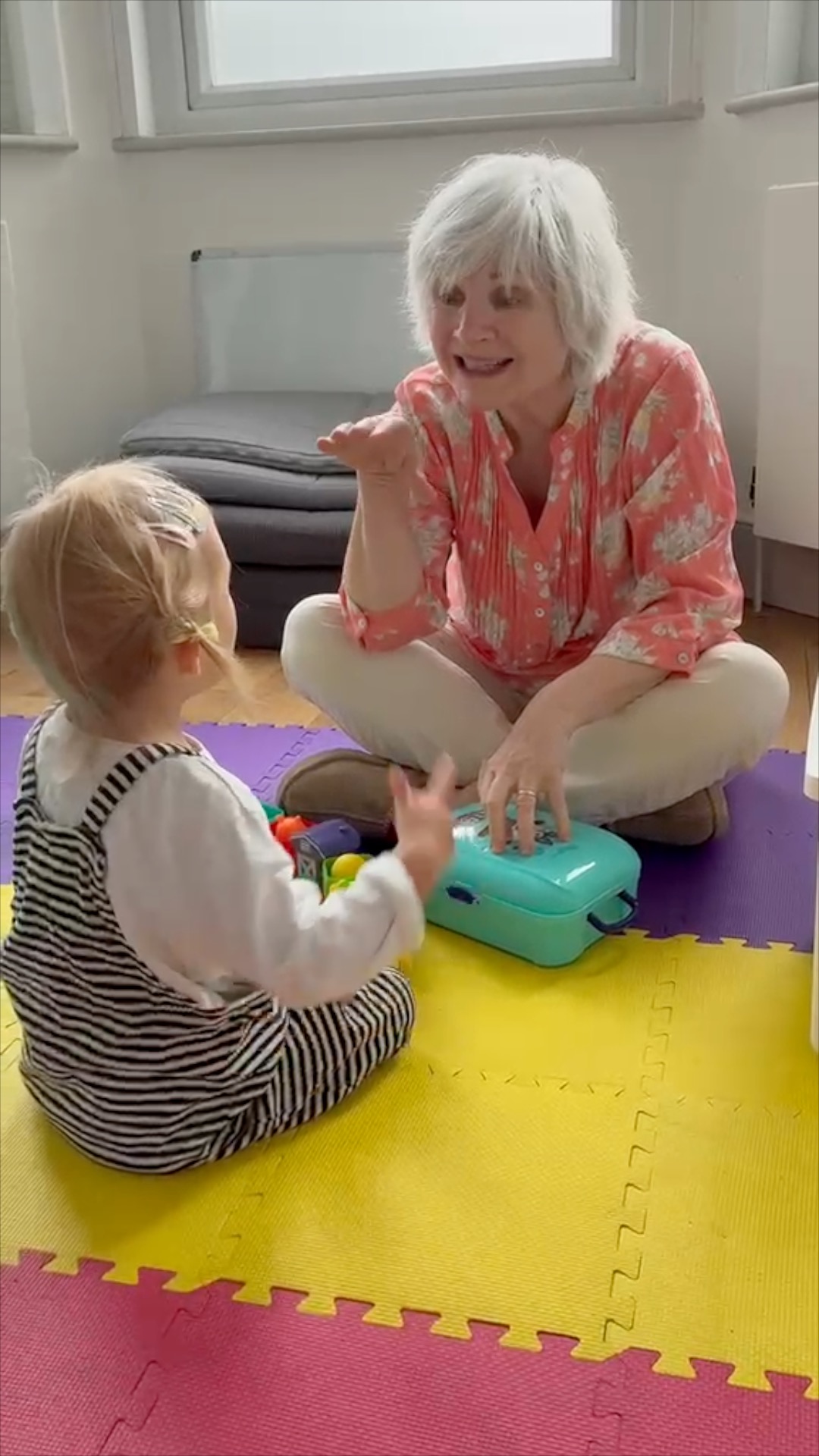
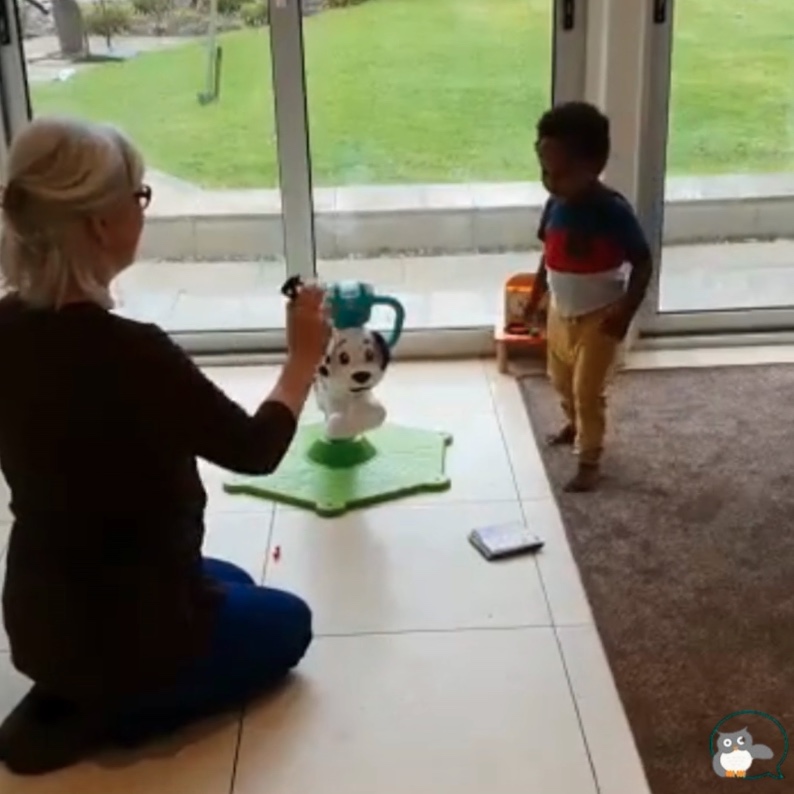
In the short video clip below you can see this dynamic in action. Notice how the session looks relaxed and playful on the surface. The child is absorbed in the pretend play scenario we have created together.

Notice, though, what is happening underneath:

  • the consistent, gentle modelling of target words
  • the use of Makaton signs alongside speech to provide an additional sensory pathway
  • the visual mouth cues that give the child a roadmap for how a sound is shaped
  • and running through all of it, the repetition. The same words, again and again, wrapped in play.

This is not therapy disguised as play. It is therapy that is play, because for a child with dyspraxia, those two things are not in opposition. They are, in fact, perfectly aligned.

If you are concerned about your child’s speech and wondering whether verbal dyspraxia might be a factor, please do not hesitate to get in touch. I would love to help you find some answers.

Sonja McGeachie

Highly Specialist Speech and Language Therapist

Owner of The London Speech and Feeding Practice.


Health Professions Council registered
Royal College of Speech & Language Therapists Member
Member of ASLTIP

Find a speech and language therapist for your child in London. Are you concerned about your child’s speech, feeding or communication skills and don’t know where to turn? Please contact me and we can discuss how I can help you or visit my services page.

3

Similar Posts

  • · ·

    A helpful addition in my toolbox for lisp correction

    Meet the MUPPY – a vestibular orthodontic plate

    I have become very well versed in Lisp Correction because so many children come to me with this problem! And I absolutely love lisp correction and Articulation Therapy! Please take a look at my blog on tips and tricks for correcting a lisp.

    The MUPPY

    Over the years I have created my unique style of remediating an Interdental Lisp and as part of my treatment I sometimes use an Orthodontic Tool, called the ‘MUPPY’, which I purchase directly from Germany. I first discovered it some years ago when working with a child with Down Syndrome. Back then I was searching for additional support with my student’s jaw grading and mouth closure difficulties and that’s when I first came across this little tool as recommended by one of my colleagues, a specialist orthodontist in Germany.

    I was a bit sceptical at first but I have used it now many times for three years on a variety of clients with varying degrees of lisps. I find it really helps together and in addition to all my other techniques which are language and motor based.

    How do I use it?

    The MUPPY is a custom-made mouth plate that gently repositions the tongue, encouraging correct tongue placement for clearer speech. It sits comfortably between the lips and teeth; a thin wire sits right behind the teeth, inside the oral cavity.

    The plate I like to use for lisp correction has a pearl in the middle. As soon as it is in situ the tongue starts fishing for the pearl and thereby keeps on moving up towards the correct place on the hard palate, just behind the front teeth. This is the place where the tongue tip needs to be for all the alveolar sounds our students find so hard to make.

    How does this help reduce a lisp?

    A lisp results mainly from incorrect tongue placement during sound production – though at times atypical dentition also contributes to the problem. Specifically, an interdental lisp occurs when the tongue protrudes between the teeth during the production of sounds like /S/ and /Z/. The tongue is often described by parents as ‘thrusting forward’ but I find that is rarely the case. Most often the tongue simply protrudes forward, which is different to tongue thrusting, a more forceful and involuntary movement. Most often I see a habitual tongue protrusion not only for /S/ and /Z/ but also for /T/, /D/, /L/ and /N/. Often /SH/ and ZH/ are also affected.

    To visualise this:

    1. A correct /S/ sound looks like this: The tongue tip is raised and touches the alveolar ridge (the bony, slightly uneven ridge behind the upper teeth). The sides of the tongue touch the upper molars.
    2. Interdental lisp: The tongue tip protrudes between the front teeth, creating a /TH/ sound.
    3. Lateral lisp: Here the mechanics of the tongue are different. But using the MUPPY can help here too. To visualise a lateral lisp, the sides of the tongue are not raised high enough, allowing air to escape over the sides. This results in a ‘slushy’ or ‘wet’ sound.

    Understanding the specific type of lisp is crucial for targeted therapy and successful correction.

    The Vestibular Plate (Muppy) HELPS to guide the tongue towards the right place from where we shape the NEW SOUND.

    Methods

    Most important to my articulation work re lisping are the motor- and language-based techniques I use, as broadly described below:

    • A thorough oral examination, tongue movements, lip closure, dentition, jaw grading, breath coordination, cheek tonicity, palatal form
    • Discussion on awareness and motivation of child to work on their speech
    • Contrasting sounds at the beginning and end of words: sing vs thing / sink vs think / mess vs mesh etc to raise awareness that it matters what sounds we use in speech and that just one sound can change the meaning of a word completely
    • Mirror work, pulling faces, moving our tongue voluntarily
    • Exploring the oral cavity and thinking about all the parts of the tongue and the palate
    • Finding the alveolar ridge and placing the tongue there at rest
    • Then working towards a good baseline of the other alveolar sounds: /T/ /D/ /L/ /N/ and from there we work towards our NEW /S/ SOUND.

    I use a variety of picture clues depending on what is most meaningful for my student:

    The child likes a train set, I use the TIRED TRAIN SOUND.

    The child knows about bike or car tyres, I use the FLAT TYRE SOUND.

    With a student who loves a balloon I might use the FLAT BALLOON SOUND.

    And we work our way from correct tongue placement to these long /SSSSSSSSS/ sounds with the help of these visual cues, but also gestural and hand cues such as Jane Passy’s Cued Articulation sound for /S/.

    I really love helping children correct their speech sound, be it an articulatory difficulty like the lisp or a phonological difficulty such as ‘fronting’ or ‘gliding’ and I also love working with motor-based speech difficulties we see in Childhood Apraxia of Speech. Feel invited to get in touch if your child needs help in these areas.

    Sonja McGeachie

    Early Intervention Speech and Language Therapist

    Feeding and Dysphagia (Swallowing) Specialist The London Speech and Feeding Practice

    The London Speech and Feeding Practice


    Find a speech and language therapist for your child in London. Are you concerned about your child’s speech, feeding or communication skills and don’t know where to turn? Please contact me and we can discuss how I can help you or visit my services page.

    1
  • · · · ·

    Let’s ditch the ‘Fix-It’ approach to autistic play and stimming

    Let’s ditch the 'Fix-It' approach to autistic play and stimming

    December is often presented as a time of perfect, reciprocal play. Children are supposed to be unwrapping toys, sharing, and engaging in imaginative scenarios with family. But for parents of young autistic children, this high-pressure, socially demanding period can often feel like a battleground.

    If you’ve been told to interrupt your child’s stimming, push for eye contact, or force them to play ‘functionally’ with toys, it’s time to take a deep breath. Those traditional approaches are not only stressful—they often miss the point of your child’s communication.

    As a neurodiversity-affirming Speech and Language Therapist, I want to encourage you this December: You are allowed to follow your child’s lead, validate his or her unique interests, and trust that his or her play and movement are profoundly meaningful.

    1. Stimming: not a distraction, but a regulator 💡

    Stimming is short for self-stimulatory behaviour and includes repetitive movements or sounds like hand flapping, humming, rocking, finger flicking, or repeating phrases (called echolalia).

    For years, parents were incorrectly advised to block or eliminate these behaviours. The neurodiversity-affirming view tells us the exact opposite: Stimming is a vital and essential tool for your child’s self-regulation.

    Think of stimming as an internal volume dial:

    • Too loud/overwhelmed: Your child may stim to reduce incoming sensory input (e.g., rocking to ground himself or herself in a busy room).
    • Too quiet/under-stimulated: Your child may stim to increase sensory input and focus (e.g., running back and forth to maintain alertness).

    The shift: validate, don’t block

    Instead of saying, ‘Stop flapping your hands’, try to understand the message behind the movement.

    • Observe: When does the stimming happen? Is it before a meltdown? When your child excited? When your child is bored?
    • Validate: Name the need, not just the behaviour. You might say, ‘I see your body needs to move fast right now. That helps you calm down!’
    • Co-regulate: If the stim is unsafe (e.g., head-banging), help your child find a safer, alternative stim that meets the same sensory need (e.g., pushing hard against a wall, squeezing a stress ball).

    By validating your child’s need to regulate, you are building trust, reducing anxiety, and teaching him or her critical self-awareness.

    2. Autistic play: Meaningful, even if it’s monologue

    The traditional idea of ‘good play’ often involves turn-taking, pretending, and specific toy functions (e.g., pushing a train around a track). When an autistic child spends 30 minutes lining up cars, spinning their wheels, or scripting whole scenes from a favourite movie, it can often be dismissed as non-functional or repetitive.

    In neurodiversity-affirming practice, we recognise that autistic play is authentic play. These activities are crucial for learning, deep focus, and imaginative development.

    • Lining up toys may be an exploration of patterns, visual organisation, and order.
    • Spinning wheels may be a deep interest in cause-and-effect and visual sensory input.
    • Scripting is often a way to process language, regulate emotions, and practise complex social situations in a safe, controlled way.

    Make a change: Join your child’s world, don’t drag them to yours.

    Stop trying to force the ‘right’ way to play. Instead, try these neuro-affirming strategies:

    1. Be a co-regulator, not a director: If your child is lining up cars, sit down next to him or her. Instead of moving a car, try handing him or her another car to line up. Focus on the shared interest rather than forcing interaction.
    2. Narrate (don’t question): Avoid constantly asking, ‘What are you doing?’ or ‘What does this car say?’ This puts pressure on your child to perform. Instead, narrate your observations using his or her interest: ‘I see you made a long, straight line of red cars. Look at all the wheels spinning!’
    3. Validate the interest: Show genuine appreciation for your child’s focus. ‘Wow, you know so much about how magnets stick together! That’s incredible.’

    3. The communication revolution: Honouring gestalt language processing 

    Many young autistic children communicate in ways that don’t fit the traditional model of building language word-by-word. Many use Gestalt Language Processing (GLP).

    A gestalt language processor learns language in chunks or scripts (e.g., ‘what’s-in-there?’ or ‘ready-go!’). These chunks (or gestalts) are not random; they are often tied to an emotional memory or meaning. Over time, the child breaks down these big chunks into individual words then learns to recombine those words creatively.

    If your child repeats movie phrases or whole sentences that seem unrelated, he or she is likely a gestalt language processor!

    Affirm the script, then model something useful.

    1. Affirm the script: When your child says a script, respond to the meaning or emotion behind it, not the literal words. If he or she says, ‘We’re going to need a bigger boat’, and he or she is looking at a messy toy pile, he or she may be trying to express overwhelm or a need for help. You can affirm: ‘That pile is too big! I can help you move it.’
    2. Model new ‘mix and match’ scripts: To help your child move from whole scripts to single words, you can model shorter, slightly changed versions of the script, also called ‘mitigated gestalts’. If they say, ‘I want to go home now’, you might model, ‘Let’s go home, now’ or ‘I wanna go home’.

    By honouring your child’s communication style, you validate his or her experience and naturally support his or her path to language development—a core part of neurodiversity-affirming SLT.

    Your December gift to your little one:

    This December, stop trying to make your child fit into a neurotypical box. Instead, make your home a safe space where he or she can be his or her authentic selves.

    Prioritise regulation and connection over compliance.

    Trust that when your child is regulated, his or her communication, learning, and engagement will flourish naturally. This is the true gift of neurodiversity-affirming practice.

    Download and print my neuro-affirming quick reference guide and keep this guide handy on your fridge and/or in your child’s play area for a quick reminder to prioritise connection over conformity.

    Sonja McGeachie

    Highly Specialist Speech and Language Therapist

    Owner of The London Speech and Feeding Practice.

    Health Professions Council registered
    Royal College of Speech & Language Therapists Member
    Member of ASLTIP

    Find a speech and language therapist for your child in London. Are you concerned about your child’s speech, feeding or communication skills and don’t know where to turn? Please contact me and we can discuss how I can help you or visit my services page.
    2
  • Attention Autism Therapy

    Sonja is kneeling on a multicoloured carpet holding a bucket in one hand and a toy in the other
    Sonja

    Attention Autism” is an Early Years Intervention designed by Gina Davies, Specialist Speech and Language Therapist. Gina created this amazing therapy approach based on her many years of working with children on the autism spectrum. It aims to develop natural and spontaneous communication through the use of highly motivating activities. These activities offer your child an IRRESISTABLE INVITATION to engage and attend to.

    I love using this approach and have trained in all of the stages including the Curiosity Stage which is for another blog. I use it frequently with all children who have trouble attending, listening, sitting or waiting regardless of whether they are neuro-diverse or neuro-typical, this activity and method is so great for all children!!

    Why is it important for our children to attend and listen?

    It is commonly assumed that, as our child has passed their hearing tests he/she will be able to listen and respond to being called, being questioned or asked to do something. However, all children I see in my practice have reduced joint attention skills, which means that whilst their hearing is often good, even brilliant to the point that they can often hear a faint noise somewhere outside the house like a distant train rushing by – but strangely they can’t seem to hear their name being called. Parents often ask me why this is the case, why can my child not turn round when I call him?

    The reason lies in the difference between hearing and listening. Listening is a skill that needs to be learned and practiced. As a child develops, their hearing tunes into (listening) the sounds and noises they hear on a daily basis. This is how a child develops understanding of the speech sounds they hear every day (which then form the basis of their native language); they also get to know “their door bell, dog barking next door, daddy coming up the stairs” and so on. They tune into those common every day sounds and noises and gradually start to copy speech sounds to form words. So listening is tuning our ears to the sounds that surround us. In contrast, many of us have to work in large office spaces or noisy environment, perhaps even a café, etc, where we are able to tune out those environmental noises and sounds that surround us, for otherwise we will not get that report/piece of work done in time! Our focus means that we become single-minded and single-channelled concentrating on our work and so we do not hear people chat and clutter all around us.

    Tuning in and out is a skill that we learn and some of us are better than it that others, it comes largely with practice but also with motivation – I go back to the report that needs doing by end of the day – my motivation is strong and I can now focus and blend out all around me so that I get the work done. Other times when I am not so motivated I might doodle and tune into what is being said at the table next to me, because my focus is not that strongly dedicated to my work.

    Many children who are delayed in their development and especially children on the neuro-diverse continuum have difficulty with tuning in. By contrast, they are very good at being single-minded, single focused on what it is they are wanting/needing to do at any one point. And so they cannot listen to sounds, speech, noises around them very easily at all. They are fully absorbed in their activity and are not able to look and listen to mum/dad calling their name. Once we understand this we can start helping our children to practise tuning in a bit more bit by bit and day by day.

    Enter the Attention Autism approach!

    There are 4 stages to this method:

    Stage 1: The Bucket to Focus Attention

    The first stage involves filling a bucket with visually engaging toys that aim to help children learn how to focus their attention. Three toys will be presented to the child/group one at a time and the therapist will make simple comments about each toy to help introduce them to the children and expand their vocabulary.

    Important to know: the Attention Autism approach does not require the child to look at the adult, or to sustain eye-gaze on the objects. Instead engagement may be indicated by non-verbal signals such as seeming alert and interested, and looking frequently at the object.

    Stage 2: The Attention Builder

    At this stage the child/group is introduced to visually stimulating activities. This stage aims to build and sustain attention for a longer period of time. Activities may include ideas such as:

    • Flour castles which can be built like sandcastles, using flour, a bowl and moulds
    • Erupting volcano activity
    • Wriggly worms foam – pile shaving foam onto an upside down plastic flower pot with the holes taped over; then slowly press down another plastic flower pot over the shaving foam and the foam will come through the top holes looking like wriggly worms, especially if you have dropped a bit of food colouring on top of the foam

    Important: children are not required to make eye contact or sit still during these activities. The focus is on engagement, in whatever way the child demonstrates this.

    Stage 3: The Interactive Game – Turn-Taking and Shifting Attention

    The therapist demonstrates a simple engaging activity and invites children up to have a turn. This may be the same activity from stage 2 or something new. The aim is for children to learn to shift their attention from the group/sitting experience to doing something and then going back to sitting again.

    Stage 4: Individual Activity

    In the final stage of Attention Autism, the adult models an activity, and then each child is given the same equipment to use themselves. They do not have to copy exactly what the adult modelled. The aim is for the child watching to have a go independently with confidence, and then to take their materials back to the leading adult at the end. The activity should be engaging and enjoyable for the children. The Attention Autism approach aims to foster an interest in learning new things and to inspire communication in whatever form works for the child.

    Ideally this should be practised 4-5 times a week aside from the therapy session. But I have seen it work with just 2-3 practice repeats per week. It can be tough in the beginning until your child gets used to the “no touch just look” rule but with a little bit of practice usually children do sit well for the first part of the Bucket activity within about 10 sessions and after that you are on a roll!

    Do get in touch with me if you would like to find out more about this approach! Here is a great link to Gina Davis’s Autism Centre facebook site for more inspiration: https://facebook.com/ginadaviesautism/.


    Find a speech and language therapist for your child in London. Are you concerned about your child’s speech, feeding or communication skills and don’t know where to turn? Please contact me and we can discuss how I can help you or visit my services page.

  • ·

    How to model AAC with our minimally speaking students?

    modelling AAC

    How should we start? Should we use prompts? What kind of prompts? hand-over-hand or just pointing? Should we wait, and, if so, how long? Introducing an alternative communication system (AAC) to our child is for many of us a confusing and sometimes scary prospect, but it needn’t be! Let me reassure you and share some tricks of my practice in this area.

    Once we have decided to try for a picture based communication system, I usually start with a paper-based single page with between 48–88 core-words. I choose the number of words depending on where the child is developmentally and also verbally.

    If a child does have a small handful of words already, I might start with the 88-cell board below. If, on the other hand, my student is completely non-speaking and still quite little then I might go for the 48-cell below here or I might have even less cells to start with. Again, sometimes I start with an electronic device in my clinic just to trial and introduce the idea and to see if, or how, a student responds. 

    Below are some samples: a 49-cell board which I made for a child in a nursery setting

    Below a Saltillo WordPower board that can be downloaded from the Saltillo website:

    Example of a slightly more advanced board, again from the Saltillo Website

    And here below one example of a board I made for a specific activity for a child who loves water and sand play:

    It is perfectly possible to be very flexible and create a suitable board for any student, starting with as few as 2–5 cells and working up to over a 100 (very small ones) on a sheet of A4 or A3 paper.

    So once we have a good board for our child, what now? How do we start introducing this into our daily life?

    We can start by showing/pointing to the word GO within a play activity. For example:

    • a car run,
    • or a marble run,
    • or a spinner activity,
    • a wind-up toy,
    • anything that can be stopped and started easily.

    How to start?

    I will talk us through each of the steps using the example for the word ‘GO’.

    First phase

    The first phase is a TEACHING/ LEARNING PHASE. In this phase we do not expect our student to do anything, to copy us or to point to the board. If they do that it is of course a huge bonus and we will celebrate it.

    Our job is to simply MODEL/SHOW/GIVE EXAMPLES of how we can use the board, by steadily and regularly pointing to the chosen word or words. We do so across the day and across settings:

    • play
    • meal time
    • getting dressed/undressed
    • bath time
    • going to the car/shops
    • etc

    Once we can be sure that our student has been submerged and SOAKED in seeing the coreboard being used, say after some 3–4 weeks of using it consistently…

    Second phase

    We can begin to move into the second phase which is the PRACTICE PHASE. By now the student has seen the boards and he or she has seen the word GO (as a example) modelled many times.

    Now we can start to see if we can tempt our student into trying this out for themselves.

    What sort of TEMPTING are we talking about? Take a look at the Prompt Hierarchy below, which shows us what to do to get our student to be independently communicating as soon as possible. 

    The PROMPT HIERARCHY: what sort of prompting should we do, should we expect something from our student or how should we view this stage?

    1.  TEMPT AND PAUSE

    I have the AAC near to the toy and each time the child starts another round of the activity I say clearly ‘GO’ and I point to the picture as do so. I then pause and wait to see what happens. NOTHING? Then…

    1. USE SIGNS AND BODY LANGUAGE

    Next time the child starts another round I might be very animated and do a Makaton sign for GO as I say ‘GO’ and I make a very over point to the picture again. Then I wait. STILL NOTHING? OK then…

    1. OPEN-ENDED QUESTION

    Now I might say ‘GO’ and follow with: ‘OOH I WONDER IF THERE IS A PICTURE TO POINT TO…’

    ‘OH LOOK HERE IS GO!’ I then point to GO.

     STILL NO RESPONSE?

    1. ASK FOR A RESPONSE

    I might say ‘GO’ followed by ‘LOOK! LET’S POINT TO GO HERE ON THE PICTURE.’

    STILL NO RESPONSE? 

    1.  PHYSICAL TOUCH

    Next time I say ‘GO’ I will try and take the student’s hand, help isolate their finger and help him or her to point to the actual picture.

    REMEMBER: Prompting serves a very important function in scaffolding learning for students BUT if we are constantly prompting kids, then we are teaching them to only communicate when someone tells them to. We want our student to become as independent in speaking and using words as possible.

    So once I have done Physical Prompting I will try and phase back down to number 1 where all I need to do is point to the picture or look at the board with the aim that the student will then point to the picture.

    Take away points:

    • Keep the learning phase pressure-free and model without expecting our student to jump in. In other words, let’s model first without expectation. Later we can have a little bit of expectation.
    • After they’ve been exposed to and have been ‘soaked’ in plenty of AAC input, then, YES, we can create an opportunity to help them say or point to the word on their own.
    • We can model BOTH with and without expectation.
    • Only after LOTS of exposure, use the least to most prompting hierarchy and start creating opportunities for a student to become an independent communicator.

    Do get in touch if you have any questions or comments or if you would like some practical help.

    I am always pleased to hear from you.


    Find a speech and language therapist for your child in London. Are you concerned about your child’s speech, feeding or communication skills and don’t know where to turn? Please contact me and we can discuss how I can help you or visit my services page.
    0
  • · · ·

    How do we play with our Gestalt Language Processors?

    Image by Freepik

    Child-led therapy

    When working with Gestalt Language Processors, it is always advisable to use child-led therapy. What does that mean? Child led therapy involves following a child’s interests and allowing her/him to lead the play activity throughout the speech and language therapy session. In other words, instead of having my own ideas of what we might want to play with or what activities I might try and use, I provide a range of toys I know the child likes or has played well with before; then I wait for the child to pick what she/he enjoys doing.

    Play can be very repetitive and we can often see our child cycling back to the same one or two toys throughout the session. But this is what she/he needs to do at that time and it means that we have focused attention and engagement. This in turn is very helpful for the therapeutic process, which is to offer great scripts and phrases/words alongside what she/he is playing with.

    Monotropic minds

    Often the mind of autistic children is more strongly pulled towards a smaller number of interests or hobbies as I like to call them. Dr Dinah Murray, Dr Winn Lawson and Mike Lesser have found in 2005 that autistic people have ‘monotropic’ minds. They explain that autistic children focus their energy on a narrow range of activities as the energy required to switch between several toys is much higher than we would see in the neuro-typical population.

    Gestalt Language Processors are often also Gestalt Cognitive Processors. This is when experiences are retained as episodic events and memories. An event is remembered by specific parts of the same event. And, therefore, these specific parts should always be part of that event, when the event is repeated.

    Should any of the specifics be changed or are missing, then this can cause great upset to Gestalt Cognitive Processors. So, for example, if the last two times in speech therapy we had the train set out and this was played with happily, then this becomes a specific part of the whole session. If, I then don’t offer the train set the third time a child comes to see me, this could be very upsetting.

    This is why I tend to try this out and see what happens. Usually in the 3rd or 4th session: I might not bring out the car run that has hitherto been super successful to see if we are able to transition well to other toys. If yes, then we can have new experiences but if not then I will re-offer the car run/or whatever toy pretty quickly so as not to cause complete dysregulation.

    A few pointers below which help with child-led play:

    Introduce a few new toys and see what happens

    Parents are encouraged to bring some familiar toys their child likes to the session. We can then introduce a couple of different toys to see how we go. Try offering a new toy alongside the familiar one; try offering new toys without the familiar one present, but be prepared to re-offer the “old” toy should our child get upset.

    Rotate toys and don’t offer out too many toys

    I find that children can get overwhelmed and overstimulated by too many items out all at once. I always talk to parents about toy rotation at home and I encourage storage and ‘tidy up’ of toys so that we can increase attention focus, and also maintain freshness and new interest in older toys.

    Some children are not yet ready to play with toys

    Here I suggest people games: these are games where the adult becomes part of a more motor-based activity. Some call it ‘rough and tumble play’ but it can be nursery rhymes such as sleeping bunnies/row row the boat or peek-a-boo for the younger ones.

    Copy/Imitation is so important – try getting two identical or similar play items

    When we are copying our child, it is often not desirable to ‘take turns’ with their toys/blogs/cars etc as our child may not be ready to let us take a turn. Instead, if we have the exact same toy that our child is having then we can play alongside our child and copy them perfectly without interrupting their play.

    References:

    Murray, D., Lesser, M., & Lawson, W. (2005). Attention, monotropism and the diagnostic criteria for autism. Autism9(2), 139-156.

    If you need help with your child, please do not hesitate to contact me.


    Find a speech and language therapist for your child in London. Are you concerned about your child’s speech, feeding or communication skills and don’t know where to turn? Please contact me and we can discuss how I can help you or visit my services page.
    0
  • · ·

    How can we support babbling and early speech development? SLT tricks and tips

    My baby isn’t babbling and developing speech – what can I do to support?

    While every baby develops at their own pace, if your child isn’t babbling by nine months, it’s worth seeking help from an Early Intervention Health Professional, such as a doctor and a speech therapist. Don’t panic! There are many reasons for delayed babbling, and early intervention is key.

    In the meantime, it is highly recommended that we talk, sing, and read to our baby often. Exaggerate sounds and expressions, and respond to their coos and smiles. This playful interaction helps stimulate their communication skills.

    Below are some tips and tricks from my experience of working with babies and toddlers who need a little bit of help and support to develop.

    The benefits of imitating your baby

    Copying your baby’s sounds and gestures isn’t just silly fun, it’s a powerful learning tool! By mimicking their babbles and actions, you activate “mirror neurons” in their brain that help them connect sounds with meaning. This playful back-and-forth teaches turn-taking, a foundation for conversation. Plus, it encourages them to copy you, building their own language skills and social interaction abilities.

    This is a nice clip on youtube showing how copying/imitating your baby looks like:

    Here are some fun ways to imitate your baby:

    • Matchmaker: Grab two of the same, or two similar toys your child loves, like rainmakers or shakers. Give one to your baby and keep the other for yourself. When your child plays with his/her toy, mirror his/her actions with yours! This creates a fun, interactive game.
    • Face Time: Get down to your baby’s level, sitting opposite him/her on the floor or kneeling. This makes eye contact easy and encourages him/her to look at you during your playful imitation.
    • Be the Funniest You: Go all out with silly faces, exaggerated sounds, and big gestures. The goal is to capture your baby’s attention and make you irresistible to watch. This playful energy encourages him/her to interact and potentially imitate you back!

    By incorporating these tips, you can turn imitation into a fun and engaging way to boost your baby’s communication skills. I have seen this happen numerous times over the past decades. It is very powerful, go ahead and try it! You cannot be silly and goofy enough!

    Great toy ideas:

    Did you know that speech and language development starts with how we talk to our babies?

    Adults naturally use a special way of speaking called motherese. It involves a higher pitch, slower pace, and exaggerated sounds compared to regular conversation. Sentences are simpler, with shorter words and repetition. This grabs babies’ attention, helps them distinguish sounds, and reinforces word meaning.

    Imitation is a key part of motherese. We wait for our baby to make a sound or gesture, then playfully imitate it with exaggeration. Babies notice this right away and often respond with more vocalisations, creating a mini conversation. This back-and-forth teaches turn-taking, a foundation for future conversations.

    By responding warmly and engaging in these playful interactions, we encourage our babies to keep exploring the world of communication. Talking, singing, reading and, of course, imitating, these simple actions can have a big impact on a baby’s language development.

    Once your conversation is underway then try and keep it going for as long as possible. It’s a beautiful dance of turn-taking, even without words!

    A last word on oxytocin

    There’s evidence suggesting early non-verbal communication with your baby can increase a mother’s oxytocin levels, often called the ‘love hormone’. This hormone plays a key role in bonding and social connection. Positive interactions, touch, and stress reduction all contribute to oxytocin release, strengthening the mother–baby bond.

    For parents of babies with extra needs

    The stress of caring for a child with medical needs or developmental delays can be difficult. Stress can lower oxytocin levels, creating a cycle of sadness for both parent and child.

    Breaking the cycle:

    1. Knowledge is Power: Understanding the importance of communication can empower parents.
    2. Seek Support: Speech therapists and other healthcare professionals can provide valuable guidance on communication strategies.
    3. Start Small, Celebrate Big: Even small interactions can boost oxytocin. Focus on playful imitation and positive reinforcement. Remember, friends, family and healthcare professionals are there to encourage you.

    This approach can help reverse the negative cycle and create a more positive and connected relationship between parent and child.

    I hope this is helpful! Don’t hesitate to reach out with any questions.

    Kind regards

    Sonja McGeachie

    Early Intervention Speech and Language Therapist

    Feeding and Dysphagia (Swallowing) Specialist The London Speech and Feeding Practice

    The London Speech and Feeding Practice


    Find a speech and language therapist for your child in London. Are you concerned about your child’s speech, feeding or communication skills and don’t know where to turn? Please contact me and we can discuss how I can help you or visit my services page.
    2