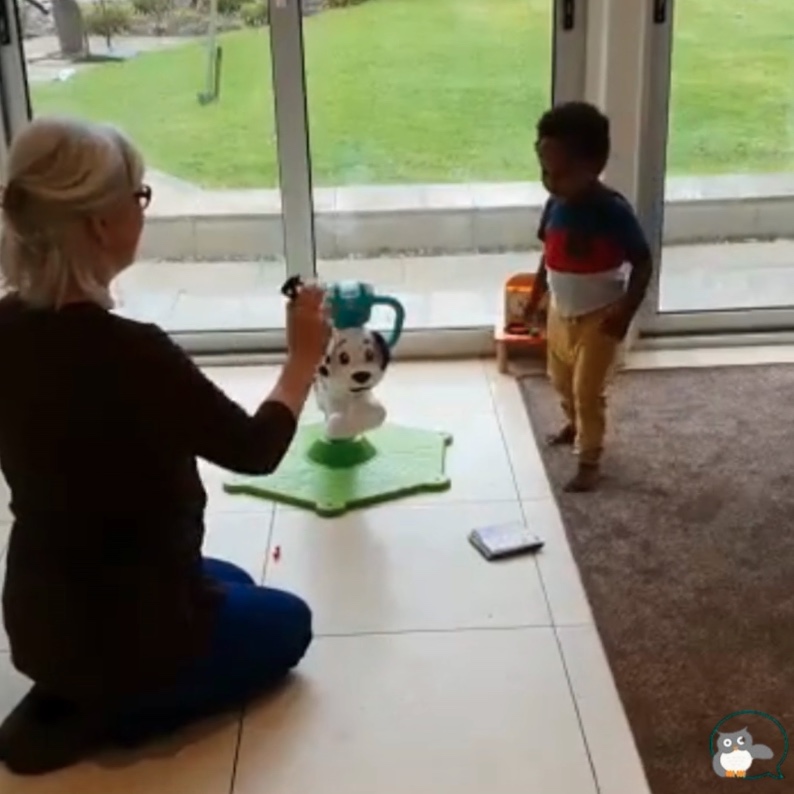
One toy, endless targets: How to grow consonant clusters, core words and colours with one flower garden toy
| |
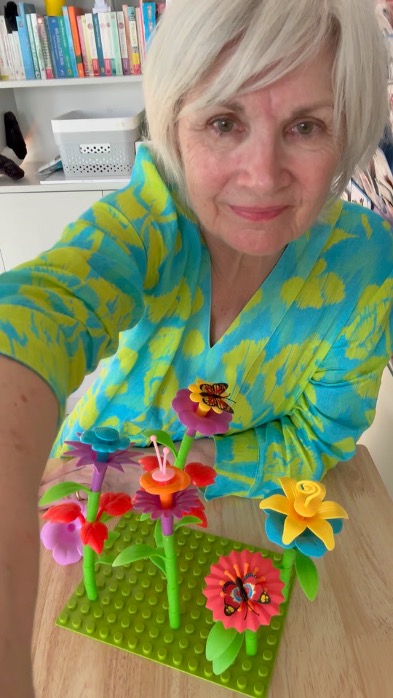
Sonja McGeachie with the build-a-flower garden toy

If you’ve been following me for a while you already know my absolute favourite rule for speech therapy: let the toy work for you. You don’t need an entire cabinet full of different flashcards or games to target a massive range of speech goals (though truth be told I do have 4 cabinets! What am I saying…) but often I find that sticking to one highly engaging, open-ended toy reduces a child’s cognitive load, keeps them firmly planted in play, and gives you dozens of natural opportunities for high-repetition practice. It also reduced my cognitive load!

In today’s post we are looking at a classic: The build-a-flower garden toy. A link is here: https://www.amazon.co.uk/Fivejoy-Flower-Garden-Building.

This vibrant, stacking toy isn’t just great for fine motor skills. It is an absolute goldmine for speech therapy. While it is incredible for targeting tricky consonant clusters (blends) like /ST/, /SP/, /SPR/, /FL/, /BL/, and /GR/, it is equally powerful for building functional core vocabulary.

1. Digging deep with /ST/

Let’s start building our garden.

Stem & stalk: ‘Look at this long stem!’ or ‘Can you put the stem in?’ or ‘do you want the green or the red stem’?

  • Stuck: If a piece is a little tight to push down, it’s a brilliant opportunity for a natural exclamation: ‘Oh no, it’s stuck! Help me!’
  • Stand: Once it’s secure, you can celebrate: ‘it can stand up now!’
  • 👉 Core word integration: Use this setup stage to practise ANOTHER ONE. As you hold the base pieces, wait for the child to use their words or AAC device to request, ‘I want another one!’ before handing over the next stem.

2. Sowing seeds with /SP/ and /SPR/

Every good gardener needs the right equipment and a close eye for detail. We can introduce tools and descriptive language to hit our /SP/ and triple-blend /SPR/ targets.

  • Spade: Grab a toy shovel or pretend to use one. ‘Let’s dig a hole with the spade.’
  • Spot: Point to the holes on the base. ‘Find a good spot for this flower.’
  • Sprout: Talk about the little green pieces: ‘Look at the little sprout!’
  • 👉 Core word integration: Build on spontaneous requesting here. If they are eyeing a specific piece, model a full phrase like: ‘I WANT THE PINK ONE.’

3. /FL/ and fine motor actions

Now, we can start adding the colourful petals.

  • Flower: This is your high-frequency word for the entire activity. ‘Put the green/blue/pink flower on top.’
  • Flat & flutter: ‘This piece is flat on the ground,’ or ‘The butterfly flutters by!’
  • 👉 Core word integration: This stage is perfect for teaching directional actions. Every time they stack a petal onto a stem, model the core phrase: ‘PUT IT ON!’

4. Blending it all together with /BL/

Building a garden is a fantastic sensory experience because of the vivid colours. We can lean heavily into the /BL/ sound by focusing on colour selection and the action of growth.

  • Blue & bloom: ‘Should we use a blue flower?’ and ‘Watch it bloom!’
  • Blade & blend: Point out the blades of grass and talk about how we blend all the colours together.
  • 👉 Core word integration: Don’t just focus on putting the toy together, taking it apart is half the fun! If a child places a piece they don’t want, or when it’s time to clean up, model: ‘TAKE IT OFF.’

5. Working the /GR/

Finally, we look at the environment supporting our garden. The /GR/ blend can be targeted by looking downward at the base of our toy setup.

  • Green: Nearly every stem and base piece in this toy is a vibrant shade of green.
  • Grass & ground: ‘Put the base down on the ground.’ ‘Look at the green grass.’
  • 👉 Core word integration: Combine your /GR/ blend with a powerful core phrase. As you pull a stem upward slowly or stack the petals higher and higher, chant together: ‘MAKE IT GROW! Grow, grow, grow!’

Maximise your repetitions in play

The beauty of the flower garden toy is its repetitive nature. Because a child builds multiple flowers, you aren’t just saying a word or a phrase once, you have the potential to repeat it 10, 15, or 20 times in a single sitting without the child losing interest.

By layering structural speech sounds (like blends) over functional communication phrases (like core words), we give children words they can use across their entire day.

What toy would you like to see us target next in our series? Let me know in the comments on Instagram, and don’t forget to swipe through the carousel there to save these word lists for your next playtime!

If you are concerned about your child’s speech, please do not hesitate to get in touch. I would love to help you find some answers.

Sonja McGeachie

Highly Specialist Speech and Language Therapist

Owner of The London Speech and Feeding Practice.


Health Professions Council registered
Royal College of Speech & Language Therapists Member
Member of ASLTIP

Find a speech and language therapist for your child in London. Are you concerned about your child’s speech, feeding or communication skills and don’t know where to turn? Please contact me and we can discuss how I can help you or visit my services page.

3

Similar Posts

  • Speech sound disorders

    Kids Speech Therapist London
    Speech Sound Disorders

    Treatment Approaches – A Typical Session

    There are various great ways to treat speech sound disorders and I use all the approaches available selectively; I decide what works with each individual child and I also vary the approach depending on the child’s frame of mind at any given time during my session.

    Some of the approaches are more “drill-based” and require a child to be able to pay attention and really participate actively in the therapy, and this is what I am showing you today with this video clip.

    My little student here has been working with me for some time and from only saying a handful of words which were not very easy to understand he has come a long way. He does have some features of Verbal Dyspraxia which I shall briefly outline here:

    • Making sounds in general is a struggle, especially when asked to copy certain sounds, example: ‘can you say: a ee ou oo?”
    • Repeating sound sequences or words sequences is hard, for example: “say p-t-k in sequence” or “say fish chips fish chips fish chips
    • When saying the same word again and again, different mistakes can be heard
    • Intonation difficulties: speech sounds monotonous
    • Vocabulary is very limited

    Some therapy approaches are more play based, for example the Core Word method: here we pick a few words at a time which are very significant to the child and therefore highly motivating to try and say. These could be characters of Pokemon or Minecraft for example, or simple words like “GO!”

    When you watch the video you will see that I use a lot of visual prompting, such as showing him where the tongue is moving to or from. I do this with my index finger and this approach is called Tactile Cueing or “Cued Articulation”. Part of the approach is to give a visual prompt and then reduce the prompt as the learner is more able to produce the correct sounds. Once he can produce the sound on its own, we quickly move to the sound within a word.

    I do mix and match my approaches and in fact here I am drilling but I also use the Core Word which for him (YELLOW) — it’s his favourite colour and I happen to have quite a few good games where a YELLOW something or other can be asked for….. WHO KNEW!? 🙂


    Find a speech and language therapist for your child in London. Are you concerned about your child’s speech, feeding or communication skills and don’t know where to turn? Please contact me and we can discuss how I can help you or visit my services page.

  • ·

    Joint attention for children with autism

    Kids Speech Therapist London

    Why is joint engagement important for communication development?

    It has been well-documented that the development of joint attention is impaired in children who have social communication difficulties or autism. It is, in fact, this impairment which distinguishes children with ASD from children who have other developmental delays.

    A lack of joint attention in very young children is an early sign of autism as it is a signal that there is a disruption in the motivation to connect socially with others. Since this is a crucial element, I thought I would outline what we mean by Joint Attention as supported by the research undertaken at Hanen.org.

    In typically developing children, the ability to shift attention between a person and an object for the purposes of connecting socially or for requesting develops around the same time. However, for children with ASD, these components emerge one at a time and in a linear fashion. Children with ASD usually start with requesting something and later they may learn to share attention for social sharing. (see pattern below as a general guide).

    As with typical development, there is variation in the order that these skills emerge but the following patterns of development is commonly seen:

    • Reaching, taking adult’s arm/hand or pointing to ask for something — but without looking at the adult
    • Gradually alternating looking between person and object of desire
    • Then learning to follow the point of another — which is responding to joint attention initiated by another
    • Directing attention to share interests — without looking at the adult: pointing to a truck on the road/ helicopter circling above
    • Then directing attention to share interest by alternating gaze shift between person and object — here the child is now initiating joint attention.

    What is important to note is that in order to fulfil the criteria for true joint attention, the purpose of directing the attention of another person must be social in nature. In other words, it must not be exclusively to obtain a desirable object or event/action. True Joint Attention is seen verbally or non-verbally; we want to share a thought with another person and direct them to something we are interested or excited or spooked by.

    For example: we can see an amazing firework display in the distance and we want to quickly direct our friend’s attention to this. In order to do this we might be tugging their sleeve/arm whilst pointing to the display in the distance, and perhaps we might add “wow look over there!” We are doing so simply to share an interest without obtaining anything, we are just being social with each other. So True Joint Attention is not just looking at what we want to have, then look at the person who can get this for us and then point to the item. We can say that this is the precursor to true joint attention, which is purely social in nature.

    Because true joint attention is an essential precursor to typical language development, the absence of joint attention in children with ASD contributes to difficulties with language learning. Beuker, K., Rommelse, N., Donders, R. & Buitelaar, J. (2013).

    The Hanen programme for Parent Child Interaction teaches parents of children with Social Communication Difficulties step by step how to enable their children to learn to pay attention to an object and the parent at the same time.

    We learn how to enable a child to:

    • engage take turns
    • shift eye gaze between toy and adult
    • copy adult’s actions, gestures and then words
    • play with toys in different, new ways
    • interact and for longer periods of time
    • have fun whilst playing

    If you would like to know more about the Hanen programme please get in touch. I look forward to exploring the topic with you and help guide you forward if this is something your child is struggling with.


    Find a speech and language therapist for your child in London. Are you concerned about your child’s speech, feeding or communication skills and don’t know where to turn? Please contact me and we can discuss how I can help you or visit my services page.

  • ·

    Four struggles parents face when out and about with children with speech, language, and communication difficulties

    A man and a woman hug a young girl at a table
    Hug

    You (as parents) often describe yourselves as being under constant pressure and stress when looking after your children and young people with Special Educational Needs and Disabilities (SEND). You may find going out to do the simplest of tasks a challenge. And you will try to avoid social situations out of fear and anxiety. One of the most important factors to you is having like-minded people who understand your position as a parent with a young person with additional needs. Let’s look at some of the challenges you face and how I can support you and your family.

    1. Challenging behaviour and going out to the shops

    When your child displays challenging behaviour and won’t go into a shop without buying a toy that they insist on having, it can be tough on your family. You see people around you staring as you try to manage the situation. They do not understand the pressures you face, or that the simplest of tasks are a huge challenge.

    I can support you by giving strategies to use when out and about. I know that using visuals is important for your child. They may not understand or take in language when they are in a heightened state of anxiety or feeling overwhelmed. You could print pictures of the places you’re going to and put them on an easily accessible chain. Then you could use that chain when out and about at the shops. You may want to introduce a visual timetable at home. That way your child or young person understands where they are going. This may lessen their anxiety and subsequent behaviour.

    2. Your child is not able to communicate their needs to an unfamiliar communication partner

    When your child has difficulty communicating to an unfamiliar person it can be hard to manage. You feel yourself explaining your situation repeatedly. I can provide your child with individualised strategies or communication aids which support your child to communicate with both familiar and unfamiliar communication partners. We’ll work together to find which communication methods work in different situations and how your child will use these to help their independence.

    3. Being overwhelmed

    Your child or young person may easily be overwhelmed which may contribute to behaviour changes. I’ll work with your family to understand what the behaviour means, looking at what happened before and what happened afterwards. We’ll not only look at the behaviour but at the environment as well. This can inform how you can support your child or young person in the future, to reduce sensory stimuli (if needed) and for them to feel emotionally regulated.

    4. People avoid engaging with you

    One of the hardest things as a parent is for others to avoid you. You see them crossing the street because they don’t know what to say to you. All you want is them to accept you, to maintain your identity as a person and not as a SEND parent. I can support you emotionally. I can give you advice on local support networks where you can find other parents in a similar situation.

    We know the stresses that being a parent with a child with SEND comes with. Please know I am always here to support you, to find solutions so that when you’re next out and about. Your experience will be a little easier and you’ll feel less isolated.

    Improve your child’s communication, confidence, reduce overwhelm and feel supported here.


    Find a speech and language therapist for your child in London. Are you concerned about your child’s speech, feeding or communication skills and don’t know where to turn? Please contact me and we can discuss how I can help you or visit my services page.

    1
  • ·

    Explore how Intensive Interaction develops Autistic children’s communication

    Intensive Interaction is an approach that I might suggest for your child. Here is an overview of this approach to increase your knowledge. There are a range of approaches that overlap and having trained in them all I use them all interchangeably to tailor to each child individually. This approach is particularly good for children who work mostly to their own agenda and find it hard to engage with others.

    So, what is Intensive Interaction?

    According to its founder, Hewett (1980), the approach “involves mirroring a person’s actions, sounds and facial expressions.” This allows your child to recognise and form communication between themselves and another, in a fun, play-based setting. Attention and listening are the fundamentals to speech and language development. By using the Intensive Interaction approach, we can increase the time your child can attend for and with another person. We are working towards a child enjoying another person’s presence. We are hoping to make gains with playing together with a child, taking turns and achieving reciprocity. That is the platform which we need to start with to build communication, language, words and perhaps even speech.

    There are many aspects that this approach supports:

    • such as using facial expressions
    • being in the presence of other people
    • having a shared space
    • attending to others
    • recognising and using non-verbal behaviours (e.g., gestures)
    • making sounds/noises (vocalisations) that have meaning
    • and eye contact. Although, we must be careful when suggesting ‘improving’ the use of eye contact. For some individuals making eye contact can be physically painful. So be aware that we are not making our children ‘look’ we are encouraging their natural behaviour.

    Who benefits from Intensive Interaction?

    Children with more complex communication and learning delay can benefit from the Intensive Interaction approach. Each session can be adapted to the needs of the individual and the sessions can be designed to use the whole or part of the approach. It is especially useful for children who are finding it hard to engage in any way socially with another person. Autistic children who tend to work to their own agenda often benefit from this approach.

    How is Intensive Interaction implemented?

    You need to have an environment that your child is comfortable in, and to be able to come down to their level so that you can see each other. This is why I often visit children in their own homes to ensure that they are comfortable and that they can withdraw for periods of time if they need to as well.

    Ensure your child knows you’re there and you are 100% present. This is very important. I would recommend that you put your phone away for some 10 minutes or so and give your undivided attention to your child for that period of time.

    Waiting

    Waiting is very important: we need to give your child time to process what is happening around them. After waiting for a response, you might want to start copying any gestures they use, any facial expressions they make, or perhaps imitate any sounds. You’ll want to continue with this for a few minutes to see if the communication between you and your child changes. Remember always take the cues from your child; if they communicate a message with you, respond. It might be that they are ready to finish and that they’ve shown this by walking away or signing.

    Giving your child a way to respond is vital. We can use visuals to support their communication. We can create ‘yes’ and ‘no’ symbols so they can use them in a functional way.

    A top tip in these sessions is to use mirrors, so that your child can see and begin to recognise their own facial expressions.

    There are other programmes that overlap with Intensive Interaction such as Hanen with following your child’s lead and the Gina Davies Curiosity Programme.

    Now you know a bit about Intensive Interaction, why not book a call to discuss how we can support your Autistic child’s communication using this evidence-based approach.


    Find a speech and language therapist for your child in London. Are you concerned about your child’s speech, feeding or communication skills and don’t know where to turn? Please contact me and we can discuss how I can help you or visit my services page.

    0
  • · ·

    How can we support babbling and early speech development? SLT tricks and tips

    My baby isn’t babbling and developing speech – what can I do to support?

    While every baby develops at their own pace, if your child isn’t babbling by nine months, it’s worth seeking help from an Early Intervention Health Professional, such as a doctor and a speech therapist. Don’t panic! There are many reasons for delayed babbling, and early intervention is key.

    In the meantime, it is highly recommended that we talk, sing, and read to our baby often. Exaggerate sounds and expressions, and respond to their coos and smiles. This playful interaction helps stimulate their communication skills.

    Below are some tips and tricks from my experience of working with babies and toddlers who need a little bit of help and support to develop.

    The benefits of imitating your baby

    Copying your baby’s sounds and gestures isn’t just silly fun, it’s a powerful learning tool! By mimicking their babbles and actions, you activate “mirror neurons” in their brain that help them connect sounds with meaning. This playful back-and-forth teaches turn-taking, a foundation for conversation. Plus, it encourages them to copy you, building their own language skills and social interaction abilities.

    This is a nice clip on youtube showing how copying/imitating your baby looks like:

    Here are some fun ways to imitate your baby:

    • Matchmaker: Grab two of the same, or two similar toys your child loves, like rainmakers or shakers. Give one to your baby and keep the other for yourself. When your child plays with his/her toy, mirror his/her actions with yours! This creates a fun, interactive game.
    • Face Time: Get down to your baby’s level, sitting opposite him/her on the floor or kneeling. This makes eye contact easy and encourages him/her to look at you during your playful imitation.
    • Be the Funniest You: Go all out with silly faces, exaggerated sounds, and big gestures. The goal is to capture your baby’s attention and make you irresistible to watch. This playful energy encourages him/her to interact and potentially imitate you back!

    By incorporating these tips, you can turn imitation into a fun and engaging way to boost your baby’s communication skills. I have seen this happen numerous times over the past decades. It is very powerful, go ahead and try it! You cannot be silly and goofy enough!

    Great toy ideas:

    Did you know that speech and language development starts with how we talk to our babies?

    Adults naturally use a special way of speaking called motherese. It involves a higher pitch, slower pace, and exaggerated sounds compared to regular conversation. Sentences are simpler, with shorter words and repetition. This grabs babies’ attention, helps them distinguish sounds, and reinforces word meaning.

    Imitation is a key part of motherese. We wait for our baby to make a sound or gesture, then playfully imitate it with exaggeration. Babies notice this right away and often respond with more vocalisations, creating a mini conversation. This back-and-forth teaches turn-taking, a foundation for future conversations.

    By responding warmly and engaging in these playful interactions, we encourage our babies to keep exploring the world of communication. Talking, singing, reading and, of course, imitating, these simple actions can have a big impact on a baby’s language development.

    Once your conversation is underway then try and keep it going for as long as possible. It’s a beautiful dance of turn-taking, even without words!

    A last word on oxytocin

    There’s evidence suggesting early non-verbal communication with your baby can increase a mother’s oxytocin levels, often called the ‘love hormone’. This hormone plays a key role in bonding and social connection. Positive interactions, touch, and stress reduction all contribute to oxytocin release, strengthening the mother–baby bond.

    For parents of babies with extra needs

    The stress of caring for a child with medical needs or developmental delays can be difficult. Stress can lower oxytocin levels, creating a cycle of sadness for both parent and child.

    Breaking the cycle:

    1. Knowledge is Power: Understanding the importance of communication can empower parents.
    2. Seek Support: Speech therapists and other healthcare professionals can provide valuable guidance on communication strategies.
    3. Start Small, Celebrate Big: Even small interactions can boost oxytocin. Focus on playful imitation and positive reinforcement. Remember, friends, family and healthcare professionals are there to encourage you.

    This approach can help reverse the negative cycle and create a more positive and connected relationship between parent and child.

    I hope this is helpful! Don’t hesitate to reach out with any questions.

    Kind regards

    Sonja McGeachie

    Early Intervention Speech and Language Therapist

    Feeding and Dysphagia (Swallowing) Specialist The London Speech and Feeding Practice

    The London Speech and Feeding Practice


    Find a speech and language therapist for your child in London. Are you concerned about your child’s speech, feeding or communication skills and don’t know where to turn? Please contact me and we can discuss how I can help you or visit my services page.

    2
  • · ·

    My child is hard to understand at school age. Should I be concerned?

    Many parents notice speech errors when their children are toddlers. At that stage it often feels quite normal. Young children are still learning the sounds of their language, and those early mispronunciations can be very endearing.

    But as children grow older, parents sometimes begin to wonder:

    ‘Should my child still be speaking like this?’

    A common concern I hear from families is that their child is still difficult to understand even after starting school. Sometimes it is a parent who notices it first. Other times it is a teacher who gently mentions that classmates occasionally struggle to understand what a child is saying.

    When this happens, parents naturally wonder whether it is something their child will grow out of, or whether some extra support might help.

    When should children’s speech be clear?

    Children learn speech sounds gradually over several years. Some sounds develop earlier, while others take longer to master.

    By the time children reach five to six years of age, most of their speech should be clear enough for unfamiliar adults to understand. There may still be a few tricky sounds developing (such as /R/ or /TH/), but overall speech should be fairly easy to follow.

    If a child is frequently difficult to understand at school age, it can sometimes indicate that a speech sound difficulty has persisted beyond the stage when it would normally resolve on its own.

    Why some children remain hard to understand

    There are several reasons why speech clarity may still be developing in older children.

    Phonological patterns

    Some children continue to use speech patterns that are typical of younger children. For example:

    • saying ‘tat’ instead of ‘cat’
    • saying ‘doe’ instead of ‘go’
    • leaving sounds out of words

    These patterns are called phonological processes. They are a normal part of early speech development, but when they persist into the school years they can make speech difficult for others to understand.

    Difficulty producing specific sounds

    Other children may have difficulty producing certain individual sounds clearly. This might include sounds such as:

    • /S/
    • /SH/
    • /R/
    • /TH/

    These difficulties are called articulation difficulties.

    A child might understand exactly what they want to say but find it hard to produce the sound accurately with their tongue, lips or airflow.

    Motor speech planning challenges

    For some children, the difficulty lies in the planning and coordination of the movements needed for speech.

    Speech requires very precise timing between the tongue, lips, jaw and breath. If the brain finds it difficult to organise these movements consistently, speech can sound unclear or inconsistent.

    In some cases this may relate to Childhood Apraxia of Speech, although only a full assessment can determine this.

    Why clarity matters for school-age children

    Speech clarity becomes particularly important once children start school.

    At this stage, children are:

    • Answering questions in class
    • Talking with friends
    • Reading aloud
    • Developing confidence in communication

    When speech is difficult to understand, children sometimes become more hesitant to speak, particularly in group situations.

    This can affect confidence and participation, even when the child has lots of ideas they would like to share.

    The good news: speech can improve

    The encouraging news is that speech sound difficulties can often improve significantly with the right support.

    Speech therapy focuses on helping children:

    • Learn how sounds are produced
    • Practise accurate speech movements
    • Understand how sounds change meaning in words
    • Build consistency through structured practice

    Different children benefit from different therapy approaches. Some need support with phonological patterns, while others benefit from more motor-based practice that strengthens speech coordination.

    Often therapy combines several strategies to support the child’s individual speech profile.

    When to seek advice

    If your child is already at school and you find that people outside the family often struggle to understand them, it can be helpful to seek advice from a speech and language therapist.

    A detailed assessment can help identify:

    • Which sounds are causing difficulty
    • Whether patterns such as fronting or sound substitutions are present
    • Whether motor planning challenges may be contributing
    • Which therapy approach is likely to be most effective

    Early support can help children develop clearer speech and greater confidence in communication.

    Every child’s speech journey is different

    Speech development is not the same for every child. Some children master speech sounds quickly, while others need a little more guidance along the way.

    The important thing is that support is available when children need it.

    With the right strategies and practice, many children make excellent progress and develop speech that is clearer, more confident and easier for others to understand. If you are concerned about your child’s speech clarity or ongoing speech sound errors, a speech and language assessment can help identify the underlying difficulty and guide the most appropriate support.

    Feel free to contact me on my contact page.

    Sonja McGeachie

    Highly Specialist Speech and Language Therapist

    Owner of The London Speech and Feeding Practice.


    Health Professions Council registered
    Royal College of Speech & Language Therapists Member
    Member of ASLTIP

    Find a speech and language therapist for your child in London. Are you concerned about your child’s speech, feeding or communication skills and don’t know where to turn? Please contact me and we can discuss how I can help you or visit my services page.


    3